.
RESEARCH PAPER.
SCIENCE CHINA
Information Sciences
Quantum cryptanalysis on some Generalized Feistel
Schemes
Xiaoyang DONG
1, Zheng LI
2& Xiaoyun WANG
1,2 *1Institute for Advanced Study, Tsinghua University, P. R. China
{xiaoyangdong,xiaoyunwang}@tsinghua.edu.cn;
2Key Laboratory of Cryptologic Technology and Information Security, Ministry of Education,
Shandong University, P. R. China [email protected]
Received ; accepted
Abstract Post-quantum cryptography has attracted much attention from worldwide cryptologists. In ISIT 2010, Kuwakado and Morii gave a quantum distinguisher with polynomial time against 3-round Feistel networks. However, generalized Feistel schemes (GFS) have not been systematically investigated against quantum attacks. In this paper, we study the quantum distinguishers about some generalized Feistel schemes. Ford-branch Type-1 GFS (CAST256-like Feistel structure), we introduce (2d−1)-round quantum distinguishers with polynomial time. For 2d-branch Type-2 GFS (RC6/CLEFIA-like Feistel structure), we give (2d+ 1)-round quantum distinguishers with polynomial time. Classically, Moriai and Vaudenay proved that a 7-round 4-branch Type-1 GFS and 5-round 4-branch Type-2 GFS are secure pseudo-random permutations. Obviously, they are no longer secure in quantum setting.
Using the above quantum distinguishers, we introduce generic quantum key-recovery attacks by applying the combination of Simon’s and Grover’s algorithms recently proposed by Leander and May. We denotenas the bit length of a branch. For (d2−d+ 2)-round Type-1 GFS withdbranches, the time complexity is 2(12d2−32d+2)·n2,
which is better than the quantum brute force search (Grover search) by a factor 2(14d 2+1
4d)n. For 4d-round Type-2 GFS with 2dbranches, the time complexity is 2d
2n
2 , which is better than the quantum brute force search
by a factor 23d
2n
2 .
Keywords Generalized Feistel Schemes, Simon, Grover, Quantum Key-recovery, Quantum Cryptanalysis
Citation Dong X Y, Li Z, Wang X Y. Quantum cryptanalysis on some Generalized Feistel Schemes. Sci China Inf Sci, 2016, (): xxxxxx, doi: xxxxxxxxxxxxxx
1
Introduction
It is well known that several public key cryptosystem standards, such as RSA and ECC, have been broken by Shor’s algorithm [1] with a quantum computer. Recently, researchers find that quantum computing not only impacts the public key cryptography, but also could break many secret key schemes, which includes the key-recovery attacks against Even-Mansour ciphers [2], distinguishers against 3-round Feistel networks [3], key-recovery and forgery attacks on some MACs and authenticated encryption ciphers [4], key-recovery
Table 1 Results on Type-1 (CAST256-like) GFS in quantum settings
Branches Distinguisher Key-recovery Rounds Complexity (log) Trivial Bound (log)
d>3 Round 2d−1 r0=d 2
−d+ 2 (12d2
−32d+ 2)·
n
2
(d2−d+2)n
2 r > r0 (12d2−3
2d+ 2)·
n
2 + (r−r0)n
2
rn
2
attacks against FX constructions [5], and others. So to study the security of more classical and important cryptographic schemes against quantum attacks is urgently needed. At Asiacrypt 2017, NIST [6] reports the ongoing competition for post-quantum cryptographic algorithms, including signatures, encryptions and key-establishment. The ship for post-quantum crypto has sailed, cryptographic communities must get ready to welcome the post-quantum age.
In a quantum computer, the adversaries could make quantum queries on some superposition quantum states of the relevant cryptosystem, which is the so-called quantum-CPA setting [7]. It is known that Grover’s algorithm [8] could speed up brute force search. Given anm-bit key, Grover’s algorithm allows to recover the key using O(2m/2) quantum steps. It seems that doubling the key-length of one block cipher could achieve the same security against quantum attackers. However, Kuwakado and Morii [2] identified a new family of quantum attacks on certain generic constructions of secret key schemes. They showed that the Even-Mansour ciphers could be broken in polynomial time by Simon algorithm [9], which could find the period of a periodic function in polynomial time in a quantum computer. The following works by Kaplan et al.[4] revealed that many other secret key schemes could also be broken by Simon algorithm, such as CBC-MAC, PMAC, GMAC and some CAESAR candidates.
Feistel block ciphers [10] are extremely important and extensively researched cryptographic schemes. It adopts an efficient Feistel network design. Historically, many block cipher standards such as DES, Triple-DES, MISTY1, Camellia and CAST-128 [11] are based on Feistel design. At CRYPTO 1989, Zhenget al. [12] summarised some generalized Feistel schemes (GFS) as Type-1/2/3 GFS. Many block ciphers are based on GFS designs. CAST-256 is based on Type-1 GFS, CLEFIA and RC6 are based on Type-2 GFS, MARS is based on Type-3 GFS, so Type-1/2/3 GFS are also denoted as CAST256-like Feistel scheme, RC6/CLEFIA-like Feistel scheme, and MARS-like Feistel scheme [13]. Chinese standard block cipher SMS4 is based on a different contracting Feistel scheme, we denote it as SMS4-like GFS.
In a seminal work, Luby and Rackoff [14] proved that a three-round Feistel scheme is a secure pseudo-random permutation. However, Kuwakado and Morii [3] introduced a quantum distinguisher attack on 3-round Feistel ciphers, that could distinguish the cipher and a random permutation in polynomial time. At Asiacrypt 2000, Moriai and Vaudenay [13] studied some generalized Feistel schemes (GFS) and proved a 7-round 4-branch CAST256-like GFS and 5-round 4-branch RC6/CLEFIA-like GFS are secure pseudo-random permutations. Quantum distinguishers against those generalized Feistel schemes are missing.
In this paper, we study the quantum distinguisher attacks on Type-1 GFS (CAST256-like), Type-2 GFS (RC6/CLEFIA-like) and others. For d-branch Type-1 GFS, we introduce (2d−1)-round quantum distinguishers with polynomial time. For 2d-branch Type-2 GFS (RC6/CLEFIA-like Feistel structure), we give (2d+ 1)-round quantum distinguishers with polynomial time. Classically, Moriai and Vaudenay [13] proved that a 7-round 4-branch Type-1 GFS and 5-round 4-branch Type-2 GFS are secure pseudo-random permutations. Obviously, they are no longer secure in quantum setting. Denote the branch size asn. We introduce generic quantum key-recovery attacks on Type-1 and Type-2 GFS by applying the combination of Simon’s and Grover’s algorithms recently proposed by Leander and May. As shown in Table 1, for (d2−d+ 2)-round Type-1 GFS withdbranches, the time complexity is 2(1
2d 2
−3 2d+2)·
n
2, which is better
than the quantum brute force search (Grover search) by a factor 2(14d 2+1
4d)n. As shown in Table 2, for
4d-round Type-2 GFS with 2dbranches, the time complexity is 2d22n, which is better than the quantum
DONG X Y, et al. Sci China Inf Sci 3
Table 2 Results on Type-2 (RC6/CLEFIA-like) GFS in quantum settings
Branches Distinguisher Key-recovery Rounds Complexity (log) Trivial Bound (log)
2d>4 Round 2d+ 1 r0= 4d
d2
2n 2d2n
r > r0 d2+(r−r0)d
2 n
rdn
2
2
Notations
x0
j thejth branch in the input;
xi
j thejth branch in the output ofith round, i>1,j>1;
d the branch number of CAST256-like GFS; 2d the branch number of RC6/CLEFIA-like GFS; n the bit length of a branch;
Ri theith (i
>1) round function of Type-1 (CAST256-like) GFS, the input and output aren-bit string,n-bit key is absorbed byRi;
Ri
j thejth (16j6d) round function in theith (i>1) round function of Type-2 ( RC6/CLEFIA
-like) GFS, the input and output aren-bit string,n-bit key is absorbed byRi j.
3
Related works
Our quantum attacks are based the two popular quantum algorithms, i.e. Simon algorithm [9] and Grover algorithm [8].
3.1 Simon’s problem
Given a boolen functionf {0,1}n
→ {0,1}n, that is known to be invariant under somen-bit XOR period
a, finda. In other words, findaby given: f(x) =f(y)↔x⊕y∈ {0n, a }.
Classically, the optimal time to solve the problem is O(2n/2). However, Simon [9] gives a quantum algorithm that provides exponential speedup and only requires O(n) quantum queries to find a. The algorithm includes five quantum steps:
I. Initializing twon-bit quantum registers to state|0i⊗n|0i⊗n, one applies Hadamard transform to the
first register to attain an equal superposition:
H⊗n|0i|0i= √1
2n
X
x∈{0,1}n
|xi|0i. (1)
II. A quantum query to the functionf maps this to the state
1
√
2n
X
x∈{0,1}n
|xi|f(x)i.
III. Measuring the second register, the first register collapses to the state:
1
√
2(|zi+|z⊕ai).
IV. Applying Hadamard transform to the first register, we get:
1
√
2 1
√
2n
X
y∈{0,1}n
1
R
2
R
3
R
0 1
x 0
2
x
1 1
x 1
2
x
2 1
x 2
2
x
3 1
x 3
2
x
b
x
Figure 1 3-round quantum distinguisher
V. The vectors y such that y·a= 1 have amplitude 0. Hence, measuring the state yields a value y thaty·a= 0.
RepeatO(n) times, one obtainsaby solving a system of linear equations.
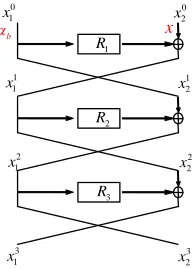
Kuwakado and Morii [3] introduced a quantum distinguish attack on 3-round Feistel scheme by using Simon algorithm. As shown in Figure 1,α0and α1 are arbitrary constants:
f :{0,1} × {0,1}n
→ {0,1}n
b, x 7→ αb⊕x32, where (x13, x32) =E(αb, x),
f(b, x) = R2(R1(αb)⊕x)).
f is periodic function that f(b, x) =f(b⊕1, x⊕R1(α0)⊕R1(α1)). Then using Simon’s algorithm, one can get the periods= 1||R1(α0)⊕R1(α1) in polynomial time.
3.2 Grover’s algorithm
The task is to find a marked element from a setX. We denote byM ⊆X the subset of marked elements. Classically, one solve the problem with time|X|/|M|. However, in a quantum computer, the problem is solve with high probability in timep|X|/|M|using Grover’s algorithm. The steps of the algorithm is as follows:
I. Initializing a n-bit register |0i⊗n. One applies Hadamard transform to the first register to attain
an equal superposition:
H⊗n|0i= √1
2n
X
x∈{0,1}n
|xi=|ϕi. (2)
II. Construct an oracleO: |xi−→O (−1)f(x)
|xi, where f(x) = 1 ifxis the correct state, andf(x) = 0 otherwise.
III. Apply Grover iteration forR≈π4√2n times:
[(2|ϕihϕ| −I)O]R
|ϕi ≈ |x0i.
IV. returnx0.
Later, Brassardet al.[15] generalized the Grover search as amplitude amplification.
Theorem 1. (Brassard, Hoyer, Mosca and Tapp [15]). LetA be any quantum algorithm onq qubits that uses no measurement. LetB:Fq2→ {0,1}be a function that classifies outcomes ofAas good or bad. Letp >0 be the initial success probability that a measurement of A|0iis good. Set k=dπ
DONG X Y, et al. Sci China Inf Sci 5
oracle. However, in the quantum CPA-model the scheme is completely insecure. The main idea of [18] was to consider the function
f(x) := EncEM(x) +P(x) =P(x+k1) +k2+P(x),
where + is the bitwise XOR.
As this function fulfills f(x) = f(x+k1) for all x, one can use Simon’s
quantum algorithm [7, 25], that allows to compute the unknown period k1 of
functionf in linear time. Oncek1is computed, computingk2 is trivial even on a
classical computer. It should be pointed out that Kaplan et al. [13] and Santoli, Schaffner [23] solved the technical issue of dealing with a function that does not
fulfill Simon’s promise, namely thatf(x) =f(y) iffy∈ {x, x+k1}, see Section 2
for more details.
The same idea was then used by Kaplan et al. [13] (and independently in [23]) to construct polynomial time quantum-CPA attacks on many modes of operations. Kaplan et al. further showed how slide attacks can profit from using a quantum computer.
The natural question that arises from the attacks on a generic cipher using Grover’s algorithm and the attack on the Even-Mansour scheme using Simon’s algorithm is the following: How secure is the FX construction against quantum adversaries?
This construction, proposed by Killian and Rogaway in [15, 16], is an elegant way of extending the key-length of a given block cipher and is the natural combination of the Even-Mansour construction and a generic cipher. For this, we
assume we are given a (secure) block cipherE, encrypting nbit messages under
anmbit keyk0, and we introduce two more nbit keys k1 and k2 as pre- and
post-whitening keys. The new block cipher is given as
Enc(x) =Ek0(x+k1) +k2.
m
k1
Ek0
k2
c
From an efficiency point of view, the overhead of this modification is negligible. Moreover, in an idealized model, one can prove that (using classical computers) in order to attack the FX construction scheme, the success probability of an
attacker is bounded by 2nq+2m, whereqis the number of queries to the encryption
scheme and to the underlying block cipher.
Initially, when considering Grover’s algorithm only, this scheme seems to provide significantly more resistance against quantum computers, since now
(k0, k1, k2)∈Fm2+2n define the key space. Moreover, Simon’s algorithm does not
apply either, as the function Enc(x) +Ek(x) is periodic only for the correct guess
ofk=k0.
3
Figure 2 FX constructions
1
R
1
k
2
R
2
k
3
R
3
k
4
R
4
k
5
R
5
k
0 1
x 0
2
x
1 1
x 1
2
x
2 1
x
2 2
x
3 1
x 3
2
x
4 1
x x24
5 1
x x52
b
Figure 3 Quantum key-recovery attacks on 5-Round Feistel structures
where θis defined viasin2(θ) =p. Moreover, define the unitary operatorQ=
−AS0A−1S
B, where the operatorSB changes the sign of the good state
|xi 7→
(
−|xiifB(x) = 1,
|xiifB(x) = 0,
while S0 changes the sign of the amplitude only for the zero state|0i. Then after the computation of QkA|0i, a measurement yields good with probability a least max{1-p,p}.
Assuming |ϕi= A|0i is the initial vector, whose projections on the good and the bad subspace are denoted|ϕ1iand|ϕ0i. The state|ϕi=A|0ihas angleθwith the bad subspace, wheresin2(θ) =p. Each Q iteration increase the angle to 2θ. Hence, after k ≈ π
4θ, the angle roughly equals to π/2. Thus, the
state after k iterations is almost orthogonal to the bad subspace. After measurement, it produces the good vector with high probability.
3.3 Combining Simon and Grover algorithms
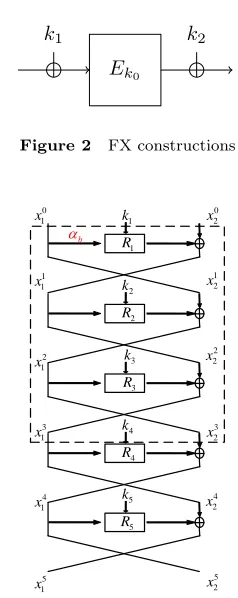
At Asiacrypt 2017, Leander and May [5] gave a quantum key-recovery attack on FX-construction shown in Figure 2: Enc(x) = Ek0(x+k1) +k2. They introduce the function f(k, x) = Enc(x) +Ek(x) =
Ek0(x+k1) +k2+Ek(x). For the correct key guess k =k0, we havef(k, x) = f(k, x+k1) for all x.
However, for k 6=k0, f(k,·) is not periodic. They combine Simon and Grover algorithm to attack FX ciphers (such as PRINCE [16], PRIDE [17], DESX [18]) in the quantum-CPA model with complexity roughly 232.
Suppose the state size isn, then the length ofki isn/2. The following functions is defined:
f(b, xR0) =R2(k2, x
0
2⊕R1(k1, αb)) =αb⊕x32=αb⊕R4(k4, R5(k5, x52)⊕x51)⊕x52, (3)
where b ∈ F2, αb ∈ Fn/2 2 is arbitrary constant and α0 6= α1, (x51||x52) = Enc(αb||x02). It is easy to verify thatf(b, x0
2) =f(b⊕1, x02⊕R1(k1, α0)⊕R1(k1, α1)). Therefore, with the right key guess (k4, k5), f(b, x0
2) =αb⊕R4(k4, R5(k5, x52)⊕x51) has a nontrivial period s= 1||R1(k1, α0)⊕R1(k1, α1). However, if the guessed (k4, k5) is wrong,f(b, x0
2) is a random function and not periodic with high probability.
Theorem 2. [19] Letg: Fn
2×F
n/2+1 2 7→F
n/2 2 with
(k4, k5, y)7→f(y) =f(b, x) =αb⊕R4(k4, R5(k5, x52)⊕x51)⊕x52,
where α0, α1 are two arbitrary constants, (x51||x52) =Enc(αb||x). Given quantum oracle to g and Enc,
(k4, k5) andR1(k1, α0)⊕R1(k1, α1) could be computed withn+ (n+ 1)(n+ 2 + 2p
n/2 + 1) qubits and about 2n/2quantum queries.
Under the right key guessk4, k5,g(k4, k5, y) =g(k4, k5, y⊕s). Let,h: Fn
2 ×F (n/2+1)l
2 7→F
(n/2)l 2 with
(k4, k5, y1, ..., yl)7→g(k4, k5, y1)||...||g(k4, k5, yl). (4)
LetUh be a quantum oracle that maps
|k4, k5, y1, ..., yl,0, ...,0i 7→ |k4, k5, y1, ..., yl, h(k4, k5, y1, ..., yl)i. (5)
Similar to the work [5], Dong and Wang [19] constructed the following quantum algorithmA.
1. Preparing the initial (n+ (n/2 + 1)l+nl/2)-qubit state|0i.
2. Apply Hadamard H⊗n+(n/2+1)l on the firstn+ (n/2 + 1)lqubits resulting in
X
k4,k5∈Fn/2 2,y1,...,yl∈Fn/2 2+1
|k4, k5i|y1i...|yli|0i, (6)
where we omit the amplitudes 2−(n+(n/2+1)l)/2.
3. ApplyingUh to the above state, we get:
X
k4,k5∈Fn/2 2,y1,...,yl∈Fn/2 2+1
|k4, k5i|y1i...|yli|h(k4, k5, y1, ..., yl)i. (7)
4. Apply Hadamard to the qubits|y1i...|yliof the above state, we get:
|ϕi= X
k4,k5∈Fn/2 2,u1,...,ul,y1,...,yl∈Fn/2 2+1
|k4, k5i(−1)hu1,y1i|u1i...(−1)hul,yli|u
li|h(k4, k5, y1, ..., yl)i. (8)
If the guessed k4, k5is right, after measurement of|ϕi, the periodsis orthogonal to all the u1, ..., ul.
According to Lemma 4 of [5], choosingl= 2(n/2 + 1 +p
n/2 + 1) is enough to compute a uniques. Without measurement and considering the superposition|ϕi, Dong and Wang [19] introduced a clas-sifierB:
Classifier B. DefineB:Fn2+(n/2+1)l7→ {0,1} that maps (k4, k5, u1, ..., ul)7→ {0,1}.
1. Let U =hu1, ..., uli be the linear span of all ui. If dim(U)6= n/2, output 0. Else, use Lemma 4
of [5] to compute the unique period s.
DONG X Y, et al. Sci China Inf Sci 7
Ri ...
... -1
1
i
x -1
2
i
x -1
3
i
x i-1
d
x
1
i
x 2
i
x 3
i
x i
d
x
Figure 4 Roundiof CAST256-like GFS withdbranches
ClassifierBpartitions|ϕiinto a good subspace and a bad subspace: |ϕi=|ϕ1i+|ϕ0i, where|ϕ1iand
|ϕ0idenotes the projection onto the good subspace and bad subspace, respectively. For the good one|xi,
B(x) = 1.
ClassifierB defines a unitary operatorSB that conditionally change the sign of the quantum states:
|k4, k5i|u1i...|uli 7→
(
−|k4, k5i|u1i...|uliifB(k4, k5, u1, ..., ul) = 1, |k4, k5i|u1i...|uliifB(k4, k5, u1, ..., ul) = 0.
(9)
The complete amplification process is realized by repeatedly for t times applying the unitary operator Q=−AS0A−1S
B to the state|ϕi=A|0i, i.e. QtA|0i.
Initially, the angle between |ϕi=A|0iand the bad subspace |ϕ0iisθ, wheresin2(θ) =p=
hϕ1|ϕ1i. Whenpis smaller enough,θ≈arcsin(√p)≈2−n
2. According to Theorem 1, afterk=dπ
4θe=d π
4×2−n2e
Grover iterationsQ, the angle between resulting state and the bad subspace is roughlyπ/2. The proba-bilityPgood that the measurement yields a good state is aboutsin2(π/2) = 1.
The whole attack needs (n+ (n/2 + 1)l+nl/2) = n+ (n+ 1)(n+ 2 + 2p
n/2 + 1) qubits. About
k=d π
4×2−n2e= 2
n/2quantum queries are required to recoverk4, k5. Thus, in our quantum cryptanalysis
on GFS, the first step is to find new quantum distinguishers, and then give a similar quantum key-recovery attacks by appending several rounds to the distinguishers.
4
Quantum cryptanalysis on Type-1 (CAST256-like) GFS
4.1 Quantum distinguishers on Type-1 (CAST256-like) GFS
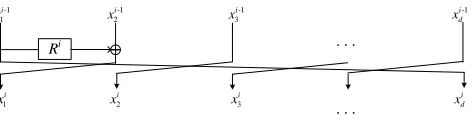
As shown in Figure 4, the input of the cipher is divided into dbranches, i.e. x0
j for 16j 6d, each of
which has n-bit, so the blocksize is d×n. Ri is the round function that absorbs n-bit secret key and
n-bit input. We construct the corresponding quantum distinguisher on the (2d−1)-round cipher. The intermediate state after the ith round isxi
j for 16j 6d, especially the output of the (2d−1)th
round is denoted asx21d−1||x22d−1||...||xd2d−1. For the input of round functionRd, we compute its symbolic
expression withx0
j for 16j6d:
Rd−1(Rd−2(...R3(R2(R1(x01)⊕x02)⊕x03)...⊕x0d−2)⊕x0d−1)⊕x0d. (10)
Similarly, the output of round functionRdis x0
1⊕x22d−1. Thus, we get the following equation:
Rd(Rd−1(Rd−2(...R3(R2(R1(x01)⊕x02)⊕x30)...⊕x0d−2)⊕x0d−1)⊕x0d) =x01⊕x22d−1. (11)
In Equation (11), let x0
1 = αb(b = 0,1, α0, α1 are arbitrary constants, α0 6=α1), x0d =x, and all of
x0
1, x02, ..., x0d be constants, we get
Rd(Rd−1(Rd−2(...R3(R2(R1(αb)⊕x02)⊕x03)...⊕x0d−2)⊕x0d−1)⊕x) =αb⊕x22d−1. (12)
Denoteh(αb) =Rd−1(Rd−2(...R3(R2(R1(αb)⊕x02)⊕x03)...⊕x0d−2)⊕x0d−1), then Equation (12) becomes Rd(h(α
R1 0 1
x 0
2
x 0
3
x 0
4 x
R2
R3
R4
R5
R6
R7 1
1
x 1
2
x 1
3
x 1
4 x
2 1
x 2
2
x 2
3
x 2
4 x
3 1
x 3
2
x 3
3
x 3
4 x
4 1
x 4
2
x 4
3
x 4
4 x
5 1
x 5
2
x 5
3
x 5
4 x
6 1
x x62
6 3
x x46
7 1
x 7
2
x 7
3
x 7
4 x x
b
Figure 5 7-round distinguisher on CAST256-like GFS withd= 4
f :{0,1} × {0,1}n → {0,1}n
b, x 7→ αb⊕x22d−1, wherex 2d−1 1 ||x
2d−1 2 ||...||x
2d−1
d =E(αb, x),
f(b, x) = Rd(h(α b)⊕x).
Sof(0, x) =f(1, x⊕h(α0)⊕h(α1)) =Rd(h(α0)⊕x),f(1, x) =f(0, x⊕h(α0)⊕h(α1)) =Rd(h(α1)⊕x).
Thus f(b, x) = f(b⊕1, x⊕h(α0)⊕h(α1)). Therefore, function f satisfies Simon’s promise with s = 1||h(α0)⊕h(α1).
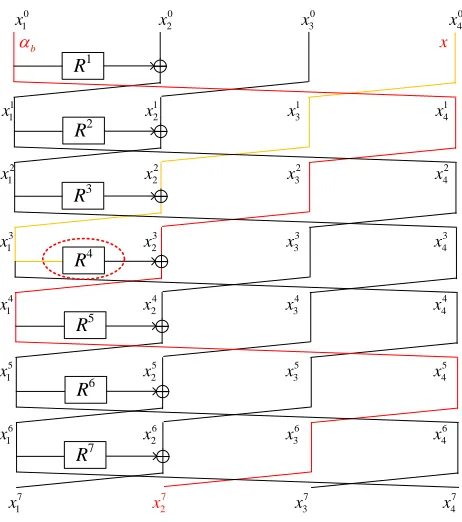
Example case of Type-1 (CAST256-like) with d= 4:
Whend= 4, we get 7-round quantum distinguisher as shown in Figure 5. Thus,h(αb) =R3(R2(R1(αb)⊕
x0
2)⊕x03), wherex02 andx03are constants.
4.2 Quantum key-recovery attacks on Type-1 (CAST256-like) GFS
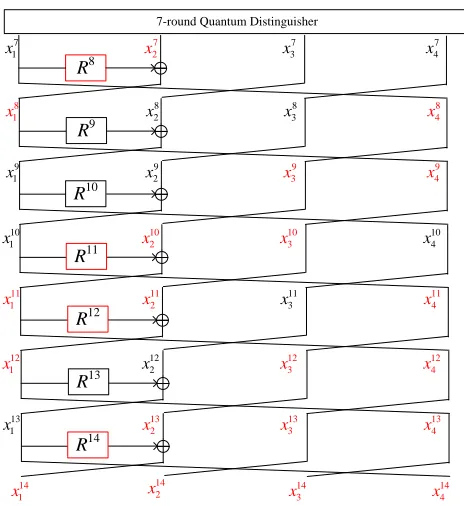
We first study the quantum key-recovery attack on CAST256-like GFS with d= 4 branches. Following the similar idea that combines Simon’s and Grover’s algorithms to attack Feistel structure [19] shown in Section 3.3, we append 7 rounds under the 7-round distinguisher to launch the attack. As shown in Figure 6, there are 4n-bit key needed to be guessed by Grover’s algorithm, which are highlighted in the red boxes of round functions. Thus, the 14-round quantum key-recovery attack needs about 22ntime and O(n2) qubits. If we attackr >14 rounds, we need guess 4n+ (r−14)nkey bits by Grover’s algorithm. Thus, the the time complexity is 22n+(r−214)n.
Generally, ford>3, we could get (2d−1)-round quantum distinguisher. We appendd2
−3d+ 3 rounds under the quantum distinguisher to attackr0=d2−d+ 2 rounds CAST256-like GFS. Similarly, we need to guess (1
2d 2
− 3
2d+ 2)n-bit key by Grover’s algorithm. Thus, for r0 rounds, the time complexity is (1
2d 2
−3 2d+ 2)·
n
2 queries, andO(n
2) qubits are needed. If we attackr > r0rounds, we need guess (1 2d
2
−
3
2d+ 2)n+ (r−r0)nkey bits by Grover’s algorithm. Thus, the time complexity is 2 (1
2d 2−3
2d+2)·n2+ (r−r0)n
2 .
If we use the quantum brute force search (Grover search) to recover the key, for r-round d-branch cipher, totally,rn-bit key need to be found, the complexity is 2rn/2. Thus, our attack is better than the quantum brute force search (Grover search) by a factor 2rn/2−((1
2d 2
−3
2d+2)·n2+ (r−r0)n
2 )= 2(14d 2
DONG X Y, et al. Sci China Inf Sci 9
R8 7
1
x 7
2
x 7
3
x 7
4 x
R9
R10
R11
R12
R13
R14 8
1
x x82
8 3
x x84
9 1
x 9
2
x 9
3
x 9
4 x
10 1
x 10
2
x 10
3
x 10
4 x
11 1
x 11
2
x 11
3
x 11
4 x
12 1
x 12
2
x 12
3
x 12
4 x
13 1
x 13
2
x 13
3
x 13
4 x
14 1
x 14
3
x 14
4 x
7-round Quantum Distinguisher
14 2 x
Figure 6 14-round quantum key-recovery attack on CAST256-like GFS withd= 4
... -1
1 i
x -1
2 i
x -1
3 i
x -1
2 -1 i
d x
1 i
x 2
i
x 2 -1
i d x
-1 4 i x
3 i x
...
-1 2 i d x
1 i
R 2
i
R i
d R
4 i x
2 i d x
Figure 7 Roundiof RC6/CLEFIA-like GFS with 2dbranches
5
Quantum cryptanalysis on Type-2 (RC6/CLEFIA-like) GFS
5.1 Quantum distinguishers on Type-2 (RC6/CLEFIA-like) GFS
As shown in Figure 7, the input of the cipher is divided into 2dbranches, i.e. x0
j for 16j62d, each of
which has n-bit, so the blocksize is 2d×n. Ri
l (1 6l 6d) is thejth round function inith round that
absorbsn-bit secret key andn-bit input. We construct the corresponding quantum distinguisher on the (2d+ 1)-round cipher.
The intermediate state after theith round isxi
j for 16j62d, especially the output of the (2d+ 1)th
round is denoted asx21d+1||x22d+1||...||x22dd+1.
Case study, 2d= 4:
As shown in Figure 8 with 2d = 4, for the input of round function R4
1 about x0j for 1 6 j 64, we
compute its symbolic expression:R3
1(R21(R11(x01)⊕x02)⊕x03)⊕R12(x03)⊕x04. The output of R41 can be expressed asx0
1⊕x54⊕R22(R12(x03)⊕x04). ThroughR41, we obtain the following equation
R41(R31(R21(R11(x01)⊕x02)⊕x03)⊕R12(x03)⊕x04) =x01⊕x54⊕R22(R12(x30)⊕x04). (13)
Letx0
1=αb,x02=x,x03,x04 be constants, it becomes
0 1
x 0
2
x 0
3
x 0
4
x
1 1
R R12
2 1
R R22
3 1
R R23
4 1
R R24
5 1
R R25
5 1
x 5
2
x 5
3
x x45
1 1
x 1
2
x 1
3
x 1
4
x
2 1
x 2
2
x 2
3
x x42
3 1
x 3
2
x 3
3
x 3
4
x
4 1
x 4
2
x 4
3
x 4
4
x
b
x
Figure 8 5-round distinguisher on RC6/CLEFIA-like GFS with 2d= 4
f4:{0,1} × {0,1}n
→ {0,1}n
b, x 7→ αb⊕x54⊕R22(R12(x03)⊕x40), wherex51||x52||x35||x54=E(αb, x),
f4(b, x) = R4
1(R31(R21(R11(αb)⊕x)⊕x03)⊕R12(x03)⊕x04).
Thusf4(b, x) =f4(b⊕1, x⊕R1
1(α0)⊕R11(α1)). Therefore, functionf4satisfies Simon’s promise with s= 1||R1
1(α0)⊕R11(α1). Case study, 2d= 6:
As shown in Figure 9 with 2d = 6, for the input of round function R6
1 about x0j for 1 6 j 66, we
compute its symbolic expression:R5
1(R14(R13(R21(R11(x01)⊕x02)⊕x03)⊕R12(x03)⊕x04)⊕R22(R12(x03)⊕x04)⊕ x0
5)⊕R32(R22(R12(x03)⊕x04)⊕x05)⊕R31(x05)⊕x06.
The output ofR16 can be expressed asx01⊕x76⊕R32(R13(x05)⊕x06)⊕R42(R32(R22(R12(x03)⊕x04)⊕x05)⊕ R1
3(x05)⊕x06). ThroughR41, we obtain the following
R61[R51(R41(R31(R21(R11(x01)⊕x02)⊕x03)⊕R12(x03)⊕x04)⊕R22(R12(x03)⊕x04)⊕x05)⊕R32(R22(R12(x30)⊕x04)⊕x05)
⊕R13(x05)⊕x06] =x01⊕x67⊕R23(R13(x05)⊕x06)⊕R24(R32(R22(R12(x03)⊕x40)⊕x05)⊕R13(x05)⊕x06). (15)
Letx0
1=αb,x02=x, x30,x04,x05,x06 be constants, it becomes
R61[R51(R41(R31(R21(R11(αb)⊕x)⊕x03)⊕R12(x03)⊕x04)⊕R22(R12(x03)⊕x04)⊕x05)⊕R32(R22(R12(x30)⊕x04)⊕x05)
⊕R13(x05)⊕x06] =αb⊕x76⊕R23(R13(x05)⊕x06)⊕R24(R23(R22(R21(x03)⊕x04)⊕x05)⊕R13(x05)⊕x06). (16)
f6:{0,1} × {0,1}n
→ {0,1}n
b, x 7→ αb⊕x76⊕R23(R13(x05)⊕x06)⊕R42(R32(R22(R12(x03)⊕x04)
⊕x0
5)⊕R13(x05)⊕x06),wherex51||x52||x53||x54||x55||x56=E(αb, x),
f6(b, x) = R6
1[R51(R41(R31(R21(R11(αb)⊕x)⊕x03)⊕R12(x03)⊕x04)
⊕R2
2(R12(x03)⊕x04)⊕x05)⊕R32(R22(R12(x03)⊕x04)⊕x05)⊕R13(x05)⊕x06].
Thusf6(b, x) =f6(b⊕1, x⊕R1
1(α0)⊕R11(α1)). Therefore, functionf6satisfies Simon’s promise with s= 1||R1
1(α0)⊕R11(α1).
Similarly, for the 2d-branch version, we can get corresponding function f2d satisfies Simon’s promise
withs= 1||R1
DONG X Y, et al. Sci China Inf Sci 11 0 1 x 0 2 x 0 3 x 0 4 x 1 1 R 1 2 R 2 1
R R22
3 1
R R23
4 1
R R24
5 1 R 5 2 R 1 1 x 1 2 x 1 3 x 1 4 x 2 1 x 2 2 x 2 3 x 2 4 x 3 1 x 3 2 x 3 3 x 3 4 x 4 1 x 4 2 x 4 3 x 4 4 x b x 0 5 x 0 6 x 1 3 R 2 3 R 3 3 R 4 3 R 5 3 R 1 5 x 1 6 x 2 5 x 2 6 x 3 5 x 3 6 x 4 5 x 4 6 x 6 1
R R26
5 1 x 5 2 x 5 3 x 5 4 x 6 3 R 5 5 x 5 6 x 7 1
R R27
6 1 x 6 2 x 6 3 x 6 4 x 7 3 R 6 5 x 6 6 x 7 1 x 7 2 x 7 3 x 7 4 x 7 5 x 7 6 x
Figure 9 7-round distinguisher on RC6/CLEFIA-like GFS with 2d= 6
5 1 x 5 2 x 5 3 x 5 4 x 1 1
R R21
2 1
R R22
3 1
R R23
6 1 x 6 2 x 6 3 x 6 4 x 7 1 x 7 2 x 7 3 x 7 4 x 8 1 x 8 3 x 8 4 x 8 2 x
5-round Quantum Distinguisher
Figure 10 8-round quantum key-recovery attack on RC/CLEFIA-like GFS with 2d= 4
5.2 Quantum key-recovery attacks on Type-2 (RC6/CLEFIA-like) GFS
Firstly, we study the quantum key-recovery attack on RC6/CLEFIA-like GFS with 2d = 4 branches. Similarly, combining Simon’s and Grover’s algorithms shown in Section 3.3, three rounds are appended under the 5-round distinguisher to launch the attack. As shown in Figure 10, there are 4n-bit key needed to be guessed by Grover’s algorithm, which are highlighted in the red boxes of round functions. Thus, the 8-round quantum key-recovery attack needs about 22n queries and
O(n2) qubits. If we attackr >8 rounds, we need guess 4n+ (r−8)×2nkey bits by Grover’s algorithm. Thus, the time complexity is 22n+(r−8)2×2n = 2(r−6)n.
Then, for the case of 2d= 6, we append 5 rounds after the 7-round distinguisher to launch the 12-round quantum key-recovery attack as shown in Figure 11. 9n key bits highlighted in red need to be guessed by Grover’s algorithm. Thus, the time complexity is 292n andO(n2) qubits are needed. When
we attackr >12 rounds, 9n+ (r−12)×3n key bits need to be guessed by Grover’s algorithm. So the time complexity is 292n+
(r−12)×3n
2 = 2
(r−9)3n
2 .
Generally, for 2d>4, we could get (2d+ 1)-round quantum distinguisher. We append 2d−1 rounds under the quantum distinguisher to attack r0= 4dround RC/CLEFIA-like GFS. Similarly, we need to guess d2n-bit key by Grover’s algorithm. Thus, for r0 rounds, the time complexity is d2n
2 queries, and
7 1 x 7 2 x 7 3 x 7 4 x 8 1
R R28
9 1
R R92
10 1
R R102
11 1 R 11 2 R 12 1 R 12 2 R 8 1 x 8 2 x 8 3 x 8 4 x 9 1 x 9 2 x 9 3 x 9 4 x 10 1 x 10 2 x 10 3 x 10 4 x 11 1 x 11 2 x 11 3 x 11 4 x 7 5 x 7 6 x 8 3 R 9 3 R 10 3 R 11 3 R 12 3 R 8 5 x 8 6 x 9 5 x 9 6 x 10 5 x 10 6 x 11 5 x 11 6 x 12 1 x 12 2 x 12 3 x 12 4 x 12 5 x 12 6 x 7-round Quantum Distinguisher
Figure 11 12-round quantum key-recovery attack on RC/CLEFIA-like GFS with 2d= 6
algorithm. Thus, the time complexity is 2d2 +(r2−r0)dn.
If we use the quantum brute force search (Grover search) to recover the key, for r-round 2d-branch cipher, totally, rdn-bit key need to be found, the complexity is 2rdn/2. Thus, our attack is better than the quantum brute force search (Grover search) by a factor 2rdn/2−d2 +(r−r0)d
2 n= 2
3d2n
2 .
6
Conclusion
This paper studies quantum distinguishers and quantum key-recovery attacks on two generalized Feistel schemes (GFS): Type-1 (CAST256-like) and Type-2 (RC6/CLEFIA-like) GFS. For d-branch Type-1 GFS, we introduce (2d−1)-round quantum distinguishers with polynomial time. For 2d-branch Type-2 GFS, we give (Type-2d+ 1)-round quantum distinguishers with polynomial time. Classically, Moriai and Vaudenay [13] proved that a 7-round 4-branch Type-1 GFS and 5-round 4-branch Type-2 GFS are secure pseudo-random permutations. Obviously, they are no longer secure in quantum setting.
Using the above quantum distinguishers, we introduce generic quantum key-recovery attacks by ap-plying the combination of Simon’s and Grover’s algorithms recently proposed by Leander and May. We denote nas the bit length of a branch. For (d2
−d+ 2)-round Type-1 GFS with dbranches, the time complexity is 2(1
2d 2−3
2d+2)·
n
2, which is better than the quantum brute force search (Grover search) by a
factor 2(1 4d
2+1
4d)n. For 4d-round Type-2 GFS with 2d branches, the time complexity is 2d 2n
2 , which is
better than the quantum brute force search by a factor 23d22n.
Open discussion: The Chinese standard block cipher SMS4 is based on a different contracting Feistel scheme, we denote it as SMS4-like GFS. For the 4-branch case, we could find a 5-round quantum distinguisher that works withO(n). However, Zhang and Wu [21] proved that 7-round 4-branch SMS4-like GFS is a pseudo-random permutation. So our quantum distinguisher does not violate Zhang and Wu’s claim. It will be interesting to find quantum distinguisher with more rounds.
Acknowledgement
DONG X Y, et al. Sci China Inf Sci 13
Conflict of interest The authors declare that they have no conflict of interest.
References
1 Shor P W. Polynomial-time algorithms for prime factorization and discrete logarithms on a quantum computer. SIAM Journal on Computing, 1997, 26(5):1484–1509.
2 Kuwakado H, Morii M. Security on the quantum-type even-mansour cipher. In: International symposium on informa-tion theory and its applicainforma-tions, ISITA 2012. IEEE, 2012. 312–316.
3 Kuwakado H, Morii M. Quantum distinguisher between the 3-round feistel cipher and the random permutation. In: International symposium on information theory, ISIT 2010. IEEE, 2010. 2682–2685.
4 Kaplan M, Leurent G, Leverrier A, et al. Breaking symmetric cryptosystems using quantum period finding. In: Robshaw M, Katz J, eds. Advances in Cryptology - CRYPTO 2016. Lecture Notes in Computer Science, Vol 9815. Berlin: Springer-Verlag, 2016. 207–237.
5 Leander G, May A. Grover meets simon - quantumly attacking the FX-construction. In: Takagi T, Peyrin T, eds. Advances in Cryptology - ASIACRYPT 2017, Part II. Lecture Notes in Computer Science, Vol 10625. Cham: Springer, 2017. 161–178.
6 Takagi T, Peyrin T. Advances in Cryptology - ASIACRYPT 2017, Part I. Lecture Notes in Computer Science, Vol 10624. Berlin: Springer-Verlag, 2017. 1-813.
7 Boneh D, Zhandry M. Secure signatures and chosen ciphertext security in a quantum computing world. In: Canetti R, Garay J A, eds. Advances in Cryptology - CRYPTO 2013. Lecture Notes in Computer Science, Vol 8043. Berlin: Springer-Verlag, 2013. 361–379.
8 Grover L K. A fast quantum mechanical algorithm for database search. In: Miller G L, eds. Proceedings of STOC 1996. ACM, 1996. 212–219.
9 Simon D R. On the power of quantum computation. SIAM Journal on Computing, 1997, 26(5):1474–1483.
10 Feistel H, Notz W A, Smith J L. Some cryptographic techniques for machine-to-machine data communications. In: Proceedings of the IEEE, 1975, 63(11): 1545–1554.
11 International Organization for Standardization(ISO). International Standard- ISO/IEC 18033-3, Information technology-Security techniques-Encryption algorithms -Part 3: Block ciphers. 2010.
12 Zheng Y L, Matsumoto T, Imai H. On the Construction of Block Ciphers Provably Secure and Not Relying on Any Unproved Hypotheses. In: Brassard G, eds. Advances in Cryptology - CRYPTO 1989. Lecture Notes in Computer Science, Vol 435. New York: Springer-Verlag, 1989. 461–480.
13 Moriai S, Vaudenay S. On the Pseudorandomness of Top-Level Schemes of Block Ciphers. In: Okamoto T,eds. Advances in Cryptology ASIACRYPT 2000. Lecture Notes in Computer Science, Vol 1976. Berlin: Springer-Verlag, 2000. 289–302.
14 Luby M G, Rackoff C. How to construct pseudorandom permutations from pseudorandom functions. SIAM Journal on Computing, 1988, 17(2):373–386.
15 Brassard G, Hoyer P, Mosca M, et al. Quantum amplitude amplification and estimation. arXiv: Quantum Physics, 2000.
16 Julia Borghoff, Canteaut A, G¨uneysu T, Kavun E B, et al. PRINCE - A Low-Latency Block Cipher for Pervasive Computing Applications - Extended Abstract. In: Wang X Y, Sako K, eds. Advances in Cryptology - ASIACRYPT 2012. Lecture Notes in Computer Science, Vol 7658. Berlin: Springer-Verlag, 2009. 208–225.
17 Albrecht M R, Driessen B, Kavun E B, et al. Block ciphers - focus on the linear layer (feat. PRIDE). In: Garay J A, Gennaro R, eds. Advances in Cryptology - CRYPTO 2014. Lecture Notes in Computer Science, Vol 8616. Berlin: Springer-Verlag, 2014. 57–76.
18 Kilian J, Rogaway P. How to Protect DES Against Exhaustive Key Search. In: Koblitz N, eds. Advances in Cryptology - CRYPTO 1996. Lecture Notes in Computer Science, Vol 1109. Berlin: Springer-Verlag, 1996. 252–267.
19 Dong X Y, Wang X Y. Quantum key-recovery attack on Feistel structures. Cryptology ePrint Archive, Report 2017/1199, 2017. https://eprint.iacr.org/2017/1199.
20 Hosoyamada A, Sasaki Y. Quantum meet-in-the-middle attacks: Applications to generic feistel constructions. Cryp-tology ePrint Archive, Report 2017/1229, 2017. https://eprint.iacr.org/2017/1229.