Volume 5, No. 1, Jan-Feb 2014
International Journal of Advanced Research in Computer Science
RESEARCH PAPER
Available Online at www.ijarcs.info
A New Approach toward Locating ERP Components on Cloud Computing
Architecture
Niloofar Khanghahi Department of Computer Engineering Islamic Azad University, Central Tehran Branch
Tehran, Iran
Ramin Nasiri
Department of Computer Engineering Islamic Azad University, Central Tehran Branch
Tehran, Iran [email protected]
Mahsa Razavi
Department of Computer Engineering Islamic Azad University, Central Tehran Branch
Tehran, Iran [email protected]
Abstract: Nowadays, Cloud Computing is an emerging phenomenon, which is subject of discussion in many Enterprises. Therefore, numerous studies have been done in this context and some well-known IT solution providers such as IBM and Oracle have provided a particular cloud architecture which can be deployed in cloud environments. On the other hand, modern Enterprises looking for standard structures and they use standard best practice ICT frameworks such as eTOM, ITIL, etc. they also use enterprise resource planning systems in order to move towards process oriented Enterprises. So, using these best practice frameworks and ERP systems in cloud architecture can lead to more popularity of cloud environments and increase reliability of organizational users. The purpose of this paper is to provide a new approach toward locating a suitable ERP system in management layer of cloud computing architecture with the aim of integrate and standardize cloud environments and improving cloud architecture. This architecture is finally compared with other architecture in a form of statistical graphs.
Keywords: Cloud Computing, Reference Architecture, ICT Frameworks, Enterprise Resource Planning, Everything as a Service
I. INTRODUCTION
The cloud computing is not a new concept. This concept was first introduced in 1960 when John McCarthy predicted that computation may someday be organized as a importance of this concept became more apparent [1-9].
The rapid development of new technologies, success and acceptance of Internet communications and migration of organizations into service-oriented environments has created complete storm for success of cloud computing [1-9]. On the other side, today across various businesses, administrative and senior managers seeking for new technologies and approaches in which they can utilize it, more easy and affordable and thereby rise up their competitive profit and utility so cloud computing is suitable solution for them. So according to, interest of cloud computing in the modern world and attention of organizations to it, cloud architecture is tremendous important. Today, large company such as IBM, Oracle, Microsoft and etc. are provided specific architecture accordance with the requirements for cloud computing.
In industry, there is still debate and confusion about the exact definition of cloud computing. National Institute of Standards and Technology defines “cloud computing as an access model to configurable computing resources at any location appropriately and through the network based on demand.” Networks, servers, storage facilities, applications, and services are examples of these resources [1-9]. In other words, cloud computing is Internet-based computing whereby information, IT resources, and software applications are provided to computers and mobile devices on-demand.
Cloud computing not only improves business processes and operational efficiency, it reinvents the role of IT and when aligned with organizational strategy, it can give a competitive success.
Pay per use, scalability, self-service provisioning and automatic de-provisioning, high performance, quick to implement, agility, next generation architecture, increased collaboration, work from anywhere and IT innovation are key benefits of cloud computing [1-9].
And the data recovery, lack of control over cloud services, service level agreements, legal problems, different architectures, audit, Reviews and evaluation of the performance cloud computing environment, security, possible downtime, limited control, dependence on a third are the major disadvantages of cloud computing [1-9].
There are three type of cloud services delivery model.
Software as a Service (SaaS), in this model, consumers can use provider’s applications running on a cloud infrastructure.
Platform as a Service (PaaS), in this model consumer can develop and execute their own applications within an environment offered by the service provider. Infrastructure as a Service (IaaS), in this model, consumers access to collections of virtualized computer hardware resources, including machines, network, and storage [1-9].
Niloofar Khanghahiet al, International Journal of Advanced Research In Computer Science, 5 (1), Jan–Feb, 2014,32-42
organization’s users. This model is suitable for an organization's infrastructure. Community, in this model, cloud resources are shared by several organizations with the same policy, issue and requirements. Hybrid, in this model, cloud resources implement in hybrid model. This means one or more resources are deployed in public model and one or more resources are deployed in private model [1-9].
There are several reference architectures for cloud computing, such as IBM, Oracle, Cisco, HP, NIST, VMware and etc. These architectures are the main references for this paper, Which can be said that, IBM, Oracle and NIST are the most complete and famous. In following section the IBM architecture will be briefly introduced.
Recently, ICT service and business management has become more structured by the help of some IT service and business processes management frameworks. As an example, ITIL and IBM are two powerful IT service management frameworks among others and eTOM and their related frameworks (frameworx) is ITU Telecommunication framework. Frameworks are the main references for this paper which are used in Cloud environments services and business processes management in order to improve the structure of the cloud and its integration.
On the other hand, other systems and applications which can help cloud environments structure and integrity improvement are enterprise resource planning (ERP) systems. There are different definitions for ERP systems. An ERP system automates and fully integrates core enterprise business processes and business management system. As an example, ERP system covers functional area of an enterprise, like logistics, productions, finance, accounting, human resource and etc. it should be mentioned that an ERP system is kind of information system and always have a common database. An ERP system has several modules and organizations sometime choose some of them. In following section one of popular ERP system modules will be briefly introduced and a simple comparison between some these systems is performed. The rest of this paper is organized as:
Section 2 introduces related works briefly. Section 3 introduces IBM cloud computing architecture as the focal reference model and then a simple comparison between cloud architectures is shown. Section 3 introduces one of popular ERP with their modules and later a simple comparison between ERP systems is shown. In section 4 the main purpose of this paper is provided. In this section and Subsections the new architecture of cloud computing based on famous cloud architectures and eTOM, ITIL V3 and IBM reference frameworks and also with new ERP modules are introduced and in section 5, a comparison between the new architecture and other architectures are presented in a form of statistical graphs. And finally conclusions and future works are listed.
II. RELATEDWORKS
Cloud Computing makes the dream of computing real as a tool and in the form of services. This technology has realized service-oriented idea too. Due to needs of organizations to move toward new technologies and reach service orientation and also changes in customer demand, cloud computing has been in the center of attentions and organizations have turned to it. For cloud computing several reference architecture have provided, which few of them are the basis of the proposed architecture in this paper. Some of
these reference architectures will be introduced briefly in the following:
a. IBM reference architecture, which is the most popular and useful for cloud computing environments [10]. This architecture will be introduced in the next sections.
b. HP Cloud System architecture which is provided by HP Company. This architecture is an integrated system for building and managing services across all cloud environments. There are three layers of supply, delivery and demand for service delivery therein [11]. c. NIST reference architecture for cloud computing is one
of the most well-known reference architecture. In the architecture, there are five main roles, which are called cloud consumer, cloud provider, cloud carrier, cloud auditor and cloud broker. In this architecture, there is also an orchestration module which is responsible for the composition of the system components to support their activities and management [12].
d. Another important architecture is Oracle. In this architecture, cloud management capabilities and policies is developed in five cloud business management, security and policy management, cloud operations, orchestration and design-time categories and also there is cloud portfolio to have roadmap for selection is shown in this architecture[13].
Nowadays, some best practices frameworks have been created in order to standardize and organize services, processes, business processes and anything associated with ICT. These frameworks are too useful and suitable for improve service oriented and IT-based environment such as cloud computing environments. Some of the most important frameworks are introduced briefly in the following:
a. IT Service Management (ITSM) drives enormous benefits from best practices. The Information Technology Infrastructure Library (ITIL) is a set of best practices for ITSM that focuses on aligning IT services with the needs of business. ITIL has five core parts; each of these parts covers an ITSM lifecycle stage [13-18].
b. The IBM Process Reference Model for IT (PRM-IT) is a generic representation of the processes involved across the complete IT Management domain. PRM-IT presents a framework that uses eight process categories which are Governance and Management System, Customer Relationships, Direction, Realization, Transition, Operations, Resilience [19].
c. Enhanced Telecom Operations Map (eTOM) is
Business Process Framework which defines a model for the telecommunications industry. The model describes business processes required by a service provider and defines key elements and they interact. This framework fall into three broad sections which are Strategy, Infrastructure and Product, which covering planning and lifecycle management, Operations, which covering the core of operational management and Enterprise Management, which covering corporate or business support management [20].
payable, human resource, manufacturing, supply chain, project and front office and reporting category. Different companies provide ERP systems. The popular ERP system providers are SAP, Oracle, Ramco, People Soft, EMIS, Microsoft, Netsuite, SAGE, Epicor and etc. [22 - 24]. The Epicor ERP will be introduced in the next sections.
III. IBMCLOUDCOMPUTINGREFERENCE ARCHITECTURE
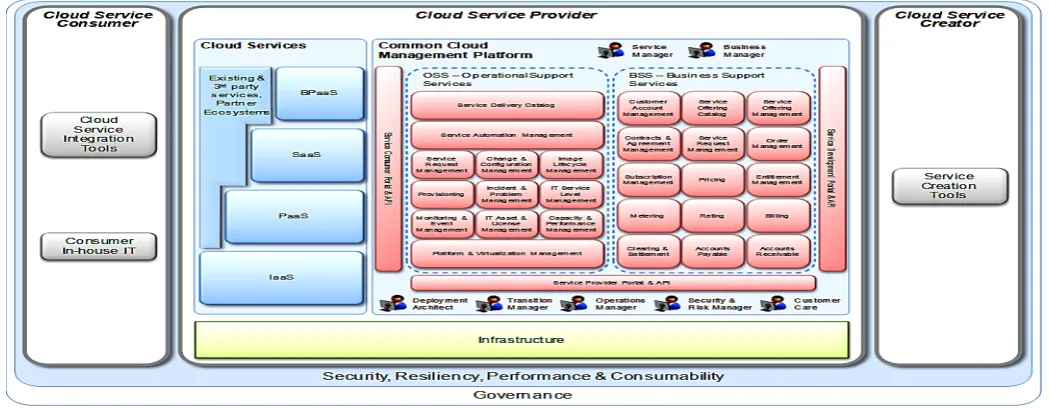
The IBM cloud computing reference architecture (CCRA) which is shown in figure 1, introduce the fundamental component of cloud environment. It should be mentioned that, the structure of this architecture is modular [9]. It defines the fundamental architectural components which underpin and provide guidelines for creating a cloud environment.
In this architecture there are three main roles, which each of these roles is to present a single person or organizations and sub-roles may be defined, based on project scenarios.
A cloud service consumer role consumes cloud service instances. Cloud service provider has responsible to supply and/or provide cloud services. This role and its sub-roles are defined by ownership of a common cloud management platform (CCMP). The third role is cloud service creator which is responsible for creating services in cloud environments. The core components of this architecture are mainly cloud services, common cloud management platform and infrastructure [9].
Cloud services may represent any type of IT capability which is provided for cloud consumers. The management functions for cloud services are defined as part of CCMP. As it can be seen in figure 1, the internal components of CCMP are categorized in operational support services (OSS) and business support services (BSS) and this component include processes and services which are required for cloud management [9].
IV. EPICORERP
Epicor is a software company which provides management (CRM),
and customers. Epicor ERP has several modules.
Epicor Customer relationship management controls every aspect of a company’s interaction with its customers. It broadens the scope of customer information to everyone within and across the organization. Epicor Sales Management delivers a complete suite that enables produce accurate estimates. Epicor Service Management optimizes customer service with timely response to customer requests.
Epicor Product Data Management serves as a central knowledge repository for process and product history.
Epicor Planning and Scheduling, is a complete solution for forecasting, material requirements planning, scheduling, and planning. Epicor Project Management is a complete solution for project managers. Epicor Production Management is a complete solution for make-to-order, engineer-to-order and etc. Epicor Supply Chain Management is a full suite of enterprise application capabilities. Epicor Financial Management is providing a suite of accounting applications to help organizations about financial management. Epicor Enterprise Performance Management is a solution for enterprise performance analysis and reporting based on key performance indicators.
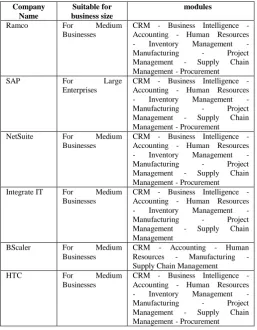
Epicor Governance, Risk and Compliance, is a solution which help companies stay compliant, and ensure that organization are aware of the associated risks of non-compliance. Epicor business architecture provides a rich user experience, affording opportunities for greater user collaboration and productivity. Epicor ERP alsohas human resource management too. Table 1 show some company which are provided ERP system [22 -24].
V. PROPOSEDARCHITECTURE
[image:3.595.33.558.566.770.2]In this section our proposed cloud computing architecture is presented. It should be mentioned that, the foundation of this architecture is based on the existing architectures and use of best practices of ICT frameworks, such as IBM, ITIL, eTOM, etc. and also an ERP System is used in this architecture. This architecture is improved two times and in this paper the final architecture will be presented [7, 8].
Niloofar Khanghahiet al, International Journal of Advanced Research In Computer Science, 5 (1), Jan–Feb, 2014,32-42
Table 1: Some ERP System providers company
Company Name
Suitable for business size
modules
Ramco For Medium
Businesses
CRM - Business Intelligence - Accounting - Human Resources
- Inventory Management -
Manufacturing - Project
Management - Supply Chain
Management - Procurement
SAP For Large
Enterprises
CRM - Business Intelligence - Accounting - Human Resources
- Inventory Management -
Manufacturing - Project
Management - Supply Chain
Management - Procurement
NetSuite For Medium
Businesses
CRM - Business Intelligence - Accounting - Human Resources
- Inventory Management -
Manufacturing - Project
Management - Supply Chain
Management - Procurement
Integrate IT For Medium
Businesses
CRM - Business Intelligence - Accounting - Human Resources
- Inventory Management -
Manufacturing - Project
Management - Supply Chain
Management
BScaler For Medium
Businesses
CRM - Accounting - Human
Resources - Manufacturing -
Supply Chain Management
HTC For Medium
Businesses
CRM - Business Intelligence - Accounting - Human Resources
- Inventory Management -
Manufacturing - Project
Management - Supply Chain
Management - Procurement
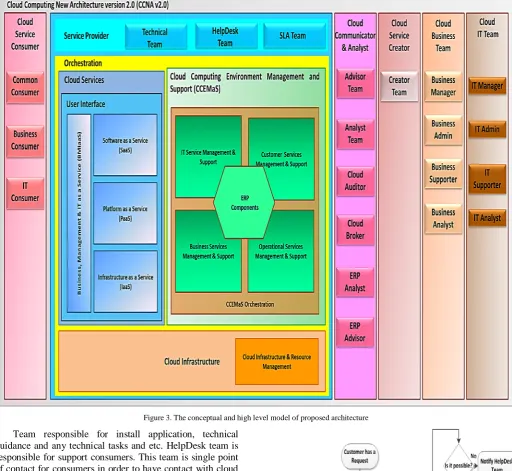
Figure 3 shows the conceptual and high level model of proposed architecture. In the following sub-sections of this paper, components and roles of this architecture will be introduced briefly.
As can be seen in figure 3, the proposed architecture combines the best component of existing architectures and in addition it has the following advantages [7, 8]:
a. A new service layer added to this architecture. This layer offers IT and business management services and processes and other related services and processes to business customers.
b. With this new service layer, organizations and business clients are separated from normal client and better services is provided to them.
c. New service layer is enabling more customization and this customization is better for organizations.
d. Cloud management layer of this architecture used ICT frameworks and best practices such as eTOM, ITIL, IBM, etc. to manage service layers, infrastructure, customer and everything related to cloud.
e. With existing processes and services in CCEMaS, the management of internal cloud components and services which provided to users will be upgraded and be more structured.
f. Cloud ERP System in this architecture will be enabling more structure and integration of cloud resources. g. Cloud ERP System will be enable better cloud resource
planning and future works in cloud environments, such as new cloud services, new cloud resources, new projects and etc.
h. Cloud ERP System will perform any kind of cloud environment reporting for future analysis.
i. Some modules of this ERP system are used by consumers normally or customized. Thus ERP system do internal cloud resource planning and management and consumers ERP system requirements parallel but in isolation mode and according to ACID law. This is the advantage of this ERP system.
A. Roles in CCNA v2.0:
As can be seen in figure 3, in this architecture has 6 major group roles. Each of these group roles are responsible for specific tasks in cloud environments which are described briefly in the following.
Cloud Service Consumer Role represents users and consumers of cloud environments. Consumers are use services which are placed in cloud service layer and they produced revenue for cloud provider company. These consumers are placed in common, IT and business categories. It should be mentioned that business and IT consumers often use Business & IT services in cloud service layer but they may use other kind of services too. Internet users, telecom companies and etc. can be example of cloud consumers.
Figure 3. The conceptual and high level model of proposed architecture
Team responsible for install application, technical guidance and any technical tasks and etc. HelpDesk team is responsible for support consumers. This team is single point of contact for consumers in order to have contact with cloud teams. SLA team is responsible for preparing and writing service level agreement contact according to customers requirements and negotiation with technical and HelpDesk team.
Cloud communicator & Analyst Role, are advisers, analysts, auditor and etc. which responsible for analysis, communicate, audit and etc. activities related to current cloud services and there improvement or new cloud services. ERP adviser and analyst are responsible for any decision and analyst related to cloud ERP system components.
Cloud Service Creator Role, responsible for produce cloud services. This team is completely technical and professional.
Cloud Business and IT Team Role, responsible for analysis, support and manage all activities related to internal cloud IT and business and cloud services.
[image:5.595.328.555.471.738.2]Figure 4 shows the trend of responding to customers requests.
Niloofar Khanghahiet al, International Journal of Advanced Research In Computer Science, 5 (1), Jan–Feb, 2014,32-42
B. New Cloud Architecture Components:
As can be seen in figure 3, this architecture has four major components. Each of these components has smaller categories. Smaller categories are composed of different processes, services and applications. These components are called as orchestration, cloud services, cloud infrastructure and Cloud Computing Environment Management and Support (CCEMaS), which would be discussed in each of the following sub-sections.
a. Cloud Services Component:
In this component, services provide to consumers in form of four service layer, which can show types of provided services.
In SaaS, like all common architectures, software is provided to consumers. These kinds of services have limited customizable and this feature is not being sufficient for organizations and business customers. Because enterprise customers are more willing to get service packages and do not being forced to prepare hardware, software and other related requirements. In PaaS, a platform or operating system is provided to consumers and consumers deploy their own services or software on top of the platform. In this model, clients will install their favorite software or services and service provider does not involve in it. Service variation in this model is low so this feature is not being favorable for organizations and business customers too. In IaaS, the infrastructure and hardware provided to clients. So due to provide hardware only, it is not being optimal for organizations and business customers.
BMIaaS is a new service layer in this architecture. In this layer, services, processes, packages and systems related to business, IT and enterprise management provide to customers. It should be mentioned that, this type of services is usually provide to business and IT consumers which could be favorite for many organizations, especially IT related organizations.
This layer is hybrid and this is the advantage of it. This means that cloud services, organization’s special services and designed services can be deployed in this layer in simple services or combination of infrastructure, platform and service in a package. B2B services, accounting services, ERP systems and etc. can be example of this layer services.
Cloud ERP components which provided in this layer is completely customizable and suitable for use of most type of business and industries. It should be mentioned that, basis of this ERP system is located in cloud management layer, which will be discussed in the nest sections. ERP system which is located in cloud management layer has specific modules for cloud consumers use.
[image:6.595.312.560.58.339.2]It should be mentioned that, consumers have an interface in order to use services and notify or negotiate with service provider about services issue. Consumers can only communicate with HelpDesk team and then the HelpDesk team will be interacting with other roles. HelpDesk team is unique team that has direct relationship and negotiates with customers and also SLA team is responsible to contracting with customers and does related contracts conditions but not directly. Figure 5 shows the trend of creating new services.
Figure 5 trend of creating new services
b. Cloud Infrastructure Component:
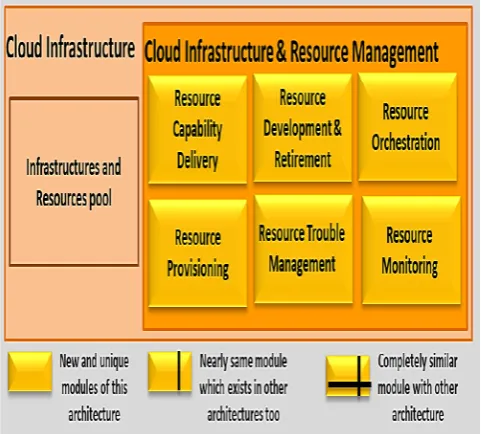
Infrastructure component provide infrastructure, hardware, platform and any related requirements for other components and associated items and also provide infrastructure for IaaS Cloud services or BMIaaS and other layers. It another component in this part is cloud infrastructure and resource management. This component and their processes are responsible to manage infrastructure and resource and also orchestrate when providing infrastructure and resource. Figure 6 shows the component, this component involves processes and resources and infrastructures pool. Most of services in this component are taken from eTOM framework.
These services are generally responsible to capability definition or requirements in order to deploy new or changed resources and infrastructure, ensure resources and infrastructure are deployed according to plans, develop new or changed resources and infrastructure and retire them by planning, allocation, configuration, activation, testing resources and infrastructure, correcting and resolving resources and infrastructure troubles, detect problem and etc.
Resource Orchestration is responsible to undertakes any type of orchestration and any necessary interactions and communications of resources with cloud infrastructure and resource management and other components of architecture in order to resource provisioning and better services.
Figure 6: Components of Cloud Infrastructure and Resource Management
c. Cloud Computing Environment Management and Support:
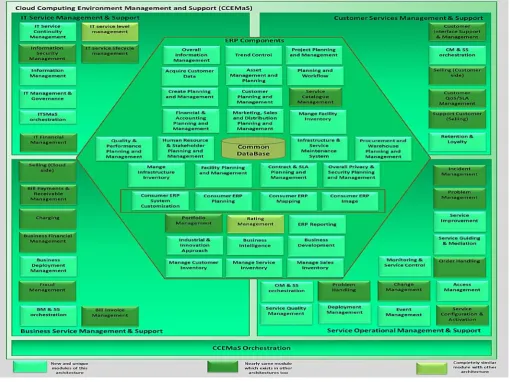
This component is responsible to support and manage all kind of processes, services, applications and activities which manage and support cloud service layers and each component related to cloud environments. These processes are classified in Cloud IT Service Management, Customer Management & Support Services, Business Management & Support Services, Operational Management & Support Services, Cloud ERP component and CCEMaS Orchestration. It should be granted that, OSS and BSS components of IBM architecture are completely supported in these components in addition to more processes. Figure 7 shows this component and its sub-component which are introduced in sections below. All roles interact with this component directly or indirectly.
a) Cloud IT Service Management Component: All type of processes and services which are related to manage IT services in cloud service layer and internal IT processes in cloud environment should be located in this component. Figure 7 shows processes and services of this component.
Most of processes in this component are taken from ITIL and IBM frameworks. These processes and services are generally responsible to support cloud IT services, continuity of IT services, IT and Business services alignment, manage security of IT information in cloud environment, manage privacy of IT services, authorized access to IT information, manage and protect IT information integrity, Manage IT costs, IT service financial management, manage fulfillment of IT service level, manage IT service lifecycle from establishment to retirement, reporting and tracking of IT services and etc. in order to provide better IT services and continual improvement of these kind of services.
It should be mentioned that, information security management process is too important, because customer’s information, especially enterprise customer’s information should be completely safe. As an example, enterprise which used ERP systems that implemented in cloud Business & IT as a Service, expected that their financial, internal and transactions related information to be completely secure.
Cloud service providers are responsible for the security in accordance with the SLA.
Information Management process is specific process of cloud environments which manage information that later will be used in reporting and financial processes.
IT Service Management orchestration processes are responsible to orchestrate all type of information, processes and anything related to IT process with other cloud components. Cloud IT team roles interact with this component directly. As an example, a new IT service which designed by Cloud IT Team and created by Cloud Service Creator in order to consumers or internal cloud use, is managed by IT Service Life Cycle Management processes.
b) Business Management & Support Services Component:
All type of processes and services which are related to manage and support business services in cloud environment will be located in this component. Figure 7 shows the components of these processes.
Most of processes in this component are taken from eTOM and ITIL frameworks.
These processes and services are generally responsible to ensure revenue collection from different channels, manage billing account, monitoring bill payment, manage fee payment by different methods, manage financial issue related to business services, manage business service deployment trend, manage selling trend, create bill invoice, prevent and manage fraud, support of fraud operations, detect fraud and etc.
Due to cloud services are provided in internet-based infrastructure and this this environments is too insecure, it is very important to prevent fraud and establish related policies to prevent and manage fraud in cloud environments and services which provided to customers. This is important because, stealing information and disclosed privacy is very important for customers especially enterprise customers. They want full security is satisfied and customers to be concerned about this issue when thinking and make decisions about cloud.
Fraud management process in this component responsible to establishing, managing and policymaking activities and capabilities related to manage, detect and prevent fraud in cloud environments.
Business Management and Support Services orchestration processes are responsible to orchestrate all type of information, processes and anything related to business with other cloud components.
Selling (Cloud side) processes are responsible to performing all type of sales operations related to business and have strong interactions with Selling in customer's component. Cloud Business team roles interact with this component directly.
c) Customer Management & Support Services Component:
All type of processes and services which are related to manage and support customers and there interactions and interfaces in cloud environment will be located in this component. Figure 4 shows the components of these processes. Most of processes in this component are taken from eTOM framework.
Niloofar Khanghahiet al, International Journal of Advanced Research In Computer Science, 5 (1), Jan–Feb, 2014,32-42
support customer interfaces availability, manage customer interface change, support customer payment and selling trend, ensure retention and loyalty, monitoring QoS and SLA of services and etc.
Selling (Customer side) processes are responsible of performing all type of sales operations related to client services in order to better quality of service.
Support Customer (Selling) processes are responsible to performing all type of operations related to customer charging, payment and financial functions.
Customer Management & Support Services
orchestration processes are responsible to orchestrate all type of information, processes and anything related to customers with other cloud components. All roles interact with this component directly or indirectly. Service consumers are also indirectly interacting with this component by Help Desk.
As an example, when a customer is having problems in using cloud services, they report these problems to service provider HelpDesk by interface. HelpDesk team has reviewed problems and resolves it, if it is possible,
otherwise problems escalate depending on type or priority and then related team resolve problem by help of processes and services. It should be reminded that, orchestration between processes and services will be done through orchestration components and associated processes.
d) Operational Management & Support Services Component:
All type of processes and services which are related to manage and support services operations in cloud environment will be located in this component. Figure 4 shows the components of these processes.
Most of processes in this component are taken from eTOM, ITIL, IBM and Microsoft frameworks.
[image:8.595.38.549.309.691.2]These processes and services are generally responsible to accepting and issuing customer orders, verifying orders, receiving trouble reports from HelpDesk and resolve it, administer service improvement, service mediation, service activation, manage provided services and available in near future, supporting services by manage incident, problem, event, change, Recovery service defects, etc.
Figure 7: Cloud Computing Environment Management and Support components
Operational Management & Support Services orchestration processes are responsible to orchestrate all type of information, processes and anything related to operational business with other cloud components. All roles specially cloud communicator and analyst interacts with this component directly.
e) Cloud ERP Component:
As mentioned in the previous sections, ERP systems fully integrate and cover functional area of an enterprise. These systems also integrate enterprise information flow and plans processes, services and applications and usually have common database. Cloud ERP system of this architecture likewise integrate processes and services of cloud environments.
In addition, this ERP system can be used by consumers in strict mode with the help of Consumer ERP System Customization, Consumer ERP Planning, Consumer ERP Mapping and Consumer ERP Image. It should be mentioned that, all components of this system is not suitable for consumers and they usually choose some of them with regard to cloud environment restrict. In this system, there is common database which maintain all cloud environment information and consumers information in order to integrity. Consumer’s information is hidden from cloud team in order to security. In the following, modules of this ERP system will be introduced briefly:
Overall Information Management responsible to manage all information of cloud environments and consumers, planning information policies, determine type of access, information reporting and etc. Trend Control responsible to control of financial flow and revenue, control service implementation trend, management decisions, reporting this trends, control cloud environment overall operation trend and etc. Project Planning and Management responsible to planning new project of cloud environment, planning project trends, scheduling project trends, control project trends, reporting this trends and etc. Acquire Customer Data responsible to inquiry customer information, control this information, reporting it and etc. Asset Management and Planning responsible to manage all assets of cloud environment, planning all assets of cloud environment, reporting this and etc. Planning and Workflow responsible to manage other components of ERP system, planning workflow trend of other modules, planning workflow trend of ERP modules, reporting and notify this workflow and etc. Create Planning and Management responsible to new service creation planning, control new service creation planning activities, reporting about this and etc. Customer Planning and Management responsible to planning service providing to costumers rules, planning and feasibility of costumers demand, report costumer statistics and etc. Service Catalogue Management responsible to provide consistent information resources associated with all services and etc. Financial & Accounting Planning and Management responsible to cloud financial account management, manage receivable and payable accounts, financial planning, reporting financial statistics and etc. Marketing, Sales and Distribution Planning and Management responsible to marketing, sales, cost and pricing planning, reporting this plans and etc. Contract & SLA Planning and Management responsible to contract and SLA rules planning, create contract and SLA draft and etc. Quality & Performance Planning and Management responsible to QoS planning, performance monitoring and improvement and etc. Human Resource & Stakeholder Planning and Management responsible to manage and planning everything related to human resources and stakeholders such as Salary, Tasks and etc. Infrastructure & Service Maintenance System responsible to infrastructures and services maintenance
scheduling and planning, infrastructures and services upgrade and update scheduling and planning and etc.
Procurement and Warehouse Planning and Management responsible to scheduling to buy Procurements, Planning content store in warehouse and etc. Portfolio Management responsible to evaluation of investment opportunities and etc. Rating Management responsible to calculating the value of services before, during or after providing service and etc. ERP Reporting responsible to reporting anything related to ERP system and etc. Industrial & Innovation Approach responsible to research related to improving cloud environment, upgrade modules, reporting industrial approaches, feasibility of new change and etc. Business Intelligence responsible to business New Approaches Planning, Analysis of data related to business and etc. Business Development responsible to develop new business approach and etc. Manage Customer, Service and Sales Inventory responsible to manage all information related to manage customer, service and sales inventory, update it and etc.
Consumer ERP System Customization, Consumer ERP Planning, Consumer ERP Mapping, Consumer ERP Image responsible to ERP system customization for consumers, Planning ERP system for consumers, feasibility ERP system for consumers, create image for consumers use, reporting related to this system mapping to existing system and etc.
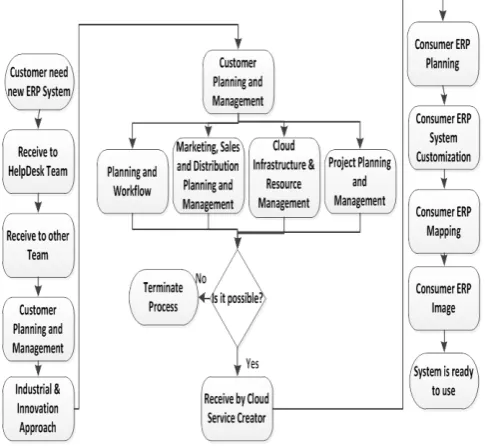
[image:9.595.315.558.394.617.2]Figure 8 shows the trend of create new ERP system for consumers which is possible and its feasibility has been done.
Figure 8: create new ERP system for consumers
f) CCEMaS Orchestration Component:
This component is responsible to orchestrate between internal CCEMaS processes and services, but orchestration between external components and this 5 components in not possible only with this component. This component is only responsible to orchestrate between 4 internal CCEMaS components.
Niloofar Khanghahiet al, International Journal of Advanced Research In Computer Science, 5 (1), Jan–Feb, 2014,32-42
i. Orchestration Component:
Orchestration component is responsible to orchestrate all type of information processes and anything related to orchestration processes which exist in other components, roles, etc.
As should be mentioned that, orchestration include any notifications, change formatting, reporting activities between components through orchestrations processes in other components.
As an example, As an example, this component orchestrates and communicates between Resource Provisioning and Information Management processes through exchange between Resource Orchestration, IT Service Management Orchestration and CCEMaS Orchestration.
VI. COMPARISONBETWEENPROPOSED ARCHITECTUREANDOTHERARCHITECTURES
In this section, the proposed architecture which is presented in section 4 will be compared and evaluated from two following respects:
a. Usage of proposed architecture from standard and best practices frameworks
b. The difference and similarity of the proposed architecture with other cloud architectures
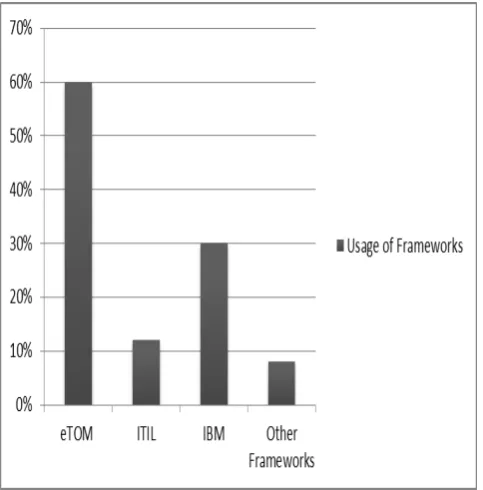
[image:10.595.316.555.53.269.2]Cloud environment is service oriented and nowadays large enterprises and many customers have turned to the environment, hence, this environment will be more successful if it is accordance with known and accepted standards and frameworks. Figure 9 show the percent of using standardized processes and services of ICT frameworks in proposed architecture.
Figure 9: the percent of using ICT frameworks
[image:10.595.36.278.439.684.2]Also, when the new architecture is proposed, Comparison improvement over the existing architecture Or the extent of its coverage from the existing architecture can be extremely important in acceptance and approval of new architecture. Figure 10 shows, comparison of proposed architecture and known cloud architectures which is NIST, IBM and Oracle.
Figure 10: comparison of proposed architecture and other architectures
VII.CONCLUSIONSANDFUTUREWORKS
The service oriented (SOA) is an absorbing architectural concept which can provide an integrated structure for organizations and moving toward this architecture is one of the main goals of today’s organizations. Also nowadays, organizations seeking for standard structures and they use standard frameworks such as eTOM, ITIL, IBM and etc. for the purpose of their internal and external structure synchronous with changes of modern world. ERP systems is another concept which is important for enterprise today.
On the other hand, today's cloud computing is the subject of ongoing discussion of societies and organizations. Large organizations moving to cloud environments and sometimes they have been outsourced their costly operations departments such as IT department to cloud, in order to save organizational costs, also provide better services and rise in competition. Therefore cloud architecture would be important and also there are several reference architectures exist for cloud, such as NIST, IBM and etc.
Integrating any new architecture with existing well-known frameworks and best practices might be considered as an affordable effort to transform and help organizations in choosing cloud with confidence.
In this paper, a new cloud computing architecture proposed based on integration of current frameworks and best practices and also with new ERP system which is suitable and perfectly designed for cloud environments. In this architecture, the first step was to combine the best components of the existing architectures, frameworks and best practices in order to provide a favorite new service layer and bold IT and business in this layer to achieve organizations satisfaction and improve cloud management. Later we augmented few other modules to enrich the architecture to cope with the requirements in real world. ERP system in this paper is used in environments and also used by consumers too
VIII.REFERENCES
[1] Borko Furht, Armando Escalante, “Handbook of Cloud Computing”, Springer, 2010
[2] Abah Joshua, and Francisca N. Ogwueleka, “Cloud Computing with Related Enabling Technologies”, IJ-CLOSER , February 2013
[3] NIST Advisory Working Group, “NIST Cloud Computing Standards Roadmap”, NIST Special Publication 500‐291, 2011
[4] Peter Mell, Timothy Grance, “The NIST Definition of Cloud Computing,” September 2011
[5] M.Malathi, “Cloud Computing Concepts,” IEEE, 2011
[6] Niloofar Khanghahi, Touraj Banirostam, “A Novel Intrusion Detection Approach Based on Intelligent Agent in Cloud Computing”, ICECE 2013
[7] Niloofar Khanghahi, Reza Ravanmehr, “CLOUD COMPUTING PERFORMANCE EVALUATION: ISSUES AND CHALLENGES”, IJCCSA, 2013
[8] Niloofar Khanghahi, Ramin , Mahsa Razavi, “ A New Approach Towards Integrated Cloud Computing Architecture”, IJDIWC, 2014
[9] Niloofar Khanghahi, Ramin Nasiri, “A New Cloud Computing Architecture by Integrating Recent Best Reference Frameworks”, SDIWC, 2013
[10] Michael Behrendt, Bernard Glasner, “Introduction and Architecture Overview IBM Cloud Computing Reference Architecture 2.0”, IBM 2011
[11] Hewlett-Packard Development Company, “Understanding the HP CloudSystem Reference Architecture”, HP 2011
[12] Fang Liu, Jin Tong, Jian Mao, “NIST Cloud Computing Reference Architecture”, September 2011
[13] Mark Wilkins, Scott Mattoon, Dave Chappelle, “Oracle® Reference Architecture/Cloud Infrastructure”, Oracle, November 2011
[14] ITIL Advisory Group, “An Introductory Overview of ITIL® V3”, The UK Chapter of the itSMF, 2007
[15] ITIL Advisory Group, “Service Strategy of ITIL® V3”, The UK Chapter of the itSMF, 2007
[16] ITIL Advisory Group, “Service Design Overview of ITIL® V3”, The UK Chapter of the itSMF, 2007
[17] ITIL Advisory Group, “Service Transition of ITIL® V3”, The UK Chapter of the itSMF, 2007
[18] ITIL Advisory Group, “Service Operation of ITIL® V3”, The UK Chapter of the itSMF, 2007
[19] ITIL Advisory Group, “Service Improvement of ITIL® V3”, The UK Chapter of the itSMF, 2007
[20] IBM Advisory Group, “INTRODUCING THE IBM PROCESS REFERENCE MODEL FOR IT V3”, IBM Corporation 2008
[21] TM Forum Advisory Group, “ Business Process Framework eTOM”, TM Forum 2012
[22]
[23] Group, Aberdeen, “SaaS ERP:Trend & Observations” 2011
[24] Group, Epicor Advisory, “Epicor Enterprise Resource Planning Overview”, Epicor