ISSN (Print) : 2320 – 3765 ISSN (Online): 2278 – 8875
I
nternational
J
ournal of
A
dvanced
R
esearch in
E
lectrical,
E
lectronics and
I
nstrumentation
E
ngineering
(An ISO 3297: 2007 Certified Organization)
Vol. 5, Issue 6, June 2016
An Efficient Image Compression Technique
using Lift Based DWT
Priyanka.M.J, Anitha S Prasad
M. Tech Student, Dept. of Electronic and Communication, SJCE, Mysore, India
Assistant Professor, Dept. of electronic and communication, SJCE, Mysore, India
ABSTRACT: This paper proposes for an efficient photograph compression procedure used in LDWT, on this paper image compression is most important for a lot of applications that contain big data storage, transmission and retrieval comparable to for multimedia, records, videoconferencing, and medical imaging. Uncompressed images require colossal storage potential and transmission bandwidth. The objective of picture compression manner is to diminish redundancy of the photograph knowledge in an effort to be in a position to retailer or transmit information in an effective form. This results within the discount of file dimension and allows more photos to be saved in a given amount of disk or memory space. In this study a brand new and very capable picture compression scheme is proposed established on discrete wavelet turn out to be that outcome less computational complexity without a sacrifice in photograph excellent. And in addition this paper presents the design and implementation of a Lifting founded DWT scheme for an effective image Compression process. This Lifting situated DWT scheme is applied using VHDL and the pre-processing of snapshot comparable to resizing; color conversion and pixel conversion are done utilizing MATLAB. The paper avoids the traditional procedure of complex mathematical calculation and the development is derived in spatial domain. Our proposed approach can be giving larger compression price and top to sign noise ratio.
KEYWORDS: Lifting based DWT, VHD, Efficient Image Compression method, Image Compression.
I.INTRODUCTION
ISSN (Print) : 2320 – 3765 ISSN (Online): 2278 – 8875
I
nternational
J
ournal of
A
dvanced
R
esearch in
E
lectrical,
E
lectronics and
I
nstrumentation
E
ngineering
(An ISO 3297: 2007 Certified Organization)
Vol. 5, Issue 6, June 2016
A typical image compressor is comprised of transform, quantization and coding blocks. The transform is used to represent the image pixels into fewer coefficients without any loss of information. The decomposed coefficients are then compressed using quantization. The 1 quantization uses set of predefined steps to remove any redundant information from the image. At this stage the compression becomes irreversible. The coding stage converts the compressed coefficients into binary values and adds it to the bit stream for the ease of transmission. This method of compression is called loss compression. The decompress or is used to perform the inverse operations of the encoder to get the original image.
II.LITERATURESURVEY
Reetinder Kaur et al [1] in this Paper proposed a method for the image compression is very necessary and popular technique in course of saving the memory on the local disc or to speed up the internet transfers. The discrete wavelet transform (DWT) has already been proved as the best image compression algorithm. The DWT technique decomposes the image matrix into various sub-matrices to create a compressed image. The new compression technique will be developed by combining the most effective and fast wavelets of DWT technique for image compression. The quality of the new image compression technique will be evaluated using the peak signal to noise ratio (PSNR), mean squared error (MSE), compression ratio (CR) and elapsed time (ET). Also, the new techniques would be compared with the existing image compression techniques on the basis of the latter mentioned parameters.
Ratnashil N Khobragade et al [2] Described Segmentation is one the most important process which decides the success of character recognition technique. Segmentation is used to decompose an image of a sequence of characters into sub images of individual symbols by segmenting lines and words. In segmentation image is partitioned into multiple parts. With respect to the segmentation of handwritten words into characters it is a critical task because of complexity of structural features and varieties in writing styles. Due to this without segmentation these touching characters, it is difficult to recognize the individual characters, hence arises the need for segmentation of touching characters in a word. Here we consider Marathi words and Marathi Numerals for segmentation. The algorithm is use for Segmentation of lines and then characters. The segmented characters are then stores in result variable. First it Separate the lines and then it Separate the characters from the input image. This procedure is repeated till end of file.
S. S. Mungona et al [3] proposes for method discrete wavelet transform is the most widely used image compression technique and it is the most efficient algorithm used in JPEG image compression. An architecture that performs both forward and inverse lifting-based discrete wavelet transform is proposed Conventional method requires more memory, area and power; lifting scheme is used as an enhanced method. Architecture of the DWT which is a powerful image compression algorithm is implemented using lifting based approach. This architecture results in reduced memory referencing¸ low power requirement¸ low latency and high throughput. The Inverse Discrete Wavelet Transform (IDWT) is also obtained in a similar way to get back the image matrix. The design can be used for both loss and lossless compression. To reduce the complexities of the design, linear algebra view of DWT and IDWT has been used [1]. The advantages of the proposed architecture are the hardware optimization, fast computing time; regular data flow and reduce complexity. Because of the regular structure, the proposed architecture can be easily be scaled with the filter length and 2D DWT level. VLSI architecture for the 2-D DWT is implemented using FPGA in VHDL. With the growing popularity of the applications that use large amounts of image and video coding is an active and dynamic field. . Image and Video Compression for Multimedia Engineering gives a basis for research and development.
III.PROPOSEDSYSTEM
ISSN (Print) : 2320 – 3765 ISSN (Online): 2278 – 8875
I
nternational
J
ournal of
A
dvanced
R
esearch in
E
lectrical,
E
lectronics and
I
nstrumentation
E
ngineering
(An ISO 3297: 2007 Certified Organization)
Vol. 5, Issue 6, June 2016
Fig 1: Architecture of Proposed System
1. Pre Processing
Humans perceive color through wavelength-sensitive sensory cells called cones. There are three different types of cones, each with a different sensitivity to electromagnetic radiation (light) of different wavelength. One type of cone is mainly sensitive to red light, one to green light, and one to blue light. By emitting a controlled combination of these three basic colors (red, green and blue), and hence stimulate the three types of cones at will, we are able to generate almost any perceivable color. This is the reasoning behind why color images are often stored as three separate image matrices; one storing the amount of red (R) in each pixel, one the amount of green (G) and one the amount of blue (B). We call such color images as stored in an RGB format.
In gray scale images, however, we do not differentiate how much we emit of the different colors; we emit the same amount in each channel. What we can differentiate is the total amount of emitted light for each pixel; little light gives dark pixels and much light is perceived as bright pixels. When converting an RGB image to gray scale, we have to take the RGB values for each pixel and make as output a single value reflecting the brightness of that pixel. One such approach is to take the average of the contribution from each channel: (R+B+C)/3. However, since the perceived brightness is often dominated by the green component, a different, more "human-oriented", method is to take a weighted average, e.g.: 0.3R + 0.59G + 0.11B. [5]
2. Lifting Based Data Wavelet Transform (LDWT)
An image compression using a lifting based 2D DWT is proposed and is implemented. The Discrete Wavelet Transform is a more efficient than the Discrete Fourier and Discrete Cosine Transform in terms of Noise, Compression ratio and Transmission speed. In order to overcome the noise and to achieve Higher Transmission speed, an improved version of lifting based Discrete Wavelet Transform VLSI architecture is proposed. In this lifting scheme- split, predict, update methods for lower computational complexities and higher efficiencies is used. Based on convolutions, the Traditional DWT architectures are designed. The second-generation DWTs, which are based on lifting algorithms, are proposed. The DWT is mainly used in image processing. Because, it supports features like progressive image transmission (by quality, by resolution), region of interest, ease of compressed image manipulation, etc. The process of image compression is performed in this paper. VLSI architecture is designed by using lifting based Discrete Wavelet Transform (DWT) and its Register Transfer Logic (RTL) is described using Verilog.
3. Compressed Image
ISSN (Print) : 2320 – 3765 ISSN (Online): 2278 – 8875
I
nternational
J
ournal of
A
dvanced
R
esearch in
E
lectrical,
E
lectronics and
I
nstrumentation
E
ngineering
(An ISO 3297: 2007 Certified Organization)
Vol. 5, Issue 6, June 2016
friendly interfaces like the graphical displays, touch screens and keypads. Images stored in smaller handheld devices are a challenge as they occupy huge storage space, and require more bandwidth for its transmission. Therefore most of the signal processing technologies today has dedicated hardware which acts as the co-processing system for compressing and decompressing. These modern day requirements cannot be made possible with the conventional compression techniques like the Fourier Transform (FT), Discrete Cosine Transform (DCT).
Compression Algorithm
The steps involved for image compression a) Fetch input image.
b) Image decomposed into wavelet coefficients using DTCWT. c) Thresholding - modification of coefficients.
d) To compress an image using arithmetic coding. e) Calculate the compression ratio.
IV.RESULTS
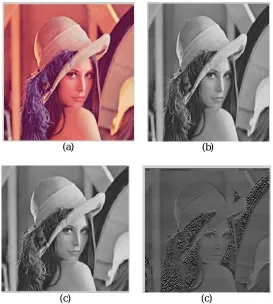
In this results shows in figure 2: represents the original image which is called input image, after it will converting into gray scale image in figure shown in (b), then we considering the LDWT means lifted based wavelet transform in this technique used to converting gray image to lifted wavelet image as figure shown in (c), and finally we got result Xilinx Inverse Wave lifted Image respectively (d).
(a) (b)
(c) (c)
Figure 2: (a) Input Image, (b) Gray Scale Image, (c) lifted wavelet image, (d) Xilinx Inverse Wave lifted Image
ISSN (Print) : 2320 – 3765 ISSN (Online): 2278 – 8875
I
nternational
J
ournal of
A
dvanced
R
esearch in
E
lectrical,
E
lectronics and
I
nstrumentation
E
ngineering
(An ISO 3297: 2007 Certified Organization)
Vol. 5, Issue 6, June 2016
V.CONCLUSION
In this Paper Concluded Compression becomes essential in this computing field to reduce the data or image size in faster transmission and minimum space for storage than uncompressed data or image. Many techniques are designed for image compression and for entropy coding in thresholding. Computer data compression is, of course, a powerful, enabling technology that plays a vital role in the information age. Among the various types of data commonly transferred over networks, image and video data comprises the bulk of the bit traffic
REFERENCES
[1] Reetinder Kaur, Mandeep Kaur, Research Scholar, “Dwt Based Hybrid Image Compression for Smooth Internet Transfers”, International
Journal of Science, Engineering and Technology Research (IJSETR), Vol 4, Issue 1, 2015.
[2] A.H.M. Jaffar Iqbal Barbhuiya1, Tahera Akhtar Laskar2, K. Hemachandran, “An Approach For Color Image Compression Of Bmp and Tiff
Images Using Dct And Dwt”, Vol 6, Issue 1, pp. 19-26, 2015.
[3] S. S. Mungona, Dr. S. A. Ladhake, “Vlsi Design Approach For Image Compression Using Wavelet”, Vol 4, Issue 8, 2015.
[4] Dr. Sudhir S. Kanade, Nayna V. Bhosale, “A Survey on Implementation of VLSI Based Image Compression Scheme on Reconfigurable
Computing System”, ISSN 2319-8885 Vol.04, Issue.10, Pages: 1907-1910, 2015.
[5] Dr. Sudhir S. Kanade, Mrs. Nayna Vijaykumar Bhosale, “A Lifting Based Dwt Scheme For Image Compression Using Vhdl”, International
Journal of Computer Engineering and Applications, Vol IX, Issue VI, 2015.
[6] P. Veera Swamy, B. Venkateswara Reddy, N. B. S. Naveen, “Efficient Compression of Image by Lifting Based Technique”, International
Journal of Engineering and Advanced Technology (IJEAT) ISSN: 2249 – 8958, Vol-3 Issue-6, 2014.
[7] K. Indiradevi and R. Shanmugalakshmi, “Dual Tree Complex Wavelet Transform Based Image Compression Using Thresholding”, Vol. 10,
No. 8, 2015.
[8] Chandny Ramachandran, T.R. Dinesh Kumar, “VLSI Implementation Of Fast Convolution Based 2-D Discrete Wavelet Transform For High
Speed, Area Efficient Image Computing”, International Journal of Power Control Signal and Computation(IJPCSC), Vol3. No1. Jan-Mar 2012.
[9] Adithya. G, Dr. N.G Kurahatti, “Image Compression System Using Low Power Vlsi Architecture & Lifting Based Dwt”, International Journal
For Technological Research In Engineering Vol 2, Issue 9, 2015.
[10] D. U. Shah, C. H. Vithlani, “Efficient Implementations of Discrete Wavelet Transforms Using Fpgas”, International Journal of Advances in