Design and Implementation of Application
Software for CSR MK II Controller Card
B.Srinivasa Reddy1, MSR Sekhar2
M.Tech Student, Dept of Electronics & Communication Engineering, Aditya Engineering College, Surampalem, (Ap)
India1
M.Tech, Asst. Professor, Dept Of Electronics & Communication Engineering, Aditya Engineering College,
Surampalem, (Ap) India2
ABSTRACT: This paper describes recent experiences with operating an Antenna. Antenna Pointing System (APS) is
an embedded system with the electromechanical assembly. The prime function of APS is to do automatic pointing of the target by moving the antenna with respective to one axis will provide azimuth angle. The close loop position control of the antenna is achieved with the help of encoders. The degree of freedom in azimuth is 0 deg to 360 deg .The APS comprises of Digital controller card and the one axis pedestal system. The Digital controller card is built using microcontroller. It is a versatile hip with rich peripheral set that can be used in Automobile application that requires high intensive communication. This paper presents the challenges in building state of art airborne embedded Hardware in terms of Digital controller card that has to be reliable, compact and capable of withstanding hostile environment conditions with less volume & weight as prime goal.
The paper also brings out in detail the various Software aspects namely the look angle computation that is required for continuous tracking. The pointing should be very precise in some applications like even if there is a heading variation of the aircraft. Hence the heading data is also sensed and included in the Look angle Computation. Finally the Industrial design aspects cannot be overlooked as it is meant to be onboard without compromising the factors namely Design for Testability (DFT), Design for Maintainability (DMT), Design for Manufacturability. The developed software shall communicate with motor drives and radar controller to position the Antenna with minimum tolerance in a closed loop system by taking angle of azimuth for Antenna position i.e. in terms of angle from 0 to 360 degree from Encoder and also keeps count of number of complete rotations made by the Antenna.
KEY WORDS: APS Antenna Pointing System, Look Angle, Microcontroller, Digital Controller Card (DCC).
I. INTRODUCTION
Antenna Control System for the CSR MKII Radar will control all electrical functions. It will rotate Antenna continuous in Azimuth at different speeds. Azimuth Control System consists of two sub-systems Azimuth Control Unit and Motor Drive Unit (MDU) forming part of the Pedestal assembly of CSR MK-II system. AZCU is the main control part which houses the controller and other electronics. It provides commands to Motor Drive Unit, which drives the motor for continuous rotation of antenna in azimuth at different speeds (1 to 60 RPM). AZCU is an environmentally sealed enclosure, a microcontroller based system.
The Azimuth angle feedback is through an 18-bit encoder (SSI Interface). AZCU will interface with main system controller on Ethernet (10/100 Mbps LAN) to provide all interlocks/feedbacks as status data on query or at regular intervals. It interfaces with Portable Drive Unit to receive rotation commands in both directions using discrete inputs through switches. Motor Drive Unit (MDU) will be basically housing the 3-Phase drive for control of motor; speed commands to the MDU will be given by AZCU. Block diagram is given below for Antenna Control System.
azimuth at different speeds (1 to 30 RPM in steps of 1RPM and in discrete steps of 5 RPM beyond 30 RPM up to 60 RPM). AZCU is an environmentally sealed enclosure, a microcontroller based system.
This paper also describes about the Design of the antenna pointing system in detail. The entire Design aspects have been divided into hardware, software and Industrial design. The control algorithm & communication capabilities are implemented on a microcontroller platform. The second section describes about the Need of the Design followed by the functional, Interface, and protocol requirements of the APS as third section.
II. SYSTEM OVERVIEW
This project is reveals about the design and development for antenna control system. Antenna Control System for the Coastal Surveillance Radar (CSR MKII) will control all electrical functions. It will rotate Antenna continuously in Azimuth at different speeds. Azimuth control system consists of two sub-systems, Azimuth Control Unit (ACU) and Motor Drive Unit (MDU) forming part of the Pedestal assembly of CSR MK-II system. AZCU is the main control part which houses the controller and other electronics.
It provides commands to Motor Drive Unit, which drives the motor for continuous rotation of antenna in azimuth at different speeds (1 to 30 RPM in steps of 0.5 RPM and in discrete steps Size of 5 RPM beyond 30 RPM up to 60 RPM). AZCU is an environmentally sealed enclosure, a microcontroller based system.
2.1 POWER SUPPLY REQUIREMENTS
The 230 VAC which enters the ACU through Connector 230VAC EMI filter it reaches to 230 VDC Switch on the front panel of the unit. Once Switch is made On the 230 VAC will reach all over the system and 230 V LED and 24VDC LED will glow. The 230VAC is converted to 24VDC from power supply 1card and through 24V EMI filter it is distributed all over the system, PDU and Drive. Power Supply 2 card takes 24 V DC as input and Converts to 3V3, 5V and ±15V. The +15V is given to encoder through connector.
a. AC Input : 230V±10%, 1-Ph, 50 Hz b. 24VDC/4A generation will be inside the unit
2.2 DRIVE & MOTOR INTERFACE
The 24VDC is the given to alarm through Relay and Relay is controlled by DO channel of Controller card. The Brake released feedback signal is also received as Digital Input to the controller card. The Unit supplies 24VDC to the PDU and receives Commands.
a. Drive interface will be discrete input & output signals (24V), Analog speed & Modbus RS485 interface. b. It will interface with motor drive unit for giving enable and stop, Forward & Reverse run, speed setting Commands etc.
2.3 Encoder Interface
The 18 bit SSI Encoder is used to get position information of antenna in azimuth axis. We have designed SSI channel Interface is for azimuth axis. Once the user enters 1, SSI Encoder Test is selected and the antenna position is continuously feedback from the encoder.
AZCU will interface with an 18-bit single turn absolute encoder. a. Synchronous Serial Interface(SSI): RS422
2.4 Radar Interface
The Antenna Control System will interface with radar controller through rotary joint over Ethernet interface for receiving commands in remote mode and also sends status.
AZCU will interface with radar controller on LAN communication (TCP/IP) at 10/100 Mbps for a. Health, Software, Antenna Position & RPM etc on query.
b. Start & Stop rotation, Set RPM, go to specific Azimuth etc.
2.5 Portable Drive Unit Interface
PDU will be a switch box with illuminated pushbutton switches (IPBs) & LEDS. a. Power ON LED
b. PDU enabled IPB c. PDU Speed-1/2 IPB d. PDU FWD Start/Stop IPB e. PDU REV Start/Stop IPB
2.6 AZCU Controller Card Specifications
Controller Card will be using 32-bit MCU core from ARM’s Cortex-M class. It includes IEEE 1588 Ethernet, full- and high-speed USB 2.0, inbuilt EEPROM and program flash with a rich suite of analog communication, timing and control peripherals. The controller card also interfaces with the other devices through Serial ports, Ethernet, SSI and DAC.
Following are the specifications:
a. Controller :
MK61FX512VMJ12:K61
FLASH :512 KB
SRAM :128 KB
EEPROM :16 KB
b. Input Power Supply-Card:24VDC±10%
c. On-Board DC-DC Convertors : +3.3V, +5V, ±15V d. Serial Ports(card)
Serial Port-1 : RS232(M&C Interface)
Serial Port-2 : RS232/RS422 configurable(Spare) Serial Port-3 : RS485(Spare)
Serial Port-4 : RS422
e. Ethernet (10/100Mbps): Radar Controller.
f. DAC Interface : 16-bit, 2 Channels (±10VDC o/p) g. ADC Interface: 4 nos. (±10VDC Input), 14-bit ADC.
h. Digital Inputs
No. of Channels : 12 independent floating channels each one fitted With Opto coupler Input voltage : Nominal Voltage 24V (19V to 36V)
Logic High - >12 VDC Logic Low - <10 VDC
Input overvoltage : Up to 30% nominal for extended periods. 300% for transitory peaks.
Channel protection : provided
Input current (ON) : 3 to 5 mA per channel Over voltage Protection : provided
Built in Test
LED indication for all Digital Inputs Spike Suppression up to 50V.
Galvanic isolation >500V on all channels with respect to TTL lines.
i. Digital Outputs
No. of Channels : 12 discrete output channels (Sinking type)
Output Standard : Opto couplers with 50VDC @ 50 mA Output open- collector phototransistors Built in Test
LED indication for all Digital Outputs.
Over current/Short Circuit Protection: Required (Resettable fuse)
j. FPGA
In this project, FPGA is used as an interface between the controller and hardware blocks. The hardware blocks consist of ADC, DAC, SSI, Digital Inputs, and Digital outputs. The FPGA contains all the needed circuit with different addresses mapped.
k. Battery for Real Time Clock
Test Software: The objective of this project is to design and implement the test software for CSR Mark-II controller card and the peripherals like ADC, DAC, Discrete Input/output, Ethernet and Serial port. The test software shall be used to test the peripherals of controller card. The test software developed on C language using code warrior tool and it is based on microcontroller with ARM Cortex-M4 architecture.
The developed software shall communicate with motor drives and radar controller to position the Antenna with minimum tolerance in a closed loop system by taking feedback of Antenna position i.e. in terms of angle from 0 to 360 degree from Encoder and also keeps count of number of complete rotations made by the Antenna.
III. ABOUT CONTROLLER UNIT
3.1 ACS – CSR MKII Test Software
The Test software for ACS – CRS MKII will be developed using FreescaleCode warrior 10.X tool. The application software lies in flash area of the controller.
Software is developed using ‘C’ programming. Software is responsible for the following interfaces,
1. Serial Ports 2. ADC 3. DAC
4. External SRAM
5. Discrete Inputs/Discrete Outputs 6. Ethernet
7. RTC
3.2 CONCEPT OF EXECUTION
3.2 System Initialization and Interface Tests
This will initialize the required module/peripheral of MK61FX512VMJ12 controller to perform different operations. Ex: System Clock, Flex Bus, Interrupts, WDOG, UART`s etc.
Function Name
Input Output Description
void sysinit( ) None None The function initializes the system clock.
void uart_init( ) Channel,Buad rate,
System Clock None
Initializes the UART with different channels and Baud rates.
voidv RS485_Test( ) None None Initializes the RS485 for Transmit, receive and Loop Back.
voidv RS422_Test( ) None None Initializes the RS422 for Transmit. Receive and Loop Back.
voidrtc_init( )
Seconds,alaram,c_ interval,c_value, interrupt
None Initializes the real time clock.
Double
dreadADCchannel( ) None Voltage
This function will read analog voltage from selected channel and convert its equivalent digital value and returns the voltage value.
vDACTest None None
Based on the index, data will be written to DAC, display on the console and output pin will be monitored at respective channels.
Void UDP_operation( ) None None Transmit and receive of data packet from/to controller to/from remote PC through UDP protocol.
vFH_FL( ) None None Perform force high and low on discrete inputs of controller card and read discrete inputs
vDIDOTest( ) None None Turn on or off controller Do based on channel number.
3.3 ADC Interface
3.4 DAC Interfaces
of the signal and average power delivered to the motor is varied and hence the motor speed. Thereby, various DAC outputs is used to drive the motor at different speeds..
3.5 Ethernet Interface
3.6 Discrete Input/Discrete Output Interfacing
Test Results
After connecting the serial port of PC to M&C port of controlled card and when the system is powered up, initially the POST, memory testing will be carried out then the control is given over to the user.
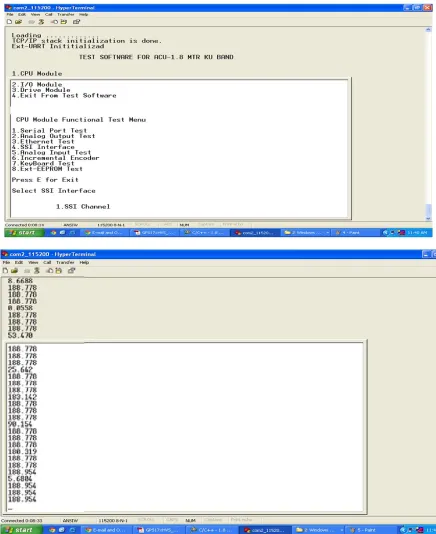
18 bit SSI Encoder is used to get position information of antenna in azimuth and elevation axis. We have designed SSI channel Interface for azimuth axis. Once the user enters 1, SSI Encoder Test is selected and the antenna position is continuously feedback from the encoder. A resolution of 0.005 degree change in antenna position can be seen in figure 4.3.
DAC Test Result
Figure 4.4: DAC output for controlling drive speed
ADC Test
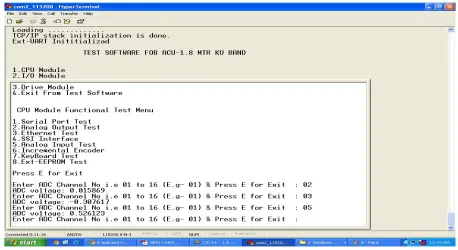
There are 4 Analog signals and these signals are configured as input signals. The range of the analog signal is -10V to +10VDC. Test setup shall generate the all of analog signals and the same shall be verified by the HOST system.
IV. CONCLUSION & FUTURE SCOPE
and elevation. The close loop position control of the antenna is achieved with the help of potentiometer sensors. The degree of freedom in azimuth is 0 deg to 360 deg and the elevation is 0 deg to 90 deg.
REFERENCES
[1] K61 Sub-Family Reference Manual
[2] Paul Horowitz Winfield Hill, The Art of Electronics, Cambridge University Press 1993 [3] KVH Industries. KVH Compass Engine Technical Manual. 2005
[4] Dtn Bone - Delay Tolerant Networking Research Group, http://www.dtnrg.org/wiki/Home.
[5] G. Dias, R. Salles, "Epidemic SIR Model Applied to Delay-Tolerant Networks", 30th BRAZILIAN TELECOMMUNICATIONS SYMPOSIUM (SBrT 2012), Sep. 2012.