ISSN 2286-4822 www.euacademic.org
Impact Factor: 3.1 (UIF) DRJI Value: 5.9 (B+)
Service Quality and Postgraduate Student
Satisfaction: A pilot study
NIGINA KADIROVA LIM LI-CHEN BENJAMIN CHAN-YIN-FAH TEE POH-KIONG
Centre for the Socio-economics of Ageing (CSEA) Asia Pacific University of Technology and Innovation
Kuala Lumpur, Malaysia
Abstract:
The field of service quality continues to be marked by several important research questions including an evaluation of student satisfaction from a service quality perspective. To address such questions, we have conducted a pilot study to assess the relationships between service quality model postulated by Lehtinen and Lehtinen (1991) using a sample of 100 postgraduate students studying at a local private university in Kuala Lumpur, Malaysia. The results suggested that all service quality dimensions are moderately to highly-related to student satisfaction. Future research directions are discussed.
Key words: Service quality, student satisfaction, pilot study
Introduction
improving cost reduction policy and also, reinforcing the permanence of its members (Rebolloso, 1999).
In order to remain competitive for all the successful companies and organisations service quality has become a requirement. Past studies have emphasized the importance of quality enhancement initiatives which have resulted in sustainable competitive advantage in service organisations (Hadikoemoro, 2002; Rapert and Wren, 1998; Stock and Lambert, 1992). Quality refers to a process and its important characteristic is its variability, which evolves gradually and continuously depending on the interaction between the customer and the service (Buzzel & Gale, 1987). Past studies have highlighted the importance of service quality as a very essential research topic because of its evident relationship to costs, profitability, customer satisfaction, customer retention and positive word of mouth. Service quality is widely regarded as a driver of corporate marketing and financial performance (Buttle, 1995).
In a developing country like Malaysia, the shift from agriculture- to knowledge-economy has brought education in all its forms (pre-school, primary school, secondary school, higher education, vocational training, and adult education) into focus. Education has for years been a “commodity” spurning big and small businesses, and now eventually education is a big business (Sohail, Jegatheesan & Nor Azlin, 2003). Moreover, the higher education sector is considered as a global business; therefore all universities must do their best to continuously explore options to expand their higher education services.
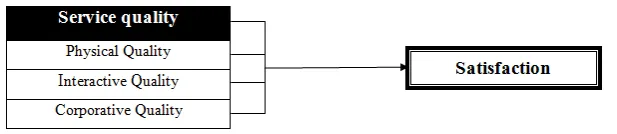
(1991) which concentrates moreon three basic service quality dimensions, mainly: the physical quality (general services, teaching and learning facilities, accommodation); the interactive quality (academic instruction, guidance, interaction with staff and students); and the corporative quality (recognition, reputation and value for money) were used to assess student satisfaction.
Satisfaction
In a competitive higher education sector, where each and every organisation struggle for potential customers, their level of satisfaction on service has become an important differentiator of marketing strategy. These customers will look at the way how a service is supplied by an organisation meets or even delights their expectation which later, contribute to customer satisfaction. Therefore, measuring the customer satisfaction will helps organisation in getting an indication of how successful they actually are in providing products to the market. Oliver (1982) found customer satisfaction is relatively transient and is consumption-specific, whereas attitudes are relatively enduring. Moreover, Westbrook and Oliver (1981) have also argued that customer satisfaction is an evaluation of the totality of the purchase situation relative to expectations, whereas an attitude is a liking for a product or service that lacks the element of comparison. Therefore there was concluded this perspective that the level of satisfaction may vary and depending on the alternatives available to customers (Munteanu and Ceobanu, 2010).
They argued that customer satisfaction determined service quality. In contrast, Cronin and Taylor (1992) argued that service quality is the antecedent of satisfaction. They found, based on empirical research in four different service industries, that satisfaction exerted a stronger and more consistent effect on purchase intentions than service quality, and concluded that customers may not necessarily buy the highest quality service, as convenience, price and availability may enhance satisfaction but not customers’ perception of service quality. Apart from that, student satisfaction is also a key determinant of student loyalty (Webb and Jagun, 1997), and it is student loyalty that encourages positive word-of-mouth on their institution even after their studies.
In a sum, all higher education institutions try to achieve student satisfaction to bring in new customers, as well to reduce numbers of drop out (Tinto, 1993); more likely to achieve higher grades (Bean and Bradley, 1986); engage in positive word-of-mouth and collaborate with the institution after they graduate (Alves and Raposo, 2009).
In an initial attempt to understand the relationship of service quality variables in higher education and if they really influence customer satisfaction, the current study assessed the relationship using service quality model proposed by Lehtinen and Lehtinen (1991). This model has three service quality dimensions which are physical quality, interactive quality and corporative quality. The research framework of this study was illustrated in Figure 1.
Satisfaction and Service Quality
Juran and Godfrey (1988) have defined quality as: (1) “those features of products which meet customer needs and thereby provide customers satisfaction” and (2) “freedom from deficiencies-freedom from errors that require doing work over again (rework) or that results in field failures, customer dissatisfaction, customer claims and so on”. The term “quality in education “has been defined with different meanings by different scholars, such as “excellence in education” (Peters and Waterman, 1982); “value addition in education” (Feigenbaum, 1951); fitness of educational outcome and experience for use” (Juran and Gryna, 1988); “specifications and requirements” (Gilmore, 1974; Crosby, 1979) and “meeting or exceeding customer’s expectations of education” (Parasuraman, Zaithaml and Berry, 1985). Therefore there is not possibility of identifying a single definition of higher education service quality, when it would be more suitable to define higher education service quality based on the criteria that their stakeholders used to judge quality as well to the competing views when assessing the education quality.
The service quality of higher education is very crucial in today’s world with a noticeable trend of increasing competition among universities and higher education institutes to attract the students from across the globe. The competitive pressure that exists in higher education industry today has forced educational institutions to look for alternative strategies. And now, in a highly competitive environment students have become more discriminating and demanding in their choice of university. Therefore it is very crucial and important for each and every institution to understand their expectations.
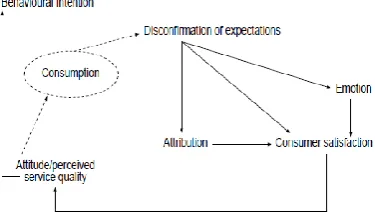
other constructs, the author started by specifying the relationship between consumer satisfaction and perceived quality using a scenario specific to higher education. Figure 2 specifies all the hypothesized links between subjective disconfirmation and consumer satisfaction. Athiyaman in his study explains that a negative disconfirmation arouses feelings such as anger in the student. Similarly a positive disconfirmation arouses pleasant emotions (for example excitement) and confirmation creates non-arousing pleasant emotions (for example contentment). Moreover there was also shown that emotions could be ordered in a bipolar scale using positive emotions on one side of the axis and negative emotions on the other side (Russell and Bullock, 1985).
Figure 1: Athiyaman’s (1997) Conceptual Framework of Consumer Satisfaction and Perceived Service Quality
Satisfaction and Physical Quality
are expected to spend hours every day in a school are likely to have attitudes toward the school system that are strongly influenced by the physical facilities (Wakefield and Blodgett, 1994, p.68).
Still, functional physical facilities in higher education are necessary to facilitate teaching learning process. It comprises: school building, availability of enough rooms, proper lighting and ventilation seating and furniture, provision of pure and safe drinking water, availability of play grounds, laboratories, writing boards, enough washrooms. General cleaning and particularly the cleanliness of classrooms are also considered as necessary issue in order to improve teaching learning process. Environmentally responsive heating, air condition and ventilating systems, either in new provides a more comfortable learning environment. A recent report competed by the council of Educational Facility Planners International documented that “Facility condition may had a stronger effect on student performance than the combined influences of family background, socio-economic status, school attendance, and behaviour” (2000). Hence physical evidence has a strong influence on employee motivations and the quality of the service encounter.
Satisfaction and Interactive Quality
service delivery in order to allow them to commit on the learning process. However the same international higher education related services can be perceived in multiple approaches by students from different countries, as all of them have different values and different backgrounds for becoming involved with international higher education related services.
Satisfaction and Corporative Quality
Corporative quality comprises such aspects as image, recognition and reputation of the educational institution as well as value for money. Institutional image refers to the overall impression made on the customer’s minds about an organisation (Barich and Kotler, 1991). This is related to different behavioural and physical attributes of the organisation, such as business name, architecture, variety of products/ services, tradition, ideology, and to the impression of quality communicated by each person interacting with the organisation’s client. According to Kennedy, 1997, there are two principal components of institutional image, namely functional and emotional. The functional component is related to tangible characteristics that can be easily measured, while the emotional component is associated with psychological dimensions that are manifested by feelings and attitudes towards organisation (Gaston et al., 2011).
1989; Weissman, 1990). Moreover there was found out that the institutions image and reputation may also considerably impact on student’s decision to stay for advanced studies. In other words institutional image and institutional reputation are considered as two distinct but strongly related social entities (Nguyen et al., 2001).
All in all higher education is being driven toward commercial competition and every university tries to build strong image of their institution that will provide them a competitive advantage among other rivals. According to Freeman (1993) this competition is the result of the development of global education market on the one hand, and the reduction of governmental funds that force public organisations to seek other financial sources on the other.
Based on the preceding review of research that drew on service quality dimensions and student satisfaction, we posit the following hypotheses:
H1: Physical quality is positively related to student satisfaction
H2: Interactive quality is positively related to student satisfaction
H3: Corporative quality is positively related to student satisfaction
Methodology
Sample
and only 100 questionnaires were returned to the authors. This yield a response rate of approximately 50 percent.
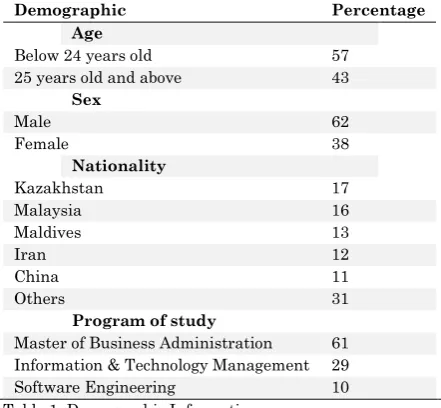
Demographic Percentage
Age
Below 24 years old 57 25 years old and above 43
Sex
Male 62
Female 38
Nationality
Kazakhstan 17
Malaysia 16
Maldives 13
Iran 12
China 11
Others 31
Program of study
Master of Business Administration 61 Information & Technology Management 29 Software Engineering 10 Table 1: Demographic Information
Measures
Control variables. Given their potential effect on service quality assessment, respondent age, sex, nationality and program of study were obtained from the postgraduate students’ personal profile.
Physical quality. Physical quality in this study refers to 3 items adopted by Daniel Jake Beaumont (2012) which was measured using 5-point Likert scale (Strongly Disagree; Disagree; Not Sure; Agree; Strongly Agree) (α=0.728). Items include: “The library resources and services are good enough for my needs”; “I have been able to access general IT resources when I needed to” and “I have been able to access specialised equipment, facilities, or rooms when I needed to”.
using 5-point Likert scale (Strongly Disagree; Disagree; Not Sure; Agree; Strongly Agree) (α=0.733). Items include: “I have received sufficient advice and support with my studies”; “I have been able to contact staff when I needed to” and “Good advice was available when I needed to make study choices”.
Corporative quality. Corporative quality in this study refers to 3 items adopted by Sohail and Shaik (2004) which was measured using 5-point Likert scale (Strongly Disagree; Disagree; Not Sure; Agree; Strongly Agree) (α=0.770). Items include: “Degree from APU improves my employment prospects”; “Degree from APU is well recognized internationally” and “APU had been extensively recommended by my friends in my home country”.
Since each of the dimension’s instruments includes three statements, the minimum composite score for each dimension is three and 15 for max. For analytical purpose, those respondents who scored within the range of 3 to 9 would be categorised as “low level” while those respondents who scored within the range of 9 to 15 would be categorised as “high level”.
Satisfaction. Satisfaction in this study refers to dependent variable adopted by Munteanu, Ceobanu and Anton (2010) and includes only one item which was measured using 7-point Likert Scale (Less Satisfied, Not Dissatisfied, Somehow Dissatisfied, Neutral, Somehow Satisfied, Satisfied, Highly Satisfied).
Results
Descriptive statistics
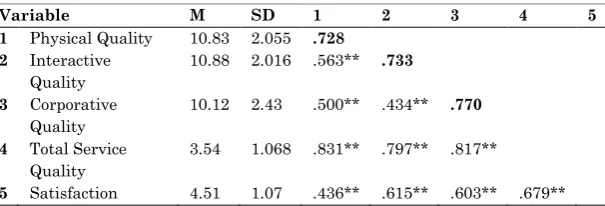
the minimum .70 level recommended by Nunnally (1967). The correlations among the three dimensions of service quality, which ranged from .603 to .434, are similar in magnitude to those found in previous research.
Table 2: Means, Standard Deviation, Cronbach’s alpha values and correlations
Variable M SD 1 2 3 4 5
1 Physical Quality 10.83 2.055 .728 2 Interactive
Quality
10.88 2.016 .563** .733
3 Corporative Quality
10.12 2.43 .500** .434** .770
4 Total Service Quality
3.54 1.068 .831** .797** .817**
5 Satisfaction 4.51 1.07 .436** .615** .603** .679** Note: n =100. Alpha reliability coefficients are in boldface along the diagonal. Correlations ** are significant at p < .01 (two-tailed).
The mean student satisfaction score was 4.51, which can be accepted as high student satisfaction. From table 2, all three dimensions of service quality; physical quality, interactive quality and corporative quality were correlated with student satisfaction (p<001).
Table 3: Multiple regression analyses for Student Satisfaction
Variables Satisfaction
Constant .661
Physical Quality 0.005** Interactive Quality .436 Corporate Quality
Total Service Quality .000**
R-square .517
F 34.312
**p< 0.01
analysis were represented in Table 3. The F statistics for the overall goodness of fit of model is 34.312, which is significant at α = 0.01.
This model explains 52% of the variance in student satisfaction. This indicates that 52% of the dependent variable (satisfaction) was explained by the linear combination of the three-predictor variables. Among the three-predictor variables, interactive quality was found to contribute more significantly towards postgraduate students’ satisfaction. It can be explained by the higher level of service quality of the university the higher level of satisfaction of postgraduate students.
Discussions
The research results of this study may have various theoretical and practical implications. In theoretical perspective although the service quality studies has long tradition in industrial sociology, the meaning of service quality has diversified and such conceptual confusions and inconsistencies may hinder the development and understanding of a clear operational definition of the service quality construct as well as disturb the effective empirical assessment of their organisational impacts. As a solution to the operational definition problem, this paper offers a three service quality dimensions at a higher education institution from general service quality model. After reconceptualising the service quality dimensions among postgraduate students in a private university in Kuala Lumpur, Malaysia, this study empirically tested the construct validity and showed the positive impacts on the student satisfaction of postgraduate students.
quality of the university, it rather can be considered as supplementary dimension that supports the interactive and corporative quality. This can be discussed from a different way. Education for students is perceived as a long process of obtaining the required knowledge, hence this factor obviously necessitate a quality interaction between students and lecturers as well as staff of the university. Interaction here is considered as a support, help or valuable advice that lecturers are obliged to provide in accordance with their profession. However there can be situations when the necessary support or advice is provided by the lecturer but it is still can be considered as an insufficient one by a student due to his or her different levels of perception caused by their cultural background or any other life factors.
Corporative quality of the university is also assessed as very important for students of Malaysia’s private university. It is believed that the image and reputation of the university do influence the future employability of the graduates. Moreover, it is also can be assumed that corporative quality is formed by the feedback and positive or negative word of mouth that graduates can spread among potential students. Furthermore, it can also be said that satisfaction and corporative quality are two interdependent variables. High corporative quality is used as a platform, fundament or expectations for the students by which they can assess it comparing with their own perception. Conversely, corporative quality is somehow dependent on student satisfaction as satisfied student spread a positive word-of-mouth, which demonstrates corporative quality from a better way hence the overall service quality of the university.
Practical Implications
an understanding of what is important to the students is essential requisite for service providers, and this study suggests that particular dimensions of service quality has capability to influence student decisions. This result is in line with the study of Sadiq Sohail, Jegatheesan and Nor Azlin (2003), which suggests that in a highly competitive environment, student have become more discriminating and demanding in their choice of university. Ensuring which dimensions of service quality is important to understand their expectations.
Given the significance of interactive quality in predicting postgraduate student satisfaction, it is important that employed front-line employees especially the academic members and administrators, to be clear with their job responsibilities. It is implied from this study that strong ability to ensure operational efficiency, information accuracy and credibility of service offerings by institution, these will resulted higher level of student satisfaction.
Strength and limitations
Our findings are limited by the use of single-source, cross-sectional data and small sample for this pilot study. We also limited our focus to three dimensions of service quality and a single dimension of student satisfaction. Our findings suggest an important advantage for organisations in using an alternative service quality model to predict and understand student satisfaction, and can be further enhanced in future research with a broader examination of undergraduate students and more items in the service quality dimensions.
Conclusion
satisfaction at the higher education institution. A more complex view of service quality dimensions, how dimensions align with another, will add value to an important area of research on the service quality predictors of student satisfaction and will be helpful to incorporate in future studies.
REFERENCES
Abdullah, Firdaus. "The Development of HEdPERF: A New Measuring Instrument of Service Quality for the Higher Education Sector." International Journal of Consumer Studies: 569-81.
Andreassen, T. and Lindestad, B. “The impact of corporate image on quality, customer satisfaction and loyalty for customers with varying degrees of service expertise”. International Journal of Service Industry Management, 1998, 7-23.
Asubonteng, A., McCleary, KJ. and Swan, J. E. “SERVQUAL revisited: a critical review of service quality. ” The Journal of Services Marketing, 1996, 62-81.
Athuyaman, A. “Linking student satisfaction and service quality perceptions: the case of university education. ” European Journal of Marketing, 1997, 528-540.
Berkley, B. J. & Gupta, A. “Improving service quality with information technology Jnternational. ” Journal of Information Management, 1994, 109-121.
Bitner, M. J, “Evaluating service encounters: the effects of physical surroundings and employee responses”. Journal of Marketing, 1990, 69-82.
Brady, M.K. & Cronin Jr, J. “Some new thoughts on conceptualizing perceived service quality: hierarchical approach. ” Journal of Marketing, 2001, 34-39.
Broderick, A. J. & Vachirapornpuk, S. “Service quality in Internet banking: the importance of customer role”. Marketing Intelligence & Planning, 2002, 327-335. Brogowicz, A. A, Delene, L. M. & Lyth, D. M. “A synthesized
service quality model with managerial implications. ” International Journal of Service Industry Management, 1990, 27-44.
Brown, M. R. & Mazzarol T. M. “The importance of institutional image to student satisfaction and loyalty within higher education.” Higher Education, 2008, 81-95
Buttle, F. “SERVQUAL: review, critique, research agenda”. European Journal of Marketing, 1996, 5-32.
Buzzell, Robert D., and Bradley T. Gale. The PIMS Principles: Linking Strategy to Performance. New York: Free Press, 1987.
Carlson, J. & O’Cass, A. “Exploring the relationship between e-service quality satisfaction, attitudes and behaviours in content-driven e-service web sites”. Journal of Service Marketing, 2010, 112-27.
Cheng, Y. C. & Tarn, M. “Multi-models of quality in education.” Quality Assurance in Education, 1997, 22-31.
Clemes, M. D., Gan, C. E. C. & Kao, T. H. “University student satisfaction: An Emperical Analysis”. Journal of Marketing of Higher Education, 2007, 292-325.
Corneliu, M., Ciprian, C., Claudia, B., & Oana, A. “An analysis of customer satisfaction in a higher education context.” International Journal of Public Sector Management, 2010.
Cronin, J. J. and Taylor, S. A. “Measuring service quality: a re-examination and extension”. Journal of Marketing, 1992, 55-68.
Cronin, J., Braddy, M. and Hult, G. “Assessing the effect of quality, value and customer satisfaction on consumer behavioural intentions in service environments”. Journal of Retailing, 2000, 193-218.
Crosby, Philip B. Quality Is Free: The Art of Making Quality Certain. New York: McGraw-Hill, 1979.
Dabholkar, P. A., Shepherd, C. D. & Thorpe, D.I. “A comprehensive framework for service quality: an investigation of critical conceptual and measurement issues through a longitudinal study”. Journal of Retailing, 2000, 131-139.
Dabholkar, P.A. “Consumer evaluations of new technology-based self-service operations: an investigation of alternative models”. International Journal of Research in Marketing, 1996, 29-51.
Dichter, E. "What's in an image.” The Journal of Consumer Marketing, 1985, 75-81.
Eskildsen, J., Kristensen, K., Juhl, H. J. and Ostergaard, P. “The drivers of customer satisfaction and loyalty: the case of Denmark 2000-2002”. Total Quality Management, 2004, 859-68.
Fornell, C. “A national customer satisfaction barometer: the Swedish experience”. Journal of Marketing, 1992, 6-21. Fornell, C., Johnson, M. D., Anderson, E. W., Cha, J. and
Bryant, B. E. (1996). “The American customer satisfaction index: nature, purpose and findings”. Journal of Marketing, 1996, 7-18.
Freeman, Richard. Quality Assurance in Training and Education: How to Apply BS5750 (ISO 9000) Standards. London: Kogan Page, 1993.
Service Organisation." Journal of Services Marketing: 358-77.
Frost, Frederick A., and Mukesh Kumar. "Service Quality Between Internal Customers And Internal Suppliers In An International Airline." International Journal of Quality & Reliability Management, 2001, 371-86.
Gounaris, S., Dimitriadis, S. and Stathakopoulos, V. “An examination of the effects of service quality and satisfaction on customers’ behavioural intentions in e-shopping”. Journal of Services Marketing, 2010, 142-56. Grönroos, Christian. "A Service Quality Model And Its
Marketing Implications." European Journal of Marketing: 36-44.
Haywood-Farmer, John. "A Conceptual Model Of Service Quality." International Journal of Operations & Production Management: 19-29.
Herbig, Paul, John Milewicz, and Jim Golden. "A Model of Reputation Building and Destruction." Journal of Business Research: 23-31.
Hill, Yvonne, Laurie Lomas, and Janet Macgregor. "Students’ Perceptions of Quality in Higher Education." Quality Assurance in Education: 15-20.
Johnson, Michael D., Anders Gustafsson, Tor Wallin Andreassen, Line Lervik, and Jaesung Cha. "The Evolution and Future of National Customer Satisfaction Index Models." Journal of Economic Psychology, 2001, 217-45.
Joseph, Mathew, and Beatriz Joseph. "Service Quality in Education: A Student Perspective." Quality Assurance in Education, 1997, 15-21.
Juran, J. M. Juran on Planning for Quality. New York: Free Press ;, 1988.
Kotler, Philip, and Karen F. A. Fox. Strategic Marketing for Educational Institutions. Englewood Cliffs, N.J.: Prentice-Hall, 1985.
Leblanc, Gaston, and Nha Nguyen. "Searching for Excellence in Business Education: An Exploratory Study of Customer Impressions of Service Quality." International Journal of Educational Management: 72-79.
Nunnally, Jum Clarence. Psychometric Theory. New York: McGraw-Hill, 1967.
Oldfield, Brenda M., and Steve Baron. "Student Perceptions of Service Quality in a UK University Business and Management Faculty." Quality Assurance in Education, 2000, 85-95.
Oliver, R. L. “Measurement and evaluation of satisfaction process in retail setting”. Journal of Retailing, 1981, 25-48.
Parasuraman, A., Zeithaml, V. A. and Berry, L. L. (1988). “SERVQUAL: a multiple-item scale for measuring consumer perception of service quality”. Journal of Retailing, 1988, 12-37.
Parasuraman, A., Zeithaml, V. and Berry, L, “A conceptual model of service quality and its implications for future research”, Journal of Marketing, 1985, 41-50.
Pereda, Maria. "Service Quality in Higher Education: The Experience of Overseas Students." The Journal of Hospitality Leisure Sport and Tourism, 2007, 55-67. Peters, M. & Roberts, P. “Globalization and the Crisis in the
Concept of the Modern University. Australian Universities Review”. 42(1), 1999, 35-41.
Peters, Thomas J., and Robert H. Waterman. In Search of Excellence: Lessons from America's Best-run Companies. New York: Harper & Row, 1982.
Journal of Quality & Reliability Management, 1997, 260-286.
Russel, J. and Bullock, M. “Multidimensional scaling of emotional facial expressions: Similarity from pre-schoolers to adults”. Journal of Personality and Social Psychology, 1985, 1290-8.
Russell, M. “Marketing education: a review of service quality perceptions among international students”. International Journal of Contemporary Hospitality Management, 2005, 65-77.
Sohail, M. Sadiq, Jegatheesan Rajadurai, and Nor Azlin Abdul Rahman. "Managing Quality in Higher Education: A Malaysian Case Study." International Journal of Educational Management, 2003, 141-46.
Sohail, S. and Shaikh, N.M “Quest for excellence in business education: a study of student impression of service quality”, The International Journal of Educational Management, 2004, 58-65.
Sohail, S., Rajadurai, J. and Abdul Rahaman, N “Managing quality in higher education: A Malaysian case study”. The international journal of Educational Management, 2003, 17 (4).
Tinto, V. “Leaving College: Rethinking the Cause and Cures of Student Attrition, University of Chicago Press, Chicago, IL, 1993.
Vauterin, Johanna Julia, Lassi Linnanen, and Esa Marttila. "Issues of Delivering Quality Customer Service in a Higher Education Environment." International Journal of Quality and Service Sciences, 2011, 181-98.
Wakefield, K.L., and Blodgett, J.G. (1994). “The importance of servicescapes in leisure service settings”. Journal of Services Marketing, 1994, 66-76.
Satisfaction, Dissatisfaction and Complaining Behaviour, 1997, 139-151.