Design and Development of a New Decentralized Access
Control Scheme for Data Storage Security & Anonymous
Authentication in Cloud
Ashaboina Nagender
1; Ms.Ch. Srilakshmi
2& Prof.Dr.G.Manoj Someswar
31
M.Tech.(CSE) from Narasimha Reddy Engineering College, Affiliated to JNTUH, Hyderabad, Telangana,
India
2
M.Tech. (CSE), (Ph.D), Associate Professor, Department of CSE, Narasimha Reddy Engineering College,
Affiliated to JNTUH, Hyderabad, Telangana, India
3
B.Tech., M.S.(USA), M.C.A., Ph.D., Principal & Professor, Department Of CSE, Anwar-ul-uloom College
of Engineering & Technology, Affiliated to JNTUH, Vikarabad, Telangana, India
ABSTRACT:
We propose a new decentralized access control scheme for secure data storage in clouds that
supports anonymous authentication. In the proposed scheme, the cloud verifies the authenticity of the series
without knowing the user’s identity before storing data. Our scheme also has the added feature of access
control in which only valid users are able to decrypt the stored information. The scheme prevents replay
attacks and supports creation, modification and reading data stored in the cloud. We also address user
revocation. Moreover, our authentication and access control scheme is decentralized and robust, unlike
other access control schemes designed for clouds which are centralized. The communication, computation,
and storage overheads are comparable to centralized approaches.
Keywords:
Decentralized Access Control Scheme; Broad Network Access; Resource Pooling; Attribute
Based Encryption; Anonymous Authentication; Cryptographic Cloud Storage
INTRODUCTION
Cloud computing is the use of computing resources (hardware and software) that are delivered as a service over a network (typically the Internet). The name comes from the common use of a cloud-shaped symbol as an abstraction for the complex infrastructure it contains in system diagrams. Cloud computing entrusts remote services with a user's data, software and computation. Cloud computing consists of hardware and software resources made available on the Internet as managed third-party services. These services typically provide access to advanced software applications and high-end networks of server
The goal of cloud computing is to apply traditional supercomputing, or high-performance computing power, normally used by military and research facilities, to perform tens of trillions of computations per second, in consumer-oriented applications such as financial portfolios, to deliver personalized information, to provide data storage or to power large, immersive computer games.
The cloud computing uses networks of large groups of servers typically running low-cost consumer PC technology with specialized connections to spread
data-processing chores across them. This
shared IT infrastructure contains large pools of systems that are linked together. Often, virtualization techniques are used to maximize the power of cloud computing.
Characteristics and Services Models
The salient characteristics of cloud computing based on the definitions provided by the National Institute of Standards and Terminology (NIST) are outlined below:
On-demand self-service: A consumer can unilaterally provision computing capabilities, such as server time and network storage, as needed automatically without requiring human interaction with each service’s provider.[1] Broad network access: Capabilities are
available over the network and accessed through standard mechanisms that promote use by heterogeneous thin or thick client platforms (e.g., mobile phones, laptops, and PDAs). Resource pooling: The provider’s computing
resources are pooled to serve multiple consumers using a multi-tenant model, with different physical and virtual resources dynamically assigned and reassigned according to consumer demand. There is a sense of location-independence in that the customer generally has no control or knowledge over the
exact location of the provided resources but may be able to specify location at a higher level of abstraction (e.g., country, state, or data center).[2] Examples of resources include storage, processing, memory, network bandwidth, and virtual machines.
Rapid elasticity: Capabilities can be rapidly and elastically provisioned, in some cases automatically, to quickly scale out and rapidly released to quickly scale in. To the consumer, the capabilities available for provisioning often appear to be unlimited and can be purchased in any quantity at any time.
Measured service: Cloud systems automatically control and optimize resource use by leveraging a metering capability at some level of abstraction appropriate to the type of service (e.g., storage, processing, bandwidth, and active user accounts). Resource usage can be managed, controlled, and reported providing transparency for both the provider and consumer of the utilized service. [3]
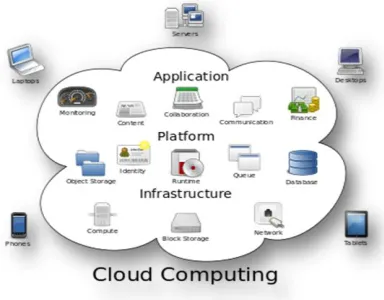
Figure 2: Characteristics of cloud computing
Services Models
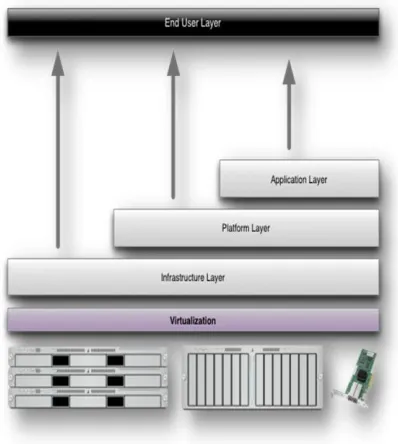
Cloud Computing comprises three different service models, namely Infrastructure-as-a-Service (IaaS), Platform-as-a-Service (PaaS), and Software-as-a-Service (SaaS). The three service models or layer are completed by an end user layer that encapsulates the end user perspective on cloud services. The model is shown in figure below. If a cloud user accesses services on the infrastructure layer, for instance, she can run her own applications on the resources of a cloud infrastructure and remain responsible for the support, maintenance, and security of these applications herself. If she accesses a service on the application layer, these tasks are normally taken care of by the cloud service provider.
Figure 3: Structure of service models
Benefits of cloud computing:
1. Achieve economies of scale – increase volume output or productivity with fewer people. Your cost per unit, project or product plummets.[4]
2. Reduce spending on technology infrastructure. Maintain easy access to your information with minimal upfront spending. Pay as you go (weekly, quarterly or yearly), based on demand. [5]
3. Globalize your workforce on the cheap.
People worldwide can access the cloud, provided they have an Internet connection. 4. Streamline processes. Get more work done in
less time with less people.
5. Reduce capital costs. There’s no need to spend
big money on hardware, software or licensing fees.
6. Improve accessibility. You have access anytime, anywhere, making your life so much easier! [6]
7. Monitor projects more effectively. Stay within budget and ahead of completion cycle times.
8. Less personnel training is needed. It takes fewer people to do more work on a cloud, with a minimal learning curve on hardware and software issues.
9. Minimize licensing new software. Stretch and grow without the need to buy expensive software licenses or programs. [7]
10. Improve flexibility. You can change direction without serious “people” or “financial” issues at stake.
Advantages:
1. Price: Pay for only the resources used.
2. Security: Cloud instances are isolated in the network from other instances for improved security.
3. Performance: Instances can be added instantly for improved performance. Clients have access to the total resources of the Cloud’s core hardware.
5. Uptime: Uses multiple servers for maximum redundancies. In case of server failure, instances can be automatically created on another server.
6. Control: Able to login from any location. Server snapshot and a software library lets you deploy custom instances.
7. Traffic: Deals with spike in traffic with quick deployment of additional instances to handle the load.
LITERATURE SURVEY
“Privacy Preserving Access Control with Authentication for Securing Data in Clouds,”
In this paper, we propose a new privacy preserving authenticated access control scheme for securing data in clouds. In the proposed scheme, the cloud verifies the authenticity of the user without knowing the user's identity before storing information. Our scheme also has the added feature of access control in which only valid users are able to decrypt the stored information.[8] The scheme prevents replay attacks and supports creation, modification, and reading data stored in the cloud. Moreover, our authentication and access control scheme is decentralized and robust, unlike other access control schemes designed for clouds which are centralized. The communication, computation, and storage overheads are comparable to centralized approaches.
“Toward Secure and Dependable Storage Services in Cloud Computing”
Cloud storage enables users to remotely store their data and enjoy the on-demand high quality cloud applications without the burden of local hardware and software management. Though the benefits are clear, such a service is also relinquishing users' physical possession of their outsourced data, which inevitably poses new security risks toward the correctness of the data in cloud. In order to address this new problem and further achieve a secure and dependable cloud storage service, we propose in this paper a flexible distributed storage integrity auditing mechanism, utilizing the
homomorphic token and distributed erasure-coded data. The proposed design allows users to audit the cloud storage with very lightweight communication and computation cost. The auditing result not only ensures strong cloud storage correctness guarantee, but also simultaneously achieves fast data error localization, i.e., the identification of misbehaving server. Considering the cloud data are dynamic in nature, the proposed design further supports secure and efficient dynamic operations on outsourced data, including block modification, deletion, and append. Analysis shows the proposed scheme is highly efficient and resilient against Byzantine failure, malicious data modification attack, and even server colluding attacks.[9]
“Cryptographic Cloud Storage,”
We consider the problem of building a secure cloud storage service on top of a public cloud infrastructure where the service provider is not completely trusted by the customer. We describe, at a high level, several architectures that combine recent and non-standard cryptographic primitives in order to achieve our goal. We survey the benefits such an architecture would provide to both customers and service providers and give an overview of recent advances in cryptography motivated specifically by cloud storage.[10]
“Identity-Based Authentication for Cloud Computing,”
the authentication protocol is more lightweight and efficient than SAP, specially the more lightweight user side. Such merit of our model with great scalability is very suited to the massive-scale cloud.[11]
“Improving Privacy and Security in Multi-Authority Attribute-Based Encryption,”
Attribute based encryption (ABE) [13] determines decryption ability based on a user's attributes. In a multi-authority ABE scheme, multiple attribute-authorities monitor different sets of attributes and issue corresponding decryption keys to users, and encryptors can require that a user obtain keys for appropriate attributes from each authority before decrypting a message. Chase [5] gave a multi-authority ABE scheme using the concepts of a trusted central authority (CA) and global identifiers (GID). However, the CA in that construction has the power to decrypt every ciphertext, which seems somehow contradictory to the original goal of distributing control over many potentially untrusted authorities. Moreover, in that construction, the use of a consistent GID allowed the authorities to combine their information to build a full profile with all of a user's attributes, which unnecessarily compromises the privacy of the user. In this paper, we propose a solution which removes the trusted central authority, and protects the users' privacy by preventing the authorities from pooling their information on particular users, thus making ABE more usable in practice.[12]
SYSTEM ANALYSIS EXISTING SYSTEM
Existing work on access control in cloud are centralized in nature. Except and, all other schemes use ABE. The scheme in uses a symmetric key approach and does not support authentication. The schemes do not support authentication as well.[13]
It provides privacy preserving authenticated access control in cloud. However, the authors take a centralized approach where a single key
distribution center (KDC) distributes secret keys and attributes to all users. [14]
DISADVANTAGES OF EXISTING SYSTEM
The scheme in uses asymmetric key approach and does not support authentication.
Difficult to maintain because of the large number of users that are supported in a cloud environment.
PROPOSED SYSTEM
We propose a new decentralized access control scheme for secure data storage in clouds that supports anonymous authentication.
In the proposed scheme, the cloud verifies the authenticity of the series without knowing the user’s identity before storing data.
Our scheme also has the added feature of access control in which only valid users are able to decrypt the stored information.
The scheme prevents replay attacks and supports creation, modification, and reading data stored in the cloud.
ADVANTAGES OF PROPOSED SYSTEM
Distributed access control of data stored in cloud so that only authorized users with valid attributes can access them.
Authentication of users who store and modify their data on the cloud.
SYSTEM DESIGN
SYSTEM ARCHITECTURE
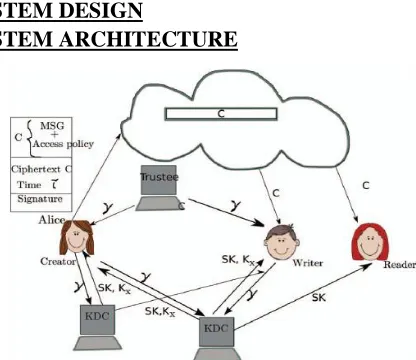
Figure 1: System Architecture
DATA FLOW DIAGRAM
1. The DFD is also called as bubble chart. It is a simple graphical formalism that can be used to represent a system in terms of input data to the system, various processing carried out on this data, and the output data is generated by this system.
2. The data flow diagram (DFD) is one of the most important modeling tools. It is used to model the system components. These components are the system process, the data used by the process, an external entity that interacts with the system and the information flows in the system.
3. DFD shows how the information moves through the system and how it is modified by a series of transformations. It is a graphical technique that depicts information flow and the transformations that are applied as data moves from input to output.
4. DFD is also known as bubble chart. A DFD may be used to represent a system at any level of abstraction. DFD may be partitioned into levels that represent increasing information flow and functional detail.
Admin
END View File
User details Name
Cloud Storage
User Login
Login
Condition
True False
Attrribute Analysis Trustee
User Activation Secret Key
Creator Reader Writer
Owner File Upload
Response from KDC Request to KDC
Key Received
File read Modify Owner File
Figure 2: Data Flow Diagram UML DIAGRAMS
UML stands for Unified Modeling Language. UML is a standardized general-purpose modeling language in the field of object-oriented software engineering. The standard is managed, and was created by, the Object Management Group.
The goal is for UML to become a common language for creating models of object oriented computer software. In its current form UML is comprised of two major components: a Meta-model and a notation. In the future, some form of method or process may also be added to; or associated with, UML. The Unified Modeling Language is a standard language for specifying, Visualization, Constructing and documenting the artifacts of software system, as well as for business modeling and other non-software systems.
The UML represents a collection of best engineering practices that have proven successful in the modeling of large and complex systems.
The UML is a very important part of developing objects oriented software and the software development process. The UML uses mostly graphical notations to express the design of software projects.
GOALS:
1. Provide users a ready-to-use, expressive visual modeling Language so that they can develop and exchange meaningful models.
2. Provide extendibility and specialization mechanisms to extend the core concepts. 3. Be independent of particular programming
languages and development process.
4. Provide a formal basis for understanding the modeling language.
5. Encourage the growth of OO tools market. 6. Support higher level development concepts
such as collaborations, frameworks, patterns and components.
7. Integrate best practices.
USE CASE DIAGRAM
A use case diagram in the Unified Modeling Language (UML) is a type of behavioral diagram defined by and created from a Use-case analysis. Its purpose is to present a graphical overview of the functionality provided by a system in terms of actors, their goals (represented as use cases), and any dependencies between those use cases. The main purpose of a use case diagram is to show what system functions are performed for which actor. Roles of the actors in the system can be depicted.
Trustee
USER
KDC
Secret Key
Attribute Validation
User Activation
Trust Key Generation
Writer Reader Creator
Figure 3: Use Case Diagram
CLASS DIAGRAM
In software engineering, a class diagram in the Unified Modeling Language (UML) is a type of static structure diagram that describes the structure of a system by showing the system's classes, their attributes, operations (or methods), and the relationships among the classes. It explains which class contains information.
USER File_ID;
Creator() Reader() Modify()
TRUSTEE USER_ID;
AttributeValidation() KeyFormation() KDC
Random_Value; User_ID;
KeyGeneration() Response()
Figure 4: Class Diagram
SEQUENCE DIAGRAM
KDC Trustee User
Key Generation
Response
Key Formation Attrribute Vaidation
Reader
Writer Creator
Figure 5: Sequence Diagram ACTIVITY DIAGRAM
Activity diagrams are graphical representations of workflows of stepwise activities and actions with support for choice, iteration and concurrency. In the Unified Modeling Language, activity diagrams can be used to describe the business and operational step-by-step workflows of components in a system. An activity diagram shows the overall flow of control.
Admin
View File
User details Name
Cloud Storage
User Login
Login
Condition
True False
Attrribute Analysis Trustee
User Activation Secret Key
Creator Reader Writer
Owner File Upload
Response from KDC Request to KDC
Key Received
File read Modify Owner File
`
Figure 6: Activity Diagram
INPUT DESIGN
The input design is the link between the information system and the user. It comprises the developing specification and procedures for data preparation and those steps are necessary to put transaction data in to a usable form for processing can be achieved by inspecting the computer to read data from a written or printed document or it can occur by having people keying the data directly into the system. The design of input focuses on controlling the amount of input required, controlling the errors, avoiding delay, avoiding extra steps and keeping the process simple. The input is designed in such a way so that it provides security and ease of use with retaining the privacy. Input Design considered the following things:
What data should be given as input?
How the data should be arranged or coded?
The dialog to guide the operating personnel in providing input.
Methods for preparing input validations and steps to follow when error occur.
OBJECTIVES
1. Input Design is the process of converting a user-oriented description of the input into a computer-based system. This design is important to avoid errors in the data input process and show the correct direction to the management for getting correct information from the computerized system.
OUTPUT DESIGN
A quality output is one, which meets the requirements of the end user and presents the information clearly. In any system results of processing are communicated to the users and to other system through outputs. In output design it is determined how the information is to be displaced for immediate need and also the hard copy output. It is the most important and direct source information to the user. Efficient and intelligent output design improves the system’s relationship to help user decision-making.
1. Designing computer output should proceed in an organized, well thought out manner; the right output must be developed while ensuring that each output element is designed so that people will find the system can use easily and effectively. When analysis design computer output, they should Identify the specific output that is needed to meet the requirements.
2. Select methods for presenting information.
3. Create document, report, or other formats that contain information produced by the system.
The output form of an information system should accomplish one or more of the following objectives.
Convey information about past activities, current status or projections of the
Future.
Signal important events, opportunities, problems, or warnings.
Trigger an action.
Confirm an action.
IMPLEMENTATION MODULES:
System Initialization.
User Registration.
KDC setup.
Attribute generation.
Sign.
Verify.
MODULES DESCRIPTION:
System Initialization:
Select a prime q, and groups G1 and G2, which are of order q. We define the mapping ˆe : G1 ×G1 → G2. Let g1, g2 be generators of G1 and hj be generators of G2, for j ∈ [tmax], for arbitrary tmax. Let H be a hash function. Let A0 = ha0 0 , where a0 ∈ Z∗ q is chosen at random. (TSig,TV er) mean TSig is the private key with which a message is signed and TV er is the public key used for verification. The secret key for the trustee is TSK = (a0, TSig) and public key is TPK = (G1,G2,H, g1,A0, h0, h1, . . . , htmax, g2, TV er).
User Registration:
For a user with identity Uu the KDC draws at random Kbase ∈ G. Let K0 = K1/a0 base . The following token γ is output γ = (u,Kbase,K0, ρ), where ρ is signature on u||Kbase using the signing key TSig.
KDC setup:
We emphasize that clouds should take a decentralized approach while distributing secret keys and attributes to users. It is also quite natural for clouds to have many KDCs in different locations in the world. The architecture is decentralized, meaning that there can be several KDCs for key management.
Attribute generation
The token verification algorithm verifies the signature contained in γ using the signature verification key TV er in TPK. This algorithm extracts Kbase from γ using (a, b) from ASK[i] and computes Kx = K1/(a+bx) base , x ∈ J[i, u]. The key Kx can be checked
for consistency using algorithm
ABS.KeyCheck(TPK,APK[i], γ,Kx), which checks ˆe(Kx,AijBx ij) = ˆe(Kbase, hj), for all x ∈ J[i, u] and j
∈ [tmax].
Sign:
a reader wants to read, the cloud sends C. If the user has attributes matching with access policy, it can decrypt and get back original message.
Verify:
The verification process to the cloud, it relieves the individual users from time consuming verifications. When a reader wants to read some data stored in the cloud, it tries to decrypt it using the secret keys it receives from the KDCs.
SYSTEM TESTING
The purpose of testing is to discover errors. Testing is the process of trying to discover every conceivable fault or weakness in a work product. It provides a way to check the functionality of components, sub assemblies, assemblies and/or a finished product It is the process of exercising software with the intent of ensuring that the software system meets its requirements and user expectations and does not fail in an unacceptable manner. There are various types of test. Each test type addresses a specific testing requirement.
TYPES OF TESTS Unit testing
Unit testing involves the design of test cases that validate that the internal program logic is functioning properly, and that program inputs produce valid outputs. All decision branches and internal code flow should be validated. It is the testing of individual software units of the application .it is done after the completion of an individual unit before integration. This is a structural testing, that relies on knowledge of its construction and is invasive. Unit tests perform basic tests at component level and test a specific business process, application, and/or system configuration. Unit tests ensure that each unique path of a business process performs accurately to the documented specifications and contains clearly defined inputs and expected results.
Integration testing
Integration tests are designed to test integrated software components to determine if they actually run
as one program.[15] Testing is event driven and is more concerned with the basic outcome of screens or fields. Integration tests demonstrate that although the components were individually satisfaction, as shown by successfully unit testing, the combination of components is correct and consistent. Integration testing is specifically aimed at exposing the problems that arise from the combination of components.
Functional test
Functional tests provide systematic demonstrations that functions tested are available as specified by the business and technical requirements, system documentation, and user manuals.
Functional testing is centered on the following items: Valid Input : identified classes of valid input must be accepted.
Invalid Input : identified classes of invalid input must be rejected.
Functions : identified functions must be exercised.
Output : identified classes of application outputs must be exercised.
Systems/Procedures: interfacing systems or procedures must be invoked.
Organization and preparation of functional tests is focused on requirements, key functions, or special test cases. In addition, systematic coverage pertaining to identify Business process flows; data fields, predefined processes, and successive processes must be considered for testing. Before functional testing is complete, additional tests are identified and the effective value of current tests is determined.
System Test
White Box Testing
White Box Testing is a testing in which in which the software tester has knowledge of the inner workings, structure and language of the software, or at least its purpose. It is purpose. It is used to test areas that cannot be reached from a black box level.
Black Box Testing
Black Box Testing is testing the software without any knowledge of the inner workings, structure or language of the module being tested. Black box tests, as most other kinds of tests, must be written from a definitive source document, such as specification or requirements document, such as specification or requirements document. It is a testing in which the software under test is treated, as a black box .you cannot “see” into it. The test provides inputs and responds to outputs without considering how the software works.
Unit Testing
Unit testing is usually conducted as part of a combined code and unit test phase of the software lifecycle, although it is not uncommon for coding and unit testing to be conducted as two distinct phases.
Test strategy and approach
Field testing will be performed manually and functional tests will be written in detail.
Test objectives
All field entries must work properly.
Pages must be activated from the identified link.
The entry screen, messages and responses must not be delayed.
Features to be tested
Verify that the entries are of the correct format No duplicate entries should be allowed
All links should take the user to the correct page.
Integration Testing
Software integration testing is the incremental integration testing of two or more integrated software
components on a single platform to produce failures caused by interface defects.
The task of the integration test is to check that components or software applications, e.g. components in a software system or – one step up – software applications at the company level – interact without error.
Test Results: All the test cases mentioned above passed successfully. No defects encountered.
Acceptance Testing
User Acceptance Testing is a critical phase of any project and requires significant participation by the end user. It also ensures that the system meets the functional requirements.
Test Results: All the test cases mentioned above passed successfully. No defects encountered.
RESULTS & CONCLUSION
We have presented a decentralized access control technique with anonymous authentication, which provides user revocation and prevents replay attacks. The cloud does not know the identity of the user who stores information, but only verifies the user’s credentials. Key distribution is done in a decentralized way. One limitation is that the cloud knows the access policy for each record stored in the cloud. In future, we would like to hide the attributes and access policy of a user.
REFERENCES
[1] S. Ruj, M. Stojmenovic, and A. Nayak, “Privacy Preserving Access Control with Authentication for Securing Data in Clouds,” Proc. IEEE/ACM Int’l Symp. Cluster, Cloud and Grid Computing, pp. 556-563, 2012.
[2] C. Wang, Q. Wang, K. Ren, N. Cao, and W. Lou, “Toward Secure and Dependable Storage Services in Cloud Computing,” IEEE Trans. Services Computing, vol. 5, no. 2, pp. 220-232, Apr.- June 2012.
Cloud Computing,” Proc. IEEE INFOCOM, pp. 441-445, 2010.
[4] S. Kamara and K. Lauter, “Cryptographic Cloud Storage,” Proc. 14th Int’l Conf. Financial Cryptography and Data Security, pp. 136- 149, 2010.
[5] H. Li, Y. Dai, L. Tian, and H. Yang, “Identity-Based Authentication for Cloud Computing,” Proc. First Int’l Conf. Cloud Computing (CloudCom), pp. 157-166, 2009.
[6] C. Gentry, “A Fully Homomorphic Encryption Scheme,” PhD dissertation,
Stanford Univ., http://www.crypto.stanford.edu/ craig, 2009.
[7] A.-R. Sadeghi, T. Schneider, and M. Winandy, “Token-Based Cloud Computing,” Proc. Third Int’l Conf. Trust and Trustworthy Computing (TRUST), pp. 417-429, 2010.
[8] R.K.L. Ko, P. Jagadpramana, M. Mowbray, S. Pearson, M. Kirchberg, Q. Liang, and B.S. Lee, “Trustcloud: A Framework for Accountability and Trust in Cloud Computing,” HP Technical Report HPL- 2011-38,http://www.hpl.hp.com/techreports/2011/HPL-2011-38.html, 2013.
[9] R. Lu, X. Lin, X. Liang, and X. Shen, “Secure Provenance: The Essential of Bread and Butter of Data Forensics in Cloud Computing,” Proc. Fifth ACM Symp. Information, Computer and Comm. Security (ASIACCS), pp. 282-292, 2010.
[10] D.F. Ferraiolo and D.R. Kuhn, “Role-Based Access Controls,” Proc. 15th Nat’l Computer Security Conf., 1992.
[11] D.R. Kuhn, E.J. Coyne, and T.R. Weil, “Adding Attributes to Role-Based Access Control,” IEEE Computer, vol. 43, no. 6, pp. 79-81, June 2010.
[12] M. Li, S. Yu, K. Ren, and W. Lou, “Securing Personal Health Records in Cloud Computing: Patient-Centric and Fine-Grained Data Access Control in Multi-Owner Settings,” Proc. Sixth Int’l ICST Conf. Security and Privacy in Comm. Networks (SecureComm), pp. 89-106, 2010.
[13] S. Yu, C. Wang, K. Ren, and W. Lou, “Attribute Based Data Sharing with Attribute Revocation,” Proc. ACM Symp. Information, Computer and Comm. Security (ASIACCS), pp. 261-270, 2010.
[14] G. Wang, Q. Liu, and J. Wu, “Hierarchical Attribute-Based Encryption for Fine-Grained Access Control in Cloud Storage Services,” Proc. 17th ACM Conf. Computer and Comm. Security (CCS), pp. 735-737, 2010.