IJEDR1702084 International Journal of Engineering Development and Research (www.ijedr.org) 477
A Study of Energy Efficient Routing Protocols in
Mobile Ad hoc Networks (MANETs)
1
Aamir Hasan,
2Deepak KumarXaxa,
3Devendra Kumar
1M.Tech. Scholar, 2Assistant Professor, 3M.Tech. 1CSE Depart ment,
1School of Engg. & IT, MATS University, Gullu-Aarang Ca mpus, Ra ipur (C.G.), India.
_________________________________________________________________________________________ _______________
Abstract- Mobile Ad Hoc ne twork is abbre viate d as MANET whic h c onsists of large number of nodes which are movi ng ar bitr arily in any direction in which nodes allow to e xchange infor mati on wi thout any special infr astructure . There are many research issues in MANET and one of the most i mportant issues is the efficient utilization of battery power or energy during routing pr ocess. There are lot of work has bee n done in this field and some of the m are pr oposed wi th good appr oaches. In this paper , a study is presente d regar ding e nergy e fficient r outing pr otoc ols which re duces the ener gy consumption of mobile nodes and increases the life ti me of batter y and there by enhance the life of network.
Index Terms - Mobile Ad hoc Networks, Routing Protoc ols, Energy Efficiency, Re vie w ,Sur ve y .
________________________________________________________________________________________________________
I. IN TRO DUC TION
A Recently extensive work has been done in integrating mobile hosts and mobile networking hardware and they are used into traditional networks such as Internet [1, 2]. So metimes, mobile users will want to co mmunicate in situations in wh ich no fixed wired infrastructure such as this is available, either because it may not be economically practical or physic ally possible. For these purposes , a mobile user needs wire less infrastructure less ad hoc networks in particular wire less applications like military operation, emergency operations etc..
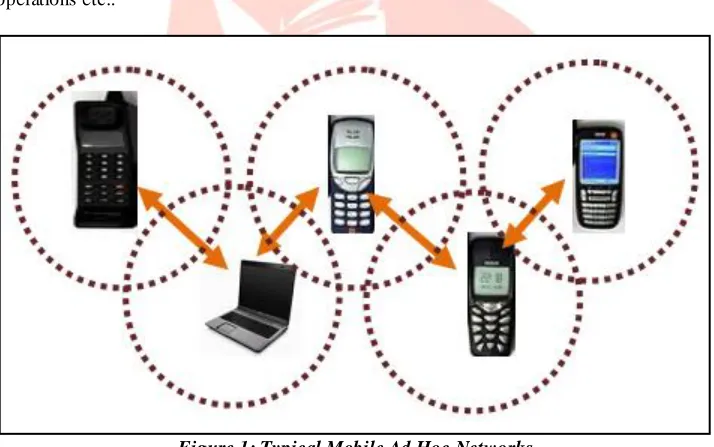
Figure 1: Typical Mobile Ad Hoc Networks
The Figure 1 depicts the overview of the mobile ad hoc network. The nodes involved in ad hoc networks have a limited lifetime, so power availability is one of the important constraints for the operation of the ad hoc network. There are diff erent sources of power or energy [2, 3, 4] consumption in a mob ile ad hoc network.
IJEDR1702084 International Journal of Engineering Development and Research (www.ijedr.org) 478
II. CHALLENGES IN MANETS
Although MANET is applicable in many areas, but researchers need to s tudy their challenges carefully before its wide comme rcia l deploy ment. Fo llo wing are the challenges involved in MANETs [5,6]:
A. Routing:
The issue of routing packets among any source destination pair of nodes in ad hoc network becomes challenges task due to constant changes in network topology. MANET fo llo ws main ly reactive and proactive type of routing protocols. Another issue may be with mult i-cast routing protocols because multi-cast tree is no longer static due to the random movement of nodes within the network.
B. Security and Reliability:
Security is another issue with such kind of networks due to nasty neighbor relaying packets. Furthermo re wire less link distinctiveness commence also reliab ility proble ms due to the restricted wireless transmission range, hidden termina l problem, mobility-induced packet losses, and data transmission errors.
C. Quality of Service (QoS):
Due to constantly changing environment quality of service (QoS) is also the challenging issue. The inherent stochastic fe ature of co mmunicat ions quality in a MA NET makes it difficult to offer fixed guarantees on the services offered to a device. A fle xib le QoS issue must be resolved over the traditional resource reservation to support the multim edia services.
D. Inter-networking:
Inter-networking issue between MANET and fixed networks (ma inly IP based) is often expected in many cases. The coexistence of routing protocols in such a mobile network is a challenge for the harmonious mobility supe rvision.
E. Power Consumption:
Power consumption issue must be considered for the mobile nodes participating in a network which do communication rela ted functions. The routing must be power aware routing and mobile nodes must conserve the power.
F. Energy Efficiency
Mobile Ad hoc networks are energy constrained since nodes operate with limited energy or battery. There may be a condition t h at some nodes may die due to lac k of energy and then they cannot communicate with each other. So me of the reasons for energy efficient routing in MANET are d ifficu lties in replac ing the batteries, limited energy of the nodes, lack of central coord ina tion, constraints on the battery source, selection of optimu m transmission power and channel utilization.
III. RELA TED WO RK
One important aim of routing protocol is to keep the network functioning as long as possible along with establishing correct and efficient routes between a pair of nodes [7]. Th is aim can be accomplished by min imizing mobile nodes’ energy not only dur ing active commun ication, but also when they are inactive mode. There a re many approaches to minimize the energy in inactive or active mode.
1. EPAR
This stands for Effic ient Power A ware Routing Protocol. This is on demand routing protocol based on min imi zing the power consumption per packet. EPAR identifies the capacity of a node in both residual battery power and the expected energy spent i n constantly forwa rding data packets over a particular link. Using a min i-ma x formu lation, EPAR selects the path that has the largest packet capacity at the smallest residual packet transmission capacity. EPA R is to min imize the variance in the re main ing energies of all the nodes and thereby prolong the network lifet ime. Reduces total energy consumption, Decreases the mean delay, and extend the network lifetime [8]. But in wh ich some node operates on limited battery resource & a mult i hop routing path and also it does not contain the alternate path in case of lin k fa ilure.
2. Modified EPAR
This protocol reduces the energy consumption using the link cost to transmit power control in EPAR in four modes (transmit, receiving, idle & sleep) and residual energy. They added two power value like to set power and ma x value for pac ket transmission. In which the cost value depend o n packet size or adjustable for small packet choose the short path and for large packet use the long path [9]. But for the large packet this protocol is not efficient chooses the longer path so network life t ime will be reduced.
3. EPRDSR
IJEDR1702084 International Journal of Engineering Development and Research (www.ijedr.org) 479 4. Novel PER
This stands for Novel Power Effic ient Routing Protocol. This protocol minimizes the power consumption for operation so that transmission power can be saved. In which instead of reinitia lizing route discovery process periodically; route discovery is initia lized only after t ransmission of an optimu m nu mber of data packets. Hence the optimu m value of this number must be chosen carefully depending on the size of the network [11] and the energy level of nodes to avoid routing overhead and ma x imize the lifet ime o f the network.
5. EDSR
This stands for Efficient DSR Protocol. In this protocol minimize the energy consumption per packet, min imize ma ximize the node cost, find the intermediate selfish nodes whose drop the packets and ma ximize the ne twork lifet ime through the route discovery process, in EDSR route discovery, Set and start the time r and destination waits for a specific time afte r rece iving the RREQ packet [12]. It then replies the best path in that time r period and ignore another. Acco rding to this protocol destination will wait for the specific time after that RREP packet will send so process will be run for longer time means it is a time consumi ng process.
6. MBCR
It min imizes the total cost of the route. This algorithm min imizes the summation of inverse of rema ining battery capacity for all nodes on the routing path. However, since it just minimizes the sum, so me nodes may still be overused because a route contain ing nodes with little re ma ining battery may still be selected. Since MBCR uses the remain ing battery of the nodes as for selecting the route which is quite a good method for selecting the route.[13]
Disadvantage-Since battery capacity is directly incorporated into the routing protocol, this metric prevents nodes from being overused; thereby increasing node lifetime and the time until the network is partit ioned. If a ll nodes have similar battery pow er, this metric will select a min imu m-hop route. However, because only the sum of values of battery cost is considered, route nodes with litt le re ma in ing battery capacity may still be selected.
7. MMBCR
This stands for Min-Ma x battery Cost Routing Protocol. It is a modificat ion of the MBCR [13]. It atte mpts to avoid the route with nodes having the min imu m battery capacity a mong all nodes in all possible routes. MMBCR [13] treats nodes more fairly from the standpoint of their rema ining battery capacity. Minimu m re main ing battery capacity nodes are avoided and ones with superi or battery capacity are favored when selecting a route. However, mo re overall energy will be consumed throughout the network since minimu m total transmission power routes are no longer favored.
8. CMMBR
This stands for Conditional Min-Ma x battery Capacity Routing Protocol. Th is chooses the route with minima l total transmission power if all nodes in the route have remaining battery capacities higher than a threshold; else the routes that consist of no des with the lowest re main ing power are avoided.
9. MPRC
It identifies the capacity of the node not just by the residual battery capacity, but also by the expected energy spent in relia bly forwa rding a packet over a specific link.
10. PSR
It is an on-demand source routing that uses an accumulative graded cost function. It also uses state of the charge of battery to ma ximize the lifet ime of the MANET.
11. MTPR
This stands for Minimu m Total Powe r Routing Protocol. In MTPR, energy metric [14] is represented by the total energy consumed to forwa rd the packets along the route. In this way, MTPR reduces the overall t ransmiss ion energy consumed per packet, but it does not directly affect the lifetime of each node. Each node learns the routing paths not only as a source or an intermediate node, but also as an overhearing neighbor node.
Disadvantage –The more nodes involved in routing packets, the larger end-to-end delay. In addition, a route consisting of more nodes is possible to be unstable, because the chances of that intermed iate nodes will move a way is higher. Hence, fro m the standpoint of minimu m hops, large numbers of no des are re mains in active mode. The route obtained from this algorith m is not attractive.
IJEDR1702084 International Journal of Engineering Development and Research (www.ijedr.org) 480 Table 1: Comparison Chart
IV. CONC LUSION
We observe that the existing routing protocols suffered fro m several proble ms like network congestion, network wide flooding, bandwidth constraints, delay, greater load on radios, processing overheads, busy network, selection of route containing nodes with litt le re ma ining battery capacity etc. In the existing power aware protocols longer path is selected whereby ma ximu m nu mber o f node participates for packet transmission fro m source node to destination node with minimu m nu mber of nodes in the idle mode and ma ximu m number of nodes in the active mode. This will ensure higher energy consumption; while some of the nodes operate on limited energy resources and mult ipath routing.
An energy efficient routing protocol is required to choose the energy efficient rout e from source to destination. Energy efficie ncy is the ma in proble m of the network. In this paper, we have undergone the survey and classified the energy effic ient routing protocols with their methods, benefits and limitations. It is difficu lt to co mpare t he m d irectly because each method is distinct with diffe rent underlying assumptions. In future we try to design a new procedure that reduces the energy consumption and incre a ses the energy utilizat ion of nodes in network.
REFER ENC ES
[1] Ashwani Kush, Phalguni Gupta, Ra m Ku mar, “Performance Co mparison of Wireless Routing Protocols”, Journal of the CSI, Vo l. 35 No.2, April-June 2005.
[2] C. Siva Ram Murthy and B. S. Manoj, “Ad Hoc Wireless Networks, Arch itectures and Protocols”, Second Ed ition, Lo w price Ed ition, Pea rson Education, 2007.
[3] Radhika D. Joshi and Priti P. rege, “Distributed Energy Efficient Routing in Ad -hoc Networks,” in 978-1-4244-3328-5/08 in IEEE 2008.
[4] Xiaoying Zhang, Tho mas Kun z, Li Li and O liver Yang, “An Energy e fficient Broadcast Protocol in MANETs,” Co mmunicat ions Networks and Serv ices Research Conference, Proceedings of the 2010 8th Annual Co mmunicat ion Netwo rks and Services Research Conference, Pages: 199-206 SBN: 978-0-7695-4041-2.
[5] Chla mtac, I., Conti, M., and Liu, J. J.-N. Mobile ad hoc networking: imperat ives and challenges. Ad Hoc Networks, 1(1), pp. 13–64, 2003.
IJEDR1702084 International Journal of Engineering Development and Research (www.ijedr.org) 481 [7] Go ldsmith AJ, Wicker SB. “Design challenges for energy constrained ad hoc wireless networks”, IEEE Wireless Co mmunicat ions 2002; 9(4): 8–27.
[8] Shivashankar, Suresh H, Va raprasad Golla, Jayanth i, “ Designing Energy Routing Protocol with Po wer Consumption Optimization in MA NET”,IEEE 2013.
[9] Shivashankar, Suresh H, Varaprasad Golla, Jayanthi, “Imp lementing an Energy Aware Issues in MANET by Designing Efficient Routing Protocol”, july 2012.
[10] Shivashankar, Suresh H, Varaprasad Go lla , Jayanthi,” Importance of on demand power aware dynamic source routing protocol in mobile ad hoc network ”, ietdl2013.
[11] Shivashankar, Suresh H, Varaprasad Golla, Jayanthi,” Designing An Efficient Routing Protocol In MANETs ”, IJWAMN Nov. 2013.
[12] Shivashankar, Suresh H, Varaprasad Golla, Jayanthi,” Imp lementing a new power aware routing protocol on existing dynamic source routing protocol for mobile ad hoc network ”, ietdl 2013.
[13] Z.Qing, T. lang, “An analytical approach to Energy aware hybrid routing for large scale Mobile Ad hoc Networks”, January 2005.