ISSN (Print) : 2320 – 3765 ISSN (Online): 2278 – 8875
I
nternational
J
ournal of
A
dvanced
R
esearch in
E
lectrical,
E
lectronics and
I
nstrumentation
E
ngineering
(An ISO 3297: 2007 Certified Organization)
Vol. 5, Issue 2, February 2016
Comparative Analysis of OCDMA System
Using Three Dimensional MPR Codes
Thasni Mol S1, Sujith Kumar V2
PG Student [OEC], Dept. of ECE, TKM Institute of Technology, Kollam, Kerala, India1
Assistant Professor, Dept. of ECE, TKM Institute of Technology, Kollam, Kerala, India2
ABSTRACT: Optical code division multiple access (OCDMA) has been recently proposed as an alternative to wavelength and time based multiplexing methods. This is because OCDMA allow many users to access the same optical fiber channel asynchronously through the assignment of unique code word sequences. Many code sequences are available in literature like 1 D, 2 D and 3 D. To increase the spectral efficiency, cardinality, and mitigate the complex construction mechanism with good BER, there is a need to explore a third dimension for spreading. Here the technique employ newly developed three dimensional code based on multiple pulses per row (MPR) code. In this paper both W/T/S and W/T/P MPR OCDMA systems are simulated and the results are obtained interms of eye diagrams.
KEYWORDS: OCDMA Optical code division multiple access, 3D Three dimensional, W/T/S MPR codes, W/T/P MPR codes
I.INTRODUCTION
Recently there has been rapidly increasing demand on optical communication with high throughput at low cost.The tremendous growth of internet has resulted in tremendous increase in users consuming large amount of bandwidth. OCDMA codes play very important role in analyzing the performance of OCDMA system. Many researchers have proposed codeset with different dimensions like 1 dimensional 2 dimensional and 3 dimensional. Here simulated the 3D W/T/S and W/T/P OCDMA system with MPR codes.
OCDMA can be described as a next generation CDMA technology which uses fiber-optic technology. Optical fibres use light pulse stream to transmit messages. Optical signal travel at much higher speed than electrical ones and give a higher bandwidth as well. The excess bandwidth offered by fiber-optic CDMA facilitates the conversion of low information rates of electrical data into high rate optical signals. In OCDMA system every bit of information is encoded and spread across several time slots or hop across several wavelengths [1]. On the receiving side, a key is used to decode the message and the original information is recreated. OCDMA does not require every user to use a separate wavelength. Earlier, existing optical fibre network backbones were accessed by users with the help of wireless or electronic connections which were much slower than the backbone. However, with the development of OCDMA devices it can become possible to connect to the network backbone by secure and fast link.
The One dimensional codes are the codes that are spread only in one domain ie, either in the time domain or in the wavelength domain. But as the number of users increases the code length increases which make the system bulkier. Two dimensional codes are the codes that are spread in both time and wavelength domain. Two dimensional codes although generate good cardinality but still a reasonable number of wavelengths and time slots cannot accommodate many data. So a third dimension for spreading is introduced. Here the technique employ newly developed three dimensional MPR codes in both W/T/S and W/T/P domain [2].
II.MATHEMATICAL MODELLING
ISSN (Print) : 2320 – 3765 ISSN (Online): 2278 – 8875
I
nternational
J
ournal of
A
dvanced
R
esearch in
E
lectrical,
E
lectronics and
I
nstrumentation
E
ngineering
(An ISO 3297: 2007 Certified Organization)
Vol. 5, Issue 2, February 2016
time slots, S= number of spatial channels, W= weight of the code, λa= peak out of phase auto correlation, λc= peak
cross correlation, P= Number of polarization states.
3D OCDMA codes are constructed by extending 2D W/T codes. For a fixed MPR OCDMA system the number of spatial channel is limited by number of wavelength [3]. In assigning wavelength to each spatial channel, we should need to keep the orthogonality to constraining the cross-correlation between any two codewords with different temporal distributions of pulses over spatial channels less than or equal to unity.
III.DESIGN OF THREE DIMENSIONAL MPR OCDMA SYSTEM
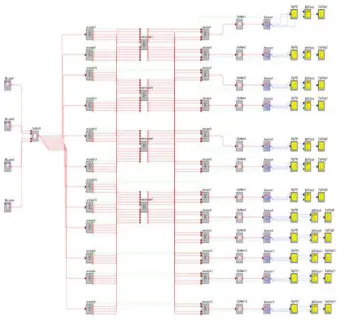
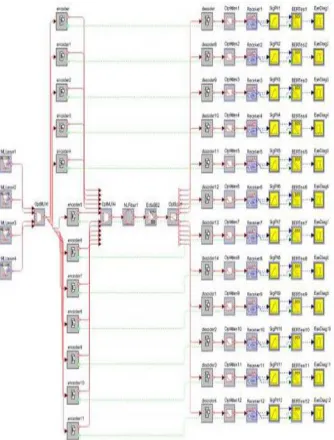
Fig 1 and Fig 2 shows the schematic of W/T/S and W/T/P MPR OCDMA system. These systems are used to analyze the performance of OCDMA system when MPR code is implemented. The simulations are carried out using OPTSIM 5.3. The performance is analyzedinterms of bit error rate and eye diagrams.
The earlier proposed codes i.e. W/T MPR codes are further extended using space as third dimension [4]. W/T/S 3D codes can be constructed by extending 2D W/T MPR codes. Here an incoherent OCDMA system based on a 3D MPR coding technique is demonstrated in Fig 1. The code has been designed by using 4 wavelengths and 97 time slots. Four MLL have been used to create a light source ie. the carrier signal. The encoder consist of four optical filters and shift signals used to produce the encoded bit stream .The encoder used delay line arrays providing delays. The role of star coupler is to combine the optical signals entering from its multiple input ports and divide it equally among its output ports. The decoder tuned to the same structure as the corresponding encoder with negative delay as compared to encoder. The decoded signal arrives at optical receiver where actual signal is recovered.
ISSN (Print) : 2320 – 3765 ISSN (Online): 2278 – 8875
I
nternational
J
ournal of
A
dvanced
R
esearch in
E
lectrical,
E
lectronics and
I
nstrumentation
E
ngineering
(An ISO 3297: 2007 Certified Organization)
Vol. 5, Issue 2, February 2016
A third dimension i.e. polarization is added in earlier proposed W/T MPR codes as shown in Fig 2. Two polarization states used are parallel and perpendicular polarization. By providing an encoded chip to each user which is encoded in wavelength, time and polarization domain such that interference between any two users does not increase if they have different set of polarization and hence a 3D codeset can be generated. This type of coding can increase the number of potential users. The encoders assigned a MPR code respective to each encoder. In this encoder signal is encoded at two polarizations i.e. perpendicular and parallel. To obtain perpendicular polarization, signal is provided with a rotation polarization of 900 degree. The combiner combines the pulses from different encoders. The power splitter is used to divide the signals to the different decoders. In the decoding section the signal is divided into two stages first stage decodes the signals which are having parallel polarization second stage provides polarization rotation of -900, as these signals were perpendicularly polarized. Finally the decoded signal arrives at optical receiver where actual signal is recovered.
ISSN (Print) : 2320 – 3765 ISSN (Online): 2278 – 8875
I
nternational
J
ournal of
A
dvanced
R
esearch in
E
lectrical,
E
lectronics and
I
nstrumentation
E
ngineering
(An ISO 3297: 2007 Certified Organization)
Vol. 5, Issue 2, February 2016
IV.RESULTS AND DISCUSSIONS
Different types of 3D OCDMA systems such as W/T/S and W/T/P are analyzed with the help of simulation software OPTSIM 5.3.
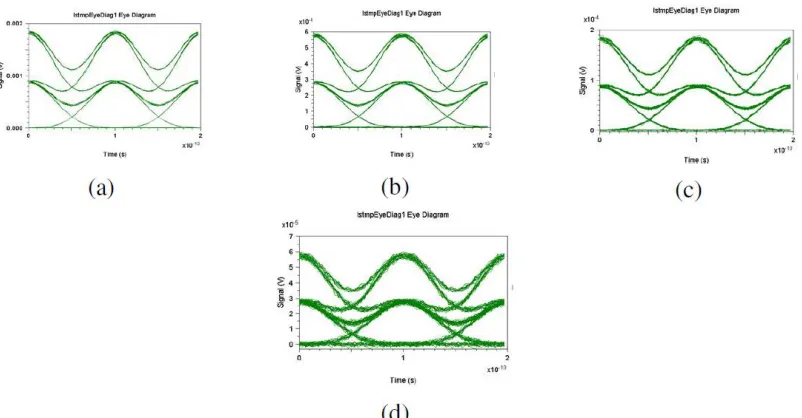
Figure 3.Eye Diagrams of 3D W/T/S OCDMA system with 12 users at a bit rate of 10Gbps and attenuations of (a) 0 dB (b)-2 dB (c)-5 dB (d)-10 dB (e)-15dB
Fig 3 shows the eye diagrams observed at the data rate of 10 Gbps at various attenuation values. The results have been observed with eye diagrams and show that attenuation increases with increase in interference and signal get distorted.
ISSN (Print) : 2320 – 3765 ISSN (Online): 2278 – 8875
I
nternational
J
ournal of
A
dvanced
R
esearch in
E
lectrical,
E
lectronics and
I
nstrumentation
E
ngineering
(An ISO 3297: 2007 Certified Organization)
Vol. 5, Issue 2, February 2016
Figure 4 shows the eye diagrams obtained at 10 Gbps data rate with various attenuations.It can be observed from the eye diagrams as attenuation increases interference increases and signal gets distorted.
Optical attenuation value (dB)
BER Q factor
0 0.0000e+000 1.4142e+003
-2 1.8346e-193 2.9647e+001
-5 1.9443e-055 1.5640e+001
-10 1.1347e-007 5.1758e+000
-15 4.8876e-002 1.6559e+000
Table 1. Optical attenuation Vs BER and Q factor of 3D W/T/S MPR OCDMA system
Table 1 shows the Bit error rate and Q factor values at various attenuation values. From this it can be observed that as attenuation increases from 0 to -15 dB the bit error rate increases and the Quality factor decreases.
Optical attenuation value ( dB)
BER Q factor
0 1.7506e-006 4.6390e+000
-5 2.0178e-003 2.8754e+000
-10 4.3261e-002 1.7140e+000
-15 9.4192e-002 1.3154e+000
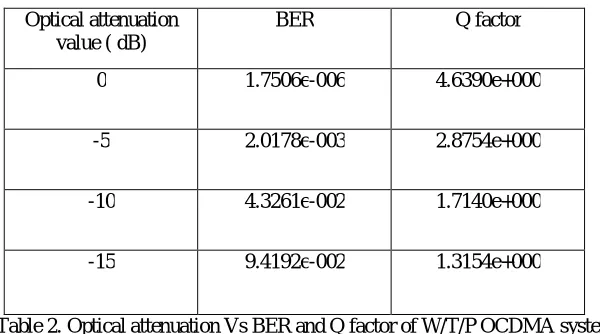
Table 2. Optical attenuation Vs BER and Q factor of W/T/P OCDMA system
Table 2 shows the BER and Q factor values at various attenuation values. From this table observed that as attenuation increases the noise is get added into the system and the signal get distorted. And also as attenuation increases BER increases and the Q factor decreases.
V. CONCLUSION
In this paper an OCDMA system is simulated successfully by using W/T/S and W/T/P MPR OCDMA codes. These systems can support 12 active users simultaneously and can support up to the data rate of 10 Gbps. Even in the presence of attenuation this system gives satisfactory results which make the 3D W/T/S and W/T/P MPR OCDMA system suitable for Local area networks.
REFERENCES
[1]J. A. Salehi ,“Code Division Multiple-Access Techniques in Optical Fiber Networks Part I: Fundamental Principles”,IEEE Trans. on Commun,vol. 37, pp. 824-833, August 1989 .
ISSN (Print) : 2320 – 3765 ISSN (Online): 2278 – 8875
I
nternational
J
ournal of
A
dvanced
R
esearch in
E
lectrical,
E
lectronics and
I
nstrumentation
E
ngineering
(An ISO 3297: 2007 Certified Organization)
Vol. 5, Issue 2, February 2016
[3]Kyungsik Yu,Namkyoo Park ,Sangin Kim, “A New Family of Space/Wavelength/Time Spread Three-Dimensional Optical Code for OCDMA Networks”,IEEE Journal of Lightwave Technology,vol. 18, no. 4, pp. 502-511, April 2000.
[4]E. S. Shivaleela ,T. Srinivas ,“Construction of Wavelength/Time Codes for Fiber-Optic CDMA Networks”,IEEE Journal of selected topics in quantum electronics, vol. 13, no. 5, september/october 2007.
BIOGRAPHY
Thasni Mol Sreceived her B.Tech degree in Electronics and Communication Engineering from Cochin University of Science and Technology in 2014. She is currently pursuing second year M.Tech in Optoelectronics and Communication Systems at TKM Institute of Technology.