ISSN (Print) : 2320 – 3765 ISSN (Online): 2278 – 8875
I
nternational
J
ournal of
A
dvanced
R
esearch in
E
lectrical,
E
lectronics and
I
nstrumentation
E
ngineering
(An ISO 3297: 2007 Certified Organization)
Vol. 4, Issue 3, March 2015
Recognization System for Security and
Surveillance Application
Ramya N.
1, Raji Pandurangan*
2Assistant Professor, Dept. of ECE, Jerusalem College of Engineering, Chennai, Tamil Nadu, India1
Assistant Professor, Dept. of ECE, Bharath University, Chennai, Tamil Nadu, India2
* Corresponding Author
ABSTRACT: Meta-recognition can be implemented in two different ways: a statistical fitting algorithm based on the Extreme Value Theory, and a machine learning algorithm utilizing features computed from the raw scores. While the statistical algorithm establishes a strong theoretical basis for meta-recognition, the machine learning algorithm is more accurate in its predictions. Machine learning algorithm and its associated features for the purpose of building a highly accurate meta-recognition system for security and surveillance applications. By comparing the machine based algorithm and statistical algorithm and tells about which is the algorithm is highly accurate to recognize the image. In this paper the methods are effective for a variety of different recognition applications across security and forensics-oriented computer vision, including biometrics, object recognition, and content-based image retrieval.
I. INTRODUCTION
The growing demand for highly accurate surveillance, intelligence, and forensics systems has propelled the unconstrained recognition problem (1:N matching, or identification) to the forefront of computer vision research. Over the past decade, excellent progress has been made toward the constrained and unconstrained verification (1:1 matching)problems. For controlled face verification, 99.9% accuracy was achieved for the FRGC set . For controlled finger print verification, accuracies between 85.83% and 99.98% have been reported for the FVC2006 set .
For uncontrolled face verification, 88.13% accuracy has been reported for the once very difficult LFW set. Verification is a fundamentally easier problem than recognition, as it only considers discrete pairs of samples for matching, with a claimed identity choosing a comparison class that is known to the matching system [8]. Recognition is made more difficult by the need to identify an unknown class out of the set of known classes.Compounding things further is the overall environment of the unconstrained scenario, where any number of effects(pose, illumination, expression, sensor noise, blur, occlusion, weather, etc.) can impact accuracy. Recognition, in general, is a challenging problem with important consequences for security and forensics applications.
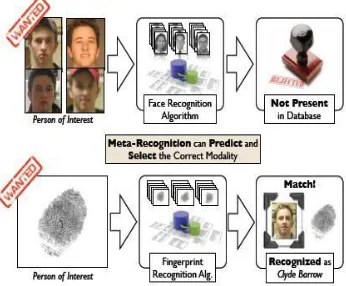
A common approach for improving recognition accuracy is to combine results from a collection of algorithms and/or sensors using score-level fusion [9]. Most of the available fusion works reported in the literature have focused on either combining consistent data to address sensor limitations or limiting the impact of a failing modality when score data is combined. Meta-Recognition is a post-recognition score analysis technique that predicts when a recognition algorithm is succeeding or failing. This is very different from any fusion approach that is focused on combining consistent data.
If a screening system is being negatively impacted by the environment (Fig. 1), then a biometric (such as multi-view face) that is providing a more consistent answer than another (perhaps fingerprint) does not always mean it should be considered with more emphasis. For instance, if our analysis predicts success for one modality and failure for the other, we can proceed with the modality that isn‟t failing, consistent or not.
Meta-recognition is formally defined as a control relationship between the post-recognition score analysis and a recognition system :
ISSN (Print) : 2320 – 3765 ISSN (Online): 2278 – 8875
I
nternational
J
ournal of
A
dvanced
R
esearch in
E
lectrical,
E
lectronics and
I
nstrumentation
E
ngineering
(An ISO 3297: 2007 Certified Organization)
Vol. 4, Issue 3, March 2015
information flows from X to Y , control information flows from Y to X, and Y analyzes the recognition performance of X, adjusting the control information based upon the observations.
The relationship between X and Y can be seen in Fig. 2, where Y is labeled “Meta-Recognition System”. Y can be one of a number of classification algorithms, such as a neural network [11], support vector machine[12], or the statistical extreme value theory [10].
For score-based meta-recognition, the primary approach considered herein, Y observes the recognition scores produced by X and, if necessary, adjusts he recognition decisions and perhaps signals for a specific response action.
We note that meta-recognition is different from meta-analysis because it does not draw broad conclusions over multiple studies [7]. Instead, it considers recognition on a per instance matching basis.
ISSN (Print) : 2320 – 3765 ISSN (Online): 2278 – 8875
I
nternational
J
ournal of
A
dvanced
R
esearch in
E
lectrical,
E
lectronics and
I
nstrumentation
E
ngineering
(An ISO 3297: 2007 Certified Organization)
Vol. 4, Issue 3, March 2015
With several options for actually implementing meta-recognition, the question of which to choose for operational systems is important. In our prior work, we have explored both pure statistical algorithms and machine learning based algorithms. In [10], we introduced a strong theoretical basis for statistical meta-recognition using the extreme value theory(EVT). The EVT approach produced predictors with accuracies well beyond standard thresholding and cohort thresholding, without the need for training data. However, our machine learning based algorithms [11]–[16] have consistently been more accurate than the EVT approach over numerous experiments.
In light of this observation, we have sought a deeper understanding of the underlying feature mechanisms for the machine learning algorithms that lead to higher accuracies.
In this article, we introduce three contributions. First, we provide a study of learning for the purpose of building a highly accurate meta recognition system that constitutes Y of Def. 1. Second, through the use of feature- and decision-level fusion, we present techniques that achieve decision-levels of accuracy well beyond those of the statistical algorithm, as well as the popular “cohort” model for post-recognition score analysis [6].
Third, we also explore the theoretical question of why the machine learning algorithm tends to outperform the statistic algorithm in many cases of meta-recognition. We show that the introduced methods are effective for a variety of different recognition applications across security and forensics-oriented computer vision [4-5].
II. MACHINE LEARNING META RECOGNITION RESULTS
In this section, we present a validation of our machine learning-based algorithm for meta-recognition, Comparing baseline features to our enhanced fusion-oriented classifiers ,along with the experimental framework used for all assessments. Our goal is to evaluate, in an empirical manner, all features and fusion techniques that are defined in Sec. III.
A. Meta-Recognition Error Trade-off Curves
All source data used for the experiments in this article are scores from identification instances. Our goal is to evaluate our machine learning algorithm for meta-recognition, as well as other comparison methods that produce a prediction of recognition success or failure [3]. In order to assess the accuracy of meta-recognition predictions, we require an analysis tool similar to a detection error trade-off curve, which allows us
to vary parameters to gain a broad overview of the system behavior. We can calculate a “Meta-Recognition Error Trade-off Curve” (MRET) from the following four cases:
C1 “False Accept”, when meta-recognition predicts that the recognition system will succeed but the rank-1 score is not correct.
C2 “False Reject”, when meta-recognition predicts that the recognition system will fail but rank-1 is correct.
C3 “True Accept”, when both the recognition system and the meta-recognition indicate a successful match. C4 “True Reject”, when the meta-recognition system predicts correctly that the underlying recognition system is failing.
ISSN (Print) : 2320 – 3765 ISSN (Online): 2278 – 8875
I
nternational
J
ournal of
A
dvanced
R
esearch in
E
lectrical,
E
lectronics and
I
nstrumentation
E
ngineering
(An ISO 3297: 2007 Certified Organization)
Vol. 4, Issue 3, March 2015
B.Pure Statistics Vs Machine Learning
Several experiments in this work correspond to existing experiments for statistical meta-recognition In all of these cases, the machine learning-basedalgorithm with feature- or decision-level fusion produces moreaccurate results. Moreover, we also find instances such as theone where baseline machine learning-based meta-recognition features produce better meta-recognition resultswhen compared to the pure statistical algorithm. To account forthis performance improvement, we consider the most significant differences between the machine learning and statisticalalgorithms – namely, the use of features computed from scores,and the use of training data by the machine learning algorithm.
ISSN (Print) : 2320 – 3765 ISSN (Online): 2278 – 8875
I
nternational
J
ournal of
A
dvanced
R
esearch in
E
lectrical,
E
lectronics and
I
nstrumentation
E
ngineering
(An ISO 3297: 2007 Certified Organization)
Vol. 4, Issue 3, March 2015
ISSN (Print) : 2320 – 3765 ISSN (Online): 2278 – 8875
I
nternational
J
ournal of
A
dvanced
R
esearch in
E
lectrical,
E
lectronics and
I
nstrumentation
E
ngineering
(An ISO 3297: 2007 Certified Organization)
Vol. 4, Issue 3, March 2015
Thus, we turn our attention to the effects of training data. It is apparent that with machine learning, the meta-recognition classifiers have knowledge of numerous training examples, whereas there is no a priori knowledge for statistical classifiers. Statistical meta-recognition only considers the scores for the recognition instance at hand. As noted in Section IV, the experiments presented thus far have always considered the same gallery for training and testing, with only the probe varying to produce different score sequences. If the machine learning is able to learn gallery information from the training samples and apply that knowledge to the classification of test samples derived from the same gallery, then the gallery‟s influence on the learning accuracy is an important contributing factor to its advantage.
In order to evaluate our hypothesis that a consistent gallery between training and testing gives machine learning based meta-recognition an advantage, three different score sets were generated
described in training setsR1 , R2 and testing set T1 . The sets R1 and T1 have 150 sets of distance scores, with no overlap in their probes, and sharea common gallery. R2 has 150 sets of distance scores with no overlap in probe or gallery. The R1 and T1 score sets have a total of 4,455,000 scores per set. The R2 score set has a totalof 3,712,500 scores for the set.
The statistical algorithm for this experiment utilized a tail size of five scores for fitting (out of numerous experiments, a size of five yielded the most accurate results) . For the machine learning classifiers, a 1,2...5 feature was used for training and testing (the same score data used by the statistical algorithm).
The first machine learning classifier was trained with R1 while the second machine learning classifier for the comparison was trained with R2 . The results in Fig. 10 support our hypothesis. When the training gallery does not overlap with the testing gallery (R2 for training and T1 for testing, represented bythe black curve), the prediction accuracy is quite consistent with the accuracy of statistical meta-recognition (represented by the green curve). When the training gallery is the same as the testing gallery (R1 and T1 , represented by the red curve), there is a noticeable increase in prediction accuracy.
ISSN (Print) : 2320 – 3765 ISSN (Online): 2278 – 8875
I
nternational
J
ournal of
A
dvanced
R
esearch in
E
lectrical,
E
lectronics and
I
nstrumentation
E
ngineering
(An ISO 3297: 2007 Certified Organization)
Vol. 4, Issue 3, March 2015
III. CONCLUSION
With two different options to implement meta-recognition,the question of which one to choose for an operational scenariois an important one addressed in our study. Statistical metarecognition achieves accuracies far beyond standard thresholding and cohort thresholding, without the need for training data.However, our machine learning- based algorithm for meta-recognition has provided us with more accurate results thanthe statistical algorithm over many experiments.
REFERENCES
P. J. Phillips, P. J. Flynn, T. Scruggs, K. W. Bowyer, and W. Worek,“Preliminary Face Recognition Grand Challenge Results,” in Intl. Conf.on Automatic Face and Gesture Recognition, 2006, pp. 15–24.
Kumar S., Das M.P., Jeyanthi Rebecca L., Sharmila S., "Isolation and identification of LDPE degrading fungi from municipal solid waste", Journal of Chemical and Pharmaceutical Research, ISSN : 0975 – 7384 5(3) (2013) pp.78-81.
R. Cappelli, M. Ferrara, A. Franco, and D. Maltoni, “Fingerprint Verification Competition 2006,” Biometric Technology Today, vol. 15,no. 7-8, pp. 7–9, 2007.
Laljee R.P., Muddaiah S., Salagundi B., Cariappa P.M., Indra A.S., Sanjay V., Ramanathan A., "Interferon stimulated gene - ISG15 is a potential diagnostic biomarker in oral squamous cell carcinomas", Asian Pacific Journal of Cancer Prevention, ISSN : 1513-7368, 14(2) (2013) pp.1147-1150. N. Pinto and D. Cox, “Beyond Simple Features: a Large-Scale FeatureSearch Approach to Unconstrained Face Recognition,” in IEEE AFGR,March 2011.
Subha Palaneeswari M., Ganesh M., Karthikeyan T., Manjula Devi A.J., Mythili S.V., "Hepcidin-minireview", Journal of Clinical and Diagnostic Research, ISSN : 0973 - 709X, 7(8) (2013) pp.1767-1771.
A. Ross, K. Nandakumar, and A. Jain, Handbook of Multibiometrics.Springer, 2006.
Thomas J., Ragavi B.S., Raneesha P.K., Ahmed N.A., Cynthia S., Manoharan D., Manoharan R., "Hallermann-Streiff syndrome", Indian Journal of Dermatology, ISSN : 0019-5154, 58(5) (2013) pp.383-384.
The Guardian, “My Boy Lollipop: Raid Ends SweetLife of the Colombian Drug Lord,” August 11
2007,http://www.guardian.co.uk/world/2007/aug/11/colombia. b razil.
Subhashini V., Ponnusamy S., Muthamizhchelvan C., "Growth and characterization of novel organic optical crystal: Anilinium d-tartrate (ADT)", Spectrochimica Acta - Part A: Molecular and Biomolecular Spectroscopy, ISSN : 1386-1425, 87() (2012) pp.265-272.
[11] BBC News, “„Fake Fingerprint‟ Chinese Woman Fools
Japan Controls,” December 2009,
12]http://news.bbc.co.uk/2/hi/asia-pacific/8400222.stm.
[13] N. Ramanathan, R. Chellapa, and A. K. R. Chawdhury, “Facial Similarity Across Age, Disguise, Illumination, and Pose,” in IEEE Intl. Conf.on Image Processing, 2011, pp. 1999– 2002.
[14]R. Singh, M. Vatsa, H. S. Bhatt, S. Bharadwaj, A. Noore, and S. S. Nooreyezdan, “Plastic Surgery: A New Dimension to Face Recognition,”IEEE Trans. on Inf. Forensics and Security, vol. 5, pp. 441–448, 2010.
[15]AgenceFrancePresse,“HelloKittyUsedasDrugLord‟sMessenger:Report,”March 102008,
[16]W. Scheirer, A. Bendale, and T. Boult, “Predicting Biometric FacialRecognition Failure With Similarity Surfaces and Support Vector Machines,” in IEEE Intl. Workshop on Biometrics, 2008.
[17]B Karthik, S Rajeswari, Design and Analysis of a Transceiver on a Chip for Novel IR-UWB Pulses, Middle-East Journal of Scientific Research 19 (6), PP 817-820, 2014.
[18]Shriram, Revati; Sundhararajan, M; Daimiwal, Nivedita; , Application of High & Low Brightness LEDs to Human Tissue to Capture Photoplethysmogram at a Finger TipRed, V-620,PP 700.
[19]Muralibabu, K; Sundhararajan, M; , PAPR performance improvement in OFDM system using DCT based on adjacent symbol groupingTrans Tech Publ, Applied Mechanics and Materials, V-550,PP 204-209, 2014.
[20]sivaperumal, s; sundhararajan, m; , advance feature extraction of mri brain image and detection using local segmentation method with watershed. [21]MURALIBABU, K; SUNDHARARAJAN, M; , PAPR reduction using DCT based sub carrier grouping with Companding Technique in OFDM system.