Outcome Based Education (OBE) - Developing and
Tracing the Efficacy of Revision Tools
Vishal V Jadhav
1, Jayant J Pharne
2 1,2Mechanical Engineering, Rajarambapu Institute of Technology, Rajaramnagar (India)
ABSTRACT
“Every individual is distinct”, inline with this principle every teacher has distinct teaching style while every
student has distinct learning style. A mismatch in teaching and learning styles results in non-achievement of the
educational outcomes. This is where OBE comes on the canvas and guides the teacher to develop such “tools”,
which will bridge the gap between teaching and learning styles; thereby making the educational experience
more efficient and fulfilling. This paper focuses on elaborating the revision tool that we developed. The sole
motive was to extract the most from the available resources and to serve it to students in a manner so that they
could easily absorb it. This quest led us and ended up in developing a revision tool; which is the focal point of
this paper.
Keywords:
outcome based education, teaching styles, learning styles
I. INTRODUCTION
Traditional educational experience revolves around transmitting knowledge from the faculty to the student
through chalk and duster method. While the faculty acts as an emitter of knowledge; the student acts as a
receiver of knowledge. Even though ideally; this conceptualization may sound efficient; practically the reverse
is true. This is so because this phenomenon is riddled with certain inherent drawbacks such as:-
i. Mismatch between teaching and learning styles.
ii. Inherent disturbances in class room.
iii. Frequent absenteeism of the pupil, leading to discontinuity in the flow of knowledge.
iv. Lack of concentration of the student during the educational experience.
v. Lack of revision of the transmitted knowledge after the completion of the educational experience.
Apart from these discrepancies it is well established fact that human brain can concentrate only in slots of time.
And these slots vary with individual. A teacher might supplement traditional teaching efforts with PPT‟s,
videos, active learning techniques, etc. but these all are futile if they fail to provoke/ attract the concentration of
pupil.
Considering these pitfalls; we planned to modify the traditional teaching-learning experience in order to enhance
the ability of students to revise knowledge during educational experience and this is where OBE comes on the
canvas of the traditional teaching learning experience.
ii. To study the impact of revision tool on students and achievement of learning outcomes.
II. LITERATURE REVIEW
William G Spady pointed out “an Outcome-based Education is NOT a program, a package, a technique, a fad, a
quick-fix, apanacea, a miracle or an event. It is transformational way of doing business in education” [1]. As per
kudlas J.M. “OBE is a process that focuses on what is to be learned - the outcomes” [2].William G Spady et al. noted that “The basic tenets of OBE are shifting the focus of educational activity from teaching to learning;
skills to thinking; content to process; and teacher instruction to student demonstration” [3]. As stated by Spady,
W. D. “An outcome based education is a culminating demonstration of learning. It is a demonstration of
learning that occurs at the end of a learning experience. An outcome is the result of learning which a visible and
observable demonstration of three things is: knowledge, combined with competence, combined with
orientations” [4]. According to James, “Education that is outcome-based is a learner-centered, results-oriented
system founded on the belief that all individuals can learn” [5]. As said by William G. Spady and Kit J.
Marshall, “Outcomes are clear, observable demonstrations of student learning that occur after a significant set of
learning experiences. They are not values, attitudes, feelings, beliefs, activities, assignments, goals, scores,
grades, or averages, as many people believe. Typically, these demonstrations, or performances, reflect three
things: (1) What the student knows; (2) What the student can actually do with what he or she knows; (3) The
student‟s confidence and motivation in carrying out the demonstration. A well-defined outcome will have
clearly defined content or concepts and be demonstrated through a well defined process beginning with a
directive or request such as „explain‟, „organize‟, or „produce‟”[6]. Boschee F, Baron and M.A, revealed that “Outcomes are future oriented, publicly defined, learner-centered, focused on life skills and contexts;
characterized by high expectations of and for all learners, and sources from which all other educational
decisions flow”. As per the statement given by Boschee F, Baron and M.A, “Learning is facilitated carefully toward achievement of the outcomes, characterized by its appropriateness to each learner‟s development level,
and active and experienced-based”[7].
III. ANALYSIS OF THE PROBLEM
The present teaching learning phenomenon has two stake holders THE TEACHERS & THE STUDENTS. The
phenomenon of teaching is nothing but a message transmitting process; in this process it is very much essential
that the pupil listens to the teacher attentively. But humans have been cursed with the ability to concentrate only
for short durations; having said this it implies that majority of the students fail to concentrate for ample period of
time thereby failing to yield the ideal outcomes from the teaching learning process. Apart from this the present
teaching learning process in itself is grappled with other problems, if the teacher himself is under educated or
under skilled he fails to transfer rich quality of knowledge to the students, apart from this if the student is facing
certain cognitive problems he cannot yield the benefits of this teaching learning process, also many a times it
IV. IDENTIFICATION OF THE CAUSES
Any problem can be tackled efficiently only if the victim has a sound and in-depth knowledge of the reasons
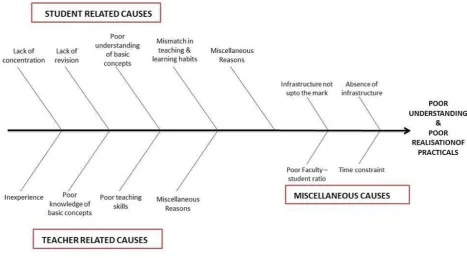
responsible for the problem. Hence we began withdrawing the fish bone diagram as it is a quality circle tool that
efficiently and logically elaborates the reasons that generate the problem. We started by making a rough list of
the causes; then the causes listed were categorized as shown below.
Fig 1 Cause and effect Diagram
V. DEVELOPMENT OF REVISION TOOL
Human brains tend to forget easily what it learns; and the best tool to overcome this natural habit of brain is to
revise frequently. Keeping this principle in mind, we have decided to record the practical and to convert M. S.
B. T. E. manuals into audio- video format. Initially we will be testing this solution by implementing it on a small
scale. And hence our first step is to start by recording the practical for only 1 or 2 experiments. While teaching
in classroom the teacher has many constraints and the most formidable challenge is the inability to maintain
uniform concentration level throughout the teaching learning process. To overcome this barrier a thought
process driven by sheer determination leads us to develop a revision tool. The sole purpose of this revision tool
was to recreate the atmosphere and the happening in the classroom at the will of the student. The revision tool
will not only help to recreate the class room but will make knowledge accessible to students at his or her own
will. To start on a pilot basis the subject CNC Machines was chosen. CNC machine is a subject which is to be
taught to the student of diploma mechanical final year students. And in this subject students have to run their
part program and verify it by using simulation software. But while implementing the curriculum of CNC
ii. non availability of resources to revise the contents taught during the practical‟s
iii. lack of concentration during practical‟s
iv. frequent absenteeism
Considering all these reasons we at R.I.T decided to develop a revision tool. To develop this revision tool
experiment no 1 and experiment no 2 were selected given in MSBTE manual of the subject CNC machine.
These experiments ask the students to develop part programs and to verify them using simulation software.
Experiment no 1 entitled “To develop a part program for plain turning operation on CNC lathe machine and to
verify it by using simulation software in single block mode” Focuses on CNC lathe machine operations.
Experiment no 2 entitled “To develop a part program for linear interpolation on CNC milling machine and to
verify it by using simulation software in single block mode” Focuses on CNC milling machine operations.
Now to develop the revision tool we downloaded the screen recording software named CAMTASIA. Using this
software we recorded the screen while using the simulation software. The video thus generated serves the
purpose of a revision tool.
VI. RESULT
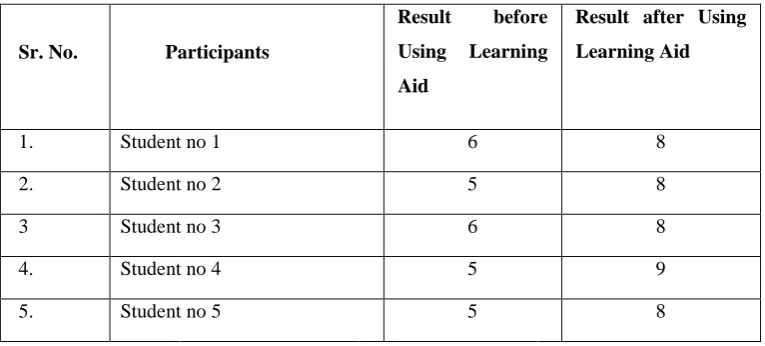
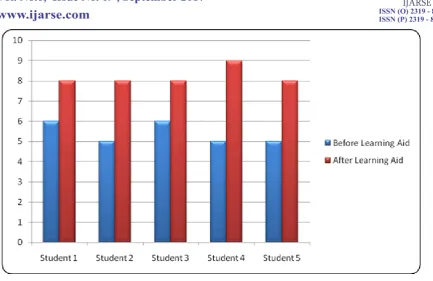
In order to trace the usefulness of the tool we analyzed the performance of the students in two stages:
Initially the performance was evaluated before giving the revision tool
Later the performance of students was evaluated after giving the revision tool.
Table no. 1 performance analysis of students
Sr. No. Participants
Result before
Using Learning
Aid
Result after Using
Learning Aid
1. Student no 1 6 8
2. Student no 2 5 8
3 Student no 3 6 8
4. Student no 4 5 9
5. Student no 5 5 8
Fig no 2 graph of performance of students
VII. ADVANTAGES OF REVISION TOOL
1. The recorded video is easily transferable and hence can reach numerous users.
2. Concept taught during practicals can be revised frequently.
3. Physical presence of the student is not mandatory, a student who is absent during practicals can recall it
at his/her own will.
4. Free and unrestricted access to the content.
5. Student can study when he is tempted to study.
VIII. OPERATING PROCEDURE
The instructor of the subject shall not initially introduce students to this revision tool and shall use traditional
methods of teaching. Once the teaching is completed the students shall then be shown the video and explain the
significance and how it is to be used.
IX. CONCLUSION
From our endeavor we hereby conclude that merely teaching a student once; unaware of the fact whether they
have learnt anything or not, does not ensure the fulfillment of learning objectives. To ensure the fulfillment of
learning objectives as enshrined in OBE developing a revision tool proves to be handy and acts as a catalyst
X. FUTURE SCOPE
Understanding what is taught helps to clarify concepts whereas revising what is taught helps recreating the
knowledge. The revision tool which we developed is merely a baby step in the direction of creating resources
which are conducive to encourage students to revise. By using I.C.T and providing a higher version of graphical
interface or animations one can further enhance the compatibility of the revision tool.
REFERENCES
[1] Spady, William G, “Outcome-Based Education: Critical Issues and Answers”, American Association of
School Administrators, Arlington VA, ISBN-0-87652-183-9 94, 1994.
[2]. kudlas, J.M., 1994, „Implications of OBE: what you should know about outcomes-based education‟, The
Science Teacher, Vol.61 (5), pp. 5-32.
[3]. William G. Spady, Kit J. Marshall, 1991, "Beyond Traditional Outcome-Based Education," Educational
Leadership, Vol.49 (2), pp.67-72.
[4]. Spady, W. D., 1994, “Outcomes Based Education: Critical Issues and Answers”. Arlington, VA:
American Association of School Administration.
[5]. James M. Towers, 1992, “Outcome-Based Education: Another Educational Bandwagon?” Journal of the
Educational Forum, Volume 56 (3), pp.291-305. Published online: 30 Jan 2008.
[6]. William G. Spady and Kit J. Marshall, 1991, "Beyond Traditional Outcome-Based Education,"
Educational Leadership, Vol.49 (2), pp.67-72.
[7]. Boschee F, Baron MA. 1993. “Outcome-Based Education: Developing Programs Through Strategic”,
Planning. Lancaster USA, Technomic Publishing Co Inc.
[8]. Duradundi. Sawant. Badkar, Dipak. N. Mudgal An Outcome Based Education (OBE): An Overview