38 | P a g e
ELECTRIC BICYCLE
Ruturaj Patil
1, Mahesh Patil
2, Prashant Patil
3Ajit Patil
4, Maharudra Pujari
5, Prashant Kanase
61,2,3,4,5,6
Electrical Engineering, Shivaji Univercity, (India)
ABSTRACT
As we know know a day’s Fuel prizes goes on high level so everyone finding new way to protect our self from that rising prices so E-bike is one solution for save fuel.
Difference between conventional E-bike and our e bike is the regenerative charging we are providing. The machine we are using as a motor will act as a generator when it is on generating mode. Our aim was to make an e bike for a rider with the weight range between 40 to 50 kg and to make a vehicle which will not pollute the environment. Our e bike consist of a 24v, 250w,
PMDC
motor and two batteries of 12v with the current rating of 18ah and a motor controller to control the speed of our bike. The batteries we are using are non- polluting, they don’t consist of any acid and they also don’t required any kind of maintenance, they are absolutely maintenance free.We have connected the motor to front wheel which is the part of experiment we wanted to perform. A switch is provided on the bicycle to select the mode of operation i.e. generating mode or motoring mode (default mode is generating mode).
When we are paddling the bicycle the switch should be on generating mode, hence the motor will act as a generator there by providing charging to the battery. And when the switch is on motoring mode the motor will drive the bicycle and the rider.
We know that same machine can be used as motor as well as generator. We are using the same principle in our project. The machine which we are using as a motor (
PMDC
) the same machine will be used as generator.When the supply is connected to motor it will convert electrical energy into mechanical energy and when the same machine is rotated by some external means i.e. when mechanical energy is applied to it, it will convert that mechanical energy into electrical energy. Our motor cum generator is able to produce up to 24 v at rated speed. To convert motor into generator we just need to turn the
DPDT
(Double pole Double Throw) switch down provided on bicycle and the motor will ac.39 | P a g e
I. INTRODUCTION
During the revolution for the eco-friendly technologies bicycles were the most depended modes of
transportation, along with this the consideration of the increase in fuel price and the environmental factors we
must admit that it is far more better to use a bicycle over a motor vehicle for short distance travelling. Imagine
how useful would the bicycle be if even the small effort applied by man for climbing slopes and riding on rough
terrain is reduced in it. We thought the same way to develop the basics of our project “The e-Bike”. E-bike or
Electric bike is nothing but a vehicle which is driven by an electric motor.
An electric bicycle, also known as an e-bike or booster bike, is a bicycle with an integrated electric motor which
can be used for propulsion. There are a great variety of e-bikes available worldwide, from e-bikes that only have
a small motor to assist the rider's pedal-power (i.e., peddles) to somewhat more powerful e-bikes which tend
closer to moped-style functionality: all, however, retain the ability to be pedalled by the rider and are therefore
not electric motorcycles. E-bikes use rechargeable batteries and the lighter varieties can travel up to 25 to 32
km/h (16 to 20 mph), depending on the laws of the country in which they are sold, while the more high-powered
varieties can often do in excess of 45 km/h (28 mph). In some markets, such as Germany, they are gaining in
popularity and taking some market share away from conventional bicycles, while in others, such as China, they
are replacing fossil fuel-powered mopeds and small motorcycles.
II. LITERATURE SURVEY
In the 1890s, electric bicycles were documented within various U.S. patents. For example, on 31 December
1895, Ogden Bolton Jr. was granted U.S. Patent 552,271 for a battery-powered bicycle with “6-pole
brush-and-commutate direct current (DC) hub motor mounted in the rear wheel.” There were no gears and the motor could
draw up to 100 amperes (A) from a 10-volt battery.
Two years later, in 1897, Hosea W. Libbey of Boston invented an electric bicycle (U.S. Patent 596,272) that was
propelled by a “double electric motor”. The motor was designed within the hub of the crankset axle. This model
was later re-invented and imitated in the late 1990s by Giant Lafree e-bikes.
By 1898 a rear-wheel drive electric bicycle, which used a driving belt along the outside edge of the wheel, was
patented by Mathew J. Steffens. Also, the 1899 U.S. Patent 627,066 by John Schnepf depicted a rear-wheel
friction “roller-wheel” style drive electric bicycle. Schnepf's invention was later re-examined and expanded in
1969 by G.A. Wood Jr. with his U.S. Patent 3,431,994. Wood‟s device used 4 fractional horsepower motors;
connected through a series of gears.
III. HARDWARE DESCRIPTION
1.0 PMDC MOTOR
In a dc motor, an armature rotates inside a magnetic field. Basic working principle of DC motor is based on the
fact that whenever a current carrying conductor is placed inside a magnetic field, there will be mechanical force
experienced by that conductor. All kinds of DC motors work in this principle only. Hence for constructing a dc
40 | P a g e
magnet. The magnet can by any types i.e. it may be electromagnet or it can be permanent magnet. Whenpermanent magnet is used to create magnetic field in a DC motor, the motor is referred as permanent magnet dc
motor or PMDC motor. Have you ever uncovered any battery operated toy, if you did, you had obviously found
a battery operated motor inside it. This battery operated motor is nothing but a permanent magnet dc motor or
PMDC motor. These types of motor are essentially simple in construction. These motors are commonly used as
starter motor in automobiles, windshield wipers, washer, for blowers used in heaters and air conditioners, to
raise and lower windows, it also extensively used in toys. As the magnetic field strength of a permanent magnet
is fixed it cannot be controlled externally, field control of this type of dc motor cannot be possible. Thus
permanent magnet dc motor is used where there is no need of speed control of motor by means of controlling its
field. Small fractional and sub fractional kW motors now constructed with permanent magnet.
Fig.1.0 PMDC Motor
II.BATTERY
In the absorbed glass mat design, or AGM for short, the spacer between the cells is replaced by a glass fibre mat
soaked in electrolyte. There is only enough electrolyte in the mat to keep it wet, and if the battery is punctured
the electrolyte will not flow out of the mats. Likewise, the mat greatly reduces evaporation, to the point that the
batteries do not require periodic refilling of the water. This combination of features allows the battery to be
completely sealed, which makes them useful in portable devices and similar roles.
Another advantage to the AGM design is that the electrolyte becomes the separator material, and mechanically
strong. This allows the plate stack to be compressed together in the battery shell, slightly increasing energy
density compared to liquid or gel versions. AGM batteries often show a characteristic "bulging" in their shells
when built in common rectangular shapes
AGM technology became popular in the early 1980s as a sealed lead acid battery for military aircraft, vehicles
and UPS to reduce weight and improve reliability. The sulphuric acid is absorbed by a very fine fiberglass mat,
making the battery spill-proof. This enables shipment without hazardous material restrictions. The plates can be
made flat to resemble a standard flooded lead acid pack in a rectangular case; they can also be wound into a
41 | P a g e
Advantages of AGM batteries1. Imparts high reliability during service life.
2. Thicker Grids and Higher Separator Compression Prolong Life Expectancy
3. Inter-cell Weld between Cells Provides a highly reliable Low resistance Path
4. PPCP Containers with Low Permeability ensure that there is no water loss
III. CHARGING CIRCUIT
Charging circuit is used to charge the batteries. Transformer, bridge rectifier and smoothing capacitor are used in
main charger circuit to obtain DC voltage .It is to transform AC voltage values coming from network to DC
voltage values. We want to explain this transformation by giving information about circuit components and
theirs area of usages. The block diagram of this transformation is given below
Fig.3.1 Block diagram of charging circuit
42 | P a g e
IV. SPROCKETS
A sprocket or sprocket-wheel is a profile wheel with teeth, cogs, or even sprockets that mesh with a chain, track
or other perforated or indented material. The name 'sprocket' applies generally to any wheel upon which are
radial projections that engage a chain passing over it. It is distinguished from a gear in that sprockets are never
meshed together directly, and differs from a pulley in that sprockets have teeth and pulleys are smooth.
Sprockets are used in bicycles, motorcycles, cars, tracked vehicles, and other machinery to transmit rotary
motion between two shafts where gears are unsuitable or to impart linear motion to a track, tape etc. Perhaps the
most common form of sprocket may be found in the bicycle, in which the pedal shaft carries a large
sprocket-wheel, which drives a chain, which, in turn, drives a small sprocket on the axle of the rear wheel. Early
automobiles were also largely driven by sprocket and chain mechanism, a practice largely copied from bicycles.
Sprockets are of various designs, a maximum of efficiency being claimed for each by its originator. Sprockets
typically do not have a flange. Some sprockets used with timing belts have flanges to keep the timing belt
centered. Sprockets and chains are also used for power transmission from one shaft to another where slippage is
not admissible, sprocket chains being used instead of belts or ropes and sprocket-wheels instead of pulleys.
They can be run at high speed and some forms of chain are so constructed as to be noiseless even at high speed.
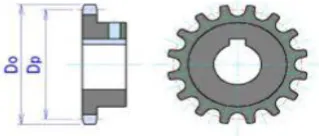
Figure 4.1shows the front and side views of the designed sprockets and the manufactured one.
Fig.4.0 Sprockets
V.ADVANTAGES
5.1 Health benefits
E-bikes can be a useful part of cardiac rehabilitation programs, since health professionals will often recommend
a stationary bike be used in the early stages of these. Exercise-based cardiac rehabilitation programs can reduce
deaths in people with coronary heart disease by around 27% and a patient may feel safer progressing from
stationary bikes to e-bikes. They require less cardiac exertion for those who have experienced heart problems
.
5.2 Environmental effects
E-bikes are zero-emissions vehicles, as they emit no combustion by-products. However, the environmental
effects of electricity generation and power distribution and of manufacturing and disposing of (limited life) high
43 | P a g e
have a significantly lower environmental impact than conventional automobiles, and are generally seen asenvironmentally desirable in an urban environment
The environmental effects involved in recharging the batteries can of course be minimised. The small size of the
battery pack on an e-bike, relative to the larger pack used in an electric car, makes them very good candidates
for charging via solar power or other renewable energy resources. Sanyo capitalized on this benefit when it set
up "solar parking lots," in which e-bike riders can charge their vehicles while parked under photovoltaic panels.
The environmental credentials of e-bikes, and electric / human powered hybrids generally, have led some
municipal authorities to use them, such as Little Rock, Arkansaswith their Wavecrest electric power-assisted
bicycles or Cloverdale, California police with Zap e-bikes. China‟s e-bike manufacturers, such as Xinri, are now
partnering with universities in a bid to improve their technology in line with international environmental
standards, backed by the Chinese government who is keen to improve the export potential of the Chinese
manufactured e-bikes.
Both land management regulators and mountain bike trail access advocates have argued for bans of electric
bicycles on outdoor trails that are accessible to mountain bikes, citing potential safety hazards as well as the
potential for electric bikes to damage trails. A study conducted by the International Mountain Bicycling
Association, however, found that the physical impacts of low-powered pedal-assist electric mountain bikes may
be similar to traditional mountain bikes.
A recent study on the environment impact of e-bikes vs other forms of transportation found that e-bikes are
about:
18 times more energy efficient than an SUV
13 times more energy efficient than a sedan
6 times more energy efficient than rail transit
About equal impact to the environent as a conventional bicycle.
One major concern is disposal of used lead batteries, which can cause environmental contamination if not
recycled. There are strict shipping regulations for lithium-ion batteries, due to the safety reason. In this regard,
the LiFePO4 lithium-ion battery is much safer than conventional LiCoO2 Lithium-ion battery.
VI.CONCLUSION
It is clearly seen that E-BIKE ensures a cleaner and more economical solution to the energy crisis. People use
bikes and fuelled vehicles for even travelling short distances without making use of cycles and other non –
44 | P a g e
providing extra effort for cycling.in order to avoid this an electric assistance has been provided to the cycle thatwill ease the user to ride the unit with the help of a motor. Even the hardship of climbing slopes and riding on
rough terrains has been reduced. All these aspects are available keeping in mind the factor of pollution being
affected at all. Our e bike successfully drives the rider of weight between 40-50 kg up to 30-35 km in one
charging. And the bike also generate electricity which was our aim.
VII. FUTURE SCOPE
Economics, the cost of gasoline and diesel fuel, and air pollution will affect the use of electric bicycles and
bicycles in general. Today's fuel price in some nations is related to the cost of production and in other nations to
the need to control imports. The price of fuel in the future will be affected by the exhaustion of reserves of
petroleum and natural gas, and the need to limit (1) the pollution of the environment and (2) the generation of
carbon dioxide. Atmospheric pollution by motor vehicles in cities can be prevented only by prohibiting these
vehicles in downtown zones. One type of bus, used in Seattle, is propelled by a diesel engine when traveling in
the suburbs and by electric trolley power in city-centre tunnels. Buses and light rail suffer from the rarely
mentioned user-inconvenience features, which drove the electrified interurban railroads into bankruptcy in the
1930s. Again bicycles, and especially battery powered electric ones, can become common vehicles for
commuting to downtown workplaces. The problems in bringing every day a million people to work in a
skyscraper-filled downtown of a large city are easy to identify. New York City built a useful subway network
with immigrant labour at a time when environmental questions did not delay construction. Today subway riders
grumble but chose not to go to work in buses or cars. A subway network feeding a downtown zone would not
work in Los Angeles or Seattle where the big employers are in outlying suburbs. We can look to European and
Chinese cities to see that bicycling to workplaces is a solution that worked. Every day in Shanghai over a
million people bicycle to work. Availability of electric bicycles would further enhance the bicycle for
commuting to work
REFERENCES
[1] Ogden Bolton, Jr., „Battery-Powered Bicycle With A 6-Pole Brush-And Commutator Direct-Current (Dc)
Hub Motor‟, U.S. Patent no. 552271, On December 31, 1895.
[2] Hosea W. Libbey "double electric motor" U.S. Patent 596272 On December 28, 1887 [3] G. A. Wood, Jr., „multiple sub fractional horsepower motors‟, V.S. Patent 3,431,994, in 1969
[4] Frank E. Jamerson, Electric Bikes Worldwide 2002: With Electric Scooters & Neighborhood EVs,
January 15,2002, 6th ed., Electric Battery Bicycle Company. Frank Jamerson, Electric Battery Bicycle
Co., Naples, FL and Petoskey, MI, Publisher, can be contacted at e-mail [email protected] or
www.EBWR.com.
[5] Frank E. Jamerson, Electric Bikes Worldwide: Intercycle Cologne 95, Electric Battery Bicycle Co.,
45 | P a g e
[6] Frank E. Jamerson, Electric Bikes Worldwide 97: China Exhibition, ShanghailInterbike Anaheim,Electric Battery Bicycle Co., Naples, FL and Petoskey, MI, January 20, 1997, 3rd ed.
[7] Gary Gardner, Bicycle Production Down Again, Vital Signs 1998, World Watch Institute, p.89.
[8] Ed Benjamin, Cycle Electric International Consulting Group, Nov. 12, 2003, website: www.
cycleelectric.com.