Dr. T. Vijayakumar , Syed Sayeeduddin*
Associate Professor, SRM Institute of Science & Technology, S.R.M. Nagar, Kattankulathur, Kancheepuram District, TN, India. Ph.D., Research Scholar, SRM Institute of Science & Technology, S.R.M. Nagar, Kattankulathur, Kancheepuram District, TN, India.
*Corresponding author’s E-mail:[email protected]
Received: 01-04-2018; Revised: 22-04-2018; Accepted: 05-05-2018.
ABSTRACT
The primary objectives of performance appraisal for teachers is to empower principals and teachers for increasing quality of education, identifying potential areas for improvement and overall enhancement of all the stakeholders of school education. Half of teachers of matriculation schools have moderate level of perception about effectiveness of performance appraisal. Significant difference is there between effectiveness of performance appraisal in matriculation schools and socio-economic profile of teachers except for gender. The effectiveness of performance appraisal is positively and moderately correlated with job performance of teachers of matriculation schools. To enhance the effectiveness of performance appraisal among teachers of matriculation schools, the performance appraisal system should accurately inform teachers what is exactly expected from them and must design in such way to clearly understand personalities of teachers.
Keywords:Matriculation School, Perception, Performance Appraisal, Teachers.
INTRODUCTION
erformance appraisal is the ongoing process exercised for discovering, measuring and improving performance of individual along with strategic objectives of an organization.1 Performance appraisal involves formal features which concentrate on increasing performance namely progression of career, learning and response and it is also used for demotion, promotion and termination objectives in all types of institutions. And performance appraisal is an efficient method applied for determining competency of school teachers and enhancing educational programmes.2 It is the key activity of schools that needs an internal commitment to energy, time and human resources across the whole school educational system.
The quality and effectiveness of teachers are of the prime importance in all types of schools that influence behaviour and achievement of school students. Given that performance appraisal for teachers is key for increasing the focus on quality of teaching and academic performance and various reforms in the past years are failed in this aspect especially in school systems.3 hence properly understanding of different features performance appraisal is very important to achieve desirable outcomes from school education.4
The primary objectives of performance appraisal for teachers is to empower principals and teachers for increasing quality of education, identifying potential areas for improvement and overall enhancement of all the stakeholders of school education. Therefore, an effective and accurate performance appraisal is highly useful for school management, principals and teachers for improving their performance and creating knowledgeable
society for future. With this backdrop, it is essential to study perception of teachers about effectiveness of performance appraisal in matriculation schools.
Review of Literature
Wilson (2005) revealed that performance appraisal increased skills, knowledge and motivation of teachers and improving their teaching abilities. Monyatsi et al (2006) stated that performance appraisal improved skills and knowledge of secondary school teachers and in turn it increased their performance and it made teachers more efficient towards their teaching efficiency.5,6
Aguinis (2007) mentioned that performance appraisal was a system that assessed the difference in earlier and current performance of teachers in academic activities. Jacob and Lefgren (2008) showed that performance evaluation was highly concentrating on quality of teaching of teachers and it was assessed by their effectiveness of teaching in classroom that was reflected on academic performance of students.7,8
Tuytens and Devos (2009) indicated that perception of teachers about performance appraisal depended on the means in which it was conducted for evaluation of their performance and its usefulness. Chacha et al (2010) found that the main purpose of performance appraisal was to increase performance of employees and it also increased organizational performance.9, 10
Dessler (2011) concluded that performance appraisal was an instrument for evaluating job performance, getting feedback and setting job expectations for employees and assessing overall performance of organization. Ali (2012) revealed that performance appraisal increased job
A Study on Perception of Teachers about Effectiveness of Performance Appraisal in
Matriculation Schools in Kanchipuram District
P
performance of teachers and was used for increasing salary, promotion and bonus.11, 12
Wanjiku (2013) stated that performance appraisal was useful to motivate teachers to improve their performance and efficiency in teaching and it provided students with modern learning techniques which improved their learning environment. Khan et al (2014) showed that performance appraisal in private schools was highly efficient as compared to government schools but environment in classroom of government schools was better in comparison with private schools.13
Uttaramar et al (2015) indicated that the performance appraisal in secondary school teachers had objectives, content, instrument and evaluation process of performance appraisal and practices of performance appraisal was at moderate level. Saljooghi and Salehi (2016) stated that attitude of teachers towards performance evaluation had positive influence on their job satisfaction, commitment and self efficacy.14-16
Objectives of the Study
1. To study perception of teachers about effectiveness of performance appraisal in matriculation schools. 2. To examine difference between socio-economic
profile of teachers and their perception about effectiveness of performance appraisal in matriculation schools.
3. To study relation between effectiveness of performance appraisal and job performance of teachers of matriculation schools.
Hypotheses of the Study
1. There is no significant difference in perception towards effectiveness of performance appraisal among socio-economic profile of teachers of matriculation schools.
2. There is no significant relation between effectiveness of performance appraisal and job performance of teachers of matriculation schools.
Methodology
The present research is done in Kanchipuram district of Tamil Nadu state. The teachers of matriculation schools are selected by using random sampling technique. The questionnaire method is used to collect the data from 120 teachers of matriculation schools. The percentages are worked out to examine socio-economic profile of teachers of matriculation schools. The mean and standard deviation are computed for perception of teachers about effectiveness of performance appraisal in matriculation schools. The t-test and F-test are used to examine difference between socio-economic profile of teachers and their perception about effectiveness of performance appraisal in matriculation schools. The correlation analysis is used to study relation between effectiveness of performance appraisal and job performance of teachers of matriculation schools.
RESULTS AND DISCUSSION
Socio-Economic Profile of Teachers of Matriculation Schools
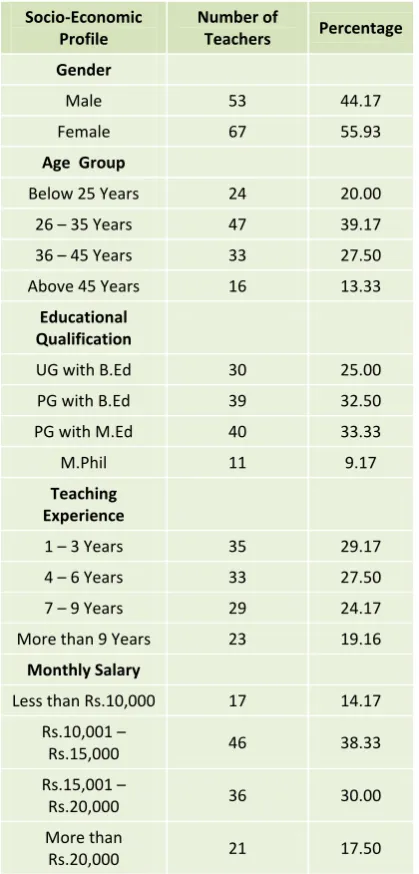
The socio-economic profile of teachers of matriculation schools was examined and the results are shown in Table-1.
Table 1: Socio-Economic Profile of Teachers of Matriculation Schools
Socio-Economic Profile
Number of
Teachers Percentage
Gender
Male 53 44.17
Female 67 55.93
Age Group
Below 25 Years 24 20.00
26 – 35 Years 47 39.17
36 – 45 Years 33 27.50
Above 45 Years 16 13.33
Educational Qualification
UG with B.Ed 30 25.00
PG with B.Ed 39 32.50
PG with M.Ed 40 33.33
M.Phil 11 9.17
Teaching Experience
1 – 3 Years 35 29.17
4 – 6 Years 33 27.50
7 – 9 Years 29 24.17
More than 9 Years 23 19.16
Monthly Salary
Less than Rs.10,000 17 14.17 Rs.10,001 –
Rs.15,000 46 38.33
Rs.15,001 –
Rs.20,000 36 30.00
More than
Rs.20,000 21 17.50
The results reveal that 55.93 per cent of teachers of matriculation schools are females and the rest of 44.17 per cent of them are males and 39.17 per cent of teachers of matriculation schools belong to age group of 26 – 35 years followed by 36 – 45 years (27.50 per cent), below 25 years (20.00 per cent) and above 45 years (13.33 per cent).
teaching experience of 1 – 3 years followed by 4 – 6 years (27.50 per cent), 7 – 9 years (24.17 per cent) and more than nine years (19.16 per cent). And 38.33 per cent of teachers of matriculation schools belong to monthly salary of Rs.10,001 – Rs.15,000 followed by Rs.15,001 – Rs.20,000(30.00 per cent), more than Rs.20,000(17.50 per cent) and less than Rs.10,000(14.17 per cent).
Perception of Teachers about Effectiveness of Performance Appraisal in Matriculation Schools
The perception of teachers about effectiveness of performance appraisal in matriculation schools was examined and the results are shown in Table-2.
Table-2: Perception of Teachers about Effectiveness of Performance Appraisal in Matriculation Schools
Effectiveness of Performance Appraisal
Mean Score
Standard Deviation
The performance appraisal gives a chance to understand precisely
what is expected from me
3.31 1.05
The performance appraisal provides valuable feedback about
my performance
3.79 0.94
The performance appraisal is useful for principal to know
requirements of teachers
3.71 0.86
The performance appraisal is helpful to me for self assessment
and reflection
3.73 0.92
The performance appraisal facilitates to understand personality features of teachers
3.28 1.15
The performance appraisal motivates open and transparent communication between principal
and teachers
3.80 1.02
The performance appraisal creates an opportunity to correct the
biases of principal
3.68 1.07
The performance appraisal improves relation between
principal and teachers
3.70 1.13
The performance appraisal assists teachers to get more insights in to their weaknesses and strengths
3.69 1.03
The performance appraisal helps the principal and teachers to have
a common understanding of teachers
3.33 1.19
The teachers of matriculation schools are agreed with the performance appraisal provides valuable feedback about their performance, the performance appraisal is useful for principal to know requirements of teachers, the performance appraisal is helpful to them for self assessment and reflection, the performance appraisal motivates open and transparent communication between
principal and teachers, the performance appraisal creates an opportunity to correct the biases of principal, the performance appraisal improves relation between principal and teachers and the performance appraisal assists teachers to get more insights in to their weaknesses and strengths, while, they are neutral with the performance appraisal gives a chance to understand precisely what is expected from them, the performance appraisal facilitates to understand personality features of teachers and the performance appraisal helps the principal and teachers to have a common understanding of teachers.
Socio-Economic Profile of Teachers and their Perception about Effectiveness of Performance Appraisal in Matriculation Schools
The distribution of teachers of matriculation schools based on effectiveness of performance appraisal is examined and the results are shown in Table-3. The effectiveness of performance appraisal is grouped into low moderate and high levels on the basis “ Mean ± SD”. The mean and SD are 32.68 and 4.33 respectively.
Table-3: Distribution of Teachers of Matriculation Schools on the Basis of Effectiveness of Performance Appraisal
Level of Effectiveness of
Performance Appraisal
Number of Teachers Percentage
Low 26 21.67
Moderate 61 50.83
High 33 27.50
Total 120 100.00
The results show that 50.83 per cent of teachers of matriculation schools have moderate level of perception about effectiveness of performance appraisal followed by high level (27.50 per cent) and low level (21.67 per cent).
Gender and Effectiveness of Performance Appraisal
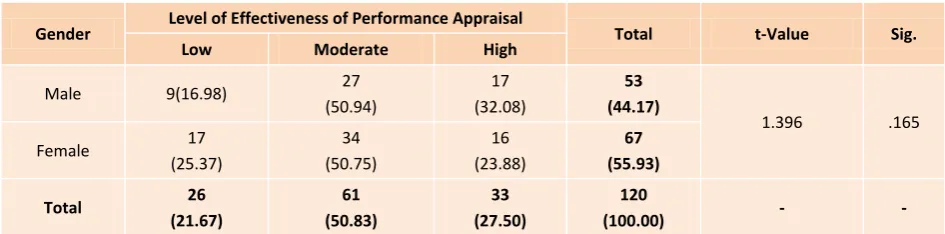
The relation between gender of teachers of matriculation schools and their perception about effectiveness of performance appraisal was examined and the results are shown in Table-4.
Table 4: Gender and Effectiveness of Performance Appraisal
Gender Level of Effectiveness of Performance Appraisal Total t-Value Sig.
Low Moderate High
Male 9(16.98) 27
(50.94)
17 (32.08)
53 (44.17)
1.396 .165
Female 17
(25.37)
34 (50.75)
16 (23.88)
67 (55.93)
Total 26
(21.67)
61 (50.83)
33 (27.50)
120
(100.00) - -
The figures in the parentheses are per cent to total
Age Group and Effectiveness of Performance Appraisal
The relation between age group of teachers of matriculation schools and their perception about
effectiveness of performance appraisal was examined and the results are shown in Table-5.
Table 5: Age Group and Effectiveness of Performance Appraisal
Age Group
Level of Effectiveness of Performance
Appraisal Total F-Value Sig.
Low Moderate High
Below 25 Years 3 (12.50)
16 (66.67)
5 (20.83)
24 (20.00)
6.473 .000 26 – 35 Years 10
(21.28)
20 (42.55)
17 (36.17)
47 (39.17)
36 – 45 Years 8 (24.24)
15 (45.46)
10 (30.30)
33 (27.50)
Above 45 Years 5 (31.25)
10 (62.50)
1 (6.25)
16 (13.33)
Total 26
(21.67)
61 (50.83)
33 (27.50)
120
(100.00) - -
The figures in the parentheses are per cent to total
Among 24 teachers of matriculation schools who have age group of below 25 years, 66.67 per cent of teachers perceived the level of effectiveness of performance appraisal at moderate level followed by high level (20.83 per cent) and low level (12.50 per cent). Among 47 teachers of matriculation schools who have age group of 26 – 35 years, 42.55 per cent of teachers perceived the level of effectiveness of performance appraisal at moderate level followed by high level (36.17 per cent) and low level (21.28 per cent).
Among 33 teachers of matriculation schools who have age group of 36 – 45 years, 45.46 per cent of teachers perceived the level of effectiveness of performance appraisal at moderate level followed by high level (30.30 per cent) and low level (24.24 per cent). Among 16 teachers of matriculation schools who have age group of above 45 years, 62.50 per cent of teachers perceived the level of effectiveness of performance appraisal at moderate level followed by low level (31.25 per cent) and high level (6.25 per cent).
The F-value of 6.473 is significant at one per cent level showing that there is significant difference between age
group of teachers of matriculation schools and their perception about effectiveness of performance appraisal. Therefore, the null hypothesis is rejected.
Among 30 teachers of matriculation schools who have education of UG with B.Ed, 46.67 per cent of teachers perceived the level of effectiveness of performance appraisal at moderate level followed by high level (30.00 per cent) and low level (23.33 per cent). Among 39 teachers of matriculation schools who have education of PG with B.Ed, 41.03 per cent of teachers perceived the level of effectiveness of performance appraisal at moderate level followed by high level (38.46 per cent) and low level (20.51 per cent).
Educational Qualification and Effectiveness of Performance Appraisal
The relation between educational qualification of teachers of matriculation schools and their perception
about effectiveness of performance appraisal was examined and the results are shown in Table-6.
Table 6: Educational Qualification and Effectiveness of Performance Appraisal
Educational Qualification
Level of Effectiveness of Performance Appraisal
Total F-Value Sig.
Low Moderate High
UG with B.Ed 7 (23.33)
14 (46.67)
9 (30.00)
30 (25.00)
5.034 .000 PG with
B.Ed
8 (20.51)
16 (41.03)
15 (38.46)
39 (32.50)
PG with M.Ed 9 (22.50)
24 (60.00)
7 (17.50)
40 (33.33)
M.Phil 2
(18.18)
7 (63.64)
2 (18.18)
11 (9.17)
Total 26
(21.67)
61 (50.83)
33 (27.50)
120
(100.00) - -
The figures in the parentheses are per cent to total
The F-value of 5.034 is significant at one per cent level showing that there is significant difference between educational qualification of teachers of matriculation schools and their perception about effectiveness of performance appraisal. Therefore, the null hypothesis is rejected.
Teaching Experience and Effectiveness of Performance Appraisal
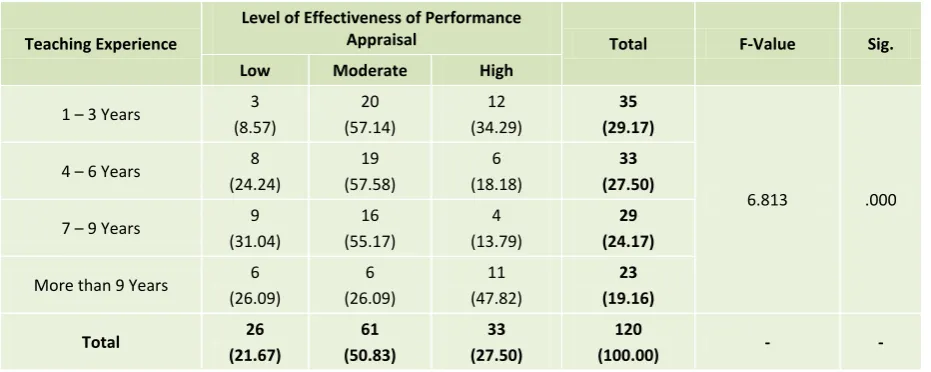
The relation between teaching experience of teachers of matriculation schools and their perception about effectiveness of performance appraisal was examined and the results are shown in Table-7.
Table 7: Teaching Experience and Effectiveness of Performance Appraisal
Teaching Experience
Level of Effectiveness of Performance
Appraisal Total F-Value Sig.
Low Moderate High
1 – 3 Years 3
(8.57)
20 (57.14)
12 (34.29)
35 (29.17)
6.813 .000
4 – 6 Years 8
(24.24)
19 (57.58)
6 (18.18)
33 (27.50)
7 – 9 Years 9
(31.04)
16 (55.17)
4 (13.79)
29 (24.17)
More than 9 Years 6 (26.09)
6 (26.09)
11 (47.82)
23 (19.16)
Total 26
(21.67)
61 (50.83)
33 (27.50)
120
(100.00) - -
The figures in the parentheses are per cent to total
Among 35 teachers of matriculation schools who have teaching experience of 1 – 3 years, 57.14 per cent of teachers perceived the level of effectiveness of performance appraisal at moderate level followed by high level (34.29 per cent) and low level (8.57 per cent). Among 33 teachers of matriculation schools who have teaching experience of 4 – 6 years, 57.58 per cent of teachers perceived the level of effectiveness of
performance appraisal at moderate level followed by low level (24.24 per cent) and high level (18.18 per cent).
cent of teachers perceived the level of effectiveness of performance appraisal at high level followed by low level and moderate level (26.09 per cent).
The F-value of 6.813 is significant at one per cent level showing that there is significant difference between teaching experience of teachers of matriculation schools and their perception about effectiveness of performance appraisal. Therefore, the null hypothesis is rejected.
Monthly Salary and Effectiveness of Performance Appraisal
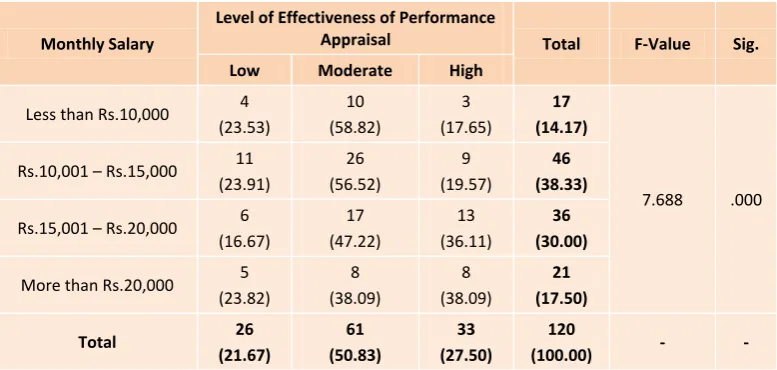
The relation between monthly salary of teachers of matriculation schools and their perception about effectiveness of performance appraisal was examined and the results are shown in Table-8.
Table 8: Monthly Salary and Effectiveness of Performance Appraisal
Monthly Salary
Level of Effectiveness of Performance
Appraisal Total F-Value Sig.
Low Moderate High
Less than Rs.10,000 4 (23.53)
10 (58.82)
3 (17.65)
17 (14.17)
7.688 .000 Rs.10,001 – Rs.15,000 11
(23.91)
26 (56.52)
9 (19.57)
46 (38.33)
Rs.15,001 – Rs.20,000 6 (16.67)
17 (47.22)
13 (36.11)
36 (30.00)
More than Rs.20,000 5 (23.82)
8 (38.09)
8 (38.09)
21 (17.50)
Total 26
(21.67)
61 (50.83)
33 (27.50)
120
(100.00) - -
The figures in the parentheses are per cent to total
Among 17 teachers of matriculation schools who have monthly salary of less than Rs.10,000, 58.82 per cent of teachers perceived the level of effectiveness of performance appraisal at moderate level followed by low level (23.53 per cent) and high level (17.65 per cent). Among 46 teachers of matriculation schools who have monthly salary of Rs.10,001 – Rs.15,000, 56.52 per cent of teachers perceived the level of effectiveness of performance appraisal at moderate level followed by low level (23.91 per cent) and high level (19.57 per cent).
Among 36 teachers of matriculation schools who have monthly salary of Rs.15,001 – Rs.20,000, 47.22 per cent of teachers perceived the level of effectiveness of performance appraisal at moderate level followed by high level (36.11 per cent) and low level (16.67 per cent). Among 21 teachers of matriculation schools who have monthly salary of more than Rs.20, 000, 38.09 per cent of
teachers perceived the level of effectiveness of performance appraisal at moderate level followed by high level (38.09 per cent) and low level (23.82 per cent).
The F-value of 7.688 is significant at one per cent level showing that there is significant difference between monthly salary of teachers of matriculation schools and their perception about effectiveness of performance appraisal. Therefore, the null hypothesis is rejected.
Relation between Effectiveness of Performance Appraisal and Job Performance of Teachers of Matriculation Schools
The relation between effectiveness of performance appraisal and job performance of teachers of matriculation schools was examined by employing correlation analysis and the results are shown in Table-9.
Table 9: Relation between Effectiveness of Performance Appraisal and Job Performance of Teachers of Matriculation Schools
Particulars Correlation Coefficient
Effectiveness of Performance Appraisal and Job Performance 0.47** **
indicates significant at one per cent level
The results show that the correlation coefficient between effectiveness of performance appraisal and job performance of teachers of matriculation schools is 0.47 that is positively and moderately related with each other at one per cent level of significance. Hence, the null hypothesis is rejected.
CONCLUSION
performance appraisal in matriculation schools and socio-economic profile of teachers except for gender. The effectiveness of performance appraisal has positive, significant and moderate relation with job performance of teachers of matriculation schools. In order to enhance the effectiveness of performance appraisal among teachers of matriculation schools, the performance appraisal system should accurately inform teachers what is exactly expected from them and must design in such way to clearly understand personality factors of teachers. Besides, the performance appraisal system should be made to help teachers and principal to understand their commonalities.
REFERENCES
1. Aguinis, H., 2007, Performance Management, Pearson Education, New York.
2. Pecheone, R. L., and Chung, R. R., “Evidence in Teacher Education: The Performance Assessment for California Teachers”, Journal of Teacher, 57(1), 2006, 22-36.
3. Kleinhenz, E., and Ingvarson, L., “Teacher Accountability in Australia: Current Policies and Practices and their Relation to the Improvement of Teaching and Learning”, Research Papers in Education, 19(1), 2004, 31-49.
4. Nolan, J., and Hoover, L. A., 2005, Teacher Supervision and Evaluation: Theory into Practice, John Wiley & Sons, Inc., New Jersey.
5. Wilson, J. P., 2005, Human Resource Development, Kogan Page, London.
6. Monyatsi, P., Steyn,T., and Kamper, G., “Teacher Perceptions of the Effectiveness of Teacher Appraisal in Botswana, South African Journal of Education, 26(3), 2006, 427-441.
7. Aguinis, H., 2009, An Expanded View of Performance Management. In J. W. Smither & M. London (Eds.), Performance Management: Putting Research into Action, CJossey-Bass, San Francisco.
8. Jacob, B. A., and Lefgren, L., “Can Principals Identify Effective Teachers? Evidence on Subjective Performance Evaluation in Education”, Journal of Labor Economics, 26(1), 2008, pp. 101-136.
9. Tuytens, M., and Devos, G., “Teachers Perception of the New Teacher Evaluation Policy: A Validity Study of the Policy Characteristics Scale”, Teaching and Teacher, 25(6), 2009, pp.924-930.
10.Chacha, C., Mwanjombe, G., Ndibalema, R., and Mwakasungura, H., 2010, Principles of Human Resource Management and Administration, Open University Tanzania, Tanzania.
11.Dessler, G., 2011, Human Resource Management, Pearson. Hall, New Jersey.
12.Ali, H.I.H., “How Should an Effective Performance Appraisal Be: EFL Teachers’ Perspective”, International Journal of Applied Linguistics and English Literature, 1(7), 2012, pp. 197-200.
13.Wanjiku, I.M., 2013, Teacher’s Perceptions of the Role of Performance Appraisal in Enhancing Teaching and Learning. A Case of Public Secondary Schools in Kiambu County Kenya, University of Kiambu, Kenya.
14.Behrooz Saljooghi and Keyvan Salehi, “Developing a Teacher Evaluation Model: The Impact of Teachers’ Attitude toward the Performance Evaluation System (PES) on Job Satisfaction and Organizational Commitment with the Mediating Role of Teachers’ Sense of Efficacy”, International Journal of Medical Research & Health Sciences, 5(5), 2016, pp. 200-209.
15.Hafiz Muhammad Ather Khan, Jawed Hassaan Chandio and Muhammad Tahir Khan Farooqi, “Comparison of Performance Appraisal System in Public and Private Schools”, Pakistan Journal of Commerce and Social Sciences, 8(1), 2014, pp. 272-278.
16.Suphawadee Uttaramar, Kowat Tesaputa and Anan Sri-Am-Pai, “The Development for Performance Appraisal System of Secondary School Teachers under Local Administrative Organization”, Journal of Education and Human Development, 4(1), 2015, 111-120.