Computation from Oblivious Linear Evaluation
Louis Cianciullo? ( )and Hossein Ghodosi
James Cook University, Townsville 4811, Australia
[email protected], [email protected]
Abstract. Oblivious linear evaluation (OLE) is a two party protocol that allows a receiver to compute an evaluation of a sender’s private, de-gree 1 polynomial, without letting the sender learn the evaluation point. OLE is a special case of oblivious polynomial evaluation (OPE) which was first introduced by Naor and Pinkas in 1999. In this article we utilise OLE for the purpose of computing multiplication in multi-party compu-tation (MPC).
MPC allows a set of n mutually distrustful parties to privately com-pute any given function across their private inputs, even if up tot < nof these participants are corrupted and controlled by an external adversary. In terms of efficiency and communication complexity, multiplication in MPC has always been a large bottleneck. The typical method employed by most current protocols has been to utilise Beaver’s method, which relies on some precomputed information. In this paper we introduce an OLE-based MPC protocol which also relies on some precomputed infor-mation.
Our proposed protocol has a more efficient communication complexity than Beaver’s protocol by a multiplicative factor oft. Furthermore, to compute a share to a multiplication, a participant in our protocol need only communicate with one other participant; unlike Beaver’s protocol which requires a participant to contact at leasttother participants.
1
Introduction
Oblivious polynomial evaluation (OPE) was first introduced by Naor and Pinkas [10] in 1999. An OPE protocol consists of two participants, a sender,Swho holds a polynomialf(x) and a receiver,Rwho has a valueα. OPE allowsRto learn
f(α) without having S learn αand also keeping f(x) private. A more formal definition, originally given in [5] is presented below:
Definition 1. [5] An OPE protocol is composed of two parties, S who has a polynomial f(x) over a finite field F and R who has an input value α ∈ F. Correctness is achieved if, at the end of the protocol, R learns f(α). Security is guaranteed if the following two conditions are met after the protocol has been executed:
?This research is supported by an Australian Government Research Training Program
1. S cannot reduce his uncertainty ofα.
2. Rdoes not learn any information relating to f(x), other than f(α).
In this article we focus on a special case of OPE, wherein f(x) is of degree at most one, known as oblivious linear evaluation (OLE). Specifically, we utilise OLE for the purpose of performing multiplication in multi-party computation (MPC).
MPC allows a set ofnmutually distrustful participants to compute any given function across their private inputs, without revealing any information relating to their private inputs. We focus on the threshold setting, where an MPC protocol is considered secure if a set of t or less participants, where t < n, cannot gain any information relating to another participant’s private input, other than what the output of the protocol gives them. More formally:
Definition 2. A (t, n) threshold MPC protocol allows a set of n participants,
P1,· · · , Pn with respective private inputs, x1,· · · , xn to compute a given func-tion, f(x1,· · · , xn).
Privacy is maintained if, after completion of the protocol, an adversary con-trolling any subset of up totparticipants (t < n), cannot learn more information (about other participant’s private inputs) than what could be derived from each participant’s individual, private input and the output of the protocol.
Traditionally, the adversary is classified as either passive or malicious. Par-ticipants under control of a passive adversary may share information with one another but do not deviate from the MPC protocol. Participants under control of a malicious adversary also share information but may act arbitrarily, i.e. they do not necessarily follow the protocol. Another aspect of the adversary consid-ered in an MPC protocol is the resources it has at its command. Specifically, an unconditionally (information theoretic) secure MPC protocol is secure against a computationally unbounded adversary. Whilst a conditionally (computationally) secure MPC protocol is secure against a computationally bounded adversary.
In this article we focus on information theoretic (t, n) threshold MPC secure against a passive adversary. We show the construction of an efficient MPC scheme based on OLE. In the next section we give some background and motivation on this topic, following this we then discuss our contribution in depth.
1.1 Background
of the protocol, a set oft+ 1 or more participants then pool their information to reconstruct the output.
Due to the homomorphic nature of Shamir’s scheme [3] participants can easily compute any linear operation by privately computing on their shares. However, since the inception of MPC [8] the largest limiting factor has been the high amount of resources required to compute a multiplication. Perhaps the most widely known and efficient method of computing a multiplication in an MPC protocol is known as Beaver’s method (A.K.A Beaver’s triples) [1]. For completeness we review this protocol below.
Beaver’s Method Beaver’s method [1] for computing a multiplication in MPC relies on some pre-shared information known as a triple. Specifically, a triple is composed of three values,a, b and c where a·b=c and a, b, c∈ Fq such that
q > n and q is a prime number. Each participant has a share of these triples, such that participantPk (k= 1,· · ·, n) receives the sharesak,bk andck relating to (respectively) a, bandc.
Suppose we have participants Pi with input xi and Pj with input xj for
i, j = 1,· · ·, n and i 6=j. To compute shares of the multiplication γ = xi·xj we first have bothPi andPj distribute shares of their private values among the other participants, where Pk gets xik relating to xi and xjk relating to xj. To compute a share,γkrelating to the productγ, a set of at leastt+ 1 participants execute the following steps:
1. Each participant,Pk, computes zk =xik−ak andvk =xjk−bk, where zk is a share of the valuez=xi−aandvk is a share ofv=xj−b.
2. A set of at leastt+ 1 participants broadcast their shares,zk andvk amongst themselves.
3. Participants publicly reconstruct the values of z and v using the shares zk andvk, respectively.
4. Pk computes his share ofγ asγk =zv+zbk+vak+ck.
5. t+ 1 or more participants can reconstructγ=xi·xjby pooling their shares.
In order to constructzandva set oft+1 participants is required to cooperate. If all participants in this set wish to compute these values (and consequently, the multiplication) then each participant must both receive and sendtmessages. Since each message would consist of 2 elements from the fieldFq (i.e.zk andvk) the communication complexity of this protocol can be given asO(qt2).
TinyOLE Recently D¨ottling et al. [7] proposed a two-party protocol (n= 2) in which the two participants, P1 and P2 use OLE to compute shares to a multiplication. Specifically, they use OLE to compute multiplication triples in an offline phase. Their scheme utilises a simple additive secret sharing scheme wherein a given value,a (for example), is represented as a=a1+a2, across a finite fieldF; whereP2has the sharea2andP1getsa1. Addition in their scheme consists of simply adding shares together. Multiplication is achieved by utilising OLE in a black-box fashion.
To compute a multiplication of two distributed (and not necessarily known) values,a and b, they rely on the fact that: ab=a1b1+a1b2+a2b1+a2b2. To compute the “troublesome” terms of the formc=a1b2 they utilise a black-box OLE. Essentially,P1acts as a sender and submits the polynomialf(x) =a1x−c1 wherec1is a randomly chosen value. The second participant,P2acts as receiver and submitsα=b2. Both participants send their values to a black-box OLE, with
P2receiving backf(α) =a1b2−c1. If we setc2=f(α) then each participant now holds a share ofcasc=c1+c2. To compute shares to the entire multiplication it is easy to see that at least 2 OLEs are needed.
D¨ottling et al. specifically use this method in a computationally secure offline phase to compute random multiplication triples, where the values ofaandbare not actually known to either participant. Our proposed scheme differs to theirs in that we wish to utilise OLE in an information theoretic, online phase to compute the multiplication of known input values for a given MPC function.
1.2 Our Contribution
In this section we summarise our proposed MPC scheme which utilises OLE to compute shares to a given multiplication. In contrast to the methods discussed above our protocol obtains the following desirable properties:
1. Unlike Beaver’s scheme [1] our proposed protocol only requires communica-tion between two participants to compute a given share to a multiplicacommunica-tion i.e. a participant may compute his share without the assistance oft other participants. We achieve this result by having one designated participant who acts as a sender in an OLE. The other participants need simply pri-vately compute an OLE with this sender participant to compute a share to a multiplication. As a result of this, the communication complexity of our protocol is O(qt), which is more efficient than Beaver’s (at O(qt2)) by a multiplicative factor oft.
3. Our scheme only utilises one OLE per participant to compute a multipli-cation. In a two party protocol we would only need one OLE. So, for an individual participant to compute his share (in either a multi-party or two-party protocol) the complexity cost is justO(q). Using Beaver’s scheme, this would beO(qt).
4. Lastly, unlike the TinyOLE scheme [7], our scheme is scalable, in that it extends to the multi-party case with n participants. In fact, computing n
shares (one for each participant) to a single multiplication requires only
n−1 OLEs, one for each individual participant to compute his share. We note that utilising allnparticipants is not actually necessary. We only really require a set oft+ 1 participants, enough to compute the output of a given multiplication at the end of the protocol.
1.3 Outline
The rest of the paper is organised as follows. In section 2 we go over some of the sub protocols and tools used in our proposed MPC protocol. Section 3 gives a high level overview of our protocol as well as a model for security. The actual construction for our protocol is given in section 4, along with an evaluation and proof of correctness and security.
2
Preliminaries
In this section we review Shamir’s secret sharing scheme [12] and the the infor-mation theoretic OPE originally given by Hanaoka et al. in [9]. Both of these protocols are fundamental building blocks of our proposed MPC protocol.
2.1 Shamir’s Secret Sharing Scheme
Like all MPC schemes our proposed protocol utilises secret sharing to ensure privacy. In a secret sharing scheme a set of n participants are each privately sent a share of a given secret. An authorised subset of these participants can pool their shares to recover the secret, whilst an unauthorised subset should get no information. We note that our proposed OLE-based MPC scheme can potentially work with any linear secret sharing scheme. However, in order to show a specific implementation we will demonstrate our proposed protocol using Shamir’s secret sharing scheme [12].
Shamir’s scheme is a (t, n) threshold scheme, meaning that an authorised subset is any set oft+ 1 or more participants wheret < n. This scheme operates over a finite field Fq where q > n and q is a prime number. To demonstrate, suppose we have participant Pi (i = 1,· · ·, n) who wishes to distribute his input value,xiamong the other participants.Picomputes a random polynomial,
2.2 Information Theoretic OPE
Hanoka et al. [9] introduced an unconditionally secure OPE protocol that utilises some pre-distributed information to achieve information theoretic security. Our proposed OLE-based MPC protocol utilises a modified variant of their OPE protocol to compute a multiplication. Therefore, for completeness, we display their full protocol in figure 1.
In the initial, setup phase of their protocol a third party, known as an ini-tialiser assigns some random information to both Rand S. Following this the initialiser takes no further part in the protocol andRandS utilise the assigned information to compute an OPE in the computation phase of the protocol.
Input:Rhas a valueαandS the polynomialf(x) of degree at mostt.
Output:Robtainsf(α) andS gets nothing.
Setup The initialiser privately sends:
1. A random polynomial,S(x), of degree at mostttoS. 2. A random value,dand the valueg=S(d) toR.
Computation
1. Rsends the valuel=α−dtoS.
2. S then computes and sends toRthe polynomialV(x) =f(l+x) +S(x). 3. Rcomputesf(α) =V(d)−g.
Fig. 1.Information Theoretic OPE [9,13]
3
Model
This section presents a high level overview of our protocol and a set of crite-ria for evaluating the security of our scheme. We use the traditional setting of MPC protocols. That is, each party Pj (1 ≤j ≤ n) distributes its private in-put,xj amongst all participants, using a Shamir (t, n) threshold scheme. Linear functions can be computed by each participant privately. In order to perform multiplication, however, we must utilise OLE.
3.1 Overview
participants Pi and Pj, for 1 ≤ i, j ≤ n and i 6= j. Further suppose, that Pj utilises the polynomial fj(x) to share xj among all participants (via Shamir’s secret sharing scheme), such that a given participantPk (k= 1,· · · , n) receives the sharexjk=fj(k) ofxj.
A simple method for computing shares ofγ is to have each participant, Pk, simply send his share,xjk, toPi who can then send back the valueγk=xixjk. Due to the homomorphic nature of Shamir’s secret sharing scheme the value
γk is a share corresponding to the polynomial Γ(x) =xifj(x) with free term
xi·xj. The obvious problem with this simple protocol is that neither Pi’s nor
Pj’s privacy is maintained.
To keepPi’s input,xi, private we can have Pi introduce a random, private masking polynomial,hi(x), of degree at mostt, with free termhi(0) = 0. Now, when he receives a given share,xjk, we requirePito send backγk =xixjk+hi(k). EachPknow holds shares to the polynomialΓ(x) =xifj(x)+hi(x). Intrinsically we can see that, due to Shamir’s secret sharing scheme, the protocol is now t -private with respect toPi, as a set oftparticipants withtshares cannot compute any information relating to the effectively random polynomialΓ(x). It remains to ensure the privacy ofPj.
Surprisingly, ensuring thatPj’s privacy is maintained is actually quite simple. Rather than having each Pk simply hand his share to Pi we instead have Pk and Pi utilise an OLE protocol, where Pk acts as the receiver and Pi as the sender. FirstPicomputes two polynomials,fi(x) =xi·xandhi(x) (the masking polynomial, as before). Each Pk (1 ≤ k ≤ n) then acts as the receiver and executes an OPE protocol withPi(who acts as the sender) to privately evaluate
Pi’s polynomial,fi(x) at the pointxjk, as beforePiadds the masking polynomial to his computation.
Fig. 2.Overview of the protocol
his own share of γ=xi·xj (of course, there is no need to perform OLE, as he plays the role of the sender and receiver at the same time).
3.2 Security and Correctness
In order to prove the security and correctness of our proposed scheme we will evaluate it against the following criteria specified below:
1. Correctness –Upon completion of the protocol each participant,Pk holds a share, γk of the polynomial Γ(x), of degree at most t with free term
Γ(0) =xi·xj.
2. Privacy – A set of t or less participants, not including either Pi or Pj, cannot reduce their uncertainty ofxior xj.
3. Privacy with respect toPi –A set oftor less participants, includingPj, cannot reduce their uncertainty ofxi.
4. Privacy with respect toPj –A set oftor less participants, includingPi, cannot reduce their uncertainty ofxj.
We note that the last three criterion presented here simply encapsulate the notion of privacy given in definition 2.
4
Proposed OLE-Based MPC Protocol
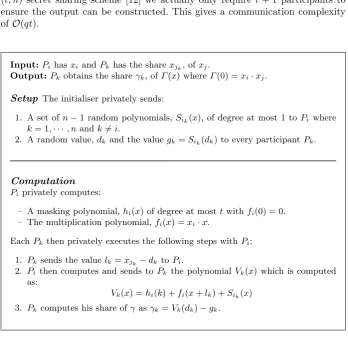
Similar to the OPE protocol given in figure 1, our proposed multiplication pro-tocol consists of two phases:
1. The Setup Phase:Where the initialiser privately sends some (essentially random) information to each participant involved in the protocol.
2. The Computation Phase:Where participants are able to compute shares to the multiplication.
Where our scheme differs, however, is in the addition of a masking polynomial (hi(x)) and the limiting of the receivers polynomial to a degree no greater than 1 (OLE).
As per section 3.1 suppose we have a set ofn participantsP1,· · ·, Pn, with respective private inputs x1,· · ·, xn, who wish to compute shares of the value
γ=xi×xj wherei, j∈[1, n] andi6=j. ParticipantPjfirst privately distributes shares forxj amongst all participants, using the polynomialfj(x), such thatPk (1 ≤k ≤n) gets the share xjk =fj(k). To compute a share γk, of γ each Pk cooperates with Pi to execute our modified OLE protocol, withPk essentially acting as the receiver and Pi acting as the sender for each Pk. Note that all computations are performed in the fieldFq whereqis a prime number such that
q > n. The full protocol is given in Figure 3.
In order to compute a sharePkandPiexchange exactly 3 field elements (land
his share can be given asO(qn). However, since the protocol is based on Shamir’s (t, n) secret sharing scheme [12] we actually only require t+ 1 participants to ensure the output can be constructed. This gives a communication complexity ofO(qt).
Input:PihasxiandPkhas the sharexjk, ofxj.
Output:Pkobtains the shareγk, ofΓ(x) whereΓ(0) =xi·xj.
Setup The initialiser privately sends:
1. A set ofn−1 random polynomials,Sik(x), of degree at most 1 toPiwhere
k= 1,· · ·, n andk6=i.
2. A random value,dkand the valuegk=Sik(dk) to every participantPk.
Computation
Piprivately computes:
– A masking polynomial,hi(x) of degree at mosttwithfi(0) = 0.
– The multiplication polynomial,fi(x) =xi·x.
EachPk then privately executes the following steps withPi:
1. Pk sends the valuelk=xjk−dktoPi.
2. Pi then computes and sends toPk the polynomialVk(x) which is computed
as:
Vk(x) =hi(k) +fi(x+lk) +Sik(x)
3. Pk computes his share ofγasγk=Vk(dk)−gk.
Fig. 3.An information theoretic, OLE-based multiplication protocol for MPC
4.1 Evaluation
In this section we evaluate the proposed protocol against the set of security criteria given in section 3.2. We note that all four of these criterion evaluate the specific multiplication protocol and not the actual MPC itself. That is, we evaluate the multiplication protocol only and assume that participants have not yet reconstructed the actual output of the MPC.
xj and bothhi(x) andfj(x) are of degree at mostt. As a result of this we can conclude that correctness is achieved, as each Pk has a share to a polynomial,
Γ(x), of degree at mostt, with free term equal toxi·xj.
Privacy
Theorem 1. A set of t participants, not including Pi or Pj, cannot compute any information relating toxi orxj.
In order to prove this we must first show that the modified OLE protocol is secure. Following this, we need to prove that a set of t shares relating to the multiplication reveals no information.
Proof. Suppose that a given participant,Pkexecutes the multiplication protocol withPi. After sendinglktoPihe receivers the polynomialVk(x) =hi(k)+fi(x+
lk) +Sik(x) which we can simplify as Vk(x) =vk+zkx. LetSik(x) =κk+ωkx and recall that fi(x) = xi ·x, then we can rewrite the equation as V(x) =
hi(k) +xilk+κk(xi+ωk)x. This givesPk the following information:
vk=hi(k) +xilk+κk
zk=xi+ωk
Since the values ωk and κk (as well as the coefficients of hi(x)) are chosen at random, Pk cannot gain any information from the above equations. The next step in the protocol is forPk to computeγk =V(dk)−gk, which can be written as γk =hi(k) +xixij. Individually, this gives no information to Pk as he does not know the value of either hi(k) or xi, it remains to be seen if a coalition of participants can compute any information.
Without loss of generality suppose that the first set oftparticipants,P1,· · ·, Pt pool their information together. Lethi(x) =m1x+m2x2+· · ·+mtxt, then the coalition can compute the following system:
γ1=xi·xi1+m1+m2+· · ·+mt γ2=xi·xi2+ 2m1+ 4m2+· · ·+ 2
tm t ..
.
γt=xi·xit+tm1+t 2m
2+· · ·+ttmt
Due to the perfectness of of Shamir’s secret sharing scheme [4,12] the above system does not reveal any information to the participants as they effectively have a set oftshares relating to a degreetpolynomial. This becomes even more evident when we take into account thatxik=fj(k) meaning that eachPk has a share of the polynomialΓ =xifj(x) +hi(x).
Privacy with respect toPi
Theorem 2. A set of t participants, including Pj, cannot compute any infor-mation relating to xi.
Proof. The proof of this is similar to the proof of theorem 1 along with some extra information. Namely, we now assume that the coalition of participants has the values of bothfj(x) and, consequentlyxj. The first, obvious ramification of this is that the coalition now know the shares of every other participant relating toxj. This actually gives them no advantage, in regards to the OLE, as they do not know (and cannot compute) the values given to the other participants by the initialiser (namelydkandgk). We therefore only need to prove that knowing
fj(x) reveals no information relating toxi.
As before, at the end of the protocol each participant has a share to the polynomial Γ(x) = xifj(x) +hi(x). It is easy to see that if the coalition can compute Γ(x) or even hi(x) then they can easily compute xi. However, the coalition do not hold direct shares to hi(x), so even knowing hi(0) = 0 gives them nothing. Furthermore, to compute any information relating toΓ(x) would require the coalition to compute a solution to the system given in the proof of theorem 1.
Computing a solution to this system is analogous to solving a system of equations composed of t+ 1 unknowns (xi and the coefficients of hi(x)) and
t equations. We can therefore conclude that a set of participants, including Pj cannot reduce their uncertainty of xi.
Privacy with respect toPj
Theorem 3. A set of t participants, including Pi, cannot compute any infor-mation relating to xj.
Proof. In the proof of theorem 1 it was shown that the modified OLE is secure, therefore to prove the above theorem we need to show that a coalition of t
participants, including Pi, with t shares relating to Γ(x) = xifj(x) +hi(x) and tshares of fj(x) cannot compute any information relating to xj. First, let
fj(x) =xj+W1x+· · ·+Wtxtand assume, as before, that a coalition composed of the first t participants (which includes Pi) pool their knowledge. They can construct the following system from their shares ofΓ(x):
γ1=xi·(xj+W1+· · ·+Wt) +hi(1)
γ2=xi·(xj+ 2W1+· · ·+ 2tWt) +hi(2) ..
.
γt=xi·(xj+tW1+· · ·+ttWt) +hi(t)
xj1 =xj+W1+· · ·+Wt xj2 =xj+ 2W1+· · ·+ 2
tW t ..
.
xjt =xj+tW1+· · ·+t tW
t
It is easy to see that the two systems are actually linearly dependent. Since the values of xi and hi(x) are known to the coalition, this results in a system composed oft+ 1 unknowns (the coefficients offj(x)) and onlytlinearly inde-pendent equations. The net result of this is that each value of xj is, from the point of view of the coalition, equally likely. Meaning that they cannot compute any information relating toxj.
References
1. Beaver, D.: Efficient Multiparty Protocols Using Circuit Randomization. In: Feigenbaum, J. (ed.) Advances in Cryptology — CRYPTO ’91. pp. 420–432. Springer Berlin Heidelberg (1992)
2. Ben-Or, M., Goldwasser, S., Wigderson, A.: Completeness Theorems for Non-cryptographic Fault-tolerant Distributed Computation. In: Proceedings of the Twentieth Annual ACM Symposium on Theory of Computing. STOC ’88, ACM, New York, NY, USA (1988)
3. Benaloh, J.C.: Secret sharing homomorphisms: Keeping shares of a secret secret (extended abstract). In: Odlyzko, A.M. (ed.) Advances in Cryptology — CRYPTO’ 86. pp. 251–260. Springer Berlin Heidelberg, Berlin, Heidelberg (1987)
4. C. L. F. Corniaux, H. Ghodosi: An entropy-based demonstration of the security of Shamir’s secret sharing scheme. In: 2014 International Conference on Information Science, Electronics and Electrical Engineering. vol. 1, pp. 46–48 (Apr 2014) 5. Chang, Y.C., Lu, C.J.: Oblivious polynomial evaluation and oblivious neural
learn-ing. In: Boyd, C. (ed.) Advances in Cryptology — ASIACRYPT 2001. pp. 369–384. Springer Berlin Heidelberg, Berlin, Heidelberg (2001)
6. Chaum, D., Cr´epeau, C., Damg˚ard, I.: Multiparty Unconditionally Secure Pro-tocols. In: Proceedings of the Twentieth Annual ACM Symposium on Theory of Computing. pp. 11–19. STOC ’88, ACM, New York, NY, USA (1988)
7. D¨ottling, N., Ghosh, S., Nielsen, J.B., Nilges, T., Trifiletti, R.: Tinyole: Efficient actively secure two-party computation from oblivious linear function evaluation. In: Proceedings of the 2017 ACM SIGSAC Conference on Computer and Commu-nications Security. pp. 2263–2276. CCS ’17, ACM, New York, NY, USA (2017) 8. Goldreich, O., Micali, S., Wigderson, A.: How to play any mental game.
In: Proceedings of the Nineteenth Annual ACM Symposium on Theory of Computing. pp. 218–229. STOC ’87, ACM, New York, NY, USA (1987), http://doi.acm.org/10.1145/28395.28420
10. Naor, M., Pinkas, B.: Oblivious Transfer and Polynomial Evaluation. In: Proceed-ings of the Thirty-first Annual ACM Symposium on Theory of Computing. pp. 245–254. STOC ’99, ACM, New York, NY, USA (1999)
11. Rabin, T., Ben-Or, M.: Verifiable Secret Sharing and Multiparty Protocols with Honest Majority. In: Proceedings of the Twenty-first Annual ACM Symposium on Theory of Computing. STOC ’89, ACM, New York, NY, USA (1989)
12. Shamir, A.: How to share a secret. Commun. ACM 22(11), 612–613 (1979) 13. Tonicelli, R., Nascimento, A.C.A., Dowsley, R., M¨uller-Quade, J., Imai, H.,