465 | P a g e
PERFORMANCE EVALUATION OF SPARK
IGNITION ENGINE RUNNING ON PETROL DOPED
WITH VARIOUS ADDITIVES
1
Mohd. Yunus Khan,
2Praveen Pachauri,
3Atishey Mittal
31
Assistant Professor, Mechanical Engineering Section, University Polytechnic,
Aligarh Muslim University, Aligarh, (India)
2
Professor, Mechanical Engineering Department,
Noida Institute of Engineering and Technology, Greater Noida, (India)
3
Assistant Professor, SRM University, NCR Campus, Delhi Meerut Road, Ghaziabad.(India)
ABSTRACT
The aim of this experimental investigation was to analyze the performance of Spark Ignition (S.I.) engine
running on petrol doped with various additives. Additives used in this work were toluene, benzene and ethanol.
The test setup consists of four cylinder, four strokes, and stationary S.I. engine. The engine performance with
petrol doped with ethanol was found to be better than pure petrol while the performance with toluene as
additive was found to be slightly poorer than petrol at low loads. However, at higher loads, engine performance
with toluene doped petrol was better than that with pure petrol. For all values of loads, the engine performance
with benzene was found to be poor. The short-term experimental results show that petrol containing 20%
toluene and 20% ethanol as additive can be successfully substituted without any alteration in engine design.
Keywords- Fuel Additives, Performance Enhancers, S.I. Engine Performance.
I. INTRODUCTION
Knocking is an abnormal combustion occurs in S.I. engines, which imposes a limit on the efficiency of such
engines [1-2]. In S.I. engines, the compressed petrol-air mixtures have a tendency to ignite prematurely rather
than burning smoothly. This creates engine knock, a characteristic pinging sound. Thus, knocking takes place as
a result of the auto-ignition of the end charge ahead of the flame front. It depends on various factors which
includes the pressure and temperature of the end charge as well as on the knock resistance of the fuel used.
Knocking can cause engine damage, if severe. Knock resistance of the fuel is measured by the Octane Number.
Fuel having higher octane number resists knocking by igniting less readily than fuel having lower octane
466 | P a g e
The octane scale is based on two paraffins: iso-octane and n-heptane. Blends of these two components are
referred to as primary reference fuels (PRFs). Octane number of the test fuel is defined as the percentage by
volume of iso-octane in the mixture of PRFs, which gives the same knock intensity as that of test fuel.
Iso-octane has a good resistance to knocking and hence, arbitrarily assigned an Iso-octane number of 100 while
n-heptane has a poor knock resistance and hence, has been assigned octane number of zero [3-4]. The knocking
tendency of a fuel varies under different operating conditions. Therefore, octane number is determined under
more than one set of test conditions. The research octane number (RON) is determined with a test engine
running at a low speed of 600 rpm while the motor octane number (MON) is determined with a test engine
running at a higher speed of 900 rpm [3].
Anti-knock rating of fuel and S.I. engine performance can be improved by adding substances that have high
octane number such as benzene, alcohol, toluene, tetraethyl lead, methyl butyl ether (MTBE), ethyl
tert-butyl ether (ETBE) etc. Such substances are known as additives (dopes or performance enhancers) and are
added to petrol in small percentage. Among the various alcohols, ethanol is more suitable for S.I. engines [5-6].
Some of these petrol additives can be hazardous to the environment. Production of high octane rating petrol
through refining process is uneconomical. Modern engines employ high compression ratios and require fuels to
have high knock resistance. Therefore, additives are added in ordinary petrol. Additives have different
properties and can result to engines operating away from design conditions. The additives can be hydrocarbon,
non-hydrocarbon, organic or inorganic compound. [7].
In the aim of this experimental investigation was to evaluate performance of S.I. engine running on petrol doped
with various additives. Toluene, benzene and ethanol are used as additives. The fuel containing 80% petrol and
20% of each additive on volume basis was prepared and used four stroke S.I. engine. The following
nomenclature is used in this work: PP: Pure Petrol; T20: 20% volume of toluene and 80% volume of petrol;
B20: 20% volume of benzene and 80% volume of petrol and E20: 20% volume of ethanol and 80% volume of
petrol. Pure petrol was used a reference fuel. The fuels used for entire testing belonged to the same supply, to
avoid the unnecessary introduction of any variation during experimentation.
II. PROPERTIES OF ADDITIVES
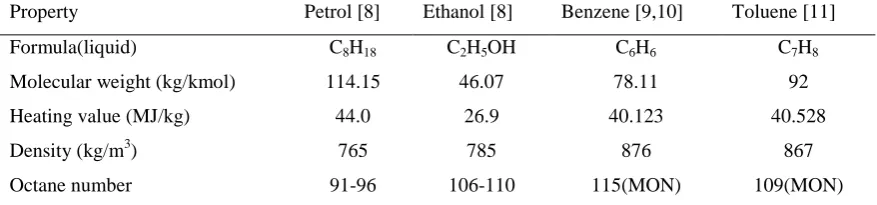
Table 1 compares properties of three additives (ethanol, benzene and toluene) with petrol.
Table 1. Properties of additives in comparison with petrol
Property Petrol [8] Ethanol [8] Benzene [9,10] Toluene [11]
Formula(liquid) C8H18 C2H5OH C6H6 C7H8
Molecular weight (kg/kmol) 114.15 46.07 78.11 92
Heating value (MJ/kg) 44.0 26.9 40.123 40.528
Density (kg/m3) 765 785 876 867
Octane number 91-96 106-110 115(MON) 109(MON)
Ethanol can be produced from renewable energy sources such as sugarcane, corn, barley and many other types
467 | P a g e
Using ethanol in pure form necessitates some alterations in engine design whereas it can be used in existing
engine design by blending it with petrol at low concentrations without any design alteration [16]. Ethanol
contains an oxygen atom, therefore, it can be considered as a partially oxidized hydrocarbon. Hence, it has lower
heating value than petrol [15-16]. Density of ethanol was observed to be slightly higher than petrol. Ethanol has
higher octane number than petrol. Hence, it can lead to operation at higher compression ratios [3,8].
Benzene is an organic compound that is a colorless or light yellow in color. It is highly flammable, has a sweet
odor and quickly evaporates into air. Benzene is formed from both natural and man-made processes [9]. It can
be seen from table that heating value of benzene is slightly lower than that of petrol. Also, its density and octane
number are higher than that of petrol.
Toluene is pure aromatic hydrocarbon compound that is colorless and flammable liquid possessing
characteristics aromatic odour. Toluene is used in the manufacture of chemicals, drugs, paints etc. The use of
pure toluene is only possible, if the engine is designed or modified for that purpose. However, it can be mixed
with petrol in varying proportions for use in unmodified engine design [11]. Density of toluene is higher than
petrol while heating value if lower. Toluene is such an effective anti-knock fuel as its octane number is higher
than petrol.
III. EXPERIMENTAL METHODOLOGY
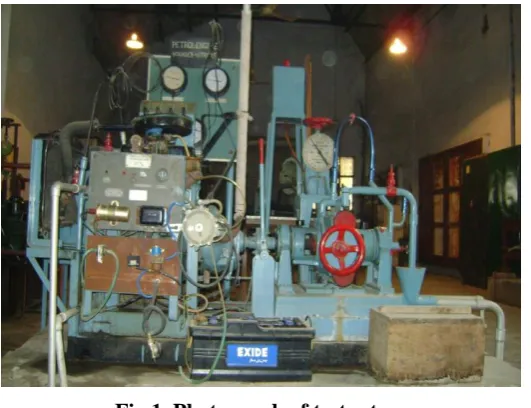
The test setup consists of four cylinder, four stroke, stationary S.I. engine of Ambassador car. The test engine is
coupled with hydraulic dynamometer and mounted on reinforced cement concrete base as shown in Fig. 1. The
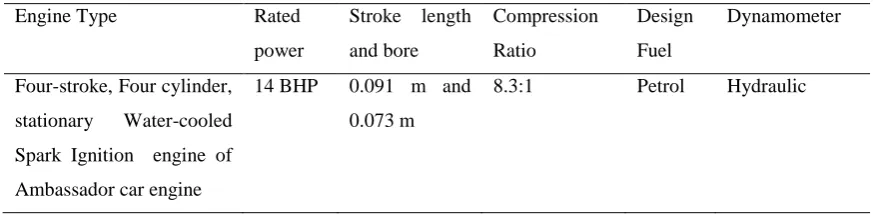
detailed specifications of the test engine are given in Table 2.
Fig 1. Photograph of test setup.
The following devices are attached with the test engine:
1. Arrangement for measuring the fuel consumption.
2. Orifice meter for the measurement of air intake to engine;
3. Cooling water arrangement with flow measuring device;
468 | P a g e
Table 2. Specifications of test engine
Engine Type Rated
power
Stroke length
and bore Compression Ratio Design Fuel Dynamometer
Four-stroke, Four cylinder,
stationary Water-cooled
Spark Ignition engine of
Ambassador car engine
14 BHP 0.091 m and
0.073 m
8.3:1 Petrol Hydraulic
Testing of engine means to run the engine at different speeds under different loading conditions and record
certain parameters. Performance of the engine means its capacity to develop power and the efficiency with
which this power is developed [7].
Constant speed performance tests were carried out using petrol doped with additives and pure petrol. First the
engine was operated using pure petrol and various parameters were recorded. Results obtained with pure petrol
operation were used as reference value. The engine tests were conducted at a constant speed of 1200 rpm. The
speed of revolutions per minute (rpm) of the engine was noted using a tachometer. The tests were repeated using
petrol doped with three different additives. All experiments were performed three times and average value was
taken.
The following parameters were recorded during engine tests:
1. Speed of the engine
2. Load on the engine
3. Specified mass of the fuel consumed
4. Time for this mass of fuel consumed
5. Temperature of exhaust gas
For analyzing the performance of S.I. engine, recorded data was used for calculating brake specific fuel
consumption (BSFC) and brake thermal efficiency. Mass consumption rate of the fuel with corresponding
calorific value gives the rate of heat input to the engine. Applied load and engine speed enabled us to calculate
the brake power (B.P.) of the engine. The actual power available at the engine shaft is known as B.P. For
investigating the extent of the fuel consumed for a unit brake power developed, BSFC was calculated. Brake
thermal efficiency was used for analyzing the conversion ability (i.e. heat into useful work) of the test engine
with different fuels. Comprehensive data were obtained and results analyzed. Exhaust gas temperature was also
measured. [8]
IV.
RESULTS AND DISCUSSIONS
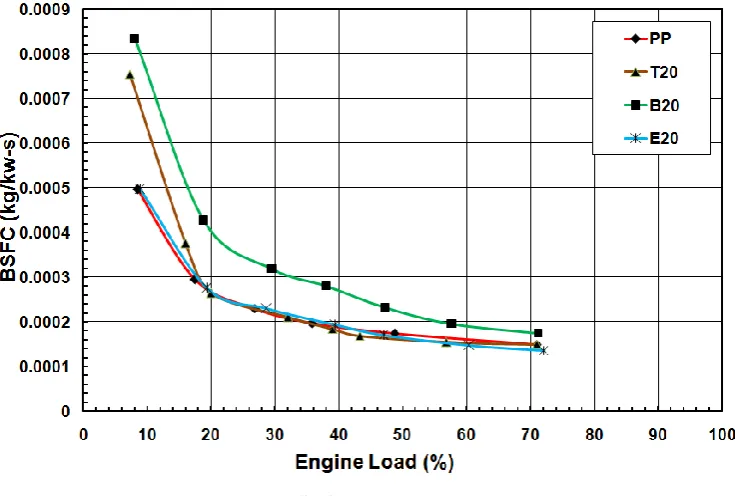
The influence of engine load on brake specific fuel consumption (BSFC) for test engine operation using PP,
T20, B20 and E20 is shown in Fig. 2. It can be seen that petrol doped with additives have similar trend as that of
469 | P a g e
BSFC was slightly higher at low loads but at higher loads, better BSFC values were obtained. When pure petrol
was doped with 20% benzene, higher values of BSFC were observed at all loads.
Fig. 2. BSFC Vs % engine load.
The variation of brake thermal efficiency with respect to engine load is shown in Fig. 3. It is clear from the
figure that doped fuel and reference fuel follows similar trend i.e. increases with engine load. The brake thermal
efficiency of E20 operated engine is higher than that obtained with pure petrol. This is a normal consequence of
the behavior of the engine BSFC. While for T20 operation, brake thermal efficiency values were close to that of
PP at low loads, which improved at higher loads. When pure petrol was doped with 20% benzene, lower values
of thermal efficiencies were achieved at all loads. Detailed experimentations are required to be carried out using
different percentage of toluene, benzene and ethanol in petrol. This will help us in understanding trend of
performance characteristics and predicting the optimum doping ratio.
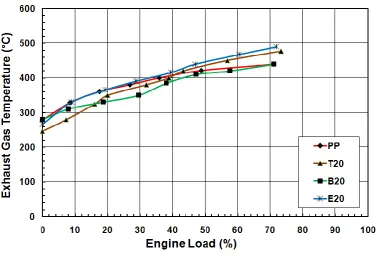
Fig. 4 shows the variation of exhaust gas temperature with engine load. It can be observed that the exhaust gas
temperature increases with engine load for all fuels. This is due to increase in quality of fuel used. The exhaust
gas temperature with E20 operation was to be highest as compared to all fuels. The exhaust gas temperature for
T20 operation is lower than that for PP operation at lower loads, which starts increasing at higher loads. For B20
operation, it is lower than all fuels tested. The behavior of exhaust gas temperature variation can be better
470 | P a g e
Fig. 3. Brake thermal efficiency Vs % engine load.
Fig. 4. Exhaust gas temperature Vs % engine load.
Khan et al. [8] experimentally evaluated performance of S.I engine running on different blends of ethanol and
petrol. Their results showed that for blend containing 15% ethanol and 85% petrol, BSFC values were slightly
lower than that for petrol operation. The maximum brake thermal efficiency was observed for the same blend.
471 | P a g e
observed that the brake thermal efficiency increases as the percentage of ethanol was increased in the fuel blend.
The maximum brake thermal efficiency was recorded with 20% ethanol in the fuel blend for all engine speeds.
Sharma et al. [11] obtained similar performance result for toluene operated S.I. engine.
V. CONCLUSIONS
Experimental investigations were conducted to evaluate the performance of four stroke, four cylinder,
water-cooled, stationary petrol engine using petrol doped with various additives. Three additives (toluene, benzene and
ethanol) were added to petrol in the ratio 20:80. Before carrying out engine test, important properties of these
fuel additives were compared with pure petrol.
Performance characteristics show that petrol containing 20% ethanol performs better than pure petrol at all
loads. Petrol doped with 20% toluene performs than pure petrol at high loads only. However, for entire range of
load, the engine performance with benzene additives was inferior along all combinations. From the experimental
investigation, it is established that 20% ethanol and 20% toluene can be used as performance enhancer.
However, systematic study of increasing percentage of ethanol and toluene in petrol will help us in
understanding the trend of performance characteristics and predicting optimum doping ratio. Also, detailed
combustion analysis is required to analyze various facts generated during this study.
VI. ACKNOWLEDGEMENTS
The authors of this paper are grateful to the University Polytechnic, Aligarh Muslim University, Aligarh for
kindly providing the facilities and extending necessary help to conduct the engine test.
REFERENCES
[1]
J.B. Heywood, internal combustion engine fundamentals (McGraw-Hill Education, 1988).[2]
R. Stone, introduction to internal combustion engines (Palgrave Macmillan, U.K., 2012).[3]
M. L. Mathur and R.P. Sharma, a course in internal combustion engine (Dhanpat Rai and sons, NewDelhi, 2003).
[4]
V. Ganesan, internal combustion engines (McGraw Hill Education India Private Limited, New Delhi,2012).
[5]
B.Q. He, J.X. Wang, J.M. Hao, X.G.Yan and J.H.Xiao, A study on emission characteristics of an EFIengine with ethanol blended gasoline fuels. Atmospheric Environment, 37, 2003, 949-957.
[6]
M. Al-Hasan, Effect of ethanol-unleaded gasoline blends on engine performance and exhaust emission.Energy Conversion and Management, 44, 2003, 1547-1561.
[7]
P.B. Joshi, U.S. Tumne and P.S. Purandare, a textbook of i.c. engines and automobile engineering. (NiraliPrashan, Pune, 2005).
[8]
M. Y. Khan and S. Nath, Performance characteristics of s.i. engine when operated on blends of ethanol472 | P a g e
[9]
http://www.worldofchemicals.com[10]
http://www.webbook.nist.gov[11]
A. Sharma, M. Mohtasibuddin, M. Alam, R. Tomar and M.Y. Khan, Performance of a s.i. engine runningon petrol doped with toluene. Souvenir cum Proc. of National Conference on Advances in Petroleum
Refining and Petrochemical Technologies, Aligarh. 2009.
[12]
M.Y. Khan, F.A. Khan and M.S. Beg, Ethanol-kerosene blends: fuel option for kerosene wick stove.International Journal of Engineering Research and Applications, 3(1), 2013, 464-466.
[13]
R.H. Thring, Alternative fuels for spark-ignition engines. SAE, Paper no. 831685, 1983, 4715-4725.[14]
J.S. Clancy, P.D. Dunn and B. Chawawa, Ethanol as fuel in small stationary spark ignition engines foruse in developing countries. IMechE, 67 (88), 1988, 191-194.
[15]
H. Bayraktar, Experimental and theoretical investigation of using gasoline-ethanol blends inspark-ignition engines. Renewable Energy, 30, 2005, 1733-1747.