Scholarship@Western
Scholarship@Western
Electronic Thesis and Dissertation Repository
7-27-2015 12:00 AM
Counteracting Bloom Filter Encoding Techniques for Private
Counteracting Bloom Filter Encoding Techniques for Private
Record Linkage
Record Linkage
Vasundhara Sharma
The University of Western Ontario
Supervisor
Dr. Aleksander Essex
The University of Western Ontario
Graduate Program in Electrical and Computer Engineering
A thesis submitted in partial fulfillment of the requirements for the degree in Master of Engineering Science
© Vasundhara Sharma 2015
Follow this and additional works at: https://ir.lib.uwo.ca/etd
Part of the Computer Engineering Commons
Recommended Citation Recommended Citation
Sharma, Vasundhara, "Counteracting Bloom Filter Encoding Techniques for Private Record Linkage" (2015). Electronic Thesis and Dissertation Repository. 2958.
https://ir.lib.uwo.ca/etd/2958
This Dissertation/Thesis is brought to you for free and open access by Scholarship@Western. It has been accepted for inclusion in Electronic Thesis and Dissertation Repository by an authorized administrator of
(Thesis format: Monograph)
by
Vasundhara Sharma
Graduate Program in Electrical and Computer Engineering
A thesis submitted in partial fulfillment
of the requirements for the degree of
Master of Engineering Science
The School of Graduate and Postdoctoral Studies
The University of Western Ontario
London, Ontario, Canada
c
R
ecord Linkage is a process of combining records representing same entity spread across multiple and different data sources, primarily for data analytics. Traditionally, this could be performed with comparing personal identifiers present in data (e.g., given name, surname, social security number etc.). However, sharing information across databases maintained by disparate organizations leads to exchange of personal information pertaining to an individual. In practice, various statutory regulations and policies prohibit the disclosure of such identifiers. Private record linkage (PRL) techniques have been implemented to execute record linkage without disclosing any information about other dissimilar records.Various techniques have been proposed to implement PRL, including cryptographically se-cure multi-party computational protocols. However, these protocols have been debated over the scalability factors as they are computationally extensive by nature. Bloom filter encoding (BFE) for private record linkage has become a topic of recent interest in the medical informat-ics community due to their versatility and ability to match recordsapproximatelyin a manner that is (ostensibly) privacy-preserving. It also has the advantage of computing matches directly in plaintext space making them much faster than their secure mutli-party computation counter-parts. The trouble with BFEs lies in their security guarantees: by their very nature BFEs leak information to assist in the matching process. Despite this known shortcoming, BFEs continue to be studied in the context of new heuristically designed countermeasures to address known attacks.
A new class of set-intersection attack is proposed in this thesis which re-examines the security of BFEs by conducting experiments, demonstrating an inverse relationship between security and accuracy.
With real-world deployment of BFEs in the health information sector approaching, the results from this work will generate renewed discussion around the security of BFEs as well as motivate research into new, more efficient multi-party protocols for private approximate matching.
Keywords: Private Record Linkage, Bloom Filter Encoding, Heuristic Security, Approxi-mate matching, Information privacy.
First and foremost, this thesis would not have been made possible without the support and
guidance of Dr. Aleksander Essex, Assistant Professor in the Department of Electrical and
Computer Engineering at Western University and my graduate supervisor for the past two years. Dr. Aleks, I feel privileged to have had this opportunity to work with you. I am deeply
thankful to you for all those countless hours you have spent on improvising my skills, tossing
around ideas, reading through and improving my writing and steering me in the right direction.
Thank you for your patience, time and effort you have given me over the past two years. To my grandfather, Bindeshwari Prasad Sinha, and my grandmother, Shivdulari Sinha,
who have moulded me into the person I am today. To my father, Raghavendra Sharma, and
my mother, Anju Sinha, who have given me love, appreciation, and seemingly infinite support
through all tides of my life. To my sister, Ankita Sharma, I thank you for your friendship, moti-vation, and love.
Extended family and friends: To my uncles, Braj Sinha and Mihir Jha and my high school
buddy, Bhavya Jha, I sincerely dedicate this work to you, without your faith and motivation, I
would not be where I am today.
I take this opportunity to express my sincere gratitude to the professors I have had the
chance to study with: Dr. Abdelkader Ouda, Dr. Abdallah Shami and Dr. Jagath Samarabandu
of the Department of Electrical and Computer Engineering at Western University for their help and guidance throughout this journey. Finally, I would like to thank all of the supportive staff members at Western University for their assistance in various ways.
Abstract ii
Acknowledgements iii
List of Figures vii
List of Tables viii
List of Abbreviations ix
List of Notations x
List of Appendices xi
1 Introduction 1
1.1 Motivation . . . 2
1.2 Thesis Contribution . . . 5
1.3 The Organization of the Thesis . . . 7
2 Background and Literature Review 9 2.1 Concept Introduction . . . 9
2.1.1 Record Linkage . . . 10
2.1.2 Challenges Associated with Record Linkage . . . 13
2.1.3 Data Re-identification Risk in Context of Medical Data . . . 15
2.1.4 Private Record Linkage . . . 16
2.1.5 Approximate Matching . . . 21
2.2 Applications of Private Record Linkage . . . 24
2.2.1 PRL Inside of the Medical Domain . . . 25
2.2.2 PRL Outside of the Medical Domain . . . 27
2.3 Implementation Techniques for Private Record Linkage . . . 28
2.3.1 Secure Multi-party Computation Methods . . . 29
2.4.1 Overview of the Bloom Filters . . . 34
2.4.2 Bloom Filter Applications . . . 36
2.4.3 Bloom Filter Encodings in PRL . . . 38
2.5 Summary . . . 42
3 Set Intersection-based Cryptanalysis 44 3.1 Security Analysis . . . 44
3.1.1 Threat Model . . . 45
3.1.2 Game-based Security Analysis . . . 45
3.1.3 Discussion . . . 48
3.2 Overview: Set Intersection-based Attack . . . 49
3.2.1 Motivation . . . 49
3.2.2 Concept Definitions . . . 50
3.2.3 Attack Model . . . 51
3.3 Data Pre-processing . . . 54
3.3.1 Element Selection . . . 54
3.3.2 Bigram Extraction . . . 55
3.3.3 BFE Parameter Selection . . . 56
3.3.4 Dice Dictionary Creation . . . 57
3.4 Framework: Set Intersection-based Attack . . . 58
3.4.1 Filtering Phase . . . 58
3.4.2 Trim Phase . . . 63
3.5 Summary . . . 66
4 SIC Materials and Methods 68 4.1 Experimental Methods . . . 68
4.2 Controls . . . 70
4.3 Evaluation Metrics . . . 74
4.3.1 Accuracy . . . 74
4.3.2 Degree of Anonymity . . . 75
4.4 Datasets and Experimental Setup . . . 76
4.5 Optimization – Data Riving . . . 77
4.6 Execution Environment . . . 79
4.7 Source Code . . . 79
4.8 Summary . . . 80
5.1.1 Dataset 1 . . . 83
5.1.2 Dataset 2 . . . 84
5.1.3 Dataset 3 . . . 84
5.1.4 Dataset 4 . . . 84
5.1.5 Discussion . . . 85
5.2 Degree of Anonymity Evaluation after Trim Phase . . . 85
5.2.1 Dataset 1 . . . 86
5.2.2 Dataset 2 . . . 87
5.2.3 Dataset 3 . . . 88
5.2.4 Dataset 4 . . . 89
5.2.5 Discussion . . . 90
5.3 BFE Accuracy Evaluation . . . 91
5.3.1 Dataset 1 . . . 91
5.3.2 Dataset 2 . . . 93
5.4 Summary . . . 93
6 Conclusion and Future Work 95 6.1 Discussion and Conclusion . . . 95
6.2 Limitations and Future Work . . . 97
6.2.1 Limitations . . . 97
6.2.2 Future Work . . . 98
Bibliography 100 Appendix A Sample Dataset 109 A.1 Sample Subset of the Dice Dictionary(DD) . . . 109
A.1.1 Steps for Creating Dice Dictionary (DD) Entries . . . 110
Curriculum Vitae 111
1.1 Abstract representation for ideal private record linkage (PRL) functionality . . . 3
1.2 Figure roadmap . . . 8
2.1 Illustration of data overestimation in absence of record linkage . . . 10
2.2 Data redundancy removed with record linkage . . . 11
2.3 Private record linkage process . . . 19
2.4 Example of attribute level comparison techniques in record linkage. . . 23
2.5 Structure of the Bloom filter data structure . . . 34
2.6 Example of the use of Bloom filters for the privacy-preserving computation based on string similarities . . . 39
2.7 BFE-based private record linkage process . . . 40
3.1 Illustration of steps in chosen plaintext attack (CPA) game . . . 47
3.2 Set intersection-based cryptanalysis (SIC) model . . . 53
3.3 Process flow diagram for pre-processing stages of SIC . . . 55
4.1 Tree structure representing prediction outcomes based on Dice similarity . . . . 75
5.1 Average degree of anonymity (DoA) after Phase 1 of SIC. . . 83
5.2 Average DoA during trim phase of the SIC for BFE datasets with maximally allowed overlaps,o=1. . . 87
5.3 Average DoA during trim phase of SIC for BFE datasets with maximally al-lowed overlaps,o=3. . . 88
5.4 Average DoA during trim phase of SIC for BFE datasets with maximally al-lowed overlaps,o=5. . . 89
5.5 Average DoA during trim phase of SIC for BFE datasets with unrestricted over-laps. . . 90
5.6 Accuracy evaluation for BFE method with different attributes and parameter settings . . . 92
2.1 Summary of various classifications methods . . . 22
4.1 Summary of different flavors of datasets used in the experiments . . . 77
4.2 The summary of implementation details for the experiments . . . 79
A.1 Sample subset of the Dice dictionary(DD) . . . 109
BF Bloom Filter
BFE Bloom Filter Encoding
CIHR Canadian Institutes of Health Research
CPA Chosen Plaintext Attack
DoA Degree of Anonymity
FDA Food and Drug Administration
HIPAA Health Insurance Portability and Accountability Act HMAC Keyed-hash Message Authentication Code
IND-CCA2 Indistinguishability under Adaptive Chosen Ciphertext Attack
IND-CPA Indistinguishability under Chosen Plaintext Attack IND-EAV Indistinguishability under Eavesdropping Attack NCVR North Carolina Voter Registry
NIST National Institute of Standards and Technology
NSA National Security Agency
PII Personal Identifiable Information PPSC Privacy Preserving String Comparators
PRF Pseudo-random Function
PRL Private Record Linkage
SHA-1 Secure Hash Algorithm-1
SIC Set Intersection-based Cryptanalysis SMC Secure Multi-party Computation
A Party A, participant in PRL
B Party B, participant in PRL
T Semi-trusted third-party asssistant
A Adversary, honest but curiousT
C Encryption Oracle in CPA game
DS Global dataset
DA BFE list for party A
DB BFE list for party B
DAB Combined BFE list for parties A and B
k Total number of hash functions in BFE
m Size of Bloom filter in bits
o Maximum number of allowed bit overlaps in a BFE
f Probability of false positives in a Bloom filter
t Matching threshold value
K Secret key for generating hash encodings
Diceb f e Dice coefficient between two BFEs
Diceplain Dice coefficient between two plaintext strings
DD Dice Dictionary
PS Possibility Set
RP Revealed BFE-Plaintext set
KP Known BFE-Plaintext set
PL Processed BFE-Plaintext set
Appendix A Sample Dataset . . . 109
Introduction
Record linkage can be defined as a task of identifying records from multiple data sources that
refer to the same individual. Although the concept itself is not new, it has gained lot of attention
in the recent times for data processing in distributed settings. Record linkage helps in resolving
issues like data duplication or data omissions from the lack of adequate information. Record
linkage applications are found in several domains due to their intrinsic nature to provide more
detailed and accurate analysis of data. For example, in the medical domain, record linkage
can be applied to patient records held by disparate health groups in order to identify records
that refer to the same patient. The primary use case of record linkage in this context is to
create a clear picture of the patient’s details by connecting the disjoint pieces of information.
Another use case is to enrich data quality for statistical analysis purposes by eliminating data
redundancy.
Record linkage in its most basic form utilizes the personal identifiers of individuals for
setting up the data correlations. Disclosure of personal identifiers, however, is not always
feasible due to privacy regulations and restrictions. For example, data sharing policies such
as the Health Insurance Portability and Accountability Act (HIPAA) prohibit direct disclosure
of patient information in certain cases [32]. Beyond regulatory impediments, the presence of
social concerns associated with sharing of personal information is also a restrictive factor in
many settings.
In light of these concerns and restrictions, private record linkage (PRL) remains an
tant tool for data analysis. PRL allows two data holders to learn which records they share in
common, while (in theory) protecting information about records that are not shared in
com-mon. Various techniques have been proposed to implement PRL, including cryptographically
secure multi-party computation protocols. However, these protocols have been debated over
the scalability factors as they are computationally expensive by nature. Alternatively, data
transformation or encoding techniques can be used. Bloom filter encoding (BFE) [88] is one
such technique for PRL which has gained traction lately. BFE ostensibly offers to realize
pri-vate data linking in timely manner by using tokenization and hashing of data values into a
Bloom filter (BF). BFEs are also versatile as a matching methodology. They can capture not
only exact matches, but alsoapproximatematches—a feature desirable in applications such as
health research where, for example, patient names might contain small misspellings or
varia-tions. As such, BFEs have become a topic of interest in the health data setting for its attempt to
balancing privacy guarantees with computational efficiency. However, the underlying security
assurance associated with BFEs has not received thorough evaluation.
In the following section, a brief description of ideal PRL functionality is presented and it is
correlated with the BFE technique to arrive at the research motivation of this thesis.
1.1
Motivation
To prevent privacy breaches, PRL must perform linking such that each party learns no
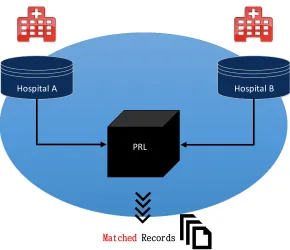
infor-mation other than the list of matched records, which we call the PRLideal functionality. The
abstract representation of the process is illustrated in Figure 1.1. Restricting this example to
the medical domain, Hospital A and Hospital B are exchanging their patient information
us-ing a PRL technique. Theonly information which they should learn during the course of the
protocol’s execution is the final set of matched records. We say a PRL scheme issecure, or
alternativelyprivateif it can be shown to realize the ideal functionality.
Hospital A Hospital B
PRL
Matched Records
Figure 1.1: Abstract representation of the ideal private record linkage (PRL) function-ality. In the medical domain context, Hospital A and Hospital B each input their respective patient records into the PRL functionality via a private channel, which outputs the matched records. Neither hospital receives any information from the protocol beyond what it learns from the list of matched records.
they can offer efficient solution for approximate record linkage which addresses scalability
is-sues while handling large volumes of data. Recent work [64, 61] has shown, however, that
Bloom filter encodings are susceptible to a range of cryptanalysis. On the other hand,
em-ploying a more robust security model, such as cryptographic secure multi-party computation
(SMC) is often seen as impractical due to performance and scalability issues. Kuzuet al.[64]
were among the first to attempt cryptanalysis of BFEs in a PRL setting, but wrote that
“al-though SMC protocols provide strong security guarantees, they are impractical for many real
data integration tasks due to their reliance on inefficient cryptography.” Further, to counteract
the success of their attack, they also propose inserting additional fields into the Bloom filter
while in parallel, Toth et al. [93] have been focusing on a software implementation of such
BFE-based PRL system.
An area that has not been well explored in literature is the security evaluation for BFE
technique in PRL. Thus, the research gap identified here is two-fold:
1. How secure are BFEs really? Considering the existing literature, security analysis of
BFEs has taken a heuristic approach: come up with an attack, come up with a
coun-termeasure, show countermeasure prevents the attack, and repeat as necessary.
How-ever, the formal security analysis1 is missing. In addition, the theoretical understanding
that BFEs offer weak or no security guarantees has not been given sufficient attention.
This leaves important open research questions: to what degree are BFEs secure? What
mechanism allows BFEs to achieve that level of security? Are there trade-offs (such as
accuracy) to increasing security?
2. Do recently proposed countermeasures actually increase security? BFEs are
“dis-tinguishable” by nature, and hence leak partial information by design. This means that
they do not adhere to the basic expectations of an ideal PRL technique, and recent efforts
have focused on chaffing as a method to increase security. The effectiveness of chaffing,
however, is an open question.
As the interest in BFEs increases, it is important to bear in mind that social and
regula-tory expectations of privacy, security must not be compromised in the pursuit of efficiency,
especially when the security mechanism underlying BFEs cannot be reduced to a hardness
as-sumption. Fundamentally if BFEs do not offer any formal security guarantees, it is essential to
at least quantify the risk to individual of their records being re-identified.
This thesis primarily focuses on addressing these concerns surrounding the usage of BFE
technique for PRL. Although efficient SMC protocols for approximate matching have proven
1Formal security analysis provides an intuitive way of analyzing complex security protocols and access
elusive, that should not justify of BFE as an alternative they offer effectively no security
guar-antees.
1.2
Thesis Contribution
The main contribution of this thesis is to revisit the security analysis of the Bloom filter
en-codings to understand precisely what privacy guarantees they offer in an attempt to quantify
re-identification risk, especially in the context of recently proposed cryptanalysis
countermea-sures.
This section summarizes the main contributions.
1. Security analysis. Theoretical conceptualization of security weaknesses in the Bloom
filter encoding techniques is presented in this thesis. Utilizing the game-based security
analysis approach from the modern cryptography, we show that BFEs are distinguishable
under chosen plaintext attacks (CPA), which is widely regarded as the minimal definition
of security across the security research community. In this way, we attempt to show that
BFEs remain below the set security standards.
2. Set intersection-based cryptanalysis framework. We propose a novel class of set
intersection-based cryptanalysis (SIC) which attempts to recover patient identifiers from
the corresponding BFEs. The SIC framework has been designed to operate in two distinct
phases: (i)the filtering phaseand (ii)the trim phaserespectively. The design details for
each of these two phases, captured in the form of algorithms, is presented in this thesis.
3. Re-identification risk assessment for BFE-based PRL systems. The effectiveness of
the proposed SIC attack is measured in terms of re-identification risk by considering the
degree of anonymity of a set of records following our attack. Although SIC is not the
first cryptanalysis attempt on BFE technique, it is novel in its kind to establish and assess
• Key independent: BFE technique offers security which is ultimately key-independent
(i.e., increasing key length for the related hash function does not diminish the
ef-fectiveness of the attack). Hence, the role of keyed hash functions is this setting is
limited.
• Limited impact of countermeasures: The Recently proposed countermeasures to
BFE cryptanalysis (e.g.,[64, 65]) show only a minor quantitative improvement to
a records anonymity set. The experiments conducted in the current work, however,
show that by adding another identifier, the increase in the average anonymity set
size is by less than 10%. This observation helps in breaking the assumption barriers
such as the underlying security issues can be fixed with chaffing or randomizing
input strings.
• Security vs. accuracy: We demonstrate BFEs exhibit a fundamental trade-off
be-tween security and accuracy. When controlling for accuracy, BFEs become much
more susceptible to cryptanalysis and the effect of countermeasure is further
mini-mized. Efficiency at the cost of quality does not serves the main purpose of linking
data correctly, and in that sense BFEs suffer from an existential dilemma.
• Risk estimation: Re-identification risk cannot be established a priorito running
the protocol. Hence, there can be no security guarantees with the use of BFEs in a
PRL setting.
4. Software implementation of SIC. In this thesis, the testing and validation of the
pro-posed attack model along with the re-identification risk assessment of BFE-based PRL
system has been accomplished through the software implementation of SIC framework.
The software for SIC framework has been developed in C++ programming language
along with some pre-processing steps utilizing Perl scripting language for faster pattern
matching and string manipulations. The software has been further modularized to
1.3
The Organization of the Thesis
The remainder of this thesis is organized as follows:
• Chapter 2outlines both the background information associated with the concept of
pri-vate record linkage, and a literature review of the various approaches for implementing it.
This chapter will first provide an introduction to common terminology that will be used
throughout the rest of the thesis. Second, an overview of practical approaches for private
record linkage will be explored, including an introduction to a variety of
implementa-tion techniques with their benefits and drawbacks. Finally, the chapter will review the
concept of Bloom filter for its specific use in context of PRL and outline the associated
security weaknesses.
• Chapter 3contains the main contribution for this thesis. First and foremost, this chapter
presents the theoretical security analysis for the BFE technique using the security game
approach. Next, this chapter will provide details for the components and framework of
the proposed Set Intersection-based Cryptanalysis (SIC). As mentioned earlier, the SIC
is categorized into two distinct phases, (i) the filtering phase and (ii) the trim phase.
This chapter houses the details for the design and working for each of the two phases.
Additionally, algorithms for each of the attack phases is described and presented.
• Chapter 4covers the details around experiment inception and the specific methodologies
adopted. This chapter also provides the list of evaluation metrics which are used for
evaluating the results of the SIC. The software implementation details and the choice of
dataset is also covered in this chapter.
• Chapter 5is focused on the evaluation of the SIC implementation. Effectiveness of BFE
is analyzed separately with each phase of the attack. In addition, an independent accuracy
analysis is presented which measures the impact of hardening BFE construction on the
this thesis work.
• Chapter 6ultimately provides the conclusion for the thesis, primarily summarizing the
accomplished work as well as a discussion on the some of the limitations and possible
future work.
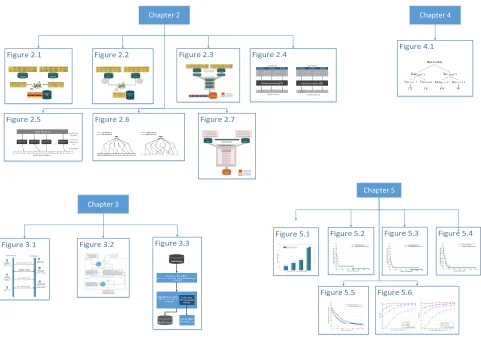
Below is the roadmap for the remaining figures (chapter-wise) present in this thesis (for
reference purposes):
Chapter 2
Chapter 3
Chapter 4
Chapter 5
Background and Literature Review
This chapter details the key concepts involved with the proposed cryptanalysis work in
Sec-tion 2.1. SecSec-tion 2.2 presents an overview of the related research works for Private Record
Linkage (PRL). The literature review specifically covers works related to data masking or
en-coding techniques utilized for PRL which are described in section 2.3, while also touching
down upon the secure alternatives, which leverage cryptographic protocols for the data
link-age. Section 2.4 details the concepts and usage of the Bloom filters and specifically its use
as encoding techniques for implementing secure data linking, while identifying some research
gaps in relation to the security associated with usage of this technique in PRL.
2.1
Concept Introduction
This section will introduce key concepts of record linkage, private record linkage (PRL)
and the use of private record linkage in the medical domain. Next, the concept of approximate
matching is discussed. Approximate matching is used for evaluating similarity between entities
which is widely used in record linkage techniques. This section serves as a primer for the
concepts which would be referenced throughout in this thesis work.
Hospital A Hospital B
Data Analyst ID Name Surname zipcode Chronic Outcome A1
A2 A3
Ann Brown 26001 Yes Fatal Zue Lee 26007 No Normal John Smith 26023 Yes Non-fatal
Aggregated Data
Chronic Condition Count
Yes Non-fatal 1
Yes Fatal 2
No Normal 3
Chronic Condition Count Yes No Yes Fatal 1 Normal 1 Non-fatal 1
Chronic Condition Count Yes No No Fatal 1 Normal 1 Normal 1
ID Name Surname zipcode Chronic Outcome B1
B2 B3
Ann Brown 26001 Yes Fatal Richard Moore 26007 No Normal
John Smith 26128 No Normal
Figure 2.1: Illustration of data overestimation in absence of record linkage. Here Hos-pital A and hosHos-pital B exchange patient health statistics as opposed to individual records. In the absence of record linking, this can result in overestimation of data. As we see here the record [Chronic, Fatal] corresponds to the same individual, which is double counted in data aggregation stage.
2.1.1
Record Linkage
Record linkage can be defined as the process of identifying records from multiple data sources
that refer to the same individual. The concept was initially conceived by Dunn [36] for
aggre-gating statistical information from the life and death registries pertaining to the same
individ-uals. Record linkage, as a process itself, is algorithmically straight forward and can be
per-formed manually without the aid of computers. Record linkage has been widely adopted with
computing techniques, however, due to the need for fast information linking across vast
infor-mation databases which may span across multiple fragmented sources of inforinfor-mation. While
computer scientists frequently refer to record linkage as“data matching”, the other prominent
Hospital A Hospital B
Data Analyst ID Name Surname Zipcode Chronic Outcome A1
A2 A3
Ann Brown 26001 Yes Fatal Zue Lee 26007 No Normal John Smith 26023 Yes Non-fatal
Aggregated Data Chronic Condition Count
Yes Non-fatal 1 Yes Fatal 1 No Normal 3
ID Name Surname Zipcode Chronic Outcome B1
B2 B3
Ann Brown 26001 Yes Fatal Richard Moore 26007 No Normal
John Smith 26128 No Normal
Hospital A: Shares complete patient database with personal identifiers Hospital B: Shares complete patient database with personal identifiers
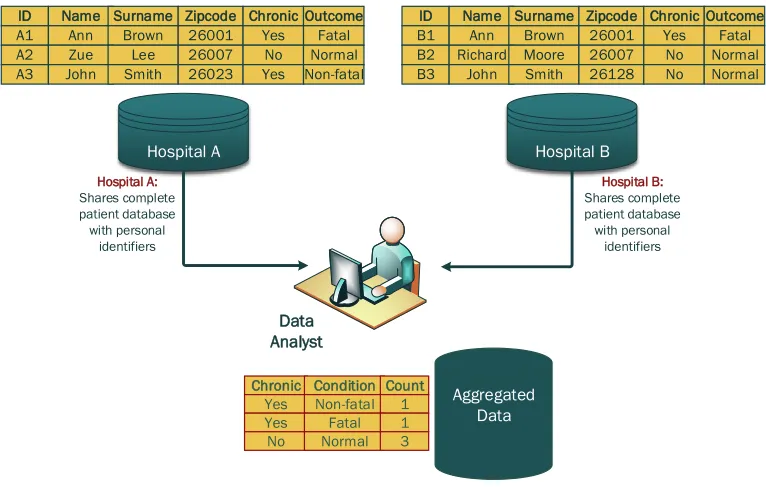
Figure 2.2: The problem of data overestimation is corrected with the deployment of record linkage. As illustrated here, Hospital A and hospital B exchange their patients health records with patient identifiers for data analysis. Records pertaining to the same individuals, originating from both hospital A and B are identified based their personal information (name, surname, zipcode combination) and the record [Chronic, Fatal] are identified and counted only once.
/name resolution” etc.,The primary benefit of record linkage is that it creates a precise picture of an individual by bringing together her information. Imagine that we do not have any record
linkage technique in place while performing disease assessment in a health setup. Figure 2.1
shows that hospitals A and B are trying to estimate the total number of patients diagnosed with
certain chronic conditions and their respective ailment stages. We notice that result
aggrega-tion based on counting total patients registered with a given hospital is resulting into double
counting the same patient information since it originates from two different sources. Thus, in
general, data redundancy can result in inaccurate disease assessments due to lack of record
linkage techniques. As a solution, record linkage can be applied to patient records held by
Record linkage works on matching combinations of personal identifiers from the data
ele-ments. Revisiting our earlier health care setup example from Figure 2.1, if we combine patient
identifiers likegivenname, surname, zipcodealong with the diagnosed chronic condition, then
we would be able to identify the duplication of information for patientAnn Brown with fatal
chronic condition. Figure 2.2 shows the revised output of data aggregation with record linkage
technique in place. The record linkage process can be of two types:
• Deterministic linkage. Also known asrule-based record linking, deterministic linkage
generates data links based on matching result of individual or combination of
identi-fiers [85]. Two records would be identified as a match if the given set of identiidenti-fiers are
identical for both. Deterministic linking works on exact matching of strings based on the
pre-defined rules. This type of linking method is good for datasets whose entities can
be filtered out based on common identifiers and where the quality of data is high. This
strategy would not work best for datasets with missing identifiers as it would lead to
incorrect match outcomes. The cost of deterministic linkage is determined based on the
cost of missed matches due to lack of error tolerance in exact matching functions.
How-ever, this can be improved to a certain extent by incorporating a multiple-step matching
strategy which allows a progressive series of less restrictive steps in which if record pairs
do not match in the first instance, are passed on to next rounds for further comparison.
If a record pair meets the criteria in any step, it is classified as a match. Otherwise, it
is classified as a non-match. The cost of such deterministic linkage scheme would then
depend on the number of rounds designed in the match function.
• Probabilistic linkage. Probabilistic linking assigns varying weights to different
identi-fiers based on the estimation of the ability of the identifier to correctly identify a match.
These weights along with the identifiers are then used to calculate the probability of the
matches and non-matches for a given threshold value. This type of linking is good for
datasets which cannot be distinguished with a single unique identifier. However,
type of record linking is also referred to as fuzzy matching orfuzzy merging. The cost
of probabilistic linkage is determined based on the relative cost of false matches and
true but missed matches. This would vary depending upon the type of approximation
function used in the implementation.
Record linking of any type does involves filtering and linking records based on unique
iden-tifiers which falls into the category ofpersonal identifiable informations(PIIs). Thus, record
linkage in its most basic form is not always a feasible solution due to privacy concerns and
restrictions involved with the sharing of personal identifiers [94, 32].
2.1.2
Challenges Associated with Record Linkage
The entire process of data integration works on the conjunction of three tasks;schema
match-ing [13], record linkage [51] anddata fusion [74, 35, 17]. The first task (schema matching)
is associated with identifying all the attributes in database entries which store equivalent
in-formation; the second task(record linkage) works on identifying the records which belong to
the same entities across these different databases; and the third task (data fusion) works on
merging together the identified records into a single record. All these tasks together complete
the whole process of data integration. Record linkage is the most challenging task among all
three and the associated challenges can be broadly categorized as:
• Quality of data.We often come across this fact that the real data-world data is perturbed
in nature. There can be several issues like typographical errors, variations, alterations,
missing data or data itself being obsolete (e.g.,due to legal name changes). Thus, even
though the data corresponding to same entities are matched against their personal
iden-tifiable informations, it can lead to incorrect or ambiguous results. For instance, in one
of the related works, Christen [23] discusses the potential source of variations and errors
associated with the “personal name” identifiers. He also discusses the characteristics of
ultimately, Christen highlights the fact that there can be no clear best matching
tech-nique in practice. Therefore, exact matching of attributes is not sufficient in the context
of record linkage. Accurate classifiers and approximate matching techniques are more
desirable for maintaining the accuracy and preserving the quality of data in record
link-age [30]. We further discuss approximate matching techniques in Section 2.1.5.
• Scalability. Record linkage suffers from scalability issues in general. In a typical
sce-nario, with the increasing size of databases, the total number of potential comparisons
would be the product of the size of the respective databases. This can be a major
per-formance hurdle as the comparison of record pairs can also involve complex similarity
comparison functions. To overcome this problem, data indexing techniques can be
de-ployed before the record comparison step. Christen [26] performs the comparative
anal-ysis of complexity, performance and scalability of 6 different indexing techniques. These
techniques are similar in functionality which aim at creating blocks of data by removing
the records which are obvious non-matches while retaining the pairs which are potential
matches. Data indexing techniques help in reducing the total number of comparisons
considerably as the total comparison space is now reduced to a single data block which
is a small subset of the entire database. The order of reduction specifically varies across
different implementations of the indexing techniques. It is determined based on the
pa-rameter settings like the matching threshold value (which represents the indexing key)
used for placing records into the same block or the fixed size of the blocks in some cases.
• Data privacy and confidentiality.Database linking involves the use of PII of
individu-als, thus, protecting privacy is a crucial requirement. Databases can contain information
that is highly sensitive such as the medical and financial details of individuals. For
in-stance, in Figure 2.2, we see that the detailed information like chronic conditions of
patients have been exchanged for record linkage along with their personal identifiers
Apart from this, database linkage used for business collaborations may even reveal
con-fidential information like business data (list of customer or suppliers etc.,) or financial
conditions of individuals. Thus, protecting the confidentiality of information is equally
important [96]. We discuss more specific privacy concerns and data re-identification
risks associated with medical data in Section 2.1.3.
Durham et al. [39] attempt to evaluate the tradeoffs between maintaining data quality and
scalability, while preserving privacy and confidentiality across six different privacy-preserving
string comparators (PPSCs). They highlight the fact that the PPSCs which are efficient and
yield higher accuracy of record linkage do not provide strong privacy guarantees and
vice-versa.
2.1.3
Data Re-identification Risk in Context of Medical Data
Sharing unmasked data has its own benefits. It facilitates accurate analysis on data sets, aids
re-search communities to perform validations to confirm results or simply promotes cost savings
by eliminating the need for collecting same data by different research communities.
Consid-ering these requirements, there has been an urge to make such data, publicly available. For
example, the Canadian Institutes of Health Research (CIHR) recently drafted a policy that
re-quires some data to be made publicly accessible [5]. This policy is in effect as of January 1st
2008. Similarly, the UK Medical Research Council (MRC) policy on data sharing sets the
expectation that data from their funded projects shall be rendered as publicly available [31].
However, it is worthwhile to note that disclosure of health data in such broad spectrum leads to
privacy risks [22]. Furthermore, these risks are somewhat real and there has been several
suc-cessful attempts of re-identifications of individuals. Thus, protecting the identity of individuals
while releasing such sensitive health data is crucial and thus mandated by privacy policies. For
instance the United States National Institutes of Health (NIH) permits sharing patient details
while at the same time prevents disclosing personal identities of patients [95]. One approach to
practical bounds for “k” in the data anonymization concept ofk-anonymity, initially proposed
by Sweeney [92] for preserving data privacy. They define the probability of re-identification,
also known as there-identification risk to a patient, as 1k wherekis the cardinality of the
asso-ciated anonymity set. The obligation of the data holder, therefore, is to define a risk threshold1k
and in turn ensure that each patient’s anonymity set is never less thank. Further, Pfitzman and
Hansen [81] offer an appropriate definition of anonymity for the current setting: “Anonymity
of a subject from an attacker’s perspective means that the attacker cannot sufficiently identify
the subject within a set of subjects, theanonymity set.” Without loss of generality each record
is associated with a patient identity, and thus the patient is anonymous within the set of all
patient records.
Anonymity Precedents in Health Data El Emam [41] provide precedents for minimum
allowable anonymity set sizes in a range of applications. In a highly trusted setting such as
an internal (i.e., within an organization) data release, k ≥ 3 may be considered acceptable,
whereas in a public (and adversarial) setting such as in patent data disclosure, k ≥ 20 may
be more appropriate. What is clear is that there is no one-size-fits-all rule. For example, the
Colorado Department of Public Health and Environment [1] and the Iowa Department of Public
Health [4] have guidelines amounting tok ≥ 4. The National Center for Health Statistics [3]
generally advises k ≥ 5, though also has criteria [60] for k ≥ 4 when considering certain
diseases, and k ≥ 20 in the context of birth and death statistics. El Emam, however, suggests
k≥ 5 is the prevailing baseline for data disclosure in the health information setting.
2.1.4
Private Record Linkage
Considering the various scenarios from Sections 2.1.2 and 2.1.3, it is evident that record
link-age in its basic form is a challenging task. The associated challenges can be attributed to
problems like missing unique identifier information in databases or privacy concerns and legal
from different organizations need to be linked together without jeopardizing the confidentiality
of the individuals involved. The increasing need for linking large and disparate databases while
preserving the privacy of the individuals whose records are stored in these databases has led
to the development of a new methodology known as Private Record Linkage (PRL). The main
requirement of any PRL system is that only limited information shall be released at the end of
the data linkage step. This limited information can be accessed by either of the parties sharing
their databases, or to any other party (such as an independent researcher or any data analytics
organization etc.,) which requires this aggregated and linked data. PRL itself is a diverse notion
and there has been several classes of proposals for the implementation of this technique. For
instance, Lawatiet al.[66] propose a potential solution for secure and efficient record linkage
by dividing the entire database into separate blocks or clusters. They suggest that a
blocking-aware private record linkage protocol can provide enhanced performance while preserving data
security. Different records are combined into a single block based on some commonality with
each other (e.g.,sharing some tokens). Each of these blocks is further associated with a unique
identifier coupled with secure hash signatures to achieve confidentiality and compactness in
the record linkage process. Bachteleret al.[10] focus on performing an empirical evaluation
of three different PRL methods which compute string similarities in privacy preserving
man-ner proposed by Schenell et al. [88], Scannapiecoet al. [86], and by Pang and Hansen [79].
Inan et al. [52] propose a hybrid method for PRL which combines the data anonymization
technique with secure cryptographic protocols. In another work, Yakout et al.[101] propose
a method which works on transforming the database records into numeric vectors which is
further used to generate complex numbers to represent the records. These numbered
represen-tations of records are then shared directly between the parties who compute similarity between
these numbers to identify data matches. This method claims to have no requirement for a
third-party while simultaneously performing efficient record linkage. Freedmanet al.[48] explore
various protocols which work on private two-party computation of set intersection between
(uniformly distributed hashing across multiple bins) based PRL solution which they claim to
be more efficient. Several encoding based solutions are also popular in the literature, such as,
Weberet al.[98] use a blind-folded hashed data exchange method in which the input string is
constructed by combining identifiers like first two letters of the first and last name along with
date of birth information. They believe that such input combination would act as a blindfolded
information thus, preserving data privacy while concurrently being sufficient for record linkage
purposes. Schnellet al.[88] propose an encoding technique which employs Bloom filters [18]
as the encoding infrastructure for implementing efficient PRL. This scheme is discussed in
detail in Section 2.4. Thus, we see that PRL can be implemented using various different
tech-niques. The various privacy techniques used to facilitate PRL has been discussed elaborately
further in Section 2.3. In this section, we restrict our discussion to understanding PRL as a
complete process in its entirety.
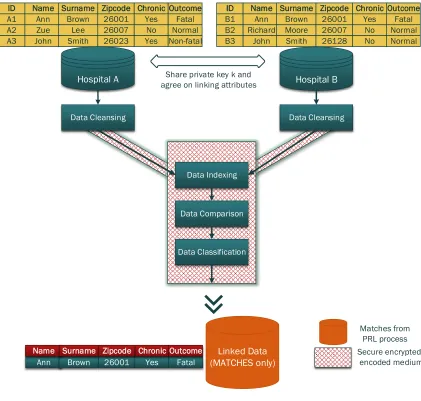
Private record linkage process An ideal PRL system should be capable of addressing all
the three problems ofdata quality, scalability and data privacywhich we earlier discussed in
Section 2.1.2. Figure 2.3 outlines the detailed steps involved in private record linkage process.
We briefly discuss the role of each of these steps:
• Data cleansing. This is the first step in the PRL process which is also known asdata
pre-processing and standardization step. This step is designed to eliminate the noise
found in the real-world data due to typographic errors, missing information and presence
of inconsistent data [11, 83]. This step also eliminates the unrelated extra information
which is not required in the data linkage process [40, 50]. The outcome of this step is a
set of well-defined and consistent dataset. While data pre-processing doesn’t completely
falls into the record linkage process entirely, it is considered to be part of record linkage
process in a privacy-preserving setting. This is due to the fact that different data sources
should perform symmetric pre-processing and also agree upon the approaches adopted as
Hospital A Hospital B ID Name Surname Zipcode Chronic Outcome
A1 A2 A3
Ann Brown 26001 Yes Fatal
Zue Lee 26007 No Normal
John Smith 26023 Yes Non-fatal
Linked Data (MATCHES only)
ID Name Surname Zipcode Chronic Outcome B1
B2 B3
Ann Brown 26001 Yes Fatal Richard Moore 26007 No Normal
John Smith 26128 No Normal
Data Cleansing Data Cleansing
Ann Brown 26001 Yes Fatal Name Surname Zipcode Chronic Outcome
Data Indexing
Data Comparison
Data Classification
Matches from PRL process Secure encrypted/
encoded medium Share private key k and
agree on linking attributes
Figure 2.3: Private record linkage process. Details of steps involved in record linkage pro-cess in a privacy preserving setup; data linking, comparison and classification steps are per-formed in a secure encrypted/encoded environment and the resulting linked information reveals only the matched records.
pre-processing is performed independently at the respective data sources and the result
is shared in a protected environment for further processing. A variety of methods can be
adopted for data pre-processing. For instance, Churcheset al.[28] suggest using lexical
tokenisation in confluence with probabilistic hidden Markov models for sanitizing name
and address data for record linkage. They state that this method also works well on data
• Indexing. Data indexing is the second step in record linkage process which aims at
providing efficiency to the entire process by reducing the total number of comparisons
needed between two databases by removing the pairs of records which are unlikely to
result in matches [12, 26]. In the absence of indexing techniques, if we had to compare
two databases X and Y withXmandYnrecords respectively, then we would have to
per-form Xm × Yn comparisons in total. This is a major performance bottleneck owing to
the growing sizes of databases and the record linkage comparisons involving expensive
operations [26]. Hence, indexing techniques help to resolve this issue by filtering out the
records which are unlikely to match. Several approaches can be used to perform data
indexing. For instance, the entire database can be divided into clusters or blocks which
can be tracked with a block key [66, 26]. In such clustering techniques, the total
num-ber of candidate pairs for performing comparisons are generated from one specific block
only. Applying indexing techniques adds scalability and compactness to the record
link-ing process. Lawatiet al.[66] proposed a secure three-party blocking protocol which can
deliver high performance record linkage using secure hash encoding with token blocking
feature for data indexing.
• Comparison. The candidate record pairs generated after data cleansing and indexing
step are compared against each other using different similarity measures. These
compar-isons can be performed at different levels. For instance, in record level comparisons, the
complete set of data attributes are chained together and compared with its other
counter-parts. The other approach is to conduct comparisons at attribute level where individual
attributes can be picked depending on the type and nature of the datasets. Further, the
choice of similarity function widely depends on the nature of attributes in the records
as well as on the context of record linkage. In a health care environment, approximate
matching similarity function is often recommended as the data here is more likely to
suffer from typographical errors and other variations. Thus, performing exact match on
expan-sion of this discusexpan-sion on approximate matching techniques is presented in Section 2.1.5.
Exact matching can be performed only in scenarios where data is not overly inconsistent
or noisy. The output of comparison step gives the similarity value between each pair of
compared records. These numbers are further utilized in classification step to classify
the records as matches and non-matches.
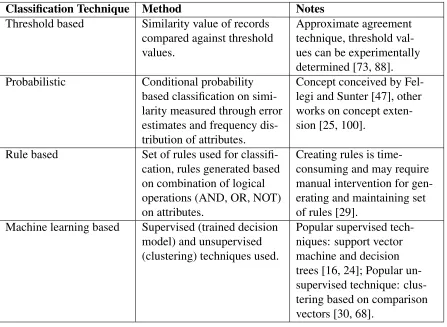
• Classification.Classification step utilizes the output from comparison step and based on
the adopted method used in the record linkage setting, segregates the data into matches
and non-matches. Record linkage classification techniques can be broadly classified as:
threshold based, probabilistic, rule based and machine learning based. These
classifi-cation techniques and the underlying methods are summarized in Table 2.1. In context
of PRL, the classification step needs to ensure that no participating party learns any
information about the other parties’ records which do not match. The only allowed
in-formation to be revealed to either of the parties is the (exclusive) record pairs which have
been classified as matches.
The resulting aggregated data (after the completion of the various pre-processing tasks) is
deemed ready for use in applications or for research and statistical analysis purposes.
Mea-suring the effectiveness, completeness and quality of linked data is an optional feature, which
typically, doesn’t fits into the scope of private record linkage process and can be performed
independently and disjointly.
2.1.5
Approximate Matching
The standard form of record linkage makes use ofexact matchingsimilarity techniques, where
two records are determined to be a match only if their corresponding identifiers are
identi-cal. In a health care setting, however, identifiers might not always match exactly (e.g.,due to
transcription errors, or name variations, etc.) and an approximate matching strategy is more
Classification Technique Method Notes
Threshold based Similarity value of records compared against threshold values.
Approximate agreement technique, threshold val-ues can be experimentally determined [73, 88]. Probabilistic Conditional probability
based classification on simi-larity measured through error estimates and frequency dis-tribution of attributes.
Concept conceived by Fel-legi and Sunter [47], other works on concept exten-sion [25, 100].
Rule based Set of rules used for classifi-cation, rules generated based on combination of logical operations (AND, OR, NOT) on attributes.
Creating rules is time-consuming and may require manual intervention for gen-erating and maintaining set of rules [29].
Machine learning based Supervised (trained decision model) and unsupervised (clustering) techniques used.
Popular supervised tech-niques: support vector machine and decision trees [16, 24]; Popular un-supervised technique: clus-tering based on comparison vectors [30, 68].
Table 2.1: Summary of various classifications methods.
andzipcode). For a given record, these attribute sets need to pass through the similarity
com-parison step of record linkage which quantifies the extent of similarity between the given two
records. The similarity comparison step runs the records through a similarity function which
computes the similarity between the two entities. Depending on the type of similarity
func-tion, its functionality and output patterns differ. For instance, if we are performing an exact
match, the result would be binary (i.e., either 0 or 1) as illustrated in Figure 2.4a. A real world
example of exact matching scheme would be the use of Hash Message Authentication Code
(HMAC) [14] based encryption scheme for private record linkage. In this particular use case,
the data holders agree upon a secret key and set of identifiers based on data fields present in the
records of their databases. Both the parties exchange only the final hashed results of HMAC
to a third party for performing the record linkage. The identifiers would result in exact match
Similarity Function
(
f1
)
Similarity Function(
f2
)
Firstname Lastname Zipcode
Marie
Marrie
Jones 23004
Jones 23004
Firstname Lastname Zipcode
Marie
Marrie
Jones 23004
Jones 23004
0 1 1 0.92 1 1
(Output Vector) f1 (Output Vector) f2
Input Records Input Records
(a)Exact matching attribute comparison
Similarity Function
(
f1
)
Similarity Function(
f2
)
Firstname Lastname Zipcode
Marie
Marrie
Jones 23004
Jones 23004
Firstname Lastname Zipcode
Marie
Marrie
Jones 23004
Jones 23004
0 1 1 0.92 1 1
(Output Vector) f1 (Output Vector) f2
Input Records Input Records
(b)Approximate matching attribute comparison
Figure 2.4: Example of attribute level comparison techniques in record linkage. The different techniques illustrated in this example are (a) exact matching similarity function and (b) approximate matching similarity function.
party to perform record linkage on the encrypted data in a secure manner. One limitation of
such scheme is that slight variations in the input will result in a different output and hence
won’t match. Despite this limitation, exact matching schemes are still popular. O ´Keefe et
al.[76] and Bermanet al.[15] propose similar flavors of exact matching techniques to be used
in PRL. On the other hand, approximate matching techniques provide error tolerance as well
as flexibility of choosing a desirable threshold based on the application itself or based on the
contents of the databases. The similarity function in this scenario works on a similarity
mea-sure calculation between the two entities. In case of approximate matching, the result is a real
number in range of [0,1]. This is further illustrated in Figure 2.4b. Together these two
fig-ures demonstrate the difference in the outcome of exact and approximate matching techniques.
Approximate matching yields probabilistic record linkage [51, 56] where the exact agreement
from all identifiers is not required. Agreements with higher weighted identifiers, out rule the
disagreements in identifiers with lower weights. Chuches and Christen [27] proposed
creat-ing bigrams (or n-grams in general) from the identifiers to enable secure probabilistic record
actual data. This method combined with cryptography, introduced yet another new concept
of blindfolded record linkage. Blindfolded record linkage is defined as the technique which
allows to carry out statistical analysis on disparate datasets without any parties having to reveal
identifying information about any of the subjects involved. Blindfolded record linkage makes
use of secure one-way hash transformations along with approximate comparison techniques to
achieve data privacy. A variety of similarity measuring techniques are available. A commonly
used set-based similarity metric is due to Dice [34]. TheDice coefficientbetween two setsX
andY is defined as:
Dice(X,Y)= 2|X∩Y|
|X|+|Y|. (2.1)
A matching function defined for a thresholdtis defined as
Match(X,Y,t)=
T rue : Dice(X,Y)≥ t
False : Dice(X,Y)< t
(2.2)
In case of string similarity measure, the Dice coefficient would work on the set of bigrams
where|X|and|Y|would represent the character bigrams found in the respective strings X and
Y and |X ∩Y| is the total number of character bigrams common to both X and Y. Schnell
et al. [88] utilize the Dice coefficient as the similarity metric for record linkage in a privacy
preserving setup. Other alternative similarity measures existing in literature are: the Jaccard
index, the Tversky index, the Levenshtein distance and the Overlap coefficient.
2.2
Applications of Private Record Linkage
Record Linkage prevents data duplication and aids in leveraging accuracy for data analysis,
arising from data aggregation from multiple sources [51]. The use of private record linkage
(PRL) is not restricted to just medical informatics. Discussion on several usage domains for
2.2.1
PRL Inside of the Medical Domain
The decentralized nature of health care systems leads to storage of patient’s medical
informa-tion in fragmented form across multiple datasets. Further, these datasets are owned by different
health care providers. PRL can enhance data analytics in several ways in such setups:
• Removing data redundancy for research studies. Sharing patient details is crucial in
biomedical research sphere [86], however in the absence of record linkage techniques,
statistical variables can be overestimated due to duplication of records or remain
under-estimated due to fragmentation of records. Consider the example shown in Figure 2.1,
either of the situations (data overestimation or underestimation), gives rise to data
redun-dancy which leads to incorrect results. Detecting duplication however, is complicated
by privacy laws preventing the direct disclosure of patient information, for instance, the
United States National Institutes of Health (NIH) permits sharing only such patient
de-tails which do not disclose the identity of individuals or correlation with others in any
form [95]. In these scenarios, PRL can be applied to achieve de-identified data sharing
to mitigate information bias, while still being able to detect and discount duplicates.
• Participation monitoring in clinical trials. Clinical trials are a form of study which is
commonly used in the pharmaceutical industry to evaluate the safety and effectiveness
of a drug. Eligible patients are hired to participate in the study. Often, patients are
financially compensated for their participation in such studies. The same patient may
be tempted to participate across different studies at the same time, which can lead to
incorrect estimation or prediction of a particular drug behavior in addition to posing
health risks to the subjects. Thus, it is important to ensure that one patient is enrolled in
only one study at a time. Detecting such double enrollments, however, can be challenging
as clinical trials are covered under privacy legislation like HIPAA [32] which prevent
the information disclosure for such participants. PRL can be used in this scenario to
concurrently [43].
• Creating health indicators. Health indicators are periodic measures which provide
rel-evant indications and vital information about population health [54]. Health indicators
are important to undertake suitable actions for improving health system performance.
It is also useful in determining useful contextual information about community health.
Creation of health indication relies upon fetching information from diverse set of data
sources. For instance, Statistics Canada generates correlation between mortality and
cancer outcomes for populations exposed to chemical hazards in industrial settings [20].
This process would involve referring to information from databases like Canadian
Mor-tality Database (CMDB), Canadian Cancer Database (CCDB), Canadian Birth Database
(CBDB) etc. Private record linkage (PRL) can be effectively deployed in such use cases
to generate correct health indicators.
• Health surveillance. PRL can be directly utilized for strengthening health surveillance
activities. This can be achieved by linking data corresponding to real-time monitoring
of safety of drugs, biologicals and medical devices when they touchdown markets. For
instance, the United States Food and Drug Administration (FDA) has already launched
a project, the Sentinel Initiative [99], which aims at providing real-time monitoring of
the safety of health products by securely querying several automated data holders for
adverse usage metrics [7]. One of the prime objectives of this project is to keep track of
the safety of the FDA-regulated products. This process can be leveraged to yield better
results with the use of PRL for linking the informations fetched from multiple resources.
Further, the other health surveillance aspects could be monitoring spread of diseases,
epidemics control or vaccination information etc. El Emamet al.[44] present one such
use case where PRL has been effectively deployed to evaluate the effectiveness of human
papilloma virus (HPV) vaccination in Canada. This was accomplished using private
from different disease registries.
• Enhancing resource allocation. Cost of medical care can be reduced with the access
to complete knowledge of patient information which is often scattered across multiple
datasets. For instance, if a care provider can determine that certain examinations have
already been rendered to a patient through a different health provider, then the cost of
current treatment gets minimized. Unilateral information set also helps in proper
delega-tion of resources to other patients by eliminating replicadelega-tion of services. Involving PRL
for improvising resource allocation of health facilities can be useful since we do not have
a uniform standard to identify patients shared across different providers. Proposals for
drafting such uniform identifying standards in health systems [21] has been rejected by
United States Department of Health and Human Services on grounds of confidentiality
issues. Thus, a complete picture of a patient’s medical information, aided by private
record linkage, has the potential to retain patient privacy and information confidentiality
while decreasing the cost of medical care.
2.2.2
PRL Outside of the Medical Domain
Though PRL methods prove to be quite useful in bridging disparities within the health system,
their applications are not restricted to a single domain. PRL can be further utilized for:
• Law enforcement. PRL can be applied to gather information about suspects from
dif-ferent data sources which are held by independent intelligence agencies which otherwise
cannot share their information databases freely. Intelligence agencies can make use of
PRL techniques to combine these informations pertaining to suspects over a secure
chan-nel. In addition, this information can be further used to setup correlation with the
activi-ties of other suspects in the same network [63]. Recent advancements in law enforcement
systems like Privacy-Protective Surveillance [77] are capable of detecting and retrieving
are detected, the PIIs associated with them is encrypted for security reasons. Next, it
undergoes record linking using secure multi-party computation techniques to allow for
the interrogation and inspection of the encrypted data. Using probabilistic analysis, this
information can be utilized to evaluate terror threat possibility based on the evidences
revealed from the linked information.
• Counter-terrorism surveillance. Video surveillance is a commonly used technique
for monitoring day-to-day operations on public spots or in places with restricted
ac-cess. However, if these techniques are deployed in specific vigilance settings, they get
surrounded with confidentiality and privacy concerns. For instance, secure face
iden-tification systems are used to compare an input face to a protected list of known
sus-pects. However, the database of known suspects cannot be shared publicly as it contains
highly confidential information. Recent development of PRL alternatives like SCiFi [78]
provide secure way of identifying facial patterns while both protecting the privacy of
subjects as well as the confidentiality of suspect databases. Homomorphic encryption
techniques are deployed to securely compare the subject’s facial information for a match
against database entries.
2.3
Implementation Techniques for Private Record Linkage
A variety of PRL protocols and implementation techniques have been proposed to allow respect
for data confidentiality in the record linkage sphere. These protocols can be broadly classified
as a third-party dependent or a third-party independent protocols. Either of these make use
of similarity computations through two types of models: (1) secure multi-party computation
(SMC) and (2) data transformations (encodings). A separate discussion, covering the literature
2.3.1
Secure Multi-party Computation Methods
SMC utilizes strong cryptographic protocols with provable security guarantees in order to
im-plement end-to-end secure computation where the involved parties cannot get access to any
other information about the data except the final output. The idea for SMC was initiated by
Yao [102], who first proposed a secure solution for a two-party computation problem. His work
was later extended by Goldreichet al.[49] with the development of a generic framework with
the extensibility to accommodate multiple parties. The different types of encryption schemes
utilized for secure computation are:
1. Homomorphic encryption. Encryption schemes which allows certain algebraic
com-putations (e.g., computation of distance similarity metrics, like Levenshtein distance) to
be carried out on ciphertexts1, resulting into encrypted results which when decrypted by
the end users, matches the result of operations performed on the plaintexts [59].
Homo-morphic encryptions, therefore, provide a mechanism of chaining different inputs from a
multi-party setting without revealing the data to each other. A practical example would
be unpadded RSA2 scheme where the multiplication of two primes represents
homo-morphism. Different operations can be performed based on the context of usage of the
homomorphic encryption scheme. For instance, Agarwal et al.[8] discuss about a
ho-momorphic encryption variant which allows multiple parties to encrypt messages using
different keys in a cascade of operations. Decryption process uses the same set of keys
but in any arbitrary order. Homomorphic encryptions are considered malleable by design
and hence are well adopted for protecting privacy in cloud computing environments.
2. Garbled Circuits. Initially conceived by Yao [102] to provide a method for secure
computation in a semi-honest setting where several parties wish to compute a function
such that no party learns the inputs of any other. The input function is transformed into a
1Encrypted plain messages are referred to as Ciphertext
2RSA is one of the first as well as widely adopted practical public-key cryptosystems used for secure data