Side Channel Attacks and Countermeasures on
Pairing Based Cryptosystems over Binary Fields
Tae Hyun Kim1, Tsuyoshi Takagi2, Dong-Guk Han3, Ho Won Kim3, and Jongin Lim1
1 Center for Information and Security Technologies(CIST),
Korea University, Seoul, KOREA {thkim,jilim}@cist.korea.ac.kr
2 FUTURE UNIVERSITY-HAKODATE, JAPAN
3 Electronics and Telecommunications Research Institute(ETRI), KOREA
{christa,khw}@etri.re.kr
Abstract. Pairings on elliptic curves have been used as cryptographic primitives for the development of new applications such as identity based schemes. For the practical applications, it is crucial to provide efficient and secure implementations of the pairings. There have been several works on efficient implementations of the pairings. However, the research for secure implementations of the pairings has not been thoroughly in-vestigated. In this paper, we investigate vulnerability of the pairing used in some pairing based protocols against side channel attacks. We propose an efficient algorithm secure against such side channel attacks of the eta pairing using randomized projective coordinate systems for the pairing computation.
Keywords:Pairing based cryptosystems, Side channel attacks, Random-ized projective coordinate systems, Eta pairing
1
Introduction
Since pairings have new and useful cryptographic properties such as bilinearity and non-degeneracy the interest and active research of them in cryptography is growing. Recently many cryptographic schemes based on the Tate pairing and the Weil pairing have been proposed. For example, identity based encryption schemes [6, 28], identity based signature schemes [17, 8, 26], short signature [7], and identity based authenticated key agreement [31].
Recently such methods of pairings have been implemented in software and hardware to accelerate constrained devices such as smartcards [5, 14, 30, 4, 27]. In the implementation of cryptosystems or protocols on such devices, we should consider not only efficiency but also security. If we don’t carefully implement cryptosystems on constrained devices then they can be insecure against side channel attacks (SCAs). Thus it is important to consider the secure implemen-tation of pairing based cryptosystems secure against SCAs. We can divide pairing based schemes into two types by whether or not an input of pairing is secret [10]. For example, identity based signature schemes such as short signature scheme by Boneh et al. require the secret information as an input (i.e., the secret scalar) of the elliptic curve scalar multiplication. Side channel attacks and countermea-sures on scalar multiplications have well been studied. However, identity based encryption schemes such as Boneh-Franklin encryption scheme [6] use the secret information as an input of the pairing. In this case, there are only few works of SCAs on the pairings [24, 29, 24]. In [24], Page and Vercauteren showed side channel attacks against the Duursma-Lee algorithm. In [29], Scott suggested countermeasures to provide resistance to more sophisticated simple power anal-ysis (SPA) and differential power analanal-ysis (DPA) attacks. However the form of some multiplication used in the eta pairing on the supersingular curves in char-acteristic two is different to the case of charchar-acteristic three. In this paper, we concretely examine the security of the eta pairing on the supersingular curve overF2m against timing attack (TA) or SPA attack and DPA attack.
In general, to speed up elliptic curve point addition and doubling, the projec-tive coordinate systems are used instead of the affine coordinate system because the affine coordinate system requires a modular inversion operation, compu-tationally expensive. In [19], Izu and Takagi showed that the Tate pairing on general elliptic curves over prime fields Fpm is efficiently computed using the
projective coordinate systems. Hess et al. [18] extended the eta pairing over su-persingular curves to general curves over prime fields Fpm, and then examined
efficiency in the projective coordinate systems. However, for providing protection of SCAs, Coron [9] used the randomized projective coordinate. In this paper, to resist SCAs, we propose an explicit algorithm using randomness of the projective coordinate systems of the eta pairing for a curve over characteristic two.
This paper is organized as follows: In the next section we review several methods for the efficient computation of the Tate pairing. Section 3 describes side channel attacks against the eta pairing on supersingular curves in characteristic two. Section 4 presents a countermeasure to prevent the attack described in Section 3. Section 5 compares the proposed countermeasure with the previous methods. Finally we conclude in Section 6.
2
The Tate Pairing
LetEbe an elliptic curve over a finite fieldFq. Letlbe a positive integer coprime toq, which divides #E(Fq), i.e.,l|#E(Fq). Letkbe the smallest positive integer such that thel-th root of unity exists inF∗
embedding degree or security multiplier. The Tate pairing ofP andQonE(Fq) of orderl is defined as follows:
el:E(Fq)[l]×E(Fqk)[l]→µl with el(P, Q) =fl,P(DQ)(q k
−1)/l, (1)
where fl,P is a rational function such that (fl,P) = l(P)−([l]P)−(l−1)(O)
andDQ is a zero divisor equivalent to (Q)−(O) such that DQ and (fl,P) have
disjoint supports. Also µl is the subgroup of the l-th root of unity inF∗qk. The
first efficient method for computing such a rational function is proposed by Miller [22]. This algorithm is based on the binary method for elliptic curve scalar multiplication combined with an evaluation of the tangent lines used in the elliptic curve addition process. In the original Miller algorithm, a denominator in the step of an evaluation of the tangent lines should be manipulated. Barreto et al. [2] showed the way able to speed up by eliminating the denominator, namely, for supersingular elliptic curves they used a specific endormorphismψ called a distortion map [32]. Thus the Tate pairing is modified by
el(P, Q) =fl,P(ψ(Q))(q
k
−1)/l. (2)
To improve the computation speed of the above pairing on curves we can use
N =hlto be a multiple of the order of elliptic curve for some integerhinstead of l [13]. Since (fN,P) =h(fl,P) = (fl,Ph ) the Tate pairing can be computed by
fN,P(ψ(Q))(q
k
−1)/N, where N = hl and fN,P is a rational function such that
(fN,P) =N(P)−([N]P)−(N−1)(O). Using this property, Duursma and Lee
[11] and Kwon [21] replacedlbyN =hlwhich has low Hamming weight in the case of characteristic three and two, respectively. In characteristic two, the order and the embedding degree of supersingular curves E :y2+y =x3+x±1 are 2m±2(m+1)/2+ 1 and 4, respectively. Thus, we can use N = 22m+ 1 = (2m+
2(m+1)/2+1)(2m−2(m+1)/2+1) of Hamming weight 2 in the binary representation and also the final exponentiation by (24m−1)/(22m+1) = 22m−1 is very simple,
which is computed by applying one Frobenius map and one division [11, 21]. The fastest method for computing the Tate pairing is the eta pairing [1], which includes the algorithms by Duursma and Lee [11] and Kwon [21] as a special case. We now present an outline of the eta pairing algorithm. The elliptic curve of our interest is the supersingular curve E : y2+y = x3+x±1 over F2m where m ≡3 mod 8. The extension field F24m is represented by the basis
{1, s, t, st} such thats2+s+ 1 = 0 and t2+t+s= 0. The distortion map is
ψ(x, y) = (x+s2, y+sx+t). For some integerT the eta pairing η
T is defined
to be ηT(P, Q) =fT,P(ψ(Q)). Then there is the following relation between the
eta pairing and the Tate pairing.
ηT(P, Q)M aTa−1
= eN(P, Q)M L
. (3)
where Ta+ 1 = LN for some a∈ N andL ∈Z, T =q+cN for some c ∈Z,
andM = (qk−1)/N. To reduce of the loop in characteristic two we can choose
compute the rational function corresponding to addition of 2(m+1)/2P and±P. Since 2(m+1)/2P is efficiently computed by Frobenius map we can easily deal with it. We have
ηT(P, Q)M
2T
=eN(P, Q)2M ⇒ ηT(P, Q)M T
=eN(P, Q)M. (4)
However, to obtain the same result as the Tate pairing, it must be further ex-ponentiated to the power of T. The concrete algorithm of the eta pairing on supersingular curves in characteristic two with m≡3 mod 8 is shown in Algo-rithm 1.
Algorithm 1 ηT(P, Q) on the curveE: y2+y =x3+x+b over F2m, where
b∈F2 andm≡3 mod 8 case [1] Input: P = (xP, yP) andQ= (xQ, yQ).
Output: ηT(P, Q).
1: u←xP+ 1
2: f←u·(u+xQ) +yP+yQ+b+ 1 + (u+xQ)s+t
3: fori= 0 to (m+ 1)/2do
4: u←xP,xP ←√xP,yP ←√yP
5: g←u·(xP +xQ) +yP+yQ+xP+ (u+xQ)s+t
6: f←f·g
7: xQ←x2Q,yQ←y2Q
8: end for
9: returnf(22m−1)(22m−2(m+1)/2+1)
Note that we mainly deal with the eta pairing in characteristic two because the algorithm is simpler in characteristic three than characteristic two in the sense of side channel attacks.
3
Side Channel Attacks
Side channel attacks (SCAs) have been recognized as serious menaces to con-strained devices such as smartcards. By monitoring computation timing, power consumption, or electromagnetic radiation, etc. during cryptographic operations, it is possible to recover the secret information related to the keys inside the de-vice [20, 9]. Timing attack (TA) analyzes the time taken to execute cryptographic algorithms. Simple Power Analysis (SPA) attack directly interprets power con-sumption measurements collected during cryptographic operations. Differential Power Analysis (DPA) attack analyzes correlation between power consumptions and specific key-dependent intermediate values which appear during computa-tion with the secret by using statistical tools and error correccomputa-tion techniques.
3.1 Weak Point in Pairing Computation
In the decryption step of identity based encryption schemes, the critical calcula-tion ise(SID, C) whereSIDis the fixed secret key andCis a part of a ciphertext.
In this case, side channel attacks may try to extract the secret key from the pair-ing computation by repeatedly manipulatpair-ingC. Recently, Page and Vercauteren [24] presented an SPA attack and a DPA attack on a field multiplication step of the pairing computation with the secret value. They showed that there are such field multiplications in the Duursma-Lee algorithm [24] and the BLKS algorithm [2] of characteristic three, i.e., y·r where y is an unknown and fixed value re-lated with they-coordinate of the secret pointSIDandris a known and variable
value related with the ciphertextC. Since the field multiplication is analogous to exponentiation on a multiplicative group or scalar multiplication on an additive group we can easily apply DPA attacks such as [9].
However, the eta pairing in characteristic two includes the multiplication of the different forma·(b+r) compared with the case of characteristic three, where both aandb are unknown. In this case, sincerchosen by an attacker is added by the known valuebwe may not simulate or guess an intermediate value related with secret value. Thus it seems secure against DPA attacks. However, in the next section, we will show that the addition and the multiplication ofa·(b+r) can be insecure against TA or SPA attack and DPA attack.
Assumption From this section assume that the first inputP = (xP, yP) of the
pairing in Algorithm 1 is secret and the second input Q = (xQ, yQ) is public.
Note however that the description of the attack is similar even ifP is public and
Qis secret. For the computation ofa·(b+r), we also assume that the addition (b+r) is first computed, and the multiplicationa·(b+r) is computed.
3.2 Finite Field Arithmetic
Letf(x) be an irreducible polynomial of degreemoverF2. Assume an element
a of F2m ' F2[x]/(f(x)) is represented by the polynomial basis. Let the bit
string (am−1am−2· · ·a1a0) whereai∈F2denote an elementaofF2m. Addition
and multiplication of a = (am−1· · ·a1a0) and b = (bm−1· · ·b1b0) in F2m are
performed as follows:
Addition: a+b= (cm−1· · ·c1c0), whereci= (ai+bi) mod 2.
Multiplication: c =a·b = (cm−1· · ·c1c0), where c is computed as a
multi-plication of polynomials a(x) andb(x) of F2[x] followed by a reduction by
f(x). That is,c=a(x)·b(x) modf(x).
The addition of two elementsaandbinF2m is easily performed by a bitwise
XOR operation. A usual way of multiplying two elementsaandbofF2m is done
by scanning the multiplier b one bit at a time. This method is known as the shift-and-add method based on the following observation
a·b=am−1x
m−1b+a
m−2x
m−2b+· · ·+a
For efficiency reason the irreducible polynomial is selected as a trinomial or a pentanomial. Therefore, we assume that a multiplication of polynomials is first performed, and then the result is reduced by an irreducible polynomial. Note however that the attack is not limited to the above multiplication and the sepa-rative computation of multiplication and reduction. we can extend our attack to other multiplication methods and the simultaneous computation of multiplica-tion and reducmultiplica-tion. The concrete algorithm of the shift-and-add method is given in Algorithm 2.
Algorithm 2Shift-and-add(Right-to-left) method for polynomial multiplication Input: a(x) = (am−1· · ·a0)2andb(x) = (bm−1· · ·b0).
Output: c(x) =a(x)·b(x). 1: C←0 andB←b
2: fori= 0 tom−1do 3: if ai= 1then
4: C←C+B
5: end if 6: B←B·x
7: end for 8: returnC
3.3 SPA or Timing Attack on the Eta Pairing in Characteristic two
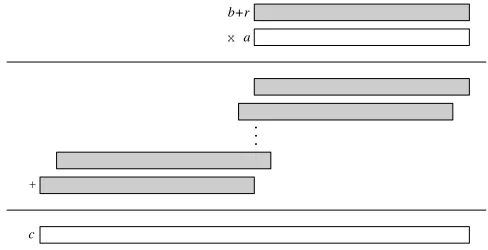
We consider the multiplicationa·(b+r). Ifais multiplier then the addition is performed depending on whetherai = 1 or not. The structure of the
shift-and-add method for the multiplication of a·(b+r) is shown in Figure 1. Page and Vercauteren [24] firstly presented an SPA attack against a·r in F3m, where a
is secret and ris public. It means that this conditional branch is vulnerable to TA or SPA attack [20, 9]. Thus, we can also recoveruofu·(xP+xQ), which is
a part of step 5 of Algorithm 1. In this case,uis thex-coordinate of the secret pointP. Thus we can obtain they-coordinate from the x-coordinate.
However, ifb+ris multiplier then the conditional branch occurs depending onbi+ri. So, if we can detect an appearance of the conditional branch by TA
or SPA attack then bi 6= ri. Otherwise, bi = ri. Thus we can recover xP by
controllingxQ in u·(xP +xQ). SincexP is the square root of thex-coordinate
of the secret pointP we can obtain thex-coordinate by squaringxP, and then
they-coordinate from thex-coordinate of the secret pointP.
3.4 DPA on the Eta Pairing in Characteristic two
To ease the explanation we consider the simplified Hamming weight model for power leakage [23]. In this model, power consumption depends on the Hamming weight of the data being processed. Thus we can express the power consumption C as follows:
C=ε·H+n,
where H, εandnrepresent the Hamming weight of the intermediate data, the incremental amount of power for each extra ‘1’ in the Hamming weight, and the noise, respectively. Note that assume the average of noisenis zero.
Attack on the addition: The addition ofb+ris of the form
(bm−1⊕rm−1)x
m−1+ (b
m−2⊕rm−2)x
m−2+· · ·+ (b
1⊕r1)x+ (b0⊕r0).
LetCbe the power consumption associated with the addition operationb+r. To recover thei-th bit ofb, we guess thatbi= 1 and divide power consumptions
into two sets by ri.
Sk={C|ri=k} withk∈ {0,1} (5)
The averages of S0 andS1 are respectively ε(M + 1)/2 andε(M −1)/2, where
M is the size of the resister. Thus the differential power consumption is
∆=hS0−S1i. (6)
If∆6= 0 thenbi = 1, otherwisebi= 0.
In conclusion, since the addition operation (xP+xQ) of step 5 of Algorithm
1 is vulnerable to the above analysis we can recoverxP. From this value we can
obtain thex-coordinate andy-coordinate of the secret pointP.
Attack on the multiplication: Since DPA attacks use correlation between power consumptions and specific key-dependent intermediate values which ap-pear during computation related with the secret it is important to examine the
b+r a
. . .
c
x
+
intermediate values for the computation of a·(b+r) by Algorithm 2. We will treat both cases: the first case is that ais multiplier and b+r is multiplicand and the second case is thatb+ris multiplier andais multiplicand.
Theorem 1. In Algorithm 2, if a is multiplier and b+r is multiplicand then the algorithm is vulnerable to the DPA attack.
Proof. In this case, the multiplication is performed as follows;
am−1x
m−1(b+r) +a
m−2x
m−2(b+r) +· · ·+a
1x(b+r) +a0(b+r). (7)
To describe how to recover a assume the lowest bitsai−1,· · ·, a0 of the secret multiplier aare already recovered. We describe how to find the next bit ai.
In Algorithm 2, the intermediate value obtained at end of i-th step of the loop is
aixi(b+r) +· · ·+a1x(b+r) +a0(b+r). (8)
Thei-th bit of (8) is
ai(b0+r0) +ai−1(b1+r1) +· · ·+a1(bi−1+ri−1) +a0(bi+ri)
= (aib0+ai−1b1+· · ·+a0bi) + (air0+ai−1r1+· · ·+a0ri). (9)
In this case, we can not simulate this intermediate value because we don’t know the value ofaib0+ai−1b1+· · ·+a0bi. However, we can accomplish a DPA attack
by only controlling the input valuerand not the intermediate value.
LetCbe the power consumption associated with computation of a·(b+r). From the formula of (9) we guess theai= 1 and divide power consumptions into
two sets byair0+ai−1r1+· · ·+a0ri, which is derived from the already known ai−1,· · ·, a0 and the random value chosen by ourself.
Sk={C|r0+ai−1r1+· · ·+a0ri=k}withk∈ {0,1} (10)
Ifaib0+ai−1b1+· · ·+a0bi= 1 in (9) then the average power consumptions of S0andS1are respectivelyε(M+1)/2 andε(M−1)/2, whereM is the size of the resister. So, we havehS1−S0i=−ε. In the case ofaib0+ai−1b1+· · ·+a0bi= 0,
the averages ofS0andS1are respectivelyε(M−1)/2 andε(M+ 1)/2. We have hS1−S0i=ε. The difference between two cases is only whether the differential average power consumptions is positive or negative. Thus we will compute the differential power consumption by using absolute value
∆=h|S1−S0|i. (11)
If ∆ 6= 0, namely, we can detect an appreciable peak then the guess is right (i.e., ai = 1), otherwise the guess is wrong (i.e., ai = 0). The remaining bits
am−1,· · · , ai+1 are recursively recovered by the same way. Thus we can recover
Theorem 2. In Algorithm 2, if b+r is multiplier and a is multiplicand then the algorithm is vulnerable to the DPA attack.
Proof. The multiplication of (b+r)·ais performed as follows;
(bm−1+rm−1)x
m−1a+ (b
m−2+rm−2)x
m−2a+· · ·+ (b
1+r1)xa+ (b0+r0)a.
In this case, we also describe how to recovera. Assume the lowest bitsai−1,· · ·, a0
ofaare already recovered. The aim is to find the next bitai.
In Algorithm 2, the intermediate value obtained at end of i-th step of the loop is
aixi(b+r) +· · ·+a1x(b+r) +a0(b+r). (12)
Thei-th bit of (12) is
(bi+ri)a0+ (bi−1+ri−1)a1+· · ·+ (b1+r1)ai−1+ (b0+r0)ai
= (bia0+bi−1a1+· · ·+b0ai) + (ria0+ri−1a1+· · ·+r0ai). (13)
The above equation is equal to (9). Thus, we can recover ai by the proof of
Theorem 1. ut
In conclusion, since the multiplication ofu(xP+xQ) of step 5 of Algorithm
1 is vulnerable to the proposed attack, we can recoveru, thex-coordinate of the secret point P. Finally, we can obtain the y-coordinate from the x-coordinate.
Remark 1. Since the eta pairing over characteristic three also includes the ad-dition a+rand the multiplication a·r, where ais secret andr is public (See [1] for detail.) the addition and the multiplication are vulnerable to the above described attack. However, note that Page and Vercauteren [24] also presented DPA attack on the multiplication ofa·r. Thus the eta pairing over characteristic three is also insecure against side channel attacks.
4
Proposed Countermeasure
The attack described in Section 3 is possible since we can choose and con-trol an input value. To incapacitate such a behavior Coron [9] proposed three method securely computing scalar multiplicationdP in elliptic curve cryptosys-tems (ECCs), where d is the secret key and P is public. Let E be an elliptic curve over finite fields Fq. Let #E be the number of points of the curve. The countermeasures for computingQ=dP are follows:
1. Randomization of the private value, i.e., dP = (d+r·#E)P for random numberr∈Fq.
2. Blinding the public value, i.e., dP =d(P +R)−dR for a random pointR
onE(Fq).
In the context of the above techniques, Page and Vercauteren [24] and Scott [29] proposed some methods for the pairings. First, they used bilinearity to ran-domize the private data, i.e., e(P, Q) =e(sP, tP)1/st wheresandt are random
variables. Furthermore, the exponentiation to the power 1/stcan be removed by selectingsandtsatisfyings·t= 1 modl, wherelis the order of the underlying elliptic curve for the pairing [24]. Second, they presented the method for blinding the input point by the relatione(P, Q) =e(P, Q+R)·e(P, R)−1[24].
4.1 Projective Coordinate Randomization
In this paper, we propose an explicit algorithm for the eta pairing using the projective coordinate in order to resist DPA attack, which is the fastest method among existing countermeasures, and then we estimate computational efficiency between the proposed method and previous countermeasures. We now describe how to make an algorithm using the randomized projective coordinate technique of the eta pairing in the case of characteristic two. The projective coordinates (X, Y, Z) of a pointP = (x, y) are given by
x=X/Z, y=Y /Z
We can randomize the input points by randomly selecting Z-coordinate value before the computation of the pairinge(P, Q). In Algorithm 1, we only randomize
Q for efficiency reason. Thus the step 5 of Algorithm 1 for the eta pairing is changed into
xP(√xP +XQ/ZQ) +√yP+√xP+YQ/ZQ+ (√xP+XQ/ZQ)s+t
= 1
ZQ
xP(ZQ√xP+XQ) +ZQ(√yP +√xP) +YQ+ (ZQ√xP+XQ)s+ZQt
.
Since 1/ZQ is in Fq it becomes one after the final exponentiation. Thus
elimi-nation of 1/ZQ does not effect the result. The concrete algorithm is shown in
Algorithm 3.
The step 6 of the proposed countermeasure is secure against the attacks described in the previous section because all operands of the addition and the multiplication operations are randomized by the projective coordinate system.
4.2 Randomizing Miller Variables
In [29], Scott introduced a method which multiplies intermediate values ap-pearing during the loop by random value in Fq. To defend from the DPA at-tacks described the previous section, all intermediate variables (not only g) in step 2 and the step 5 of Algorithm 1 must be multiplied by a random value. Thus the step 2 and the step 5 should be respectively changed into
f ← u·(r·u+r·xQ) +r·yP +r·(yQ+b+ 1) + (r·u+r·xQ)s+t and
Algorithm 3 Randomized Projective Coordinate ηT(P, Q) on the curve E:
Y2Z +Y Z2 = X3+XZ2+bZ3 over F
2m, where b ∈ F2 and m ≡ 3 mod 8
case
Input: P = (xP, yP) andQ= (xQ, yQ).
Output: ηT(P, Q).
1: (XQ, YQ, ZQ)←(λxQ, λyQ, λ), whereλis a random integer.
2: u←xP+ 1
3: f←u·(ZQ·u+XQ) +ZQ·(yP +b+ 1) +YQ+ (ZQ·u+XQ)s+ZQt
4: fori= 0 to (m+ 1)/2do
5: u←xP,xP ←√xP,yP ←√yP
6: g←u·(ZQ·xP+XQ) +ZQ·(yP +xP) +YQ+ (ZQ·u+XQ)s+ZQt
7: f←f·g
8: XQ←XQ2,YQ←YQ2,ZQ←ZQ2
9: end for
10: returnf(22m−1)(22m−2(m+1)/2+1)
5
Efficiency Comparison
We first estimate the computational cost of the proposed algorithm. In the orig-inal eta pairing, the initial step requires 1 multiplication in F2m and each loop
requires 7 multiplications in F2m, where 1 multiplication to compute g and 6
multiplications at step 6 because of the sparse form of g. However, the initial step of the proposed algorithm requires 5 multiplications inF2m where 2
mul-tiplications at step 1 and 3 mulmul-tiplications at step 3, and each loop requires 13 multiplications inF2m, where 4 multiplications at step 6 and 9 multiplications at
step 7. See Appendix for detail. Since addition and squaring inF2m are relatively
inexpensive compared to multiplication and inversion we can ignore the cost of field additions and squarings [16]. Moreover, we can ignore the cost of square roots because the method described in [12] for computing square roots in F2m
is as fast as squaring. Thus the additional cost for the eta pairing including the initial step is 3(m+ 1) + 4 multiplications inF2m.
We now compare computational efficiency of the techniques described in Section 4. First, the method using bilinearity additionally requires 2 scalar mul-tiplications. In supersingular curves, doubling a point is free and adding two distinct points requires two multiplications and one inversion [22]. In general, the ratio of inversion to multiplication is approximately 10 to 1 [16]. If we use the binary method for scalar multiplication then the additional cost of the eta pairing using this method is 11 multiplications in F2m. Second, the method of
e(P, Q) = e(P, Q+R)e(P, R)−1 additionally requires 1 pairing computation,
1 extension field multiplication, and 1 extension field inversion. The computa-tional cost of the eta pairing, i.e., Algorithm 1, is approximately 7(m+ 1)/2 multiplications in F2m plus the final exponentiation required 3 applications of
2m-Frobenius map, 4 multiplications in the extension fieldF
24m, and 1 inversion
in F24m [1]. In the approach randomizing intermediate variables by Scott [29],
Table 1.Additional Cost for DPA Resistance over the Eta pairing (not over the Tate pairing) on Supersingular Curves onF2m
Countermeasure Additional Cost
Page-Vercauteren (randomized private value) [24] 11mM
Page-Vercauteren (blinding public value) [24] 3.5(m+ 1)M+α
Scott (randomizing intermediate value) [29] 4(m+ 1)M+ 4M
The Proposed Method (Algorithm 3) 3(3(3(mmm+ 1)+ 1)+ 1)MMM+ 4+ 4+ 4MMM
as Section 4.2. We give a comparison table of the number of operations among existing techniques in Table 1, where M and α denote the computation time of a multiplication in F2m and the final exponentiation plus 1 extension field
multiplication inF24m and 1 extension field inversion inF24m, respectively.
6
Conclusion
In this paper, we have investigated the security of pairing based cryptosystems against side channel attacks. Since the use of pairing has different properties from primitives of traditional cryptosystems such as RSA or ECC the application of pairings such as identity based schemes has been interesting for implementing on constrained devices such as smartcards. Although the work for efficient im-plementation of pairings has concentrated the secure imim-plementation has not been worked precisely. In this paper, we have investigated security against side channel attacks for implementations of the eta pairing on supersingular curves in characteristic two. To avoid such attacks we have proposed an explicit algorithm of the eta pairing using the projective coordinate and showed that the proposed method is the most efficient countermeasure compared with previous techniques.
References
1. P.S.L.M. Barreto, S. Galbraith, C. OhEigeartaigh and M. Scott, “Efficient Pairing Computation on Supersingular Abelian Varieties,” Preprint 2005, to appear in Designs, Codes and Cryptography.
2. P.S.L.M. Barreto, H.Y. Kim, B. Lynn, and M. Scott, “Efficient algorithms for pairing-based cryptosystems,”CRYPTO 2002, LNCS 2442, pp.354-368, 2002. 3. P.S.L.M. Barreto, B. Lynn, M. Scott, “Efficient implementation of pairing based
cryptosystems,”Journal of Cryptology, Vol.17, No.4, pp.321-334, 2004.
4. G. Bertoni, L. Breveglieri, P. Fragneto, and G. Pelosi, “Parallel Hardware Ar-chitectures for the Cryptographic Tate Pairing,” Proceedings of the Third In-ternational Conference on Information Technology: New Generations (ITNG’06), pp.186-191, 2006.
6. D. Boneh and M. Franklin, “Identity Based Encryption from the Weil Pairing,”
SIAM J. of Computing, Vol.32, No.3, pp.586-615, 2003.
7. D. Boneh, B. Lynn, and H. Shacham, “Short signatures from the Weil pairing,”
Asiacrypt 2001, LNCS 2248, pp.514-532, 2002.
8. J.C. Cha and J.H. Cheon, “An Indentity-Based Signature from Gap Diffie-Hellman Groups,”PKC 2003, LNCS 2567, pp.18-30, 2003.
9. J.S. Coron, “Resistance against Differential Power Analysis for Elliptic Curve Cryptosystems,”CHES 1999, LNCS 1717, pp.292-302, 1999.
10. R. Dutta, R. Barua, and P. Sarkar, “Pairing-Based Cryptographic Protocols : A Survey,” Cryptology ePrint Archive, Report 2004/064, 2006.http://eprint. iacr.org/2004/064.
11. I. Duursma and H.-S. Lee, “Tate pairing implementation for hyperelliptic curves
y2=xp
−x+d,”Asiacrypt 2003, LNCS 2894, pp.111-123, 2003.
12. K. Fong, D. Hankerson, Julio L´opez, and A. Menezes, “Field inversion and point halving revisited,” Technical Report CORR 2003-18, University of Waterloo, Au-gust 2002.
13. S.D. Galbraith, K. Harrison, and D. Soldera, “Implementing the Tate pairing,”
ANTS V, LNCS 2369, pp.324-337, 2002.
14. Gemplus, “ID based Cryptography and Smartcards,” 2005. http://www. gemplus.com/smart/rd/publications/pdf/Joy05iden.pdf.
15. R. Granger, D. Page, and M. Stam, “Hardware and software normal basis arith-metic for pairing based cryptography in characteristic three,”IEEE Transactions on Computers, Vol.54, No.7, pp.852-860, July 2005.
16. D. Hankerson, J.L. Hernandez, and A. Menezes, “Software Implementation of Elliptic Curve Cryptography over Binary Fields,”CHES 2000, LNCS 1965, pp.1-24, 2000.
17. F. Hess, “Exponent group signature schemes and efficient identity based signature schems based on pairing,”SAC 2002, LNCS 2595, pp.310-324, 2002.
18. F. Hess, N. Smart, and F. Vercauteren, “The eta pairing revisited,” Cryptology ePrint Archive, Report 2006/110, 2006.http://eprint.iacr.org/2006/110. 19. T. Izu and T. Takagi, “Efficient Computations of the Tate Pairing for the Large
MOV Degrees,”ICISC 2002, LNCS 2587, pp.283-297, 2003.
20. C. Kocher, J. Jaffe, B. Jun,“Differential Power Analysis,”CRYPTO 1999, LNCS 1666, pp.388-397, 1999.
21. S. Kwon, “Efficient Tate Pairing Computation for Elliptic Curves over Binary Fields,”ACISP 2005, LNCS 3574, pp.134-145, 2005.
22. A. Menezes, “Elliptic Curve Public Key Cryptosystems,” Kluwer Academic Pub-lishers, 1993.
23. T.S. Messerges, “Using Second-Order Power Analysis to Attack DPA Resistant Software,”CHES 2000, LNCS 1965, pp.238-251, 2000.
24. D. Page and F. Vercauteren, “Fault and Side-Channel Attacks on Pairing Based Cryptography,” Cryptology ePrint Archive, Report 2005/283, 2005. http:// eprint.iacr.org/2005/283.
25. D. Page and F. Vercauteren, “A Fault Attack on Pairing Based Cryptography,” To appear in IEEE Transactions on Computers 2006.
26. K.G. Paterson, “ID-based signature from pairings on elliptic curves,”Electronics Letters, Vol.38, No.18, pp.1025-1026, 2002.
28. R. Sakai and M. Kasahara, “ID based cryptosystems with pairing on el-liptic curve,” Cryptography ePrint Archive, Report 2003/054, 2003. http:// eprint.iacr.org/2003/054.
29. M. Scott, “Computing the Tate Pairing,”CT-RSA 2005, LNCS 3376, pp.293-304, 2005.
30. M. Scott, N. Costigan, and W. Abdulwahab, “Implemetation Cryptographic Pairings on Smartcards,” Cryptography ePrint Archive, Report 2006/144, 2006.
htt://eprint.iacr.org/2006/144.
31. N.P. Smart, “An identity based authentication key agreement protocol based on pairing,”Electronics Letters, Vol.38, No.13, pp.630-632, 2002.
32. E. Verheul, “Evidence that XTR is more secure than supersingular elliptic curve cryptosystems,”Journal of Cryptology, Vol.17, No.4, pp.277-296, 2004.
A
Multiplication in
F
24mThe extension fieldF24m is represented by the basis {1, s, t, st} such thats2+
s+ 1 = 0 andt2+t+s= 0. Let g= (g
0, g1, g2, g3) =g0+g1s+g2t+g3st and
f = (f0, f1, f2, f3) =f0+f1s+f2t+f3st. Then we haveh= (h0, h1, h2, h3) =f·g where
h0=f0g0+f3g2+f2g3+f3g3,
h1=f1g0+f0g1+f1g1+f2g2+f3g2+f2g3,
h2=f2g0+f3g1+f0g2+f2g0+f1g3+f3g3,
h3=f3g0+f2g1+f3g1+f1g2+f3g2+f0g3+f1g3+f2g3+f3g3.
In Algorithm 3, sinceg3= 0 the above formula is simplified as follows.
h0=f0g0+f3g2,
h1=f1g0+f0g1+f1g1+f2g2+f3g2,
h2=f2g0+f3g1+f0g2+f2g0,
h3=f3g0+f2g1+f3g1+f1g2+f3g2.