Almost Optimal Hash Sequence Traversal
Don Coppersmith
∗Markus Jakobsson
†Abstract
We introduce a novel technique for computation of consecutive preimages of hash chains. Whereas traditional techniques have a memory-times-computation complexity of
O(n) per output generated, the complexity of our technique is onlyO(log2n), wheren
is the length of the chain.
Our solution is based on the same principal amortization principle as [1], and has the same asymptotic behavior as this solution. However, our solution decreases the real complexity by approximately a factor of two. Thus, the computational costs of our solution are approximately 1
2log2n hash function applications, using only a little more
thanlog2nstorage cells.
A result of independent interest is the lower bounds we provide for the optimal (but to us unknown) solution to the problem we study. The bounds show that our proposed solution is very close to optimal. In particular, we show that there exists no improvement on our scheme that reduces the complexity by more than an approximate factor of two.
Keywords: amortization, hash chain, pebbles, upper and lower bounds.
1
Introduction
Hash chains have been proposed as a tool for improving the efficiency of a variety of practical and valuable cryptographic applications, e.g., [5, 6, 7, 8, 11]. However, the cost for computing the next value on a hash chain is a topic that has largely been ignored. For long chains, this task may account for a quite noticeable – if not overwhelming – portion of the total computational effort of the protocol.
The technique most oftenly employed (whether implicitly or explicitly stated) is to com-pute each preimage by iterative hash function application to a common seed. However, such a method – which clearly has a computational complexity ofO(n) for a chain of lengthn– is highly wasteful in that the same sequence of values is repetitively computed. Another possi-ble method, in which all values are precomputed and stored, substantially reduces the on-line computational cost, but has a staggering storage complexity of O(n). All straightforward combinations of these two techniques can be shown to have a memory-times-computation complexity of O(n), which is often beyond the reasonable for desirable parameter choices. As an example, one can see that such a high complexity would be punitive in protocols like the broadcast authentication protocols by Perrig et al. [6, 7, 8]. There, the delay between
the transmission of a packet and the receiver’s authenticity check of the same is determined by the amount of time between the release of consecutive hash preimages. This makes short time periods (i.e., rapid hash chain traversal) desirable. At the same time, since their method is intended for very inexpensive devices, the permissible ”allowances” for computation and storage are strict. Together, these restrictions drastically limit the possible lifetime of such broadcast devices.
Influenced by amortization techniques proposed by Itkis and Reyzin [2], Jakobsson [1] showed how to reduce the above mentioned memory-times-storage complexity to O(log2n).
This was accomplished by the introduction of a technique in which multiple intermediary values are kept, but their values (and positions in the chain) constantly modified. While the protocol of Jakobsson stressed simplicity over efficiency, we take the opposite approach in this paper. By introducing a set of tricks and new techniques, we are able to improve the efficiency at the expense of simplicity – the latter both in terms of the protocol and its associated proofs. Thus, our improved protocol allows for a reduction of the computational requirements to slightly less than half of [1], while slightly reducing the storage demands for most practical parameter choices.
Using a numeric example to illustrate the differences, we have that consecutive preimages of a chain of length 231can be generated using 31 hash function applications and 868 bytes of
storage in [1], while our algorithm only needs 15 hash function applications and 720 bytes of storage – both assuming the use of SHA [10]. More generally, the computational requirements of our protocol are blog2√nc hash function evaluations per output element. The storage
requirements, in turn, are dlog2ne+dlog2(log2n+ 1)ememory cells, where each cell stores
one hash chain value and some short state information. Note that these arenotaverage costs, but upper bounds on the cost per element that is output, given a hash chain of lengthn.
In order to allow for these savings, it is necessary to shift from a strategy with a very simple movement pattern to a more complicated strategy where the per-element budget always is exhausted. (Another way to think about it is that the reduction of the budget demands a wiser spending strategy under which no resources are wasted.) Consequently, we develop a rationale for how to assign a now reduced budget among a set of pebbles whose demands and priorities are modified over time. Furthermore, we propose a protocol based on these design criteria and show it to be correct.
Finally, we show that our strategy, and the related protocol we propose, are near optimal. We do this by providing upper and lower bounds for the most efficient algorithm possible, and compare the resulting complexity to that of our protocol.
2
Intuition
the adjacent value in the direction of the end of the chain. In other words, each output value is the hash preimage of the previously output value. Therefore, previously output values are not useful in computing the next value to be output, which instead has to be computed by iterative application of the hash one-way function to a value towards the end of the chain.
Our solution employs novel amortization techniques to reduce the worst case computa-tional cost per element to the average cost. Simply put, we use the known principle of conserving resources by not letting anything go to waste. Technically speaking, this is done by assigning a computational budget per step in the chain, and applying any ”leftover com-putation” towards the computation of future elements. The contribution of this paper is a technique for computing the desired sequence without ever exceeding the per-step budget, along with the establishment of the required computational budget and memory demands.
In order to reach our goals, the leftover computation we apply towards future elements to be computed must be sufficient to compute these. More importantly, it must be sufficient to compute themon time. Thus, at each point in the chain, the cumulative required expenditures must not exceed the cumulative computational budget.
Assume that we want to compute a value close to the beginning of the chain. If no values along the chain are stored, then we have to perform an amount of work proportional to the length of the chain, which we denote n. Let us now introduce one ”helper value” at some distancedfrom the current chain element. Then, the cost of computing the current value is that ofd−1 hash function evaluations. The cost for the next value to be computed, in turn, will bed−2 such evaluations. However, once the helper value is reached, the cost of the next value will be that of reaching the endpoint of the chain – assuming we only employ one helper value. One can see that the total cost is minimized ifd=n/2, i.e., the helper value is located on the mid-point of the chain.
If we can use twohelper points (which corresponds to storing two extra elements instead of one) then one could let the entire interval be split into three equally long intervals, in which case the cost of computing the next element would be upper bounded byn/3 hash function evaluations. On the other hand, if we first split the entire interval in two equally long intervals, and then split the first of these two into two sub-intervals, then we have upper bounded the
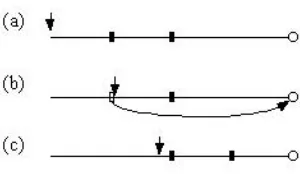
initial computational cost at n/4 hash function evaluations. This lower cost applies to the first half of the entire interval, after which the distance to the next element (which is the endpoint) would ben/2. However, if we – once we reach the first helper point – relocate this to the midpoint between the ”global midpoint” and the endpoint, we will maintain an upper bound ofn/4. (See figure 1 for an illustration of how the relocation occurs.)
This assumes that we have enough remaining computation for this relocation. Note now that if we have three helper points, we have more values to relocate, but we also reduce the computational upper bound for each element (since the intervals decrease in length with an increasing number.) We can see that using approximately log n helper values, we will maximize the benefits of the helper points, as we then, for every element to be computed, will have a helper point at a maximum distance of two steps away.
Figure 1: The figure shows the movement of helper values (squares) as the current posi-tion (small arrow) changes. In (a) the posiposi-tions right after setup are shown; (b) shows the relocation of the first helper value as it has been reached. In (c), its relocation is completed.
be. However, the cost metric we are interested in minimizing is not computation alone, but the product of computational complexity and memory complexity.
For each element to be computed and output we assign a budget, corresponding to the computational upper bound per element. The computation of the next element has the highest priority to access this budget, since for each step, one has to compute and output the appropriate element. Any leftovers are assigned to the computation of helper values. These are partitioned intohigh priority helper values and low priority helper values. High priority helper values are relocated into already rather small intervals, located close to the current element (i.e., the element to be output in the current round). Low priority helper values, in turn, traverse larger distances, and further from the current element. The low priority helper values are only assigned those portions of the budget that remain after the current element has been computed, and the high priority helper values have exhausted their needs (i.e., arrived at their respective destinations.) Given that low priority helper values are traversing distances large enough to make it impossible for them to both get started and arrive in one and the same time interval, we can with only two such helper values guarantee that there always will be one left to ”soak up” any computational leftovers.
During the setup phase, the endpoint of the chain is randomly selected, and the start point obtained by iterated hash function evaluation. This may be done by a device with less computational limitations than the device that later will compute and output the consecutive elements. During setup, the helper values will also be initialized. The first helper value will be placed at the mid-point between the endpoint and the starting point, thereby splitting the entire interval in two. The ith helper value will be placed on the midpoint between the position of thei−1st helper value and the starting point. Thus, each helper value will have a position and a value associated with them, where the value is obtained by iterated hash function application of the endpoint value or a previously placed helper value.
Outline: We begin by introducing our method for computing the sequence of hash preim-ages, first laying out the preliminaries (section 3) and then elaborating on the protocol (sec-tion 4). In sec(sec-tion 5, we present and prove our claims relating to the completeness and correctness of the protocol, and relating to the upper and lower bounds of the optimal solu-tion to the problem we study.
3
Preliminaries
Definitions
We use the termhash chain H to mean a sequence of values< v0, v1, . . . , vi, . . . vn >, where vn is a value chosen uniformly at random from{0,1}l, andvi=h(vi+1), whereh:{0,1}∗→
{0,1}lis a hash function or another publicly computable one-way function. We refer tov0as
thestarting point, and to vn as theendpoint.
We define the spannto be the length of the hash chain, i.e., the number of elements in the sequence to be generated. We assume thatn= 2σ for some integerσ >2.
We define the budget b as the number of computational units allowed per element of the sequence that is output. Here, we only count hash function evaluations and not other computational steps associated with the protocol execution. This is reasonable given the fact that the computational effort of performing one hash function evaluation far exceeds the remaining work per step.
We refer to each helper value, and to the endpoint, as a pebble. Each pebble pj has a position in the chain and a value associated with itself. The position of the start value is zero, and the position of the endpoint equals the spann. Ifpositionis the position of a pebble, then its value isvposition. Additionally, each pebble is associated with a destination(the position to which it is going); a priority (high or low); and an activity status (free, ready, active, arrived.) Here, pebbles that are not in use are referred to asfree; these may be allocated to a particular task once the need arises. A pebble that is readyhas been assigned a task, but has not yet started to move, while anactivepebble in in motion. We use the ready state for a so-called “backup” pebble. This is a pebble that will become a low-priority pebble as soon as the active low-priority pebble reaches its destination. Finally, a pebble is assigned status
arrived if it located at its destination point, and is still needed there (i.e., has not yet been reached by the “current” pointer, which corresponds to the position of the current output value.) We letkdenote the number of pebbles used; the amount of storage needed isktimes the amount needed per value, plus the amount (registers, etc.) needed for the execution of the protocol.
Goal
After performing a setup phase, we wish to generate the sequence H, element by element (and starting from v1), using a minimal budget and a minimal number of pebbles. We will
demonstrate a method with required budget b = bσ/2c and using k = σ+dlog2(σ + 1)e
Design Guidelines
If a pebble is located at the position corresponding to the current output, we say that this pebble has beenreached, at which time it receives ”free” status. All pebbles with status free are assigned a new position, destination, state and priority, according to guidelines that are set up to guarantee protocol completeness. To explain the proposed protocol, we present these guidelines along with their technical motivations.
”First things first”. At each step, we first compute and output the appropriate hash chain value (which we call thecurrentvalue); then, any remaining budget is assigned to active high-priority pebbles, starting with the pebble with the lowest position value (i.e., closest to the position associated with the current output value.) First then, any still remaining budget is assigned to active low-priority pebbles. This is to ensure that computational results that soon will be needed are ready on time.
Controlling high-priority pebbles. The high-priority pebbles are started at the ”far end” of the first interval after the current value that does not already contain an active pebble, counting only intervals of size greater than two. In other words, if there is a pebble infree
state, this will obtain the position and value of the first interval of size four or greater in which there is no active pebble, and will be given state active. Here, pebbles that just have been assigned to a position are considered to be in the interval in question. When the pebble reaches its destination (at the mid-point of the interval), it is given statearrived. Thus, if the resulting intervals (half the size of the original interval) are at least of size four, a new pebble may immediately be assigned a starting position equalling the position of the pebble that just reached its destination.
High-priority pebbles are only allowed to be active in positions lower than the active low-priority pebble, and are otherwise kept infreestate. This is to make sure that high-priority pebbles do not take too much of the available budget: it slows them down to the benefit of low-priority pebbles when they complete their imminent tasks.
Controlling low-priority pebbles. We want there always to be a low-priority pebble that can “soak up” any remaining computational budget. We can achieve this by (1) having one ”backup” pebble that is not assigned to any task, but which is ready to become the active low-priority pebble; and by (2) making each low-priority pebble traverse a distance that is sufficiently long that it and its backup cannot both complete before a new pebble becomes available. (When a new pebble does become available, it will be assigned to become a backup pebble if there is none, otherwise a high-priority pebble.)
pebble will be created before the converted pebble reaches its goal. Thus, our requirement will be satisfied.
By taking this approach, we can guarantee that the entire budget of each step will always be consumed, since there will always be an active low-priority pebble. According to our suggested approach, we only needoneactive low-priority pebble at the time, and one ”backup” low-priority pebble.
4
Protocol
Setup. The endpoint vn is chosen uniformly at random from {0,1}l, where we may set l = 160. The sequenceH =< v0, v1, . . . , vi, . . . , vn >is computed by iterated application of the hash functionh, wherevi =h(vi+1), 0≤i < n−1. Pebblepj, 1≤j ≤σ, forσ=log2n,
is initialized as follows:
position←2j destination←2j value←v2j
status←arrived.
The remaining pebbles, pj, σ < j ≤ k, have their status set to free. All the pebble in-formation is stored on the device we wish to later generate the hash sequence; this de-vice also stores counters current ← 0 and backup ← 0, along with the span n. The pair (startpoint, current) = (v0,0) is output. The starting point v0 corresponds functionally to
the public key of the chain.
Maintenance. In the following, we assume that the pebblespj, 1≤j≤k, are kept sorted with respect to their destination, with the lowest destination value first; and that pebbles that do not have a destination assigned appear last in the ordered list. Consequently, the next pebble to be reached (from the current position) will always bep1. When the status of the
pebbles is changed at any point, the altered item is inserted at the appropriate place in this sorted list. We let LP (short for low priority) be an alias of the active low-priority pebble. Thus,LP.positionis the current position of the active low-priority pebble, independently of what pebble number this corresponds to. Similarly, BU refers to the backup low-priority pebble.
1. Setavailable←b. (Set the remaining budget.)
2. Increasecurrentby 1.
3. If currentis odd then (No pebble at this position.)
outputh(p1.value), (Compute and output.)
decreaseavailableby 1,
else (A pebble at this position.)
outputp1.value, (Output value, set pebble free.)
set p1.status←free,
ifcurrent=n, then halt. (Last value in sequence.)
4. For all free pebblespj do (Reassign free pebbles.) ifbackup= 0 then (Backup low-priority needed.)
pj.priority←low, pj.status←ready, BU ←pj,
backup←1, else
CallplaceHP(pj) (Make it high priority.) 5. Sort pebbles.
6. Setj ←1. (First pebble first.)
7. Whileavailable >0 do
ifpj.status=activethen (Only move active pebbles.) decreasepj.positionby 1, (Update its position...) pj.value←h(pj.value), (... and value...)
decreaseavailableby 1, (... and do the accounting.)
ifpj.position=pj.destinationthen (Pebble arrived!) pj.status←arrived,
ifpj.priority=lowthen (A low-priority pebble arrived.)
LP ←BU, (Backup becomes low priority.)
backup←0,
CallplaceLP, (Activate new low priority pebble!)
Sort pebbles.
increasej by 1. (Next pebble!)
8. Sort pebbles.
9. Go to 1. (Next element now.)
Routine PlaceLP. We begin by describing how one could compute the sequence of values assigned to variables during calls to PlaceLP. (We later describe how justonesuch assignment can be computed, as opposed to an entire sequence. We also elaborate on a method that is less wasteful of stack space.) The wanted functionality of the routine is to compute the next starting point for a low-priority pebble, along with the associated destination.
In the following, we use ”normalized” positions for ease of reading and uniformity over different spans. To get a real position from a normalized position, one multiples the latter by a valueλ, whereλis the smallest power of two not smaller than 2b, and wherebis the budget. In other words,λ= 2dlog2be+1. Thus, the series of normalized starting points, starting with
Figure 2: The left part of the figure shows the desired destinations of pebbles, where the num-ber corresponds to the relative order of assignment. The relative order therefore corresponds to the depth-first traversal order of the corresponding tree, shown to the right. Note that the hash chain nodes correspond to a vertical projection of the tree nodes.
for b = 4, λ = 8. Similarly, the destination points and the distances between the starting points for the pebbles and their destinations are described in normalized terms.
When a free pebble is activized, it is placed on top of another pebble (located at its starting point) and given a destination. The destination is at the mid-point of the interval to the next pebble (in the direction of the current pointer). Thus, the intervals are split in two; as the pebble arrives, a new pebble is placed on top of it, with a destination of the next lower midpoint. If an interval is too small to be split, the pebble is instead placed at the end of thenextinterval.
We associate the first split of an interval with the root of a tree. The children of the root correspond to the splits of the resulting two intervals, andtheir children by their respective splits. The leaves correspond to the smallest splits of the intervals. Figure 2 shows the nodes of a small tree, and their order of traversal, and how these corresponds to the order of pebble placement in the hash chain. Figure 3 shows the starting points and destinations for one example tree, according to the assignment strategy described below.
We say that the height of a tree is the number of layers of nodes it has. (Thus, a tree consisting on only one node has height 1.) With each node of the tree, we associate a starting point; a distance; and a destination, where the destination is the difference between the starting point and the distance.
The normalized starting point for the root of a tree of height j is start = 2j+1. The
normalizeddistanceof a node at height iin the tree is dist= 2i−1; thus the distance of the
root is 2j−1, and leaves of the tree all have normalized distance dist = 1. The normalized
destinationdestof any node (and the root in particular) is the difference between its starting point and distance, i.e.,dest=start−dist. Finally, the starting point for a left child is its parent’s destination value,parent.dest, while it is the parent’s starting valueparent.startfor a right child.
Figure 3: The left part of the figure shows the desired movement pattern of low priority pebbles in the interval between normalized positions 8 and 16, where the numbers on the arrows correspond to the relative order of the movements. The right part of the figure shows the tree structure from which these movements are obtained. The node number corresponds to the relative order of the movement, and is obtained by depth-first traversal of the tree. The triple associated with a node is the (starting point, distance, destination) of the corresponding pebble. A tree of height 2 is used for the normalized interval 4-8, and one of height 1 for the interval 2-4. Similarly, larger trees are used for later intervals.
assignments we need in our protocol.
Each call to PlaceLP first computes such a pair of normalized values, all from the above described sequence; these are then multiplied byλand the product returned as the result of the function. Thus, it sets
LP.priority ←low LP.status←active LP.position←λ start LP.destination←λ dest
As soon asλ start > n, no assignment is performed, since there is no need for low priority pebbles any longer. Any calls toPlaceLPafter that return without any assignment.
Claim: The routinePlaceLPgenerates a sequence of elements, where the ith element of the sequence corresponds to the pair of starting position and destination of the ith low-priority pebble to be activated. The starting point corresponds to that of a pebble already placed on the hash chain, and the destination corresponds to the middle point between this same pebble and the closest pebble in the direction of the current pointer. The distance between starting point and destination is at least twice the budget per step that is available for moving pebbles, which guarantees that a recently placed low priority pebble does not reach its destination before another pebble has been activated. Once such a pebble does reach its destination, a “backup low-priority pebble” is activated by being turned into a standard (active) low-priority pebble. Once a new pebble is reached by the current pointer (at which time it is redundant in its current position, and needs to be relocated), such a pebble is made into a backup low-priority pebble, if the old such pebble has been activated.
Routine PlaceHP. The routine for computing the next location for a high-priority pebble is similar to the above, its main differences being that (1) the real and normalized values coincide, and (2) after the trees in the forest have reached heightlog2λ, they stop growing.
The starting position of thejth tree isstart= 2j+1forj≤log
2λ, andstart=λ(j−log2λ)
forj > log2λ. As before, the starting point for a left child is its parent’s destination value,
parent.dest, while it is the parent’s starting valueparent.startfor a right child. Thedistance
of a node at height iin the tree isdist = 2i−1. The destination, as before, is the difference
between its starting point and destination, i.e.,dest=start−dist.
Before any assignment is made, it is verified that start ≤ LP.position, i.e., that the assignment in question is to a position before the active low priority pebble. If this is not the case, no assignment is made at this point, and the comparison re-performed at the next call to the routine. Otherwise, the following assignment is made to parameterpj to the routine:
pj.priority←high pj.status←active pj.position←start pj.destination←dest
Claim: The routinePlaceHPgenerates a sequence of elements, where the ith element of the sequence corresponds to the pair of starting position and destination of theith high-priority pebble to be activated. The starting point corresponds to that of a pebble already placed on the hash chain, and the destination corresponds to the middle point between this same pebble and the closest pebble in the direction of the current pointer. The starting point is chosen as a point between the current pointer and the active low-priority pebble, as close to the current pointer as possible, such that the distance between the starting point and the destination is at least two.
Memory Complexity. In order to conserve working space, one can opt for a solution that does not use a stack, but which recomputes the state from scratch when needed. One variable would store the height of the tree; one would store the number of steps (using depth-first search) from the root. Additionally, we need variables forstart,dist anddest. To compute these values, we would (at each time) begin with their starting assignments, and then modify them according to the tree traversals leading to the wanted number of steps from the root. This is done in accordance with the respective assignments, as above.
The maximum tree height for PlaceLP is σ −log2λ−1, since this corresponds to a
normalized starting point of 2σ−λ and a starting point of 2σ. Thus, this variable needs
blog2σc bits. For PlaceHP, the maximum height is log2λ, requiring log2dlog2dλee bits of
storage. A tree of the maximum height has 2σ−log2λ−1
−1 nodes for PlaceLP, and 2λ−1 nodes forPlaceHP. Thus, the distances from the root can be represented withσ−log2λ−1
respectiveλbits. Finally, the maximum value of the last three variables isσbits for each one of them, since the maximum value they can be assigned is 2σ. (These only keep state within a computation, and so, we do not need one set for each algorithm.)
Therefore, the memory requirements ofPlaceLPandPlaceHPare less than 4σ+log2σ+
5
Claims
Consider a spann= 2σ, a budgetb=bσ/2candkpebbles, fork=σ+dlog
2(σ+ 1)e.
We refer to the sum of the budgets from the setup stage until a particular step as the
cumulative budgetat the step in question. We say that the protocol with a budget restriction of b and a storage restriction of k succeeds at step j if and only if it outputs the jth value
vj of the hash sequence during this step, and that the protocol succeeded at stepj−1. The protocol is said to succeed (by definition, and due to the setup procedure) at step 0 – this corresponds to the setup phase, on which we do not place any strict restrictions in terms of computation and storage.
Theorem 1: (Completeness.) The protocol succeeds at stepj, 1≤j≤n, for a spann= 2σ, budgetb=bσ/2candk=σ+dlog2(σ+ 1)epebbles.
The proof of the theorem will be based on the following lemmata, all of which relate to the above assignments forn, b and k. Recall that λis defined to be the smallest power of two not smaller than 2b.
Lemma 1: (Bootstrapping.) The protocol succeeds at stepj, 1≤j≤λ.
Proof of Lemma 1:
We will consider two cases: λ <8, andλ≥8. Recall that the cost of moving one step ahead equals the distance from the position we move to the next (forward) pebble. Recall also that
λis defined to be the smallest power of two equal to or larger than 2b, and thus,λ <4b. The first case corresponds to the two possibilities λ= 2 or λ= 4. For λ = 2, we have
b= 1. We need budget 1 to computev1 fromv2(where there is a pebble), and zero budget to
obtainv2. Forλ= 4, we know thatb= 2. Since there are pebbles at positions 2 and 4, the
budgets to reach these are zero, and the budget to reach step 1 and 3 from the step before is one. Therefore, the lemma holds for the first case.
For the second case, i.e.,λ≥8, we know that there is one pebble at λ, one at λ/2, and one atλ/4, since we start with pebbles at each position that is a power of two, and which is in the interval between 0 andn. Consider the first two quarters of the interval between 0 andλ. Notice first that the budget will be sufficient for each step of these two quarters, since the pebbles are spaced λ/4 apart, and the budget isb > λ/4 (given howλis defined). The traversal cost for both of the quarters is upper bounded by (λ/4−1)+(λ/4−2)+. . .+2+1+0 = (λ/4−1)λ/8, giving a total of (λ/4−1)λ/4. The total budget assignment for this first half is (λ/2)b. Sinceb > λ/4, we have that the cumulative budget is (λ/2)λ/4. Thus, the budget ”surplus” for the first half is at least (λ/2)λ/4−(λ/4−1)λ/4 = (λ/4 + 1)λ/4> λ/4.
This surplus will be applied to moving pebblesoutsidethe first half of the interval, since any pebble movementinsidethe first half could only lower the expenditures for this portion, which would cause an even larger surplus. The surplus, in turn, is always spent on moving pebbles, with the closest high-priority pebbles receiving priority. The first pebble outside the first half of the interval would start atλ, and have destination 3λ/4. Given that the surplus of the first half of the interval is at leastλ/4, the pebble would reach its destination by the time the current position isλ/2.
b > λ/4. Thus, the budget will be sufficient for each step of the two last quarters of the interval, and we see that the protocol will succeed at stepλ. This concludes the proof.
Lemma 2: (Discrete points.) The protocol succeeds at stepj= 2iλ+ 1, 0≤i≤σ−log
2λ,
if it succeeds at step 2iλ.
Proof of Lemma 2:
Assume that we have arrived at position j = 2iλ for some 0 ≤ i ≤ σ−log
2λ−1. (This
means that the protocol succeeded up until this point.) We wish to prove that the protocol will succeed for the next step, too. In order for this to occur, the next pebble must be at mostb+ 1 steps away from stepj, or the budget will not suffice. We will show that there will be a pebble atj+ 2, which would make the lemma hold, sinceb≥1.
At the time when we are at stepj, the total incurred costs for pebbles equal the cost for filling the space between 0 and j with pebbles, plus that for populating (with exponentially increasing intervals) the interval between j and 2j. We will argue that this sum is equal to the cost of populating the interval between 0 andj only,were this interval empty. This will result in a simpler way of determining the total required pebble expenditure up until step j. Consider the location of all pebbles in the interval between 0 andjat the start time. These pebbles are located at positions 2,4,8, . . . , j/2. We want pebbles at positionsj+ 2, j+ 4, j+ 8, . . . , j+j/2 when we are at position j. Due to the setup, there will already be a pebble at 2j= 2i+1λ. The cost of placing the pebbles at (j+ 2, j+ 4, j+ 8, . . . , j+j/2), given the
pebble at 2j, is identical to the cost we would have incurred if we wanted to place pebbles at 2,4,8, . . . , j/2, given the pebble atj, since the relative distances fromj resp. from 2j are identical for the two sequences. We can therefore substitute the cost for the real sequence betweenj and 2j by the hypothetical cost for the interval 0 toj.
Therefore, the total pebble expenditures at stepjwill equal the total pebble expenditures we were to incur if we were to fill an empty interval between 0 andj. The cost of filling an empty interval between 0 and j involves moving one pebble a distance j/2; two pebbles a distancej/4 each, four pebbles a distance ofj/8 each, etc. Filling the space means that (over time) every even position in the interval has a pebble. Thus, the total pebble expenditure is Plog2j−1
κ=1 2κ−1j2−κ, where 2κ−1 is the cardinality andj2−κis the associated cost. This total
expenditure can be seen to equalj/2(log2j−1).
If at any time we are either one or two steps from a pebble (where our position corresponds to the value being output), then the total expenditures for moving a step ahead is either zero (if we are at a position with an odd number, meaning next position has a pebble) or one (if we are at an evenly numbered position.) Thus, the total ”stepping” expenditures up until stepj arej/2.
We see that the total expenditures up until stepj = 2iλwould be j/2(log
2j−1) +j/2
in order for there to be pebbles at positions (j+ 2, j+ 4, . . . , j+j/2) at the time the current position reaches step j. This equals 1
2jlog2j. Given that for each of the j steps, we are
assigned a budgetb, the total budget up until that point will be jb. We will be successful if
b≥1
2log2j. This quantity will be the largest for the end of the interval that the proof is valid
for, i.e.,i=σ−log2λ−1. Plugging iniin the formula forjgives usj= 2σ−log2λ−1λ= 2σ−1.
Thus, if b ≥ 1
2(σ −1), then the lemma holds. According to the specifications, we have
Lemma 3: (Intervals.) The protocol succeeds at stepj= 2i+1λ, if it succeeds at step 2iλ+1.
Proof of Lemma 3:
Assume that the protocol succeeds at step j = 2iλ+ 1. We wish to prove that then, the protocol also succeeds at step 2j−2 = 2i+1λ. This will be shown using a symmetry argument.
Consider intervals of size 2iλ. Consider first such an interval starting at position 1 and ending at 2iλ, and then one starting at position 2iλ+ 1 and ending at 2i+1λ.
Assume that the current position is at the beginning of the second interval. Assume further that the relative positions of the pebbles in the second interval (in relation to the current position) are identical to the relative positions of the pebbles in thefirstinterval (in relation to the current pointer when located in the beginning of the first interval). Then, the required expenditures to reach the end of the second interval from its beginning must equal the required expenditures to reach the end of the first. This is so since the resource allocation strategy is the same for both intervals, namely that pebbles close to the current position are given priority over pebbles further away. Therefore, if the budget is sufficient to reach the end-point of the first interval, then it is also sufficient to reach the end-point of the second.
We know that the first interval will have pebbles at positions 2,4,8, . . . , j when we are at position 1. As was shown in Lemma 2, the cumulative budget available to pebbles at stepj
is sufficient for the placement of pebbles at positions j+ 2, j+ 4, j+ 8, . . . j+j/2, and we know that there already is one (due to the setup) at position 2j. Therefore, the required expenditures in the interval between 2iλ+ 1 and 2i+1λare the same as those for the interval
between 1 and 2iλ. This concludes the proof.
Proof of Theorem 1: The theorem follows from the above lemmata, all of which are proven in the appendix. Lemma 1 establishes that the protocol succeeds forj, 1 ≤ j ≤ λ. Then, Lemma 2 shows that it succeeds for λ+ 1 (i.e., setting i= 0), and lemma 3 shows that it succeeds for all values up until 2λ(again usingi= 0). Then, usingi= 1, lemmata 2 and 3 establish that the protocol succeeds up to position 4λ. We apply lemmata 2 and 3 iteratively, and for increasing values of i, ending with i = σ−1−log2λ, finally establishing that the
protocol succeeds forj=n, which completes the proof.
In the following, we show that our solution isalmost optimal. More particularly, we con-sider the product of the number of hash function evaluations needed, and the number of storage cells required, where each storage cell holds one hash chain value and some short state information. Then, the complexity of the optimal solution is 14log2n per output
ele-ment, while the complexity of our solution is approximately 12log2n – more precisely, it is 1
2blog nc(dlog2ne+dlog2(log2n+ 1)e). Thus, we are (practically speaking) no more than a
factor of two away from the optimal solution in terms of computation-times-storage complex-ity.
Theorem 2: (Lower bound.) The optimal solution to the problem has a memory-times-computational complexity of at least 41klg2n, wherenis the length of the hash chain andk
is the number of pebbles.
Let g(n, k) be the required cumulative budget for covering a string of length n with k
pebbles, excluding the initial cost (n) of setting up the pebbles.
Suppose that the furthest pebble is at position n−T, at the last time that it is used (cloned or used directly). Then we must cover an interval of lengthn−T withk−1 pebbles (not using the kth pebble, which is stuck at position n), expend energy T to lay down the pebbles in the remaining interval, and cover that last interval with k pebbles. Optimizing over choice ofT, we would have
g(n, k) = min
T [g(n−T, k−1) +T+g(T, k)].
We want to show, by induction, that g(n, k)≥ nlg4k2n.
The inductive step will go through if we can show that, for alln, T, k, we haveh(k, T)≥0, where for fixednwe define
h(k, T) =−nlg
2
n
4k +
(n−T) lg2(n−T) 4(k−1) +T+
Tlg2T
4k .
For convenience we setL = lgn. We evaluatehand its derivatives around the point (k0 =
L/2, T0=n/2), which is near its global minimum. We have:
h(L/2, n/2) = −nL2
4(L
2)
+ n2(L−1) 2
4(L
2−1)
+n
2 +
n
2(L−1) 2
4(L
2)
= 2nL((L−L−1)2)≈ n
2 lgn
∂h
∂k(L/2, n/2) = + nL2
4(L
2) 2 −
n
2(L−1) 2
4(L
2−1) 2 −
n
2(L−1) 2
4(L
2) 2
= n(−3L
2
+6L−2)
L2(L−2)2 ≈ −3n
lg2 n
∂h
∂T(L/2, n/2) = −
lg2
(n/2)+2(lge) lg(n/2) 4(L
2−1)
+ 1 +lg2(n/2)+2(lg4(L e) lg(n/2)
2)
= −(L−1)
2
+2(L−1) lge
4(L
2−1)(
L
2)
+ 1
= −(L−1)2+2(LL−(L−1) lg2) e+L(L−2) = 2(L−L(1) lgL−2)e−1 ≈2 lglgne
∂2 h
∂k2(L/2, n/2) = − nlg2
n 2(L 2) 3 + n 2lg 2n 2 2(L
2−1) 3 + n 2lg 2n 2 2(L 2) 3
= −(L2−1) 3 nL2 +((L 2) 3 +(L
2−1) 3
)n
2(L−1) 2
2(L
2) 3(L
2−1) 3
= n(4L
4
+4L3 −44L2
+56L−16)
L3(L−2)3 ≈
4n
lg2 n
∂2 h
∂k∂T(L/2, n/2) =
lg2
(n/2)+2(lge) lg(n/2) 4(L
2−1)
2 −
lg2
(n/2)+2(lge) lg(n/2) 4(L
2) 2
= (4L−4)((L−1)
2
+2(lge)(L−1))
L2
(L−2)2 ≈ 4
lgn
∂2 h
∂T2(L/2, n/2) =
2(lge)(lge+lg(n/2))/(n/2) 4(L
2−1)
+2(lge)(lge+lg(4(Ln/2))/(n/2)
2)
Using the first-order approximations of the first and second derivatives, we calculate that the functionh(k, T) will reach its global minimum at about
k = k0+4 lg5 lge−e4 ≈ lg2n+ 4.07
T = T0+ (−4 lg2 lge−e−43)nL ≈ n2 −3.32lgnn
and its value there will be n
2 lgn−O( n
lg2n),
which is positive fornsufficiently large. This concludes the proof.
References
[1] M. Jakobsson, “Fractal Hash Sequence Representation and Traversal,” To appear in ISIT ’02; available at http://eprint.iacr.org/2002/001 and
www.markus-jakobsson.com.
[2] G. Itkis and L. Reyzin, ”Forward-Secure Signatures with Optimal Signing and Verify-ing,” Crypto ’01, pp. 332–354.
[3] L. Lamport, ”Constructing Digital Signatures from a One Way Function,” SRI Inter-national Technical Report CSL-98 (October 1979).
[4] R. Merkle, ”A digital signature based on a conventional encryption function,” Proceed-ings of Crypto ’87.
[5] S. Micali, ”Efficient Certificate Revocation,” Proceedings of RSA ’97, and U.S. Patent No. 5,666,416.
[6] A. Perrig, R. Canetti, D. Song, and D. Tygar, ”Efficient and Secure Source Authenti-cation for Multicast,” Proceedings of Network and Distributed System Security Sym-posium NDSS 2001, February 2001.
[7] A. Perrig, R. Canetti, D. Song, and D. Tygar, ”Efficient Authentication and Signing of Multicast Streams over Lossy Channels,” Proc. of IEEE Security and Privacy Sympo-sium S & P 2000, May 2000.
[8] A. Perrig, R. Canetti, D. Song, and D. Tygar, ”TESLA: Multicast Source Authentica-tion Transform”, Proposed IRTF draft,http://paris.cs.berkeley.edu/˜perrig/
[9] K. S. J. Pister, J. M. Kahn and B. E. Boser, ”Smart Dust: Wireless Networks of Millimeter-Scale Sensor Nodes. Highlight Article in 1999 Electronics Research Laboratory Research Summary.”, 1999. See http://robotics.eecs.berkeley.edu/
˜pister/SmartDust/
[10] FIPS PUB 180-1, ”Secure Hash Standard, SHA-1,”
www.itl.nist.gov/fipspubs/fip180-1.htm