A SIMULATION
STUDY OF
TRUNCATION SELECTIONFOR
A QUANTITATIVE TRAIT OPPOSEDBY
NATURAL SELECTIONFRANCIS MINVIELLE
Department of Animal Science, Uniuersity of California, Davis
and
1De’partement de Zootechnie, Uniuersitk Laual, Que‘bec, Canada GIK 7P4
Manuscript received April 30, 1979 Revised copy received December 17, 1979
ABSTRACT
A quantitative character controlled at one locus with two alleles was sub-
mitted to artificial (mass) selection and to three modes of opposing natural se- lection (directional selection, overdominance and underdominance) in a large random-mating population. The selection response and the limits of the selec- tive process were studied by deterministic simulation. The lifetime of the
process was generally between 20 and 100 generations and did not appear to
depend on the mode of natural selection. However, depending on the values of the parameters (initial gene frequency, selection intensity, ratio of the effect of the gene to the environmental standard deviation, fitness values) the follow- ing outcomes of selection were observed: fixation of the allele favored by arti- ficial selection, stable nontrivial equilibrium, unstable equilibrium and loss
of the allele favored by artificial selection. Finally, the results of the simula- tion were compared to the results of selection experiments.
T is a well-documented observation that a trait under artificial selection can
I
be, at .the same time, under the influence of natural selection (e.g., REEVE andROBERTSON
1953; FOWLER and EDWARDS 1960; DAWSON 1965;KAUFMAN,
ENFIELD and COMSTOCK 1977). I n their reviews on the limits to artificial selec- tion, AL-MURRANI (1974) and KRESS (1975) point to natural selection as a possible cause of observed selection plateaux. Several authors, e.g., GRIFFING(1960) and
HILL
and ROBERTSON (1 966), acknowledged that quantitative genet- ics theory did not take the action of natural selection into account. Recently, NORDSKOG (1977) noted that the interaction between artificial selection and nat- ural selection was an important unsolved question, and KEMPTHORNE (1977)stated, “The blending of natural selection with directed selection uia metric attri- butes is an outstanding theoretical and experimental problem. This is potentially a topic on which ideas of population genetics and quantitative genetics may merge with fruitful results.”
KARLIN and CARMELLI (1974,1975) analytically studied the combined effects of artificial selection and natural selection. They used one- and two-locus models
of inheritance without environmental variability and derived the expected limits to the selection process in an infinite population, under various modes of natural and artificial selection, with several systems of mating. I n 1978, KARLIN and CARMELLI explored the concept of selection function and studied several types
Present address.
990 F. MINVIELLE
of associations between genotype and phenotype for characters determined by one locus.
SVED (1977) used a computer simulation to study the effects of artificial and natural selection. H e considered a trait determined by several loci, partially linked to other loci submitted to natural selection. No environmental variability was present in the finite population and natural selection acted only through symmetric overdominance.
I n the present study, a trait determined by the genotype at one locus with two alleles and by the environment is submitted to truncation selection and to antagonistic natural selection.
A
general condition for a nontrivial selection plateau is derived. Then, the selective process is studied by deterministic com- puter simulation with various combinations of input variables to estimate the relative effects of the original gene frequency, the effect of the gene, the selection intensity, the environmental variability and the fitness of the genotype on the rate of change of the infinite population and on the limits to the selective process.METHODS
Artificial and natural selection are the two forces acting on a diploid, random mating, infinite population. Correspondingly, each one of the three possible genotypes at an autosomal locus A with two alleles, A , and A,, is assigned two independent fitness coefficients that are the probability of passing through the artificial selection process and the probability of leaving progeny under natural selection, respectively. The overall fitness, defined as the probability of passing through the artificial selection process and leaving progeny under natural selection, is obtained as follows:
artificial fitness wj w1 WZ w3
natural fitness kj
Ai
kz k ,The two alleles act additively with respect to the metric character
(w,
>
w z
>
w 3 ) . Thus, artificial selection favors allele A,. Opposing natural selection favors allele A , (by selection for A,A, or for A,A, and A,A, or the genotype
A,A,
(overdominance) or acts against the genotype A A , (underdominance). Theory
Calculation of wj: Let GI, G2 and G, be the genotypic values of the genotypes A I A I , A A , and A,A,, respectively. The artificial fitness coefficient, wj, assigned to the kth individual
with
a genotypic value, Gi, is proportional to the proba- bility (prob) that the phenotype Pjb of this individual has a value beyond the truncation pointT ,
that is,(1)
S I M U L A T I O N O F O P P O S I N G N A T U R A L A N D A R T I F I C I A L S E L E C T I O N 991
variance u2 equally, that is
Then (1) becomes
For simplicity, we assume the three genotypes are canalized
E5 *
u2
=a,,
j = l , 2 , 3 . E jwj cc prob (Gj
+
E j k>
T )
,
orWjKprob
( Z >
(T-Gj)/uE),
(2) where 2 is a standard normal random variable.Analogous derivations are found in the works of
KIMURA
(1958);GRIFFING
(1960); FELSENSTEIN (1965);
MERAT
(1969) andMILKMAN
(1978). Let Gj be equal to +a, 0 and -a as j = 1,2 and 3. Before truncation selection, the popu- lation mean is M = a ( 2 p - l ) , where p is the frequency of the allele A , , the additive variance is uA2 = 2a2p (1-p) and the truncation point is T =M
+
i'up,
where'
i
is the standardized truncation point and up2 = ad2+
uE2. Note that'
i
isclosely related, but not identical, t o the standardized selection differential,
i
(FALCONER 1960). Then (2) is equivalent t oWuj 0: prob (2
>
( M+
i'up
-
Gj)/an),
which yields, after expressing M and up in terms of p , a and uE:wj aprob (2
>
Lj)
,
where
Lj
= ( a / u 8 ) ( 2 p-
1)-
(Gf/a,)+
'
i
[2(a/UE)'p (1- p >
+
l]".".
To standardize the wj's ( w , = l ) , letw5 = prob (2
>
Lj)/prob (2>
L,)
.
(3)Note that wj is a function of the gene frequency p . Truncation selection therefore is a mode of frequency-dependent selection.
Change of gene frequency: The frequency of the allele A , after one cycle of selection becomes
p'
= kiWiP2/W+
kzwzp (1-
p ) / W whereW
is the mean overall fitness.It can be shown that
(p'
-
p)W
=p
(1-
p ) [kiwip+
kzwz (1-
2 p )-
k 3 ~ 3 (1-
p )1
with wl, w 2 and w3 as in ( 3 ) . Since W andp
( l - p ) are positive, the sign of the change of gene frequency, (p'-
p )
,
is the sign ofQ = kiwlp
+
kzwz (1-
2 p )-
k 3 ~ 3 (1-
p ).
I n particular, a nontrivial equilibrium will be reached for any value of p
between zero and one such that Q is equal to zero. Since no assumption has been made on the relative magnitudes of either a and U, or of ud2 and up2, the approxi-
992 F. MINVIELLE
Equilibrium stability is determined by considering the sign of Q for values of p in the neighborhood of the equilibrium gene frequency.
Simulation
Each set of initial values for a/uE,
i’
and kl’s will be referred to as a problem. For each problem, one cycle of selection was executed, and w 1 and Q were cal- culated for several values of p to determine the final qualitative outcome of the selective process. Then, successive generations of selection were simulated for a sample of problems until the final outcome was reached.The life cycle was:
adult -- -+ progeny
-
selected-
--+ a d u l t . ..
Given a problem, the initial gene frequency p o was taken very close to 0 or to 1 in order to be as far as possible from the final gene frequency, pi. Thus, the response to selection was followed over the largest possible range of gene fre- quencies. At each generation, the additive variance and the heritability before selection, the mean fitness after selection, the gene frequency and the pheno- typic mean were calculated.
T h e
ratio a/uE is very similar to one-half the proportionate effect of a locus defined byFALCONER
(1 960) as 2a/up. Quantitative genetics theory assumes thata trait is determined by a large number of genes each with small effect. There- fore, the additive genetic variance due to a single gene ua2 is negligible com- pared to the total variance, up2 = ua2
+
uE2, where E accounts for all other sources of variation (environment and other loci). Then, up and uE are equivalent inFALCONER’S
definition. The parameter 2a/uD, which will also be called the rela- tive effect, was routinely given values between 4 and 1/25. The standardized truncation point was chosen between 2 and 1/10. Three classes of natural selec- tion were used: selection for A,, overdominance and underdominance. The fit- ness sets, ki’s were chosen over the whole range of possible numerical values, but no assumption was made on their biological significance. In particular, for simplicity, a fixed value of natural fitness was assigned to each genotype as in the classical models for natural selection. Controls (ki = 1, j = 1, 2, 3 ) were also run to evaluate, within the model, the time to fixation of A , when artificial selection acted alone. I n this study, gene frequencies are rounded off to three decimal places, so that a population with a true gene frequency higher than 0.9995 is considered to be fixed for that allele.Analysis of the results: Each of the three modes of natural selection was studied separately. The outcomes of the selective process obtained f o r a sample of prob- lems covering the entire range of possible values of the parameters were tabu- lated and patterns of outcomes, as well as their trends in relation to changes in values of the parameters, were determined. Then, the outcomes and the responses to selection obtained for each class of natural selection were compared. Heritability was monitored in each simulation run; as expected, h2 was maxi-
S I M U L A T I O N O F OPPOSING N A T U R A L A N D ARTIFICIAL SELECTION 993
3 $ a
% & +
$ 2 ;
d
11;
.:
:
Y-2
g
P q-4 3
a r z E?
$5
g.2
.e
3 %
a 2 ! d m s dy a $ 2
2g'ydzb-f
2 E I1
I I
I.s.s
A--+ ".?..E,
" . - " y $ z
E n ,
11 IIe
11 x k m b * me .E
2
8
U
0
U
Y
*
3
4
E
5
W I
4 p
2 2
b . ,
5
4-
*
s
2
8
- U U
- 2
"cf
*- U
U
N
._
4=
994 F. MINVIELLE
mum at p = 0.5, was equal to zero when one allele was fixed and to a nonzero value when a stable intermediate selection plateau was reached.
RESULTS
Results common
to
the three modes of natural selectionFor the three classes of natural selection, the time required to reach the selec- tion limit was generally between 20 and 100 generations. It is the upper limit of the full-life of the selective process. As the relative effect increases, artificial selection overpowers natural selection. In general, fixation of
A ,
is always observed when the relative effect is larger than 3, that is, when A is a major gene. On the other hand, shifting the standardized truncation point from the mean has a much weaker effect on the qualitative outcome of selection.Artificial selection for
A,
and natural selection for A,Four different outcomes were observed. Fixation of A,, (F j
,
occurs as expected under artificial selection alone, but loss of A,, (L),
was also observed under low pressure of artificial selection or a low value of the relative effect. For interme- diate values of these parameters, two types of equilibrium were also reached: (1) stable, (S), or (2) unstable ( U ) , leading eventually to the fixation of alleleA, or A,, depending on the original gene frequency. A few multiple equilibria were also obtained, A summary of the observed limits is given in Table 1. When allele A, is completely recessive under natural selection,
k,
=k,),
fixation of A,, unstable equilibrium and loss of A , are successively observed as 2a/a,decreases. CARMELLI and KARLIN (1975) obtained similar results when they showed that the combined effect of the recessive superiority of A,A,, under natural selection, and of the dominant superiority of A,A, and A,A,, under artificial selection, always led to the fixation of one of the two alleles. Complete dominance of A, under natural selection ( k l = 1.0) yields either fixation of A ,
or a stable polymorphism. When the fitness of A,A, is intermediate
(k,
<
k,
<
1.0), the outcome of the selective process varies withA,.
At IOW values ofk,
(kz
-
k,;
A, nearly completely recessive), the same qualitative outcomes as those described above fork,
=k,
( A , completely recessive) were observed. Ask,
increases, the zone of unstable equilibrium disappears and, finally, at higher values of
k,,
the observed outcomes are fixation of A,, stable equilibrium and loss of A , as the relative effect decreases.A few muliiple equilibria were found a t low intensities of selection
(0.5
and 0.1). Each equilibrium, observed for a given fitness set and an intensity of selec- tion, is found only for a narrow range of values of the relative effect. Three types of equilibria, each with a stable equilibrium point (Sj and at least one unstable equilibrium point ( U ),
were observed and are described below:U
I
S I M U L A T I O N O F O P P O S I N G N A T U R A L A N D A R T I F I C I A L S E L E C T I O N 995
U
1
I
tYPeSU1
S
I
‘ 0
‘ 0 1
U
Y
7
1
1
typeUSUArtificial selection for
AI
and natural selection for AIAzThe selective process led to the fixation of A , for the higher values of
if
and/or2a/uE and to a stable equilibrium otherwise. A few multiple equilibria were also found. The results are summarized in Table 2.
As expected, a stable equilibrium occurs for any overdominant fitness set when
if
and 2a/uB are equal to zero. As the pressure(i’)
and/or the effectiveness(%/U,) of artificial selection are increased, the equilibrium point expected under balancing selection alone is shifted towards higher frequencies of the allele A , .
These observations of fixation of the allele A , seem to be i n contradiction with the results obtained by CARMELLI and KARLIN (1975). Working on a similar problem [artificial selection for the dominant phenotype A , (with natural selec- tion for A , A , ) ] , they showed that the selective process always led to a stable genetic equilibrium at a frequency of the allele A , larger than
0.5.
This result, however, comes directly from two particular features built in their model: both A,A, and A,Ag had exactly the same fitness under the culling procedure, and natural selection used a model of symetric overdominance. Overall, A,A, always was the best genotype, and A,A, was necessarily more fit than A,A,. Therefore, their model automatically led to a stable equilibrium, with p larger than 0.5.Multiple equilibria of the type ( S U ) were observed under small pressure of artificial selection and low natural fitness of A,A,. They occurred as a transition between outcomes ( F ) and (S)
.
Artificial selection for A, and natural selection against A,A,
No
stable equilibrium was observed; each run led to fixation through out- comes ( F ) or(U).
The outcome( L )
never occurred: natural selection was inef- ficiently opposing truncation selection. Limits to selection are given i n Table 3.In general, if a locus submitted to artificial selection also shows underdomi- nance with respect to natural selection, a high intensity of selection will ensure that fixation of the “best” allele occurs, provided its initial frequency was not very low.
DISCUSSION
996 F. MINVIELLE
0 0 0 0 '
3 , - 3 . + " l n l n h h h C n o ?
998 F. MINVIELLE
TABLE 4
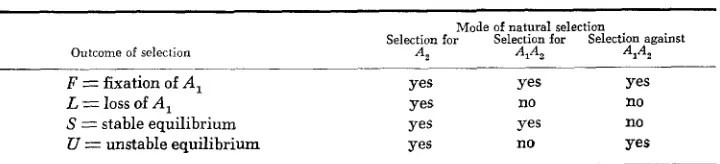
A summary of ihe seleciion limits observed for the three modes of natural selection
Outcome of selection
Mode of natural selection
Selection for Selection for Selection against
A2 *,A,
*A
~
P = fixation of A ,
L =loss of A ,
S = stable equilibrium U = unstable equilibrium
expected under mass selection. Underdominance does not have a consistent effect, but it leads indirectly to the fixation of A$ when the original gene frequency, po, is smaller than the unstable equilibrium gene frequency.
When the relative effect is “small” the fitness values of the three genotypes, A,A,, A,A, and &A,,, under truncation selection can be approximated, respec- tively, by 1
+
s, 1 and 1-
s, where s = 2ia/a, (FISHER 1918;HALDANE
1931 ;KIMURA 1958) and
i
is FALCONER’S intensity of selection. Then, the outcomes of selection, when opposing natural selection(kl,
k,
and k 3 ) is also present, are easily derived. I t can be shown that, for each one of the three modes of natural selection, KIMURA’S approximation yields the same possible qualitative outcomes as those found in this study for minor genes, that is, for small values of 2a/u,.In practice then, if one is willing to assume, or if it is known that the quantita- tive trait under study is determined by minor genes, the effect of opposing nat- ural selection on the character under artificial selection can be deduced by cal- culating KIMURA’S approximations of artificial fitness values. Otherwise, one must take the exact approach to find the qualitative outcome of the selective process.
What is the significance of the results from the standpoint of animal genetics? I n addressing this question, the possible sets of numerical values of the parame- ters will be restricted to the relevant ones. The intensity of selection is commonly equal to or larger than one. The true proportionate effect (relative effect) in actual populations is unknown, but was roughly estimated at 0.2 by
FALCONER
(1960) for several traits and arbitrarily chosen to be between 1 and 1/10 by ROBERTSON (1 960), NEI (1963) and LATTER (1965). Therefore, values of
ea/,,
between 2 and 1/25 seem to be appropriate. The fitness set(kj)
is arbitrary. However, except for a few reports of lethal genes involved in a quantitative trait (REEVE and ROBERTSON 1953; CLAYTON and ROBERTSON 1957, for example), one may assume that natural selection does not usually have a drastic effect in relation to a quantitative trait. The fitness values of the three genotypes in our model are generally rather close. With these numerical constraints, the predic- tions of our simple model will be checked against the results obtained i n various selection experiments. However, caution should be exercised in extending our results to actual quantitative traits.SIMULATION O F OPPOSING NATURAL A N D ARTIFICIAL SELECTION 999
have ever been reported from selection experiments. However,
( L )
or(U)
is expected to take place, when 2a/cE is small, under directional natural selection for A , or underdominance. Although we may tentatively dismiss underdomi- nance as a major mode of natural selection in this instance, fixation of A, still remains possible under directional selection. However, in reality, many genes are expected to determine a quantitative trait. Positive contributions to the mean made by loci with higher values of 2a/ufl could mask negative contributions (smaller in absolute values) made by loci with lower relative effects and which are subject to opposing natural selection.
Selection plateaus have been observed in several selection experiments reviewed by AL-MURRANI (1974) and KRESS (1975). Further genetic analyses of the plateaued populations have shown that they may have resulted from the exhaustion of the additive genetic variance or from the antagonistic action of natural selection. These two kinds of selection plateaus correspond nicely to the outcome
(17)
and (S) of our model. Moreover, the number of generations actually required to reach such limits varied generally between 20 and 70 generations (increasing, however, with the effective population size). These observations are very compatible with the results of the simulations.One can note by looking at Tables 1 and 2 that the gene frequency reached at an intermediate stable equilibrium increases with
i’.
Fixation of A , can occur for higher values ofi’.
In practice, if the effective population is large, it might then be possible to break a nontrivial selection plateau caused by a balance between artificial selection and natural selection by increasing the selection intensity. Also, unintentional changes ini’
may change the outcome of a selection experiment if opposing natural selection is present. Moreover, cyclical changes ofi’,
“in phase” with the change in gene frequency brought about by the selec- tive process, will cause the gene frequency and the mean phenotype to oscillate back and forth correspondingly.The unknown mode of natural selection opposing artificial selection that yields nontrivial observed selection plateaus has been much speculated about, and both directional selection and overdominance are still considered. This study confirms that either one of the two modes can lead t o selection plateau, but it cannot help in deciding which one, if either, is more important in this respect.
Although fruitful, the one-locus model used in this work is obviously simplis- tic. A two-locus study of the same problem is presently being investigated and should be the subject of a future contribution.
I thank G. A. E. GALL, R. HALLIBURTON, J. HARDING, E. J. POLLACK and a n anonymous re- viewer for their useful comments on the manuscript. This work was done while the author held an Animal Science Research Fellowship and a Jastro-Shields Fellowship from the University of California at Davis.
LITERATURE CITED
AL-MURRANI, W. K., 1974 CARMELLI, D. and S. KARLIN, 1975
1000 F. MINVIELLE
CLAYTON, G. A. and A. ROBERTSON, 1957
DAWSON, P. S., 1965
FALCONER, D. S., 1960 FELSENSTEIN, J., 1965
FISHER, R. A., 1918
An experimental check on quantitative genetical
Genetic homeostasis and developmental rate in Tribolium. Genetics 51 :
Introduction to Qrcantitatiue Genetics. Ronald Press Co., New York. theory. 11. The long-term effects of selection. J. Genet. 55: 152-170.
873-885.
The effect of linkage on directional selection. Genetics 52: 349-363. The correlation between relatives on the supposition of Mendelian inheri- tance. Trans. Roy. Soc. Edin. 52 : 399-433.
The fertility of mice selected for large or small body size. Genet. Res. 1 : 393-407.
Theoretical consequences of truncation selection based on the individual phenotype. Aust. J. Biol. Sci. 13: 307-343.
A mathematical theory of natural and artificial selection. Part VII. Selection intensity as a function of mortality rate. Proc. Camb. Phil. SOC. 27: 131-136.
The effect of linkage on limits to artificial selection. Genet. Res. 8 : 269-294.
Some populations genetics models combining artificial and natural selection pressures. Proc. Natl. Acad. Sci. U.S. 71: 4724-4731. __ , 1975 Some population genetics models combining artificial and natural selection pressures: 11. Two- locus theory. Theor. Pop. Biol. 7 : 123-148. -, 1978 Evolutionary aspects and sensi- tivity studies of some major gene models. J. Theor. Biol. 7 5 : 197-222.
Stabilizing selection for pupa weight in Tribolium castaneum. Genetics 87: 327-341.
Status of quantitative genetics theory. Proc. Int. Conf. Quant. Genet. pp. 719-760. Iowa State Univ. Press, Ames.
On the change of population fitness by natural selection. Heredity 12: 145- 167.
Results from long-term selection experiments relative to selection limits. pp. 253-271. In: 'Genetics Lectures 4. Oregon State Uniu. Press, Corvallis.
The response to artificial selection due t o autosomal genes of large effect.
I. Changes in gene frequency at an additive locus. Aust. J. Biol. Sci. 18: 585-598.
R61e de I'intensitk d'une selection artificielle en prksence de ghnes h effet individuel important ou non. I. S,election avec troncature-Modkle d6terministe. Ann. Gknbt. Sk1. Anim. 1 : 243-272.
FOWLER, R. E. and R. G. EDWARDS, 1960
GRIFFING, B., 1960
HALDANE, J. B. S., 1931
HILL, W. G. and A. ROBERTSON, 1966
KARLIN, S. and D. CARMELLI, 1974
KAUFMAN, P. K., F. D. ENFIELD and R. E. COMSTOCK, 1977
XEMPTHORNE, O., 1977
KIMURA, M., 1958
KRESS, D. D., 1975
LATTER, B. D. H., 1965
MERAT, P., 1969
MILKMAN, R., 1978 NEI, M., 1963
Selection differentials and selection coefficients. Genetics 88: 391-403. Effect of selection on the components of genetic variance. pp, 501-515. In:
Symposium of StatisiicaZ Genetics and PZant Breeding. Edited by H. F. ROBINSON. N.A.S. Research Council, Washington, D.C.
Introductory statement: poultry. Proc. Int. Conf. Quant. Genet. pp. 47-51. Iowa State Univ. Press, Ames.
Studies in quantitative inheritance. 11. Analysis of a strain of Drosophila melamgaster selected for long wings. J. Genet. 51 : 276-316.
A theory of limits in artificial selection. Proc. Royal. Soc. Lond. Series B 153: 234-249.
Opposition to artificial selection caused by natural selection at linked loci.
Corresponding editor: B. S. WEIR NORDSKOG, A. W., 1977
REEVE, E. C. R. and F. W. ROBERTSON, 1953
ROBERTSON, A., 1960
SVED, J. A., 1977