A Comparative Study on Metal Adsorption
Properties of Different Forms of Chitosan
Adarsh K J
1*, Dr. G Madhu
2Sophisticated Test & Instrumentation Centre (STIC), Cochin University of Science and Technology, Cochin - 682 022, Kerala, India1
School of Engineering, Cochin University of Science and Technology Cochin - 682 022, Kerala, India2
*Corresponding author
Abstract: Application of chitinous products in waste water treatment has received considerable attention in recent years. The Chitosan, deacetylated chitin derivative is the most interesting biopolymer in the world of adsorption science.The preparation of chitosan beads and chitosan membranes were explained in this paper. The properties of chitosan flake, beads, and film was studied with different analytical method such as CHN, SEM, FTIR, DSC, etc. Chemical modification of chitosan membranes and beads were performed by crosslinking with glutaraldehyde and its properties were analysed.The Adsorption studies of Hg(II) ion was carried out in a batch process at room temperature in static manner with varying parameters such as pH of solution, adsorbent concentration and different Chitosan forms. Metal concentration was measured using ICP AES. It has been shown that cross linked chitosan beads have higher adsorption degree compared to chitosan flakes and cross linked chitosan membrane. The removal efficiency of cross linked chitosan beads on multi element solution shows that the maximum adsorption shown by Chromium (88.29%) followed by Cd > Cu > Ni > Ag > Pb > Zn.
Keywords: Chitosan, Surface modification, Heavy metal removal, Crosslinking with glutaraldehyde
Abbreviations: CS-Chitosan, GA- glutaraldehyde
I. INTRODUCTION
The development of chitosan-based materials as useful adsorbent polymeric matrices is an expanding field in the area of adsorption science [1]. Chitosan is considered as answer to researchers interest in developing cost effective and environmental friendly technologies for the remediation of soil and water polluted with toxic trace elements. Its use as a biosorbent is justified due to following advantages, low cost compared to commercial activated carbon, ease in availability, removal efficiency of wide variety of metals and outstanding chelating behaviour [2]. The Chitosan, deacetylated chitin derivative is the most interesting biopolymer in the world of adsorption science [3-4].
of their respiratory, excretory, and digestive systems [14]. It is also found in the reflective material (iridophores) both in the epidermis and the eyes of arthropods and cephalopods and also a component of the cell wall of fungi.
There are three forms of chitin: α, β, and γ chitin. The α-form, which is mainly obtained from rab and shrimp shells, is widely distributed. Both α and β chitin/chitosan are commercially available. The α-chitin chains are aligned in anti-parallel fashion. The anti-anti-parallel arrangement in α-chitin give rise to strong hydrogen bonding and consequently makes it more stable [15]. The β-form mainly obtained from molluscs such as squids arranged parallelly, whereas the γ-form contains two parallel and one anti-parallel strands of chitin [16]. Chitin is insoluble in water due to its intermolecular hydrogen bonds [17]. The most mportant feature is its flexibility to convert into different forms such as fibres, hydro-gels, beads, sponges, and membranes [18].
Chitosan is N-deacetylated derivative of chitin. A sharp nomenclature with respect to the degree of N-deacetylation has not been defined between chitin and chitosan [19]. The commercially available Chitosan is normally polymers with less than 20- 25% acetyl content. Chitosan and chitin are of commercial interest due to their high percentage of nitrogen compared to synthetically substituted cellulose (Fig.1 ). Chitosan is soluble in acid solutions and is chemically more versatile than chitin or cellulose. Chitosan has three types of reactive functional groups, an amino group as well as both primary and secondary hydroxyl groups at the C-2, C-3 and C-6 positions respectively .Its advantage over other polysaccharides is that its chemical structure allows specific modifications especially –NH2 group in the C-2 position.
Fig.1 Structure of Cellulose, Chitin & Chitosan.
Chitin and chitosan exhibit special characteristics such as hydrophilicity, biocompatibility, biodegradability, non-toxicity, adsorption properties, film-forming ability, bio-adhesivity, poly-functionality etc. [20-21]. Chitosan can be used as an adsorbent to remove heavy metals due to the presence of amino(-NH2) and hydroxyl (-OH) groups, which
can serve as the active sites [22]. However, chitosan is very sensitive to pH and other factors like; the origin and nature of the chitosan, the activation conditions of the raw polymer, chemical modifications, physical conditions (Temperature, stirring rate etc) and the influence of process variables (contact time, initial concentration, polymer dosage etc)
Chitosan properties, such as aqueous solubility in neutral to basic media and mechanical characteristics, can be enhanced by chitosan modification. The –NH2 in the C-2 position allow direct substitution reactions and chemical
Different structural conditions of chitosan
1) Flakes: Most of the studies on chitosan have been performed on chitosan flakes, since they are easier to manage than gelled materials[34]. The major limiting parameter with flaked material will be the size of chitosan particles due to diffusion restrictions.
2) Gel beads: Gel beads has been widely used for the preparation of catalyst particles [26-27]. The preparation of the chitosan gel beads can be operated independently for the preparation of the catalyst. The polymer is dissolved in acetic acid and the viscous solution of chitosan is pumped through a thin nozzle into an alkaline coagulation bath [28-29].
3) Fibres & hollow fibres: For the preparation of fibres and hollow fibres, a two-step procedure is used (a) dissolving the polymer in acetic acid solution followed by (b) extrusion of the viscous solution through a thin nozzle and coagulation of the solution with a suitable neutralization or coagulation agent [30].
4) Membranes: The chitosan can also be prepared as membranes. The limitations of chitosan membrane can be overcome with [31] an inorganic supports.
5) Inorganic immobilized support for chitosan: In many applications, the poor diffusion properties or weak mechanical properties (especially for thin membranes) necessitates the chitosan to be deposited in thin layers on the surface of porous materials to improve the specific surface area and mechanical properties and to optimize efficacy and accessibility of the chitosan’s internal amino groups. Silica beads, glass beads[32], perlite[33] are some of the immoblized supports used for chitosan.
II.EXPERIMENTAL A. Materials and methods
A detailed study of Chitosan cross linking with glutaraldehyde and adsorption properties were carried out using chitosan flake, GA cross linked chitosan beads and chitosan membrane.
Chitosan flakes with deacetylation degree of about 94% was collected from India Sea Foods, Cochin, India. The glutaraldehyde (50%) was purchased from Sigma Aldridge, India. All other chemicals and reagents used were analytical grade and used as received. The C-H-N analyzer (Elementar, Vario EL III) is used for elemental analysis of chitosan flakes and Cross linked chitosan membrane and beads. The cross linking of glutaraldehyde with chitosan was characterised by FT-IR spectrometer (Thermo Nicolet, Avatar 370 with HATR Assembly). Porous nature of chitosan and cross linked chitosan were compared with SEM Image (JEOL, JSM - 6390LV). Thermal properties are studied again by Differential Scanning Calorimetry (Mettler Toledo). The metal concentration was analyzed using ICP AES system (ThermoElectron, IRIS intrepid II).[34]
B. Preparation of chitosan membranes
Chitosan solution was prepared by dissolving 5g of chitosan flakes into 200 ml of 3% (v/v)acetic acid solution. Chitosan solution 2.5% (w/w) was spread on a Petri dish. The dish was kept at 60◦C, until a reduction of 50% in its initial weight was reached and kept one day at room temperature to form the membrane by natural drying. The membranes were then immersed in NaOH solution (1 M), for 24 hrs to neutralize the excess acid. The chitosan membranes were rinsed in Milli-Q water, air dried and stored.
C. Preparation of chitosan beads
The Chitosan solution 2.5% (w/w) was sprayed into a precipitation bath containing 250 ml of 1 M NaOH, which neutralized the acetic acid within the chitosan gel and thereby coagulated the chitosan gel to spherical uniform chitosan gel beads. The aqueous NaOH solution was stirred using magnetic stirrer. The wet chitosan gel beads were extensively rinsed with distilled water to remove any NaOH, filtered and finally air dried to remove the water from the pore structure [34].
D. Chemical modification
The chitosan beads were heterogeneously crosslinked in 0.75% (w/w) aqueous glutaraldehyde solution without agitation, at room temperature for 2 hrs. After 2 hrs cross linked chitosan beads washed in deionized water to remove the unseated glutaraldehyde residues , air dried and kept in a closed container.
E. Bach Adsorption study
1) Mercury adsorption using chitosan membrane
Batch adsorption experiments were performed to study the effectiveness of Chitosan membrane in the removal of Hg(II) ions from water. Effect of various parameters such as pH, Influence of chitosan dosage, glutaraldehyde cross linking was also studied.
Standard stock solution of Hg (1000mg/L concentration) was diluted to 4mg/L and 10mg/L using Milli-Q water. The effect of Hg(II) ions adsorption was studied in the pH range of about 2–8. The initial pH of the solution was adjusted using 0.1 M HNO3 or 0.1 M NaOH. 0.2 g of chitosan membrane and GA cross linked chitosan membrane adsorbates
were added to 50 ml of Hg(II) solution (4mg/L concentration) and equilibrated with magnetic stirrer for 24 hrs, at room temperature in a closed container. The membrane is removed and the metal concentration on the solution was measured using ICP AES.
2) Comparison of metal adsorption of chitosan flake, membrane and beads :
The adsorption experiment by chitosan membrane, chitosan beads and chitosan flakes was carried out and the closed container
3) Multielement removal efficiency of cross linked chitosan beads
Removal efficiency of cross linked chitosan beads was checked using multielement standard (elements Ag, B, Ba, Ca, Cd, Cr, Cu, K, Li, Mg, Ni, Pb and Na ions in solution) and ICP AES standard (Merck , Germany ). The 1000mg/L stock solution was diluted to5mg/L solution using Mill-Q water. 1g of chitosan beads was added to 100 ml solution and kept for 24hrs. The magnetic stirrer used to enhance the adsorption. The pH of the solution kept in the range of 5.1 to 5.4 using 0.1M HNO3 or 0.1M NaOH Solution. Samples are filtered using Whatman No.1 filter paper . The
concentrationof metal ions present in the solution was analyzed using ICP AES.
The adsorption capacity of chitosan membrane and beads were calculated based on difference of metal ion concentration in the bulk of solution before and after adsorption, as depicted in
qe =
V
m
)
C
(C
i
e(1)
Ce = The equilibrium metal ion concentration (mg/L),
qe = The amount of metal ion adsorbed by the filter at equilibrium (mg/g)
Ci = The initial metal ion concentration (mg/L),
V = The volume of metal solution (L)
m = The weight of the chitosan coated polypropylene fabric (g). The metal removal efficiency calculated using equation
% removal =
(
)
100
Ci
Ce
Ci
(2) The Ci & Ce notations are given above the formula.
III. RESULTS AND DISCUSSIONS
The physical parameters of the chitosan are given in the table1. The viscosity of the chitosan was measured using Brookfield Viscometer and Muzzarelli’s spectroscopy method used for Degree of acetylation (DA) measurement.
Table .1. Physical parameters of the Chitosan used for analysis.
A. Characterization of chitosan and Glutaraldehyde cross linked chitosan
1) CHN Analysis: The table 2 gives CHN analysis data of chitosan and cross linked chitosan. The glutaraldehyde reacts with chitosan and results in formation of covalent bonds with the amino groups of the polymer. The change in the percentage of Nitrogen, Carbon and Hydrogen of cross linked beads and film may be due to variation in percentage of cross linking.
Table 2. CHN Analysis data of Chitosan and cross linked chitosan
Sample Name N% C% H%
Chitosan flake 7.32 38.75 9.51 Glutaraldehyde cross
linked chitosan bead 5.52 39.91 7.88 Glutaraldehyde cross
linked chitosan film 6.97 39.26 8.26
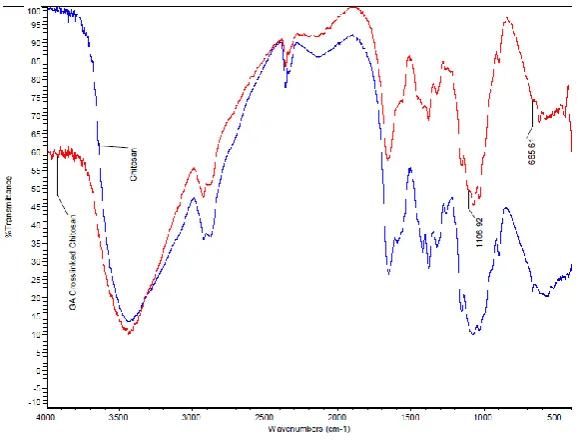
2) FT IR Spectrum of Glutaraldehyde cross linked chitosan: FT IR spectra of chitosan and glutaraldehyde cross linked chitosan are displayed in fig 2. The main peaks of 3438 cm−1 (N–H and O–H stretching vibration), 2927 cm−1 (CH3symmetric stretch), 1660 cm−1 (C=O stretching vibration), 1379 cm−1 (CH3 bending vibration), 1152
cm−1 (C–O–C bending vibration), and 1070 cm−1 (C–OH stretching vibration). A peak at 1106 cm−1 (amide II) was found in FT IR of Glutaraldehyde cross linked chitosan, but not in FT IR of chitosan . The result from this study is consistent with many previous studies [35] which have demonstrated that there was a difference in FT IR profile between chitosan and crosslinked chitosan.
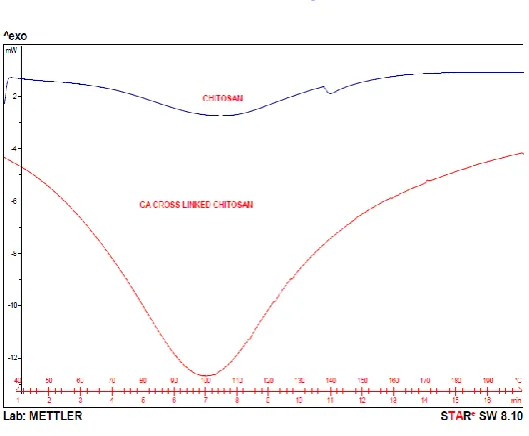
3) Comparison of DSC spectrum: The DSC thermal studies shows that( fig 3.) there is no change in thermal behaviour of natural and cross linked chitosan membrane .
Fig3. DSC studies of chitosan and GA cross linked chitosan
4) Comparison of SEM Image : The SEM image of Chitosan flakes and GA cross-linked chitosan beads shows an increase in the porosity of the chitosan in chitosan beads(fig 4)
Fig 4. SEM Images of Chitosan Flake (left) and GA cross-linked Chitosan bead.
B. Adsorption behaviour of Chitosan
Fig. 5. Effect of pH on Hg ion adsorption
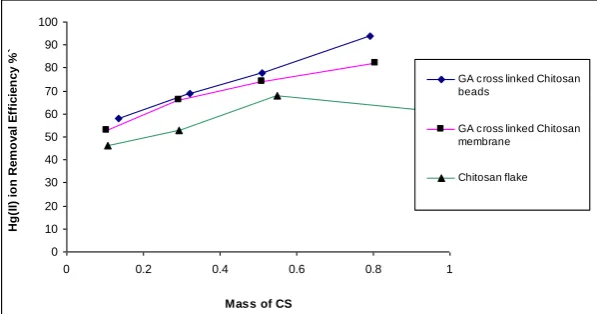
2) Metal removal properties of Chitosan flake, Chitosan membrane and chitosan beads: The Hg (II) removal capacity(fig.6) and removal efficiency (fig.7) from aqueous solution by using Chitosan flake, Chitosan membrane and chitosan beads were accounted.
Fig. 6. The metal removal capacity of Chitosan flake, Chitosan membrane and chitosan beads
The amount of Hg(II) ions adsorbed was influenced by the adsorbent shape. The maximum adsorption capacity was observed on glutaraldehyde cross linked chitosan membranes followed by beads and then flakes. This may be due to availability of large area, or large adsorption site compared to chitosan membrane[37].
Fig.7. Metal removal efficiency of chitosan beads, membranes and chitosan flakes Chitosan Adsorption 0.0 1.0 2.0 3.0 4.0 5.0 6.0
0.0 0.2 0.4 0.6 0.8 1.0
Mass of Chitosan used in g
T h e a m o u n t o f H g i o n s a d s o r b e d ( m g /g )
GA cross linked Chitosan membrane
GA cross linked Chitosan bead Chitosan flake 0 10 20 30 40 50 60 70 80 90 100
0 0.2 0.4 0.6 0.8 1
Mass of CS
H g (I I) i o n R e m o v a l E ff ic ie n c y % `
GA c ross linked Chitosan beads
GA c ross linked Chitosan membrane
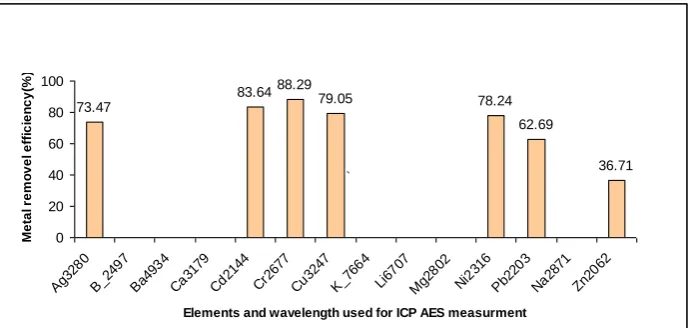
3) The removal efficiency of cross linked chitosan beads on multi element solution: The removal efficiency of cross linked chitosan beads on multi element standard (fig.8) containing elements Ag, B, Ba, Ca, Cd, Cr, Cu, K, Li, Mg, Ni, Pb, Na and Zn were analysed using ICP AES. The maximum adsorption shown by Chromium (88.29%) followed by Cd > Cu > Ni > Ag > Pb > Zn. Other elements like Ba, Ca, K, Li, Mg and Na does not show adsorption.
Fig. 8. Adsorption efficiency of cross linked chitosan beads on multi element ICP AES standard
IV. CONCLUSION
The Chitosan and cross linked chitosan characterization studies were carried out to establish the previously discussed properties of chitosan .Metal adsorption capacity and efficiency of cross linked beads are higher compared to chitosan flakes and cross linked chitosan membrane. The optimum pH for adsorption of Hg(II) by Chitosan and GA cross linked chitosan is 6. The degree of adsorption varies with chitosan mass, pH of the solution, form of chitosan, cross linking degree etc. Glutaraldehyde cross linked chitosan have a tremendous capability in accumulating Ag2+ , Cd 2+ , Cu 2+ , Cr 2+, Pb 2+ , Zn2+, Hg2+ and Ni 2+ from the aqueous solutions.
ACKNOWLEDGEMENT
All experiments were performed at Sophisticated Analytical Instrument facility (SAIF) at STIC, Cochin. The author is thankful to The Director and staff of STIC for their support.
REFERENCES
[1]. Gre´gorio Crini, Pierre-Marie Badot, “Application of chitosan , a natural aminopolysaccharide , for dye removal from aqueous solutions by adsorption processes using batch studies : A review of recent literature”. Prog. Polym. Sci. 33 399–447 (2008)
[2]. W.S. Wan Ngaha,, L.C. Teonga, M.A.K.M. Hanafiah, “Adsorption of dyes and heavy metal ions by chitosan composites: A review” Elsevier ,I
1446–1456, (2011)
[3]. Dutta, P. K., Dutta, J., Tripathi, V. S. “Chitin and chitosan : Chemistry , properties and applications” Journal of Scientific & Industrial Research, Vol. 63 , PP. 20–31.(2004)
[4]. N. Ahalya, T.V. Ramachandra and RD. Kanamadi “Review Paper:Biosorption of Heavy Metals” Res. J. Chem. Environ.,Dec. , Vol. 7 (4),
(2003)
[5]. Braconnot, H. “Sur la nature des champignons”. Annales de Chimie Physique,79, 265–304. (1811).
[6]. Children, J. G. “ On the nature of mushrooms”. Zoological Journal, 1, 101–111.(1824)
[7]. Lassaigne, I. L. “Sur les tissues tegumentaires des insectes de differents ordres, Comptes Rendus des Séances” de la Académie des Sciences, 16,
1087–1089.(1843).
[8]. Jeuniaux C. “A brief survey of the early contribution of European scientists to chitin knowledge.” In: Domard A, Jeuniaux C, Muzzarelli RAA,
Roberts G, editors. Advances in Chitin Sciences. Jacques André Publ; Lyon, France: pp. 1–9.(1996).
[9]. Odier, A. “Memoir sur la composition chimique des parties cornees des insectes. Mémoirs” de la Societé d’Histoire Naturelle, 1, 29–42.(1823).
[10].Muzzarelli RAA, Muzzarelli C. “Chitin and chitosan hydrogels.” In: Phillips GO, Williams PA, editors. Handbook of
Hydrocolloids. Woodhead Publishing Ltd; Cambridge, UK: pp. 849–888.(2009).
[11].Payen, A., Proprietes distinctives entre les membranes vegetales et les enveloppes des insectes et des crustaces. Comptes Rendus des Séances
73.47
83.6488.2979.05
78.24 62.69 36.71 0 20 40 60 80 100 Ag3 280 B_2 497 Ba4 934 Ca3 179 Cd2 144 Cr2 677 Cu3 247 K_7 664 Li67 07 Mg2 802 Ni2 316 Pb2 203 Na2 871 Zn20 62
Elements and wavelength used for ICP AES measurment
[12].Muzzarelli, R. A. A.” Chitin”. Oxford, UK: Pergamon Press.(1977)
[13].Synowiecki J, Al-Khateeb N A. “Production, properties, and some new applications of chitin and its derivatives” Crit Rev Food Sci Nutrition ;
43:145–71.(2003)
[14].Clark G.L, Smithz, A.F. “X-Ray diffraction studies of chitin, chitosan, and derivatives”. J. Phys. Chem. 40, 863–879. (1936)
[15].Sikorski P, Hori, R, Wada, M. “Revisit of alpha-chitin crystal structure using high resolution X-ray diffraction data” Biomacromolecules 10,
1100–1105. (2009).
[16].Atkins E. “Conformations in polysaccharides and complex carbohydrates”. J. Bio sci. 8, 375–387. (1985)
[17].Minke R, Blackwell, J. “The structure of alpha-chitin”. J. Mol. Biol. 120, 167–181. (1978)
[18].Mano J.F, Silva G.A, Azevedo, H.S, Malafaya P.B, Sousa R.A, Silva S.S, Boesel, L.F, Oliveira J.M, Santos T.C, Marques A.P, Neves N.M,
Reis, R.L. “Natural origin biodegradable systems in tissue engineering and regenerative medicine: present status and some moving trends”. J. R. Soc. Interface 4, 999–1030. (2007)
[19].Herring P.J. “Marine Ecology and natural products”. Pure Appl. Chem. 51, 1901–1911(1979)
[20].Majeti N.V., Ravi Kumar, “A review of chitin and chitosan applications” Elsevier Reactive & Functional Polymers 46,1–27 (2000)
[21].R.A.A. Muzzarelli (Ed.), Natural Chelating Polymers, Pergamon Press, New York, p. 83.(1973).
[22].Chiou, M. S, Ho, P. Y., & Li, H. Y. “Adsorption of anionic dyes in acid solutions using chemically cross-linked chitosan beads. Dyes and Pigments”, 60, 69–84. (2004).
[23].Rinaudo “Chitin and chitosan: Properties and applications” Prog. Polym. Sci. 31 P. 603–632, (2006)
[24].Rodrigo S. Vieira, Marisa M. Beppu, “Interaction of natural and crosslinked chitosan membranes with Hg(II) ions Colloids and Surfaces”
Physicochem. Eng. Aspects 279 ,P 196–207, (2006)
[25].Guibal e,1 t. Vincent,1 r. Navarro Mendoza, “Synthesis and Characterization of a Thiourea Derivative of Chitosan for Platinum Recovery”,
Journal of Applied Polymer Science, John Wiley & Sons, Inc. Vol. 75, P. 119 –134, (2000).
[26].Kucherov AV, Kramareva NV, Finashina E, Koklin AE, Kustov LM. “Heterogenized redox catalysts on the basis of the chitosan matrix. 1. Copper complexes”. J Mol Catal A: Chem ; 198:377–89.(2003)
[27].Kramareva NV, Finashina E, Kucherov AV, Kustov LM. “Copper complexes stabilized by chitosans: peculiarities of the structure, redox, and
catalytic properties”. Kinet Catal; 44:793–800, (2003).
[28].Shu XZ, Zhu KJ. “A novel approach to prepare tripolyphosphate/ chitosan complex beads for controlled release drug delivery”. Int J Pharm ;
201:51–8.(2000).
[29].Dambies L, Vincent T, Domard A, Guibal E. “Preparation of chitosan gel beads by ionotropic molybdate gelation”. Biomacromolecules ;
2:1198–205.(2001)
[30].Urbanczyk GW, Lipp-Symonowicz B.“The influence of processing terms of chitosan membranes made of differently deacetylated chitin on the
crystalline structure of membranes”. J Appl Polym Sci; 51: 2191-4. (1994)
[31].Krajewska B, Olech A. Pore structure of gel chitosan membranes. I. Solute diffusion measurements”. Polym GelsNtwk ; 4:33–43.(1996).
[32].Liu XD, Tokura S, Haruki M, Nishi N, Sakairi N. “Surface modification of nonporous glass beads with chitosan and their adsorption property
for transition metal ions. Carbohydr Polym ; 49:103–8.(2002).
[33].Hasan, Shameem , Krishnaiah, Abburi , Ghosh, Tushar K. , Viswanath, Dabir S., Boddu, Veera M. andSmith, Edgar D, “Adsorption of
Chromium(VI) on Chitosan-Coated Perlite”, Separation Science and Technology, 38, 15, 3775- 3793, (2003).
[34].Adarsh K J, Dr. G Madhu , Chitosan coated surface modified polypropylene fabric for the removal of Cd(ii) and Zn(ii)ions from aqueous solution, International Journal of Innovative Research in Science, Engineering and Technology, Vol. 2, Issue 7, July 2013
[35].Rodrigo S. Vieira, Marisa M. Beppu “Dynamic and static adsorption and desorption of Hg(II) ions on chitosan membranes and spheres” Water
Research Vol 40, Is 8, P 1726–1734, (2006).
[36].N. R. Kildeeva, P. A. Perminov, L. V. Vladimirov, V. V. Novikov, S. N. Mikhailov “About mechanism of chitosan cross-linking with
glutaraldehyde” Russian Journal of Bioorganic Chemistry , Volume 35, Issue 3, pp 360-369, (2009).
[37].Choong Jeon, Wolfgang H Höll , “Chemical modification of chitosan and equilibrium study for mercury ion removal” Water Research Vol.37,