International Journal of Innovative Research in Science, Engineering and Technology
An ISO 3297: 2007 Certified Organization Volume 6, Special Issue 5, March 2017
National Conference on Advanced Computing, Communication and Electrical Systems - (NCACCES'17)
24th - 25th March 2017
Organized by
C. H. Mohammed Koya
KMEA Engineering College, Kerala- 683561, India
An Android Controlled Integration System
Thanseela A1, Babitha Asif2
Operations Supervisor, Gypco, Kochi, Kerala, India1
Assistant Professor, Department of Electronics & Communication Engineering, KMEA Engineering College, Edathala,
Kerala, India2
ABSTRACT: Mankind has always strived to give life like qualities to its artifacts in an attempt to find substitutes for himself to carry out his orders and also to work in a hostile environment. The popular concept of a mechanical arm is of a machine that looks and works like a human arm. The industry is moving from current state of automation to Robotization, to increase productivity and to deliver uniform quality. The industrial robots of today may not look the least bit like a human being although all the research is directed to provide more and more anthropomorphic and human like features and super-human capabilities in these. One type of robot commonly used in industry is a robotic manipulator or simply a mechanical arm. It is an open or closed kinematic chain of rigid links interconnected by movable joints. The system provides a pick and place robotic arm which is a soft catching gripper system. It can be used to pick and place objects as needed. This arm is mounted on a robotic vehicle that can be controlled wirelessly through an android mobile phone. The android phone acts as the controller used to transmit the control commands through Bluetooth. These commands are used to operate the robot front, backwards, left and right directions. The android phone is used as remote controlling device used to control the robotic vehicle. The use of Bluetooth technology provides adequate operational range with instant transmissions. The microcontroller after receiving these commands, operate required motors through the driver IC. It can be remotely controlled by any android device. This machine may be used in industrial or even domestic purposes and even as a help for industrial workers.
KEYWORDS: Catching arm, Blue control application, Pick and Place operation, Android control
I. INTRODUCTION
Mechanical is the branch of engineering science and technology related to machinery, and their design, manufacture, application, and structural disposition. Robotics is related to electronics, mechanics, and software. Robotics research today is focused on developing systems that exhibit modularity, flexibility, redundancy, fault tolerance, a general and extensible software environment and seamless connectivity to other machines, some researchers focus on completely automating a manufacturing process or a task, by providing sensor based intelligence to the mechanical arm, while others try to solidify the analytical foundations on which many of the basic concepts in robotics are built[1].In this highly developing society time and man power are critical constrains for completion of task in large scales. The automation is playing important role to save human efforts in most of the regular and frequently carried works. One of the major and most commonly performed works is picking and placing of jobs from source to destination [1].
The system provides a pick and place arm which is a soft catching gripper system. It can be used to pick and place objects as needed. This arm is mounted on a vehicle that can be controlled carelessly through an android mobile phone. At the transmitting end using android application device, commands are sent to the receiver to control the movement of the machine either to move forward, backward and left or right etc. At the receiving end four motors are interfaced to the microcontroller where two of them are used for arm and gripper movement of the arm while the other two are for the body movement of the vehicle. The microcontroller after receiving these commands, operate required motors through the driver IC. It can be remotely controlled by any android device.[4]
This type of machines is indispensable in many manufacturing industries. The reason is that the cost per hour to operate a machine is a fraction of the cost of the human labour needed to perform the same function. More than this, once programmed, machines repeatedly perform functions with a high accuracy that surpasses that of the most experienced human operator. [5] Human operators are, however, far more versatile. Humans can switch job tasks easily. As machines evolve, they will become more versatile, emulating the human capacity and ability to switch job tasks easily. Without risking human life or limb, these machines can replace humans in some hazardous duty service. Such machines are used in many bomb squads across the nation. They can help clean up toxic wastes. They can work in all types of polluted environments, chemical as well as nuclear[10].In that situations without a considerable amount of safety precautions like, the disposal of hazardous wastes, radioactive substances, remote handling of explosive devices and righting and hostage situations help can be taken from this moving machines. It can safely work at hazardous conditions. These machines ensure the human safety and replace massive human work force. It can be also applied in medical science, surgeries, and defence purposes, with artificial intelligence, super market field, and manufacturing field. These are compact and efficient.[10]
Objectives
The main objectives of automatic pick and place machine are;
a) To increase the manufacturing capacity for local food industries.[6]
b) To increase the labor productivity by the redistribution of laborers in the industries.[6] c) Reducing the cost factor and manufacturing time of a product.[7]
d) To avoid the direct contact of humans from hazardous substances.[7] e) To eliminate the manual based tasks and operations.[7]
Such machines are indispensable in many manufacturing industries. The reason is that the cost per hour to operate a machine is a fraction of the cost of the human labour needed to perform the same function. More than this, once programmed, such machines repeatedly perform functions with a high accuracy that surpasses that of the most experienced human operator. Human operators are, however, far more versatile. Humans can switch job tasks easily. Today's most advanced industrial machines will soon become dinosaurs.[8] As such machines evolve, they will become more versatile, emulating the human capacity and ability to switch job tasks easily. While the personal computer has made an indelible mark on society, the personal machine hasn't made an appearance. Obviously there's more to a personal robot than a personal computer. Machines require a combination of elements to be effective: sophistication of intelligence, movement, mobility, navigation, and purpose. [9] In the beginning, personal robots will focus on a singular function (job task) or purpose. Building a useful personal machine is very difficult. But recent days such machine occupies a good place in community. The main functioning of technology in recent days are Hazardous duty: Without risking human life or limb, machines can replace humans in some hazardous duty service. Take for example bomb disposal. Such machines are used in many bomb squads across the nation. It’s arms can grab a suspected bomb and place it in an explosion-proof safe box for detonation and/or disposal. [2]
Our system aims to pick a hazardous object and place it somewhere else carefully. It consists of a PIC Microcontroller IC, Bluetooth module, four DC Motors with driver IC and power supply. The pick and place machine consists of an arm placed on a moving vehicle. The vehicle is able to move along any type of surfaces irrespective of it is smooth or rough. It uses two motors for the operation and a belt type tyre is attached to the vehicle like in the tanks, for the smooth and reliable operation. The pick and place machine uses four motors for the operation of the system, two for the operation of moving vehicle and two for the pick and place operation. The pick and place arm consists of an arm assembly with a jaw, which is only able to move in up and down direction.
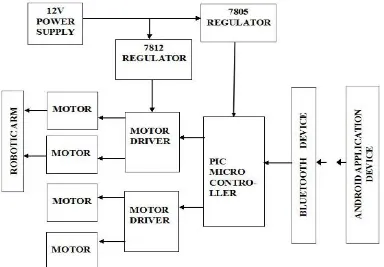
The movement of the machine is done by the algorithm.Fig. 1 shows the block diagram.
II. BLOCK DIAGRAM
the microcontroller by a Bluetooth module. L293D has 2 set of arrangements where one set has input 1, input 2, output 1 and output 2 and other set has input 3, input 4, output 3 and output 4, according to block diagram if pin no 2 and 7 are high then pin no 3 and 6 are also high. The main components used in this work are the DC motors, Microcontroller, Bluetooth interfacing device and user interfacing device (Android phone) and Android application (Blue control). The commands from the android device is given to the pick and place machine through Bluetooth. Once the Bluetooth is turned on, the device can be searched and paired when found. Then the commands can be passed on to the pick and place machine by pressing on the required keys on the touch screen. The vehicle moves forward and backward according to the commands given through the blue control application in the android device. The arm also moves in upward and downward directions according to the commands given through it. The jaw of the arm can be closed and opened through the commands.
Fig. 1: Block diagram of pick and place machine
III. ALGORITHM
The algorithm steps are summarized as follows
.
1. Start
2. Initialize and declare variables, ports, pins and user defined functions. 3. Enable serial communication.
4. Check if character received is ‘U’ or ‘D’
5. If yes, The vehicle will move in forward or backward direction otherwise go to next step. 6. Check if the received character is ‘R’ or ‘L’
7. If yes, the vehicle will move in right or left direction. Otherwise go to next step.
8. Check whether the character received is ‘a’. If yes then the test LED will glow. Otherwise go to step 10 9. Check whether if ‘c’ is received. If yes then the LED will become off.
10. Check whether the character received is ‘b’. If yes then the arm will move upward ,otherwise go to step 12. 11. Check whether ‘C’ is received. If yes then the motor for arm’s upward motion gets stopped
12. If ‘e’ is received them the jaw of arm will close otherwise check for next
13. If the received character is ‘b’ then arm will move downwards, otherwise go to next step. 14. If ‘f’ is received then the jaw of arm will get opened otherwise take no action
15. End
IV. FLOW CHART
Fig.2: Flow cart of the algorithm of Pick and Place machine
V. EXPERIMENTALRESULTS
A Pick and place machine which is controlled by an Android application is implemented. We know that the whole the digital devices in the world are transformed in to Android OS based systems, as it is more versatile, flexible and easy to control and it is an open source software. Here the Pick and place machine is controlled wirelessly by an Android application called Blue control through a Bluetooth module. The main feature of this pick and place machine is the soft catching arm or soft catching Gripper. We know that when handling the explosive items like bomb it should be handled carefully. Excessive pressure will cause explosion. So it is very essential to have a soft catching arm. This is designed to handle a maximum weight of 2 kg. The weight handling capacity of Pick and Place machine is determined by the capacity of DC motors used. Very useful and interesting can be made by interfacing the Pick and Place machine with explosive detectors, metal detectors, wireless cameras, night vision cameras etc. At first we have done the designing of circuit and implemented the circuit. The program can be developed from the written algorithm.
Fig.4: Working Model
VI.CONCLUSION
The aim of this work is the development of wireless control of a pick and place machine using Android application. It is controlled by an android application. The microcontroller used is a PIC microcontroller and embedded C software is used to program it. Number of joints on the arm determines the type of object it can handle. The main feature of this is the soft catching arm. We know that when handling the explosive items like bomb it will be handled smoothly. Excessive pressure will cause explosion. So this device helps to avoid such situations. The maximum weight that can be carried by this model is depends on the capacity of DC motors used. Very useful models can be made by interfacing the Pick and Place machine with explosive detectors, metal detectors, wireless cameras, night vision cameras etc. for finding the bombs and proper visual assistance.
REFERENCES
[1] Mohamed Naufal bin Omar,“Pick and place robotic arm controlled by Computer”, Universitite knikal Malaysia, Melaka April 2007 [2] John Iovine.,“Robots,Androids, and Animations 12 Incredible Projects You Can Build”, Second Edition,McGraw-Hill.2002
[3] Yanjianghuang, ryosukechiba, tamioarai, tsuyoshiueyama and junota. ,“Integrated design of multi-robot system for pick-and-place tasks”, Proceeding of the IEEE International conference on robotics and bio-mimetic (ROBIO) Shenzhen, china, December 2013.
[4] Sungwookmoon ,youngjinkim, ho junmyeong , changsookim, namjucha,and dong hwanki ,“Implementation of smart phone environment remote control and monitoring System for android operating system-based robot platform” ,The 8 th international conference on ubiquitous robots and ambient intelligence (URAI 2011) Tc1-1 Nov. 23-26, 2011 in songdoconventia, incheon, korea 978-1-4577-0723-0 / 11 /$26.00 2011 IEEE.
[5] SGS Thomson Microelectronics L293D - L293D [DATASHEET] Push-Pull four channel driver with diode .June 1996
[6] Fairchild semiconductor KA78XX/KA78XXA 3-Terminal 1A Positive Voltage Regulator Data sheet.2001 Fairchild Semiconductor Corporation.
[7] R.M. Haralick, L.G. Shapiro, Computer and Robot Vision, vol. I, Addison Wesley,1992
[8] Jacquier E, Polson NG, Rossi PE (1993) Priors and models for multivariate stochastic volatility. Unpublished manuscript, Graduate School of Business, University of Chicago.
[9] L. Righetti, A. Ijspeert, Design methodologies for central pattern generators: an application to crawling humanoids, in: G.S. Sukhatme, S. Schaal, W. Burgard, D. Fox (Eds.), Proceedings of Robotics: Science and Systems, MIT Press, 2006.