ISSN(Online): 2320-9801 ISSN (Print) : 2320-9798
I
nternational
J
ournal of
I
nnovative
R
esearch in
C
omputer
and
C
ommunication
E
ngineering
(An ISO 3297: 2007 Certified Organization)
Vol. 4, Issue 2, February 2016
Black Hole Detection in MANET Using
Modified AODV Protocol
Vinay Singh1,Sanjay Kumar2
Student of M.Tech, Dept. of CSE, Faculty of Technology, Uttrakhand Technical University Campus, Uttrakhand India.1
Assistant Professor, Dept. of CSE.,Uttrakhand Technical University Campus, Uttrakhand India.2
ABSTRACT: This paper represents a method of detecting black-hole attack in mobile ad hoc networks, which are extremely vulnerable to attacks compared to conventional wired networks due to its mobility and broadcast in nature. In this case black-hole attacks can be easily deployed by the adversary. To defend against this attack, we use an approach to detect whether there is present a black hole and a path (routing) recovery protocol to set up a correct path for the real destination. Our method has a remarkable advantage that it can be implemented with a slight modification in basic AODV protocol without much affecting the efficiency, throughput and end to end delay. This is one of the efficient methods that can find out black hole node if any exist in the network.
KEYWORDS: Mobile ad hoc network, Black hole attack. Ad hoc on-demand distance vector routing protocol.
I. INTRODUCTION
Mobile ad hoc Network is a autonyms network consisting of nodes working cooperatively in ad hoc manner without a fixed network infrastructure. Each node in a MANET is mobile and is free to move in anywhere random fashion. The salient differentiating feature of MANET is the dual behaviour of each node, as it acts as both a router and a host. MANET (mobile ad hoc network) nodes include cell phones, laptops, PDA, GSM devices etc. typically having limited computation, communication and energy resources for their use.
A MANET is much more vulnerable to attacks as compared to a wired network due to the following factors:
Nodes have limited energy due to which complex security solutions cannot be implemented.
There is no central management node, which makes it difficult to ensure that all nodes participating in the network are friendly.
Transmission of routing and data packets is done in wireless medium, which is shared and generally unreliable to makes eavesdropping more likely. Even if the channel is reliable, the communication may still be unreliable due to the broadcast nature of MANETs.
Mobility of nodes plays a very important role in the network, which makes routing even more challenging as the topology keeps changing regularly.
Attacks can be launched from all layers of network protocol stack but the routing layer attacks are the most damaging. Routing layer attacks can be categorized as outsider attacks and insider attacks. Outsider attacks are those in which the attacker has no authentication information about the control and data packets. These attacks can easily be dealt with using cryptography and authentication schemes. The most typical insider attacks on the routing layer are black hole, selective forwarding, hello flood, RREQ flood, sinkhole, denial of service, wormhole etc.
In this paper we proposed a mechanism that deal with the security breakdown due to the black hole attack, and can easily identified the black hole nodes and prevent it further.
ISSN(Online): 2320-9801 ISSN (Print) : 2320-9798
I
nternational
J
ournal of
I
nnovative
R
esearch in
C
omputer
and
C
ommunication
E
ngineering
(An ISO 3297: 2007 Certified Organization)
Vol. 4, Issue 2, February 2016
II. BLACK HOLE ATTACK IN AODV
A Overview of Route Discovery Process In AODV
In case of reactive routing protocol, control packets (Route Request messages) are broadcast by source node in order to discover the optimal route path to the destination node in given topology. The destination sequence number is an important attribute in RouteRequest that is used to find out the freshness of a particular node. After receiving the Route Request packet (control message) a node have two option : i- Reply to the source node with a Route Reply packet if it contain the knowledge of the destination node or it contain intermediate node with ‘fresh enough’ route discovery information to destination node. OR
ii) Forwards the Route Request packet to its neighbour node if it is not containing the above-mentioned nodes detail. An intermediate node is specified to have a fresh enough route nodes to the destination and the destination sequence number in its routing table record is greater than or equal to the destination sequence number of the Route Request packets. Once the source node finds the Route Reply packet, then it maintains a route path to the destination. The Route Reply message normally has the increased value for the Route Request packet destination sequence number, normally increased by one [1]. Fig.1 represents a route discovery process as described above.
Fig.1. Route Discovery Process in AODV
A. Black Hole Attack
ISSN(Online): 2320-9801 ISSN (Print) : 2320-9798
I
nternational
J
ournal of
I
nnovative
R
esearch in
C
omputer
and
C
ommunication
E
ngineering
(An ISO 3297: 2007 Certified Organization)
Vol. 4, Issue 2, February 2016
Fig.2. Black Hole Attack Condition in AODV
The Values of the different fields of RREQ and RREP packets forwarded by both authorised and malicious nodes: (I) The nodes A1 and A2 forwarded correctly the RREQ and RREP packets (II) the node C take-off the destination node’s address (D) and augments illegitimately the DST-SEQ-NUM.
Sender RREQ RREP
S A1 A2 D A2 A1 C
IP-src S A1 A2 D A2 A1 D
Dst-adr D S S
40 41 55
Table 1 The Values of the different fields of RREQ and RREP packets send.
II. RELATED WORK
ISSN(Online): 2320-9801 ISSN (Print) : 2320-9798
I
nternational
J
ournal of
I
nnovative
R
esearch in
C
omputer
and
C
ommunication
E
ngineering
(An ISO 3297: 2007 Certified Organization)
Vol. 4, Issue 2, February 2016
neighbourhood based approach to detect as well as respond to the black hole attack. The core of their approach is outlined as follows.
1) Concept: Once the normal path discovery process is finished, the source node sends a special control packet to request the destination to send its current neighbor set.
2) Neighbor set: The neighbor set of a node is defined as all nodes that are within the nodes radio transmission range. They claim this metric provides a good “identity“ of a node, that is if the two neighbor sets receive at the same time are different enough, it can be assume that they are generated by two different nodes. They verified their claim through the following two experiments:
i) They measured the neighbour set difference of one node at different time instants t and t+1 seconds under different moving speeds and network sizes. The result shows that there is not much change of a nodes neighbour set during a route discovery process.
ii) They examined the neighbor set difference of two different nodes at the same time, that is (({A‟s neighbor set} U {B‟s neighbor set}) – ({A‟s neighbor set} ∩ {B‟s neighbor set})). The result shows that the probability that node A‟s
neighbor set is the same as that of node B is very small.
3) Detection: After source node receives the neighbor set information, it analyses them by measuring the neighbor set difference. If the difference is larger than the predefined threshold values, the source node knows that current network has black hole attacks and responds to it accordingly [8] .
III. PROPOSED ALGORITHM
Step 1- Mobile ad hoc network (MANET) node initiate with sendhello ( ) call for checking the presence of its neighbors nodes.
Step 2- Neighbors node receive sendhello request and reply with recvhello packet. After that nodes maintain its link with neighbor nodes.
Step 3- After maintain the link with neighbors node source node initiate with broadcast RREQ packets to his neighbor nodes.
Step 4- RREQ packets are receive by the different types of node like destination node, fresh node, intermediate nodes.
Step 5- If( node = = Destination node) then Check
If (rt->rt_seqno >= 3 * NETWORK_DIAMETER + rq->rq_seqno) { set rt_seqno = 0 and send updated RREP packet) Else (send normal RREP packet )
Step 6- If ( node = = Fresh node) then Check
If (rt->rt_seqno >= 3 * NETWORK_DIAMETER + rq->rq_seqno) { set rt_seqno = 0 and send updated RREP packet) Else (forword RREQ packet )
Step 7- If (node = = intermediate nodes) then check
If (rt->rt_seqno >= 3 * NETWORK_DIAMETER + rq->rq_seqno) { set rt_seqno = 0 and send updated RREP packet) Else (forword RREQ packet )
Step 8- After receiving RREP packet routing table update with maximum destination sequence number and minimum hop count value.
rt->rt_seqno = max(rt->rt_seqno, rp->rp_dst_seqno);
rt->rt_hop_count = min(rt->rt_hop_count, rp->rp_hop_count);
Step 9- After updating routing table source node unicast RREQ packets to the destination node, fresh node and intermediate nodes.
Step 10- If( node = = Destination node) then Check
If (rt->rt_seqno >= 3 * NETWORK_DIAMETER + rq->rq_seqno) { send black hole RREP packet)
Else (send normal RREP packet )
ISSN(Online): 2320-9801 ISSN (Print) : 2320-9798
I
nternational
J
ournal of
I
nnovative
R
esearch in
C
omputer
and
C
ommunication
E
ngineering
(An ISO 3297: 2007 Certified Organization)
Vol. 4, Issue 2, February 2016
If (rt->rt_seqno >= 3 * NETWORK_DIAMETER + rq->rq_seqno) { send black hole RREP packet)
Else (forword RREQ packet )
Step 12- If (node = = intermediate nodes) then check
If (rt->rt_seqno >= 3 * NETWORK_DIAMETER + rq->rq_seqno) { send black hole RREP packet)
Else (forword RREQ packet )
Step 13- After receiving RREP packet routing table update his routing information by creating a path between source node to the destination node by avoiding black hole node in the routing path.
Step 14- Source node initiate forwarding the data packet to destination node avoiding black hole nodes in the path.
A. Control Packets Format Use in The Proposed Approach
Type J R Reserved Hop count Broadcast_Id
Dest_IP_Addr Dest_Sequence_No
Source_IP_Addr Source_Sequence_No Table 3: RREQ Packet Format
Type: xx
J Join flag: set when source node wants to join multicast group.
R Repair flag: set when a node wants to initiate a repair to connect two previously disconnected portions of the multicast tree.
Reserved: Sent as 0, ignored on reception.
Hop Count: The number of hops from the Source IP Address to the node handling the request.
Broadcast ID: A sequence number identifying the particular RREQ uniquely when taken in conjunction with the source node's IP address.
Destination IP Address: The IP address of the destination for which a route is desired.
Destination Sequence Number: The last sequence number received in the past by the source for any route towards the destination.
Source IP Address: The IP address of the node which originated the Route Request.
Source Sequence Number: The current sequence number for route information generated by the source of the route request.
Type L Reserved Hop count Dest_IP_Addr
Dest_Sequence_No Source_IP_Addr
Lifetime
Table 4: RREP packet format
Type: xx
L flag: If the 'L' bit is set, the message is a "hello" message and contains a list of the node's neighbors.
Reserved: Sent as 0, ignored on reception.
ISSN(Online): 2320-9801 ISSN (Print) : 2320-9798
I
nternational
J
ournal of
I
nnovative
R
esearch in
C
omputer
and
C
ommunication
E
ngineering
(An ISO 3297: 2007 Certified Organization)
Vol. 4, Issue 2, February 2016
Destination Sequence Number: The destination sequence number associated to the route.
Source_IP_Addr: The IP address of the node which originated the Route Request.
Lifetime: The time for which nodes receiving the RREP consider the route to be valid.
IV.SIMULATION RESULTS
For the simulations, we use NS-2 (v-2.33) network simulator. NS-2 provides faithful implementations of the different network protocols. At the physical and data link layer, we used the IEEE 802.11 algorithm. The channel used is Wireless Channel with Two Ray Ground radio propagation model. At the network layer, we use AODV as the routing algorithm. Finally, UDP is used at the transport layer. All the data packets are CBR (continuous bit rate) packets. The size of the packet is 512 bytes. The packets transmission rate is 0.2 Mbps. The connection pattern is generated using
cbrgen and the mobility model is generated using setdest utility. Setdest generates random positions of the nodes in the network with specified mobility and pause time. The terrain area is 800m X 800m with number of nodes varying from minimum 10 to maximum 80 with chosen maximum speed up to from 10 m/s to 70 m/s. The simulation parameters are summarized in table 6. Each data point represents an average of ten runs. The same connection pattern and mobility model is used in simulations to maintain the uniformity across the protocols.
Parameter Value
Simulator Ns-2 (ver. 2.33) Simulation Time 100 s
Number of nodes 10 to 60 Routing Protocol AODV Traffic Model CBR Pause Time 2 s
Mobility 10 – 70 m/s Terrain area 800m × 800 m Transmission Range 250 m
Type of Attack Black hole attack Table 6: Simulation Parameters
V. METRICS USED FOR SIMULATION
To analyse the performance of our solution, various contexts are created by varying the number of nodes and node mobility. The metrics used to evaluate the performance of these contexts are given below.
Packet Delivery Ratio: The ratio between number of packets received by the CBR sink at the final destinationand the numbers of packets originated by the “application layer” CBR sources.
ISSN(Online): 2320-9801 ISSN (Print) : 2320-9798
I
nternational
J
ournal of
I
nnovative
R
esearch in
C
omputer
and
C
ommunication
E
ngineering
(An ISO 3297: 2007 Certified Organization)
Vol. 4, Issue 2, February 2016
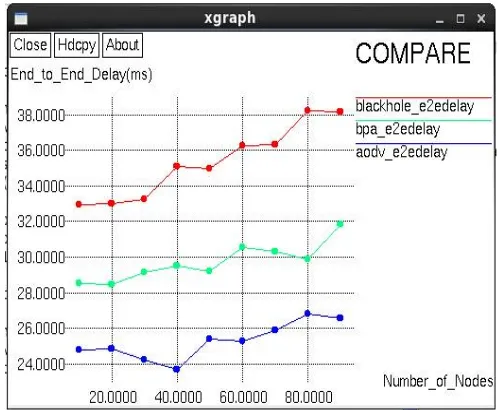
Fig. 3 (a) Comparison between % PDR vs Number of Node in black hole attack condition, standard AODV and proposed algo (bpa_pdr).
ISSN(Online): 2320-9801 ISSN (Print) : 2320-9798
I
nternational
J
ournal of
I
nnovative
R
esearch in
C
omputer
and
C
ommunication
E
ngineering
(An ISO 3297: 2007 Certified Organization)
Vol. 4, Issue 2, February 2016
Fig. 3 (c) Comparison between % PDR vs Node Mobility(m/s) in black hole attack, standard AODV and proposed algo(bpa_pdr).
Fig. 3 (d) Comparison between End To End Delay vs Node Mobility (m/s) in black hole attack, standard AODV and proposed algo(bpa_e2edelay)
VI.CONCLUSION AND FUTURE WORK
ISSN(Online): 2320-9801 ISSN (Print) : 2320-9798
I
nternational
J
ournal of
I
nnovative
R
esearch in
C
omputer
and
C
ommunication
E
ngineering
(An ISO 3297: 2007 Certified Organization)
Vol. 4, Issue 2, February 2016
the destination nodes. We also emphasize that though the proposed algorithm is implemented and simulated for the AODV routing algorithm, it can also be further trivially extended for use by any other routing algorithms, as well. As part of our future endeavor, we aim to study the impact of varying pause time on the protocol efficiency. In addition, we would also attempt to investigate the impact of varying network size and node mobility on Normalized Routing Overhead in the protocol.
REFERENCES
[1] C.E.Perkins, E.M.B. Royer and S.R.Das, “Ad Hoc on Demand Distance Vector (AODV) routing”, RFC 3561, July 2003.
[2] H. Deng, W. Li, and D. P. Agrawal: "Routing security in wireless ad hoc network". IEEE Communications Magazine, pages 70- 75, (2002) [3] Latha Tamilselvan, V.Sankaranarayanan: "Prevention of Black Hole Attack in MANETs", The 2nd international conference on wireless, Broadband and Ultra Wideband Communications (January 2007)
[4] Mohanmmad AI-Shurrnan et al: "Black Hole Attack in Mobile Ad Hoc Network", ACMSE' 04, (April 2004).
[5] Satoshi Kurosawa, Hidehisa Nakayama, Nei Kato, Abbas Jamalipour, and Yoshiaki Nemoto: "Detecting Blackhole Attack on AODV-based Mobile Ad Hoc Network by Dynamic Learning Method", International Journal of Network Security, Vo1.5, PP.33S-346, (November, 2007) [6] S, Ramaswamy, 1-1. Fu, M, Sreekantaradhya, 1. Dixon, and K, Nygard: "Prevention of cooperative black hole attack in wireless ad hoc networks", Proceedings of 2003 International Conference on Wireless Networks (ICWN'03), pages 570-575. Las Vegas, USA, (2003).
[7] I. Rubin, A. Behzad, R. Zhang, H, Luo, and E. Caballero, Tbone: "A mobile-backbone protocol for ad hoc wireless networks", In Proceedings of IEEE Aerospace Conference, volume 6, pages 2727-2740, (2002).
[8] B. Sun, Y. Guan, J. Chen and U. W. Pooch, Detecting black- hole attack in mobile ad hoc networks, In Proc. 5th European Personal Mobile
Communications Conference, Glasgow, UK, April 2003.
BIOGRAPHY
Vinay Singh1 is completed his M.Tech. Degree (2013-15) in the Computer Science & Engineering Department, College of Faculty of Technology Uttrakhand Technical University Campus, Uttrakhand. He completed B.Tech Degree in Information Technology (IT) in 2012 from IMS Engineering Collage, Ghaziabad (U.P.) India. Her research interests are Computer Networks.
Sanjay Kumar2 is a Assistant Prof. in CSE Dept. Uttrakhand Technical University Campus Uttrakhand Indian .He is completed his master degree from IISc Bangalore & pursuing his Ph.D Degree from Uttrakhand Technical University. Her research interests are Computer Networks & Security.