ISSN(Online): 2320-9801 ISSN (Print): 2320-9798
I
nternational
J
ournal of
I
nnovative
R
esearch in
C
omputer
and
C
ommunication
E
ngineering
(An ISO 3297: 2007 Certified Organization) Vol. 4, Issue 2, February 2016
Survey on Secure Data Hiding Using Line
Based Cubism-Art Image
Vaishali N.Ingle
M.E.Student, Dept. of E&TC., J.T.Mahajan College of Engineering , NMU University, Faizpur , Maharashtra,India
ABSTRACT: New types of computer art, called line-based Cubism-like image, and a technique to create it automatically from a source image have been proposed. The idea of the proposed art image creation technique is inspired by these concepts of the Cubism art. Specifically, there are two major stages in the proposed line based Cubism-like image generation process—prominent line extraction and region recoloring. In the first stage, at first we extract line segments from a given source image by edge detection and the Hough transform. Then, we conduct short line segment filtering and nearby line merging. In the second stage, at first we create regions in the image by extending the line segments to the image boundary to partition the image space. Then, we recolor the regions by the average region colors and within the boundaries of the regions. Data hiding is the method of hiding secret messages in cover art image. The attacker will not know the presence of that data in the image so that data will be secure from hacker.
KEYWORDS: computer art image,cover image,line-based cubism-like image,reversible data hiding.
I. INTRODUCTION
Data hiding is a secure technique for information security, authentication, copyright protection, etc. Data hiding means information represented by some data are hidden in a cover art image to keep these data as secure. Different data hiding algorithms are implemented on images. But in most cases, the cover image is permanently distorted due to data hiding and thus the original image is difficult to restore. Due to this there is no proper way to recover the stego image back to the original image without distortion. In Least significant bit-plane (LSB) embedding method, the LSBs of the elements pointed by the determined locations are used for embedding and extraction.
A new method of data hiding by using an art image generation algorithm to enhances the camouflage effect for various information-hiding application is proposed.an art image created by source image based on cubism properties is called line-based cubism art image. Cubism artists transform a natural scene into geometric forms in paintings by breaking up, analyzing, and reassembling objects in the scene from multiple viewpoints. In addition, with the scene objects rearranged to intersect at random angles, each Cubism painting seems to be composed of intersecting lines and fragmented regions in an abstract style. The idea of the proposed art image creation technique is inspired by these concepts of the Cubism art. Specifically, there are two major stages in the proposed line based Cubism-like image generation process—prominent line extraction and region recoloring. In the first stage, at first we extract line segments
from a given source image by edge detection and the Hough transform. Then, we conduct short line segment filtering
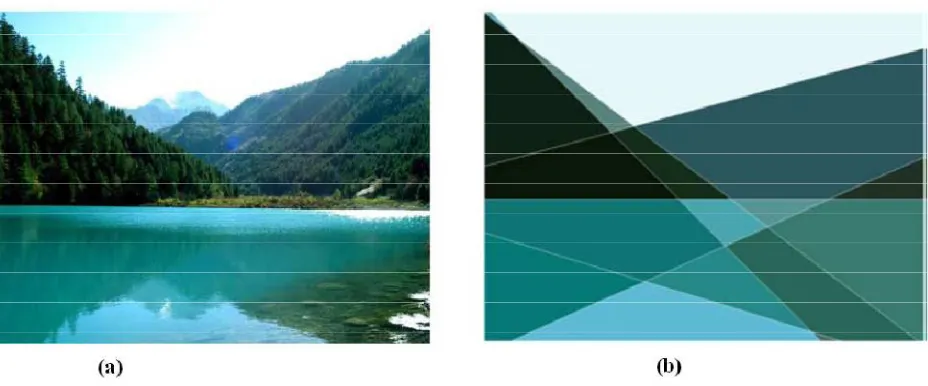
and nearby line merging. In the second stage, at first we create regions in the image by extending the line segments to the image boundary to partition the image space. Then, we recolor the regions by the average region colors and within the boundaries of the regions. Two art images so created in this paper as shown
ISSN(Online): 2320-9801 ISSN (Print): 2320-9798
I
nternational
J
ournal of
I
nnovative
R
esearch in
C
omputer
and
C
ommunication
E
ngineering
(An ISO 3297: 2007 Certified Organization) Vol. 4, Issue 2, February 2016
Fig 1. Example of line-based Cubism-like images created automatically in this study. (a) Source image. (b) Created art image from the source image.
A new method of combining art image generation & data hiding to enhance the canoulflage effect for various information hiding application is proposed.in this paper we hide message data in the automatically-generated art image during the image creation process by shifting the colors of the pixels in the image region slightly for the minimum amount of±1 while keeping the average colors of the region unchanged.based on rounding- off property in integer valued color computation,the data hiding technique is proved by thermo tobe reversible & thus useful for lossless recovery of the cover art image from stego image.their are four security enhancement measuresare also adopted to prevent hackers from extracting embedded data correctly.
1. Randomization of the data string to be embedded.
2. Randomization of the processing order of the region.
3. Randomization of the processing order of the pixels in each region.
4. Embedding camouflage string in intact regions to mislead a hacker to guess data in them erroneously.
Basic steps used in data hiding are:
1. Select a cover image & convert into art image.
2. Select the secret data to be masked inside the cover image.
3. A function will be used to hide the data into the cover image and its inverse is used to retrieve data from the cover image.
4. During hiding process, we can use an optional key to enhance authentication.
II. LITERATUREREVIEW
There is a very good literature survey on art image & data hiding techniques.here we are presenting various automatic art image creation by using the computer arouses interest of many people,& many methods have been proposed[1]-.
Art image
Hertzmann[1]surveys the ideas & algorithms of creating art images by” A survey of stroke-based rendering “survey on
the art images by stroke based rendering which is an creates images by using discrete elements like paint strokes &stipples.the main aim to create such type of images look like another type of image so that hackers will not be known about the presence of data.
ISSN(Online): 2320-9801 ISSN (Print): 2320-9798
I
nternational
J
ournal of
I
nnovative
R
esearch in
C
omputer
and
C
ommunication
E
ngineering
(An ISO 3297: 2007 Certified Organization) Vol. 4, Issue 2, February 2016
Data hiding
Here we are presenting various types of data hiding
Yih-Chuan Lin, Tzung-Shian Li, Yao-Tang Chang, Chuen-Ching Wang, Wen-Tzu Chen[10], “A Subsampling and Interpolation Technique for Reversible Histogram Shift Data Hiding presented a reversible technique that is based on the block division to conceal the data in the image. In this approach the cover image is divided into several equal blocks and then the histogram is generated for each of these blocks. Maximum and minimum points are computed for these histograms so that the embedding space can be generated to hide the data at the same time increasing the embedding capacity of the image. A one bit change is used to record the change of the minimum points.
Jan Tian[13] proposed a method of reversible data hiding using difference expansion.reversible data hiding method provides the original data as it is without degradation at the receiver side.this method used in audio as well as video data hiddin
III. PROPOSEDSYSTEM
Line Based cubism
Generated key
channel
Key
Line-Based Cubism-Like Image Creation
The Art image creation technique is inspired by these concepts of the Cubism art. Specifically, there are two major stages in the proposed line based Cubism-like image generation process —
1. Prominent line extraction
Cover
Image
generation
Art image
Art image
Reversible
data hiding
technique
Stego
image
Stego
image
Reversible data
extraction
technique
ISSN(Online): 2320-9801 ISSN (Print): 2320-9798
I
nternational
J
ournal of
I
nnovative
R
esearch in
C
omputer
and
C
ommunication
E
ngineering
(An ISO 3297: 2007 Certified Organization) Vol. 4, Issue 2, February 2016
2. Region recoloring.
In the first stage, at first we extract line segments from a given source image by edge detection and the Hough transform. Then, we ignore the short line segment and nearby line merging. In the second stage, at first we create regions in the image by extending the line segments to the image boundary to partition the image space. Then, we recolor the regions by the average region colors and within the boundaries of the regions.
Data Hiding Technique
There are various types of data hiding technique we have to use tree based parity check method. The TBPS method is a least significant bit (LSB) stegnographic method. A steganographic method consists of an embedding algorithm and an extraction algorithm. The embedding algorithm describes how to hide a message into the cover object and the extraction algorithm illustrates how to extract the message from the stego object. In this paper, we propose an efficient embedding scheme that uses the least number of changes over the tree-based parity check model. The TBPC method can be formulated as a matrix embedding method, but is more efficient than those based on linear codes. Due to its simplicity, the TBPC method provides very efficient embedding and extraction algorithms. Recently, proposed a systematic method to generate code with an arbitrary small relative payload from any code with a large relative payload. Since our method works naturally with large relative payloads, the result implies that our method applies to small relative payloads as well. We observe that the toggle criteria of a node in the TBPC method can be relaxed by the strategy of majority vote.
TBPS method
The TBPC method is a least significant bit (LSB) steganographic method. Only the LSBs of the
elements pointed by the determined locations are used for embedding and extraction. The TBPC method constructs a complete N-ary tree, called the master tree, to represent the LSBs of the cover object. Then it fills the nodes of the master tree with the LSBs of the cover object level by level, from top to bottom and left to right. Every node of the tree corresponds to an LSB in the cover object. Denote the number of leaves of the master tree by L. The TBPC embedding algorithm derives an L-bit binary string, called the master string, by performing a parity check on the master tree from the root to the leaves.
master tree
1
0
1
0
master string
1
1
0
1
message
0
1
1
1
toggle string
ISSN(Online): 2320-9801 ISSN (Print): 2320-9798
I
nternational
J
ournal of
I
nnovative
R
esearch in
C
omputer
and
C
ommunication
E
ngineering
(An ISO 3297: 2007 Certified Organization) Vol. 4, Issue 2, February 2016
The embedding algorithm hides the message by modifying the bit values of some nodes in the master tree. Assume that the length of the message is also L bit. Performing the exclusive-or (XOR) operation between the message and the master string, we obtain a toggle string
Then, the embedding algorithm constructs a new complete N-ary tree, called the toggle tree.
Toggle tree-
1.Build one empty N-ary complete tree with the same structure of master tree. 2.Fills the leaves with the bit values of the toggle string & the other nodes with 0.
3.If each of the nonleaf nodes child nodes are both 1 & it child nodes to 0 in the bottom up order.
step-1 emptyN-ary
Step-2 fills the leaves
Step-3 toggle tree Fig.1. Constuction of a toggle tree
The embedding algorithm obtains stego-tree by performing X-OR operation between master tree & toggle tree.
Fig.2. Modify the master tree into the stego tree by the toggle tree construction.
The TBPS extraction algorithm is simple. We can extract the message by performing a parity check on each root-leaf path of the stego-tree from left to right.
ISSN(Online): 2320-9801 ISSN (Print): 2320-9798
I
nternational
J
ournal of
I
nnovative
R
esearch in
C
omputer
and
C
ommunication
E
ngineering
(An ISO 3297: 2007 Certified Organization) Vol. 4, Issue 2, February 2016
IV. CONCLUSION
In this paper, we have to discuss various method of data hide into art image.all the methods are having some degree of success, but each method having some kind of own drawbacks.one of the best method is data hiding a line based cubism image.in this method we have to create cubism-like image to distract the hacker’s attention to the hide data & secret keeping.
REFERENCES
1. A. Hertzmann, “A survey of stroke-based rendering,” IEEE Computer Graphics Applicat., vol. 23, no.4, pp.70–81, Jul./Aug. 2003.
2. A. Hertzmann, “Painterly rendering with curved brush strokes of multiple sizes,” in Proc 1998 Int. Conf. on Computer Graphics & Interactive
Techniques(SIGGRAPH 1998), Orland FL, Jul. 1998, pp. 453–460.
3. D. Mould, “Stipple placement using distance in a weighted graph,” in Proc. Int. Symp. Computational Aesthetics in Graphics, Visualization &
Imaging, Banff,Alberta, Canada, 2007, pp. 45–52.
4. D. Mould, “A stained glass image filter,” in Proc. 14th Eurographics Workshop on Rendering, Leuven, Belgium,2003, pp. 20–25.
5. A. Hausner, “Simulating decorative mosaics,” in Proc. 2001 Int. Conf. Computer Graphics & Interactive Techniques (SIGGRAPH 01),
LosAngeles, CA, Aug. 2001, pp. 573–580.
6. P. Haeberli, “Paint by numbers: Abstract image representations,” in Proc. 1990 Int. Conf. Computer Graphics & Interactive Techniques
(SIGGRAPH 1990),Dallas, TX, 1990, pp. 207– 214.
7. Y. Z. Song, P. L. Rosin, P. M. Hall, and J. Collomosse, “Arty shapes,” in Proc. Computational Aesthetics inGraphics, Visualization &
Imaging, Lisbon, Portugal,2008, pp. 65–72.
8. M. Nosrati, R. Karimi, H. Nosrati, and A. Nosrati, “Embedding stego-text in cover images using linked list concepts and LSB technique”,
Journal of American Science, Vol. 7, No. 6, 2011, pp. 97-100.
9. Wen-Chung Kuo, Dong-Jin Jiang, Yu-Chih Huang, “A Reversible Data Hiding Scheme Based on Block Division”, Congress on Image and
Signal Processing, Vol. 1, 27-30 May 2008, pp. 365-369.
10. Yih-Chuan Lin, Tzung-Shian Li, Yao-Tang Chang, Chuen-Ching Wang, Wen-Tzu Chen, “A Subsampling and Interpolation Technique for
Reversible Histogram Shift Data Hiding”, Image and Signal Processing, Lecture Notes in Computer Science, Vol. 6134, 2010, Publisher: Springer Berlin/Heidelberg, pp. 384-393.
11. Chyuan-Huei Thomas Yang, Chun-Hao Hsu, “A High Quality Reversible Data Hiding Method Using Interpolation Technique," IEEE Fifth
International Conference on Information Assurance and Security, Vol. 2, 18-20 Aug. 2009, pp. 603- 606
12. Che-Wei Lee and Wen-Hsiang Tsai, “A Lossless Data Hiding Method by Histogram Shifting Based on an Adaptive Block Division Scheme”,
Pattern Recognition and Machine Vision, River Publishers, Aalborg, Denmark, pp. 1–14.
13. J. Tian, “Reversible data embedding using a difference expansion, ”IEEE Trans. Circuits Syst. Video Technol., vol. 13, no. 8, pp. 890–
896,Aug. 2003.
14. J. Canny, “A computational approach to edge detection,” IEEE Trans.Pattern Anal. Mach.Intell., vol. 8, no. 6, pp. 679–698, Nov. 1986.
15. J. Fridrich, M. Goljan, and R. Du, “Lossless data embedding—New paradigm in digital watermarking,” EURASIP J. Appl. Signal Process.,
vol. 2, pp. 185–196, 2002.
16. M. Awrangjeb andM. S. Kankanhalli, “Reversible watermarking using a perceptual model,” J. Electron. Imag., vol. 14, no. 013014, Mar.
2005.
BIOGRAPHY
Vaishali N.Ingle is a Student in the Electronics and Telecommunication Department, J. T. Mahajan College of engineering Faizpur, India. North Maharashtra University. She received a Bachelor degree in Electronics and Telecommunication in 2010 from, KGCE, Karjat , India.