ISSN(Online): 2319-8753 ISSN (Print) : 2347-6710
I
nternational
J
ournal of
I
nnovative
R
esearch in
S
cience,
E
ngineering and
T
echnology
(A High Impact Factor, Monthly, Peer Reviewed Journal)
Visit: www.ijirset.com
Vol. 8, Issue 3, March 2019
Microcontroller Based Smart Energy
Auditing System
Mekala N, K.Kanagaraj, R.Karthikeyan, P.Mohan
Department of Electrical and Electronics Engineering, The Kavery Engineering College, Mecheri, Salem,
Tamil Nadu, India
Department of Electrical and Electronics Engineering, The Kavery Engineering College, Mecheri, Salem,
Tamil Nadu, India
ABSTRACT: The power demands are globally increased at every moment. Everyone must concentrate to produce a large amount of energy and also try to save this energy. In this proposed system tries to solve the unnecessary energy consumption in household. It will monitor and analyses the energy consumed rating of home applications and send the information to consumer through GSM. The currently used energy billing system is error prone in many cases where the bill is paid and then which is shown as a due amount in the next bill. The proposed system gives the mobile application which will act as mobile communication between the system and user mobile.
KEYWORDS: GSM, Energy Consumed Rate, Energy auditing, Home application.
I. INTRODUCTION
Smart energy meter mainly focused to monitoring the energy consumption of an organization, company or an individual household. Everyone can maintain their tariff without exceeding the certain limit. Excess energy consumption leads to air pollution through the extra secretes released by the power plants. It monitors the electrical energy consumption by the customers and communicates the information to the customer at set intervals. So the
customer are more aware of their energy consumption .hence improves the accuracy.
ISSN(Online): 2319-8753 ISSN (Print) : 2347-6710
I
nternational
J
ournal of
I
nnovative
R
esearch in
S
cience,
E
ngineering and
T
echnology
(A High Impact Factor, Monthly, Peer Reviewed Journal)
Visit: www.ijirset.com
Vol. 8, Issue 3, March 2019
II. PROPOSED SYSTEM
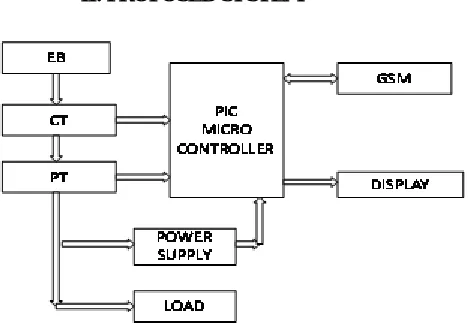
Figure 2.1: Smart Energy Auditing System
The block diagram consist PIC microcontroller, GSM modem, display, CT’s and PT’s, power supply.
In this proposed work is used for uses eco friendly manner without anyone instruction or help from home itself. For that we proposed a new smart energy auditing system by using PIC microcontroller. Here we used PIC microcontroller to get the load utilizing power in household for getting voltage and current value using CT and PT circuits.
III.MICROCONTROLLER : (PIC16F877A)
The PIC is a family of microchip Technology which is developed by general instrument microelectronics division. The PIC is initially referred to peripheral interface controller then it corrected as programmable intelligent computer. The PIC microcontroller can be programmed with variety of software which is available in the market. An assembly language is used in the PIC microcontroller. The advanced and common software and compiler has been developed by microchip itself. The integrated development environment (IDE) needs to program the PIC microcontroller where the programming takes place. A compiler convert the program into hex file the hex file dumped into the PIC MCU's by using integrated programming environment (IPE). In order to upload our code, we need PIC kit 2 loader. It is simple and low cost which is controlled by PC running MPLAB IDE software on a windows platform.
The ADC section of the PIC microcontroller enabled and RAO pin is assigned as the ADC input pin. The resolution of ADC is set at 10 bits and then reference voltage is +5V. Then the PIC microcontroller pin is used to send and control the data signal to the LCD module are defined according to PIC C compiler specifications.
Components associated with PIC :
ISSN(Online): 2319-8753 ISSN (Print) : 2347-6710
I
nternational
J
ournal of
I
nnovative
R
esearch in
S
cience,
E
ngineering and
T
echnology
(A High Impact Factor, Monthly, Peer Reviewed Journal)
Visit: www.ijirset.com
Vol. 8, Issue 3, March 2019
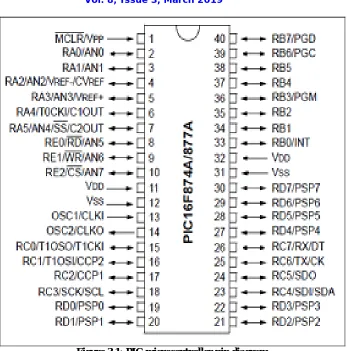
Figure 3.1: PIC microcontroller pin diagram
There are 3 memory blocks in each of the PIC16F877A. The program memory and data memory have separate buses so the access can occur.
IV. GSM
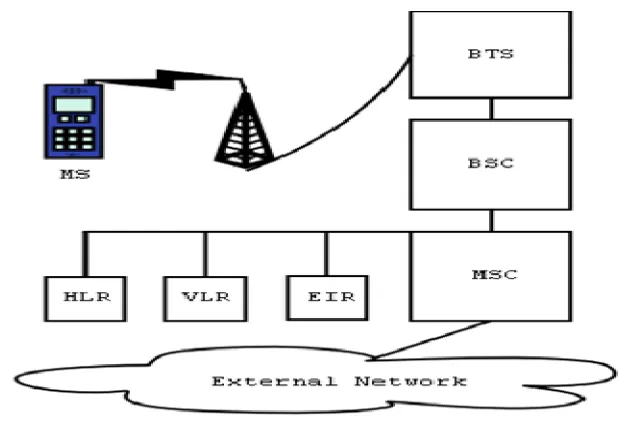
The GSM (Global system for mobile application) system is mostly used in the recent days. It is one of the successful cellular phone technologies because it including the reasons are ability to roam worldwide and it being able to operate on GSM networks in exactly the same way provided building agreement are in place.
ISSN(Online): 2319-8753 ISSN (Print) : 2347-6710
I
nternational
J
ournal of
I
nnovative
R
esearch in
S
cience,
E
ngineering and
T
echnology
(A High Impact Factor, Monthly, Peer Reviewed Journal)
Visit: www.ijirset.com
Vol. 8, Issue 3, March 2019
Figure 4.1: Schematic Diagram of Global Positioning System
V. LCD DISPLAY
A liquid crystal display is a flat panel display used electronically modulated optical device which uses liquid crystals. Liquid crystals do not EMIT the light directly instead using a backlight which produces the image in color is monochrome. The consumption of LCD is much less compared to LED's because the principle involved in this technique is blocking the light rather than emitting it. Generally their LCD’s are made with passive Matrix display or active Matrix display. The active Matrix LCD is also called thin film transistor display (TFT). In passive Matrix LCD the pixels located at each intercession off the grid and it has grid conductors.
Figure 5.1: LCD pin description
For controlling the light with any pixel current is sent across two conductors. In active matrix transistors are located at each pixel intersection requiring less current to control Luminous of pixel. The active Matrix display can be switched ON and switched off more frequently and it improve the screen refresh time.
ISSN(Online): 2319-8753 ISSN (Print) : 2347-6710
I
nternational
J
ournal of
I
nnovative
R
esearch in
S
cience,
E
ngineering and
T
echnology
(A High Impact Factor, Monthly, Peer Reviewed Journal)
Visit: www.ijirset.com
Vol. 8, Issue 3, March 2019
VI. POWER SUPPLY
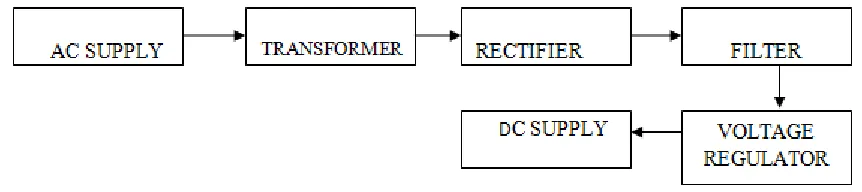
A typically 230Vrms ac voltage is connected to a transformer which steps that Ac voltage down to the desired Ac voltage level. A diode rectifier provides a full wave rectified voltage that is filtered by a simple capacitor filter to produce a dc voltage. Generally the resulting dc voltage usually has some ripple or ac voltage variations.
Figure 6.1: Power supply unit
The regulator circuit provides the dc input to output which have much less ripple’s, the required dc supply is obtained from the ac supply after rectification, filtration, regulation.
VII. HARDWEAR SETUP
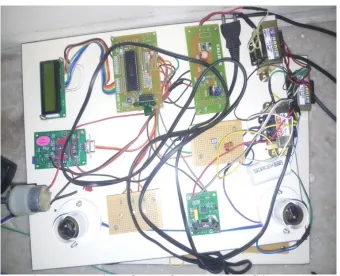
The proposed system consist of hardware and software. The hardware setup consists of microcontroller, LED display, GSM modem, voltage regulator. The software used in this project are PIC C compiler, Embedded C PIC KIT 2 loader. In this proposed system the consumer proper utilization unit and their corresponding cost are send to consumer mobile and also EB after the 60 days completed and then there data’s are reset, again start with new. The units are split into government standard cycles such as 100 units, 200 units, etc...
Which cycle fixed as deadline such as 80 units , 180 units, etc...Once the cycle and deadlines are reached then the intimation will be sent to user mobile in the form of unit and cost by using smart meter technique. Through this technique user can decide and maintain the tariff with their required limit. The different LED's used to intimate the cycle changes which are provided on the smart meter. The amount changes can be modified by the EB only.
The PIC KIT 2 loader used to dump the codes in microcontroller. In this proposed system the lamps and motors are used as the load.
Once the unit reached with it’s deadline like 80 unit, 180 unit the intimation will be sent to consumer and then they will shut down the heavy loads manually so that they can decide their bill by means of minimizing the power consumption.
ISSN(Online): 2319-8753 ISSN (Print) : 2347-6710
I
nternational
J
ournal of
I
nnovative
R
esearch in
S
cience,
E
ngineering and
T
echnology
(A High Impact Factor, Monthly, Peer Reviewed Journal)
Visit: www.ijirset.com
Vol. 8, Issue 3, March 2019
Figure 7.1: Experimental Setup of Smart Energy Auditing System
VIII. CONCLUSION
This paper describe design and working of energy meter and how smart energy meter need for automatic meter reading and how consumer can maintain their tariff. The smart accurate meter provides intelligent, advanced power control for the next century. many new technologies involved to supporting the sensing, controlling, human interface .The fundamental infrastructure of charging electricity can be implemented. The automation of billing system eliminates the human involvement. It sends a SMS alert to energy provider company whether a consumer using more than specify limit of load.
IX. FUTURE SCOPE
In this project we will talk about our future plans for the system and a way to expand its scope .Ongoing work on the project is include the design of a voltage sensor that will be connected in parallel to the electrical line. Instantaneous values are taken from both the current sensor and the voltage sensor and then those are multiplied to give exact readings for all types of loads. Another future goal is to expand the system so it can handle entities such as factories, office buildings, and apartment blocks. If the industrial sector to takes more care of its energy management, air pollution levels will decrease which helps protect the environment for the next generation’s.
REFERENCES
[1]. Yang, Xiang, et al. “Study and Design of Home Intelligent System Based on Embedded Internet.” 2008 International Conference on Embedded Software and Systems Symposia, 2008, doi:10.1109/icess.symposia.2008.43.
ISSN(Online): 2319-8753 ISSN (Print) : 2347-6710
I
nternational
J
ournal of
I
nnovative
R
esearch in
S
cience,
E
ngineering and
T
echnology
(A High Impact Factor, Monthly, Peer Reviewed Journal)
Visit: www.ijirset.com
Vol. 8, Issue 3, March 2019
[3] Ms..Devjani Banerjee, Prof Dr. Mrs. N. R. Kulkarni Electrical Engineering Department. “Three Phase Parameter Data Logging and Fault Detection Using GSM Technology”, ISSN 2250-3153, Volume 3, Issue 2, February 2013.
[4] Y. Chen, N. M. Nasrabadi, and T. D. Tran, "Hyperspectral Image Classification Using Dictionary- Based Sparse Representation," IEEE Trans. Geosci. Remote Sens., vol. 49, no. 10, pp. 3973-3985, 2011.
[5] L. Zhang, Y. Zhong, B. Huang, J. Gong, and P. Li, "Dimensionality reduction based on clonal selection for hyperspectral imagery," IEEE Trans. Geosci. Remote Sens., vol. 45, no. 12, pp. 4172-4186, 2007. [3] Y. Chen, X. Zhao, and X. Jia, "Spectral-spatial classification of hyperspectral data based on deep belief network," IEEE J. Sel. Topics Appl. Earth Observ. Remote Sens., vol. 8, no. 6, pp. 2381-2392, 2015.
[6] A. Krizhevsky, I. Sutskever, and G. E. Hinton, "Imagenet classification with deep convolutional neural networks," in Advances in neural information processing systems, 2012, pp. 1097-1105.
[7] Y. LeCun, Y. Bengio, and G. Hinton, "Deep learning," Nature, vol. 521, no. 7553, pp. 436-444, 2015.