Simulation and Implementation of Light
Flickermeter
Roshani Supriya B N1, Nayana P Shetty2
M.Tech Student, Department of Microelectronics and Control Systems, NMAM Institute of Technology, Udupi, India1
Associate Professor, Department of Electrical and Electronics, NMAM Institute of Technology, Udupi, India2
ABSTRACT: Thepaper presents the analysis and implementation of light flickermeter. MATLAB simulink is used for the analysis purpose to measure the amount of flicker. ARM processor is used for hardware implementation. The main aim of light flickermeter is to eliminate the dc level and high frequency components. Thus quantified flicker obtained is nothing but the flicker of low frequency component sensed by the human eye.The modified flickermeter analogous to the StandardIEC flickermeter with some modification added.
KEYWORDS: Low pass Filter(LPF), High pass filter(HPF), Incandecent lamps(IL), Non-incandecent lamp(NIL)
I. INTRODUCTION
Flicker is the phenomenon of variation in the light intensity. This fluctuationchanges continuouslyovertime [1] causes headache, visual tiredness and loss of concentration in many individuals[2]. Flickermeter is a device used to measure the severity of flicker present in different lamp technologies [2]. Thus it helps the industrial and residential customers to choose the appropriate flicker free lamps suitable for the human eye. The proposed flickermeter is developed based on the standard IEC flickermeter using MATLAB simulink. ARM processor is used for practical implementation to check the severity of the flicker present.
II. SIMULATION
Flickering lamps are modeled at different variable intensities to give as input to modeledflickermeter using MATLAB simulink. This helps to show the advantage of proposed flickermeter over standard IEC flickermeter. IEC flickermeter can able to measure the flickering present only in incandecent lamps where as proposed one can compute for both incandecent and non-incandescent lamps[3]
ISSN(Online) : 2319-8753 ISSN (Print) : 2347-6710
I
nternational
J
ournal of
I
nnovative
R
esearch in
S
cience,
E
ngineering and
T
echnology
(An ISO 3297: 2007 Certified Organization)
Vol. 5, Special Issue 9, May 2016
A. Standard IEC Flickermeter
Voltage fluctuations in fundamental input power supply of 230 V and 50Hz causes flickering in lamps as shown in Figure1. Fluctuating frequency [Fm] and amplitude modulation [M] are the two important parameters responsible for flicker[1]. IEC flickermeter has the fluctuating voltage as the input from block 1(figure 2). Digitalized and normalised voltage signal from block 1 under go some quadratic operations[6] to produce the illumination equal to incandecent lamps in block 2. High frequency and dc components are removed using LPF and HPF Filters in block 3.Block 4 is related to effect on brain memory. Statistical analysis is computed to check the sharpness of flicker.
Fig.2: Standard IEC Flickermeter
B. Lamp Modeling
Model of an IL lamp is shown in figure 3 fluctuation frequency(Fm) 3.5Hz and amplitude modulation (M) 5% are considered in fundamental supply voltage shown in figure 1. With the known number of watts on the bulb, current and resistor values are calculated.
60watts of lamp requires184mA and 1.7k ohm of current and resistance.
R= V/I
Power converted to lumens which is given by
Illumination(Lm) = Power(W) * illumination per watt(Lm/W)
Typically, 60W IL gives the lumens of 480 Lm
Therefore 1 watt IL gives the lumens of 8 Lm/Watt
Average of all these of lumens is given as input to the flickermeter
Fig.3 Model of IL lamp
C. Model of proposed Light Flickermeter
Fig. 4: Model of Proposed Flickermeter
HPF of 1st order and LPF of sixth order with the cutoff frequency of 0.05Hz and 42Hz isused to eliminate the dc level and high frequency component respectively. Another LPF of first order ensures smoothing of signal which is related to disturbance in the brain memory[5]. The output amplitude is adjusted by squaring the signal. Thus flicker obtained is the equal to the sharpness of flicker sensed by human eye.
Fig. 5: Model of Proposed Flickermeter(continue)
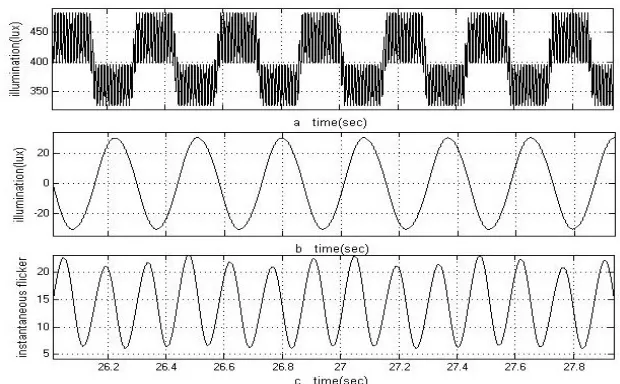
1. Instantaneous flicker produced by IL OF 60W as shown in figure 6
a. Flicker from IL Lamp
b. Illumination produced from ADC
c. Instantaneous flicker sensed by human eye
ISSN(Online) : 2319-8753 ISSN (Print) : 2347-6710
I
nternational
J
ournal of
I
nnovative
R
esearch in
S
cience,
E
ngineering and
T
echnology
(An ISO 3297: 2007 Certified Organization)
Vol. 5, Special Issue 9, May 2016
2. Instantaneous flicker produced by IL OF 60W as shown in figure 7
a.Flicker from IL Lamp
b. Illumination produced from ADC
c.Instantaneous flicker sensed by human eye
Fig. 7: Result from Non-Incandecent lamp
III.HARDWAREIMPLEMENTATION
Created light source of different intensity from block A shown in figure.9 is given to photo sensor in block B. Sensor convert fluctuating light to voltage. This voltage consist of dc level, high frequency component and flicker due to arc furnaces[2]. The main aim of block C is to eliminate this high frequency component and dc. Depending on the amount of flicker present in particular lamp, percentage of flicker will be calculated and displayed in block D.
A. Block A
The light source of 5V white LED bulb (D1) is used. Variable intensity of light source is created by adjusting the duty ratio of 555 timer output as shown in fig.8.
Duty Ratio = Ton/(Ton+Toff)
Ton=0.693×R1×C1, Toff=0.693×R2×C1
R1=101K POT, R2=101KPOT
Fig.8: Block A-Equivalent diagram
B. Block B—TEMT6000 Photo sensor
The response of this sensor is similar to that of sensibility of human eye to the fluctuating light. Beside it offers low cost around 200INR. Appropriate frequency band is purpose of choosing this sensor. It consumes less amount of supply current.The timeresponse of this sensor is very fast and output voltage has excellent linearity v/s input light.
C. Block C and D—ARM Cortex-M3 processor
The signal from sensor is sampled in analog to digital converter using ARM Cortex-M3 LPC1768 microcontroller under the resolution of 2400 samples/sec beside it has good memory capacity with low cost. The sampled signal is normalized and it is compared with that of initial samples which gives error in the signal. Low pass filter of second order is implemented to remove high frequency component in error signal. Percentage of flicker is obtained is given by
Percentage of flicker = (error signal×100)/Normalized value
Fig.9: Proposed Flickermeter
D. Prototype Results
ISSN(Online) : 2319-8753 ISSN (Print) : 2347-6710
I
nternational
J
ournal of
I
nnovative
R
esearch in
S
cience,
E
ngineering and
T
echnology
(An ISO 3297: 2007 Certified Organization)
Vol. 5, Special Issue 9, May 2016
Fig.10: Percentage of flicker at better quality of LED
The figure.11 shows the display of percentage of flicker in LCD when LED emits high frequency flicker using 555 timer. This flicker is visible to human eye even when subjected to short duration.
Fig.11: Percentage of flicker at low quality of LED
IV.CONCLUSION
The Proposed flickermetermodeled using MATLAB simulink overcomes the drawback of IEC Flickermeter. It found to produce satisfactory results not only for incandecent lamps but also for non-incandecent lamps. Measuring of flicker using ARM processor is cost effective with lesser power consumption. Thus helps the industrial customers to choose the appropriate bulbs suitable for human eye.
ACKNOWLEDGMENT
I would like to thank Nayana P Shetty and Vishnu Prasad V Bhat for internal and external guidance of project
REFERENCES
[1] GuilhermePiazentiniColnago , Jose Rubens Macedo, Jose Luiz de FreitasVieira,Dept. “Electrical Engineering Implementation of a light Flickermeter in a low cost embedded system”IET Science, Measurement & Technology, Vol.9, pp.522–531, 2015
[2] Wilkins, A.J., Nimmo-Smith, I., Slater, A.I., Bedocs, L. “Fluorescent lighting, headaches and eyestrain”, Light. Res. Technol., Vol.21, pp.11– 18, 1989.
[4] Wilkins, A., Veitch, J., Lehman, B. “LED lighting flicker and potential health concerns: IEEE standard PAR1789 update”, Atlanta, USA, Vol.21, pp. 171–178, September 2010.
[5] Wang, C.S., Devaney, M.J. “Incandescent lamp flicker mitigation and measurement”, IEEE Trans. Instrum. Meas., Vol.53, pp. 1028–1034, 2004.
[6] Gallo, D., Landi, C., Langella, R., Testa, A. “On the use of the flickermeter to limit low-frequency interharmonic voltages”, IEEE Trans. Power Deliv., Vol.23, pp. 1720–1727, 2008.