ABSTRACT
PANDITA, RAHUL. Inferring Semantic Information from Natural-Language Software Artifacts. (Under the direction of Laurie Williams.)
Specifications play and important role in software engineering for ensuring software qual-ity. Not only do the specifications guide the development process by outlining what/how to reuse, they also help in the verification process by allowing testers to test the expected out-come. For instance, static and dynamic program analysis tools use formal specifications such as code contracts or assertions to detect violations of these specifications as defects. Likewise, API migration tools use predefined mapping specifications to perform automated migration. While highly desirable, oftentimes such formal specifications are missing from existing soft-ware. In contrast, these specifications are described in natural language in various software artifacts. Particularly, Application Programming Interface (API) documents that are targeted towards developers, are invaluable source of information regarding code-level specifications. However, (most of) existing developer productivity tools/frameworks are not designed to pro-cess the natural-language descriptions in software artifacts.
The goal of this work is to improve developer / tester / end-user productivity by accurately identifying specification sentences from the natural language text in software artifacts and representing them formally through adaptation of existing text analysis techniques.
Since natural-language software artifacts are often verbose, manually writing formal spec-ifications from software artifacts may be resource intensive and error prone. To address this issue, this dissertation presents a text mining and natural language processing (NLP) frame-work to automate the task of inferring semantic information from natural-language in soft-ware artifacts to bridge the disconnect between the inputs required by softsoft-ware engineer-ing tools/frameworks and the specifications described in natural-language software artifacts. Specifically, this dissertation reports on the process and effectiveness of applying text mining and NLP techniques in the following developer problems:
in identifying sentences that describe such specifications from more than 2500 sentences of API documents. Furthermore, our results show that our approach has an average 83% accuracy in inferring specifications from over 1600 specification sentences.
2. Temporal specifications of an API are the allowed sequences of method invocations in the API. We propose ICON: an approach based on machine learning and NLP for iden-tifying and inferring formal temporal constraints to assist tool based verification. Our evaluation results indicate that ICON is effective in identifying temporal constraint sen-tences (from over 4000 human-annotated API sensen-tences) with the average precision, re-call, and F-score of 79.0%, 60.0%, and 65.0%, respectively. Furthermore, our evaluation also demonstrates that ICON achieves an accuracy of 70% in inferring and formalizing 77 temporal constraints from these temporal constraint sentences.
3. API mappingsfacilitate tool based language migration. We propose TMAP:TextMining based approach to discover likelyAPI mappings using the similarity in the textual de-scription of the source and target API documents. We evaluated TMAP by comparing the discovered mappings with state-of-the-art source code analysis based approaches: Rosetta and StaMiner. Our results indicate that TMAP on an average found relevant mappings for 57% more methods compared to previous approaches. Furthermore, our results also indicate that TMAP found, on average, exact mappings for 6.5 more meth-ods per class as compared to previous approaches.
© Copyright 2015 by Rahul Pandita
Inferring Semantic Information from Natural-Language Software Artifacts
by Rahul Pandita
A dissertation submitted to the Graduate Faculty of North Carolina State University
in partial fulfillment of the requirements for the Degree of
Doctor of Philosophy
Computer Science
Raleigh, North Carolina
2015
APPROVED BY:
William Enck Emerson Murphy-Hill
Munindar P. Singh Laurie Williams
DEDICATION
“Would you tell me, please, which way I ought to go from here?” “That depends a good deal on where you want to get to.” “I don’t much care where ”
“Then it doesn’t matter which way you go.”
– Lewis Carroll,Alice in Wonderland
BIOGRAPHY
ACKNOWLEDGEMENTS
This journey would not have been possible without the support of a lot of people.
First, I would like to thank my adviser Dr. Laurie Williams for supporting me through the PhD process. Laurie provided me with the freedom to explore and pursue my research direc-tions and was very patient with me during the process. Throughout the way, Laurie provided me with valuable technical and professional advice, helping me to grow as a researcher. I am also thankful to Dr. Tao Xie for introducing me to the wonderful world of software engineering research and shaping me as a professional during my initial years in the doctoral program. I know I will continue to benefit from my interactions with them throughout my career.
I would like to extend my gratitude towards my committee members: Dr. William Enck, Dr. Emerson Murphy-Hill, and Dr. Munindar Singh. First, I thank them for serving as my committee members and providing valuable feedback on my work. In addition, I have been very lucky to work closely with each of my committee members. These work opportunities have helped me a lot professionally and made me appreciate the diverse research areas and approaches.
I wish to acknowledge the support of my research collaborators: Dr. Raoul Jetley and Dr. Sithu Sudarsan at ABB Research India (formerly at United States Food and Drug Adminis-tration) to introduce me to the text mining concepts. I would also like to thank my mentor at IBM India Research Labs Dr. Saurabh Sinha for helping me understand the concepts of pro-gram analysis. I am thankful to Dr. Teresa Tung from Accenture Research Labs for allowing me to extend my university research into a corporate study. I am grateful to Nikolai Tillmann and Peli de Halleux at Microsoft Research for their support on Pex and their guidance on the testing infrastructure. I am also thankful to the reviewers of various conferences for providing the valuable feedback on the submitted drafts.
The members of Realsearch group have been a source of constant support. I would like to take this opportunity to acknowledge the help extended by the members for: countless reviews of the half baked drafts, providing feedback on the presentations, critiquing the study design, and on occasions helping out with the studies as well. I am also thankful for the help extended by members of Automated Software Engineering Group at North Carolina State University (now at University of Illinois at Urbana-Champaign).
Thum-malapenta, Kunal Taneja, Jeehyun Hwang, Xusheng Xiao, Da Young Lee, Padmashree Ravin-dra, Niranjan “Kulla” Kulkarni, Suprit “Pats” Patankar, John Majikes, John Slankas, Patrick Morrison, Brittney Johnson, and Yoonki Song for making Raleigh a home away home for me. The research presented in this dissertation has been supported by (in part) by USA National Security Agency (NSA) Science of Security Lablet at NCSU; NSF grants 0845272, CCF-0915400, CNS-0958235, CNS-1160603, CNS-1222680, CNS-1253346, CNS-0720641, and CCF-0725190; ARO grant W911NF-08-1-0443 and ARO grant W911NF-08-1-0105 managed by NCSU SOSI; and an NCSU CACC grant. Portions of this dissertation were previously published at ICSE’12, USENIX’13. The material included in this dissertation has been updated and extended.
TABLE OF CONTENTS
LIST OF TABLES . . . ix
LIST OF FIGURES . . . x
Chapter 1 Introduction . . . 1
1.1 Motivation . . . 1
1.2 Summary . . . 2
1.3 Challenges . . . 4
1.4 Scope . . . 5
1.5 Contributions . . . 6
1.6 Outline . . . 7
Chapter 2 Background . . . 8
2.1 Natural Language Processing . . . 8
2.2 Text Mining . . . 10
2.3 Formal representation used in this work . . . 13
Chapter 3 Inferring Method Specifications from Natural Language API Descrip-tions . . . 15
3.1 Introduction . . . 15
3.2 Motivating Examples . . . 18
3.3 Approach . . . 20
3.3.1 Parser . . . 20
3.3.2 Pre-Processor . . . 21
3.3.3 Text Analysis Engine . . . 23
3.3.4 Post-processor . . . 26
3.3.5 Code Contract Generator . . . 28
3.4 Evaluation . . . 29
3.4.1 Subjects . . . 30
3.4.2 Evaluation Results . . . 31
3.4.3 Threats to Validity . . . 36
3.5 Discussion and Future work . . . 36
3.5.1 Limitations: . . . 37
3.6 Chapter Summary . . . 38
Chapter 4 ICON: Inferring Temporal Constraints from Natural Language API Descriptions . . . 39
4.1 Introduction . . . 39
4.3 ICON Overview . . . 43
4.3.1 Preprocessor . . . 43
4.3.2 NLP Parser . . . 45
4.3.3 Candidate Identifier . . . 45
4.3.4 Text Analysis Engine . . . 48
4.3.5 Constraint Extractor . . . 51
4.3.6 Semantic-Graph Generator . . . 53
4.3.7 Type Analysis . . . 53
4.4 Evaluation . . . 54
4.4.1 Subjects . . . 55
4.4.2 Evaluation Setup . . . 56
4.4.3 Results . . . 58
4.4.4 Summary . . . 61
4.4.5 Threats to Validity . . . 61
4.5 Limitations and Future work . . . 61
4.6 Chapter Summary . . . 62
Chapter 5 WHYPER: Towards Automating Risk Assessment of Mobile Applications 63 5.1 Introduction . . . 63
5.2 Android Applications . . . 66
5.3 WHYPEROverview . . . 66
5.3.1 Use Cases and Threat Model . . . 67
5.4 WHYPERDesign . . . 69
5.4.1 Preprocessor . . . 69
5.4.2 NLP Parser . . . 72
5.4.3 Intermediate-Representation Generator . . . 73
5.4.4 Semantic Engine (SE) . . . 76
5.4.5 Semantic-Graph Generator . . . 77
5.5 Evaluation . . . 79
5.5.1 Subjects . . . 80
5.5.2 Evaluation Setup . . . 80
5.5.3 Results . . . 82
5.5.4 Summary . . . 88
5.5.5 Threats to Validity . . . 88
5.6 Discussions and Future work . . . 89
5.7 Chapter Summary . . . 90
Chapter 6 Discovering Likely Mappings Between APIs using Text Mining . . . . 92
6.1 Introduction . . . 92
6.2 Example . . . 95
6.3.1 Indexer . . . 98
6.3.2 Query Builder . . . 101
6.3.3 Searcher . . . 103
6.3.4 Implementation . . . 104
6.4 Evaluation . . . 104
6.4.1 Subjects . . . 105
6.4.2 Evaluation Setup . . . 106
6.4.3 Results . . . 108
6.5 Limitation and Future work . . . 113
6.6 Chapter Summary . . . 114
Chapter 7 Related Work . . . 115
7.1 Formal Specifications . . . 115
7.2 NLP in Software Engineering . . . 116
7.3 Program Comprehension . . . 117
7.4 Program Synthesis . . . 118
7.5 Language Migration . . . 119
7.6 Information Retrieval . . . 121
7.7 Query Formulation . . . 121
Chapter 8 Future Work . . . 122
8.1 Generic Limitations . . . 122
8.2 Coding-specific activities . . . 124
8.3 Self Assurance . . . 125
8.4 WHYPER: Generalization to Other Permissions . . . 125
8.5 Long term goal . . . 126
Chapter 9 Summary and Lessons Learned . . . 127
9.1 Summary . . . 127
9.2 Lessons learned . . . 129
LIST OF TABLES
Table 3.1 Categories of Shallow Parsing Semantic Templates. . . 25
Table 3.2 Statistics of Subject classes and Evaluation results . . . 33
Table 4.1 Semantic Templates . . . 50
Table 4.2 Evaluation Results (Identification) . . . 58
Table 4.3 Evaluation Results (Inference) . . . 59
Table 5.1 Examples of Semantic Templates for Stanford Typed Dependencies . . . . 75
Table 5.2 Statistics of Subject permissions . . . 81
Table 5.3 Evaluation results . . . 82
Table 5.4 Keywords for Permissions . . . 86
Table 5.5 Comparison with keyword-based search . . . 86
Table 6.1 Query Results . . . 97
Table 6.2 Evaluation Results . . . 109
LIST OF FIGURES
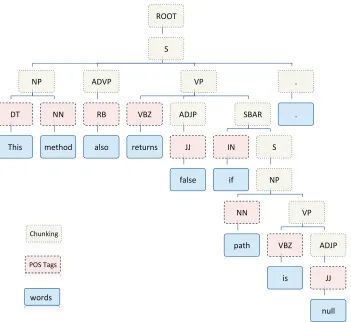
Figure 2.1 An example of POS tags and Chunking annotation. . . 9
Figure 2.2 An example of Stanford Typed Dependencies representation. . . 11
Figure 2.3 An example of Intermediate Representation. . . 14
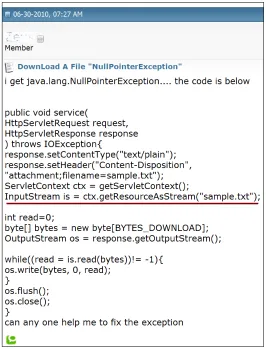
Figure 3.1 Description of a question posed in a Java forum . . . 19
Figure 3.2 Overview of our approach to infer method specification . . . 21
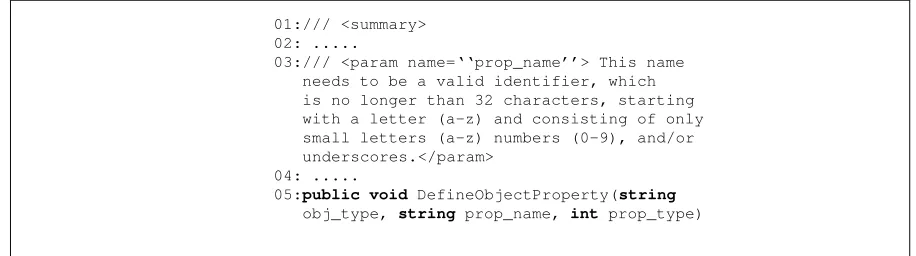
Figure 3.3 The method description of theDefineObjectPropertymethod . . . . 22
Figure 3.4 Specifications in format of FOL expressions extracted by our NLP Parser . 24 Figure 3.5 FOL expression after synonym analysis and compaction . . . 29
Figure 3.6 Example of the inferred specifications forDefineObjectPropertymethod 30 Figure 4.1 Query posted on StackOverflow forum about Amazon S3 REST API . . . 42
Figure 4.2 Overview of the ICON approach . . . 44
Figure 4.3 Sentence annotated with Stanford dependencies . . . 46
Figure 4.4 An example FOL-like representation of a sentence . . . 51
Figure 4.5 Semantic Graph for theObjectmethod in Amazon S3 REST API . . . . 54
Figure 5.1 Overview of WHYPER . . . 68
Figure 5.2 Overview of WHYPER framework . . . 70
Figure 5.3 Sentence annotated with Stanford dependencies . . . 73
Figure 5.4 First-order logic representation of annotated sentence in Figure 5.3 . . . . 73
Figure 5.5 Semantic Graph for the READ CONTACT permission . . . 78
Figure 6.1 drawStringAPI method description from Graphicsclass in the Java ME API . . . 95
Figure 6.2 drawTextAPI method description fromCanvasclass in the Android API 96 Figure 6.3 Overview of ICON approach . . . 98
Figure 6.4 Description ofIterator.hasNextmethod from Java API . . . 102
CHAPTER
1
Introduction
1.1
Motivation
Specifications play an important role in software engineering. In general, specifications help end users to access the functionality of the software, before they actually use it. An example of such specification is code-level specifications. Not only, these specifications guide the develop-ment process by outlining what/how to reuse, they also help in verification process by allowing quality assurance practitioners to test the expected outcome.
Specifications in general are distributed across various software artifacts such as require-ments docurequire-ments, design docurequire-ments and application descriptions. Application Programming Interface (API) documents, that are targeted towards developers, are invaluable source of in-formation regarding code-level specifications. Typically, library developers commonly describe legal usage of the library in natural language text in API documents. Such documents are usu-ally provided to client-code developers through online access, or are shipped with the API code. For example, J2EEs API documentation is one of the popular API documents.
(pre-conditions), expected return values (post-conditions) and functionality of method in gen-eral. These specifications are invaluable to automated tools directed towards improving devel-oper/tester productivity. For instance, a typical automated testing tool will check to see if any of the pre-conditions or the post conditions are violated. However, such tools are not designed to work with the natural language descriptions, and often require more formal specifications. Thus, a disconnect exists between the inputs required by these tools and the natural language specifications described in software artifacts.
The goal of this work is to improve developer / tester / end-user productivity by accurately identifying specification sentences from the unconstrained natural language text in software ar-tifacts and representing them formally through adaptation of existing text analysis techniques. The formal representation of the specification sentences are meant to bridge the gap be-tween the existing tools that help the target audience and inputs required by tools. This disserta-tion presents my recent research projects for developing/applying text mining and Natural Lan-guage Processing (NLP) techniques to discover specifications from natural lanLan-guage software artifacts. The evaluation of these efforts show promising results to improve developer/tester productivity. For example, a formal representation of API method expectations could assist a developer in writing better code. Similarly, a formal representation of appropriate usage of an API method could be beneficial to a quality assurance practitioner by explicitly delineating the illegal usages of an API. From an end users perceptive automated analysis of application de-scription can empower them by answering a variety of questions regarding privacy and security such as: how a users private data will be used.
1.2
Summary
This section summarizes the individual instances of inferring formal specifications form natural language artifacts for improving developer, tester, and end user productivity.
in identifying sentences that describe method arguments and return value specifications from more than 2500 sentences of API documents. Furthermore, our results show that our approach has an average 83% accuracy in inferring specifications from over 1600 method arguments and return value specification sentences.
2. Temporal specifications for method invocationTemporal specifications of an Appli-cation Programming Interface (API) are the allowed sequences of method invoAppli-cations in the API. We propose ICON: an approach based on Machine Learning (ML) and Natural Language Processing (NLP) for identifying and inferring formal temporal constraints to assist tool based verification. To evaluate our approach, we apply ICON to infer and formalize temporal constraints from theAmazon S3 RESTAPI, thePayPal Payment RESTAPI and thejava.iopackage in the JDK API. Our results indicate that ICON is effective in identifying temporal constraint sentences (from over 4000 human-annotated API sentences) with the average precision, recall, and F-score of 79.0%, 60.0%, and 65.0%, respectively. Furthermore, our evaluation also demonstrates that ICON achieves an accuracy of 70% in inferring and formalizing 77 temporal constraints from these tem-poral constraint sentences.
3. API mappings for language migration API mappings facilitate tool based language migration. Previously, researchers proposed to learn mapping specifications by mining existing code-bases. However, these approaches require as input a manually ported (or at least functionally similar) code across source and target API’s. To address the shortcom-ing, we propose TMAP: Text Mining based approach to discover likelyAPI mappings using the similarity in the textual description of the source and target API documents. To evaluate our approach, we apply TMAP to discover API mappings for 15 classes across: 1) Java and C# API; 2) Java ME and Android API. We next compare the discov-ered mappings with state-of-the-art source code analysis based approaches: Rosetta and StaMiner. Our results indicate that TMAP on an average found relevant mappings for 57% more methods compared to previous approaches. Furthermore, our results also indi-cate that TMAP found, on average, exact mappings for 6.5 more methods per class with a maximum of 21 additional exact mappings for a single class as compared to previous approaches.
and mobile devices. However, keeping malware out of application markets is an ongoing challenge. To assist third-party quality assurance practitioners in assessing risk, this study presents the first step by automatically inferringexpected functionalityfrom the natural language application description. Specifically, we focus on permissions for a given ap-plication and examine whether the apap-plication description provides any indication for why the application needs a permission. We present WHYPER, a framework using Nat-ural Language Processing (NLP) techniques to identify sentences that describe the need for a given permission in an application description. WHYPER achieves an average pre-cision of 82.8%, and an average recall of 81.5% for three permissions (address book, calendar, and record audio) that protect frequently-used security and privacy sensitive resources. These results demonstrate great promise in using NLP techniques in aiding the risk assessment of mobile applications.
1.3
Challenges
In this section we briefly summarize some of the technical challenges addressed by this disser-tation in applying text mining and natural language processing techniques on natural language software engineering artifacts.
1. Ambiguity. Existing linguistic analysis techniques focus on well-written documents such as news articles [SNL99]. In contrast, method descriptions are often not well-written. For instance, consider the sentence from theFileclass in the C# .NET Framework:“true if path is an absolute path; otherwise false”. This sentence does not have the main subject and the verb, which may cause the linguistic techniques to behave undesirably.
2. Programming Keywords. Method descriptions often contain programming keywords (e.g.,
true, null, buffer), which have a different meaning in the context of programs, in contrast to general linguistics. For instance, consider this sentence from thePathclass
3. Semantic Equivalence. A legal usage in natural language can be described in differ-ent words and semantic structures. For instance, consider the following two fragmdiffer-ents that describe the same specification: “name can contain numbers, underscores...’’ and “name consists of numbers and/or underscores...”. Thus, semantic equivalence of legal usage described in different ways needs to be identified. The proposed text mining and natural language processing techniques must be reasonably resilient to such semantic equivalence.
4. Confounding Effects. Certain keywords have confounding effects and are important de-pending on the context. For example, to find sentences related to “user contacts” in an application description keyword “contact” exhibits a confounding effect. For instance, ‘... displays user contacts, ...’vs‘... contact me at [email protected]’. The first sentence frag-ment refers to a sensitive operation while the second fragfrag-ment does not. However, both fragments include the keyword “contact”. The proposed techniques must consider the context of a sentence into account for such cases.
5. Semantic Inference. Natural language is very expressive, and oftentimes the sentences implicitly convey information about concepts without explicitly referring to them. For example, consider the problem to identify sentences that describe a sensitive operation such asreading user contacts. Oftentimes, sentences do not even explicitly contain the keyword “contact”. For instance, “share... with your friends via email, sms”. The sen-tence fragment describes the need to read contacts; however the “contact” keyword is not used. The proposed text mining and natural language processing techniques should be able to perform such semantic reasoning.
1.4
Scope
The approaches presented in this dissertation focuses on inferring semantic information from API documents with the exception of WHYPERthat works on mobile application descriptions. However, the approaches presented in the dissertation addresses the generic issues of applying NLP techniques on software artifacts and thus may be extended to other software artifacts as well.
Our approach to infer method specifications [PXZ+12] infers method specifications in
API method descriptions written in the C# langauge of .NET platform. ICON: our approach for inferring method sequence specifications has been evaluated on the API written for Java language as well as language agnostic REST APIs. TMAP: our approach to infer method map-pings across API has been evaluated on the following language/platform pairs: 1) Java and C#; and 2) Android and J2ME. The techniques proposed in these approaches are programming lan-guage agnostic and can be applied to various API’s with minor changes to the pre-processing infrastructure. The pre-processing infrastructure is responsible to extract the desired descriptive text from an natural language artifacts.
Finally, WHYPER [PXY+13, YXP+14] approach has been implemented for application
descriptions in Android ecosystem. However, the WHYPER infrastructure can be leveraged to perform similar analysis in other mobile application ecosystems such as the Windows Phone and the iOS.
The presented techniques were implemented using the “Stanford Parser” [KM03a] as our choice of external NLP annotation library. However, this dissertation uses the Stanford Parser as a black box implementation of the NLP functionality to perform analysis thus making the proposed techniques realizable through NLP annotation libraries other than Stanford Parser. As the accuracy of the external NLP annotation libraries improves accuracy of the approaches pro-posed in this dissertation increases and some of the preprocessing steps such as annotation of programming keywords may be rendered redundant. Finally, this dissertation does not directly contributes to the techniques in the fields of text mining and machine learning. However, this dissertation proposes enhancements to the techniques in these fields for addressing problems in software engineering domain.
1.5
Contributions
This section summarizes the main contributions of this dissertation.
• An approach that effectively identifies natural language sentences (in the API documents for a library) that describe method parameter and return value specifications, and a tech-nique to infer specifications from the identified specification sentences.
• An ML- and NLP-based approach that effectively infers formal temporal constraints of method invocations.
• An approach that uses NLP techniques to help bridge the semantic gap between what mobile applications do and what users expect them to do.
– A publicly available prototype implementation of our approach is available on-line [proc].
• A text mining based approach that effectively discovers mapping between source and target API.
– A prototype implementation of our approach based on extending the Apache Lucene [luc]. An open source implementation of our prototype is publicly available online. [prob] – The evaluation results and artifacts are publicly available online. [prob]
1.6
Outline
CHAPTER
2
Background
This chapter briefly introduces the concepts and techniques from natural language processing, information retrieval, and text mining domain that have been used/adapted in this work. The remainder of the chapter is organized as follows. Section 2.1 introduces the concepts from natural language processing used in this dissertation. Section 2.2 briefly introduces text mining. Finally, Section 2.3 describes formal representation used in this work.
2.1
Natural Language Processing
Natural language is well suited for human communication, but converting natural language into unambiguous specifications that can be processed and understood by computers is diffi-cult. However, research advances [dMMM06, dMM08, KM03b, KM03c] have increased the accuracy of existing NLP techniques to annotate the grammatical structure of a sentence. We next introduce the core NLP techniques used in this work.
!""#$
%$
&'$
(#$
#)*+$
&&$
,-.)/0$
1(2'$
!3$
45+/$
2'$
236$
7-.879+$
1(:'$
::$
;45+-$
%31!$
<&$
*;$
%$
&'$
&&$
=4.)$
2'$
236$
*+$
1(:'$
::$
9855$ >$
>$
?)89@*9A$
'"%$#4A+$
B/70+$
the art approaches been have demonstrated to achieve 97% [SNL99] accuracy in classi-fying POS tags for well written news articles. Figure 2.1 shows the a sentence annotated with POS tags.
• Chunking. Also known as phrase and clause parsing, this technique divides a sentence into a constituent set of words (or phrases) that logically belong together (such as a Noun Phrase and Verb Phrase). Chunking thus further enhances the syntax of a sentence on top of POS tagging. Current state-of-the-art approaches can achieve around 90% [SNL99] accuracy in classifying phrases and clauses over well written news articles. Figure 2.1 shows the a sentence annotated with chunking tags.
• Typed Dependencies[dMMM06, dMM08]. The Stanford typed dependencies represen-tation is designed to provide a simple description of grammatical relationships directed towards non-linguistics experts to perform NLP related tasks. It provides a hierarchical structure for the dependencies with precise definitions of what each dependency means, thus facilitating machine based manipulation of natural language text. Figure 2.1 shows the a sentence annotated with Stanford typed dependencies.
• Named Entity Recognition[FGM05]. Also known as‘entity identification’and‘entity extraction’, these techniques are a subtask of information extraction that aims to classify words in a sentence into predefined categories such as names, quantities, expression of times, etc. These techniques help in associating predefined semantic meaning to a word or a group of words (phrase), thus facilitating semantic processing of named entities.
• Co-reference Resolution [RLR+10, LPC+11]. Also known as ‘anaphora resolution’, these techniques aim to identify multiple expressions present across (or within) the sen-tences, that point out to the same thing or ‘referant’. These techniques are useful for extracting information; especially if the information encompasses many sentences in a document.
2.2
Text Mining
!"#$% &'(")*%
+,$)% -'(.-/$%
0+,$'%
#0%
1+("%
#$% /.,,%
/$.23%
*'(%
+*4&)*%
+5)&1%
+*45,%
&+-6%
/$.23%
5)1%
indicates that a significant (35%) of business information is captured in unstructured data. A large part of this information is in documents containing narrative text, such as reports, presentations, web data, and design documents. Text mining is used to infer the knowledge in these documents through a combination of extraction and analytical methods.
As opposed to traditional data mining, text mining analyzes free-form text spread across documents (rather than data localized and maintained within a database). To analyze this data, text mining uses concepts from traditional data analytics, natural language processing, and data modeling. We next introduce the concepts from text mining that have been used in the presented approach.
Indexing [Fra92, MRS08]: Indexing is the process of extracting text data from source documents and storing them in well-defined indexes. The indexing process starts with, division of document into its constituent units, known as tokens, based on a well-defined criterion. A token is usually an individually identifiable unit of the document (such as a word) and relates to the individual terms stored in an index. Once the tokens within each document are identified, they are added to the index, with the corresponding link to the document and associated term frequencies. Term frequency is the simple count of the occurrence of a term in a document. An optional pre-processing step further assists with indexing, such as removing stop-words, grouping similar words together.
Among various indexing strategies, the use ofinverted file indexing[Fra92] is well suited for large document collections. In the simplest form, inverted file index maintains the mapping of terms and their location in a text collection. For instance, a text document can be thought of as a collection of m words. Typically a document is made up of a sequence of n unique words such thatn <= m. The number n is usually far less thanm as most of the words are repeated while forming a document. For instance, the word “the” is repeated many times in this dissertation. The set of unique words within an index forms the “Term List”v of the index. If a pointer (say numeric location) is associated with each word inv to the location of that word in text document, the resultant data structure is a form of inverted file index. As the document collection grows, the number of documents matching a word in the index becomes sparser.
The index is oftentimes annotated with the information regarding the frequency of occur-rence of each term in the document. The representation of a document as a vector of frequencies of terms is referred to asvector space model[Sin01, Fra92].
Of-ten used as a weighting metric in information retrieval and text mining, the tf-idf weight increases proportionally to frequency of the occurrence of a term in a document, however the weight is also offset by the frequency of occurrence the term in the corpus.
Cosine Similarity [Sin01]: In mathematics, cosine similarity is a numerical statistic to measure the similarity between two vectors. cosine similarity is defined as a dot product of magnitude of two vectors. In context of text mining, the cosine similarity is used to capture the similarity between two documents represented as term frequency vectors.
2.3
Formal representation used in this work
We use First-Order Logic (FOL) like expressions for representing the specifications inferred from the natural language text in API documents. We chose FOL as formal representation because the syntax is simple and yet powerful enough to represent the inferred specifications.
Terms and formulas form the basic building blocks of FOL expressions. Terms can be further resolved into two sub categories: variables (or entities) and functions (or predicates). Functions constitutes of arguments that are terms. Thus, arguments can be either variables or functions. Below are the five rules for constructing valid FOL expressions:
• Predicate Symbols: If P is a Predicate symbol involving n terms thenP(t1, t2, ...tn)is a
valid FOL expression.
• Equality: Ift1andt2 are two valid terms thent1 =t2 is valid FOL expression.
• Negation: If E1 is a valid FOL expression then its negation, denoted by ¬E is a valid
FOL expression.
• Binary Connectives: If E1 and E2 are two valid FOL expressions then an expression
involving binary connectives ( inclusive of∧,∨, and→) is a valid FOL expression. The symbol∧is ‘conjunction’,∨is ‘disjunction’ and→is a conditional (if/then) statement.
• Quantifiers: IfE is a valid FOL expression andv is a valid variable then∃vE and∀vE
are valid expressions.
!"#
$%&'# ()*+(,&#
-.!&#
/)*.'0#
"$%&)#
!&#
1$*.# ,+%%#
1()0!2$*)#
),3*4#
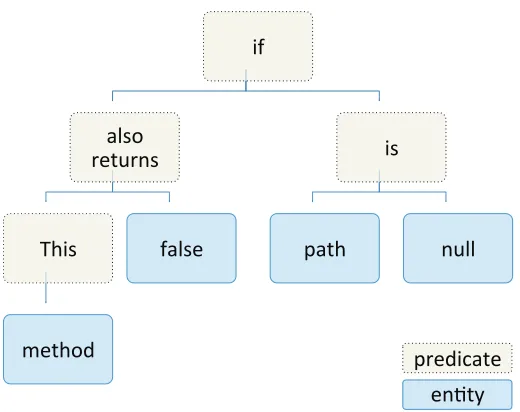
Figure 2.3: Intermediate representation of comment “This method also returns false if path is null”
CHAPTER
3
Inferring Method Specifications from Natural Language API
Descriptions
This chapter introduces an approach to infer method arguments and return values specifica-tions.1 These specifications describe how to use a particular method within a class in terms
of the expectations of the method arguments and expected return values. The remainder of this chapter is organized as follows. Section 3.1 introduces the approach. Section 3.2 presents an two real world examples motivating the approach. Section 3.3 presents the approach. Sec-tion 3.4 presents evaluaSec-tion of the approach. SecSec-tion 3.5 presents a brief discussion and future work.
3.1
Introduction
Software reuse is commonly practised since the advent of software development [FK05]. Soft-ware reuse facilitates development of larger, more complex, and timely-delivered softSoft-ware sys-tems [GC92]. To determine what and how to reuse, specifications of reusable software libraries play an important role. In the absence of specifications, developers may write code that is
1This work was done in collaboration with Xusheng Xiao, Hao Zhong, Tao Xie, Stephen Oney, and Amit
inconsistent with the expectations of libraries. As a result, not only such code is of inferior quality and contains faults, the added cost of debugging and correcting such faulty code could also defeat the purpose of reusing software.
Code contracts [Mey92, Cha06] have emerged as a popular way of formalizing method specifications close to the implementation level. Code contracts unambiguously capture the expectations of a method in terms of what is required (pre-conditions) and what to expect after method execution (post-conditions). Furthermore, code contracts can be subjected to formal verification by existing state-of-the-art verification tools such as Spec# [BLS04], JML2, and
Code Contracts for .NET3. Additionally, code contracts can be used for formal proofs and
automated code correction [WPF+10].
Despite being highly desirable, code contracts do not exist in a formalized form in most existing software systems in practice [PCM09]. In contrast, library developers commonly de-scribe legal usage in natural language text in Application Programming Interface (API) docu-ments. Typically, such documents are provided to client-code developers through online access, or are shipped with the API code. For example, Oracle’s J2EE API documentation4 is an
ex-ample of online documentation for Java programming language.
Even with such API documents, client-code developers often overlook some API descrip-tions and use methods in API libraries incorrectly [NW06]. Since these documents are written in natural language, existing tools cannot verify legal usage described in a library’s API doc-uments against the client code of that library. One possible solution is to manually write code contracts based on the specifications described in API documents. However, due to a large number of sentences in API documents, manually hunting for contract sentences and writing code contracts for the API library is prohibitively time consuming and labor intensive. For in-stance, theFile class of the C# .NET Framework has around 800 sentences. Moreover, not all of these sentences describe code contracts, requiring extra effort to first locate the sentences describing code contracts and then translate them into formal specifications.
To address the preceding problem, we propose a novel approach to facilitate verification of legal usage described in natural language text of API documents against client code of those libraries. We propose new techniques that apply Natural Language Processing (NLP) on method descriptions in API documents to automatically infer specifications. In particular, our techniques address the following challenges to infer specifications automatically.
2
http://www.eecs.ucf.edu/˜leavens/JML/
3http://research.microsoft.com/en-us/projects/contracts/
Ambiguity. Existing linguistic analysis techniques focus on well-written documents, such as news articles [SNL99]. In contrast, method descriptions are often not well-written. For in-stance, consider the sentence from theFileclass in the C# .NET Framework:“true if path is an absolute path; otherwise false”. This sentence does not have the main subject and the verb. To address this challenge, we use meta-data such as position information of description as well as method signatures. In particular, in this example, the sentence is located within the return descriptions, and the method signature describes the return type as boolean. We use this information to infer that words “true” and “false” describe the return value of the method.
Programming Keywords. Method descriptions often contain programming keywords (e.g.,
true, null, buffer), which have a different meaning in the context of programs, in con-trast to general linguistics. For instance, consider this sentence from thePathclass in the C# .NET Framework: “This method also returns false if path is null”. In this sentence, words ‘false’ and ‘null’ are nouns in the context of object-oriented languages such as, Java and C#, whereas in general linguistics these words are adjectives. Thus, these keywords need to be handled differently. For those keywords, we propose a new technique calledNoun Boostingto distinguish keywords from the other words.
Semantic Equivalence. A legal usage in natural language can be described in different words and semantic structures. For instance, consider the following two fragments that de-scribe the same specification: “name can contain numbers, underscores...’’ and “name con-sists of numbers and/or underscores...”. Thus, semantic equivalence of legal usage described in different ways needs to be identified.
To address this challenge, we propose a new technique called equivalence analysisbased on identified grammatical structures (main nouns and verbs) of a sentence.
In summary, our approach infers specifications from existing API documents, thus facilitat-ing verification of client code of an API library against the natural language descriptions of the library. As our approach analyzes API documents in natural language, it can be reused inde-pendent of the programming language of the library. Additionally, our approach complements existing approaches [WFKM11, CTS08, NE02] that infer code contracts from source code or binaries. To the best of our knowledge, ours is the first approach that analyzes API documents to infer specifications targeted towards generating code contracts.
This chapter makes the following major contributions:
technique to infer specifications from the identified contract sentences.
• A prototype implementation of our approach based on extending the Stanford Parser [KM03a, SNL99], which is a natural language parser to derive the grammatical structure of sen-tences. An open source implementation of our prototype can be found at our website5.
• An evaluation of our approach on 2717 sentences (for 333 methods) in five different classes from the .NET Framework and Facebook API for C#. Our evaluation results show that our approach effectively identifies contract sentences with an average of 92% precision and 93% recall. Additionally, our approach infers specifications from 1691 contract sentences with an average accuracy of 83%.
3.2
Motivating Examples
We next present two examples where developers wrote faulty code because they overlooked legal usage in method descriptions. We collected these examples from online developer forums. These examples highlight the importance of our approach, since the defects shown in them could have been prevented with our inferred code contracts.
NullPointerException. As shown in Figure 3.1, a developer asked a question (on06-30-2010) in one of the Java forums6regardingjava.lang.NullPointerException. Figure 3.1 shows
the code snippet. After going through the suggestions from the contributing forum members, the author of this question was finally able to resolve the problem to a path issue occurring in the underlined line, a month (07-30-2010) after he initially posted the question.
The associated API documents reveal that there are many ways to throw java.lang. NullPointerException, thus making the task of debugging non-trivial. The problem caused due to invoking thereadmethod on anullobject ofInputStream. The method description for thegetResourceAsStreammethod in theServletContextinterface states that“This method returns null if no resource exists at the specified path.”. The sentence, once translated into a formal specification, can be verified statically, or at runtime to pinpoint the problem. For instance, given the specification that the method can returnnull, advanced Integrated Devel-opment Environments (IDEs) can raise a warning after the developer attempts to perform an
5http://research.csc.ncsu.edu/ase/projects/pint/
operation on the return value of thegetResourceAsStreammethod, thus asking the devel-oper to put the necessary checks in place.
Path format not supported. Another developer posted a 44-line code snippet in a forum7. The developer reported that he/she was noticing exceptions while moving a file. After a brief exchange of messages, the issue was traced to themoveTomethod in theFileInfoclass in C#
.NET. Further exchanges revealed that the developer was attempting to move and rename the file to “11-19-2009 5:48:27.txt”. The method description for themoveTomethod inFileInfo
states that the method throws anArgumentExceptionif the new file name consists of invalid characters defined inPath.getInvalidCharacters()(including‘:’ character). After our approach infers a code contract from the description, the problem can be identified and reported by static checkers that are usually built into IDEs.
3.3
Approach
We next present our approach for inferring specifications from method descriptions. Figure 3.2 gives an overview of our approach. Our approach uses a parser, a pre-processor, a text analy-sis engine, a post-processor, and a code contract generator. The parser accepts the API docu-ments and extracts desired descriptive texts from the method descriptions. The pre-processor augments the sentences in an intermediate representation with meta-data. The text analysis en-gine accepts the intermediate representation of the sentences, and then based on our semantic templates, generates specifications in the form of First-Order Logic (FOL) expressions. The post-processor refines the FOL expressions. The code contract generator accepts the FOL ex-pressions and generates code contracts by using a mapping relation to the constructs of the target programming language. We next describe these components in detail.
3.3.1
Parser
Our parser accepts API documents and extracts intermediate contents from the method descrip-tions. In particular, from the method descriptions, our parser extracts the following contents: (1) summary description: the summary of the method; (2)argument description: the descriptions of the method’s arguments; (3)return description: the descriptions of the method’s return value;
7
Figure 3.2: Overview of our approach
(4)exception description: the descriptions of exceptions explicitly thrown by the method; (5) remark description: additional descriptions about the functionality of the method.
3.3.2
Pre-Processor
Our pre-processor accepts extracted contents of the method descriptions, and performs three major tasks.
Meta-data augmentation. For each identified method, our pre-processor collects the fol-lowing meta-data information and associates it with respective sentences: (1) the names and data types of method arguments; (2) the types of the return value and exceptions; (3) the names of the classes, namespaces, and methods. For example, for the method description shown in Figure 3.3, the meta-data information associated with the sentences in Line 03 is as follows: (1) Sentence Type: Argument Description; (2) Argument Name: prop name; (3) Argument Type:String.
01:/// <summary> 02: ...
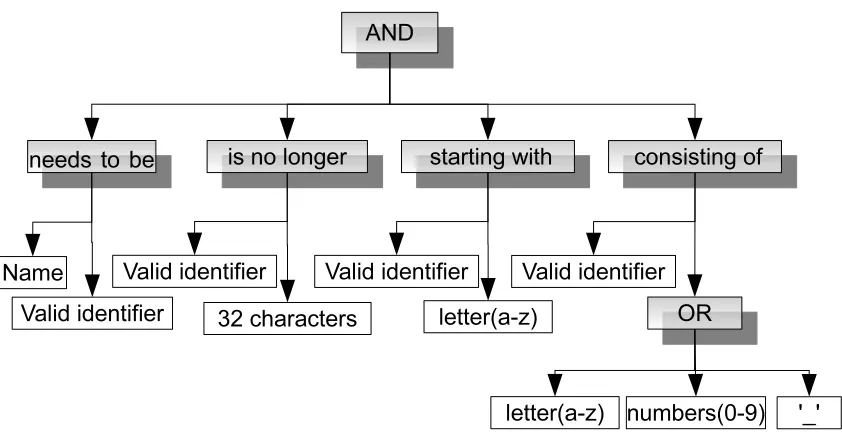
03:/// <param name=‘‘prop_name’’> This name needs to be a valid identifier, which is no longer than 32 characters, starting with a letter (a-z) and consisting of only small letters (a-z) numbers (0-9), and/or underscores.</param>
04: ...
05:public void DefineObjectProperty(string obj_type, string prop_name, int prop_type)
Figure 3.3: The method description of theDefineObjectPropertymethod in Facebook API
method arguments, the data types of the method arguments, and the exceptions thrown by the method.
Noun Boosting. Since our text analysis engine uses the Parts-Of-Speech (POS) tags pro-vided by a POS-tagger, the accuracy of the inferred specifications is dependent on the accuracy of the POS-tagger. However, there are specific words that represent nouns in the context of programs, in contrast to adjectives or verbs in the context of general linguistics. For example, consider the statement“This method also returns false if path is null”. In this sentence, “false” and “null” should be treated as nouns since they are constructs of programming languages, but a typical POS tagger would incorrectly classify them as adjectives.
Our pre-processor identifies these words from the sentences based on a domain specific dictionary, and thus forces the underlying POS tagger to identify them as nouns. In particular, our pre-processor uses a predefined list of words for noun boosting. We manually collected these words by looking into the method descriptions in the Dataclass of the Facebook API and the Path class of the .NET Framework API. A list of these words is available on our project website.
Programming Constructs and Jargon Handling. In English grammar, the “.” charac-ter represents the end of a sentence. However, in programming languages, the “.” characcharac-ter is used as a separator character as well. For example, in theFacebook.Datanamespace, the “.” character represents that theFacebook.Datanamespace exists within theFacebook
names-pace. Our pre-processor identifies these separators, and replaces “.” with “ ”. For example,
Additionally, developers tend to use abbreviations for specific words (e.g., max. for maxi-mum and min. for minimaxi-mum). Our pre-processor identifies these words, and replaces abbrevi-ations with their full names. For example, “max.” is replaced with “maximum”.
These techniques increase the accuracy of the underlying POS tagger, and thus increase the accuracy of our text analysis engine. Furthermore, our pre-processor maintains mapping relations of the place-holder words from the programming language constructs to the original words and locations, and these relations are used by our post-processor later to infer specifica-tions.
Methods and namespaces have a well-defined lexical structure in a programming language. Our pre-processor uses this structural information, and builds regular expressions to identify these words. For handling jargons and abbreviations such as “max.”, we manually built a list of such words. In future work, we plan to adapt Hill et al.’s technique [HFB+08] to generate the list automatically.
Although a POS tagger can be retrained to achieve these pre-processing steps, we prefer an-notations to make our approach independent of any specific NLP infrastructure, thus ensuring interoperability with various POS taggers.
3.3.3
Text Analysis Engine
Our text analysis engine parses pre-processed sentences, and builds specifications in the form of FOL expressions. We chose FOL, since previous research [SPKB09, SSP10] shows that FOL is an adequate representation for natural language analysis.
We first use a POS tagger to annotate POS tags in a sentence. We then use an NLP tech-nique, called shallow parsing [Bog00]. A shallow parser accepts the lexical tokens generated by the POS tagger and attempts to classify sentences based on pre-defined semantic tem-plates. Shallow parsing is implemented as a sequence of cascading finite state machines. Re-search [Bog00, ST97, SPKB09, Gre99] has shown the effectiveness of using finite state ma-chines in different areas of linguistic analysis such as morphological lookup, POS tagging, phrase parsing, and lexical lookup.
true over terms “path” and “null”.
As another example, our text analysis engine uses the semantic pattern, transitive predi-cate, described in the fourth row in Table 3.1 to analyze the sentence in Line 3 of Figure 3.3. Figure 3.4 shows the graphical FOL expression. Each internal node (shaded grey) represents a predicate and the children of these nodes represent the terms to that predicate.
We implemented a configurable infrastructure to accept a POS tagger to annotate a sentence with POS tags. In particular, for our evaluation, we used the Stanford Parser [KM03a], which is a natural language parser to work out the grammatical structure of sentences. The Stanford Parser parses a natural language sentence and determines POS tags associated with different words/phrases. We also implemented a generic and extensible framework that accepts semantic patterns based on the functions of POS tags and converts them into a series of cascading FSMs. Once POS tags have been determined by a POS tagger, the sentences along with tags are passed as an input to the shallow parser, which generate FOL expressions based on the FSMs.
Figure 3.4: Specifications in format of FOL expressions extracted by our NLP Parser for
Table 3.1: Categories of Shallow Parsing Semantic Templates.
Name Example Description
1. Predicate (Name) The (path)subject(can not be)verb The subject and object form the terms of the
nullobject predicate represented by verb.
2. Conditional followed or If (path does not have extension)conditional, The subject-verb-object forms specification
preceded nominal (GetExtension)subject(returns)verb as described in row 1, which is true when the
predicate (System.String.Empty)object condition highlighted byconditionalis true.
The condition is further resolved using one of the templates.
3. Prepositional predicate (Path)subject(is)verb(not null The verb forms the partial predicate and the subject
or empty String)preposition forms one of the terms. The second term
and the remaining of the predicate are extracted by resolving the preposition.
4. Transitive predicate (Name)subject(is)verb a (valid , The sentence is broken down into two sentences.
identifier)object−subject, which (is no The first sentence ends with the phrase labeled
longer than 32 characters)clause object−subject, and the second sentence begins
with the phrase labeledobject−subject. Each sentence
3.3.4
Post-processor
Our post-processor accepts the FOL expressions produced by the previous component and per-forms three types of semantic analysis: removing irrelevant modifiers in predicates, classifying predicates into a semantic class based on domain dictionaries, and augmenting expressions.
Equivalence analysis. Consider the predicate,‘needs to be’, in FOL representation shown in Figure 3.4. The words,“needs to”, are modal modifiers to the verb’be’. Such modal mod-ifiers are identified and eliminated. Furthermore, our post-processor classifies predicates into pre-defined semantic classes based on domain dictionaries. This classification addresses the challenge of inferring semantic equivalence. For instance, the predicate, “starting with”, in Figure 3.4 can also be represented as “begins with”. Our post-processor identifies and classi-fies all semantically equivalent predicates into a single category, and thus reduces the effort to individually write mappings for every predicate in inferred FOL expressions even when they represent same the semantic function. We have identified the following seven major semantic categories for predicates: (1) Greater, (2) Lesser, (3) Begin, (4) End, (5) Consist, (6) Equal, and (7) Action with respect to expressions dealing with code contracts. The negative semantic categories are represented using a negation operator preceding the identified semantic class.
In the preceding semantic analysis, our post-processor uses an NLP technique called lemma-tization [SNL99]. Lemmalemma-tization involves full morphological analysis to accurately identify the lemma for each word. Extracting lemmas reduces the various operational forms of a word to its root. For example, “am”, “are”, and “is” are all reduced to “be”. Once the lemma of a word is identified, our post-processor uses the lemma to query a synonym from the WordNet [ea98] database for a suitable replacement. From the implementation perspective, we maintain a list of modifier words to identify and discard them. We have also collected synonyms from WordNet to classify a predicate in one of the semantic classes. If a match is not found, our post-processor places the predicate in the unknown category.
Our post-processor identifies such terms and eliminates them by replacing their usage with their definition. In particular, our post-processor eliminates intermediate terms by parsing FOL expressions. We specifically watch out for terms that are involved in an equality operator with a variable name followed by the same term being used as an input to another predicate in the representation.
Expression Augmentation. The sentences in return descriptions and exception descrip-tions in an API document are often not well written. For example, consider the following sentences:
1. “true if path is an absolute path; otherwise false.”— the return descriptions for the
IsPathRootedmethod in thePathclass in the C# .NET Framework. The main subject and verb are missing as in what is true and false.
2. “If path is null.”— one of the exception descriptions repeated in many methods in the
Fileclass in the C# .NET Framework. The action is missing as in what happens if the path is null.
3. “IO error occurs while accessing specified directory.”— one of the exception descrip-tions repeated in many methods in the Directoryclass in the C# .NET framework. While the sentence describes a code contract, the sentence omits important information in terms under what specific condition the exception is thrown.
Our expression augmentation attempts to augment these expressions. In particular, for each method, we use meta-data collected in the pre-processor augment to complete the FOL expres-sions involving return and exception descriptions. Here, we propose Algorithm 1 to achieve our expression augmentation. The algorithm accepts an FOL expression and the meta-data of a sentence. The algorithm returns an augmented expression if successful, and otherwise returns the original expression. The algorithm first checks whether the expression corresponds to a return description statement (Line 2). If the expression is a conditional expression and the right hand side of the expression is a variable term, the algorithm checks whether the type of the variable matches the return type described in the meta-data. Literals, ‘true’, and ‘false’, are identified as boolean; ‘numeric values’ are identified as numeric that matches integer, float, and double. If a match is found, we construct the right hand side of the original predicate as returns.
Algorithm 1Expression Augmentation generator Require: Expre, Meta-datad
Ensure: Expre′ 1: Expr e′ = e
2: if(d.description==return)then
3: if(e′.root== “→”)&&(e′.right is variable)then 4: T erm t=e′.right
5: iff indT ype(t) ==d.returnT ypethen 6: P redicate p=new P redicate(“returns”)
7: p.term=t
8: e′.right=p 9: end if
10: end if 11: end if
12: if(d.description==exception)then
13: if(e′.root== “→”)&&(e′.right is empty)then 14: T erm t=d.exception name
15: P redicate p=new P redicate(“throw”)
16: p.term=t
17: e′.right=p 18: end if
19: if(e′.root! == “→”)then 20: T erm t=d.exception name
21: P redicate p=new P redicate(“throw”)
22: p.term=t
23: Expr e′′=new Expr(“→”)
24: e′′.lef t=e′ 25: e′′.right=p 26: e′=e′′ 27: end if 28: end if 29: return e′
Additionally, for the expressions in exception descriptions where no conditional expression is identified, we explicitly construct a conditional FOL expression (Line 23-25) and associate the expression to the left hand side and the throws predicate to the right hand side.
3.3.5
Code Contract Generator
Our code-contract generator generates code contracts from the extracted FOL expressions. The generator uses the predefined mapping of semantic classes of the predicates to the programming constructs to produce valid code contracts.
For example, consider the FOL expression in Figure 3.5. The “greater” predicate is mapped to thelength method of theString class. Thus, the resulting code contract isrequires( !(name.length()>32)). In contrast, “begins” is mapped to thestartswithand
Figure 3.5: FOL expression after synonym analysis and compaction for the
DefineObjectPropertymethod in Facebook API
(characterized by a single character in quotes) or string (characterized by a string in quotes), our generator uses the startswith method, and if the argument is a range (characterized by expression ‘a–z’), our generator uses the substring(0,1) method by converting the range to a regular expression. Thus, the final contract is requires(name.substring(0, 1).matches("[a-z]+")).
3.4
Evaluation
We conducted an evaluation to assess the effectiveness of our approach. In our evaluation, we address three main research questions:
• RQ1: What are the precision and recall of our approach in identifying contract sentences (i.e.,
01:requires(!prop_name.length()>32)
02:requires(prop_name.substring(0,1).matches([a-z]+)) 03:requires(prop_name.matches(([a-z][0-9][_])*))
Figure 3.6: The inferred specifications for the prop name variable of the
DefineObjectPropertymethod in Facebook API
• RQ2: What is the accuracy of our approach in inferring specifications from contract sentences in
the API documents?
• RQ3: How do the specifications inferred by our approach compare with the human written code
contracts?
3.4.1
Subjects
We used the API documents of the following two libraries as subjects for our evaluation. C# File System API documents. These documents describe correct usage of methods for manipulating files in the .NET environment. However, developers still post a lot of questions regarding their usage. Because of the importance of the File API, we chose these API docu-ments as the first set of subject docudocu-ments for inferring specifications. In particular, we use three key classes (File,Path, andDirectory) in our evaluations.
Facebook API documents. Facebook is a popular social networking site, which allows de-velopers to write their own third-party applications. According to Facebook statistics, people on Facebook install 20 million applications everyday8. Due to the sheer popularity of Facebook
and a huge number of developers developing third-party applications, we chose the Facebook API9for C# as another set of subject documents for our evaluation. In particular, we use four
key classes (Data,Friends,Events, andComments) within the Facebook API for our eval-uations.
Table 3.2 shows the statistics of the subject documents used in our evaluations. Column “Class[API Library]” lists the name of classes and their corresponding libraries. Column “#M” lists the number of methods in each class. Column “#S” lists the number of natural language sentences in method descriptions of each class.
8https://www.facebook.com/press/info.php?statistics
3.4.2
Evaluation Results
RQ1: Precision and recall in identifying contract sentences
In this section, we quantify the effectiveness of our approach in identifying contract sentences by answering RQ1. We first manually measured the number of contract sentences in the API documents. We considered a sentence as a contract sentence if it contains a clause that is either a pre-condition or post-condition. Two researchers independently labeled sentences as contract sentences by discussing iteratively until they reached a consensus. We then applied our approach on the API documents and manually measured the number oftrue positives
(TP), false positives(FP), and false negatives(FN) produced by our approach as follows:
• TP. A sentence that is a contract sentence and is identified by our approach as a contract sentence.
• FP. A sentence that is not a contract sentence and is identified by our approach as a contract
sentence.
• FN. A sentence that is a contract sentence and is identified by our approach as not a contract
sentence.
In statistical classification [Ols08], Precision is defined as the ratio of the number of true positives to the total number of items reported to be true, and Recall is defined as the ratio of the number of true positives to the total number of items that are true. F-score is defined as the weighted harmonic mean of Precision and Recall. Higher values of Precision, Recall, and F-Score indicate higher quality of the contract statements inferred using our approach. Based on the total number of TP, FP, and FN, we calculated thePrecision,Recall, andF-scoreof our approach in identifying contract sentences as follows:
P recision= T P
T P +F P
Recall= T P
T P +F N
F-score= 2X P recision X Recall
P recision+Recall
Table 3.2 shows the effectiveness of our approach in identifying contract sentences. Column “Class[API Library]” lists the names of the classes. Column “#S” lists the number of sentences in each class, and Column “SC” lists the number of sentences manually identified as
false positives, andfalse negatives, respectively. Columns “P”, “R”, and “FS” list
values of precision, recall, and f-scores, respectively. Our results show that, out of 2717 sentences, our approach effectively identifies contract sentences based on average Preci-sion, Recall and F-score of 91.8%, 93% and 92.4% respectively.
We next present an illustrative example of how our approach incorrectly identifies a sen-tence as a contract sensen-tence. Consider the sensen-tence from the getLastWriteTime method
description in theDirectoryAPI for C#:“The file or directory for which to obtain write date and time information.”The sentence describes the input parameterpath. Ideally, a POS tagger should parse the statement as a phrase statement, i.e., a sentence including just a noun-phrase. However, the POS tagger incorrectly annotates this sentence as including a subject, object, and predicate, where the predicate is “write”. Since our shallow parser is dependent on the POS tagger to correctly annotate POS tags, our approach incorrectly identifies this sentence as a contract sentence. The FP produced by our approach are primarily due to the incorrect POS tags annotated by the POS tagger. The FN in our approach are also primarily due to incorrect POS tags annotated by the POS tagger. Overall, a significant number of FP and FN can be further reduced by improving the existing underlying NLP infrastructure.
RQ2: Accuracy in inferring specifications from contract sentences
To address RQ2, we apply our approach on sentences that were manually identified as contract sentences to infer FOL expressions. We then manually verify the correctness of the inferred specifications. We define theaccuracyof our approach as the ratio of the contract sentences with correctly inferred expressions to the total number of contract sentences.
Table 3.2 shows the effectiveness of our approach in inferring specifications (FOL expres-sions) from contract sentences. Column “Class[API Library]” lists the name of the classes. Column “SC” lists the number of sentences manually identified as contract sentences. Column
“SI” lists the number of specifications that were correctly inferred from contract sentences.
Table 3.2: Statistics of Subject classes and Evaluation results
Class [API Library] #M #S SC TP FP FN P R FS SI Acc SD C Q
Data[Facebook.Rest] 133 810 320 288 55 32 84.0 90.0 86.9 244 76.3 102 21 0.75
Friends[Facebook.Rest] 37 215 126 96 10 30 90.6 76.3 82.8 84 66.7 17 0 0.83
Events[Facebook.Rest] 29 194 122 110 12 12 90.2 90.2 90.2 84 68.9 15 0 0.85
Comments[Facebook.Rest] 16 96 33 33 19 0 63.5 100.0 77.7 28 84.9 12 0 0.70
File[System.IO(.NET)] 56 795 647 627 15 20 97.7 97.0 97.3 599 92.6 NA NA NA
Path[System.IO(.NET)] 18 99 63 48 11 15 81.4 76.2 78.7 44 69.8 NA NA NA
Directory[System.IO(.NET)] 44 508 380 371 18 9 95.4 97.6 96.5 327 86.1 NA NA NA
Total 333 2717 1691 1573 140 118 91.8∗
93.0∗
92.4∗
1410 83.4∗
146 21 0.79∗
∗
We next present an illustrative example of how our approach infers an incorrect specifica-tion from a contract sentence. Consider the sentence from theFriendsclass in the Facebook API for .NET:“The first array specifies one half of each pair, the second array the other half; therefore, they must be of equal size.”. The sentence describes the two input parameters. Our approach successfully identifies the sentence as a contract sentence. However, while inferring the specification, our approach faces difficulty in accurately inferring the semantic relations. In particular, the complexity of the sentence (involving both code contracts and generic de-scriptions) makes it difficult for the POS tagger to correctly annotate POS tags, thus causing a semantic pattern to be incorrectly applied to the sentence. This sentence appears 20 times across different method descriptions in theFriendsclass where our approach performed the worst. If our approach would have correctly inferred specifications from the sentence, the ac-curacy of our approach for the Friends API would have been 82.5% instead of 66.7%.
RQ3:Comparison with human written contracts
To answer RQ3, we compared the specifications inferred from contract sentences by our ap-proach with the human written code contracts. The Facebook API for C# is equipped with code contracts that were written by Rubinger et al. [RB10] as a part of their experience report on applying the Microsoft Code Contract system for the .NET framework. We first manually calculatedSI as the number of specifications correctly inferred by our approach for a class. We
then calculated SD as the number of code contracts written by Rubinger et al. for that class,
andC as the number of specifications in common.
Table 3.2 shows the comparison of the specifications inferred by our approach to the human written contracts. Column “Class[API Library]” lists the name of the classes. Column “SI” lists
the number of specifications correctly inferred by our approach. Column “SD” lists the number
of human written code contracts. Column “C” lists the number of the specifications that are common between “SI” and “S
′
D”. Our results show that out of 440 inferred specifications and
146 human written contracts only 21 are in common. We next discuss some of the implications of the results.