
This is an Accepted Manuscript, which has been through the Royal Society of Chemistry peer review process and has been accepted for publication.
Accepted Manuscripts are published online shortly after
acceptance, before technical editing, formatting and proof reading. Using this free service, authors can make their results available to the community, in citable form, before we publish the edited article. We will replace this Accepted Manuscript with the edited and formatted Advance Article as soon as it is available.
You can find more information about Accepted Manuscripts in the
author guidelines.
Please note that technical editing may introduce minor changes to the text and/or graphics, which may alter content. The journal’s standard Terms & Conditions and the ethical guidelines, outlined in our author and reviewer resource centre, still apply. In no event shall the Royal Society of Chemistry be held responsible for any errors or omissions in this Accepted Manuscript or any consequences arising from the use of any information it contains.
Accepted Manuscript
rsc.li/dalton
Dalton
Transactions
An international journal of inorganic chemistry
www.rsc.org/dalton
ISSN 1477-9226
PAPER Joseph T. Hupp, Omar K. Farha et al. Effi cient extraction of sulfate from water using a Zr-metal–organic framework
Volume 45 Number 1 7 January 2016 Pages 1–398
Dalton
Transactions
An international journal of inorganic chemistryNormal and abnormal NHC coordination in cationic hydride iodide complexes of
aluminium
Michael Trose,a Stuart Burnett,a Simon J. Bonyhady,b Cameron Jones,b David B. Cordes,a Alexandra M. Z. Slawin,a Andreas Stasch*a
a
EaStCHEM School of Chemistry, University of St Andrews, North Haugh, St Andrews, KY16 9ST,
United Kingdom. E-mail: [email protected].
b
School of Chemistry, Monash University, P O Box 23, Clayton, Victoria 3800, Australia.
†
Electronic supplementary information (ESI) available. CCDC 1840598-1840601. For ESI see
DOI: 10.1039/...
________________________________________________________________________________
The mixed N-heterocyclic carbene (NHC) complexes NHCAlHxI3-x, where NHC is IDip or IMes
((HCNAr)2C:, Ar = 2,6-iPr2C6H3 = Dip (IDip); or 2,4,6-Me3C6H2 = Mes (IMes)), x = 1 or 2, were
either prepared from NHCAlH3 and NHCAlI3 or by halogenation of NHCAlH3 with MeI. Reaction
of [(IDip)AlHxI3-x], with x = 0-3, with another equivalent of a IDip afforded either fluxional
equilibria in benzene solution for x = 0, no reaction for x = 3, or the new mixed normal-abnormal
NHC-coordinated ionic complexes [(IDip)AlH2(aIDip)]I (9) and [(IDip)AlHI(aIDip)]I (10), where
aIDip is the abnormal IDip carbene tautomer bonded through its 4-position. The molecular
structures of 9 and 10 were determined and show slightly shorter Al–C(aIDip) than Al–C(IDip)
distances. In addition, a complex containing [(IDip)AlI2(aIDip)]I (11) was structurally characterized
though could not intentionally be synthesised. Possible formation mechanisms for 9-11 are
discussed and the normal and abnormal IDip coordination to the aluminium(III) centre is believed
to occur for steric reasons.
________________________________________________________________________________
Dalton
Transactions
Accepted
Manuscript
Published on 11 July 2018. Downloaded by University of St Andrews Library on 7/11/2018 2:34:00 PM.
View Article Online
Introduction
N-heterocyclic carbenes (NHCs) have found wide applications in chemistry for example as part of
improved transition metal catalysts and for the stabilization of unusual main group molecules.1,2 As strong σ-donor ligands, these are ideally suited for the complexation of typically electron-deficient
molecular aluminium(III) fragments,3 but have also recently been instrumental in the synthesis of donor-stabilized low oxidation state aluminium complexes.4-7 Coordination to NHCs has for example allowed the synthesis of thermally stable aluminium hydride8,9 complexes with sterically demanding NHC ligands, such as [(IMes)AlH3] 1 (IMes = (HCNMes)2C:, Mes = 2,4,6-Me3C6H2),10
[(IDip)AlH3] 2 (IDip, often named IPr, = (HCNDip)2C:, Dip = 2,6-iPr2C6H3),11 and related
compounds,12 showing a considerable improvement of their thermal stability over N- and P-donor adducts.13 Along with a range of other structurally characterised NHCAlH3 complexes,14 a series of
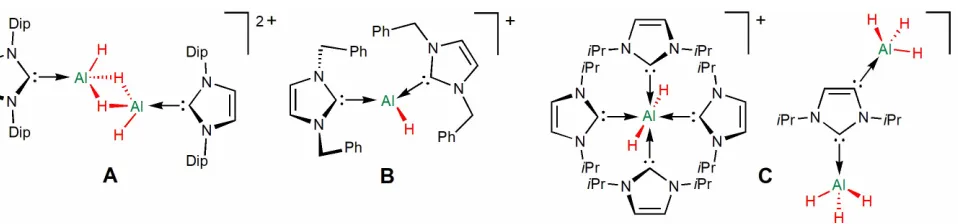
rare and reactive NHC-coordinated aluminium hydride cations has been obtained,15,16 see Figure 1, such as the dinuclear dicationic IDip example A, the monomeric example B with a
[image:3.595.66.545.405.517.2]three-coordinated AlH centre,15 and the ionic complex C containing both normal (e.g. imidazol-2-ylidene) and abnormal17 (e.g. imidazol-4-ylidene) NHC coordination in its anion.16
Figure 1. Cationic NHC-stabilised AlH complexes.
NHCAlH3 complexes have further been used to break down the stable ring system of some NHCs
via ring expansion and ring opening reactions.16,18,19 Given that many of the reactions that form reactive NHC-coordinated AlH cations or AlH-induced NHC breakdown products were achieved
with relatively small NHC ligands, we started a study to attempt the coordination of two sterically
demanding NHC ligands to one aluminium(III) centre bearing both hydride ligands and iodide
substituents as potential leaving groups.
Dalton
Transactions
Accepted
Manuscript
Published on 11 July 2018. Downloaded by University of St Andrews Library on 7/11/2018 2:34:00 PM.
View Article Online
Results and discussion
Synthesis of NHCAlH3-nIn (n = 1, 2) complexes
Several mixed aluminium hydride-halide complexes stabilized by NHC ligands have been reported
previously.20 These were for example obtained by treating NHCAlH3 complexes with halogenating
agents such as amine· HX (X = Cl, Br) or by using NHC ligands with 4,5-dihalogenated
imidazol-2-ylidene ligands. We were interested in the simple molecules NHCAlHxI3-x with NHC = IDip and
IMes, and x = 1 and 2, containing iodide ligands as good leaving groups. Therefore we reacted two
equivalents of [(IDip)AlH3] 211 with one equivalent of [(IDip)AlI3] 321 in toluene or benzene at
room temperature. The reaction was slow and only reached ca. 90% conversion after six days and
selectively formed the new complex [(IDip)AlH2I] 4. Alternatively, heating the reaction mixture for
24 h to 50 °C achieved a good yield of [(IDip)AlH2I] 4, see scheme 1. The reaction of one
equivalent of [(IDip)AlH3] 2 with two equivalent of [(IDip)AlI3] 3 was very slow, though heating
this mixture to 50 °C for two days led to full consumption of 2 and the formation of a mixture of
[(IDip)AlH2I] 4, [(IDip)AlHI2] 5 and [(IDip)AlI3] 3 in an approximate ratio of 4:5:3 ≈ 40:16:44.
Increasing the temperature to 80 °C shifted the composition of the mixture in favour of
[(IDip)AlHI2] 5 (ratio 4:5:3 ≈ 12:60:28), which remained largely unchanged when the temperature
was further risen to 100 °C. Similarly, using two equivalents of [(IMes)AlH3] 1 and one equivalent
of [(IMes)AlI3] 621 in an aromatic solvent at room temperature selectively afforded [(IMes)AlH2I] 7
after 5 h, scheme 1. The reaction of [(IMes)AlH3] 1 with ca. two equivalents of [(IMes)AlI3] 6
slowly formed a mixture of [(IMes)AlH2I] 7, [(IMes)AlHI2] 8 and [(IMes)AlI3] 6 at room
temperature that largely converted to [(IMes)AlHI2] 8 after heating for several hours to 50°C
though did not show a completely pure product as judged by 1H NMR spectroscopy. The syntheses of [(IDip)AlH2I] 4 and [(IMes)AlHI2] 7 could be translated to a facile preparation in excellent
isolated yield on a preparative scale using this method.
Scheme 1. Synthesis of [(IDip)AlH2I] 4 and [(IMes)AlHI2] 7.
Because this methodology has been convenient for the synthesis of [(IDip)AlH2I] 4 and
[(IMes)AlH2I] 7, though not for pure samples of [(IDip)AlHI2] 5 and [(IMes)AlHI2] 8, we tested
Dalton
Transactions
Accepted
Manuscript
Published on 11 July 2018. Downloaded by University of St Andrews Library on 7/11/2018 2:34:00 PM.
View Article Online
reactions of a halogenating agent, MeI, with [(IDip)AlH3] 2 and [(IMes)AlH3] 1, respectively. The
addition of five equivalents of MeI to 2 in deuterated benzene at room temperature revealed full
consumption of the starting material and formation of a mixture of [(IDip)AlH2I] 4, [(IDip)AlHI2] 5
(ratio 4:5 ≈ 85:15) immediately after addition as judged by 1H NMR spectroscopy, see Figure 2. After 30 h, mainly the formation of [(IDip)AlHI2] 5 is evident (Figure 2), see scheme 2. After
longer reaction times, more [(IDip)AlI3] 3 was slowly formed. All products [(IDip)AlH2I] 4,
[(IDip)AlHI2] 5 and [(IDip)AlI3] 3 can be observed at different stages of the reaction, see Figure 1.
On a preparative scale, the reaction of [(IDip)AlH3] 2 with five equivalents of methyl iodide in
toluene for 37 h followed by removal of all volatiles afforded the desired [(IDip)AlHI2] 5 in good
purity. Analogously, [(IMes)AlHI2] 8 was prepared from [(IMes)AlH3] 1 with five equivalents of
methyl iodide in toluene after 6 h, see scheme 2. As part of this wider study, the molecular structure
of [(IDip)Al(Ph)I2] was determined and is included in the ESI (Figure S4).
Figure 2. 1H NMR spectra (400 MHz, in deuterated benzene, excerpt) of the reaction of [(IDip)AlH3] 2 with five equivalents of MeI at room temperature showing the region of the
Dip-isopropyl methyl groups. The singlet at ca. 1.43 ppm is due to methyliodide.
Scheme 2. Synthesis of [(IDip)AlHI2] 5 and [(IMes)AlHI2] 8.
Dalton
Transactions
Accepted
Manuscript
Published on 11 July 2018. Downloaded by University of St Andrews Library on 7/11/2018 2:34:00 PM.
View Article Online
[image:5.595.93.501.301.590.2]All complexes [(IDip)AlH2I] 4, [(IDip)AlHI2] 5, [(IMes)AlH2I] 7, and [(IMes)AlHI2] 8, show
resonances for a highly symmetric ligand environment in their 1H NMR and 13C{1H} NMR spectra comparable to those of their parent NHCAlH3 and NHCAlI3 compounds.10,11,21 1H NMR spectra of
isolated IDip derivatives 4 and 5 show that the complexes are stable when heated to 80°C overnight
whereas those of IMes, 7 and 8 are initially stable at 80°C though slowly form some decomposition
products that are not simple dismutation complexes from H/I scrambling. IR spectra of these
complexes show two bands (1807 cm-1 with shoulder at ca. 1830 cm-1 for 4, and 1846 and 1802 cm
-1
for 7) for those of type NHCAlH2I and one band (one band with two sharp maxima of 1884,
1869 cm-1 for 5, which may be due to differently oriented hydride ligands in the solid state, and 1869 cm-1 for 8) for those of NHCAlHI2; the former examples having lower wavenumbers. These
values compare well with Al-H stretches from related examples, e.g. 1798 cm-1 for [(IMes)AlH2Cl],
1851 cm-1 for [(IMes)AlHCl2], and 1888 cm-1 for [(IMes)AlHBr2].20
Reactivity of NHCAlX3 (X = H, I) complexes with an additional NHC ligand
We were interested in the possibility of coordinating two sterically demanding NHC ligands such as
IDip or IMes to one aluminium(III) centre. We have chosen a combination of small ligands
(hydrides) and good leaving groups (iodides) for our study. Thus, we first treated [(IDip)AlH3] 2
with a further equivalent of IDip in deuterated benzene, see Figure 3. The 1H NMR spectrum of this mixture, and for other ratios of 2 and IDip, shows resonances for one single NHC environment in
solution, with a general broadening and shifting of the ligand resonances. This can be attributed to a
ligand exchange equilibrium in solution, likely between both starting materials via an associated
intermediate, possibly the pentacoordinated species [(IDip)2AlH3], see scheme 3. Single crystals
obtained from this mixture were recovered [(IDip)AlH3] 2. An equilibrium via significant quantities
of free AlH3 is unlikely in our view due to the high thermal stability of [(IDip)AlH3] 2 in solution
and the solid state (decomposition around 230°C), and the fact that "free" AlH3 would likely rapidly
decompose to aluminium metal and hydrogen.13 For further insight into this equilibrium, variable temperature 1H NMR spectroscopic experiments were performed on a 1:1 mixture of 2 and IDip in deuterated toluene (Figure S1). A single set of resonances for the IDip moieties was detected when
cooling from room temperature that is broadened at 263 K and splits at an approximate coalescence
temperature (Tc) of 245-250 K corresponding to an estimated ∆G≠≈ 12 kcal/mol for this process. At
lower temperatures, two sets of resonances for 2 and IDip were observed. A similar solution
equilibrium can be observed for [(IMes)AlH3] 1 and IMes showing one set of ligand resonances
only at room temperature (Figure S2). This shows that routine 1H NMR spectra are not sufficient to ascertain the purity of [(IMes)AlH3] 1 and [(IDip)AlH3] 2 with respect to excess of the free NHC
ligand, especially since the AlH resonances are extremely broad and may not reliably integrate with
Dalton
Transactions
Accepted
Manuscript
Published on 11 July 2018. Downloaded by University of St Andrews Library on 7/11/2018 2:34:00 PM.
View Article Online
sufficient accuracy. We studied systems with mixed NHC ligands and the reaction of [(IDip)AlH3]
2 with one equivalent of IMes rapidly forms [(IMes)AlH3] 1 and IDip at room temperature.
Accordingly, no significant conversion is observed when [(IMes)AlH3] 1 is treated with one
equivalent of IDip demonstrating the driving force to the carbene adduct of the least sterically
hindered ligand.
Figure 3. 1H NMR spectra (400 MHz, in deuterated benzene) of a) (top) [(IDip)AlH3] 2; b)
(middle) IDip; c), (bottom) [(IDip)AlH3] 2 and IDip.
Scheme 3. Proposed equilibrium between [(IMes)AlH3] 1 and IMes, and [(IDip)AlH3] 2 and IDip.
When the iodide derivatives [(IDip)AlH2I] 4 and [(IDip)AlHI2] 5 were reacted with an additional
equivalent of IDip, respectively, new species were formed and crystallised from the reaction
mixtures. Complete consumption of the starting materials was detected when samples were heated
Dalton
Transactions
Accepted
Manuscript
Published on 11 July 2018. Downloaded by University of St Andrews Library on 7/11/2018 2:34:00 PM.
View Article Online
[image:7.595.117.483.551.682.2]for 16 h at 85 °C. The new complexes formed as colourless crystals at elevated temperatures that
hinted at their ionic and insoluble nature. Single crystal X-ray diffraction revealed the products to
be [(IDip)AlH2(aIDip)]I 9 (from 4) and [(IDip)AlHI(aIDip)]I 10 (from 5), respectively, where
aIDip is the abnormal tautomer of IDip bound in 4-position, i.e.
1,3-bis(2,6-diisopropylphenyl)imidazol-4-ylidene, see Scheme 4 and Figure 4. In one instance, a crystal of
[(IDip)AlI2(aIDip)]I 11, that contained approximately 25% [(IDip)AlHI(aIDip)]I 10 as judged by
the disorder model of one iodide position in the complex was obtained from a reaction of
[(IDip)AlHI2] 5 and IDip that gave 10, see Figure 4. We consequently performed the reaction of
[(IDip)AlI3] 3 and IDip but no reaction was observed with no evidence for the formation or
precipitation of [(IDip)AlI2(aIDip)]I 11 or another product, even when heated at 100 °C for 16 h,
see Figure S4. These experiments also showed that no fluxional equilibrium between [(IDip)AlI3] 3
and IDip is observable at room temperature, unlike for the mixture of [(IDip)AlH3] 2 and IDip
(Scheme 3). Even at 105°C (378 K) in deuterated toluene, a mixture of [(IDip)AlI3] 3 and IDip
shows separate sets of resonances that suggest that a similar equilibrium to that of [(IDip)AlH3] 2
and IDip (Scheme 3) would require an activation barrier in excess of 18 kcal/mol. 1
H-1
H NOESY NMR experiments carried out at 378 K in deuterated toluene did indicate a very slow
IDip ligand exchange rate only. Consequently it is likely that the isolated small amount of
[(IDip)AlI2(aIDip)]I 11 was not formed from an [(IDip)AlI3] 3 impurity in [(IDip)AlHI2] 5 during
the synthesis of 10, but likely from ligand exchange processes or an Al-H iodination reaction on
solubilised [(IDip)AlHI(aIDip)]I 10 to 11 before it precipitated. Longer reaction times of
[(IDip)AlI3] 3 and IDip at around 100°C in deuterated benzene or toluene did afford small
resonances in 1H NMR spectra that suggest some conversion to an IDipH+ or aIDip-species after about four days. Longer reaction times gave rise to resonances of further by-products in low
concentrations and small quantities of insoluble products.
Scheme 4. Synthesis of [(IDip)AlH2(aIDip)]I 9 and [(IDip)AlHI(aIDip)]I 10.
Dalton
Transactions
Accepted
Manuscript
Published on 11 July 2018. Downloaded by University of St Andrews Library on 7/11/2018 2:34:00 PM.
View Article Online
Figure 4. Molecular structures (25% thermal ellipsoid) of [(IDip)AlH2(aIDip)]I 9, (left)
[(IDip)AlHI(aIDip)]I·C6H6 10·C6H6 (centre) and [(IDip)AlIX(aIDip)]I· 2 C6H6 (X ≈ 75% I, 25%
H), 110.75·100.25·2 C6H6 (right). Only Al-H, except the minor proportion of 10 in
110.75·100.25·2 C6H6, and NHC ring hydrogen atoms shown for clarity. Solvent molecules and minor
disordered parts in 110.75·100.25·2 C6H6 not shown.
Table 1. Selected bond distances (Å) and angles (°) for complexes 9-11.
9 10 11
C1-Al1 2.051(2) 2.031(13) 2.067(4)
C28-Al1 2.012(2) 1.998(13) 1.992(4)
Al1-X 1.54(2) (H1)
1.56(2) (H2)
2.577(4) (I1)
1.55(2) (H1)
2.5570(13) (I1)
2.4964(13) (I2)
C1-Al1-C28 114.24(8) 119.2(5) 116.40(16)
The salts [(IDip)AlH2(aIDip)]I 9, [(IDip)AlHI(aIDip)]I·C6H6 10·C6H6 and
[(IDip)AlIX(aIDip)]I·2 C6H6 (X ≈ 75% I, 25% H), 110.75·100.25·2 C6H6, crystallized with a full
formula unit in the asymmetric unit, are depicted in Figure 4 and selected metrical data is given in
Table 1. In 9-11, each salt contains a [(IDip)AlX2(aIDip)]+ cation, with X being H and/or I, which
have a central, distorted tetrahedral AlIII centre, balanced by an iodide counter anion. The IDip and
aIDip heterocyclic planes in 9 having the least steric crowding around the Al centre are nearly
co-planar and are slightly more twisted in 10 and 11. The iodide counter anion shows an interaction to
the N2CH hydrogen of the aIDip ligand in the solid state of 9-11. A short H···Dipcentroid contact with
a distance of ca. 2.24 Å in 9 is found for the H in the 5-position of the aIDip ligand to a Dip group
from the IDip ligand. The Al-C distances are as expected slightly shorter (by ca. 5 pm for the mean
values) for the abnormal NHC Al-C(28) coordination compared with the normal NHC Al-C(1)
coordination bond. This is not surprising given that remote and abnormal NHCs are even stronger
donor ligands than popular imidazol-2-ylidenes and that abnormal NHC ligands show a smaller
steric profile.1,15 The Al-C distances for the normal and abnormal NHC bonds reflect those of other
Dalton
Transactions
Accepted
Manuscript
Published on 11 July 2018. Downloaded by University of St Andrews Library on 7/11/2018 2:34:00 PM.
View Article Online
[image:9.595.61.549.64.187.2]structurally determined complexes, for example Al-C(NHC) of 2.048(3) Å and Al-C (aNHC) of
2.006(3) Å in the anion of C.16 A series of aluminium complexes with abnormal NHC-ligand coordination3,17,19,22 have been studied in recent years that show comparable features to compounds
9-11.
Once crystallized, complexes [(IDip)AlH2(aIDip)]I 9 and [(IDip)AlHI(aIDip)]I 10 do not
show any significant solubility in aromatic solvents or THF. Due to their reactive Al-H moieties,
the range of polar NMR solvents is very limited and hence no solution state NMR spectra could be
recorded. In-situ reactions also showed no strong resonances that could be attributed to 9 or 10. The
complexes show Al-H stretching bands in their IR spectra (1827 and 1811 cm-1 for 9, and 1867 cm-1 for 10) that are comparable to those of the other hydride-iodide compounds with four-coordinate Al
centres, i.e. 4, 5, 7 and 8. NHC-stabilized AlH cation B shows an even higher wavenumber for the
Al-H stretch (1963 cm-1) due to its three-coordinate Al centre.15 The cation of 9, [(IDip)AlH2(aIDip)]+, was detected by mass spectrometry.
A related set of experiments was conducted between [(IMes)AlH2I] 7 and [(IMes)AlHI2] 8
with IMes, respectively. The solubilities of [(IMes)AlH2I] 7 and [(IMes)AlHI2] 8 are markedly
lower than those of the related IDip complexes which impeded solution studies. These reactions
produced an insoluble precipitate at room temperature when 7 was used. An IR spectrum of the
residue shows weak bands at around 2000 cm-1 though no comparable stretches to the Al-H bonds of IDip derivative 9. A reaction between [(IMes)AlHI2] 8 and IMes slowly proceeds at 80°C with
some initial broadening and the formation of a product mixture including an IMesAl-complex with
symmetric IMes resonances, possibly [(IMes)AlI3] 6, and some insoluble products.
Abnormal NHC-Al complexes have been found to be slightly lower in energy than directly
comparable normal NHC-Al complexes for the sterically demanding NHC, ItBu =
1,3-di-tert-butylimidazol-2-ylidene.22c A series of [(aItBu)MX3] (M = Al, Ga, In; X = Me, iBu, Cl) were
formed from the free normal NHC ItBu and the Lewis-acidic formal three-coordinate MX3
precursor and a related study formed [(aIDip)GaR3] (R = CH2SiMe3, Cl) and related species.23 Fast
and reversible H-exchange processes were suggested to play a role in the isomerisation
mechanism.22a
Mechanistically, overall nucleophilic substitution of a neutral aIDip ligand for an iodide
ligand, e.g. via a short-lived five-coordinated intermediate (c.f. the equilibria observed for
[(IDip)AlH3] 2 with IDip, scheme 3) or via short-lived [(IDip)AlX2]+ (X = H, I) cations, is possible.
The formation of normal-abnormal NHC complexes 9-11 is believed to occur due to steric reasons
with the coordination of two normal IDip molecules to AlIII not resulting in strong metal-ligand interactions. Low concentrations of an abnormal carbene (aIDip) could be accessible in solution
and form a stable product with an Al-C(aIDip) interaction. Alternatively, complexes [(IDip)AlX3]
Dalton
Transactions
Accepted
Manuscript
Published on 11 July 2018. Downloaded by University of St Andrews Library on 7/11/2018 2:34:00 PM.
View Article Online
(X = H, I) could rearrange in solution in an equilibrium to a small and non-observed proportion of
the abnormal NHC complexes [(aIDip)AlX3] (X = H, I),22 which allows the approach of free IDip
either after iodide elimination, i.e. on [(aIDip)AlX2]+, or in a substitution reaction via an associative
mechanism with a short-lived five-coordinate intermediate to 9 and 10. The precipitation of
products 9 and 10 formed in equilibria in solution provide a further driving force for their isolation.
The related cationic system [(IDip)2ZnMe]+ rearranges to the more thermodynamically
stable, and less sterically congested species [(IDip)ZnMe(aIDip)]+ in the presence of THF or IDip.24 The mechanism for this reaction is suggested to involve deprotonation of a hydrogen in the
4-position of an IDip ligand in [(IDip)2ZnMe]+ by free IDip. Cationic examples related to 9-11 from
main group chemistry include the tin(II) complex [(IDip)SnX(aIDip)]OTf (X = Cl, OTf; -OTf = triflate), formed from Sn(OTf)2 and two equivalents of IDip,25 and the group 15 complexes
[(IDip)SbF2(aIDip)][SbF4],26 [(aIDip)2SbBr2]Br and closely related species.27 Similar mechanistic
arguments to those for the Zn systems24 were made for the formation of these abnormal NHC complexes including the deprotonation of the hydrogen in the 4-position of IDip-complexes by the
free base IDip.25-27 1H NMR spectra on some tin and antimony complexes in THF-d8 revealed the
formation of IDipH+ from decomposition reactions.25,26
Mechanistic considerations as discussed above highlight the most likely pathways to 9 and
10 though do not unequivocally explain why the reaction of [(IDip)AlI3] 4 and IDip to give
[(IDip)AlI2(aIDip)]I 11 is significantly suppressed, especially when an outer Al-IDip deprotonation
or Al-IDip isomerisation would be involved. Also, both H and I ligands appear to be required for a
facile reaction which could be explained by a reductive elimination/oxidative addition28 mechanism. The reductive elimination of HI from [(IDip)AlH2I] 4 and [(IDip)AlHI2] 5 by the relatively strong
base IDip could potentially form the imidazolium salt IDipH+I-. The latter was not observed in solution state in-situ NMR spectra, however, small concentrations can’t be ruled out. Its presence
would also be explained by an IDip deprotonation mechanism. A reductive elimination could result
in a short-lived low oxidation state intermediate such as (IDip)AlIX (X = H or I), or an oligomer, that subsequently CH activates IDipH+I- again and for steric reasons forms an abnormal IDip product. NHC-stabilised low oxidation state aluminium complexes are highly reactive species and
examples have been predicted from quantum chemical calculations, proposed as reactive
intermediates and few examples were isolated.4-7 Furthermore, reversible σ-bond metathesis between AlIII/AlI species via reductive elimination and oxidative addition steps are known in a similar temperature range, for example between LAlI (L = HC(MeCNDip)2 or Cp* = C5Me5) and
Cp*H to LAlIII(H)(Cp*).29 The reaction of an anionic gallium(I) carbene analogue with IMesH+Cl -afforded an oxidative addition product featuring an (IMes)GaIIIH fragment.30 These studies show that the reaction steps are feasible. The insoluble nature of salts 9-10 precluded further solution state
Dalton
Transactions
Accepted
Manuscript
Published on 11 July 2018. Downloaded by University of St Andrews Library on 7/11/2018 2:34:00 PM.
View Article Online
studies with these compounds. The possibility that an AlH moiety acts as a base during the reaction
to deprotonate an IDip ligand in the 4-position, c.f. the anion of C, and is thus required for the
reaction has been considered. In this case H2 would be a by-product and no traces for a H2
resonance were observed in in-situ 1H NMR spectra for reactions producing 9 and 10. The fact that [(IDip)AlH3] 2 and IDip exchange their ligands rapidly at temperatures below 0°C whereas the
same exchange is suppressed for [(IDip)AlI3] 4 and IDip at temperatures above 100°C may hint at
an alternative mechanism that requires coordination of a second IDip ligand to aluminium which
becomes increasingly difficult with more coordinated iodide ligands.
Conclusions
We have prepared the complexes [(IDip)AlH2I] 4, [(IDip)AlH2I] 5, [(IMes)AlH2I] 7, and
[(IMes)AlH2I] 8, either via a ligand scrambling approach from appropriate quantities of NHCAlH3
with NHCAlI3 which was preferable for the formation of the monoiodides 4 and 7, or via iodination
of NHCAlH3 with an excess of methyl iodide to the diiodides 5 and 8. Reactions of NHCAlX3 (X =
H, I) with one equivalent of NHC showed a reversible fluxional, dynamic behaviour for X = H, no
reaction for X = I (NHC = IDip), or formed the new normal-abnormal NHC complexes
[(IDip)AlH2(aIDip)]I 9 and [(IDip)AlHI(aIDip)]I 10, when 4 and 5 are used, respectively. The
complexes 9, 10 and [(IDip)AlIX(aIDip)]I (X ≈ 75% I, 25% H), 110.75·100.25, were structurally
characterized and show slightly shorter Al–C(aIDip) distances than Al–C(IDip) distances. The
mixed normal abnormal IDip coordination to aluminium in 9-11 is believed to occur for steric
reasons. Complex 11 could not be prepared from [(IDip)AlI3] 3 and IDip under forcing conditions
suggesting that mixed hydride and iodide on one Al centre are required for this reaction.
Nucleophilic substitution and reductive elimination/oxidative addition mechanisms have been
discussed for the formation of 9 and 10.
Conflicts of interest
There are no conflicts to declare.
Acknowledgements
We thank the University of St Andrews and the EPSRC UK National Mass Spectrometry Facility
(NMSF) at Swansea University.
Dalton
Transactions
Accepted
Manuscript
Published on 11 July 2018. Downloaded by University of St Andrews Library on 7/11/2018 2:34:00 PM.
View Article Online
References
1 (a) M. N. Hopkinson, C. Richter, M. Schedler and F. Glorius, Nature, 2014, 510, 485–496;
(b) T. Dröge and F. Glorius, Angew. Chem. Int. Ed., 2010, 49, 6940–6952.
2 (a) Y. Wang and G. H. Robinson, Inorg. Chem., 2014, 53, 11815−11832; (b) C. D. Martin,
M. Soleilhavoup and G. Bertrand, Chem. Sci., 2013, 4, 3020–3030; (c) D. J. D. Wilson and
J. L. Dutton, Chem. Eur. J. 2013, 19, 13626–13637; (d) Y. Wang and G. H. Robinson,
Inorg. Chem., 2011, 50, 12326–12337.
3 C. Fliedel, G. Schnee, T. Avilés and S. Dagorne, Coord. Chem. Rev., 2014, 275, 63–86.
4 S. J. Bonyhady, D. Collis, G. Frenking, N. Holzmann, C. Jones and A. Stasch, Nat. Chem.,
2010, 2, 865−869.
5 G. Tan, T. Szilvási, S. Inoue, B. Blom, and M. Driess, J. Am. Chem. Soc., 2014, 136,
9732−9742.
6 P. Bag, A. Porzelt, P. J. Altmann and S. Inoue, J. Am. Chem. Soc., 2017, 139, 14384−14387.
7 (a) N. Holzmann, A. Stasch, C. Jones and G. Frenking, Chem. Eur. J., 2013, 19, 6467–6479;
(b) N. Holzmann, A. Stasch, C. Jones and G. Frenking, Chem. Eur. J., 2011, 17, 13517–
13525.
8 S. Aldridge and A. J. Downs, Chem. Rev., 2001, 101, 3305−3365.
9 W. Li, X. Ma, M. G. Walawalkar, Z. Yang and H. W. Roesky, Coord. Chem. Rev., 2017,
350, 14−29.
10 A. J. Arduengo, III, H. V. R. Dias, J. C. Calabrese and Fredric Davidson, J. Am. Chem. Soc.,
1992, 114, 9724−9725.
11 R. J. Baker, A. J. Davies, C. Jones and M. Kloth, J. Organomet. Chem., 2002, 656,
203−210.
12 (a) J. A. B. Abdalla, I. M. Riddlestone, J. Turner, P. A. Kaufman, R. Tirfoin, N. Phillips, and
S. Aldridge, Chem. Eur. J., 2014, 20, 17624–17634; (b) J. A. B. Abdalla, I. M. Riddlestone,
R. Tirfoin, N. Phillips, J. I. Bates and S. Aldridge, Chem. Commun., 2013, 49, 5547−5549.
13 (a) T. D. Humphries, K. T. Munroe, A. Decken and G. S. McGrady, Dalton Trans., 2013,
42, 6953-6964; (b) M. Gardiner and C. L. Raston, Coord. Chem. Rev., 1997, 166, 1−34; (c)
C. Jones, G. A. Koutsantonis and C. L. Raston, Polyhedron, 1993, 12, 1829−1848.
14 (a) M. D. Francis, D. E. Hibbs, M. B. Hursthouse, C. Jones and Neil A. Smithies, J. Chem.
Soc., Dalton Trans., 1998, 3249–3254; (b) R. J. Baker, M. L. Cole, C. Jones and M. F.
Mahon, J. Chem. Soc., Dalton Trans., 2002, 1992−1996.
15 L. L. Cao, E. Daley, T. C. Johnstone and D. W. Stephan, Chem. Commun., 2016, 52,
5305−5307.
Dalton
Transactions
Accepted
Manuscript
Published on 11 July 2018. Downloaded by University of St Andrews Library on 7/11/2018 2:34:00 PM.
View Article Online
16 H. Schneider, A. Hock, R. Bertermann and U. Radius, Chem. Eur. J., 2017, 23,
12387−12398.
17 (a) M. Uzelac and E. Hevia, Chem. Commun., 2018, 54, 2455−2462; (b) R. H. Crabtree,
Coord. Chem. Rev., 2013, 257, 755−766; (c) O. Schuster, L. Yang, H. G. Raubenheimer and
M. Albrecht, Chem. Rev., 2009, 109, 3445−3478; (d) P. L. Arnold and S. Pears, Coord.
Chem. Rev., 2007, 251, 596−609.
18 (a) S. Würtemberger-Pietsch, U. Radius and T. B. Marder, Dalton Trans., 2016, 45, 5880–
5895; (b) K. J. Iversen, D. J. D. Wilson and J. L. Dutton, Dalton Trans., 2014, 43, 12820–
12823.
19 M. D. Anker, A. L. Colebatch, K. J. Iversen, D. J. D. Wilson, J. L. Dutton, L. García, M. S.
Hill, D. J. Liptrot, and M. F. Mahon, Organometallics, 2017, 36, 1173−1178.
20 (a) S. G. Alexander, M. L. Cole and C. M. Forsyth, Chem. Eur. J., 2009, 15, 9201−9214; (b)
S. G. Alexander, M. L. Cole, S. K. Furfari and M. Kloth, Dalton Trans., 2009, 2909−2911;
(c) S. G. Alexander, M. L. Cole, M. Hilder, J. C. Morris and J. B. Patrick, Dalton Trans.,
2008, 6361−6363.
21 R. S. Ghadwal, H. W. Roesky, R. Herbst-Irmer and P. G. Jones Z. Anorg. Allg. Chem., 2009,
635, 431−433.
22 (a) G. Schnee, O. N. Faza, D. Specklin, B. Jacques, L. Karmazin, R. Welter, C. Silva López
and S. Dagorne, Chem. Eur. J., 2015, 21, 17959−17972; (b) T. K. Sen, S. C. Sau, A.
Mukherjee, P. K. Hota, S. K. Mandal, B. Maity and D. Koley, Dalton Trans., 2013, 42,
14253−14260; (c) A.-L. Schmitt, G. Schnee, R. Welter and S. Dagorne, Chem. Commun.,
2010, 46, 2480–2482; (d) Y. Wang, Y. Xie, M. Y. Abraham, P. Wei, H. F. Schaefer III, P. v.
R. Schleyer and G. H. Robinson, J. Am. Chem. Soc., 2010, 132, 14370–14372;
23 (a) M. Balmer, M. Kapitein and C. von Hänisch, Dalton Trans., 2017, 46, 7074−7081; (b)
M. Uzelac, A. R. Kennedy, A. Hernán-Gómez, M. Á. Fuentes and E. Hevia, Z. Anorg. Allg.
Chem., 2016, 642, 1241−1244; (c) M. Uzelac, A. Hernán-Gómez, D. R. Armstrong, A. R.
Kennedy and E. Hevia, Chem. Sci., 2015, 6, 5719−5728; (d) M. Chen, Y. Wang, R. J.
Gilliard, Jr., P. Wei, N. A. Schwartz and G. H. Robinson, Dalton Trans., 2014, 43,
14211−14214.
24 D. Specklin, C. Fliedel, C. Gourlaouen, J.-C. Bruyere, T. Avilés, C. Boudon, L. Ruhlmann,
and S. Dagorne, Chem. Eur. J., 2017, 23, 5509–5519.
25 R. S. P. Turbervill and J. M. Goicoechea, Aust. J. Chem., 2013, 66, 1131−1137.
26 B. Alič, A. Štefančiča, and G. Tavčar, Dalton Trans., 2017, 46, 3338–3346.
27 J. B. Waters, Q. Chen, T. A. Everitt and J. M. Goicoechea, Dalton Trans., 2017, 46,
12053−12066.
Dalton
Transactions
Accepted
Manuscript
Published on 11 July 2018. Downloaded by University of St Andrews Library on 7/11/2018 2:34:00 PM.
View Article Online
28 T. Chu and G. I. Nikonov, Chem. Rev., 2018, 118, 3608−3680.
29 (a) S. J. Urwin, D. M. Rogers, G. S. Nichol and M. J. Cowley, Dalton Trans., 2016, 45,
13695−13699; (b) C. Ganesamoorthy, S. Loerke, C. Gemel, P. Jerabek, M. Winter, G.
Frenking and R. A. Fischer, Chem. Commun., 2013, 49, 2858−2860; (c) T. Chu, I. Korobkov
and G. I. Nikonov, J. Am. Chem. Soc., 2014, 136, 9195−9202.
30 C. Jones, D. P. Mills and R. P. Rose, J. Organomet. Chem., 2006, 691, 3060−3064.
Dalton
Transactions
Accepted
Manuscript
Published on 11 July 2018. Downloaded by University of St Andrews Library on 7/11/2018 2:34:00 PM.
View Article Online
TOC entry:
Sterically demanding NHC aluminium hydride iodide complexes react with one equivalent of NHC
to cationic mixed normal-abnormal NHC AlIII complexes.
Dalton
Transactions
Accepted
Manuscript
Published on 11 July 2018. Downloaded by University of St Andrews Library on 7/11/2018 2:34:00 PM.
View Article Online

![Figure 3. 1H NMR spectra (400 MHz, in deuterated benzene) of a) (top) [(IDip)AlH3] 2; b)](https://thumb-us.123doks.com/thumbv2/123dok_us/8982482.394142/7.595.117.483.551.682/figure-nmr-spectra-mhz-deuterated-benzene-idip-alh.webp)
![Figure 4. Molecular structures (25% thermal ellipsoid) of [(IDip)AlH2(aIDip)]I 9, (left)](https://thumb-us.123doks.com/thumbv2/123dok_us/8982482.394142/9.595.61.549.64.187/figure-molecular-structures-thermal-ellipsoid-idip-alh-aidip.webp)
