LINKED INHERITANCE OF CERTAIN CHARACTERS I N THE ADZUKI BEAN
Y ~ I C H I KAKIZAKI
Saitama Agricultural Experiment Station, Urawa, Saitama, Japan
Received December 26, 1922
TABLE O F CONTENTS
INTRODUCTION. . . . ... 168
Material and methods..
.
...
168Results of experiments.. . . . 169
DISCUSSION. ... ... 174
S W M A R Y ... 177
LITERATFRE CITED.. ... 177 INTRODUCTION
Many authors working with numerous species of plants and animals, have made it increasingly evident that the various hereditary character- istics of organisms and their determiners or factors are inherited in more or less closely linked groups, and not independently, as was supposed in the early Mendelian studies, these linkage groups being held together, perhaps, by chromosomes. I n the present paper the author intends to report an instance of the same phenomenon in his crossing experiments with the Adzuki bean, Phaseolus chrysanthos Sav.,l in which three dis- ti ct characters are considered.
%he author is much indebted to Dr. H. TERAO of the IMPERIAL AGRI- CULTURAL EXPERIMENT STATION, TBkyB, for his helpful suggestions through the whole course of this research.
MATERIAL AND METHODS
The Adzuki bean has an advantage for breeding experiments in the fact that, because of the arrangement of the floral organs, self-pollination takes place automatically before blooming. Although, in fact, the experi- ments were made largely through natural pollinations, the results ob-
The Adzuki bean often has other scientific names, as Phaseolus Mungo L. var. subtrilobata,
P. radiatus L. var. aureus Prain, and P. angularis. P. chrysanthos Sav. has been offered as the
correct one by T. NAKAI (Bot. Mag., TBky8, 33: 264, Oct., 1919).
LINKED INHERITANCE IN THE ADZUKI BEAN 169 tained were always parallel to those from the experiments
in
which flowers were artificially protected from accidental natural crossing. There was no apparent sterilityin
regard either to the formation of germ cells or the germination of seeds.The varieties Miyako and Donsu were chosen for crossing, as these two varieties exhibited very clear distinctions in several characters. I n August 1912, two individuals were selected, one from Miyako and the other from Donsu, each being assumed to be representative of its variety. These were cross-pollinated artificially, Miyako being used as the female parent.
The cross-bred seeds were sown in the spring of 1913, and gave four F1 plants. From one of these plants, taken at random, an F? family was grown in 1914 and a number of Fa families in 1915. Each year
a
certain number of plants of the two parental strains were also grown for compari- son. Both in the hybrids and the parental strains, the individual plants reserved for the next generation had some flowers enclosed in paper bags in order to prevent accidental natural crossing, the remaining flowers being allowed to bloom naturally.The characters dealt with in the present experiments are limited to the color of stems, the black-spotting of seed-coats, and the color of ripe pods, Miyako having green stems, brown seed-pods and unspotted red seed-coats, while Donsu has light reddish-purple stems, blackish-brown seed-pods, and seed-coats intensely black-spotted on red ground-color.
I n distinguishing different types of stem colors special caution was required, because the intensity of stem colors in certain strains changes according to the stage of development. For grouping individuals in this regard, correctly, the inspection of all plants should be made at the same stage of development, and when the several types are most distinct. The ideal time for this classification was found to be five to seven days after germination of the seeds. Errors rarely occur when the grouping is made a t this stage.
RESULTS OF EXPERIMENTS
Fifty plants from selfed seeds of each parental variety were raised in each of three succeeding generations, and both varieties had bred true to the characters described above and indeed for almost all visible charac- ters.
The four F1 plants were uniform, all showing reddish-purple color in the stems, black-spotting on red seed-coats, and blackish-brown color in ripe pods, thus showing these characters to be dominant over their
170 YOICHI KAKIZAKI
recessive allelomorphs, green stems, unspotted seeds and brown pods. The color of stems was much darker, however, and the spotting on seed- coats was distinctly less intense than in the male parent.
The characters appearing in Fz are distinguished with respect to the color of stems, the black-spotting of seed-coats, and the color of ripe pods, respectively, as follows:
(a) Color of stems:*
1. Dark reddish-purple (the
F1
type) ;2. Light reddish-purple (the male parent type);
3. Green (the female parent type).
1. More intensely black-spotted (the male parent type); 2. Less intensely black-spotted (the Fl type);
3 . Unspotted (the female parent type). 1. Blackish-brown (the male parent type) ;
2. Brown (the female parent type). (b) Black-spotting of seed-coats:
(c) Color of ripe pods:
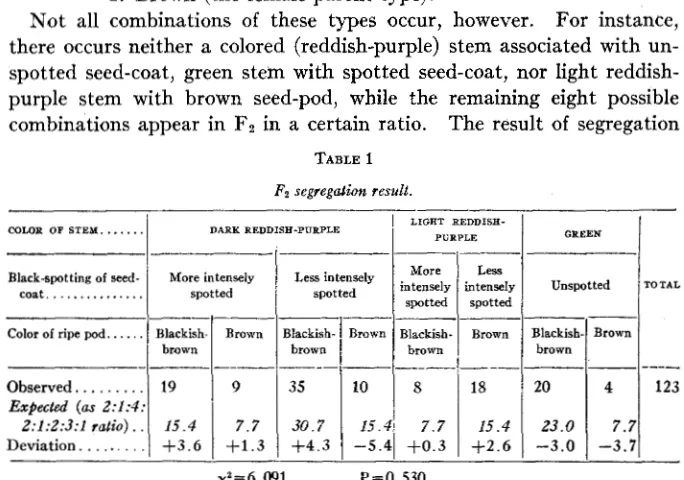
Mot all combinations of these types occur, however. For instance, there occurs neither a colored (reddish-purple) stem associated with un- spotted seed-coat, green stem with spotted seed-coat, nor light reddish- purple stem with brown seed-pod, while the remaining eight possible combinations appear in Fz in a certain ratio. The result of segregation
TABLE 1
F2 segregation result.
____
C O l o R OF STEM.. ...
i
DARK REDDISH-PURPLE I1
LIGHT REnnIsH- PURPLEBlack-spotting of seed- More intensely coat. ... spotted
-l
Color of ripe pod. Blackish-
__-
...
brawn
~ " _ _ -"
Observed.. . . .
Exfiected (as2:1:4:
19
+ 3 . 6 Deviation. . . .
15.4 2:1:2:3:1 ratio). .
_ _
Brown
9
7 . 7 +1.3
l- Less intensely More
spotted intensely spotted
Blackish- Brown Blackish- brown brown
"" .~
35 10 8
30.7 15.4 7.7
+ 4 . 3 -5.4 +0.3 "
1
"
"
_ _
LeSS ntensely spotted
Brown
___
" " 18
1 5 . 4
+ 2 . 6
x2=6.091 P = 0 . 5 3 0
GREEN
"l
Unspotted TOTAL"
-Blackish- Brown brown
20 4 123 " _ _ ----
23.0
-3.7 - 3 . 0
7 . 7
* In the dark reddish-purple color of stems the individual differences in intensity were too large to be considered as environmental effects. In the light reddish-purple sterns also some comparatively lighter ones existed. But these have not been classified in the experiments, be-
LINKED INHERITANCE I N THE ADZUKI BEAN 1 7 1
in the Fz is shown in table 1. The observed numbers of individuals are near enough to the expected numbers that the departures may be reason- ably attributed to errors of random sampling. The
F1
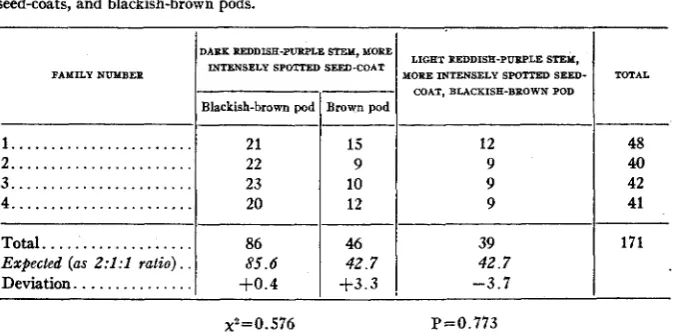
results are sum- marized in table 2. The deviations of the observed numbers from the expected, in all kinds of families, are very slight and values of P calculatedby PEARSON'S method are all high enough. Of the families which have
been summarized in table 2(G), two kinds are expected, one constant and the other segregating in the color of ripe pods, with the ratio of families 1 : 2 or with the numbers two and four. The actual numbers obtained, as shown in the table, were one constant family and five segregating families, with the deviation
5
1. The number of families is too small to give sig- nificance to this deviation. All the segregation ratios expected in Fzand F3 were actually observed.
t
TABLE 2
Fa segregation results.
(A) The F8progenies of the F2 plants with dark reddish-purple stems, more intensely spotted
seed-coats, and blackish-brown pods.
DAXK REDDISH-PURPLE STEH, MORE INTENSELY SPOTTED SEED-COAT XAMILY NUldBEP
Blackish-brawn pod Brawn pod
1
...
12 20
4
...
10 23
3
...
9 22
2 ...
15 21
Total.
...
86 4 6Exfiected (as 2:I: I ratio)
.
. 85.6 42.7Deviation. ... +0.4 + 3 . 3 x 2 = 0 . 5 7 6
LIGHT PEDDISH-PUPPLE STEM,
MORE INTENSELY SW= SEED- TOTAL COAT, BLACKISH-BROWN POD
12
40 9
48
41
9
42 9
39 171
42.7
- 3 . 7
P = 0 . 7 7 3
(B) The Fa progenies of the F2 plants with dark reddish-purple stems, more intensely spotted seed-coats, and brown pods.
FAMILX NUMBER
I
SIMILAR TO THE Pr PLANT5
...
47 6...
7
...
I "
Total.
...
142Expected.
...
I
All172 YOICHI KAKIZAKI
(c)
The Fa progenies of the F2 plants with dark reddish-purple stems, less intensely spottedseed-coats, and blackish-brown pods.
-
l TOTAL " 46 30 47 33 51 41 47 37 39DARK EEDDISH-PUXPLE STEEM LIGHT REDDISH- PUBPLE STEM
Less intensely More spotted intensel] seedsoat
l-
spottedGXEEN STEY, UNSPO2TED SEEDCOAT - " 1 " " More intensely spotted seed-coat Less intensely spotted ieed-coat, blackish- brown pod 6 4 4 4 8 5 6 6 4 47 46.4 +0.6
"_
"_
PAYILY NUMBEX
-
Blackish brown pod 11 6 9 12 16 10 12 4 11 91 92.7 -1.7 "" _I_-
-
seed-coaBrown blackish brown pod
pod
-
-"5 4 ,3 6 1 3 6 1 5 1
1 8
2 3
6 1
9 5
50 20
46.4 23.2
"-
+3.6 -3.2
t , I
" " " Blackish- brown pod Brown
"_
7 2
5 1 8 3
2 2 6 4
4 5
4 1 8 4
3 5
47 26
46.4 23.2
+0.6 +2.8
"_
"Blackish- brown
pod pod
7 4
5 4 12 3 10 2 6 2 4 3 8 3 5
2 8 2
65 25
69.5 23.2
-
-
~
_"
--4.5
I
+ l .- 1
"
"
"
8.
...
9 .
...
10
...
11...
12...
13....
14....
15.
...
16.
...
Total.
...
Expected (as 2:1:4:2:1:2:3:1 raiio)
. .
Deviation.
...
371
x2=1.521 P=0.977
(D) The F) progenies of the F2 plants with dark reddish-purple stems, less intensely spotted
seed-coats, and brown pods.
GREEN STEM,
UNSPOTTED
B X O W N POD SEED-COAT,
TOTAL DARK REDDISH-PUXPLE STEM
PAMILY NUMBEX
spotted seedsoat,
brown pod brown pod
Less intensely More intensely spotted seedsoat, - 11 11 8 40 45 47
17. ... 12 17 18.
...
19....
Total.
...
36 66 Expected (as 1:Z:lraiiU)l 33.01
66.0
1
Deviation.
...
+3 .O kO.030
33.0
-3.0
LINKED INHERITANCE I N T H E ADZUKI BEAN 173
(E) The Fs progenies of the F2 plants with light reddish-purple stems, more intensely spotted seed-coats, and blackish-brown pods.
FAMILY NUMBER SIMILAR TO THE F t PLANT
" -"
20
...
21. ...45
44 23 ...
37 22
...
46
Total.
...
174Expected. ... All
"
(F) The Fs progenies of the F2plants with light reddish-purple stems, less intensely spotted
seed-coats, and blackish-brown pods.
I
LIGHT REDDISH-PURPLE STEMFAMILY NUMBER spotted seedsoat, spotted seedsoat, More intensely Less intensely blackish-brown blackish-brown
pod
1
pod24.
...
21
7
27.
...
10 8
26.
...
24 6
25
...
18
17
Total.
...
38 73 Ezpected (us 1 :2:1 ratio)1
39.51
79.0
Deviation.
...
-1.5 -6.0x2=1.937
GREEN STEM, UNSPOTTED
SEW-COAT, TOTAL
BLACKISH-BROWN POD
15
38 8
50
40
12
30 12
47 158
39.5
+ 7 . 5
P=0.383
"
-( G ) The Fa progenies of the F2 plants with green stems, unspotted seed-coats, and blackish- brown pods.
GREEN STEM, UNSPOTTED SEED-COAT FAMILY NUMLIER
Blackish-brown pod Brown pod
31.
...
All
Expected.
...
40
28.
...
36 33
...
25 32
...
25 30.
...
24 29.
...
30
Total. ... 140 Expected (us 3:l ratio). .... 146.2
Deviation.
...
-6.214
9
15 9 8
55 18.8 +6.2
TOTAL
44
33 40 34
44
195
"
174 I'OICHI KXKIZAKI
(H) The Fs progenies of the Fz plants with green stems, unspotted seed-coats, and brown
pods.
FAMILY NUMBER
i
S m m A R To m E Ft PLANT34 . . .
All Expected. ...
78 Total. . . .
36
35 . . .
42
DISCUSSION
When the color of stems is considered separately from the other two characters above mentioned, the segregation in the F2 generation (table 1)
shows 73 : 26 : 24, a rather marked deviation from a 9 : 3 : 4 ratio as to dark reddish-purple, light reddish-purple and green, respectively, but it is nevertheless probable that the color of stems in this experiment is due to the interaction of two factors, one for purple color, the other for intensi- fying the color.
I n regard to the black-spotting of seed-coats, the F2 result gives
36 : 63 : 24, or approximately a 1 : 2 : 1 ratio of more intensely spotted to less intensely spotted to unspotted, respectively, and it may be ap- propriately assumed that these differences are due to only one factor pair, the less intensely spotted being an intermediate type presented by the heterozygote. TJEBBES and KOOIMAN (1919) have explained from the results 'of their experiments with beans that a factor causing marbling of the seed-coat may be compared, in its effect, with a corrosive substance, and that its presence in a homozygous condition destroys the pigment more completely than when present in a heterozygous condition.
Finally, the color of ripe pods shows in the F, generation a ratio of
100 : 23 of blackish-brown and brown, and while the deviation from a
3 : 1 ratio is considerable, it may be assumed that only one factor pair is involved.
LINKED INHERITANCE IN THE ADZUKI BEAK 175 linked. From the present experiments i t is impossible to decide between these alternative hypotheses. However, certain experiments of TAKA- HASHI and FUKUYAMA (1917) suggest partial linkage rather than multiple effects of a single gene. Although they did not mezntion a correlation between color of the stems and color of the ripe pods, they did note a cor- relation between the stem color and the color of the seed-coats. Accord- ing to them, in many crosses among the varieties of Adzuki beans, except the two varieties Kon-adzuki and Midori-yogore-adzuki, reddish-purple stems were almost completely correlated with black or black-spotted seed-coats, and green stems with non-black seed-coats. But in a total of 8280 individuals in Fz, FB and F4 of crosses Kuro-adzuki X Kensaki, and Yogore-adzuki X Kensaki, there were 36, or 0.43 percent, excep- tional plants with reddish-purple stems associated with non-black seed- coats. They also state that of S2 varieties investigated, the two varieties mentioned above, both with green stems, are exceptional in regard to the relation between the stem color and seed-coat color. But as they have described the color of seed-coats of the former variety as “kon-iro” or dark-blue and that of the latter variety as “n6ranshok~’~-spotted or deep-blue-spotted on a light yellowish-green ground, i t seems unreason- able to suppose that these colors are genetically the same as the black discussed in this paper. TAKAHASHI and FUKUYAMA have assumed two factors, one for the reddish-purple color of stems and the other for the black color of seed-coats, and they have also assumed that partial coup- ling between these two factors occurred in the exceptional crosses. The questionable identity of these colors with those in the above-mentioned two varieties, Kon-adzuki and Midori-yogore-adzuki, is unfortunate. They obtained some reddish-purple stems, however, associated with non- black seed-coats in the exceptional crosses, so that these seem to be unquestionably crossover individuals. These exceptional individuals seem to justify the assumption that in the case presented in this paper two separate factors are also concerned. Of the two factors for the color of stems, one which is linked with the factor for the black-spotting of seed-coats may be, evidently, the factor for the reddish-purple color, and not the intensifying factor, for the foregoing data show that the black- spotting of seed-coats is correlated completely with presence or absence of the reddish-purple color in stems, while it is independent of the intensity of the color of stems.
176 YOJCHI KAKJZAKI
two factors are concerned, which are completely linked. If the former possibility be true there is the difficulty that the factor is dominant in one of i t s manifestations and recessive in another. Such cases are known, but they are infrequent and it seems more probable that two very closely linked factors are responsible for the two characters.
Thus, the results presented in this paper may be explained by assuming the factors:
P
for the reddish-purple color of stems, I for the intensifier of this color,S
for the black-spotting of seed-coats, and B for the color of ripe pods, the corresponding re,cessive allelomorphs beingp ,
i,
S and b.It should be noted, however, that dominance is not complete in the case of the factor S which gives a less intensely black-spotted seed-coat when heterozygous, than when homozygous. It may then be assumed that
P
and S are located very near each other in one chromosome,p
and S beingassociated in the homologous chromosome, so that in gametogenesis crossing over between these factors occurs rarely if at all. The factors I and b are assumed to be similarly associated in another chromosome with
i
and B in the homologous chromosome.P
and S are independent of I and B.Then the variety Miyako, the female parent, may be represented by
$S
PS
I b Ib, and Donsu, the male parent, byPS
PS
iB iB,
linked factorsn n n h
-
A n n"
being tied together. The F, individuals are, therefore,
PS
PSI6
iB,
andform four kinds of gametes,
PS
I b ,PS iB,
p s I b andPS
iB,
in equal num- bers. From the combinations of these gametes the followingFz
in- dividuals are expected:.
-n h -n -n
n n n n h h n n
Genoty#e
n h n h
P S PS Ib iB
h
?-.
h hP S PS Ib Ib
PS
PS
I b iBh h h h
PS PS Ib Ib
n n n n
PS
-
PS iB iBh h h
PS ps i B iB
- n n n
h h h h
ps ps I b i B
ps ps i B i B
ps ps I B I b
h h h h
- h nn
Ratio
2
1
4
2
1
2
2 113
1
Color of stems
Dark reddish- Purple Dark reddish-
purple Dark reddish-
purple
Dark reddish- Purple
P u d e Light reddish-
Light reddish- purple
Green
Green
.S#ottieg of seed-coals
More intensely black-spotted
More intensely black-spotted
Less intensely black-spotted
Less intensely black-spotted
More intensely black-spotted
Less intensely black-spotted
Unspotted
Unspotted
Color of ripe pods
Blackish-brown
Brown
Blackish-brown
Brown
Blackish-brown
Blackish-brown
Blackish-brown
LINKED INHERITANCE IN THE ADZUKI BEAN 177
The above theoretical ratio agrees well with the actual result shown in table 1. The expectation of the FI types to be derived from each kind of Fz plant is apparent. The agreement between expectation and the actual results (table 2) has been also very satisfactory. The conclusion is drawn, therefore, that the foregoing assumptions are in general accord with the facts derived from the experiments here recorded.
SUMMARY
The studies presented in this paper are chiefly concerned with the cor- relative inheritance of the three characters, the color of stems, the black- spotting of seed-coats, and the color of ripe pods. A cross was made between two selected individual plants, one from the variety Miyako and the other from the variety Donsu, these two varieties being clearly dif- ferentiated in all three characters. Three generations of the hybrid prog- enies and of the parental strains were grown.
On the basis of the data here presented the following conclusions are suggested:
1. The factor
P
for reddish-purple color of stems and its recessive al- lelomorphp
(green stems) are very closely linked with S , a factor for black-spotting of seed-coats, and its recessive allelomorph S, respectively,and hardly any crossing over occurs between them.
2. The I factor which intensifies the purple color of the stem,' and its recessive allelomorph
i
are also very closely linked with theB
factor which produces a blackish-brown color of the ripe pods, and b, its recessive al- lelomorph, and this linkage is also very close, so that crossing over hardly ever occurs between them.3. The P-S linkage group is independent of the I-B linkage group. 4. Presence of S in a homozygous condition produces more intense spotting of the seed-coats than when it is present in a heterozygous con- dition.
LITERATURE CITED
TAKAHASHI, Y . , and FUKUYAMA, J., 1917 Morphological and genetic studies on the Adzuki TJEBBES, K., and KOOIMAN, H. N., 1919 Erfelijkheidsonderzoekingen bij Boonen. Genetica
bean. uapanese.] Rept. HokkaidB Agric. Exp. Sta., No. 7. 181 pp., 5 plates, 3jigures. 1 : 323-346.