ISSN(Online): 2320-9801 ISSN (Print): 2320-9798
I
nternational
J
ournal of
I
nnovative
R
esearch in
C
omputer
and
C
ommunication
E
ngineering
(An ISO 3297: 2007 Certified Organization)
Vol. 3, Issue 4, April 2015
Frequency Domain Approaches for
Fingerprint Based Gender Classification
Suchita Tarare
1,
Akhil Anjikar
2,
Mukesh Raghuwanshi
3Student, Dept. of Comp. Science & Engg, Rajiv Gandhi College of Engg, & Research, RTM Nagpur
University, Nagpur, India.
Lecturer, Dept. of Comp. Science & Engg, Rajiv Gandhi College of Engg, & Research, RTM Nagpur University,
Nagpur, India.
Professor, Dept. of Computer Technology, Yeshwantrao Chavan College of Engg (An autonomous institution),
Nagpur, India.
ABSTRACT: Fingerprint based gender classification can be studied using frequency domain approaches like discrete
wavelet transform (DWT), discrete cosine transform (DCT) and block-based discrete cosine transform (BBDCT). These give the energy based features of fingerprint.
This paper is based on the “Frequency Domain Approaches for Fingerprint Based Gender Classification”, where fingerprint is used to identify gender of person. Dataset of some male and female fingerprints is divided into training and testing sample. All training sample images are pre-processed and feature database is created by extracting features of all images using frequency domain technique (dwt, dct, bbdct). Testing sample is used for testing purpose, testing fingerprint is processed in same way as training sample images to get feature vector. Using knn classifier testing fingerprint feature vector is compared with training sample feature database and classified as male or female fingerprint.
KEYWORDS: Fingerprint, dwt, dct, bbdct, knn classifier, Euclidean distance, features of fingerprint.
I. INTRODUCTION
Each person’s fingerprint structure is unique and is developed for biometric authentication systems than others because fingerprints have advantages such as: feasible, differ from each other (distinct), permanent, accurate, reliable and acceptable all over the world for security and person identity. Fingerprints are considered as legal proof of evidence in courts of law all over the world [1]. Within today’s environment of increased importance of security and organization, identification and authentication methods have developed into a key technology. Such requirement for reliable personal identification in computerized access control has resulted in the increased interest in biometrics [2].
A Fingerprint is the representation of the based upon their visual pattern: arches, loops, and whorls. Loop is very common pattern and 60% of people have loops, 35% of people have whorls, and 5% of people have arches [3]. Fingertip ridges evolved over the years to allow epidermis of a finger; it consists of a pattern of interleaved ridges and valleys. There are 3 specific classes for all fingerprints humans to grasp and grip objects. Like everything in the human body, fingerprint ridges form through a combination of genetic and environmental factors. This is the reason why even the fingerprints of identical twins are different. Fingerprint analysis helps in identifying the person responsible for an audacious crime. Fingerprints are also used for the gender and age identification because of its unique nature and do not change throughout one’s life [4]. Existing methods for gender classification have limited use for crime scene investigation because they depend on the availability of bones, teeth, or other identifiable body parts having physical features. Gender determination of unknown person can guide investigators to the correct identity among the large number of possible matches, means reduces the search space.
ISSN(Online): 2320-9801 ISSN (Print): 2320-9798
I
nternational
J
ournal of
I
nnovative
R
esearch in
C
omputer
and
C
ommunication
E
ngineering
(An ISO 3297: 2007 Certified Organization)
Vol. 3, Issue 4, April 2015
fingerprint image parameters related to ridges and valleys are the physical parameters. There are variations in ridge dimensions and sex differences in ridge breadth of every person. Fingerprint patterns exhibit number of properties that reflect the biology of individuals. Fingerprint features differ statistically between the sexes, ethnic groups and age categories. These features help in classifying a person [5].
The frequency domain approach works on the measuring parameters of an image rather than working on physical parameters of an image. That is frequency domain approach works on the frequencies of that image and uses energy of the image as feature of that image. Here, features are extracted using different methods, like Discrete Wavelet Transform, Discrete Cosine Transform, Block-based discrete cosine transform, Fast Fourier Transform and Region Properties [6]. Discrete cosine transform (DCT) transforms an image and provide energy based coefficients of an image. DCT is designed in such a way that most of the information of an image in contained in few coefficients. These coefficients can be used as features of fingerprint. Block-based DCT splits an image into blocks of 8*8, 16*16, 32*32, 64*64 and so on. It is same as DCT only the difference is DCT is applied on whole image whereas BBDCT is applied on each block of an image [7, 8]. Whereas dwt works on wavelets, a waveform of effectively limited duration that has an average value of zero. In mathematical term wavelets are mathematical functions that cut up data into different frequency components, and then study each component with a resolution matched to its scale. Here the fundamental frequency is used for gender Classification [8]. These methods give feature vectors of fixed length which makes calculations easier, and can be mapped with other methods easily.
II. LITERATURE REVIEW
Gender classification based on fingerprint can be done using spatial domain approach or frequency domain approach. Also it can be done using the combination of both approaches. Most of the works had based on the spatial domain parameters and few were based on frequency domain parameters. Gender classification based on ridge density shows that females have higher ridge density than male and analysed fingerprints of tribal population [8, 9]. Fingerprint have many parameters related to ridge like ridge distance, ridge period and ridge frequency, all these parameters have very important role in gender classification [10, 11]. Many of the studies on fingerprint gender detection were made by manual measurements from the inked fingerprints. Study based on fingerprint ridge count and ridge area to valley area ratio shows that male has higher ridge count than female and female have higher ratio compared to male [12]. Some studies on fingerprint based gender identification using frequency domain approach and fingerprints were analysed using Fast Fourier Transform, Discrete Cosine Transform, discrete wavelet transform and power spectral density.
III.PROPOSED METHOD
The proposed project is divided into three sections, first is pre-processing of all dataset images, second is calculation of feature vector of training images using DWT or DCT or BBDCT and the third is classification of testing fingerprint as male fingerprint or female fingerprint using knn classifier which uses Euclidean distance measure for distance calculation.
Female Male
Training Sample
Testing Image
Pre-processing
frequency Feature Extraction
Pre-processing
Frequency Feature Extraction
Database
Knn Classifier
ISSN(Online): 2320-9801 ISSN (Print): 2320-9798
I
nternational
J
ournal of
I
nnovative
R
esearch in
C
omputer
and
C
ommunication
E
ngineering
(An ISO 3297: 2007 Certified Organization)
Vol. 3, Issue 4, April 2015
A. Pre-processing:
All training images are color images and of different sizes, so in pre-processing all the images are converted or resized to same size (512*512). Then ridge regions are selected to normalize them. Then ridge orientation, local ridge frequency is calculated and appropriate filters are applied to get pre-processed image. This makes the processing fast and reduces processing time
.
B. DWT based feature extraction:
Two dimensional DWT decomposes an image into sub-bands that are localized in frequency and orientation (Horizontal, vertical, diagonal). The decomposition of images into different frequency bands helps to isolate different frequency components. Different frequency components help in identifying small changes in image to study fine details of an image.
The 2-D wavelet decomposition of an image is results in four decomposed sub-band images referred to as low–low (LL), low–high (LH), high–low (HL), and high–high (HH). Each of these sub-bands help to study different image details. Most of the energy of images is contained in the low frequencies and hence decomposition is generally repeated on the LL sub band only.
Many signals or images contain features at various levels of detail (i.e., scales) and multi-resolution helps in studying that details. Small size objects should be examined at a high resolution. Large size objects should be examined at a low resolution.
DWT is basically used for edge detection in images. LL (low low) frequency sub-band is upper left block which consists of all the coefficients and represents the approximated version of original image at half the resolution. LL preserves essential visional features for the original image. LL corresponds to low frequency rows and low frequency columns of original image. HL (high low) frequency sub-band shows horizontal edges of original image very clearly. HL corresponds to high frequency rows and low frequency columns of the original image. LH (low high) frequency sub-band shows vertical edges of the image clearly where HL corresponds to high frequency rows and low frequency columns of the image. HH (high high) frequency sub-band shows the edges in diagonal direction where HH corresponds to high frequency rows and high frequency columns. All these sub-bands help in studying fine details of the image.
For k level DWT, there are (3*k) + 1 sub-bands available. The energy of all these sub-band coefficients is used as feature vector which is called as sub-band energy vector (E). We are using 6 level (k=6) of 2D DWT that is we will get (3*6) +1=19 features of single image. Likewise, we are calculating the features of all training images and storing them in database along with the class as male or female fingerprint to use it as a look up table for classifying gender of unknown fingerprint. The energy of each sub-band is calculated by using the equation (1).
𝐸𝑘 = 1 𝑀𝑁 𝑥𝑘 𝑖, 𝑗 𝑀 𝑗 =1 𝑁
𝑖=1 eq. (1)
Where, k is specific sub-band, M and N is the width and height of particular sub-band. As we are getting sub-band of different resolution in each level the size of sub-bands will change in each level. xk(i,j) represents the specific pixel of particular sub-band.
In database we are first storing the features of all female fingerprints that is first class is female class, and then we are storing the features of male fingerprints so second class is male class. The testing fingerprint will be classified to one of two classes defined above.
256*256 LL 64*64 HL 64*64 LH 64*64 HH 64*64 HH 64*64 LL 16*16 HL 16*16 LH 16*16 HH 16*16 HL 64*64 LH 64*64
Image to be decomposed
1st level 2d dwt
ISSN(Online): 2320-9801 ISSN (Print): 2320-9798
I
nternational
J
ournal of
I
nnovative
R
esearch in
C
omputer
and
C
ommunication
E
ngineering
(An ISO 3297: 2007 Certified Organization)
Vol. 3, Issue 4, April 2015
C. DCT based feature extraction:
DCT uses cosine as its basis function which gives the energy based features of an image. DCT expresses a finite sequence of data points in terms of cosine function oscillating at different frequency. Very few cosine functions are needed to approximate an image, which means it has strong energy compaction property. DCT uses cosine function to separate images into parts of differing frequency to give a coefficient matrix which depends on the horizontal, diagonal and vertical frequencies.
DCT of an image consists of three frequency components low, middle, high. Low frequency components contain the average intensity or energy of an image. DCT has property that most of the visually significant information of an image is concentrated in just few coefficients of dct which we can use as features of that image. DCT is designed so that larger coefficients occur first and small later, based on this a raster scan order is defined based on energy carried out by that coefficient.
A formula to calculate dct coefficients of an image is
𝐹 𝑢, 𝑣 = 𝛼 𝑢 𝛼(𝑣) cos 𝜋𝑢 2𝑥+1 2𝑁 cos
𝜋𝑣 2𝑦+1 2𝑀 𝑀−1
𝑦 =0 𝑓(𝑥, 𝑦)
𝑁−1
𝑥=0 eq. (2)
nth finger- print
1 2 n 1st finger-
print Features
Class= female
Class= male
Figure.3. Database storing features of training images with their class
ISSN(Online): 2320-9801 ISSN (Print): 2320-9798
I
nternational
J
ournal of
I
nnovative
R
esearch in
C
omputer
and
C
ommunication
E
ngineering
(An ISO 3297: 2007 Certified Organization)
Vol. 3, Issue 4, April 2015
𝛼 𝑢 𝛼 𝑣 = 1
𝑁 𝑓𝑜𝑟 𝑢, 𝑣 ≠ 0
2
𝑁 𝑓𝑜𝑟 𝑢, 𝑣 = 0
Where, x and y are index values of an image of which coefficients have to be calculated. u and v are index values of dct coefficient image. M and N is the size of an image.
Using this formula calculate the dct coefficients of all the images in dataset and select the first 10 coefficients according to raster scan order as features of images and create feature vector database. Arrange this database in two classes one is female class and second is male class.
D. BBDCT based feature extraction:
Block-based DCT divides an image into blocks of n*n (n=8, 16, 32, 64). . It is same as DCT only the difference is DCT is applied on whole image whereas BBDCT is applied on each block of an image. We can choose an appropriate block size which gives better results with less number of features. We have divided an image of size 512*512 into blocks of 64*64 to get 64 blocks of an image. Apply DCT on each block of an image to get dct coefficients. Now choose very first dc coefficient as feature from each block, so taking very first coefficient from each block gives us 64 features. So, feature vector of size 64 is obtained from single image. Likewise using dct formula calculate bbdct coefficients of all the training sample images to create feature vector database. Arrange this database in two classes one is female class and second is male class.
IV.TESTING FINGERPRINT CLASSIFICATION
Testing fingerprint which is to be classified as male or female fingerprint is taken as input (fig.1). This image is also pre-processed in the same way as we have pre-processed training images and features are extracted using the same method used for training images to get feature vector. If we have used DWT for feature database creation then use DWT for feature extraction on testing image, if DCT then use DCT for testing image and if BBDCT then use BBDCT for testing image. K nearest neighbor (knn) classifier is used as a classifier which uses Euclidean distance measure for classifying testing fingerprint as male or female fingerprint. The testing fingerprint feature vector is compared with all the feature vector in database that is Euclidean distance is calculated between them (3). As we are having only two classes we will select odd number of k to break the ties. We are using 3nn classifier, where the 3 minimum distance values are selected and if two or more than two values are from female class then the testing fingerprint is of female class or otherwise it is of male class.
If we want to calculate the Euclidean distance between two vectors like Vector 1 = {a b c ….} And vector 2 = {x y z….}
ED = a − x 2+ b − y 2+ c − z 2+ … eq. (3)
ISSN(Online): 2320-9801 ISSN (Print): 2320-9798
I
nternational
J
ournal of
I
nnovative
R
esearch in
C
omputer
and
C
ommunication
E
ngineering
(An ISO 3297: 2007 Certified Organization)
Vol. 3, Issue 4, April 2015
V. RESULT
A. 6 level dwt decomposition
Do this decomposition up to 6 levels so you get 19 sub-bands of each image of training images.
B. DCT based feature extraction
C. Testing fingerprint classification
Input the testing fingerprint which we want to classify as male or female fingerprint.
Calculate the feature vector of this image using DWT or DCT or BBDCT which is used for training sample images.
Compare this feature vector with all the feature vectors in database using Euclidean distance. The minimum distance class will be the class of testing fingerprint.
1st level dwt decomposition
3rd level dwt decomposition 2nd level dwt
decomposition
Figure.7. DCT coefficients
ISSN(Online): 2320-9801 ISSN (Print): 2320-9798
I
nternational
J
ournal of
I
nnovative
R
esearch in
C
omputer
and
C
ommunication
E
ngineering
(An ISO 3297: 2007 Certified Organization)
Vol. 3, Issue 4, April 2015
Fingerprint to be classified
VI.PERFORMANCE ANALYSIS
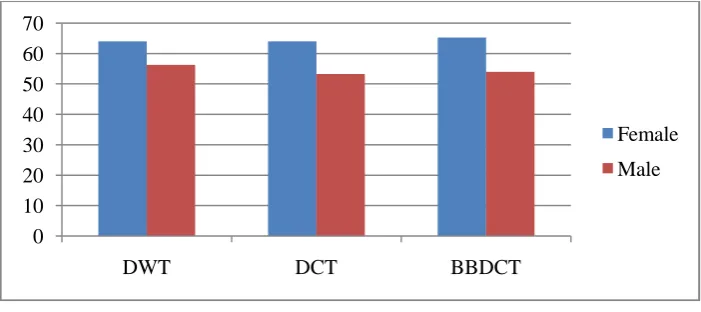
The algorithm is written in MATLAB programming language. The process of feature vector extraction for the database is time consuming. We have used the dataset of 1300 male and 1300 female fingerprints, out of which 900 male and 900 female fingerprints are used for feature extraction (training sample) and the rest is used for testing purpose. The result of the gender classification using DWT, DCT and BBDCT of 400 male and 400 female fingerprints is shown in Fig.9.
VII. CONCLUSION
The frequency domain based methods give better results than spatial domain approaches. It requires less processing time. The success percent for female using DWT is 65, using DCT is 64 and using BBDCT is 65.25. Likewise success percent for male using DWT, DCT and BBDCT is 52.25, 55.75 and 52 respectively. Use of another database may give improved results. An appropriate method can be used as per requirement.
VIII. FUTURE WORK
Combination or union of results of DWT, DCT and BBDCT will give better results or else we can try the different combination of methods and also use another classifier which will give improved results. Also the combination of spatial domain and frequency domain approaches will help to find different parameters like age, rural, urban people.
0 10 20 30 40 50 60 70
DWT DCT BBDCT
Female
Male Fig.8. Resulted class of fingerprint
ISSN(Online): 2320-9801 ISSN (Print): 2320-9798
I
nternational
J
ournal of
I
nnovative
R
esearch in
C
omputer
and
C
ommunication
E
ngineering
(An ISO 3297: 2007 Certified Organization)
Vol. 3, Issue 4, April 2015
REFERENCES
1. P.Gnanasivam, Dr. S. Muttan “Estimation of Age Through Fingerprints Using Wavelet Transform and Singular Value Decomposition” International Journal of Biometrics and Bioinformatics, Volume (6): Issue (2): pp 58-67. 2012, www. arxiv.org/abs/1205.6745.
2. D. Maltoni, D. Maio, A. K. Jain, S. Prabhakar, “Handbook of Fingerprint Recognition”, first ed., Springer, New York, 2003. 3. Dr. Sudeep Thepade, Dimple Parekh, Jinali Shah, Bhumin Shah, Paras Vora, “Classification of Fingerprint using KMCG Algorithm”,
International Journal Of Scientific & Technology Research Volume 1, Issue 6, July 2012, pp.105-107, www.ijstr.org/final-print /july2012/classification-of-fingerprint-using-KMCG-algorithm.pdf.
4. Suchita Tarare, Akhil Anjikar and M. M. Raghuwanshi “Fingerprint Based Gender Classification Using Discrete Cosine Transform”, IEEE sponsored 2nd international conference on innovations in information embedded and communication systems ICIIECS’15. Vol. 1, pp. 554-558.
5. Rijo Jackson and Tom T.Arulkumaran “Fingerprint Based Gender Classification Using 2D Discrete Wavelet Transforms and Principal Component Analysis” International Journal of Engineering Trends and Technology- Volume (4): Issue (2) – 2013, www.ijettjournal.org/volume-4/issue-2/IJETT-V4I2P224.pdf.
6. Samta Gupta and A. Prabhakar Rao, “Fingerprint Based Gender Classification Using Discrete Wavelet Transform & Artificial Neural Network” Int. J. of Computer Science and Mobile Computing, Vol (3): Issue (4): April- 2014, pg. 1289-1296 © 2014, www. ijcsmc.com/docs/papers/April2014/V3I4201499b77.pdf.
7. A K Manikantan, Vaishnawi Gowindarajan, “Face Recognition Using Block-based DCT Feature Extraction”, Journal of Advanced Computer Science and Technology, 1 (4) (2012) 266-283c Science Publishing Corporation, www.sciencepubco.com/index.php/JACST.
8. Ritu Kaur and Susmita Ghosh Mazumdar, “Fingerprint Based Gender Identification Using Frequency Domain Analysis”, International Journal of Advances in Engineering & Technology, March 2012.
9. M. Acree, “Is There A Gender Difference In Fingerprint Ridge Density?”, Forensic Science International, volume 102, no 1, 1999, pp.35-44.
10. Y.Yin, J. Tian, and X. Yang, “Ridge Distance Estimation in Fingerprint Images,” EURSIP Journal on Applied Signal Processing, vol. 4,
no. 4, 2004, pp. 495-502.
11. D. C. Douglas Hung, “Enhancement and feature purification of fingerprint images,” Pattern Recognition, volume. 26, no. 11, 1993, pp. 1661–1671.
12. E.O. OMIDIORA, O. OJO, “Analysis Towards Age & Gender Determination, Ridge Thickness To Valley Thickness Ratio & Ridge
Count On Gender Detection”, International Journal of Advanced Research in Artificial Intelligence, V. 1, No. 2, 2012, pp.57-63.