Implementation and Contrasting Comparision of
Transform Techniques of OFDM
Neha Gupta
Prof. D.K.Saxena
Dehradun Institute Of Technology Dehradun Institute Of Technology Dehradun (India) Dehradun(India)
ABSTRACT
Different type of transform techniques such as Discrete Hartley transform (DHT), Discrete Cosine Transform (DCT), Fast Fourier Transform (FFT) and their inverse are used for the fast computational algorithms in digital signal processing. These transforms are used to perform the modulation and demodulation operations for the OFDM system. In this paper the three transforms are describe, these transforms are used in OFDM and shows the comparison between these different schemes used in OFDM system and also the simulation results based on the BER performances.
General Terms
Orthogonal Frequency Division Multiplexing, Fast Fourier Transform (FFT), Discrete Fourier transform (DFT), Discrete Fourier Transform (DFT).
Keywords
DCT, DHT, FFT, ICI, ISI, MJPEG, MPEG, OFDM.
1.
INTRODUCTION
The different transforms used in this paper have their own applications, pons and cons in digital signal processing. These transforms have a wide importance in the orthogonal frequency division multiplexing. These transforms are adopted in OFDM because of their multiplexing and demultiplexing and because of their less computational time. A Fast Fourier Transform (FFT) is an efficient algorithm to compute the discrete Fourier transform (DFT) and its inverse. The Discrete Fourier Transform (DFT) is used to produce frequency analysis of discrete non-periodic signals. The FFT is a faster version of the Discrete Fourier Transform (DFT). The FFT utilizes some clever algorithms to do the same thing as the DTF, but in much less time.
The Discrete Hartley Transform is closely related to the Discrete Fourier Transform, but unlike the DFT, the DHT has the advantage of producing real numbers and it is (quasi-)symmetrical. The Hartley transform produces real output for a real input, and is its own inverse. It therefore can have computational advantages over the discrete Fourier transform.
The DCT has found wide applications in image/video processing and other fields. Discrete cosine transforms (DCTs) express a function or a signal in terms of a sum of sinusoids with different frequencies and amplitudes. A DCT operates on a function at a finite number of discrete data points. The obvious distinction between a DCT and a DFT is DCT uses only cosine functions, while DFT uses both cosines and sines. DCT implies different boundary conditions than the DFT or other related transforms. DCT is used in JPEG image compression, MJPEG, MPEG, and DV video compression.
The modified discrete cosine transform, or MDCT is used in AAC, Vorbis and MP3 audio compression.
OFDM is the modulation technique used in many new and emerging broadband communication systems including wireless local area networks (WLANs), high definition television (HDTV) and 4G systems. To achieve high data rates OFDM is used in wireless LAN standards like IEEE 802.11a, IEEE 802.11g. Orthogonal Frequency Division Multiplexing (OFDM), which allows the overlapping of the subcarriers but keeps them orthogonal to avoid intercarrier interference (ICI) and inter-symbol interference (ISI) [1], has been adopted for mobile communication standards due to its ability to combat with the frequency-selective multipath fading channel effects and has high spectral efficiency. OFDM is robust against narrowband interference because such interference affects only a small percentage of the subcarriers; also it increases robustness against frequency-selective fading. This paper considers the different sections which are – 2. OFDM system model, 3- Comparision between transforms used in OFDM, 4-simulation results, and 5- Conclusion.
2. OFDM SYSTEM MODEL
2.1 FAST FOURIER TRANSFORM (FFT)
2 1 0 i N nk N k n n
X
x e
k=0,….., N-1
Evaluating these sums directly would take O(N2) arithmetical operations An FFT is an algorithm to compute the same result in only O(N log N) operations. In general, such algorithms depend upon the factorization of N, but there are FFTs with O(N log N) complexity for all N, even for prime N. Many FFT
algorithms only depend on the fact that
2 i N
e
is a primitive root of unity. Since the inverse DFT is the same as the DFT, but with the opposite sign in the exponent and a 1/N factor, any FFT algorithm can easily be adapted for it as well.
Fig1. Simulation Diagram of OFDM System
2.2.
DISCRETE
HARTLEY
TRANSFORM (DHT)
A discrete Hartley transform (DHT) is a Fourier-related transform of discrete, periodic data similar to the discrete Fourier transform (DFT), with analogous applications in signal processing and related fields. Its main distinction from the DFT is that it transforms real inputs to real outputs, with no intrinsic involvement of complex numbers. Just as the DFT is the discrete analogue of the continuous Fourier transform, the DHT is the discrete analogue of the continuous Hartley transform, introduced by R. V. L. Hartley in 1942.
Because there are fast algorithms for the DHT analogous to the fast Fourier transform (FFT), the DHT was originally proposed as a more efficient computational tool in the common case where the data are purely real. It was subsequently argued, however, that specialized FFT algorithms for real inputs or outputs can ordinarily be found with slightly fewer operations than any corresponding algorithm for the DHT. Formally, the DHT is a linear,
invertible function H
R
n
R
n, where R is the set of realnumbers. The N real numbers
x
0,....,
x
N1 are transformed into the N real numbersH
0,....,
H
N1 according to the formula1
0
2
2
[cos(
) sin(
)]
k
N
n n
H
x
nk
nk
N
N
k=0,……., N-1The IDHT is given by
1
0
1
2
2
[cos(
) sin(
)]
N
n k
k
x
H
nk
nk
N
N
N
n=0,…., N-1The overall scale factor in front of the transform and the sign of sine term are differ and It does not affect the essential properties and it is matter of convention.
2.3. DISCRETE COSINE TRANSFORM
(DCT)
A discrete cosine transform (DCT) is a Fourier-related transform similar to the discrete Fourier transform (DFT), but using only real numbers. DCTs are equivalent to DFTs of roughly twice the length, operating on real data with even symmetry (since the Fourier transform of a real and even function is real and even), where in some variants the input and/or output data are shifted by half a sample. The Discrete Cosine Transform (DCT) attempts to uncorrelated the image data. After decorrelation each transform coefficient can be encoded independently without losing compression efficiency. The DFT, like the Fourier series, implies a periodic extension of the original function. A DCT, like a cosine transform, implies an even extension of the original function.
However, because DCTs operate on finite, discrete sequences, two issues arise that do not for the continuous cosine transform. First, one has to specify whether the function is even or odd at both the left and right boundaries of the. Second, one has to specify around what point the function is even or odd. In particular, consider a sequence abcd of four equally spaced data points, and say that we specify an even left boundary. There are two sensible possibilities: either the data is even about the sample a, in which case the even extension is dcbabcd, or the data is even about the point halfway between a and the previous point, in which case the even extension is dcbaabcd (a is repeated). Its DCT is given by
1
0
2
(2
1)
cos(
)
2
s
N
i n n
n s s
n i
x
d
N
N
0,...,
s1
i
N
And IDCT is given by
1
0
2
(2
1)
cos(
)
2
s N n i i s sn i
d
n
x
N
N
3. COMPARISION OF DIFFERENT
TRANSFORM SCHEME USED IN OFDM
PARAMETERS FFT DHT DCT
Pulse shaping Required Required Required
Symmetric Extension
Not Required
Not required
Required
Cyclic Prefix Required Required Required
Transform Complex valued
Real valued
Real valued
Implementation Complexity
Less Less Less
Time-Frequency Resolution
Fixed Dynamic Fixed
4. SIMULATION RESULTS
In the OFDM system implementation FFT, DCT, DHT were used to perform the modulation and demodulation operations. BPSK is used as digital modulation technique. For OFDM-based transceivers, the modulator needs to compute a long-length inverse transform and the demodulator needs to compute a long length transforms, where the transform length is up to 512 or more. Software used for simulation is MATLAB 7.0. Parameters for simulation the transform based OFDM.
Table1. Parameters for Simulation
PARAMETERS VALUES
No. of bits transmitted 12000
No. of carriers used 6
Bits per each carrier 2000
Spacing between each carrier 6KHZ
Carrier frequencies 6,12,18,24 and 30 KHZ
[image:3.595.320.505.77.222.2]Modulation Technique BPSK
Fig 2. BER versus SNR curve for FFT based OFDM
[image:3.595.321.507.86.372.2]Fig3. BER versus SNR curve for DHT based OFDM
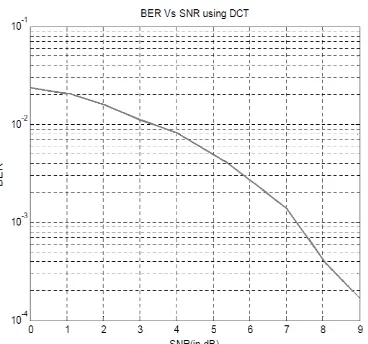
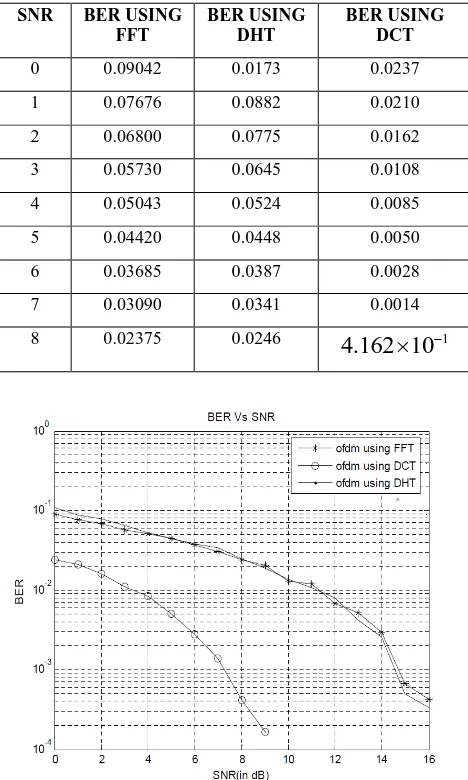
[image:3.595.326.510.444.616.2]The following table shows the results of three transform based OFDM. Figure 5 shows comparison of the BER versus SNR curves obtained in the FFT, DHT, and DCT based OFDM systems with BPSK as a modulation technique. The BER for these transform system is inversely proportional to SNR that is if SNR increases then BER reduces. The BER performance of FFT and DHT are almost same but DCT based OFDM curve is below the FFT and DHT curves.
Table 2. BER results for FFT, DHT, DCT based OFDM
SNR BER USING FFT
BER USING DHT
BER USING DCT
0 0.09042 0.0173 0.0237
1 0.07676 0.0882 0.0210
2 0.06800 0.0775 0.0162
3 0.05730 0.0645 0.0108
4 0.05043 0.0524 0.0085
5 0.04420 0.0448 0.0050
6 0.03685 0.0387 0.0028
7 0.03090 0.0341 0.0014
8 0.02375 0.0246 1
4.162 10
Fig 5. Comparision of BER of FFT, DCT,DHT based OFDM system
5. CONCLUSION
OFDM is a widely used and important modulation technique. It is computationally efficient because of FFT techniques. Using MATLAB software, the performance of OFDM system is taken for three different transform techniques namely FFT, DHT, and DCT. By simulation results, it observed that BER is improved in noisy channel by using BPSK at maximum data transmission capacity. DCT implies different boundary conditions than the DFT or other related transforms because of real valued nature and strong energy compaction property. DHT based OFDM, due to its real valued it require less computation complexity and implementation cost. From the results, it conclude that DHT,DCT transform technique may be alternative of DFT for implementation of OFDM-based communication systems.
6. ACKNOWLEDGMENT
The Authors would like to thank Prof. D.K.Saxena for their encouragement and support in this work.
7. REFERENCES
[1] Sadat, A.; Michael, W.B.” Fast Fourier Transform for high speed OFDM wireless multimedia system, Proceedings of the 44th IEEE 2001 Midwest Symposium on circuits andsystems,2001, Volume 2, 14-17 Aug. 2001 Page(s):938 - 942 vol.2
[2] Jizhong Han; Gang Ren; Chengde Han,’’ A novel fixed-point FFT algorithm on embedded digital signal processing systems”, 5 the international conferences on signal Processing proceedings, 2000, WCCC-ICSP2000, Volume 1, 21-25 Aug. 2000 Page(s):48 – 53 vol.1. [3] Khan, A.U.; Al-Akaidi, M.M.; Khan, S.A.; Khattak, S.;
Mir, A,” Performance analysis of a 64-point FFT/IFFT block designed for OFDM technique used in WLANs”, 7 the international multi topic conference-2003(INMIC 2003), 8-9 Dec. 2003 Page(s):65 – 71.
[4] Welch, P,”a fixed point fast Fourier transform analysis”, IEEE transactions on audio and electro acoustics, Volume 17, Issue 2, Jun 1969 Page(s):151 – 157. [5] K. R. Rao and P. Yip, Discrete Cosine Transform. New
York: Academic, 1990.
[6] Simon Haykin, Digital Communications, Wiley Publications Ltd, Singapore, 1988.
[7] Taub & schilling, principles of communication systems, second edition, TATA McGraw- HILL Publications [8] John G.Proakis, Dimitris G.Manolakis, Digital signal
processing, Principles, Algorithms, and Applications, Prentice- Hall publications
[9] Naofal Al-Dhahir, Senior Member, IEEE, Hlaing Minn, Member, IEEE, and Shilpa Satish. “Optimum DCT-Based Multicarrier Transceivers for Frequency-Selective Channels” IEEE Transactions on Communications, VOL. 54, NO. 5, MAY 2006: page. No 911-921. [10]H.Malvar, “Fast computation of the discrete cosine
transform and the discrete Hartley transform,” IEEE Trans. Acoust., Speech, Signal Processing, vol. ASSP-35, pp. 1484–1485, Oct. 1987.
[11]W.Chen, C. H. Smith, and S. C. Fralick, “A fast computational algorithm for the discrete cosine transform,” IEEE Trans. Commun., vol.COMM-25, pp. 1004–1009, Sept. 1977.
[12]B. G. Lee, “A new algoithm to compute the discrete cosine transform,” IEEE Trans. Acoust., Speech, Signal Processing, vol. ASSP-32, pp.1243–1245, Dec. 1984. [13]Peng Tan, Norman C. Beaulieu “A Comparison of
DCT-Based OFDM and DFT-DCT-Based OFDM in Frequency Offset and Fading Channels”, IEEE Transaction on communications, VOL. 54, NO. 11, November 2006. [14]Chin-Liang Wangt, Ching-Hsien Changt, John L. Fan,
and John M. CiofJi, Discrete Hartley Transform Based Multicarrier Modulation, Department of Electrical Engineering, National Tsing Hua University, Hsinchu, Taiwan 300, R.O.C; Information Systems Laboratory, Department of Electrical Engineering, Stanford University, Stanford, CA 94305
[15]A.Bahai and B. Saltzberg, “Multi-Carrier Digital Communications, Theory and Applications of OFDM”, Kluwer, 1999.
[image:4.595.49.283.180.570.2][17]R. Parmar, Shilpi Gupta, and Dr. (Mrs.) U. D. Dalal, “Comparison of BER Performances For Conventional and Non-Conventional Mapping Schemes Used in OFDM”, International Conference on World Academy of
Science, Engineering and Technology, Issue 79, July 2011,pp. 733-736.