ISSN(Online): 2320-9801 ISSN (Print) : 2320-9798
I
nternational
J
ournal of
I
nnovative
R
esearch in
C
omputer
and
C
ommunication
E
ngineering
(An ISO 3297: 2007 Certified Organization)
Vol. 3, Issue 9, September 2015
EEL-AODV: Energy Efficient Load Balancing
Ad Hoc On-demand Distance Vector Routing
Protocol
Vankudothu Ramesh, Sreenu Naik B
Department of Computer Science and Engineering, National Institute of Technology Calicut, Kerala, India
ABSTRACT: Mobile Ad Hoc Network (MANET) is an infrastructure less network. In MANET each node is self-configurable and intermediate nodes forwards packets in order to support neighbor node data exchange. In Ad Hoc On-Demand Distance Vector (AODV) Routing, source node broadcast route request (RREQ) to neighbor node for finding route to destination node.
The intermediate node with low battery also broadcast RREQ packets. When destination node sends route reply (RREP) packet, the low battery intermediate node goes down and it can’t forward RREP packet on reverse path to source node. This results retransmission of RREQ packet, when a node acts as an intermediate node for multiple active paths it leads to overloading and more energy degradation. An Energy Efficient Load balancing Ad Hoc On Demand Distance Vector (EEL-AODV) routing protocol is presented in this paper. It selects the best route by considering the traffic and energy of intermediate nodes.
KEYWORDS: MANET, AODV, EEL-AODV, Intermediate Node, Energy.
I.INTRODUCTION
Mobile Ad Hoc network is a Dynamic self-configurable wireless network where nodes communicate with each other without instruction of any centralized Administrator (base station). This typical feature makes MANET suitable for critical situations, where nodes themself form a network by interacting with each other. This type of behavior of MANET is used where rapid deployment and dynamic reconfiguration is necessary, includes military battlefields, major disaster areas.
Manny [1] protocols are proposed for route discovery and maintenance of route in MANET. They are classified as proactive, reactive and hybrid. The difference among these is the way they determine route from source to destination. A proactive protocol maintains fresh lists of destinations and their routes by periodically distributing routing tables throughout the network. Reactive routing protocols find a route on demand by flooding the network with Route Request packets, AODV [2], [8] comes under reactive protocol. Hybrid protocol combines both proactive and reactive protocols.
Nodes in MANETs are acts as a router and end nodes. A node receives and forwards the packets even they are not the source and destination nodes, few nodes are selected such a way that they always takes part in packet forwarding resulting to early death. So design a routing algorithm such a way that routes are formed in different paths so that none of the node expires due to energy consumption. There are some algorithms they consider energy and load while forming routes. These algorithms aim to increase network life time.
II.LITERATURE SURVEY
Due to power constraint in mobile node it is important to choose a path which has more energy.
ISSN(Online): 2320-9801 ISSN (Print) : 2320-9798
I
nternational
J
ournal of
I
nnovative
R
esearch in
C
omputer
and
C
ommunication
E
ngineering
(An ISO 3297: 2007 Certified Organization)
Vol. 3, Issue 9, September 2015
and remaining RREQ it computes the difference between the maximum power of the already accepted packet and the power containing in other RREQ packets. If the difference is less than or equal to e (a predefined value) for a specific node x, then the current node records the id of node x with next higher priority, and discard remaining route request. Maximum priority RREQ is broadcast by replacing its remaining energy. Destination Node upon receiving the route request packet waits for particular time and sends RREP to the nodes which are saved in its routing table.
In [4] Young J. Lee et al. proposed a Work load Based Adaptive Load-Balancing Technique for Mobile Ad Hoc Networks. It selects the route by checking average of minimum threshold and maximum threshold with traffic of a node (TON).
III. PROBLEM DEfiNITION
Main objective of this paper is to find a route in Mobile Ad hoc networks of better energy and less load.
IV. PROPOSED ROUTING PROTOCOL
Proposed routing protocol adds four fields to RREQ packet of AODV Routing protocol. 1)Minimum Energy (MinE)
2)Energy Threshold (ET) 3)Maximum Load (MaxL) 4)Traffic Threshold (TT)
In a proposed routing protocol when a node wants to communicate with a destination node it broadcasts the RREQ packet. The destination node receives the RREQ packet from different paths. Suppose there are N paths (P1 P2
...PN) from source to destination and Pi is the ith path then MinEi is the minimum energy of a node in Pi path and MaxLi is the maximum load of a node in Pi path. Energy threshold is the minimum energy required for a node to broadcast a RREQ packet.
The Route Discovery Process is as follows:
Source Node
When a source node wants to communicate with a destination node it broadcast RREQ packet by checking its energy or battery power (BP) with the energy threshold and also the traffic with the traffic threshold. And update MinE to its battery power and MaxL to its traffic. If energy or traffic is not within the threshold it must not forward RREQ packet. Following is the simple algorithm for the source node functionality.
Algorithm 1 Implemented at Source Node
1:Input: Energy Threshold Value (ETV), Traffic Threshold Value (TTV) 2:Energy Threshold (EThr) = ETV
3:Traffic Threshold (TThr) = TTV 4:if EThr < BP And TThr > TON then 5:MinE = BP
6:MaxL = TON
7:Broadcast RREQ packet 8:end if
Intermediate Node
ISSN(Online): 2320-9801 ISSN (Print) : 2320-9798
I
nternational
J
ournal of
I
nnovative
R
esearch in
C
omputer
and
C
ommunication
E
ngineering
(An ISO 3297: 2007 Certified Organization)
Vol. 3, Issue 9, September 2015
Algorithm 2 Implemented at Intermediate node 1:Input: RREQ packet from neighbor node 2:if BP < EThr And TON > TThR then 3:drop the packet
4:return 5:else
6:MinE = Min(MinE,BP) 7:MaxL = Max(MaxL,TON) 8:broadcast the RREQ packet 9:end if
Destination Node
Destination node who receives RREQ packet will check its energy against energy threshold and traffic against traffic threshold. If energy and traffic are within the specific thresholds then it waits and receives RREQ packets from different routes. Then it calculates route priority (RP) of each path and sends RREP in a path whose route priority is high. If they are not satisfying the given thresholds then destination node discards the RREQ packet. Following is the simple algorithm for the destination node functionality.
Algorithm 3 Implemented at Destination Node 1:Input: RREQ Packet from Neighbor Node 2:if BP<EThr and TON>TThr then
3:drop the packet 4:return
5:else
6:receive RREQ packets from different paths 7:after a time T stop receiving and
8:compute each path:
9:RP=MinE/(MaxL*hop count)
10:send a RREP in a path whose RP is high 11:end if
For the implementation of proposed protocol some network simulation manuals [5] [6] [7] have been referred.
V. SIMULATIONS AND PERFORMANCE EVALUATION
ISSN(Online): 2320-9801 ISSN (Print) : 2320-9798
I
nternational
J
ournal of
I
nnovative
R
esearch in
C
omputer
and
C
ommunication
E
ngineering
(An ISO 3297: 2007 Certified Organization)
Vol. 3, Issue 9, September 2015
randomly distributed, Random Waypoint is used to model the node mobility .Nodes moves with a uniform speed from 1 to 30 m/s. Simulation is carried out with 10,20,30,40 connections with a data rate of 10 packets per second. The total simulation time is 800 seconds. Performance of EELOADV is evaluated in terms of Routing Overhead
It is the ratio of control packets sent and the number of data packets delivered at the destination. Figure 1: Routing Overhead versus Number of connections
ISSN(Online): 2320-9801 ISSN (Print) : 2320-9798
I
nternational
J
ournal of
I
nnovative
R
esearch in
C
omputer
and
C
ommunication
E
ngineering
(An ISO 3297: 2007 Certified Organization)
Vol. 3, Issue 9, September 2015
Packet Delivery Ratio
It is the ratio between number of packets received at destination and number of packet sent by the source. Figure 2: PDR versus Number of connections
As we can observe in Fig. 2. that packet delivery ratio is decreased as we increasing the traffic. EEL-AODVperformed better when compared with AODV.
End to End Delay
It is the average time taken by a data packet to reach destination. Figure 3: End-to-End Delay versus Number of connections
As we can observe in Fig. 3. the AODV is better performed when compared with EEL-AODV this is because the route is selected by considering the energy and traffic threshold so the hop count is increased as a result End to End delay increases.
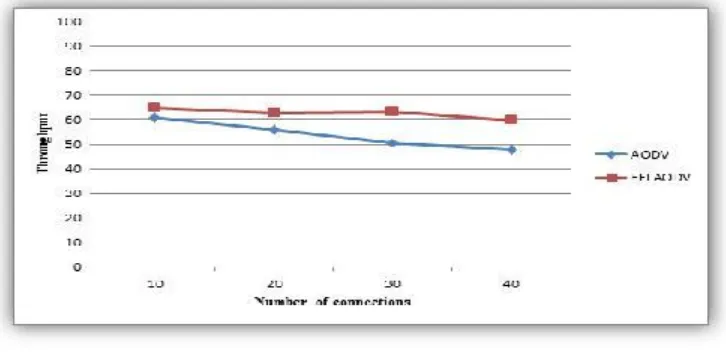
Throughput
Throughput is the number of data packets delivered at destination per second over a network.
Figure 4: Throughput versus Number of connections . As we can observe in Fig. 4. that throughput is decreased as we increasing the traffic. EEL-AODV performed better when compared with AODV.
VI.CONCLUSION
AODV achieves minimum delay by selecting the path considering hop count. From the implementation of Proposed routing protocol we can conclude that considering the Energy, Load of a mobile node and hop count we can get better throughput ,End to End Delay and less routing overhead than AODV.
REFERENCES
[1]Avinash Mistry, Nitin Chander, Prashanth Patlolla, Vivek Yadlapalli, Amit Shrivastava, and Aravinth Raj Shanmogavel. Overview of Routing Protocols in MANETs and Enhancements in Reactive Protocols.4(9):1–6, 2011.
[2]http://tools.ietf.org/html/rfc3561.
[3]S.Banerjee, P.Bera, S.Choudhury, and M.Dasgupta. A Power Aware Multicast On-demand Routing with Load Balancing. 2010.
[4]Young J. Lee and George F. Riley. A WorkloadBased Adaptive Load-Balancing Technique for Mobile Ad Hoc Networks. pages 1–5, 2005. [5]Ekram Hossain and Teerawat Issariyakul. Introduction to Network Simulator NS2.
[6]http://nile.wpi.edu/ns/.
[7]http://www.isi.edu/nsnam/ns/doc/node170.html.