ISSN(Online): 2320-9801
ISSN (Print): 2320-9798
International Journal of Innovative Research in Computer
and Communication Engineering
(An ISO 3297: 2007 Certified Organization)
Vol. 3, Issue 9, September 2015
An Efficient Change Detection Model for
Hyper Spectral Images Using Hierarchical
Clustering Algorithm
Prof. K.Jeyalakshmi, P.Sathyasri
Associate Professor, PG & Research, Dept. of Computer Science, Hindustan College of Arts and Science, Coimbatore,
Tamil Nadu, India.
Research Scholar, PG & Research, Dept. of Computer Science, Hindustan College of Arts and Science, Coimbatore,
Tamil Nadu, India
ABSTRACT: When dealing with Multi-temporal Hyper spectral (HS) Images change detection (CD) problems; pixels difference about the nature of the changes is often unavailable. Thus, when multi-temporal images are considered, they allow us to detect many possible differences in HS images. This paper proposed a robustness of the Hierarchical clustering based Change detection method will be tested on the available multi-temporal HS images showing differences in illumination conditions and no real change. The proposed method to derive the Change detection into two ways: 1) the spatial information in order to boost the robustness and the accuracy of the CD results, 2) define a reliable automatic technique for the detection of the aforementioned threshold. Experimental results obtained on synthetic and real multi-temporal HS images demonstrate the effectiveness of the proposed CD method.
KEYWORDS: Change detection (CD), hierarchical clustering, hyperspectral (HS) images, multiple changes, multi-temporal analysis, remote sensing.
I. INTRODUCTION
A Hyperspectral image (HSI) is a set of images taken at many different wavelengths (usually between 100 and 200), not just the usual three visible bands of light (red at 650 nm, green at 550 nm, and blue at 450 nm). An important problem in hyperspectral imaging is blind hyperspectral unmixing (blind HU): Given an HSI, the goal is to recover the constitutive materials present in the image (the end members) and the corresponding abundance maps (i.e., determine which pixel contains which end member and in which quantity). Blind HU has many applications such as quality control in the food industry, analysis of the composition of chemical compositions and reactions, monitoring the development and health of crops, monitoring polluting sources, military surveillance, and medical imaging [1].
A comprehensive understanding of the global change is necessary for sustainable development of human society. As one of the interesting subtopics in global change study, detection of anthropogenic and natural impacts on land surface is essential for environmental monitoring. To enable whole monitoring and evaluation of changes occurred on the ground, both long-term and short-term observations are required. Due to the revisit property of polar Earth Observation (EO) satellites, we can acquire remote sensing images in a given area at different times. Thus, multi-temporal remote sensing images are an important data source to detect the land surface changes in wide geographical areas, which is gradually reducing the need for conventional field investigations. Change detection (CD) is the process that identifies changes occurred between two (or more) images based on the image properties [2].
ISSN(Online): 2320-9801
ISSN (Print): 2320-9798
International Journal of Innovative Research in Computer
and Communication Engineering
(An ISO 3297: 2007 Certified Organization)
Vol. 3, Issue 9, September 2015
methods have been proposed for binary CD [3]. From the methodological point of view, we can categorize them into thresholding-based and Hierarchical clustering-based techniques.
The change end member’s problem can be addressed by using clustering methods to automatically find the different change classes. However, the problem of multiple-class separation in HS images is much more difficult than in MS images. This is due to the following issues: 1) the high spectral resolution makes the spectrum more sensitive to changes; thus, a high number of changes might be detected; and 2) subtle changes within major changes are always difficult to be directly identified.
II. RELATED WORK
In [1] authors proposed the imaging spectrometers are therefore often referred to as hyperspectral cameras (HSCs). Higher spectral resolution enables material identification via spectroscopic analysis, which facilitates countless applications that require identifying materials in scenarios unsuitable for classical spectroscopic analysis. Due to low spatial resolution of HSCs, microscopic material mixing, and multiple scattering, spectra measured by HSCs are mixtures of spectra of materials in a scene. Thus, accurate estimation requires unmixing. Pixels are assumed to be mixtures of a few materials, called end members. In [3] authors discussed the Nonnegative matrix factorization (NMF) has become a prominent technique for the analysis of image databases, text databases and other information retrieval and clustering applications. In this report, we define an exact version of NMF. Then we establish several results about exact NMF: (1) that it is equivalent to a problem in polyhedral combinatorics; (2) that it is NP-hard; and (3) that a polynomial-time local search heuristic exists. In [4] authors introduced a completely new way to obtaining more well-posed NMF problems whose solutions are sparser. Our technique is based on the preprocessing of the nonnegative input data matrix, and relies on the theory of M-matrices and the geometric interpretation of NMF. This approach provably leads to optimal and sparse solutions under the separability assumption of Donoho and Stodden (NIPS, 2003), and, for rank-three matrices, makes the number of exact factorizations finite. Their illustrate the effectiveness of our technique on several image datasets. In [5] authors proposed two inherent characteristics of hyperspectral data, piecewise smoothness (both temporal and spatial) of spectral data and sparseness of abundance fraction of every material, are introduced to NMF. The adaptive potential function from discontinuity adaptive Markov random field model is used to describe the smoothness constraint while preserving discontinuities in spectral data. At the same time, two NMF algorithms, nonsmooth NMF and NMF with sparseness constraint, are used to quantify the degree of sparseness of material abundances. In [6] authors had considered the problem of factorizing a hyperspectral image into the product of two nonnegative matrices, which represent nonnegative bases for image spectra and mixing coefficients, respectively. This spectral un-mixing problem is a non-convex optimization problem, which is very difficult to solve exactly. We present a simple heuristic for approximately solving this problem based on the idea of alternating projected subgradient descent. Finally, we present the results of applying this method on the 1990 AVIRIS image of Cuprite, Nevada and show that our results are in agreement with similar studies on the same data. In [7] authors studied the nonnegative matrix factorization problem under the separability assumption (that is, there exists a cone spanned by a small subset of the columns of the input nonnegative data matrix containing all columns), which is equivalent to the hyperspectral unmixing problem under the linear mixing model and the pure-pixel assumption. We present a family of fast recursive algorithms and prove they are robust under any small perturbations of the input data matrix. This family generalizes several existing hyperspectral unmixing algorithms and hence provides for the first time a theoretical justification of their better practical performance.
III.PROPOSED ALGORITHM
ISSN(Online): 2320-9801
ISSN (Print): 2320-9798
International Journal of Innovative Research in Computer
and Communication Engineering
(An ISO 3297: 2007 Certified Organization)
Vol. 3, Issue 9, September 2015
A. Image preprocessing:
Image pre-processing, also called image restoration, involves the correction of distortion, degradation, and noise introduced during the imaging process. This process produces a corrected image that is as close as possible, both geometrically and radio metrically, to the radiant energy characteristics of the original scene. Radiometric and geometric are the most common types of errors encountered in remotely sensed imagery.
Image pre-processing is the name for operations on images at the lowest level of abstraction whose aim is an improvement of the image data that suppress undesired distortions or enhances some image features important for further processing. It does not increase image information content. Its methods use the considerable redundancy in images. Neighbouring pixels corresponding to one object in real images have the same or similar brightness value and if a distorted pixel can be picked out from the image, it can be restored as an average value of neighbouring pixels
Fig: 1 Proposed Architecture Flow diagram
B. Hierarchical Clustering Change Detection Approach for Hyperspectral Images
A novel hierarchical clustering Change Detection method for detecting changes in an images and separating them into different change end members. The Hierarchical clustering is a processing of change detection data to find clusters or groups of similar data in hierarchical structure. In each division, the item membership levels have some similarity in type of data. The principles of hierarchical clustering are searching value of score (conditions i.e. <,> and =) in similarity, and assigning each memberships to be in the different group of other members that have similar or same
score. The output has three classes. After separating the change (Ωc) and no-change (n) classes is defined.
The class of changes (Ωc) is used to initialize the root node of a tree structure for change representation.
C. Analysis or decomposition hierarchy for 2-D DWT
Analysis-synthesis filter are often implemented with hierarchical sub-sampling, leading to a pyramid. Wavelets and quadrature mirror filters (QMFs) are often used this way, in which case they yield orthogonal transforms. The Haar filters are not very frequency selective, and so don’t cleanly separate the information in the sub-bands. Analysis-synthesis filter banks are often implemented with hierarchical sub sampling, leading to a pyramid. Wavelets and quadrature mirror filters (QMFs) are often used this way, in which case they yield orthogonal transforms. The Laplacian pyramid of a sub sampled system with analysis and synthesis filters. Note, however, that it is not symmetrical. The analysis filters are band pass, and the synthesis filters are low pass. Thus the synthesis filters can
Input HS images
Image pre-processing
Change Detection
Spectral Difference
Distance method
Pixel Difference
Hierarchical Clustering Change Detection
Analysis-by-Synthesis
ISSN(Online): 2320-9801
ISSN (Print): 2320-9798
International Journal of Innovative Research in Computer
and Communication Engineering
(An ISO 3297: 2007 Certified Organization)
Vol. 3, Issue 9, September 2015
remove high frequency artifacts introduced by nonlinear processing, but not low frequency artifacts. It is possible to use the Laplacian pyramid architecture without sub sampling, which reduces aliasing effects, but the asymmetry remains. When nonlinearities introduce distortions that show up in low frequencies, the synthesis filters cannot remove them. In spite of these problems, we can get fairly good results with the Laplacian pyramid when we compute smooth gain maps.
IV.RESULTS
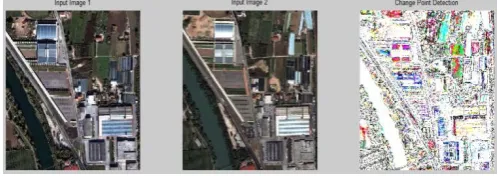
For evaluating the proposed work, in Fig. 2, the input images of two different time periods taken in the place of remote sensing area are considered. These images are of type land cover image.
Fig 2: Input images of two different time periods
The change detection method is difference image generation. The difference image X can be computed pixel-wise
as the absolute-valued difference of intensity values of the two images under comparison. The resultant difference image is shown in Fig. 3 change detection result image.
Fig 3: Hierarchical Change Detection results obtained on the real HS images
V. CONCLUSION AND FUTURE WORK
In this paper, an unsupervised Hierarchal clustering based change detection method is proposed and implemented in Hyperspectral Images. The proposed method is possible to discover the difference among similar changes by decreasing the difficulty of detection. Moreover, the proposed approach is designed in an unsupervised way with difference illumination conditions; thus, it fits most of actual applications, for which often the mask image is not available.
In future work, we intend to enhance the Clustering algorithm to develop the experimental methods for non-linear optimization to control the growth of tree attributes of the result image data.
REFERENCES
1. J. Bioucas-Dias et al., “Hyperspectral unmixing overview: Geometrical, statistical, sparse regression-based approaches,” IEEE J. Sel. Topics Appl. Earth Observ. Remote Sens., vol. 5, no. 2, pp. 354–379, Apr. 2012.
2. L. Bruzzone and F. Bovolo, “A novel framework for the design of changedetection systems for very-high-resolution remote sensing images,” Proc. IEEE, vol. 101, no. 3, pp. 609–630, Mar. 2013.
ISSN(Online): 2320-9801
ISSN (Print): 2320-9798
International Journal of Innovative Research in Computer
and Communication Engineering
(An ISO 3297: 2007 Certified Organization)
Vol. 3, Issue 9, September 2015
4. N. Gillis, “Sparse and unique nonnegative matrix factorization through data preprocessing,” J. Mach. Learn. Res., vol. 13, no. 1, pp. 3349– 3386, Jan. 2012.
5. S. Jia and Y. Qian, “Constrained nonnegative matrix factorization for hyperspectral unmixing,” IEEE Trans. Geosci. Remote Sens., vol. 47, no. 1, pp. 161–173, Jan. 2009.
6. A. Zymnis, S.-J. Kim, J. Skaf, M. Parente, and S. Boyd, “Hyperspectral image unmixing via alternating projected subgradients,” in Conf. Rec. 41st Asilomar Conf. Signals, Syst. Comput., 2007, pp. 1164–1168.