Article
Communities of Practice Approach for Knowledge
Management Systems
Sitalakshmi Venkatraman 1,* and Venkat Ramanathan 2
1 Melbourne Polytechnic; [email protected] 2 National University of Singapore; [email protected]
* Correspondence: [email protected]; Tel.: +61-3-9269-1171
Abstract: In this digital world, organisations are facing global competition as well as manpower pressures leading towards knowledge economy, which heavily impacts on their local and international businesses. The trend is to foster collaboration and knowledge sharing to cope with these problems. With the advancement of technologies and social engineering that can connect people in virtual world across time and distance, several organisations are embarking on knowledge management (KM) systems, implementing community of practice (CoP) approach. However, virtual communities are relatively new paradigms, and there are several challenges to their successful implementation from an organisation’s point of interest. There is lack of CoP implementation framework that can cater to today’s dynamic business and sustainability requirements. To fill the gap in literature, this paper develops a practical framework for a CoP implementation with a view to align KM strategy with business strategy of an organization. It explores the different steps of building, sharing and using tacit and explicit knowledge in CoPs by applying Wiig KM cycle. It proposes a practical CoP implementation framework that adopts the Benefits-Tools-Organisation-People-Process (BTOPP) model in addressing the key questions surrounding each of the BTOPP elements with a structured approach. Finally, it identifies key challenges such as organizational culture and performance measurements, and provides practical recommendations to overcome them for a successful CoP implementation.
Keywords: knowledge management (KM); communities of practice (CoP); tacit knowledge; knowledge sharing; KM cycle; CoP framework, organizational culture, performance measurement.
1. Introduction
With the recent trends in globalization and new developments in the field of information and communication technology (ICT), knowledge has been identified as one of the most critical resources that contributes to the competitive advantage of an organization [1-3]. McElroy describes the management of knowledge to be closely connected to innovation management and organizational learning [4]. Knowledge management (KM), an emerging discipline is aimed to facilitate people to transform their way of thinking and to arrive at KM initiatives that could contribute to the governance of exploratory and exploitative learning for organisations [5]. Hence, KM projects could encourage exploitative learning to increase efficiency, and exploratory learning to stimulate innovation for sustainability of organisations in this increasingly competitive environment [6]. In general, KM projects are focused either towards providing technology with ICT-based innovative KM initiatives, or towards governing human processes with social practice-based KM initiatives for organizational learning and the management of knowledge [7-8]. From Wiig’s work, “historically knowledge has always been managed, at least implicitly” [9]. Therefore, KM has not been popular until the past decade with the new paradigm shift in transmitting and managing organizational knowledge [10-12].
In recent years, many research studies have put forth the case for KM with the rapid advancements in innovative technology solutions [13-14]. However, technologies being easily imitable, the competitive differentiating factor still lies in the uniqueness of each organisational
knowledge by virtue of its tacitness and immobility [15-16]. The organisational knowledge buried in the human capital of an organization is recognized as its prime economic asset. Organisational learning, which is the process of creating, retaining, and transferring knowledge within an organization will facilitate individual learning as well as group / team learning, wherever possible [17-18]. In reality, such theoretical arguments for applying KM have failed to relate to actual experience of businesses when it comes to practical implementation [19-20]. In today’s digital and competitive world, the absence of a practical framework for managing an organizational knowledge forms the key motivation for this research work. This paper explores Communities of Practice (CoP) approach with a mixed model of combining ICT-based KM initiatives with social practice-based KM initiatives for implementing KM systems (KMS) successfully.
The rest of the paper is organized as follows. In Section 2, we explain the background concepts of knowledge, KM and CoP in literature and identify the need for this research. In Section 3, we propose a practical framework for adopting CoP approach for KMS implementation. Then, we describe in detail the key steps of the framework with suitable illustrations in Section 4. Finally, in Section 5, we provide conclusions and future research directions.
2. Background
KM is perceived differently in literature by different researchers and practitioners based on the focus portrayed in its description [21-23]. KM is the explicit control and management of knowledge within an organization aimed at achieving the company’s objectives - van der Spek. Knowledge Management can be considered as the way organisations build, supplement and organise knowledge routines. According to Larry Prusak of McKinsey Consulting: “It is the attempt to recognize what is essentially a human asset buried in the minds of individuals, and leverage it into an organisational asset that can be accessed and used by a broader set of individuals on whose decision the firm depends”. Knowledge management relates to activities such as learning and innovation, benchmarking and best practice, strategy, culture, and performance measurement [24-25]. More recently, it is widely accepted that KM is concerned with the generation, capture, storage, and sharing of knowledge with an intent to take timely action for increasing an organisation’s competitive advantage.
Explicit and Tacit Knowledge
Knowledge is considered as the prime source of competitive dominance in an organisation and it exists in both tacit and explicit forms. Explicit knowledge is information that is searchable and can easily be found in books, documents, software, hardware, and other instruments including the Internet [26]. It can be recorded and expressed in a number of ways such as text, numbers, codes or mathematical formulas. Examples of this type of knowledge include security policy document of an organization, formal customer complaints or suggestions, etc. While transferring explicit knowledge to others is easy, safeguarding it from unauthorized use is more difficult. On the other hand, Tacit knowledge is deeply rooted with knowledge that is in the human mind from the experience gained through the jobs done or knowledge gained through opinion communicated by experts / management about market trends or decision strategies, etc. The embodied expertise that exists in tacit form is the most valuable asset to organisations as it could be difficult for competitors to imitate. However, it is a complex task to transform tacit knowledge into tangible forms such as a written document or in digital storage form [27-28]. Tacit knowledge is more commonly transmitted to others verbally in the form of stories, coaching, or apprenticeship [29].
and tough to formalize [32]. While face-to-face interaction facilitates of knowledge sharing, it could be time consuming. However, both explicit and implicit knowledge need to be secured and safeguarded within the boundaries that are clearly earmarked for knowledge sharing. Good knowledge sharing strategies could lead to employee satisfaction and motivation, as well as greater business improvements. There is a need for a structured approach to facilitate knowledge sharing and benchmark the implementation efforts. With a view to address these challenges, this paper explores CoP strategies for practically incorporating knowledge sharing techniques that would result in successful KMS implementations.
The Need to Revisit Community of Practice
The term community of practice (CoP) was initially introduced in the seminal work of Lave and Wenger [33-34]. They refer CoP to groups of individuals who share a craft or profession and engage in the sustained pursuit of a shared enterprise. CoPs have long existed in various forms where people with a common passion, a concern or a set of problems regarding a particular topic interact regularly with an intention to deepen their knowledge and expertise [35]. In CoP, individuals with related interests interact with respect to situated learning in the workplace as well as with other communities in a more informal manner [36]. The use of CoPs as a formal strategy for knowledge management is relatively recent and calls for much innovation and research.
The 21st century is witnessing the emergence of a new global knowledge-based economy as
knowledge is becoming increasingly diverse, sophisticated and distributed. Businesses are going global with the developments in ICT and these have significantly increased the ability to create and share knowledge worldwide [37-38]. There has been an explosion in mobile and telecommunication technologies in the past decade with a trend towards flexible working environments, where employees work outside the physical office locations from anywhere and anytime [39-40]. In addition, with the recent evolution of Internet of Things and Big Data in the digital world, organisations are required to innovate in order to survive in this new paradigm shift. Specifically, they must look to new sources of competitive advantage and engage in new forms of competition, and knowledge is considered as the key source of competitive advantage for organisations to succeed in this knowledge economy [41-42]. An organisation’s resources and manpower capabilitiesinfluence the strategic decision making to stay competitive. This human capital, that can innovate and renew knowledge, has the potential to create value for the future of the organization and forms the foundation for revisiting and renewing the development of communities of practice [43-44].
In the past, only large organisations have predominantly adopted CoPs as a major element of their KM strategy [12][45]. World Bank, an international financial institution involved in global partnership for fighting poverty worldwide, has successfully used CoPs as a sustainable solution. They have successfully tapped into the vast knowledge that already exists within the organisation, rather than trying to discover new knowledge [46-47]. Similarly, some of the leading multinational companies such as IBM have been supporting and acknowledging their CoPs for their success [48]. In healthcare, it is more common to create CoPs to facilitate sharing of knowledge and learning among healthcare professionals to improve medical practice [49-50]. However, with the proliferation and advancement of Internet, CoPs can be adopted by any firm irrespective of their size and type of industry. Importantly, future CoPs are required to adopt different strategies for KM as they have the ability to operate anywhere and anytime with no physical or geographical barriers. In order to reap the full benefits of these CoPs that exist virtual over the Internet, they need to be properly understood, deployed and supported. CoPs cannot be conceived and supported in the same way as other organisational initiatives as they lack formal structure, standardized protocols and performance measurements. Organisations have to create conducive environments for employees to voluntarily participate and include other members of the community in their pursuit for knowledge sharing and organizational learning.
connecting people, sharing knowledge, and fostering individual as well as group learning and development. In an attempt to provide a framework for a successful CoP model, this paper provides a guideline by following through a typical set of KM cycle steps with a focus of adopting the best practices as an illustration.
3. KM Cycle and CoP Implementation Framework
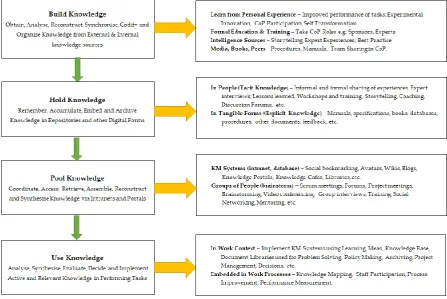
According to Karl Wiig, for knowledge to be useful and valuable, it must be first organized. Further, it should be organized differently depending on what the knowledge will be used for with useful properties such as completeness, connectedness, congruency, as well as perspective and purpose [9][21]. Wiig identifies three requirements for an organization to conduct its business successfully: i) business (products/services) and customers; ii) resources (people, capital, and facilities); and iii) ability to act. While the first two are quite commonly met by organisations, the distinguishing factor is their ability to act intelligently. The principal driving force for this to happen is by acquiring the knowledge to do things better. Wiig identifies the major purpose of KM as an effort “to make the enterprise intelligent-acting by facilitating the creation, cumulation, deployment and use of quality knowledge”. The emphasis here is to work smarter by acquiring relevant and high-quality knowledge that can be applied in a number of different ways. For CoP implementation framework proposed in this section, we adopt the Wiig KM cycle as it steps through how to build, hold, pool and use knowledge as individuals and as organizations. We present the four major steps in the Wiig KM cycle for CoP implementation (Figure 1).
Figure 1. CoP implementation using the Wiig KM cycle
The CoP implementation by adopting these four steps of The Wiig KM cycle is described below: Step 1: Build Knowledge
This step involves obtaining knowledge from internal as well external sources. New knowledge can be obtained in the following modes:
According to the social theory of learning, the process of learning does not happen in isolation, rather it takes place from social participation [34]. Learning is associated with: a) Meaning (Sense making) – when people discuss their life experiences in relation to the world; b) Practice – when individuals talk about the activities and the how they are done; 3. Community – when someone is recognized to be competent through participation; and 4. Identity – when individuals change and get transformed. Hence, CoPs, where these forms of learning are embedded, can facilitate organisational learning, which is key to building knowledge.
ii) Formal education and training – this mode of gaining knowledge through formal and intense coaching with goal setting and specialised training facilitates experts from a knowledge domain to participate in CoP taking various roles [35][51][52].
CoP includes typical defined roles such as 1. Sponsors – champions of the CoP, resource brokers, advisors to the community, recruiters of new members, etc.; 2, Leaders – drivers of the strategic goals of the community; 3. Subject matter experts – the ‘gurus’ who guide in developing the community’s knowledge base; 4. Content editors – people who are trained to review and approve member contributions to the CoP; and 5. Facilitators– individuals who help community members come together and facilitate communication among them. They form the pillars of a structured approach to learning in an organization.
iii) Intelligence sources – these are developed from experts’ sharing of experiences, storytelling, etc. Knowledge reconstruction takes place through analysis of the knowledge obtained by this mode. This process consists of listening to experiences and stories shared and selecting the concept for further consideration. By translating the content into a preferred form for the end user or creating a short executive summary, individuals can analyse the data that they have learnt and heard from somebody or from the expert. Such intelligence sources provide information about broad principles, establishing conformance between new and existing knowledge to reconstruct and update new knowledge learnt through this process. In CoP approach, people share and learn from one another face-to-face, or in virtual mode via online technologies, or both. They have common interest in developing a body of knowledge and share problems, experiences, insights, templates, tools, and best practices from the foremost domain experts in building a common store of knowledge [46].
iv) Media, books and peers – this mode refers to knowledge obtained from videos, procedure manuals, sharing ideas by people of the same or different departments, etc. When knowledge is obtained through this mode, it involves further processing by software tools to codify and structure the knowledge as it could have an unstructured and tacit representation in the mind of the peers sharing the knowledge using CoP [53]. It also involves processes to obtain the knowledge from books and manuals so as to encode and organise the knowledge for storage into a knowledge repository in Step 2.
Step 2: Hold Knowledge
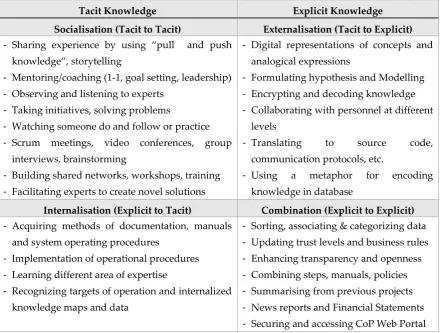
and Takeuchi introduced the SECI model [24], which lays the foundation of knowledge creation and transfer theory in today’s digital world. As it is difficult to capture tacit knowledge as well as explicit knowledge and their varying forms that can be captured using different CoP approaches, we recommend the SECI model for an organisation to hold knowledge. In Table 1, we present the two types of knowledge (Tacit and Explicit) that an organisation can hold by following the SECI model’s four process of Socialisation, Externalisation, Combination and Internalisation within the different CoP approaches. It also provides an illustration to convert tacit and explicit knowledge using the SECI model.
• Socialization: Knowledge is passed on through practice, guidance, imitation, and observation and this process of socialization within various CoP approaches facilitates knowledge conversion from tacit to tacit forms.
• Externalization: Conversion of tacit knowledge to explicit forms can be quite difficult though it plays an important process to codify tacit knowledge into manuals, documents, and other digital forms that can be more accessible by more people in the organisation. The used of metaphor is a common technique for performing this process of externalization.
• Combination: Explicit knowledge can be converted to another explicit form using the process of combination where codified knowledge such as manuals or documents could be merged to create new explicit knowledge.
• Internalization: This process of internationalisation is used to incorporate an explicit knowledge learnt into the knowledge repository by modifying the existing tacit knowledge.
Table 1. Tacit and Explicit knowledge conversion for CoP approaches
Tacit Knowledge Explicit Knowledge
Socialisation (Tacit to Tacit) Externalisation (Tacit to Explicit) - Sharing experience by using “pull and push
knowledge”, storytelling
- Mentoring/coaching (1-1, goal setting, leadership)
- Observing and listening to experts
- Taking initiatives, solving problems
- Watching someone do and follow or practice
- Scrum meetings, video conferences, group
interviews, brainstorming
- Building shared networks, workshops, training
- Facilitating experts to create novel solutions
- Digital representations of concepts and
analogical expressions
- Formulating hypothesis and Modelling
- Encrypting and decoding knowledge
- Collaborating with personnel at different
levels
- Translating to source code,
communication protocols, etc.
- Using a metaphor for encoding
knowledge in database
Internalisation (Explicit to Tacit) Combination (Explicit to Explicit) - Acquiring methods of documentation, manuals
and system operating procedures
- Implementation of operational procedures
- Learning different area of expertise
- Recognizing targets of operation and internalized
knowledge maps and data
- Sorting, associating & categorizing data
- Updating trust levels and business rules
- Enhancing transparency and openness
- Combining steps, manuals, policies
- Summarising from previous projects
- News reports and Financial Statements
- Securing and accessing CoP Web Portal
Step 3: Pool Knowledge
problems in an organization. Some of the approaches like Blogs, Wikis, Avatars and Social Bookmarking approaches could be adopted to pool knowledge. Search links and other sites can be stored, classified and shared easily by using social bookmarking techniques. Similarly, using Blogs and Wikis, people can share events or insights with the community using collaborative trust established online.
Step 4: Use Knowledge
This step involves using the knowledge from the knowledge repositories created inprevious steps for performing tasks, solving problems and making decisions. Analysis of work processes and embedding knowledge in various work contexts take place through learning and sharing using CoP approaches [56]. Many performance measurement metrics are adopted in this step to evaluate the relevance, use and efficiency of KM systems. CoPs are vehicles of knowledge diffusion and enable the application of an organisation’s intellectual assets in various aspects of the business including project management and process improvements. CoP offers a valuable tool for organisations in evaluating the use of knowledge and maintains knowledge as it helps to: create new ideas, decrease the learning curve of new employees, provide faster response to customers, reduce any rework and prevent redundancies.
4. CoP Implementation Framework
A variety of CoP approaches are adopted in different organizations. In general, we classify such practical CoP implementations under four broad categories [46][57]:
i) Internal CoP – These CoPs are formed internal to the organization which could begin to operate informally, but later gets matured to have formal processes in place. An organization may plan for innovative communities where individuals across departments connect with cross-functional views to solve problems creatively using existing knowledge. ii) Networked Organisational CoP – Such CoPs are based on a network of organisations that are related through their formal business partnerships or other existing methods of collaboration. These are supporting organisations that collaborate with each other to solve business problems.
iii) CoP Networks – These CoPs are networks formed across organisations with a formal relationship established to share knowledge. These CoPs could be communities that focus on a particular profession or discipline. For example, discipline-based consortiums where organisations participate as members and share best practices.
iv) Self-organised CoP – Such CoPs form networks that have no formal operating mechanism but are maintained through ad-hoc relationships among individuals in the network. Individuals who have a common interest form these CoPs. They are knowledge stewarding communities that facilitate in connecting people together.
Overall, CoPs need to be customer oriented or problem focused in order to perform well. Further, to be successful, an organisation must understand how knowledge flows in the network of communities as well as between communities and the organization. This understanding is important for organisations to create, nurture, and sustain these knowledge flows that occur between individuals within the contexts shared by different individuals and groups [59].
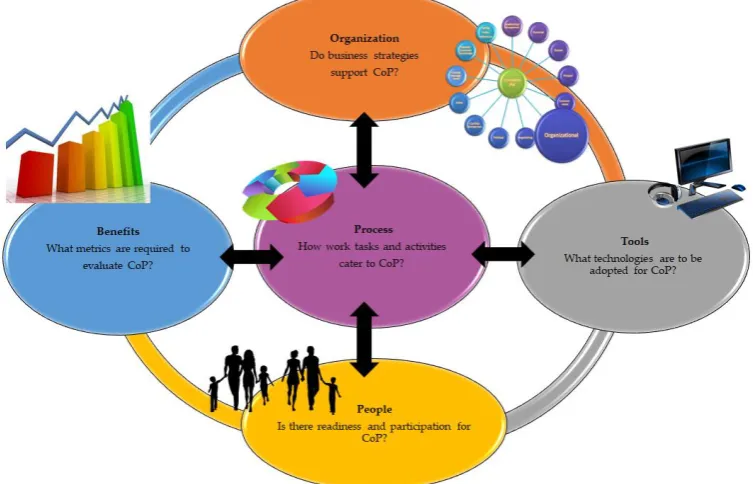
have an impact on KM success factor. We provide below key guidelines in adopting BTOPP model in this context.
Figure 2. CoP implementation guideline using BTOPP model
Benefits
Knowledge management is expected to provide various benefits to individual employees and to the organization including employees and customers [23][46][60]. Although there is an establishment of relationship between knowledge and practice, the leading purpose of CoP approach to KM is to bring value to an organisation. Some of the key benefits of adopting CoP as a KM strategy are listed below:
• Facilitates collaboration and effective networking • Provides opportunities to contribute
• Cross-fertilizes ideas and increases opportunities for innovation
• Assists people to be up-to-date with knowledge of products and services • Develops professional skills to solve problems quickly
• Results in efficient organisational decision-making • Builds organizational memory and diffuses best practices • Enables organizations to have a competitive advantage
However, one of the biggest questions when investing into CoP is, how to measure its value for the organization that can be addressed by answering by the following question:
What metrics are required to evaluate CoP? Our recommended strategy to answer this question is as follows:
Tools
In the context of KM, the tools used could be of various nature: Information Technology (IT) based tools and strategy based non-IT tools. However, in today’s digital world, even non-IT tools require the right technologies for effective CoP implementation. Hence, choosing the right tools in CoP will go a long way to help organisations fulfil their KM goals [53]. Some of the tools that could be effectively use in various CoP approaches are:
• Groupware and other collaboration tools which are essential enablers of knowledge flow and knowledge-sharing activities among the people who participate in the CoP.
• Data mining and knowledge discovery tools which can be used to “discover” or identify emergent patterns that could not have otherwise been detected. These techniques when adopted in various CoP approaches provide valuable insights into the tacit and explicit knowledge created through the SECI model.
• Knowledge repositories which form the most frequently used tool is the most visible aspect of a KM technology adopted in CoP. Organisation make use of their intranet and a KM
database to store their knowledge repositories and share them.
Recent emergence of wireless technologies have resulted in the development of new tools that make use of mobile information and communication technologies (ICT). These tools challenge the traditional practices of document management to take innovative steps for their effect use. Their impact on CoP approaches for retaining knowledge as part of organizational memory is yet to be explored fully. Hence, a relevant question raised in this context is:
What technologies are to be adopted for CoP? To answer this question, we recommend the following strategy:
Leverage on Technology - Effective use of technology in CoP would help to acquire the tacit knowledge from the domain experts through online discussions, chats, forums, blogs, etc. We recommend the use of automatic acquisition techniques to extract tacit knowledge from such implied expert knowledge and store in the organizations’ data warehouses [61]. However, the size of the data warehouses would become very large and any data mining or discovery mechanism may pose issues. Our recommendation is to manage these technologies through appropriate processes, methods and techniques such as summarization of tacit knowledge gained and other methods by adopting the Wiig KM cycle.
Organisation
The focal point of KM in an organization is to determine how management functions are structured in an organization, including support functions such as Human Resources and IT Services. The structure of an organisation influences the effectiveness of CoP as a KM strategy. Hence, CoP needs to reach out to all the different parts/functions of the organisation, and it needs to be supported by the management [44][51]. Organizational structure determines the manner and the extent to which “the roles, power and the responsibilities are delegated, controlled and coordinated”, and how the information flows between the levels of management. Some of the questions raised to determine a suitable organization structure and business strategy to support CoP are: What are the CoP projects and reporting structures? What are individual/team responsibilities? Where are they are located and who do they report to? The various types of organizational structures adopted for CoP are:
• Informal reporting structure where employees take into voluntary membership of CoPs and this can result in multi-disciplinary members forming groups and project teams. Here,
the people’s effectiveness is based on trust development.
• Empowered department structure which can result in increased capacity for improved action when members of CoP are highly motivated as they adopt an empowered leadership style.
Before embarking on KM, the management may wish to understand what the popular CoP approaches are, and how to employ business strategies to support the CoPs and the communities to link to one another. Hence, the management of an organization would like to answer the following question:
Do business strategies support CoP? Our recommendation is that the management should adopt a corporate culture with a set of understanding that members of a community should share in common. This is would help to align their business strategies to support CoPs and the knowledge flow within an organisation as follows:
Establish Purposeful Relationships - Create and support member directories with relationship-based data fields that can link to the member profiles in the network. A social network is a set of interconnected people who directly or indirectly interact and influence each other. Businesses are using social networks for various reasons, and organisations could make use of such popular networks to discover and establish their CoPs. Organisations adopt social network analysis to examine what type of knowledge is being exchanged and the pattern of its exchange within the organizational structure. This would facilitate not only to discover the barriers to knowledge exchange but also to identify areas of the organization that need better integration into the knowledge network. Knowledge mapping and folksonomy help in establishing purposeful relationships in CoP through classifying online content into different categories. Collaborative tagging content on the web is often done with social bookmarking and metadata so that people with similar interests could form purposeful relationships in the CoP.
People
It requires organizational change for making people to share knowledge and to get themselves comfortable with the idea of KM. Staff should be able to see the benefits of sharing knowledge with other employees. Employees already overworked in their daily tasks may not be willing to participate in knowledge sharing activities [19-20]. Organisations should embark on ways and means to keep people motivated with the idea of knowledge management. They need to be given training as well as staff autonomy on their jobs to innovate new methods to fulfil their tasks. When people participate in CoPs, some of the outcomes are:
• Enhanced communication within the organisation
• Increased participation of employees in business decisions • Faster delivery of cost effective projects
• Reduction in the problem-solving time • Improved productivity.
The organization requires to adopt good change management strategies to prepare the staff for embarking on CoP approaches for KM.. If there is resistance among people in using KM tools and technologies, then they need to be provided with sufficient and focused training [27][52]. The management should endeavor to answer the following question:
Is there readiness and participation for CoP? To answer this question, we recommend the following:
tasks. Another way to motivate staff participation is by introducing goal and rewards system. Each employee’s individual goals and targets could be linked to their level of contribution in CoPs. Feedback systems could be developed to encourage people to innovative ideas and suggestions to improve the workplace tasks. The emphasis should be on the quality of the contribution rather than the quantity. Relevant ongoing training opportunities should be provided to employees as part of their professional development. Process
Many organisations plan for KM with a ‘physical’ community by providing shared document repositories and databases, and only some organizations provide virtual community spaces for synchronous or asynchronous communication and the sharing of tacit knowledge that can facilitate the development of CoPs [19]. Knowledge can be pooled and used in a variety of different ways to provide support with key enabling features as listed below:
• Capable of holding large amounts of data in various formats with easy search facilities so that employees can make use of them in their work processes
• Reasonable response times for downloading large data files so that these repositories can be utilized for real-time problem solving in projects
• Secure access to knowledge so that integrity and authenticity of knowledge is maintained even after different people reuse in in several work related processes
Employees will be able to see the benefit of intellectual capital reuse depending on the context and the purpose in which knowledge can relate to their work processes [2][5]. Hence, it is important to ask the following question that will help an organization to align the business processes for effective CoP implementation:
How work tasks and activities cater to CoP?
We recommend that organizations follow the business strategy given below:
Embed KM processes into Business Processes – Re-engineer the business activities to cater to CoP by embedding KM processes into work related processes. For successful use of both the physical and virtual community spaces, organisations need to implement the internal work processes to be aligned with the following KM processes:
• Knowledge Discovery & Detection: Organisational knowledge resides internally and externally. Knowledge detection includes the various processes of identifying the
knowledge sources that already exist, as well as discovering hidden knowledge that is within the data and information. These processes should be embedded within the
emplyees’work tasks and activities.
• Knowledge Organization & Assessment: This is the process of mapping, categorizing, indexing as well as evaluating the knowledge assets of the organisation. The IT department of the organisation should deploy the necessary software tools to facilitate
automatic and easy categorization and retrieval of knowledge from the organisation’s knowledge assets in a variety of ways that are appropriate for the job-related
processes.
• Knowledge Sharing: In CoPs approaches, knowledge sharing is the most significant KM process directly related to job-related process leading to the creation of knowledge
as well as knowledge reuse.
• Knowledge Reuse: In every work activity, three roles can be identified - i) knowledge producer for knowledge creation, ii) intermediary for knowledge preparation, and iii) consumer for knowledge reuse. These can be embedded into business processes
• Knowledge Creation: This process depends upon knowledge sharing, collaboration and access to the relevant information and data. The role of management is to create work related environments suitable to the type of CoP adopted. Establishing
work-based access to the relevant data and information from various sources such as structured data warehouses, digital stories and idea banks is important in order to
integrate the knowledge creation process with the business process of the organisation. • Knowledge Acquisition: Knowledge can be acquired both internally and externally
using CoP approaches that include Web conferencing, online discussions, online meetings, expert knowledge bases and search tools with various stakeholders such as
customers, partners, suppliers, competitors and mergers. When these sharing sessions are directly integrated with the job activities and work tasks, there will be more
willingness to share and acquire knowledge, thereby reaping the benefits of CoP.
4. Challenges to CoP Implementation and Recommendations
CoP approaches have been adopted to support collaboration in many organisations as a KM strategy to improve knowledge generation and dissemination. However, several studies have also reported challenges that form barriers to their successful implementation [19]. Some of the barriers identified are, resistance to knowledge sharing, work overload, lack of management support, technical issues using the IT tools, lack of time, non-clear benefits and conflicting priorities between CoP and business functions. We identify these key challenges under two main categories: Organisational Culture and Performance Measurement.
Organisational Culture
The most difficult constraint that organisations face in the successful implementation of CoPs is to establish the right organisational culture. Some organisations have introduced change management programs to encourage staff participation in CoPs and to share knowledge with a positive attitude. Many organisations provide an induction training for staff to understand the tools used for CoPs. Some organisations also adopt business process re-engineering methods to link the KM activities of CoP with the work tasks and business processes. However, with dynamic changes in the business and staff turnover, it is important to continuously recognise and monitor organisational change in achieving the desired organisational culture required for a successful CoP adoption and for reaping the benefits of KM.
Recommendation:
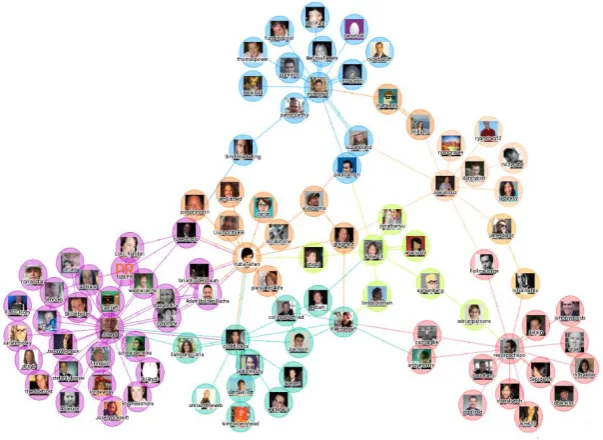
The concept of social networks was introduced in early 20th century that depicts relationships
developed to understand how the organization has used or shared the knowledge and to even identify for which tasks the employees have shared the knowledge. It can be employed to find out if the type of knowledge held by a person is important to the work and whether it is easy for others to access it. Such information helps the organisation to identify bottlenecks in their organisational culture and to make the necessary transformation for change. By monitoring the knowledge networks using SNA, the organisation can reorganize the work structures, provide support in knowledge transfer and introduce a shared goal for the CoP so that members can collaborate and work towards a business theme of interest.
Figure 3. Illustration of a SNA graph of the knowledge network in a CoP
Performance Measurement
One of the critical challenges for most organisations is to demonstrate the benefits of CoP in their KM pursuit. This is due to the difficulties in explicitly linking KM with business strategy. While organisations have demonstrated introduction of KM initiatives through CoP approaches, they have not put in place methods to evaluate the contribution of such activities towards business improvements. There is a need to establish a shared goal of developing and aligning KM strategy to business objectives. Organisations need to monitor and communicate the KM benefits through the performance metrics, which can help in increasing an understanding of the level of staff awareness, and the recognition of reform required to address the existing barriers.
Recommendation:
The most important characteristic to consider when choosing or defining a KM performance measure is that the metric should relate to the knowledge being shared and used [21]. Three types of metrics that need to be suitably defined and employed are: i) System Metrics, ii) Output Metrics , and iii) Outcome Metrics. We illustrate these three metrics in the context of conducting a performance measurement with regard to evaluating the usefulness and responsiveness of a support technology in CoP. System metrics such as, Number of contributions and Contribution rate over time could give an indication of the amount of knowledge shared and reused. Other metrics could also be developed to identify which knowledge assets are the most popular ones and which have usability problems. Output metrics such as Number of problems resolved and Time taken to resolve could measure the use of knowledge at the project or task level. Outcome metrics such as Savings in time/money and Improvement in quality/efficiency of a business process or a group project could provide a measure on the impact of the KM project or initiative of the organization. They measure large-scale characteristics such as increased productivity. With the availability of technologies of Big Data and data warehousing, intelligent data mining techniques could be adopted to gain deep insights using such performance metrics with the tangible and explicit knowledge gained through CoPs [28][47][63].
Figure 4. Illustration of Performance measurements for KM initiatives
Figure 4 shows a 3D line chart illustrating a possible trend in key performance indicators of the organisation’s KM initiative over a period of time. The blue line indicates the system metrics showing an initial high response of contributions within the first 10 days and then falling gradually. Probably an email reminder was sent soliciting contributions on day 20 which resulted in an increasing trend, and after 30 days the response decreases rapidly. The grey line illustrates the growth of output metrics on the number of problems resolved after introducing the KM initiative. Within 20 days, this metric has increased but slowly, then in the next 10 days the trend improves and finally there is a significant increase in the metric for the following 10 days. The orange line shows a steady and consistently increasing trend of the outcome metrics such as money or time saved throughout the 40-day period of monitoring. Hence different performance metrics could be used for gaining insgights into the KM initiatives of the organistion.
Overall, organisations should encourage and facilitate formal and informal knowledge sharing activities to create new intellectual capital of interest. Both SNA and performance metrics could help organistaions to assess the effectiveness of their KM initiatives. They provide feedback on the usage of the system and the level of knowledge reuse in business processes. Evaluating the content management of the intellectual capital as well as the organisation’s culture towards knowledge
System Output
Outcome
0 1 2 3 4 5
Day 10
Day 20
Day 30
Day 40
Key performance indicators
sharing is essential to understand the areas where benefits of KM have been realized as well as those that require improvement.
5. Conclusions and Future Research
The concept of CoP is perceived to make a valuable contribution to the sharing and diffusion of knowledge by connecting people together. Many organisations treat CoP implementation as another project by leveraging on technologies. While a project also brings people together to work in teams, sharing and applying knowledge to solve a problem, the activities are undertaken in a structured manner within the project boundaries, which is in contrast to CoPs where there are no clear-cut boundaries, and the objectives emerge as the participation progresses. Hence, the organisations have difficulties in identifying an appropriate CoP implementation framework. Further, with organisations entering into a competitive digital economy, CoP approaches adopted in KM systems require a revisit and review for a successful and sustained implementation. This research has aimed to address these challenges by proposing a CoP implementation framework for a successful KM strategy in an organisation. The fundamental role of CoP in KM systems was revisited in today’s context and an effective mechanism of applying Wiig KM cycle for CoP with an emphasis on building, sharing and using tacit and explicit knowledge was explored following the SECI model. The proposed CoP implementation framework was developed by adopting the BTOPP model for incorporating various practical knowledge sharing techniques. Finally, key barriers of CoPs that relate to organizational culture and performance measurement were discussed with recommendations to overcome them. Practical measures to continuously improve and sustain CoP implementations were illustrated with the focus on the organization’s KM strategy to complement and add value to the business operations.
This research could trigger and point towards additional areas related to CoP that could be of interest to KM practitioners as future study. Understanding the dynamics of interactions in the virtual communities, facilitating the participants to tap on their creativity and many other dimensions of CoP to enhance collaborative KM across time and distance need further exploration.
Author Contributions: Conceptualization, V.R. and S.V.; Methodology, S.V.; Investigation, V.R. and S.V.; Resources, V.R.; Writing-Original Draft Preparation, S.V.; Writing-Review & Editing, V.R.
Conflicts of Interest: The authors declare no conflict of interest.
References
1. Kankanhalli, A.; Tanudidjaja, F.; Sutanto, J.; Tan, B.C.Y. The role of IT in successful knowledge management initiatives. Communications of the ACM, 2003, 46(9), 69-73.
2. Su, N.M.; Wilensky, H.N. & Redmiles, D.F. Doing Business with Theory: Communities of Practice in Knowledge Management, Computer Supported Coop Work, 2012, 21(2-3): 111-161.
3. Ihrig, M.; MacMillan, I. Managing your mission-critical knowledge. Harvard business review, 2015, 93(1-2), 81-87.
4. McElroy, M.W. The New Knowledge Management. London: Routledge, 2010.
5. Mohapatra, S.; Agrawal, A.; Satpathy, A. Designing Knowledge Management-Enabled Business Strategies. Springer International Publishing. 2016.
6. Tallman, S.; Jenkins, M.; Henry, N.; Pinch, S. Knowledge, clusters, and competitive advantage. Academy of Management Review, 2004, 29(2), 258-271.
7. McDermott, R. Why information technology inspired but cannot deliver knowledge management. California Management Review, 1999, 41(4), 103-117.
8. Chase, Charles. Turning knowledge into action at Heinekin USA, KM Review, 2002. 5 (2), pp: 22-25. 9. Wiig, K.M. Knowledge Management: Where Did it Come From and Where Will It Go?. Expert Systems with
Applications, 1997, 13(1), 1-14.
12. Cerchione, R.; Esposito, E.; Spadaro, M.R. A literature review on knowledge management in SMEs. Knowledge Management Research & Practice, 2016, 14(2), 169-177.
13. Coakes E.; Communities of Practice and Technology Support in E. Coakes & S. Clarke Encyclopedia of Communities of Practice in Information and Knowledge Management, Hershey: IGP Reference. 2006.
14. Young, R. D. Knowledge Management Tools and Techniques Manual. Hirakawacho, Tokyo, Japan: Asian Productivity Organization. 2010.
15. Louis Sanzogni, Gustavo Guzman On & Peter Busch, Artificial intelligence and knowledge management: questioning the tacit dimension, Prometheus. Critical Studies in Innovation, 2017, 35(1), pp. 37-56.
16. Bennet, A.; Bennet, R. The partnership between organizational learning and knowledge management. In C.W. Holsapple (Ed.), Knowledge management handbook: Volume 1—knowledge matters (pp. 439-455). Berlin: Springer-Verlag. 2003.
17. Cavusgil, S. Tamer, Roger J. Calantone and Yushan Zhao. Tacit knowledge transfer and firm innovation capability, Journal of Business and Industrial Marketing, 2003, 18 (1), pp: 6-21.
18. Von Krogh, G.; Ichijo, K.; Nonaka, I. Enabling knowledge creation: How to unlock the mystery of tacit knowledge and release the power of innovation. Oxford University Press. 2000.
19. Ardichvilli, A.; Page, V.; Wentling, T. Motivation and barriers to participation in virtual knowledge-sharing communities of practice. Journal of Knowledge Management, 2003, 7(1), 64-77.
20. Schofield, K.; Analoui, B.; Brooks, J.; Husain , S. F. Competitive Communities of Practice, Knowledge Sharing, and Machiavellian Participation: A Case Study. International Journal of Training and Development. 2018.
21. Dalkir, K.. Knowledge Management in Theory and Practice. Amsterdam: Elsevier, 2005.
22. Sapsed, J.; Besant, J.; Partington, D.; Tranfield, D.; Young, M. Teamworking and knowledge management: A review of converging themes. International Journal of Management Reviews, 2002, 4(1), 71- 85.
23. Inkinen, H. Review of empirical research on knowledge management practices and firm performance. Journal of Knowledge Management, 2016, 20(2), 230-257.
24. Nonaka, I.; Takeuchi, H. The knowledge-creating company. New York; Oxford: Oxford University Press. 1995. 25. Kraatz, M. S. Learning by association? Interorganizational networks and adaptation to environmental
change. Academy of Management Journal, 1998, 41(6), 621.
26. Mäkinnen S. Document Management, Organisational Memory and Mobile Environment In E. Coakes, S. Clarke Encyclopedia of Communities of Practice in Information and Knowledge Management Hershey: IGP Reference, 2006, pp. 141-147.
27. Mäkinen, S. The use of mobile ICT in organizational document management in the context of organizational memory. Proceedings of the Information Resources Management Association International Conference IRMA2004, May 23-26, 2004, New Orleans, Louisiana. 2004.
28. Owrang Discovering Implicit Knowledge from Data Warehouses in E. Coakes, S. Clarke Encyclopedia of Communities of Practice in Information and Knowledge Management, Hershey: IGP Reference. 2006.
29. Lam, A. Embedded firms, embedded knowledge: Problems of collaboration and knowledge transfer in global cooperative ventures. Organizational Studies, 1997, 18(6), 973-997.
30. Narvaez, L.-M.; Dalkir, K.; Gardoni, M. Managing knowledge needs during new product lifecycle. Montreal, Canada: Automated Production Department. 2012.
31. Avent, M. S. A network-based approach to organizational culture and learning, College Station, Texas, 2015. 32. Heald, B. Convincing your staff on CoPs— what’s in it for them? KMOnline, 2004, 7(2), 3.
33. Cox, A. What are communities of practice? A comparative review of four seminal works. Journal of Information Science, 2005, 31(6), 527–540.
34. Wenger, E. C. Communities of Practice: Learning, meaning and identity. Cambridge: Cambridge University Press. 1998.
35. Wenger, E. C.; Snyder, W. M. Communities of practice: The organizational frontier. Harvard Business Review, 2000, 78(1), 139-145.
36. Grey, B. Informal Learning in an Online Community of Practice. Journal of Distance Education, 2004, Vol 19, No. 1, pp 20-35.
37. Kulkki, S. Knowledge creation of global companies. In C.W. Choo & N. Bontis (Eds.), The strategic management of intellectual capital and organisational knowledge (pp. 501-519). Oxford, UK: Oxford University Press. 2002.
39. Allen, D. K.; Shoard, M. Spreading the load: Mobile information and communication technologies and their effect on information overload. Proceedings of the ISIC Conference, Dublin, Ireland. 2004.
40. Pan, S.L. Leidner, D.E. Bridging communities of practice with information technology in pursuit of global knowledge sharing. Journal of Strategic Information Systems, 2003, 12, 71-88.
41. Grant, R.M. The knowledge-based view of the firm. In C.W. Choo & N. Bontis (Eds.), The strategic management of intellectual capital and organisational knowledge (pp. 133-148). Oxford, UK: Oxford University Press. 2002.
42. Vestal, W. Ten traits for a successful community of practice. Knowledge Management Review, 2003, 5(6), 6. 43. Stewart, T.A. The wealth of knowledge: Intellectual capital and the twenty-first century organisation. New York:
Currency. 2001.
44. Boisot, M. The creation and sharing of knowledge. In C.W. Choo & N. Bontis (Eds.), The strategic management of intellectual capital and organisational knowledge (pp. 65-77). Oxford, UK: Oxford University Press. 2002.
45. Gongla, P.; Rizzuto, C. R. Evolving communities of practice: IBM Global Services experience. IBM Systems Journal, 2001, 40(4), 842-862.
46. Wenger, E.; Trayner, B.; de Laat, M. Promoting and assessing value creation in communities and networks: a conceptual framework. Rapport 18, Ruud de Moor Centrum, Open University of the Netherlands. 2011. 47. Henke, N.; Bughin, J.; Chui, M.; Manyika, J.; Saleh, T.; Wiseman, B.; Sethupathy, G. The Age of Analytics:
Competing in a Data-driven World. McKinsey Global Institute. 2016.
48. Wenger, E.C.; McDermott, R.; Snyder, W.M. Cultivating communities of practice. Boston: Harvard Business School Press. 2002.
49. Ranmuthugala, G.; Plumb, J.J.; Cunningham, F.C.; Georgiou, A.; Westbrook, J.I.; Braithwaite, J. How and why are communities of practice in the healthcare sector? A systematic review of the literature. BMC Health Services Research, 2011, 11, 273.
50. Barbour, L.; Armstrong, R.; Condron, P.; Palermo C. Communities of practice to improve public health outcomes: a systematic review, Journal of Knowledge Management, 2018, 22(2), pp.326-343
51. Benner, C. Learning communities in a learning region: The soft infrastructure of cross-firm learning networks in Silicon Valley. Environment and Planning A: Economy & Space, 2003, 35, pp. 1809-1830. 52. Kischuk, N.; Gauthier, B.; Roy, S.N.; Borys, S. Learning circles for advanced professional development in
evaluation. The Canadian Journal of Program Evaluation, 2013, 28(1), pp. 87-96
53. Coakes E. A Comparison of the Features of some CoP Software in E. Coakes & S. Clarke Encyclopedia of Communities of Practice in Information and Knowledge Management Hershey: IGP Reference, 2006, pp 89-91. 54. Burress, A.; Wallace, S. Brainstorming across boundaries at Shell. KM Review, 2003, 6(2), 20-23.
55. Kling, R.; Courtright, C. Group behaviour and learning in electronic forums: A sociotechnical approach. Information Society, 2003, 19(3), 221-235.
56. Kaplan, S. Models for group and organizational collaboration. Walnut Creek, CA: iCohere, 2002.
57. Bogenrieder, I.; Nooteboom, B. Learning groups: What types are there? A theoretical analysis and an empirical study in a consultancy firm. Organization Studies, 2004, 25(2), 287.
58. Gongla, P.; Rizzuto, C.R. Where did that community go? Communities of practice that disappear. In P. Hildreth & C. Kimble (Eds.), Knowledge networks: Innovation through communities of practice (pp. 295-307). Hershey, PA: Idea Group Publishing. 2004.
59. Preece, J.; and Maloney-Krichmar, D. Online communities: Design, Theory, and Practice. Journal of Computer-Mediated Communication, 2005, 10(4), 1.
60. Malhotra, Y. Knowledge Management for E-Business Performance: Advancing Information Strategy to Internet Time , Information Strategy, The Executive's Journal, 2000, 16(4), pp 5-16.
61. Venkatraman, S. A Proposed Business Intelligent Framework for Recommender Systems. Informatics 2017, 4, 40.