
The Boomerang Attacks on BLAKE and BLAKE2
Yonglin Hao
Department of Computer Science and Technology, Tsinghua Universtiy, Beijing 100084, China
Abstract. In this paper, we study the security margins of hash functions BLAKE and BLAKE2 against
the boomerang attack. We launch boomerang attacks on all four members of BLAKE and BLAKE2, and compare their complexities. We propose 8.5-round boomerang attacks on both BLAKE-512 and BLAKE2b with complexities 2464 and 2474 respectively. We also propose 8-round attacks on BLAKE-256 with complexity 2198 and 7.5-round attacks on BLAKE2s with complexity 2184. We verify the correctness of our analysis by giving practical 6.5-round Type I boomerang quartets for each member of BLAKE and BLAKE2.
According to our analysis, some tweaks introduced by BLAKE2 have increased its resistance against boomerang attacks to a certain extent. But on the whole, BLAKE still has higher a secure margin than BLAKE2.
1
Introduction
Cryptographic hash functions (simply referred as hash functions) are playing a significant role in the modern cryptology. They are indispensable in achieving secure systems such as digital signatures, message authenti-cation codes and so on. In the cryptanalysis of hash functions, one of the greatest breakthrough was made by Wang et al. in 2005 when they successfully launched collision attacks on widely used hash functions MD5 [1] and SHA-1 [2]. After that, the analytic methods against hash functions have been greatly improved which threatens the security of existing hash functions. To cope with this situation, NIST proposed the transition from SHA-1 to SHA-2. Furthermore, NIST also launched the SHA-3 competition to develop a new hash standard. After years’ analysis, five proposals entered the final round of SHA-3 and the one named Keccak became the new SHA-3 standard in 2012 [3].
The BLAKE hash function [4] was one of the five finalists of the SHA-3 competition [5]. Although it was not selected as the SHA-3 standard, along with the other finalists, BLAKE is assumed to be a very strong hash function with high security margin and very good performance in software.
BLAKE2 [6] is a new family of hash functions based on BLAKE. According to [6], the main objective of BLAKE2 is to provide a number of parameters for use in applications without the need of additional constructions and modes, and also to speed-up even further the hash function to a level of compression rate close to MD5.
Ever since its proposal, BLAKE has attracted a considerable amount of cryptanalysis, such as impossible differential attack [7], differential attack[8], collision, preimage [9] etc. There is also a boomerang distinguisher on BLAKE-32 given by Biryukov et al. in [10] but some incompatible problems were pointed out by Leurent in [11]. Despite of the incompatibilities, [10] indicates that the boomerang method may have good efficiency in analyzing the BLAKE family. Recently, Bai et al. have given the first valid 7-round and 8-round boomerangs for BLAKE-256 [12].
As to BLAKE2, Guo et al. [13] have given a thorough security analysis of it. In their paper, they applied almost all the existing attacks on BLAKE to BLAKE2. According to their results, the tweaks introduced by BLAKE2, if analyzed separately, reduce the security of the version in some theoretical attacks. Some cryptanalysis methods manage to reach more rounds for BLAKE2 than BLAKE. BLAKE seems to have better resistance than BLAKE2 against various cryptanalysis methods. However, [13] did not evaluate the security margin of the two hash function families under the boomerang method and this is what we are going to do in this paper.
Later, Kelsey et al. [15] developed the original version into a chosen plaintext attack called the amplified boomerang attack. Developments were also made by Biham et al. in [16] and [17].
During the past few years, the idea of the boomerang attack has been applied to many hash functions. Biryukov et al. [10] and Lamberger et al. [18] independently applied the boomerang attack to BLAKE-32 and SHA-256. The SHA-256 result was later improved by Biryukov et al. in [19]. Ever after, we saw the boomerang results on many hash functions such as SIME-512 [20], HAVAL [21], RIPEMD-128/160 [22], HAS-160 [21], Skein-256/512 [23,24], SM3 [25,26] and BLAKE-256 [12]. The boomerang attack has become a common tool for analyzing various hash functions.
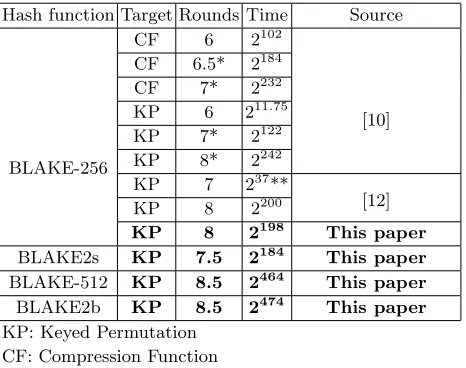
Our contribution. We reevaluate the boomerang attack on BLAKE-256 in [12] and apply the method to the keyed permutations of all BLAKE and BLAKE2 members namely BLAKE-256, BLAKE-512, BLAKE2s and BLAKE2b. We construct boomerang distinguishers for 8.5-round keyed permutation of BLAKE-512 and BLAKE2b (both from round 2.5 to 11). The complexity for attacking BLAKE-512 is 2464 and that for BLAKE2b is 2474. We also present 7.5-round attack on BLAKE2s (round 2.5 to 10) with complexity 2184.
Besides, we lower the complexity of the 8-round BLAKE-256 result in [12] from 2200 to 2198 with slight
modification of the differential characteristic. We present our boomerang results along with previous ones in Table 1. As can be seen, some tweaks introduced by BLAKE2 have surprisingly increased its resistance against boomerang attacks to a certain extent. But, since BLAKE has more rounds, the secure margin of BLAKE is still higher than that of BLAKE2.
Table 1.All existing boomerang results on BLAKE and BLAKE2.
Hash function Target Rounds Time Source
BLAKE-256
CF 6 2102
[10] CF 6.5* 2184
CF 7* 2232
KP 6 211.75
KP 7* 2122
KP 8* 2242
KP 7 237**
[12]
KP 8 2200
KP 8 2198 This paper
BLAKE2s KP 7.5 2184 This paper
BLAKE-512 KP 8.5 2464 This paper
BLAKE2b KP 8.5 2474 This paper
KP: Keyed Permutation CF: Compression Function
*: there are some incompatible problems in their attacks **: this is the complexity for the Type III boomerang
while others are of Type I.
Organization of the Paper.In Section 2, we briefly introduce the round functions of BLAKE and BLAKE2, and provide the overview of the boomerang attack. Section 3 describes the way that we deduce the differential characteristics and the process of building the boomerang distinguishers. Finally, we conclude our paper in Section 4.
2
Preliminary
In the second part of this section, we review the procedure of the boomerang attack on hash functions and give some definitions that we use in the description of our attacks.
2.1 The Round Functions of BLAKE and BLAKE2
BLAKE and BLAKE2 share many similarities. As the successor of BLAKE, BLAKE2 has a 32-bit version (BLAKE2s) and a 64-bit version (BLAKE2b), corresponding to BLAKE-256 and BLAKE-512 of BLAKE respectively. Both BLAKE and BLAKE2 process 16-word message blocks. However, differences can be wit-nessed at every level including internal permutation, compression function, and hash function construction. Some notations have to be introduced first:
← variable assignment;
+ modular 232 or 264addition (according to the word length);
− modular 232 or 264subtraction (according to the word length);
⊕ bitwise exclusive or;
≪n cyclic shiftnbits towards the most significant bit; ≫n cyclic shiftnbits towards the least significant bit;
∧ bitwise AND operation for words.
The Round functions of both BLAKE and BLAKE2 process a state of 16 64-bit or 32-bit words represented by a 4×4 matrix as follows:
V =
v0 v1 v2 v3
v4 v5 v6 v7
v8 v9 v10v11
v12v13v14v15
.
In the remainder of this paper, we denote the 16-word intermediate state by the capital letters such asV, T V and M for message block. Single 64-bit or 32-bit words are denoted by small letters such asv, tvand mfor message words. We also refer to the i-th bit of a wordv (i= 0,· · ·31 or 63 from the least significant to the most significant) asv[i].
Once the stateV is initialized,V is processed by several rounds (10, 12, 14, 16 for BLAKE2s, BLAKE2b, BLAKE-256, BLAKE512 respectively) ofGfunctions, which means computing
G0(v0, v4, v8, v12), G1(v1, v5, v9, v13), G2(v2, v6, v10, v14), G3(v3, v7, v11, v15)
G4(v0, v5, v10, v15), G5(v1, v6, v11, v12), G6(v2, v7, v8, v13), G7(v3, v4, v9, v14)
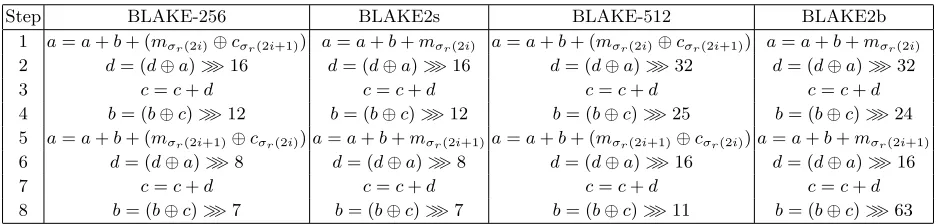
where Gi(a, b, c, d), i = 0,· · · ,7 differ among BLAKE2s, BLAKE2b, BLAKE-256, BLAKE512 and are all
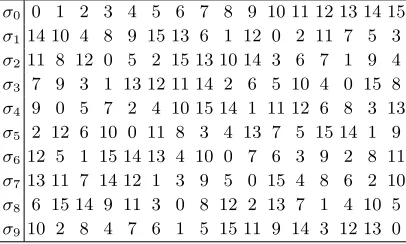
listed in Table 2. The σr in Step 1 and 5 of theGi function in Table 2 belongs to the set of permutations as
defined in Table 3. At roundr >9, the permutation used isσr mod 10(for example, ifr= 11, the permutation
σ11 mod 10=σ1 is used).
Table 2.TheGi Functions of BLAKE-256, BLAKE2s, BLAKE-512, BLAKE2b
Step BLAKE-256 BLAKE2s BLAKE-512 BLAKE2b
1 a=a+b+ (mσr(2i)⊕cσr(2i+1)) a=a+b+mσr(2i) a=a+b+ (mσr(2i)⊕cσr(2i+1)) a=a+b+mσr(2i) 2 d= (d⊕a)≫16 d= (d⊕a)≫16 d= (d⊕a)≫32 d= (d⊕a)≫32
3 c=c+d c=c+d c=c+d c=c+d
4 b= (b⊕c)≫12 b= (b⊕c)≫12 b= (b⊕c)≫25 b= (b⊕c)≫24 5 a=a+b+ (mσr(2i+1)⊕cσr(2i))a=a+b+mσr(2i+1)a=a+b+ (mσr(2i+1)⊕cσr(2i))a=a+b+mσr(2i+1) 6 d= (d⊕a)≫8 d= (d⊕a)≫8 d= (d⊕a)≫16 d= (d⊕a)≫16
7 c=c+d c=c+d c=c+d c=c+d
8 b= (b⊕c)≫7 b= (b⊕c)≫7 b= (b⊕c)≫11 b= (b⊕c)≫63
steps ofG0,···,3andVr+0.5is computed afterG0,···,3are completed. Similarly, we can computeT Vr+0.5from
Vr+0.5by applying steps 1,2,3,4 ofG
4,···,7and further computeVr+1by finishingG4,···,7. This representation
is illustrated as (1) and (2).
G0,···,3:Vr
Steps 1,···,4
−−−−−−−−→T Vr−−−−−−−−→Steps 5,···,8 Vr+0.5 (1) G4,···,7:Vr+0.5
Steps 1,···,4
−−−−−−−−→T Vr+0.5−−−−−−−−→Steps 5,···,8 Vr+1 (2) In this way, we can refer to any intermediate state word of any round easily.
Table 3.The definition ofσrwherer= 0,· · ·,9.
σ0 0 1 2 3 4 5 6 7 8 9 10 11 12 13 14 15
σ114 10 4 8 9 15 13 6 1 12 0 2 11 7 5 3
σ211 8 12 0 5 2 15 13 10 14 3 6 7 1 9 4
σ3 7 9 3 1 13 12 11 14 2 6 5 10 4 0 15 8
σ4 9 0 5 7 2 4 10 15 14 1 11 12 6 8 3 13
σ5 2 12 6 10 0 11 8 3 4 13 7 5 15 14 1 9
σ612 5 1 15 14 13 4 10 0 7 6 3 9 2 8 11
σ713 11 7 14 12 1 3 9 5 0 15 4 8 6 2 10
σ8 6 15 14 9 11 3 0 8 12 2 13 7 1 4 10 5
σ910 2 8 4 7 6 1 5 15 11 9 14 3 12 13 0
2.2 The Boomerang Attack
About the boomerang attack on hash functions, we mainly review the known-related-key boomerang method given in [19]. We consider the compression function, denoted byCF, asCF(M, K) =E(M, K) +M and that it can be decomposed into two sub-functions asCF =CF1◦CF0. In this way, we can start from the middle
steps since M and the key K can be chosen randomly [19,23]. Then we have a backward (top) differential characteristic (β, βk)→ α with probability p for CF0−1, and a forward (bottom) differential characteristic
(γ, γk)→δwith probabilityqforCF1. Finally, we can launch the known-related-key boomerang attack with
these two differential characteristics as follows:
1. Choose randomly a intermediate state (X1, K1) and compute (Xi, Ki), i = 2,3,4 by X3 = X1⊕β,
X2=X1⊕γ,X4=X3⊕γ, andK3=K1⊕βk,K2=K1⊕γk,K4=K3⊕γk.
2. Compute backward from (Xi, Ki) and obtainPi byPi =CF0−1(Xi, Ki) (i= 1,2,3,4).
3. Compute forward from (Xi, Ki) and obtainCi byCi=CF1(Xi, Ki) (i= 1,2,3,4).
4. Check whetherP1⊕P3=P2⊕P4=αandC1⊕C2=C3⊕C4=δ.
It can be deduced thatP1⊕P3=P2⊕P4=αandC1⊕C2=C3⊕C4=δhold with probability at least
p2in the backward direction andq2 in the forward direction. Therefore, the attack succeeds with probability p2q2when assuming that the differential characteristics are independent.
According H. Yu et al. in [24], for a n-bit random permutation, there are three types of boomerang distinguishers:
– Type I: A quartet satifiesP1⊕P3=P2⊕P4=αandC1⊕C2=C3⊕C4=δfor fixed differencesαand
δ. In this case, the generic complexity is 2n.
– Type II: Only C1⊕C2 = C3⊕C4 is satisfied (This property is also called zero-sum or second-order
differential collision). In this case, the complexity for obtaining such a quartet is 2n/3 [27].
– Type III: A quartet satisfied P1⊕P3=P2⊕P4 and C1⊕C2 =C3⊕C4. In this case, the best known
still takes time 2n/2.
We only study the Type I boomerang distinguisher in this paper. Besides, the complexity 237 of the 7-round
3
The Boomerang Attacks on BLAKE and BLAKE2
In this section, we describe our boomerang attacks on BLAKE and BLAKE2. We only illustrate our strate-gies by comparing BLAKE-512 and BLAKE2b while those of BLAKE-256 and BLAKE2s can be deduced accordingly. Details are presented in Appendix A.
3.1 Construction of Differential Characteristics
The very first step for the boomerang attack is constructing two differential characteristics with high probabil-ity. Since BLAKE and BLAKE2 are ARX hash functions (only use three simple operations namelyModular Add“+”,Rotation“≫” andXOR“⊕”), we can use the XOR difference and deduce the difference linearly by considering the only nonlinear operation “+” as similar linear operation “⊕”.
The XOR difference in this paper is represented in two forms as follow:
– Hex form:such as∆v= 0x8003 indicates that bitsv[0,1,15] of the word vare active (having non-zero XOR difference).
– Numeric form:such as∆v= (15,1,0) is equivalent to∆v= 0x8003 in hex form. Besides, if ∆v= 0x0 in hex form, we denoted by∆v=φin numeric form.
The numeric form is mainly used to describe the differential characteristics since it has better outlook and can save some space. But in practice, we use the hex form to linearly deduce differential characteristics. For example, in theGfunction of BLAKE-512, we have
ta=a+b+ (mi⊕cj)
where cj is constant. Suppose we have acquired the differences ∆a,∆band∆mi, we can dedcue ∆taas
∆ta=∆a⊕∆b⊕∆mi.
Once we have determined the difference of the message block ∆M and that of a intermediate state ∆Vr
(r= 0,0.5,1,· · ·), we can linearly extend the difference backward and forward.
We construct the two differential characteristics for the boomerang attack, where the top differential characteristic is from round 2.5 to 6.5 and bottom differential difference is from 6.5 to 11. We denote the difference of the top by ∆tVr (r ∈ [2.5,6.5]) and that of the bottom by ∆bVr (r ∈ [6.5,11]). Similarly,
the difference for the message block is denoted as ∆tM in the top characteristic and∆bM in the bottom characteristic. The main procedures for our characteristic construction can be summarized as follows: Import Difference: We first import simple difference to message block∆bM (∆tM) and the intermediate
state∆bV8(∆tV4).
Linear Extension: After we have determined ∆bM (∆tM) and ∆bV8 (∆tV4), we extend the difference
backward to round 6.5 (2.5) and forward to round 11 (6.5) to acquire the whole bottom (top) differential characteristic.
Construct the Bottom Differential Characteristic: In order to lower the complexity, we only import 1-bit differences to both∆bM and∆bV8. The selection of active bits is based on Observation 1in [10].
We found thatm11of the 16 message words, namelym0,· · ·, m15, appears at Step 1 inG2at round 8 and
also appears at Step 5 inG4at round 9. So, the first step of our construction is importing 1-bit difference to
m11 andv28 as
∆bm11=∆bv28= (63). (3)
In this way, according to Observation 1in [10], we can pass round 8 and 9 with probability 2−1. Then, we set ∆bm
i=φ(i∈ {0,1,· · ·,15} \ {11}) and∆bv8j =φ(j∈ {0,1,· · ·,15} \ {2}). Now that∆bM and∆bV8
are settled, we can linearly extend the difference backward to ∆bV6.5 and forward to ∆bV11. This method
For BLAKE-256 and BLAKE2s, we can also import difference to∆bM and∆bV8 as
∆bm11=∆bv28= (31). (4)
and linearly deduce the whole bottom differential characteristics. The differential characteristic for BLAKE-256 mounts to round 10.5 and BLAKE2s reaches round 10 since it only has 10 rounds in total according to [6]. Refer to Table 6 and Table 7 in Appendix A for detailed descriptions.
Construct the Top Differential Characteristic: The top differential characteristic starts from∆tV2.5
and ends at ∆tV6.5. The strategy of constructing the top differential characteristic is similar to that of its bottom counterpart. We found thatm5appears at Step 1 inG1at round 4 and also appears at Step 5 inG5
at round 5, so we decide to import the 1-bit difference at m5and v41. We assign that
∆tm5=∆tv41= (y), wherey∈ {0,· · ·,63}. (5)
and that ∆bmi =φ ( i ∈ {0,· · · ,15} \ {5}) and∆bvj4 = φ(j ∈ {0,· · · ,15} \ {1}). Then, we can linearly
extend the difference backward and forward. The position of the active bityin (5) requires careful selection. In order to avoid incompatible problems and enhance the efficiency of the attack,y must meet the following conditions:
1. When linearly extend the difference from∆tV4(y) to∆tV6.5(y), make sure that
∆bvi6.5∧∆tvi6.5(y) = 0x0, for alli∈ {0,· · ·,15}. (6) This restriction avoid the contradictions in the intersection part of the two differential characteristics. 2. (Only for BLAKE-512)Make sure that the constantsc10 andc7 satisfies:
c10[y] =¬c7[y]. (7)
According to the linear extension, we have∆tv13.5 =φ. It requires (m5⊕c10)[y] =¬(m5⊕c7)[y], so (7)
must be satisfied.
3. (Only for BLAKE2b)When linearly extend to∆tV3.5,∆tv3.5
1 should be set to
∆tv13.5=∆tm5+∆tm5
instead of 0x0. Because BLAKE2b omit the use of constant, the difference can not be eliminated atv3.51 .
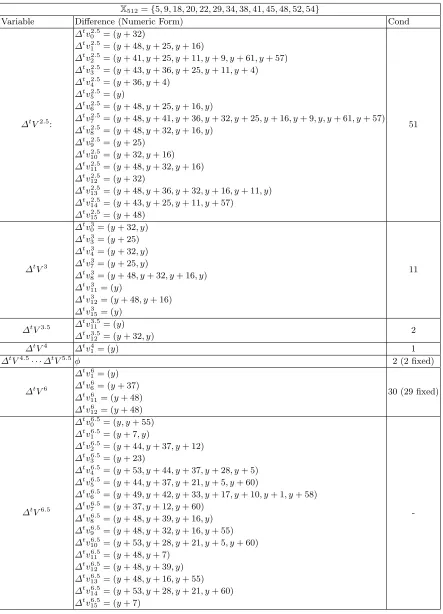
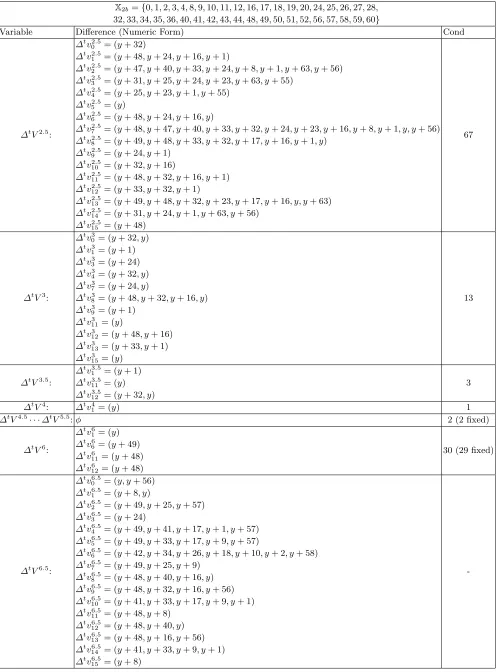
The available ys satisfying conditions 1 and 2 compose a setX512, and those satisfying conditions 1 and 3
compose a setX2b. According to our analysis,X512has 13 elements andX2bhas 40 elements. We presentX512
andX2b along with the corresponding top differential characteristics in Table 8 and Table 9 in Appendix A.
Using the same method, we can also acquire the availableys for BLAKE-256 (X256) and BLAKE2s (X2s).
We illustrateX256 andX2s along with their characteristics in Table 10 and Table 11 in Appendix A.
3.2 Finding the Boomerang Quartet Using Message Modification Technique
The goal of our boomerang attack is to find a quartet, denoted by (aV2.5,bV2.5,cV2.5,dV2.5), and the message
blocks (aM,bM,cM,dM) that satisfies
aV2.5⊕cV2.5=bV2.5⊕dV2.5=∆tV2.5 (8)
aM⊕cM =bM ⊕dM =∆tM (9)
aM⊕bM =cM ⊕dM =∆bM (10)
and, after 8.5 rounds, the corresponding quartet (aV11,bV11,cV11,dV11) satisfies
We start by searching for appropriateaV6.5 andaM. Once aV6.5is determined, bV6.5,cV6.5 anddV6.5 can
be settled directly since
aV6.5⊕cV6.5=bV6.5⊕dV6.5=∆tV6.5 (11)
aV6.5⊕bV6.5=cV6.5⊕dV6.5=∆bV6.5 (12)
Once aM is determined, bM, cM and dM can also be determined according to (9) and (10). The step of
finding the quartet is as follows:
1. Construct an intermediate state, denoted byV6.5, and a message block, denoted by M, by setting the values of their 16 words randomly.
2. Compute backward toT V6andV6, and forward toT V6.5, V7. During the process, if one of bit conditions,
which are deduced from the top and bottom characteristics, is violated, we can fix it by modifying the words ofV6.5 orM. This process is called the “message modification”.
3. After all conditions between round 6 and 7 are satisfied, we assign thataV6.5 ←V6.5 and aM ←M.
We also assign corresponding values to bV6.5, cV6.5, dV6.5 according to (11) (12) and to bM, cM, dM
according to (9) (10).
4. Having acquired (aV6.5,bV6.5, cV6.5dV6.5) and (aM,bM,cM,dM), we compute backward to round 2.5.
During the process, we check whether the differences of the intermediate states conform to the top differential characteristic. Once a contradiction is detected, go back to 1.
5. Compute forward from round 6.5 to round 11. During the computation, we check whether differences of the intermediate states conform to the bottom differential characteristic. Once a contradiction is detected, go back to 1. Otherwise, output the quartet (aV11,bV11,cV11,dV11).
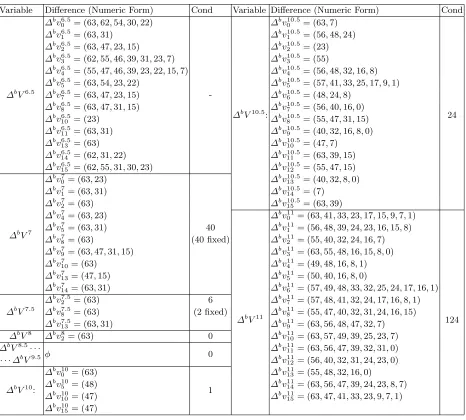
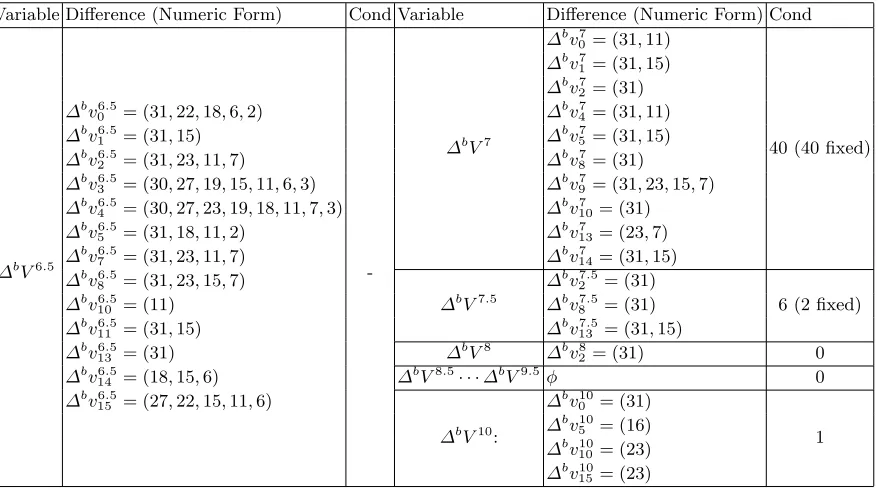
Complexity analysis. For all 4 members of BLAKE and BLAKE2, there are 30 conditions in ∆bV6 →
∆tV6.5. 29 of them can be fixed using the message modification technique. All two conditions in ∆tV6 →
∆tV5.5 can be fixed as well. Similarly, all 40 conditions in∆bV6.5 → ∆bV7 and 2 out of 6 conditions in ∆bV7→∆bV7.5can be fixed. Then, we analyze the four members separately as follows:
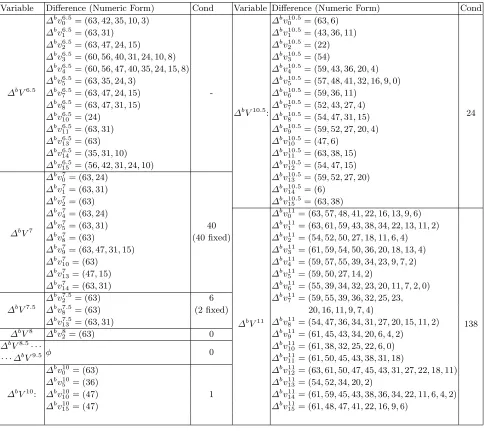
BLAKE-512: In the bottom characteristic, there are 4 unfixed conditions in∆bV7→∆bV7.5, 1 in∆bV9.5→
∆bV10, 24 in∆bV10→∆bV10.5 and 138 in∆bV10.5→∆bV11, which is 167 in total. In the top
charac-teristics, the situation is as follows: 1 unfixed condition in∆tV4.5 →∆tV4, 2 in∆tV4→∆tV3.5, 11 in
∆tV3.5 →∆tV3 and 51 in∆tV3 →∆tV2.5, which is 65 in total. So, the complexity of the boomerang
attack on BLAKE-512 is 2(167+65)×2= 2464.
BLAKE2b: In the bottom characteristic, there are 4 unfixed conditions in∆bV7→∆bV7.5, 1 in∆bV9.5→
∆bV10, 24 in∆bV10→∆bV10.5and 124 in∆bV10.5→∆bV11, which is 153 in total. The top differential characteristic is slightly different from BLAKE-512 after finishing the procedure∆tV6.5→∆tV4. There
are 3 unfixed conditions in∆tV4 →∆tV3.5, 13 in∆tV3.5 → ∆tV3 and 67 in∆tV3 →∆tV2.5. So the
number of unfixed conditions in the top characteristic enhances to 1 + 3 + 13 + 67 = 84. The complexity of the boomerang attack on BLAKE2b is 2(153+84)×2= 2474.
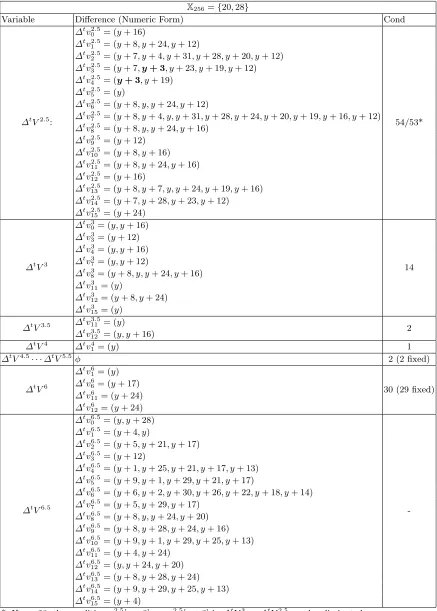
BLAKE-256: Similar to BLAKE-512, the bottom characteristic of BLAKE-256, terminated at round 10.5, has 4 + 1 + 24 = 29 unfixed conditions (∆bV6.5→∆tV10.5). For the top characteristic of BLAKE-256, if we choose the active bit position y = 20 ∈ X256, which is also the case of [12], there should be 71
unfixed conditions and the complexity of this 8-round boomerang attack is 2(29+71)×2= 2200. However,
if we choosey= 28∈X256, 1 condition in∆tV3→∆tV2.5 can be eliminated and the complexity of the
attack can lower to 2(29+70)×2= 2198.
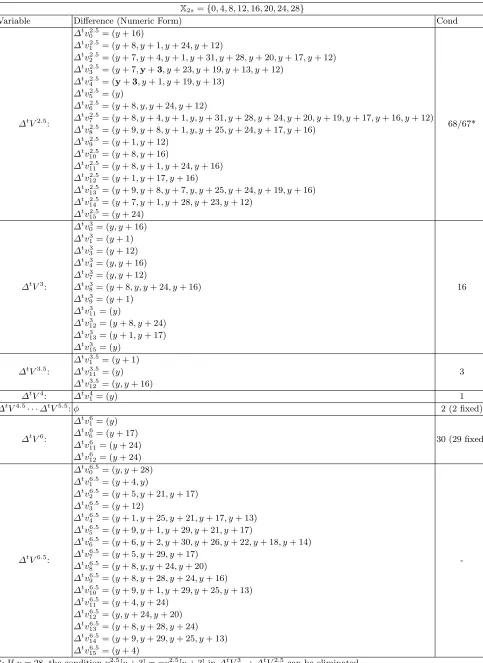
BLAKE2s: Similar to BLAKE2b, the bottom characteristic for BLAKE2s, terminated at round 10, has 4 + 1 = 5 unfixed conditions. The top characteristic has 88 unfixed conditions. So the complexity of this 7.5-round boomerang attack for BLAKE2s is 2(5+88)×2 = 2186. Like BLAKE-256, if we choose y= 28∈X2s, we can eliminate 1 condition in∆tV3→∆tV2.5and lower the complexity by 22 to 2184.
Practical Verifications.For each member of BLAKE and BLAKE2, we present a 6.5 round ( from round 3.5 to round 10) Type I boomerang quartet based on our characteristics and present it in Appendix B. In order to show the structural difference between BLAKE and BLAKE2, we use the examples with the same message difference, which means: for BLAKE-256 and BLAKE2s,∆tm
5 = (28) (y = 28∈X256TX2s) and
4
Conclusion
In this paper, we compare the security margin of BLAKE and BLAKE2 under the boomerang attack mod-el. We deduce valid differential characteristics and present boomerang attacks on keyed permutations of BLAKE-512, BLAKE2b, BLAKE-256 and BLAKE2s. According to our analysis, the boomerang method can mount to similar rounds for BLAKE and BLAKE2. For the same number of rounds, the complexities for attacking BLAKE2 are slightly higher than those for BLAKE, which indicates that some tweaks introduced by BLAKE2, aiming at enhancing efficiency and flexibility, have accidentally reinforced the resistance a-gainst the boomerang attack. However, since BLAKE has more rounds than BLAKE2, the security margin of BLAKE is still higher than that of BLAKE2. This result is in accordance with the assumptions of the designers.
Acknowledgement. This work has been supported by the National Natural Science Foundation of China (Grant No. 61133013) and by 973 Program (Grant No. 2013CB834205).
References
1. Wang, X., Yu, H.: How to break md5 and other hash functions. In: Advances in Cryptology–EUROCRYPT 2005. Springer (2005) 19–35
2. Wang, X., Yin, Y.L., Yu, H.: Finding collisions in the full sha-1. In: Advances in Cryptology–CRYPTO 2005, Springer (2005) 17–36
3. Bertoni, G., Daemen, J., Peeters, M., Assche, G.: The keccak reference. Submission to NIST (Round 3)13(2011) 4. Aumasson, J.P., Henzen, L., Meier, W., Phan, R.C.W.: Sha-3 proposal blake. Submission to NIST (2008) 5. Chang, S.j., Perlner, R., Burr, W.E., Turan, M.S., Kelsey, J.M., Paul, S., Bassham, L.E.: Third-round report of
the SHA-3 cryptographic hash algorithm competition. Citeseer (2012)
6. Aumasson, J.P., Neves, S., Wilcox-OHearn, Z., Winnerlein, C.: Blake2: simpler, smaller, fast as md5. In: Applied Cryptography and Network Security, Springer (2013) 119–135
7. Aumasson, J.P., Guo, J., Knellwolf, S., Matusiewicz, K., Meier, W.: Differential and invertibility properties of blake. In: Fast Software Encryption, Springer (2010) 318–332
8. Dunkelman, O., Khovratovich, D.: Iterative differentials, symmetries, and message modification in blake-256. In: ECRYPT2 Hash Workshop. Volume 2011. (2011)
9. Ji, L., Liangyu, X.: Attacks on round-reduced blake. Technical report, Citeseer (2009)
10. Biryukov, A., Nikoli´c, I., Roy, A.: Boomerang attacks on blake-32. In: Fast Software Encryption, Springer (2011) 218–237
11. Leurent, G.: Arxtools: A toolkit for arx analysis. In: The Third SHA-3 Candidate Conference. (2012)
12. Bai, D., Yu, H., Wang, G., Wang, X.: Improved boomerang attacks on round-reduced sm3 and blake-256. (2013)
http://eprint.iacr.org/.
13. Guo, J., Karpman, P., Nikoli´c, I., Wang, L., Wu, S.: Analysis of blake2. In: Topics in Cryptology–CT-RSA 2014. Springer (2014) 402–423
14. Wagner, D.: The boomerang attack. In: Fast Software Encryption, Springer (1999) 156–170
15. Kelsey, J., Kohno, T., Schneier, B.: Amplified boomerang attacks against reduced-round mars and serpent. In: Fast Software Encryption, Springer (2001) 75–93
16. Biham, E., Dunkelman, O., Keller, N.: The rectangle attackrectangling the serpent. In: Advances in Cryptolo-gyEUROCRYPT 2001. Springer (2001) 340–357
17. Biham, E., Dunkelman, O., Keller, N.: Related-key boomerang and rectangle attacks. In: Advances in Cryptology– EUROCRYPT 2005. Springer (2005) 507–525
18. Lamberger, M., Mendel, F.: Higher-order differential attack on reduced sha-256. IACR Cryptology ePrint Archive
2011(2011) 37
19. Biryukov, A., Lamberger, M., Mendel, F., Nikoli´c, I.: Second-order differential collisions for reduced sha-256. In: Advances in Cryptology–ASIACRYPT 2011. Springer (2011) 270–287
20. Mendel, F., Nad, T.: Boomerang distinguisher for the simd-512 compression function. In: Progress in Cryptology– INDOCRYPT 2011. Springer (2011) 255–269
22. Sasaki, Y., Wang, L.: Distinguishers beyond three rounds of the ripemd-128/-160 compression functions. In: Applied Cryptography and Network Security, Springer (2012) 275–292
23. Leurent, G., Roy, A.: Boomerang attacks on hash function using auxiliary differentials. In: Topics in Cryptology– CT-RSA 2012. Springer (2012) 215–230
24. Yu, H., Chen, J., Wang, X.: The boomerang attacks on the round-reduced skein-512. In: Selected Areas in Cryptography, Springer (2013) 287–303
25. Kircanski, A., Shen, Y., Wang, G., Youssef, A.M.: Boomerang and slide-rotational analysis of the sm3 hash function. In: Selected Areas in Cryptography, Springer (2013) 304–320
26. Bai, D., Yu, H., Wang, G., Wang, X.: Improved boomerang attacks on sm3. In: Information Security and Privacy, Springer (2013) 251–266
27. Wagner, D.: A generalized birthday problem. In: Advances in cryptologyCRYPTO 2002. Springer (2002) 288–304
Appendix
A
The Bottom & Top Differential Characteristics for BLAKE and BLAKE2
Table 4.The bottom characteristic for BLAKE-512.∆bm
11= (63).
Variable Difference (Numeric Form) Cond Variable Difference (Numeric Form) Cond
∆bV6.5
∆bv6.5
0 = (63,42,35,10,3)
-∆bV10.5:
∆bv10.5
0 = (63,6)
24
∆bv6.5
1 = (63,31) ∆bv110.5= (43,36,11)
∆bv6.5
2 = (63,47,24,15) ∆bv210.5= (22)
∆bv6.5
3 = (60,56,40,31,24,10,8) ∆bv310.5= (54)
∆bv64.5= (60,56,47,40,35,24,15,8) ∆bv410.5= (59,43,36,20,4)
∆bv65.5= (63,35,24,3) ∆bv510.5= (57,48,41,32,16,9,0)
∆bv67.5= (63,47,24,15) ∆bv610.5= (59,36,11)
∆bv68.5= (63,47,31,15) ∆bv710.5= (52,43,27,4)
∆bv610.5= (24) ∆bv810.5= (54,47,31,15)
∆bv611.5= (63,31) ∆bv910.5= (59,52,27,20,4)
∆bv613.5= (63) ∆
b
v1010.5= (47,6)
∆bv6.5
14 = (35,31,10) ∆bv1110.5= (63,38,15)
∆bv6.5
15 = (56,42,31,24,10) ∆bv1210.5= (54,47,15)
∆bV7 ∆bv7
0= (63,24) ∆bv1310.5= (59,52,27,20)
∆bv7
1= (63,31) ∆bv1410.5= (6)
∆bv7
2= (63) ∆bv1510.5= (63,38)
∆bv74= (63,24)
∆bV11
∆bv011= (63,57,48,41,22,16,13,9,6)
138
∆bv75= (63,31) 40 ∆bv111= (63,61,59,43,38,34,22,13,11,2)
∆bv78= (63) (40 fixed) ∆bv211= (54,52,50,27,18,11,6,4)
∆bv79= (63,47,31,15) ∆bv311= (61,59,54,50,36,20,18,13,4)
∆bv710= (63) ∆bv411= (59,57,55,39,34,23,9,7,2)
∆bv713= (47,15) ∆bv511= (59,50,27,14,2)
∆bv714= (63,31) ∆
b
v611= (55,39,34,32,23,20,11,7,2,0)
∆bV7.5
∆bv7.5
2 = (63) 6 ∆bv711= (59,55,39,36,32,25,23,
∆bv7.5
8 = (63) (2 fixed) 20,16,11,9,7,4)
∆bv7.5
13 = (63,31) ∆bv811= (54,47,36,34,31,27,20,15,11,2)
∆bV8 ∆bv8
2= (63) 0 ∆bv911= (61,45,43,34,20,6,4,2)
∆bV8.5· · ·
φ 0 ∆
bv11
10= (61,38,32,25,22,6,0) · · ·∆bV9.5 ∆bv1111= (61,50,45,43,38,31,18)
∆bV10:
∆bv100 = (63)
1
∆bv1211= (63,61,50,47,45,43,31,27,22,18,11)
∆bv105 = (36) ∆bv1311= (54,52,34,20,2)
∆bv1010= (47) ∆bv1411= (61,59,45,43,38,36,34,22,11,6,4,2)
Table 5.The bottom characteristic for BLAKE2b.∆bm
11= (63).
Variable Difference (Numeric Form) Cond Variable Difference (Numeric Form) Cond
∆bV6.5
∆bv6.5
0 = (63,62,54,30,22)
-∆bV10.5:
∆bv10.5
0 = (63,7)
24
∆bv6.5
1 = (63,31) ∆bv110.5= (56,48,24)
∆bv6.5
2 = (63,47,23,15) ∆bv210.5= (23)
∆bv6.5
3 = (62,55,46,39,31,23,7) ∆bv310.5= (55)
∆bv64.5= (55,47,46,39,23,22,15,7) ∆bv410.5= (56,48,32,16,8)
∆bv65.5= (63,54,23,22) ∆bv510.5= (57,41,33,25,17,9,1)
∆bv67.5= (63,47,23,15) ∆bv610.5= (48,24,8)
∆bv68.5= (63,47,31,15) ∆bv710.5= (56,40,16,0)
∆bv610.5= (23) ∆bv810.5= (55,47,31,15)
∆bv611.5= (63,31) ∆bv910.5= (40,32,16,8,0)
∆bv613.5= (63) ∆bv1010.5= (47,7)
∆bv614.5= (62,31,22) ∆
b
v1110.5= (63,39,15)
∆bv6.5
15 = (62,55,31,30,23) ∆bv1210.5= (55,47,15)
∆bV7 ∆bv7
0= (63,23) ∆bv1310.5= (40,32,8,0)
∆bv7
1= (63,31) ∆bv1410.5= (7)
∆bv7
2= (63) ∆bv1510.5= (63,39)
∆bv7
4= (63,23)
∆bV11
∆bv11
0 = (63,41,33,23,17,15,9,7,1)
124
∆bv75= (63,31) 40 ∆bv111= (56,48,39,24,23,16,15,8)
∆bv78= (63) (40 fixed) ∆bv211= (55,40,32,24,16,7)
∆bv79= (63,47,31,15) ∆bv311= (63,55,48,16,15,8,0)
∆bv710= (63) ∆bv411= (49,48,16,8,1)
∆bv713= (47,15) ∆bv511= (50,40,16,8,0)
∆bv714= (63,31) ∆bv611= (57,49,48,33,32,25,24,17,16,1)
∆bV7.5
∆bv72.5= (63) 6 ∆
b
v711= (57,48,41,32,24,17,16,8,1)
∆bv7.5
8 = (63) (2 fixed) ∆bv811= (55,47,40,32,31,24,16,15)
∆bv7.5
13 = (63,31) ∆bv911= (63,56,48,47,32,7)
∆bV8 ∆bv8
2= (63) 0 ∆bv1011= (63,57,49,39,25,23,7)
∆bV8.5· · ·
φ 0 ∆
bv11
11= (63,56,47,39,32,31,0)
· · ·∆bV9.5 ∆bv11
12= (56,40,32,31,24,23,0)
∆bV10:
∆bv100 = (63)
1
∆bv1311= (55,48,32,16,0)
∆bv105 = (48) ∆bv1411= (63,56,47,39,24,23,8,7)
∆bv1010= (47) ∆bv1511= (63,47,41,33,23,9,7,1)
Table 6.The bottom characteristic for BLAKE-256.∆bm11= (31).
Variable Difference (Numeric Form) Cond Variable Difference (Numeric Form) Cond
∆bV6.5
∆bv06.5= (31,22,18,6,2)
-∆bV8 ∆bv28= (31) 0
∆bv16.5= (31,15) ∆bV8.5· · ·∆bV9.5φ 0
∆bv26.5= (31,23,11,7)
∆bV10:
∆bv010= (31)
1
∆bv36.5= (30,27,19,15,11,6,3) ∆bv510= (16)
∆bv46.5= (30,27,23,19,18,11,7,3) ∆bv1010= (23)
∆bv56.5= (31,18,11,2) ∆
b
v1510= (23)
∆bv6.5
7 = (31,23,11,7)
∆bV10.5: 24
∆bv6.5
8 = (31,23,15,7)
∆bv6.5
10 = (11) ∆bv010.5= (31,3)
∆bv6.5
11 = (31,15) ∆bv110.5= (20,16,4)
∆bv6.5
13 = (31) ∆bv210.5= (11)
∆bv146.5= (18,15,6) ∆bv310.5= (27)
∆bv156.5= (27,22,15,11,6) ∆bv410.5= (28,20,16,8,0)
∆bV7
∆bv07= (31,11)
40 (40 fixed)
∆bv510.5= (29,25,21,17,13,5,1)
∆bv17= (31,15) ∆bv610.5= (28,16,4)
∆bv27= (31) ∆bv710.5= (24,20,12,0)
∆bv47= (31,11) ∆bv810.5= (27,23,15,7)
∆bv57= (31,15) ∆
b
v910.5= (28,24,12,8,0)
∆bv7
8 = (31) ∆bv1010.5= (23,3)
∆bv7
9 = (31,23,15,7) ∆bv1110.5= (31,19,7)
∆bv7
10= (31) ∆bv1210.5= (27,23,7)
∆bv7
13= (23,7) ∆bv1310.5= (28,24,12,8)
∆bv7
14= (31,15) ∆bv1410.5= (3)
∆bV7.5
∆bv27.5= (31)
6 (2 fixed)
∆bv1510.5= (31,19)
∆bv87.5= (31)
∆bv137.5= (31,15)
Table 7.The bottom characteristic for BLAKE2s.∆bm
11= (31).
Variable Difference (Numeric Form) Cond Variable Difference (Numeric Form) Cond
∆bV6.5
-∆bV7
∆bv70= (31,11)
40 (40 fixed)
∆bv71= (31,15)
∆bv72= (31)
∆bv6.5
0 = (31,22,18,6,2) ∆bv74= (31,11)
∆bv6.5
1 = (31,15) ∆bv75= (31,15)
∆bv6.5
2 = (31,23,11,7) ∆bv78= (31)
∆bv6.5
3 = (30,27,19,15,11,6,3) ∆bv79= (31,23,15,7)
∆bv6.5
4 = (30,27,23,19,18,11,7,3) ∆bv710= (31)
∆bv65.5= (31,18,11,2) ∆bv713= (23,7)
∆bv67.5= (31,23,11,7) ∆bv714= (31,15)
∆bv68.5= (31,23,15,7)
∆bV7.5
∆bv72.5= (31)
6 (2 fixed)
∆bv610.5= (11) ∆bv78.5= (31)
∆bv611.5= (31,15) ∆bv713.5= (31,15)
∆bv613.5= (31) ∆bV8 ∆bv82= (31) 0
∆bv614.5= (18,15,6) ∆bV8.5· · ·∆bV9.5 φ 0
∆bv615.5= (27,22,15,11,6)
∆bV10:
∆bv100 = (31)
1
∆bv10 5 = (16)
∆bv10 10= (23)
Table 8.The top characteristic for BLAKE-512. Message difference is∆tm
5= (y) wherey∈X512
X512={5,9,18,20,22,29,34,38,41,45,48,52,54}
Variable Difference (Numeric Form) Cond
∆tV2.5:
∆tv02.5= (y+ 32)
51
∆tv12.5= (y+ 48, y+ 25, y+ 16)
∆tv22.5= (y+ 41, y+ 25, y+ 11, y+ 9, y+ 61, y+ 57)
∆tv32.5= (y+ 43, y+ 36, y+ 25, y+ 11, y+ 4)
∆tv42.5= (y+ 36, y+ 4)
∆tv2.5 5 = (y)
∆tv2.5
6 = (y+ 48, y+ 25, y+ 16, y)
∆tv2.5
7 = (y+ 48, y+ 41, y+ 36, y+ 32, y+ 25, y+ 16, y+ 9, y, y+ 61, y+ 57)
∆tv2.5
8 = (y+ 48, y+ 32, y+ 16, y)
∆tv2.5
9 = (y+ 25)
∆tv102.5= (y+ 32, y+ 16)
∆tv112.5= (y+ 48, y+ 32, y+ 16)
∆tv122.5= (y+ 32)
∆tv132.5= (y+ 48, y+ 36, y+ 32, y+ 16, y+ 11, y)
∆tv142.5= (y+ 43, y+ 25, y+ 11, y+ 57)
∆tv152.5= (y+ 48)
∆tV3
∆tv03= (y+ 32, y)
11
∆tv33= (y+ 25)
∆tv43= (y+ 32, y)
∆tv73= (y+ 25, y)
∆tv83= (y+ 48, y+ 32, y+ 16, y)
∆tv113 = (y)
∆tv3
12= (y+ 48, y+ 16)
∆tv3 15= (y)
∆tV3.5 ∆
t
v113.5= (y)
2
∆tv123.5= (y+ 32, y)
∆tV4 ∆tv14= (y) 1
∆tV4.5· · ·∆tV5.5φ 2 (2 fixed)
∆tV6
∆tv16= (y)
30 (29 fixed)
∆tv6
6 = (y+ 37)
∆tv6
11= (y+ 48)
∆tv6
12= (y+ 48)
∆tV6.5
∆tv06.5= (y, y+ 55)
-∆tv16.5= (y+ 7, y)
∆tv6.5
2 = (y+ 44, y+ 37, y+ 12)
∆tv6.5
3 = (y+ 23)
∆tv6.5
4 = (y+ 53, y+ 44, y+ 37, y+ 28, y+ 5)
∆tv6.5
5 = (y+ 44, y+ 37, y+ 21, y+ 5, y+ 60)
∆tv6.5
6 = (y+ 49, y+ 42, y+ 33, y+ 17, y+ 10, y+ 1, y+ 58)
∆tv76.5= (y+ 37, y+ 12, y+ 60)
∆tv86.5= (y+ 48, y+ 39, y+ 16, y)
∆tv96.5= (y+ 48, y+ 32, y+ 16, y+ 55)
∆tv106.5= (y+ 53, y+ 28, y+ 21, y+ 5, y+ 60)
∆tv116.5= (y+ 48, y+ 7)
∆tv126.5= (y+ 48, y+ 39, y)
∆tv136.5= (y+ 48, y+ 16, y+ 55)
∆tv6.5
14 = (y+ 53, y+ 28, y+ 21, y+ 60)
∆tv6.5
Table 9.The top characteristic for BLAKE2b. Message difference is∆tm5= (y) wherey∈X2b
X2b={0,1,2,3,4,8,9,10,11,12,16,17,18,19,20,24,25,26,27,28, 32,33,34,35,36,40,41,42,43,44,48,49,50,51,52,56,57,58,59,60}
Variable Difference (Numeric Form) Cond
∆tV2.5:
∆tv2.5
0 = (y+ 32)
67
∆tv21.5= (y+ 48, y+ 24, y+ 16, y+ 1)
∆tv22.5= (y+ 47, y+ 40, y+ 33, y+ 24, y+ 8, y+ 1, y+ 63, y+ 56)
∆tv23.5= (y+ 31, y+ 25, y+ 24, y+ 23, y+ 63, y+ 55)
∆tv24.5= (y+ 25, y+ 23, y+ 1, y+ 55)
∆tv25.5= (y)
∆tv26.5= (y+ 48, y+ 24, y+ 16, y)
∆tv27.5= (y+ 48, y+ 47, y+ 40, y+ 33, y+ 32, y+ 24, y+ 23, y+ 16, y+ 8, y+ 1, y, y+ 56)
∆tv28.5= (y+ 49, y+ 48, y+ 33, y+ 32, y+ 17, y+ 16, y+ 1, y)
∆tv2.5
9 = (y+ 24, y+ 1)
∆tv2.5
10 = (y+ 32, y+ 16)
∆tv2.5
11 = (y+ 48, y+ 32, y+ 16, y+ 1)
∆tv2.5
12 = (y+ 33, y+ 32, y+ 1)
∆tv213.5= (y+ 49, y+ 48, y+ 32, y+ 23, y+ 17, y+ 16, y, y+ 63)
∆tv214.5= (y+ 31, y+ 24, y+ 1, y+ 63, y+ 56)
∆tv215.5= (y+ 48)
∆tV3:
∆tv3
0 = (y+ 32, y)
13
∆tv3
1 = (y+ 1)
∆tv33 = (y+ 24)
∆tv34 = (y+ 32, y)
∆tv37 = (y+ 24, y)
∆tv38 = (y+ 48, y+ 32, y+ 16, y)
∆tv39 = (y+ 1)
∆tv311= (y)
∆tv312= (y+ 48, y+ 16)
∆tv313= (y+ 33, y+ 1)
∆tv3 15= (y)
∆tV3.5:
∆tv31.5= (y+ 1)
3
∆tv311.5= (y)
∆tv312.5= (y+ 32, y)
∆tV4: ∆tv41 = (y) 1
∆tV4.5· · ·∆tV5.5:φ 2 (2 fixed)
∆tV6:
∆tv61 = (y)
30 (29 fixed)
∆tv6
6 = (y+ 49)
∆tv6
11= (y+ 48)
∆tv6
12= (y+ 48)
∆tV6.5:
∆tv60.5= (y, y+ 56)
-∆tv61.5= (y+ 8, y)
∆tv6.5
2 = (y+ 49, y+ 25, y+ 57)
∆tv6.5
3 = (y+ 24)
∆tv6.5
4 = (y+ 49, y+ 41, y+ 17, y+ 1, y+ 57)
∆tv6.5
5 = (y+ 49, y+ 33, y+ 17, y+ 9, y+ 57)
∆tv6.5
6 = (y+ 42, y+ 34, y+ 26, y+ 18, y+ 10, y+ 2, y+ 58)
∆tv67.5= (y+ 49, y+ 25, y+ 9)
∆tv68.5= (y+ 48, y+ 40, y+ 16, y)
∆tv69.5= (y+ 48, y+ 32, y+ 16, y+ 56)
∆tv610.5= (y+ 41, y+ 33, y+ 17, y+ 9, y+ 1)
∆tv611.5= (y+ 48, y+ 8)
∆tv612.5= (y+ 48, y+ 40, y)
∆tv613.5= (y+ 48, y+ 16, y+ 56)
∆tv6.5
14 = (y+ 41, y+ 33, y+ 9, y+ 1)
∆tv6.5
Table 10.The top characteristic for BLAKE-256. Message difference is∆tm
5= (y) wherey∈X256 .
X256={20,28}
Variable Difference (Numeric Form) Cond
∆tV2.5:
∆tv20.5= (y+ 16)
54/53*
∆tv21.5= (y+ 8, y+ 24, y+ 12)
∆tv22.5= (y+ 7, y+ 4, y+ 31, y+ 28, y+ 20, y+ 12)
∆tv23.5= (y+ 7,y+ 3, y+ 23, y+ 19, y+ 12)
∆tv24.5= (y+ 3, y+ 19)
∆tv2.5 5 = (y)
∆tv2.5
6 = (y+ 8, y, y+ 24, y+ 12)
∆tv2.5
7 = (y+ 8, y+ 4, y, y+ 31, y+ 28, y+ 24, y+ 20, y+ 19, y+ 16, y+ 12)
∆tv2.5
8 = (y+ 8, y, y+ 24, y+ 16)
∆tv2.5
9 = (y+ 12)
∆tv210.5= (y+ 8, y+ 16)
∆tv211.5= (y+ 8, y+ 24, y+ 16)
∆tv212.5= (y+ 16)
∆tv213.5= (y+ 8, y+ 7, y, y+ 24, y+ 19, y+ 16)
∆tv214.5= (y+ 7, y+ 28, y+ 23, y+ 12)
∆tv215.5= (y+ 24)
∆tV3
∆tv30= (y, y+ 16)
14
∆tv33= (y+ 12)
∆tv34= (y, y+ 16)
∆tv37= (y, y+ 12)
∆tv38= (y+ 8, y, y+ 24, y+ 16)
∆tv311= (y)
∆tv3
12= (y+ 8, y+ 24)
∆tv3 15= (y)
∆tV3.5 ∆
t
v311.5= (y)
2
∆tv312.5= (y, y+ 16)
∆tV4 ∆tv41= (y) 1
∆tV4.5· · ·∆tV5.5 φ 2 (2 fixed)
∆tV6
∆tv61= (y)
30 (29 fixed)
∆tv66= (y+ 17)
∆tv6
11= (y+ 24)
∆tv6
12= (y+ 24)
∆tV6.5
∆tv60.5= (y, y+ 28)
-∆tv61.5= (y+ 4, y)
∆tv62.5= (y+ 5, y+ 21, y+ 17)
∆tv6.5
3 = (y+ 12)
∆tv6.5
4 = (y+ 1, y+ 25, y+ 21, y+ 17, y+ 13)
∆tv6.5
5 = (y+ 9, y+ 1, y+ 29, y+ 21, y+ 17)
∆tv6.5
6 = (y+ 6, y+ 2, y+ 30, y+ 26, y+ 22, y+ 18, y+ 14)
∆tv67.5= (y+ 5, y+ 29, y+ 17)
∆tv68.5= (y+ 8, y, y+ 24, y+ 20)
∆tv69.5= (y+ 8, y+ 28, y+ 24, y+ 16)
∆tv610.5= (y+ 9, y+ 1, y+ 29, y+ 25, y+ 13)
∆tv611.5= (y+ 4, y+ 24)
∆tv612.5= (y, y+ 24, y+ 20)
∆tv613.5= (y+ 8, y+ 28, y+ 24)
∆tv614.5= (y+ 9, y+ 29, y+ 25, y+ 13)
∆tv6.5
15 = (y+ 4)
Table 11.The top characteristic for BLAKE2s. Message difference is∆tm5= (y) wherey∈X2s.
X2s={0,4,8,12,16,20,24,28}
Variable Difference (Numeric Form) Cond
∆tV2.5:
∆tv2.5
0 = (y+ 16)
68/67*
∆tv2.5
1 = (y+ 8, y+ 1, y+ 24, y+ 12)
∆tv22.5= (y+ 7, y+ 4, y+ 1, y+ 31, y+ 28, y+ 20, y+ 17, y+ 12)
∆tv23.5= (y+ 7,y+3, y+ 23, y+ 19, y+ 13, y+ 12)
∆tv24.5= (y+3, y+ 1, y+ 19, y+ 13)
∆tv25.5= (y)
∆tv26.5= (y+ 8, y, y+ 24, y+ 12)
∆tv27.5= (y+ 8, y+ 4, y+ 1, y, y+ 31, y+ 28, y+ 24, y+ 20, y+ 19, y+ 17, y+ 16, y+ 12)
∆tv28.5= (y+ 9, y+ 8, y+ 1, y, y+ 25, y+ 24, y+ 17, y+ 16)
∆tv29.5= (y+ 1, y+ 12)
∆tv2.5
10 = (y+ 8, y+ 16)
∆tv2.5
11 = (y+ 8, y+ 1, y+ 24, y+ 16)
∆tv2.5
12 = (y+ 1, y+ 17, y+ 16)
∆tv2.5
13 = (y+ 9, y+ 8, y+ 7, y, y+ 25, y+ 24, y+ 19, y+ 16)
∆tv214.5= (y+ 7, y+ 1, y+ 28, y+ 23, y+ 12)
∆tv215.5= (y+ 24)
∆tV3:
∆tv3
0 = (y, y+ 16)
16
∆tv3
1 = (y+ 1)
∆tv3
3 = (y+ 12)
∆tv34 = (y, y+ 16)
∆tv37 = (y, y+ 12)
∆tv38 = (y+ 8, y, y+ 24, y+ 16)
∆tv39 = (y+ 1)
∆tv311= (y)
∆tv312= (y+ 8, y+ 24)
∆tv313= (y+ 1, y+ 17)
∆tv315= (y)
∆tV3.5:
∆tv31.5= (y+ 1)
3
∆tv311.5= (y)
∆tv312.5= (y, y+ 16)
∆tV4: ∆tv41 = (y) 1
∆tV4.5· · ·∆tV5.5:φ 2 (2 fixed)
∆tV6:
∆tv61 = (y)
30 (29 fixed)
∆tv66 = (y+ 17)
∆tv6
11= (y+ 24)
∆tv6
12= (y+ 24)
∆tV6.5:
∆tv60.5= (y, y+ 28)
-∆tv61.5= (y+ 4, y)
∆tv62.5= (y+ 5, y+ 21, y+ 17)
∆tv6.5
3 = (y+ 12)
∆tv6.5
4 = (y+ 1, y+ 25, y+ 21, y+ 17, y+ 13)
∆tv6.5
5 = (y+ 9, y+ 1, y+ 29, y+ 21, y+ 17)
∆tv6.5
6 = (y+ 6, y+ 2, y+ 30, y+ 26, y+ 22, y+ 18, y+ 14)
∆tv6.5
7 = (y+ 5, y+ 29, y+ 17)
∆tv68.5= (y+ 8, y, y+ 24, y+ 20)
∆tv69.5= (y+ 8, y+ 28, y+ 24, y+ 16)
∆tv610.5= (y+ 9, y+ 1, y+ 29, y+ 25, y+ 13)
∆tv611.5= (y+ 4, y+ 24)
∆tv612.5= (y, y+ 24, y+ 20)
∆tv613.5= (y+ 8, y+ 28, y+ 24)
∆tv614.5= (y+ 9, y+ 29, y+ 25, y+ 13)
∆tv6.5
15 = (y+ 4)
B
6.5-Round Examples For BLAKE and BLAKE2
The main difference between BLAKE-256 and BLAKE2s (BLAKE-512 and BLAKE2b) is at∆tv3.5 1 , where
∆tv3.5
1 = (29) for BLAKE-2s (∆tv13.5 = (10) for BLAKE-2b) and φ for BLAKE-256 (BLAKE-512). We
specifically emphasize this part with bold dark format.
Table 12.Example for 6.5-round BLAKE-256 withy= 28∈X256TX2s.
∆M ∆bm11= (31),∆tm5 = (28)
aM
0x932a5d7f 0xa2625330 0x46a9466f 0xae3052a3 0xbf9a6338 0xd4167790 0x7bf0ef5e 0x4ef572ba
0x308dc96d 0x23b415c3 0x6fb64798 0xa75b42e8 0x3cb6d30e 0xb56003b4 0x7a4db777 0x715b79a
bM
0x932a5d7f 0xa2625330 0x46a9466f 0xae3052a3 0xbf9a6338 0xd4167790 0x7bf0ef5e 0x4ef572ba
0x308dc96d 0x23b415c3 0x6fb64798 0x275b42e8 0x3cb6d30e 0xb56003b4 0x7a4db777 0x715b79a
cM
0x932a5d7f 0xa2625330 0x46a9466f 0xae3052a3 0xbf9a6338 0xc4167790 0x7bf0ef5e 0x4ef572ba
0x308dc96d 0x23b415c3 0x6fb64798 0xa75b42e8 0x3cb6d30e 0xb56003b4 0x7a4db777 0x715b79a
dM
0x932a5d7f 0xa2625330 0x46a9466f 0xae3052a3 0xbf9a6338 0xc4167790 0x7bf0ef5e 0x4ef572ba
0x308dc96d 0x23b415c3 0x6fb64798 0x275b42e8 0x3cb6d30e 0xb56003b4 0x7a4db777 0x715b79a
∆tV3.5 ∆tv3.5
1 =φ,∆tv311.5= (28),∆tv312.5= (28,2)
aV3.5
0x7ce3001a 0x5f257eb 0x7cb1b540 0xf5f76e6 0x62eba0a0 0x8723a3b3 0x3a617d3b 0x616c91a2
0xf2e28cd6 0x2dd8b157 0x888f9a21 0x6074df04 0x370f729f 0xeecddee4 0x7f42197f 0x36ace0f3
bV3.5
0xce7042ae 0xc394a0c1 0xbdedbda1 0xbf9d773f 0x7fdd9e46 0xdefe6c9e 0xf9985a99 0x2e67c857
0x8903f293 0xfc2ed055 0xbcb66021 0x5ac97fd7 0xa42a029b 0x60de7589 0x637162de 0xfd1bd434
cV3.5
0x7ce3001a 0x5f257eb 0x7cb1b540 0xf5f76e6 0x62eba0a0 0x8723a3b3 0x3a617d3b 0x616c91a2
0xf2e28cd6 0x2dd8b157 0x888f9a21 0x7074df04 0x270f629f 0xeecddee4 0x7f42197f 0x36ace0f3
dV3.5
0xce7042ae 0xc394a0c1 0xbdedbda1 0xbf9d773f 0x7fdd9e46 0xdefe6c9e 0xf9985a99 0x2e67c857
0x8903f293 0xfc2ed055 0xbcb66021 0x4ac97fd7 0xb42a129b 0x60de7589 0x637162de 0xfd1bd434
∆bV10 ∆bv100 = (31),∆bv510= (16),∆bv1010= (23),∆bv1510= (23)
aV10
0x9920f4d5 0x7d8a6621 0xc7139615 0x205a3fce 0x4ded77e1 0x1ed1c43f 0x6e8efedc 0xf6f4fe72
0x6e17623b 0x4cd8bea2 0xfe2149af 0xd2f8e09c 0x53b6139c 0x3972162e 0xd4f82167 0x4d1b2a46
bV10
0x1920f4d5 0x7d8a6621 0xc7139615 0x205a3fce 0x4ded77e1 0x1ed0c43f 0x6e8efedc 0xf6f4fe72
0x6e17623b 0x4cd8bea2 0xfea149af 0xd2f8e09c 0x53b6139c 0x3972162e 0xd4f82167 0x4d9b2a46
cV10
0x5a870d65 0x8d12db5 0x537127c9 0xabdb13a9 0xcaf27105 0x17ef5f49 0x66721638 0x8f333fbf
0xccdc1196 0x3d9aaba6 0x84ee030c 0xda86539 0x976348e3 0xfde7c240 0x1df99dc8 0x568a818c
dV10
0xda870d65 0x8d12db5 0x537127c9 0xabdb13a9 0xcaf27105 0x17ee5f49 0x66721638 0x8f333fbf
Table 13.Example for 6.5-round BLAKE2s withy= 28∈X256TX2s.
∆M ∆bm
11= (31),∆tm5 = (28)
aM
0xce9f1cc6 0x7f3a9b64 0x9e9ddc55 0x4553fa8c 0xe2f4ad99 0x33a0533a 0x8b1d785c 0xc7f56492
0xe5b2b205 0xd44f69a1 0x2d83e500 0x18b03f68 0x13d0c628 0x15fce9f2 0x9108f878 0xc477ca04
bM
0xce9f1cc6 0x7f3a9b64 0x9e9ddc55 0x4553fa8c 0xe2f4ad99 0x33a0533a 0x8b1d785c 0xc7f56492
0xe5b2b205 0xd44f69a1 0x2d83e500 0x98b03f68 0x13d0c628 0x15fce9f2 0x9108f878 0xc477ca04
cM
0xce9f1cc6 0x7f3a9b64 0x9e9ddc55 0x4553fa8c 0xe2f4ad99 0x23a0533a 0x8b1d785c 0xc7f56492
0xe5b2b205 0xd44f69a1 0x2d83e500 0x18b03f68 0x13d0c628 0x15fce9f2 0x9108f878 0xc477ca04
dM
0xce9f1cc6 0x7f3a9b64 0x9e9ddc55 0x4553fa8c 0xe2f4ad99 0x23a0533a 0x8b1d785c 0xc7f56492
0xe5b2b205 0xd44f69a1 0x2d83e500 0x98b03f68 0x13d0c628 0x15fce9f2 0x9108f878 0xc477ca04
∆tV3.5 ∆tv13.5= (29),∆tv311.5= (28),∆tv123.5= (28,2)
aV3.5
0x71177c4a 0x456e63aa 0x63bc0484 0xe348f6a9 0xfa5c62fe 0x1229c0a3 0x12ea25d0 0xd7a6a55f
0x3ca79134 0x6ccc6e48 0x2bd29e5 0xc386b1 0x86f12557 0x414c79f1 0x3fb6c33 0x4baef1a0
bV3.5
0xaae6286d 0x1af8dcfe 0x70a74337 0xa293966a 0xe35d9b23 0xe74273b3 0xfb967985 0xc16500a7
0x57a589c8 0x5edbf5ae 0x66de7b25 0x15c8f5ff 0xd730836 0x357d6100 0x3ae77969 0x54a834da
cV3.5
0x71177c4a 0x656e63aa 0x63bc0484 0xe348f6a9 0xfa5c62fe 0x1229c0a3 0x12ea25d0 0xd7a6a55f
0x3ca79134 0x6ccc6e48 0x2bd29e5 0x10c386b1 0x96f13557 0x414c79f1 0x3fb6c33 0x4baef1a0
dV3.5
0xaae6286d 0x3af8dcfe 0x70a74337 0xa293966a 0xe35d9b23 0xe74273b3 0xfb967985 0xc16500a7
0x57a589c8 0x5edbf5ae 0x66de7b25 0x5c8f5ff 0x1d731836 0x357d6100 0x3ae77969 0x54a834da
∆bV10 ∆bv10
0 = (31),∆bv510= (16),∆bv1010= (23),∆bv1510= (23)
aV10
0x945cf52e 0x422107ab 0x3a682330 0x2f8bd4f1 0xeead389 0x21e907ec 0x17138a07 0xae021462
0x229a3e13 0x3c623c2c 0x64327d4a 0xf1d0e09a 0x5df5abad 0x1be8464a 0x7890983a 0x85288868
bV10
0x145cf52e 0x422107ab 0x3a682330 0x2f8bd4f1 0xeead389 0x21e807ec 0x17138a07 0xae021462
0x229a3e13 0x3c623c2c 0x64b27d4a 0xf1d0e09a 0x5df5abad 0x1be8464a 0x7890983a 0x85a88868
cV10
0xc136da56 0xe91ba476 0xfa9ad265 0x6b4d2f9e 0x68ef06c8 0x9ab4757a 0xe63456e0 0x8818e9d4
0x5da1784c 0x57ecd14b 0xcb0788b8 0xf3148edf 0xa19d7f24 0xf17b5303 0x9ec70b70 0x2f763872
dV10
0x4136da56 0xe91ba476 0xfa9ad265 0x6b4d2f9e 0x68ef06c8 0x9ab5757a 0xe63456e0 0x8818e9d4
Table 14.Example for 6.5-round BLAKE-512 withy= 9∈X512TX2b.
∆M ∆bm11= (63),∆tm5= (9)
aM
0x9c1860c444a6a9f4 0xc95a712fd5a29b72 0x6e5c6811448b300f 0x5c0af45531e396d3 0x679dee5280c15ad0 0x329f5347ccb9bf64 0x297828d3ec89e9d0 0xa55ffc029ea78609 0xef01f63ec485f87d 0x86560936e36d9dff 0xfd9674bb724d62e0 0x9c03f6f64a96659f 0xe3666bd816053d27 0xe4669665a4a0a440 0x1cbf0c93a121eb09 0x65a6a90ac809c019
bM
0x9c1860c444a6a9f4 0xc95a712fd5a29b72 0x6e5c6811448b300f 0x5c0af45531e396d3 0x679dee5280c15ad0 0x329f5347ccb9bf64 0x297828d3ec89e9d0 0xa55ffc029ea78609 0xef01f63ec485f87d 0x86560936e36d9dff 0xfd9674bb724d62e0 0x1c03f6f64a96659f 0xe3666bd816053d27 0xe4669665a4a0a440 0x1cbf0c93a121eb09 0x65a6a90ac809c019
cM
0x9c1860c444a6a9f4 0xc95a712fd5a29b72 0x6e5c6811448b300f 0x5c0af45531e396d3 0x679dee5280c15ad0 0x329f5347ccb9bd64 0x297828d3ec89e9d0 0xa55ffc029ea78609 0xef01f63ec485f87d 0x86560936e36d9dff 0xfd9674bb724d62e0 0x9c03f6f64a96659f 0xe3666bd816053d27 0xe4669665a4a0a440 0x1cbf0c93a121eb09 0x65a6a90ac809c019
dM
0x9c1860c444a6a9f4 0xc95a712fd5a29b72 0x6e5c6811448b300f 0x5c0af45531e396d3 0x679dee5280c15ad0 0x329f5347ccb9bd64 0x297828d3ec89e9d0 0xa55ffc029ea78609 0xef01f63ec485f87d 0x86560936e36d9dff 0xfd9674bb724d62e0 0x1c03f6f64a96659f 0xe3666bd816053d27 0xe4669665a4a0a440 0x1cbf0c93a121eb09 0x65a6a90ac809c019
∆tV3.5 ∆tv3.5
1 =φ,∆tv311.5= (9),∆tv123.5= (41,9)
aV3.5
0xc87af7255a6ec986 0xc59be5b07a4418d7 0x5295eb179fee042c 0x4f87d569d171c685 0xc1c24f85f094b263 0xbc711b20878eb4ea 0x1cda016fcf08ee93 0x878f439bd1398fec 0x982d7a384b8549bb 0x29cd6958f1a234c3 0xb81579ed9e3eff45 0xbfba600ee495e360 0x4d5e10f24eba6506 0x4f8a20a0c7164ef8 0x4156d917e0e33e7b 0x8f204cb6dc806747
bV3.5
0x57926274c228f656 0x5ac46fa843cda867 0x936f1f621381dad4 0xbd0f73ec836d47bc 0xbac8918094537e74 0x1edec058ea817875 0xc5bf41aeadf39382 0x4149082191041e60 0x9fd575b7fe10ace3 0x8fed3642acc17d51 0x1ded33ae6ee468ba 0x5365299759c0a42 0x89f06ef09e1612ee 0xe597ede91683a2d8 0x389825cb39587e4f 0xff48c413164455c3
cV3.5
0xc87af7255a6ec986 0xc59be5b07a4418d7 0x5295eb179fee042c 0x4f87d569d171c685 0xc1c24f85f094b263 0xbc711b20878eb4ea 0x1cda016fcf08ee93 0x878f439bd1398fec 0x982d7a384b8549bb 0x29cd6958f1a234c3 0xb81579ed9e3eff45 0xbfba600ee495e160 0x4d5e12f24eba6706 0x4f8a20a0c7164ef8 0x4156d917e0e33e7b 0x8f204cb6dc806747
dV3.5
0x57926274c228f656 0x5ac46fa843cda867 0x936f1f621381dad4 0xbd0f73ec836d47bc 0xbac8918094537e74 0x1edec058ea817875 0xc5bf41aeadf39382 0x4149082191041e60 0x9fd575b7fe10ace3 0x8fed3642acc17d51 0x1ded33ae6ee468ba 0x5365299759c0842 0x89f06cf09e1610ee 0xe597ede91683a2d8 0x389825cb39587e4f 0xff48c413164455c3
∆bV10 ∆bv100 = (63),∆bv510= (36),∆bv1010= (47),∆bv1510= (47)
aV10
0x1b404ab31fbe9343 0xc01ae4355f49855f 0xf52deb99e6d25dee 0xba1e74d813d9e09c 0x1d4142ceee078181 0x8c7261a65899559 0x780312586191c134 0x86c7c29f8161a9ac 0x77f4ec97a373e3dd 0x7068ac849086f0c3 0xfc3c0163cdc3f7b9 0x52d68b2940599cfa 0x59ad1c82831be8f7 0x74d99e11568eb396 0x3552275c6ddcf7a3 0x8dfe0979b5e83dbd
bV10
0x9b404ab31fbe9343 0xc01ae4355f49855f 0xf52deb99e6d25dee 0xba1e74d813d9e09c 0x1d4142ceee078181 0x8c7260a65899559 0x780312586191c134 0x86c7c29f8161a9ac 0x77f4ec97a373e3dd 0x7068ac849086f0c3 0xfc3c8163cdc3f7b9 0x52d68b2940599cfa 0x59ad1c82831be8f7 0x74d99e11568eb396 0x3552275c6ddcf7a3 0x8dfe8979b5e83dbd
cV10
0xcc0a78ca6c133737 0xa6a12a75a2ab0a78 0xaaff3e032bf0964f 0x6a833f52c06326f8 0x1571fbe8468d6869 0x224b394014f172d8 0x72a0866c8eb1dfcc 0x4af2b98060eea9bb 0xe7f5b1b201006785 0xa57c9190f805d201 0xdea0ecffe0219e24 0xbbec25c771762bfb 0xd312a8ab8e4df740 0xd9a366032739ede2 0xb8d5bfa962e8d684 0xb122b4542c543d9d
dV10
Table 15.Example for 6.5-round BLAKE2b withy= 9∈X512TX2b.
∆M ∆bm11= (63),∆tm5= (9)
aM
0x3cec6965bf357a5 0x3efa6687e114e70d 0x6fe9d72277e832e4 0x60574e830fad0b27 0x1bad3b4b1257079e 0x43b8e8ebf1bc4557 0xc553a639b52984b0 0x95bd9c03c94695e5 0xc4e9f58d840c74c9 0x2186128d765d51b0 0x10bc4fee175e6c82 0x18ddcb4d4ac938ee 0x5cf2d8b6cf1ea3ce 0x3ec5aa659dacedf5 0xadf91c482e6b4506 0xa34876d149007c7b
bM
0x3cec6965bf357a5 0x3efa6687e114e70d 0x6fe9d72277e832e4 0x60574e830fad0b27 0x1bad3b4b1257079e 0x43b8e8ebf1bc4557 0xc553a639b52984b0 0x95bd9c03c94695e5 0xc4e9f58d840c74c9 0x2186128d765d51b0 0x10bc4fee175e6c82 0x98ddcb4d4ac938ee 0x5cf2d8b6cf1ea3ce 0x3ec5aa659dacedf5 0xadf91c482e6b4506 0xa34876d149007c7b
cM
0x3cec6965bf357a5 0x3efa6687e114e70d 0x6fe9d72277e832e4 0x60574e830fad0b27 0x1bad3b4b1257079e 0x43b8e8ebf1bc4757 0xc553a639b52984b0 0x95bd9c03c94695e5 0xc4e9f58d840c74c9 0x2186128d765d51b0 0x10bc4fee175e6c82 0x18ddcb4d4ac938ee 0x5cf2d8b6cf1ea3ce 0x3ec5aa659dacedf5 0xadf91c482e6b4506 0xa34876d149007c7b
dM
0x3cec6965bf357a5 0x3efa6687e114e70d 0x6fe9d72277e832e4 0x60574e830fad0b27 0x1bad3b4b1257079e 0x43b8e8ebf1bc4757 0xc553a639b52984b0 0x95bd9c03c94695e5 0xc4e9f58d840c74c9 0x2186128d765d51b0 0x10bc4fee175e6c82 0x98ddcb4d4ac938ee 0x5cf2d8b6cf1ea3ce 0x3ec5aa659dacedf5 0xadf91c482e6b4506 0xa34876d149007c7b
∆tV3.5 ∆tv3.5
1 = (10),∆tv113.5= (9),∆tv312.5= (41,9)
aV3.5
0xa8f431bca7166664 0x2bce47208c2b479d 0x2554f082eb89d530 0x12b06bc7f71ebe12 0x5d733d5fa41457fc 0xae2b3d68d8adfe2f 0xe03c7fa88285b93d 0xe134f22af656a9d9 0x8bcd47a74a5e35a2 0x21098bd0acfbc078 0x9d0ddd6c2403d2ab 0xf0dbb0c6a9a392c5 0xd72aa227f3c2a651 0x406e07f8eec1929f 0x863da54a0653fe1f 0xefb750af7de2c392
bV3.5
0x63b1930b9a252aff 0xd754470ae2a5de96 0x1b39d8f987ec3762 0x201afad51a642cb1 0x1d5c8e5fb50c1c68 0x709103f9ba538f43 0xb847dad7a1bf8a56 0xa59f9b63902edb4 0x40d96db5d9d3b546 0x332aed26d86aceaa 0x424eaab611c9c6f 0x802b683db9ac54b9 0x110cd82fdac384dd 0xa93fe8a10201b57b 0x49eed3d94b17685a 0xcdf2a00fd5300651
cV3.5
0xa8f431bca7166664 0x2bce47208c2b439d 0x2554f082eb89d530 0x12b06bc7f71ebe12 0x5d733d5fa41457fc 0xae2b3d68d8adfe2f 0xe03c7fa88285b93d 0xe134f22af656a9d9 0x8bcd47a74a5e35a2 0x21098bd0acfbc078 0x9d0ddd6c2403d2ab 0xf0dbb0c6a9a390c5 0xd72aa027f3c2a451 0x406e07f8eec1929f 0x863da54a0653fe1f 0xefb750af7de2c392
dV3.5
0x63b1930b9a252aff 0xd754470ae2a5da96 0x1b39d8f987ec3762 0x201afad51a642cb1 0x1d5c8e5fb50c1c68 0x709103f9ba538f43 0xb847dad7a1bf8a56 0xa59f9b63902edb4 0x40d96db5d9d3b546 0x332aed26d86aceaa 0x424eaab611c9c6f 0x802b683db9ac56b9 0x110cda2fdac386dd 0xa93fe8a10201b57b 0x49eed3d94b17685a 0xcdf2a00fd5300651
∆bV10 ∆bv100 = (63),∆bv510= (48),∆bv1010= (47),∆bv1510= (47)
aV10
0x96ace3d164600933 0x6785c14493444a3d 0xadc3b5f6dbc8c992 0xada06d115f42653a 0xcb06b797a6152dbe 0xf701f3e0f76be4cb 0xf4baf3238d75bdb6 0xb71965677688de57 0xaa494db2c0d12db8 0x10ab8d9652485fcf 0xb97f5a3ef869239f 0x560aff2ec6a0d95f 0x1597013f79b484d1 0x182beacffdc6ec05 0x6802644a544f6271 0x59ac761a17acecca
bV10
0x16ace3d164600933 0x6785c14493444a3d 0xadc3b5f6dbc8c992 0xada06d115f42653a 0xcb06b797a6152dbe 0xf700f3e0f76be4cb 0xf4baf3238d75bdb6 0xb71965677688de57 0xaa494db2c0d12db8 0x10ab8d9652485fcf 0xb97fda3ef869239f 0x560aff2ec6a0d95f 0x1597013f79b484d1 0x182beacffdc6ec05 0x6802644a544f6271 0x59acf61a17acecca
cV10
0xe8d4f6a3aa68e9d6 0x1ba5272a94ed608d 0x51b3a429d5ee6873 0x50af4c1bb7b31dd2 0x738835de6bff309d 0xc5fc88e668afef14 0x1671fea856c55b2d 0xd04b446c31b59a1b 0x8f120d94bae51fa1 0x5be58c40a2d2c0a9 0xe9c1de5ac5992a67 0xa307fd45e31b7817 0xbd4864acd0f2e4bc 0x4a8a43605d94a9b4 0x16e63ec7c12bc056 0x30e48769ae169de0
dV10
![catena Poly[[diaquamanganese(II)] μ iminodiacetato κ4O,N,O′:O′′]](data:image/gif;base64,R0lGODlhAQABAIAAAP///wAAACH5BAEAAAAALAAAAAABAAEAAAICRAEAOw==)