
Universally Composable Non-Interactive Key Exchange
∗Eduarda S.V. Freire†1, Julia Hesse2, and Dennis Hofheinz‡2
1Royal Holloway, University of London, United Kingdom
[email protected] 2Karlsruhe Institute of Technology, Germany
{julia.hesse,dennis.hofheinz}@kit.edu
Abstract
We consider the notion of anon-interactive key exchange (NIKE). A NIKE scheme allows a partyA to compute a common shared key with another party B from B’s public key and A’s secret key alone. This computation requires no interaction between Aand B, a feature which distinguishes NIKE from regular (i.e., interactive) key exchange not only quantitatively, but also qualitatively.
Our first contribution is a formalization of NIKE protocols as ideal functionalities in the Universal Composability (UC) framework. As we will argue, existing NIKE definitions (all of which are game-based) do not support a modular analysis either of NIKE schemes themselves, or of the use of NIKE schemes. We provide a simple and natural UC-based NIKE definition that allows for a modular analysis both of NIKE schemes and their use in larger protocols.
We proceed to investigate the properties of our new definition, and in particular its relation to existing game-based NIKE definitions. We find that
(a) game-based NIKE security is equivalent to UC-based NIKE security againststatic corrup-tions, and
(b) UC-NIKE security against adaptive corruptionscannot be achieved without additional as-sumptions (butcan be achieved in the random oracle model).
Our results suggest that our UC-based NIKE definition is a useful and simple abstraction of non-interactive key exchange.
Keywords: non-interactive key exchange, universal composability.
1
Introduction
Non-interactive key exchange. In a non-interactive key exchange (NIKE) scheme, any two parties can compute a common shared key without any interaction. Concretely, a NIKE scheme enables a party A to compute a shared key KA,B = KB,A with party B from A’s secret key skA and B’s public key pkB. A very simple (albeit only mildly secure) example of a NIKE scheme is the Diffie-Hellman key exchange protocol [14]. (Here, KA,B =gab can be computed from skA =a and pkB =gb, or frompkA=ga and skB =b.)
A NIKE scheme offers guarantees that are quite different from a regular (i.e., interactive) key exchange (KE) protocol: a NIKE scheme can only offer one session (i.e., shared key) per pair of
∗
An extended abstract of this work will appear in the proceedings of SCN 2014. This is the full version.
†
Supported by CAPES Foundation/Brazil on grant 0560/09-0 and Royal Holloway, University of London
‡
public keys. On the other hand, in NIKE schemes, the notion of (specifically adversarial) key registrations plays a crucial role. Namely, while KE schemes use long-term public keys commonly only to achieve authentication properties (e.g., [7, 8]), a NIKE scheme must completely rely on public and secret keys. In return, a NIKE scheme offers its functionality without any interaction – a feature that has found use, e.g., in constructions of PKE schemes [18], designated verifier signature schemes [25], deniable authentication [15], or in wireless and sensor networks [20]. To see how the latter could benefit from the non-interactivity we refer to [11], where it is shown that the energy costs of communication can be significantly reduced when using non-interactive key exchange schemes rather than interactive ones. Moreover, as a further application, NIKE can even be used as a basis for interactive key exchange [2]. We stress that in many of the above mentioned applications [18, 25, 15], non-interactivity is a crucial requirement, and not only an efficiency bonus. We believe that this justifies the investigation of NIKE schemes as such.
Previous NIKE definitions. Somewhat surprisingly, the syntax and security of NIKE schemes has been formalized only very recently, by Cash, Kiltz, and Shoup [12].1 They also construct an efficient NIKE scheme in the random oracle model, based on the Computational Diffie-Hellman assumption. Further constructions and variants of the NIKE definition were given by Freire et al. [18]. All of the security definitions in [12, 18] are game-based and do not consider the registration process of public keys itself. This is a bit unfortunate, in particular since a factoring-based NIKE scheme from [18] explicitly requires a nontrivial key registration (and can thus not be completely modeled in the setting of [18]).
In fact, game-based security definitions (like those from [12, 18]) appear unsuitable to model an interactive key registration process for NIKE schemes. Namely, adding a (presumably adversarially controlled) interactive message scheduling would considerably complicate the clean and simple NIKE definitions of [12, 18]. Indeed, it seems more natural and modular to conceptually separate the interactive key registration process from the actual security of (non-interactive) NIKE sessions. However, it is not obvious how to achieve such a conceptual separation using a game-based security definition.
Our contribution. In this work, we devise a simple and intuitive NIKE definition that enables a modular analysis both of NIKE schemes themselves and their use in larger protocols. Our definition is set in the framework of Universal Composability (UC) [4],2 which allows for a convenient separation of the interactive key registration phase and the actual NIKE scheme. Specifically, we can analyze key registration and NIKE scheme (assuming correctly registered public keys) separately. Besides, a formalization as an ideal functionality in the UC framework yields a very natural and intuitive characterization of a NIKE scheme.
We demonstrate the usefulness of our definition by showing that our definition can be seen as a generalization of existing game-based NIKE definitions, and that the factoring-based NIKE scheme of [18] can be analyzed with respect to our NIKE definition. This in particular means that, while being conceptually simpler, our NIKE notion retains a form of backward compatibility with existing notions.
Why KE functionalities are not suitable for NIKE protocols. Existing KE functionalities (e.g., [8, 24]) are designed for interactive key exchange protocols and allow multiple sessions per pair
1A formalization of NIKE schemes as variants of interactive KE schemes (e.g., using the KE security models of
[3, 30, 7, 8]) seems possible; however, as argued above, a case-tailored NIKE definition would appear simpler and more useful.
2
of public keys. In contrast, our own NIKE functionality is a non-interactive (i.e., immediate) and supports only one session per pair of public keys. As mentioned above, non-interactivity is crucial in certain applications (e.g., [18, 25, 20, 15]); however, currently no NIKE schemes that support multiple sessions per pair of public keys are known. (Hence we have restricted our functionality to one session per pair of public keys.)
Of course, one could modify existing KE functionalities by restricting their usage to one session, or by modifying the adversary to immediately deliver outputs. This would have essentially the same effect as our tailor-made NIKE functionality. We believe, however, that a specific NIKE functionality is simpler, and the conceptual differences between (interactive) KE and NIKE justify a separate functionality.
Some technical details. As already explained, we formalize a NIKE scheme itself and the key registration process separately. Concretely, we consider three ideal functionalities (in the sense of UC),FCRS,FNIKE andFKR. FCRS provides a common reference string (CRS), which abstracts the availability of public parameters for the NIKE scheme. FKR abstracts the key registration process. We stress that, similar to [26], and unlike [1, 10], our FKR functionality allows a party to register arbitrary public keys (that pass some – possibly interactive – validity check). In particular, FKR
does not choose key pairs for a party. This yields a weaker, but arguably more realistic abstraction of key registration. Indeed, we will not attempt to implementFKR itself – rather, we viewFKR as an abstraction of an actual key registration authority.
FNIKE, on the other hand, completely abstracts a NIKE scheme. Hence, a NIKE scheme may (or may not) implementFNIKE in the (FCRS,FKR)-hybrid model (i.e., using an instance ofFCRS
and FKR). In a nutshell,FNIKE simply provides every pair of parties with a single, independently uniform shared key K.
We first show that our formalization can be seen as a generalization of the previous game-based definitions of [12, 18]. Concretely, let us call a NIKE scheme NIKE CKS-secure if it achieves the game-based notion of [12]. We show (in Appendix B) that the CKS notion and the NIKE security notions from [18] are all polynomially equivalent even if we allow some special types of re-registration of users that are not allowed in those models. Since [12, 18] do not model key registration, we must assume thatNIKEruns with a trivial key registration in which parties simply send their public keys to FKR, and no validity check whatsoever is performed. We show that (a) NIKE isCKS-secure if and only if NIKEsecurely realizesFNIKE (with respect to the trivial key
registration described above) againststatic3 adversaries,
(b) FNIKE cannot be realized without additional (e.g., set-up) assumptions against adaptive ad-versaries, but
(c) ifNIKEisCKS-secure,4 then a variant ofNIKEwith hashed shared keys securely realizesFNIKE
against adaptive adversaries in the random oracle model.
Results (b) and (c) resemble similar results by Nielsen [27] for the case of UC-secure public-key encryption. Specifically, to show (b), we show that a UC simulator S (as necessary to show UC security) attempting to emulate an adaptive attack onNIKE may run into a commitment problem. (We note, however, that the commitment problem we encounter for NIKE schemes is slightly different from the one for public-key encryption from [27]; see Section 4.2.1 for details.)
Secondly, we remark thatFNIKE andFKRallow to model NIKE schemes that cannot be modeled using previous NIKE notions. Specifically, we observe that the key registration of the
factoring-3However, our result hinges on the exact definition of “static corruptions” — see Section 4.1 for details.
4
based NIKE scheme from [18] can be handled using FKR.
Further related work. Apart from the mentioned works dealing with public-key-based NIKE schemes, the concept of NIKE has also been considered in theidentity-based setting (e.g., [29, 16, 28, 20, 19]).
Roadmap. After recalling (and slightly adapting) previous NIKE definitions in Section 2, we present our UC-based NIKE definition in Section 3. We investigate the properties of our new definition in Section 4. Namely, Section 4.1, relates our definition (restricted to static corruptions) to existing (game-based) definitions. Section 4.2 and Section 4.4 contain our results for adaptive corruptions: Section 4.2 shows that adaptive UC-based NIKE security cannot be achieved without additional (e.g., setup) assumptions, and Section 4.4 describes a simple transformation that achieves adaptive UC-based NIKE security in the random oracle model. Due to lack of space, we postpone a complete modelling of the factoring-based NIKE scheme from [18] to Appendix A. We deliver more details about the game-based NIKE notions (and our adaptations) in Appendix B. The remaining appendix recalls some details about the UC model (Appendices C,D, and E), and delivers full versions of proofs that are only sketched in the main part (Appendices F and G).
2
Preliminaries
NIKE schemes. Following [12], and later [18], we formally define non-interactive key exchange in the public key setting. A non-interactive key exchange scheme NIKE in the public key setting consists of three algorithms: NIKE.CommonSetup, NIKE.KeyGen and NIKE.SharedKey. The first algorithm is run by a trusted authority, while the second and third algorithms can be run by any user.
• NIKE.CommonSetup(1k): This algorithm is probabilistic and takes as input a security param-eter k. It outputs a set of system parameters,params.
• NIKE.KeyGen(params,ID): This is the key generation algorithm, a probabilistic algorithm that on inputs params and a user identifier ID ∈ IDS, where IDS is an identity space, outputs a public key/secret key pair (pk,sk).
• NIKE.SharedKey(ID1,pk1,ID2,sk2): On inputs a user identifier ID1 ∈ IDS and a public key pk1 along with another user identifier ID2 ∈ IDS and a secret key sk2, this deterministic algorithm outputs a shared key inSHK, the shared key space, for the two users, or a failure symbol ⊥. We assume that this algorithm outputs ⊥ if ID1 = ID2 or if any of its input is missing or is not in the correct domain.
For correctness, for any pair of user identifiers ID1,ID2, and corresponding public key/secret key pairs (pk1,sk1), (pk2,sk2), NIKE.SharedKeysatisfies
NIKE.SharedKey(ID1,pk1,ID2,sk2) =NIKE.SharedKey(ID2,pk2,ID1,sk1).
Throughout the paper we will be considering, w.l.o.g., a shared key spaceSHK={0,1}k.
check that the party submitting the public key knows the corresponding secret key. An adversary against a NIKE scheme in those models is thus allowed to introduce arbitrary public keys (for which it might not know the corresponding secret keys) into the system. However, the security models in [18] do not capture re-registration of (honest or corrupted) users, (i.e., when a user renews its public key).
In this paper, we make use of some of the security notions from [18], but in the more realistic scenario where users are allowed to re-register public keys with a CA, and an adversary against a NIKE scheme is allowed to re-register a user as corrupted even if it was registered as honest before. Also, for some cases we need weaker security notions, where an adversary instead of being required to distinguish real from random keys, it is required to actually output the shared key between two honest users.
We present in Appendix B the security models from [18] as well as our augmented versions of those models, allowing honest re-registrations of users and corrupt registration of previously registered honest users. Moreover, in Appendix B, we prove the equivalence of all the above mentioned security modelswith or without the re-registration of users just described. Additionally, a weaker, search-based (instead of indistinguishability-based) security notion is also described there. Throughout the paper we add + to the notation of the security models from [18] to denote the augmented versions of those models when re-registration of honest users is allowed; We add ++to the notation to denote that both re-registration of honest users, as well as corrupt registration of previously registered honest users, are allowed.
3
NIKE in the UC model
NIKE in the UC model of protocol execution. In order to establish relationships between game-based NIKE security notions and UC notions, we first explain how parties behave in a real execution of a NIKE schemeNIKE with environmentZ and adversary A, in the hybrid-model with a key registration functionalityFKRf (described below) and a common reference string functionality
FCRS (described in Appendix E). For a more detailed description of how the UC model of protocol execution works, we refer the reader to Appendix C.
A party Pi proceeds as follows, running withZ,A,FKRf and FCRS:
• Upon receipt of (register,Pi) fromZ for the first time, requestparamsfrom theFCRS
func-tionality and runNIKE.KeyGen(params,Pi) to generate a public key/secret key pair (pki,ski). Register the public key pki withFKRf by sending (register,Pi,pki, τ), where τ is a proof of validity ofpki5.
• On input (init,Pi,Pj) fromZ, request the public key corresponding to partyPj by sending (lookup,Pj) toFKRf . ComputeKi,j ←NIKE.SharedKey(Pj,pkj,Pi,ski) and send (Pi,Pj, Ki,j) toZ.
• On input (renew,Pi) from Z compute (pki,ski) $
←− NIKE.KeyGen(params,Pi) to generate a new public key/secret key pair. Registerpki withFKRf as before.
• Upon receipt of (corrupt,Pi) fromA, send the entire current state toAand from this point on relay everything to or fromA.
Ideal functionalities for NIKE. We now introduce our ideal functionalities FNIKE and FKRf .
FNIKE abstracts the task of non-interactive key exchange. To enable a modular analysis of NIKE
5
schemes we separate the process of key registration from the issuance of shared keys and, in addition toFNIKE, introduce a separate ideal functionalityFKRf for the task of public key registration.
The key exchange functionality FNIKE. Our ideal functionality FNIKE is suitable for non-interactive key exchange in the public key setting. FNIKE handles the generation of shared keys between two parties, providing the security guararantees of non-interactive key exchange: if an honest party Pi obtained a key Ki,j from a session with an honest party Pj, then Ki,j is ideally random and unknown to the adversary. Also, FNIKE requires the requesting party to know the identity of the peer. We stress thatFNIKE can also handle issuance of new shared keys (e.g., after a party renews its public key in a real NIKE scheme). If one of the parties is corrupted by the time that a request was made, then there is no guarantee of security of the shared key.
We remark that, as standard in the GNUC model, FNIKE’s output towards the parties is scheduled immediately, i.e., without adversarial intervention. Even more, we model FNIKE such that the computation of shared keys between honest parties is completely oblivious to the adversary. This models the fact that a party, when using a non-interactive key exchange scheme, needs to be able to perform this computation without the help of other parties. ModelingFNIKE as immediate enforces this, because the execution of an interactive protocol can be delayed by the real-world adversary and is thus not simulatable in the ideal world, where the adversary has no ability to scheduleFNIKE’s output. We note that even in this setting, during computation of a shared key, a real-world party is still able to use hybrid ideal functionalities that do not communicate with the adversary.
FNIKE operates in two modes, depending on the kind of session for which it should output a key. We call a session honest if both parties are honest, otherwise the session is called corrupted. We assume FNIKE knows which parties are corrupted.6 Additionally, FNIKE maintains three lists:
• a list Λrenew to store parties that want to renew their public key/secret key pair;
• a list Λreg to store parties that successfully registered a public key;
• a list Λkeys to store shared keys for pairs of parties.
We note that technically, sessions with dishonest parties who still maintain an honestly registered key could alternatively be treated as honest. This yields an alternative ideal functionality that pro-vides slightly better security guarantees thanFNIKE at the cost of a more complicated description. (Our proofs below carry over to such an alternative functionality.)
On the immediateness of FNIKE. As specified above, FNIKE does not guarantee immediate output upon aninit query that refers to a corrupted session. Namely, in that case, the adversary is queried for a keyKi,j, and could potentially blockFNIKE’s output by not sending that key. (We
stress that the simulators we construct will never block immediate delivery of keys in this sense.) To avoid this possibility to block outputs, we could have let the adversary upload an algorithmAdvKey to FNIKE that is used to immediately derive keys Ki,j := AdvKey(Pi,Pj) without querying the adversary. (This is in analogy to similar algorithms in signature and encryption functionalities [5, 6].) While possible, this would entail technical complications (such as communicating code and an AdvKey function that will have to use a pseudorandom function to derive keys), so we keep the slightly simpler and more intuitive formulation from above.
6This assumption is standard in UC (e.g., [9, 8]) and implemented as part of the model of computation. However,
FNIKE proceeds as follows, running on security parameterk, with partiesP1, . . . ,Pn and an adversary.
• On input (register,Pi) from Pi forward (register,Pi) to the adversary.
• On input (Pi,registered) from the adversary, if Pi ∈/ Λreg, add Pi to Λreg. Else, if Pi ∈ Λrenew, delete every existing entry ({Pi,·}, key) from Λkeys and delete Pi from Λrenew. In any case, send (Pi,registered) back to the adver-sary.
• On input (init,Pi,Pj) from Pi, if Pj ∈/ Λreg, return (Pi,Pj,⊥) to Pi. If Pj ∈Λreg, we consider two cases:
– Corrupted session mode: if there exists an entry ({Pi,Pj}, Ki,j) in Λkeys, set key=Ki,j. Else send (init,Pi,Pj) to the adversary. After receiving ({Pi,Pj}, Ki,j) from the adversary, setkey=Ki,jand add ({Pi,Pj}, key) to Λkeys.
– Honest session mode: if there exists an entry ({Pi,Pj}, Ki,j) in Λkeys, set
key=Ki,j, else choose key $
←− {0,1}k and add ({P
i,Pj}, key) to Λkeys. Return (Pi,Pj, key) to Pi.
• On input (renew,Pi) from Pi, store Pi in Λrenew and forward (renew,Pi) to the adversary.
Description of the ideal functionalityFNIKE.
The key registration functionality FKRf . The ideal functionality for key registration is mo-tivated by the key registration process in the real world, which is usually operated by a trusted authority, e.g., a CA. We can assume authenticated channels between each party and the CA (be-cause usually a CA requires a proof of identity, e.g. possession of an identity card or, for remote use, a valid signature). Using standard techniques (e.g., public-key encryption), we can then establish secure channels between party and CA. Note that, even with secure channels, the adversary still learns about registrations taking place and is able to delay them. This leads to the following ideal functionality:
FKRf proceeds as follows, running with partiesP1, . . . ,Pn and an adversary.
• On input (register,Pi,pki, τ) from Pi send (register,Pi) to the adversary.
• On input (output,Pi) from the adversary, if f(Pi,pki, τ) = 0, send ⊥ to Pi. Otherwise, store (Pi,pki) and send (Pi,pki,registered) to Pi.
• On input (lookup,Pi) return (Pi,pki). If this entry does not exist, return ⊥.
Description of the ideal functionalityFKRf .
FKRf is provided with an efficiently computable functionf that takes as input a party identifierPi, a public keypki and a proof of validity,τ, of the public key. f returns 1 ifτ is a valid proof forpki, and 0 otherwise. The adversary obtains a notification fromFKRf when a party tries to register and needs to send a notification back so that FKRf can proceed. This models the fact that the output of the functionality can be delayed by the adversary.
e.g. f ≡ 1. We denote this special functionality by F1
KR and allow omitting τ in the inputs for F1
KR. We explicitly allow interactive key registrations (i.e., implementations of F f
KR) – only the
ideal functionalityFKRf usesf to (non-interactively) check validity of keys. (Hence, an interactive key registration protocol could enable a simulator to extract a witness for f.)
Finally, we remark that we explicitly do not require proofs of possession (of secret keys), as popular in concrete public-key infrastructures. However, proofs of possession can be seen as a special case ofFKRf (in whichτ simply is the secret key for pk, which can be verified by a suitable
f).
4
Results
4.1 Static corruption
We show that anyCKS+-secure NIKE schemeNIKE emulates the functionalityFNIKE in a hybrid UC model, if and only if the environment Z is restricted to static corruptions. (With static corruptions, we mean that a party can only be corrupted before it obtains any protocol input from Z. However, we point out that there is a subtlety regarding the precise definition of static corruptions – see the comment after the proof of Theorem 4.2.)
We remind the reader that the CKS+ security notion is an augmented version of the CKS
security notion from [18] including honest re-registration of parties (see Section 2 and Appendix B for definitions).
Theorem 4.1. Let NIKE be a CKS+-secure NIKE scheme. Then NIKE realizes FNIKE in the (FCRS,F1
KR)-hybrid model with respect to static corruptions.
Proof. It suffices to show that there exists a simulator S for the dummy adversary A. S interacts with an environmentZandFNIKE. Smaintains a list of corrupted parties and a list Λ with entries of the form (Pi,pki,ski), containing party identifiers and their public key/secret key pairs. For every party only the newest entry is kept. Thus, there is at most one entry for each party identifier Pi. A party’s entry contains a public key if and only if it successfully registered this key withFKR1 . We specify the reactions ofS to invocations fromZ and FNIKE:
(parameters) from Z. Z issues this request to the adversary because it cannot accessFCRS
di-rectly. S simulates FCRS by obtaining params ←−$ NIKE.CommonSetup(1k) once and, from then on,S always answers this request withparams.
(register,Pi) fromFNIKE. We may assume thatS already computedparams. If Λ contains no
entry (Pi,·,·), S obtains (pki,ski) $
←− NIKE.KeyGen(params,Pi) and stores (Pi,pki,ski) in Λ.
S then sends a message (Pi,registered) toFNIKE, waits for (Pi,registered) from FNIKE and sends (register,Pi) toZ (simulating that message fromFKR1 to the dummy adversary A).
(init,Pi,Pj) from FNIKE. The receipt of this input implies thatPi,Pj are not both honest. We may assumePj is corrupted, becauseS would not send (init,Pi,Pj) through a corruptedPi. Finally, S returns (Pi,Pj,NIKE.SharedKey(Pj,pkj,Pi,ski)) to FNIKE (note that this output
could be ⊥).
(renew,Pi) from FNIKE. S obtains (pki,ski) $
←−NIKE.KeyGen(params,Pi) and stores (Pi,pki,ski) in Λ, overwriting any existing entry for Pi if necessary. S then sends (Pi,registered) to
FNIKE, waits for (Pi,registered) from FNIKE and sends (register,Pi) toZ.
(register,Pi,pki) from Z. Such a request will only be made byZto the adversary, which is asked to let a corrupted partyPi registerpki as its public key. S then stores (Pi,pki,⊥) in Λ, sends (Pi,registered) toFNIKE, waits for (Pi,registered) fromFNIKE and sends (register,Pi) to Z. S then sends (register,Pi) to Z, (Pi,registered) to FNIKE and stores (Pi,pki,⊥) in Λ.
(lookup,Pi) from any entity. If Λ contains an entry (Pi,pki,·) return (Pi,pki), else return ⊥.
FKR FCRS
Pi Pj
A
Z Z
F
S
Pi Pj
FKR FCRS
A
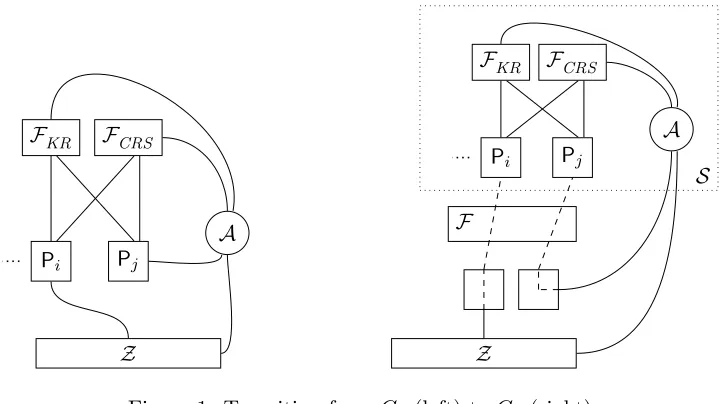
Figure 1: Transition fromG0 (left) to G1 (right)
Now let Abe the dummy adversary andNIKE aCKS+-secure NIKE scheme. We show that for every environmentZ
Exec[FNIKE,S,Z]≈Exec[NIKE,A,Z].
Here Exec[NIKE,A,Z] (resp. Exec[FNIKE,S,Z]) denotes the random variable describing the output of environment Z when interacting with adversary A(resp. S) and protocol NIKE (resp. function-alityFNIKE).7
Game G0: Real protocol run. This is the real execution ofNIKEwith dummy adversaryA. A specific instance of this game is depicted on the left-hand side of Figure 1.
Game G1: Regrouping of machines and addition of relays. We regroup every machine except for Z from game G0 into one machine and call it S. We add single relays for every party, outside ofS, and one relay calledF covering all wires between the single relays andS.
Obviously the view ofZis distributed exactly as in gameG0. Figure 1 shows the transformation from G0 toG1 in a situation with one honest and one corrupted party.
Game G2: Merging wires. Merge all wires between F and S into one wire. Let F determine recipients of messages (consisting of a tuple) from S by choosing the first party that occurs in the tuple. S determines recipients in the same way.
Messages are delivered to the same recipients as in the previous game, hence, the view of Z is distributed exactly as before.
7
The main difference between G2 and the ideal execution with FNIKE is that inG2 the keys of honest sessions are computed using the algorithmNIKE.SharedKey, whereas in the ideal execution the keys are randomly chosen. This will change in the last gameG5. Next, in gameG3, we make a simple but slightly technical modification: we letF perform a check to determine whether it should forward a shared key coming from S to the requesting party. (Namely, if the other party involved in this session has not registered its public key yet, then F can answer this request with ⊥ on its own.)
GameG3: AllowingF to store information and make decisions. We letSsend (Pi,registered) toF whenever a party successfully registers a public keypki withF1
KR. We letF bounce the
mes-sage back toS and additionally maintain a list Λreg with parties for whichF already received such a message. Upon receiving (init,Pi,Pj), if Pj ∈/ Λreg, F sends (Pi,Pj,⊥) to Pi. Else F relays (init,Pi,Pj) to S and receives an answer (Pi,Pj, Ki,j). F relays (Pi,Pj, Ki,j) to Pi.
We have to check whether the output ofPi inG2 is (Pi,Pj,⊥) if and only if the output of Pi in
G3 is (Pi,Pj,⊥). In G2,Pi outputs (Pi,Pj,⊥) if and only if⊥ ←NIKE.SharedKey(Pj,pkj,Pi,ski). By definition of F in G3, the output of a party Pi is (Pi,Pj,⊥) if and only if Pj ∈/ Λreg or S answered with (Pi,Pj,⊥). A missing pkj will causeNIKE.SharedKey(Pj,pkj,Pi,ski) to output ⊥, hence, both events together are equivalent to ⊥ ←NIKE.SharedKey(Pj,pkj,Pi,ski).
Game G4: More lists and more decisions for F. Here, we introduce two new lists, Λkeys and Λrenew, to F. These lists resemble the lists used internally by FNIKE. Specifically, whenever
F has to send a message (Pi,Pj, key) to Pi where key=6 ⊥, it also stores ({Pi,Pj}, key) to Λkeys. Whenever F receives a message (renew,Pi) from Pi, it adds Pi to Λrenew. Whenever F receives a message (Pi,registered) from S, if Pi ∈ Λrenew, F deletes all entries ({Pi,·}, key) from Λkeys and removes Pi from Λrenew. So far there were no modifications regardingF’s outputs. Now upon receipt of (init,Pi,Pj) withPj ∈Λreg we letF check the list Λkeys for an entry ({Pi,Pj}, key). If there is one,F does not relay (init,Pi,Pj) to the adversary and instead returns ({Pi,Pj}, key) to Pi right away.
The output of F is the same as in Game G3, because any entry in Λkeys was computed by S and therefore matches the answer of S to the initrequest in Game G3.
Game G5: Building the ideal functionality FNIKE. We now substitute all real shared keys between two honest parties in Λreg (computed via the NIKE.SharedKey algorithm) with random keys. Concretely, for every honest session (init,Pi,Pj), forPj inF’s list Λreg, we letF determine the key for that session. First of all we preventF from forwarding (init,Pi,Pj) to the adversary. Next, if Λkeys contains an entry ({Pi,Pj}, Ki,j),F setskey=Ki,j. Else F chooseskey←− {$ 0,1}k, stores ({Pi,Pj}, key) and sends (Pi,Pj, key) to Pi.
Let Z be a distinguishing environment between games G4 and G5. We use Z to construct an adversary B against NIKE in the CKS+ security game. Besides playing the CKS+ security game with its challengerC,Bruns Z and acts as a mediator between Z andC.
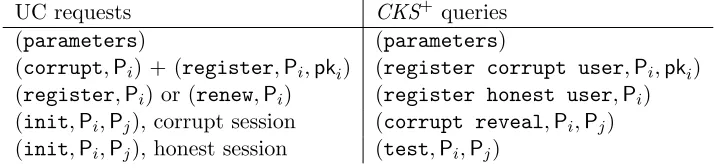
Table 1 shows requests of Z and the corresponding queries in the CKS+ security game that
B issues to get answers for Z’s requests. Note that B can embed its own challenge into the UC execution withZ by answering initialization requests for honest sessions fromZ withC’s responses to test queries. We omit a detailed description of B and briefly list what B has to do besides issuing the requests shown in Table 1.
UC requests CKS+ queries
(parameters) (parameters)
(corrupt,Pi) + (register,Pi,pki) (register corrupt user,Pi,pki) (register,Pi) or (renew,Pi) (register honest user,Pi) (init,Pi,Pj), corrupt session (corrupt reveal,Pi,Pj) (init,Pi,Pj), honest session (test,Pi,Pj)
Table 1: Corresponding queries
• When answering (init,Pi,Pj) requests fromZ,Breturns⊥toZifPj has not been registered withC yet.
Note that according to Table 1 both (register,Pi) and (renew,Pi) requests from Z lead to the same request in the CKS+ game. This is due to the fact that renewing a public key in the CKS+
game is done by re-registering the user as honest. Let AdvG4,G5
Z = |(Pr[1← Z|Z is running inG5]−Pr[1← Z|Z is running inG4])| denote the advantage of Z in distinguishing G4 and G5. By assumption, AdvGZ4,G5 is non-negligible. Let ˆb
denote the output bit of Z and b the bit chosen by the CKS+ challenger C. If b = 0, C answers
testqueries with real shared keys, else the keys are randomly chosen from{0,1}k. Thus ifb= 0,B simulatesG4, and ifb= 1,BsimulatesG5. We letBoutput ˆb, i.e. the same bit asZ. Hence, we have that AdvCKSB + = AdvG4,G5
Z . Clearly, as Adv
G4,G5
Z is non-negligible, AdvCKS +
B is non-negligible as
well. This contradicts theCKS+security of NIKEand thus we conclude that AdvG4,G5
Z is negligible.
It is easy to see that F in game G5 behaves exactly like FNIKE, and game G5 is equal to an ideal execution of NIKE withFNIKE and S. It follows that
Exec[NIKE,A,Z] = GAMEG0
Z ≈GAME
G5
Z = Exec[FNIKE,S,Z],
where GAMEG0
Z (resp. GAMEGZ5) denotes the output ofZwhen running in gameG0(resp. G5).
Remark. The hybrid functionality FCRS is required to guarantee that the parameters for the NIKE scheme cannot be adversarially chosen. But since there is no need for the simulator to program the CRS, we can also assumeFCRS to be aglobal functionality. The global CRS function-ality, denoted by ¯GCRS, can be directly accessed byZ and is a strictly weaker assumption than our functionality FCRS. A detailed description of ¯GCRS can be found in [10].
Theorem 4.1 states thatCKS+security (or any equivalent notion) of a NIKE scheme is sufficient for UC security of the scheme with respect to static adversaries. Next we show thatCKS+security (or any equivalent notion) is also a requirement for UC-secure NIKE schemes. We recall that there is an equivalence between several flavours of game-based security notions for NIKE (see [18] or Appendix B) and it therefore suffices to show CKS-light security.
Theorem 4.2. LetNIKE be a UC-secure NIKE scheme realizingFNIKE in the (FCRS,F1
KR)-hybrid
model with respect to static corruptions. Then NIKE is CKS-light -secure.
Proof sketch. We will first map any CKS-light adversaryB to a suitable environmentZ that sim-ulates Band translates B’s queries in a similar way as shown in Table 1.8 Hence, runningZ with
NIKE provides B with a view as in theCKS-light game with b= 0 (i.e., with real keys). Now con-sider an environment ˜Z that works like Z, but substitutes all shared keys between honest parties
8
provided by NIKE (or FNIKE) with random keys. Hence, running ˜Z with NIKE provides B with a view as in theCKS-light game withb= 1 (i.e., with random keys). Intuitively, ifB is a successful
CKS-light distinguisher, thenBcan distinguish between running withZor ˜Z in the real UC model. However, in the ideal UC model, Z and ˜Z provide B with identical views; hence, B will not be able to distinguish running with Z or ˜Z in the ideal UC model. In this way, a successful B acts as a successful distinguisher between the real and the ideal UC model. (See Appendix F for a full proof.)
On the UC notion of static corruption. In the proof of Theorem 4.2, we use the relatively loose definition of static corruption in the UC model (cf. [6, Section 6.7]). In fact, Theorem 4.2 would not hold if we applied a stricter (with respect to adversarial constraints) definition of static corruption. For instance, we could require that no corruptions take place afterthe first honest party receives an input. (This is in fact the default notion of static corruptions in the GNUC model of security, at least since the December 2012 update of [23].) For this notion of static corruption, we can construct counterexamples to Theorem 4.2. On the other hand, once there is only a fixed polynomial number of parties whose identities are known in advance, the environmentZ from the proof of Theorem 4.2 can guess the two honest parties that Bchooses and corrupt all other parties in advance. Hence, Theorem 4.2 holds even with respect to stricter notions of static corruption, once the set of possible honest parties is polynomially small.
4.2 Adaptive corruption
We consider adaptive corruption, where Z is now allowed to corrupt formerly honest protocol participants. To avoid trivial protocols, say that a function f (that recognize valid keys in FKRf ) is nontrivial for a given NIKE scheme iff f(Pi,pki, τ) = 1 for all parameters params generated by NIKE.CommonSetup(1k) and all public keys generated by NIKE.KeyGen(params,Pi) along with proofsτ.
Theorem 4.3. There is no NIKE schemeNIKE and function f which is nontrivial forNIKE, such thatNIKE realizes FNIKE in the (FCRS,FKRf )-hybrid model with respect to adaptive corruptions.
Proof. We specify an adversary A and an environment Z and show that there is no simulator S
for this setup.
Let NIKE be any non-interactive key exchange scheme. W.l.o.g we assume that all secret keys have the same bit length l =l(k), where k denotes the security parameter. Let NIKE.SharedKey
be the shared key algorithm ofNIKE that takes as inputs (Pi,pki,Pj,skj), i6=j, and outputs shared keys of length k. Letn:=dkle+ 2. For convenience we let A be the dummy adversary and let Z
mount the attack onNIKE, which is described in five steps:
1. Send (parameters) to A to obtainparams, a set of system parameters.
2. Send (register,Pi) toPi,i= 1, . . . , nand (init,Pi,P1) toPi,i= 2, . . . , n. Thus,Z obtains the shared keysK1,i between party P1 and party Pi,i= 2, . . . , n.
3. Obtain the public keys pk1, . . . ,pkn, corresponding to partiesP1, . . . ,Pn, from A. 4. Send (corrupt,P1) to A to learn sk1. Abort ifsk1 ∈ {/ 0,1}l.
5. IfK1,i=NIKE.SharedKey(Pi,pki,P1,sk1)∀i= 2, . . . , n, output 1, else output 0.
In the real worldZ will always output 1 by the correctness ofNIKEand the nontriviality off. Now let S be any simulator. The ideal world execution withS will have to proceed as follows:
1. S arbitrarily chooses a set of system parameters params and sends params toZ.
3. NowS arbitrarily chooses public keyspk1, . . . ,pkn, simulatingFKRf , and sends them toZ. 4. S also corrupts P1 and learns ˜K1,i,i= 2, . . . , n. S chooses sk1 ∈ {0,1}l and sends it toZ.
To see what happens in step 5 we define
Fpk~ (sk1) :{0,1}l −→ {0,1}(n−1)k
sk1 7−→(NIKE.SharedKey(P2,pk2,P1,sk1), . . . ,
NIKE.SharedKey(Pn,pkn,P1,sk1))
wherepk~ := (pk2, . . . ,pkn). FNIKE chooses ( ˜K1,2, . . . ,K˜1,n) uniformly from{0,1}(n−1)k, hence the probability that there existssk1 with
Fpk~(sk1) = ( ˜K1,2, ..,K˜1,n)
is at most 2(n2−l1)k. Asnwas chosen such that (n−1)k≥l+k, we have
2l
2(n−1)k ≤
2l
2l+k ≤2
−k, which
is negligible ink. It follows that Z will output 1 only with negligible probability.
Remarks. (1) If the secret key depends deterministically on the public key, the attack is simpler, because after the first step S is committed to secret keys. After receiving the public keys, Z
initializes a key exchange session between two honest parties and later corrupts one of them. Due to the commitment in the first step, the probability that the secret key matches the uniformly chosen shared key is negligible in the sizek of the shared key.
(2) In the security models from [18], adaptive corruption corresponds to an adversary which issues a test query for two honest identities and additionally uses an extract query to get one of the secret keys. This case is excluded as trivial win for the adversary.
4.2.1 Relation to a similar result of Nielsen in secure message transfer
Nielsen’s results. We have shown that security against adaptive corruptions is not possible without additional assumptions. Taking into account the results of Nielsen [27], this is not sur-prising. There, it is shown that there is no non-interactive protocol which realizes secure message transfer (SMT) without additional assumptions. Non-interactive SMT protocols (according to the definition of [27]) can essentially be viewed as a PKE scheme. The impossibility result is due to the fact that the simulator has to commit to a transcript of encryptions before knowing the underlying messages. Upon corruption,S, now knowing the messages, can only hope to adjust the secret key to explain the transcript. Nielsen shows that a secret key of fixed length does not provide enough entropy to explain an unbounded number of encryptions.
Why his result does not imply ours. RegardingNIKE, a similar problem arises when formerly honest parties, when being corrupted, reveal an unbounded number of earlier computed shared keys. The simulator has to use the secret key to explain those shared keys. Analogous to [27] we can prove an impossibility result due to a lack of entropy in the secret key.
Therefore Nielsen’s impossibility result for non-interactive SMT can not be used to directly conclude Theorem 4.3. Nevertheless our technique is strongly inspired by the idea of Nielsen, namely using an unbounded number of key exchange sessions instead of unbounded-length messages.
Generalizations of our negative result to other (non-programmable) functionalities.
Theorem 4.3 shows that security against adaptive corruption is not achievable in the (FCRS,FKRf )-hybrid model. The result would be even stronger if we added more powerful )-hybrid functionalities. We find that, similar to another result from [27], even a global random oracle functionality to which Z has direct access does not facilitate security against adaptive corruption. (This notion of a globally accessible functionality has been formalized in [27], but can be cast more generally in the “GUC” variant of UC [10].)
Even more, (the proof of) Theorem 4.3 would still hold in any hybrid model that, in addition to FCRS and FKRf , provides only non-programmable hybrid functionalities. In this context, by non-programmable we mean that the input/output behaviour of the functionality is completely independent of the simulator (note that this also includes that the simulator is not able to program the output of the functionality via scheduling of messages). This observation points us to hybrid functionalities that actually facilitate adaptive corruption. And indeed, in Section 4.4 we will see that a programmable random oracle functionality is enough to achieve adaptive UC security.
4.3 Summary of relations established so far
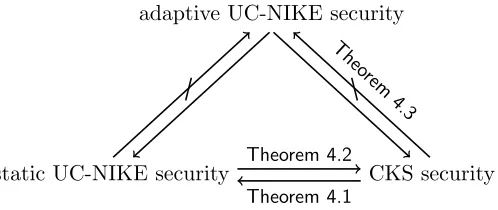
There is a strong relation between the game-based security notions from [12, 18] and UC security with respect to FNIKE, our functionality for non-interactive key exchange. In Section 4.1 we have shown equivalence ofCKS security (or other equivalent notions from [18] or Appendix B) to static UC-NIKE security (w.r.t FNIKE using FCRS and FKR). Furthermore, Theorem 4.3 implies that
CKS security is not enough to achieve adaptive UC-NIKE security (w.r.t FNIKE using FCRS and
FKR). The relations between the security notions are depicted in Figure 2.
adaptive UC-NIKE security
static UC-NIKE security CKS security Theorem 4.1
Theo
rem 4.3
Theorem 4.2
Figure 2: Relations between CKS security models and UC-NIKE security
4.4 Transformation to adaptively secure NIKE in the random oracle model
users, then a hash variant of NIKE securely realizes our non-interactive key exchange functionality
FNIKE in the FRO-hybrid model (see Appendix D for a description of FRO). The security model used in our reduction is denoted byweakCKS++ (see Appendix B for a definition).
Definition 4.4 (Transformation to the random oracle model). Let NIKE be a non-interactive key exchange scheme with shared key algorithm NIKE.SharedKey and let H : {0,1}∗ → {0,1}k0 be
a hash function (viewed as a random oracle), where k0 is a security parameter. Let NIKE’ be a modification of the scheme NIKE such that its shared key algorithm, NIKE’.SharedKey’, is defined as
NIKE’.SharedKey’(Pi,pki,Pj,skj)
if
(
Pi <Pj returnH(Pi,Pj,NIKE.SharedKey(Pi,pki,Pj,skj)) Pj <Pi returnH(Pj,Pi,NIKE.SharedKey(Pi,pki,Pj,skj))
Here we are assuming that the party identifiers come from a space with a natural ordering and that the shared key space of NIKE’ is{0,1}k0.
Theorem 4.5. Let NIKE be a weakCKS++-secure non-interactive key exchange protocol. Then the transformed protocol NIKE’ realizes FNIKE in the (FCRS,F1
KR,FRO)-hybrid model, in the presence
of adaptive adversaries.
Proof sketch. We show that Z cannot distinguish the real protocol run of NIKE’ with the ideal functionalitiesFCRS,F1
KR and FRO, and an adversaryA, from the ideal protocol run with FNIKE
andS, unlessZ makes a specific type of random oracle query. Then we show that if Z makes such a random oracle query, we can construct an adversary against NIKE in the weakCKS++ security game. By our assumption, there is no such adversary with non-negligible advantage. Thus, the probability that Z makes that random oracle query is negligible and therefore the real and ideal execution (with our simulator S) cannot be distinguished by any environment Z. (See Appendix G for a full proof.)
References
[1] Boaz Barak, Ran Canetti, Jesper Buus Nielsen, and Rafael Pass. Universally composable protocols with relaxed set-up assumptions. In 45th Annual Symposium on Foundations of Computer Science, pages 186–195. IEEE Computer Society Press, October 2004.
[2] Elaine Barker, Don Johnson, and Miles Smid. NIST special publication 800-56A: Recommen-dation for pair-wise key establishment schemes using discrete logarithm cryptography (revised), March 2007.
[3] Mihir Bellare and Phillip Rogaway. Entity authentication and key distribution. In Douglas R. Stinson, editor,Advances in Cryptology – CRYPTO’93, volume 773 ofLecture Notes in Com-puter Science, pages 232–249. Springer, August 1993.
[4] Ran Canetti. Universally composable security: A new paradigm for cryptographic protocols. In
42nd Annual Symposium on Foundations of Computer Science, pages 136–145. IEEE Computer Society Press, October 2001.
[6] Ran Canetti. Universally composable security: A new paradigm for cryptographic protocols. Cryptology ePrint Archive, Report 2000/067, 2005. http://eprint.iacr.org/.
[7] Ran Canetti and Hugo Krawczyk. Analysis of key-exchange protocols and their use for building secure channels. In Birgit Pfitzmann, editor, Advances in Cryptology – EUROCRYPT 2001, volume 2045 ofLecture Notes in Computer Science, pages 453–474. Springer, May 2001.
[8] Ran Canetti and Hugo Krawczyk. Universally composable notions of key exchange and secure channels. In Lars R. Knudsen, editor,Advances in Cryptology – EUROCRYPT 2002, volume 2332 ofLecture Notes in Computer Science, pages 337–351. Springer, April / May 2002.
[9] Ran Canetti, Yehuda Lindell, Rafail Ostrovsky, and Amit Sahai. Universally composable two-party and multi-two-party secure computation. In 34th Annual ACM Symposium on Theory of Computing, pages 494–503. ACM Press, May 2002.
[10] Ran Canetti, Yevgeniy Dodis, Rafael Pass, and Shabsi Walfish. Universally composable se-curity with global setup. In Salil P. Vadhan, editor, TCC 2007: 4th Theory of Cryptography Conference, volume 4392 ofLecture Notes in Computer Science, pages 61–85. Springer, Febru-ary 2007.
[11] Cagatay Capar, Dennis Goeckel, Kenneth G. Paterson, Elizabeth A. Quaglia, Don Towsley, and Murtaza Zafer. Signal-flow-based analysis of wireless security protocols. Inf. Comput., 226:37–56, 2013.
[12] David Cash, Eike Kiltz, and Victor Shoup. The twin Diffie-Hellman problem and applications. In Nigel P. Smart, editor, Advances in Cryptology – EUROCRYPT 2008, volume 4965 of
Lecture Notes in Computer Science, pages 127–145. Springer, April 2008.
[13] Ivan Damg˚ard, Jesper Buus Nielsen, and Daniel Wichs. Universally composable multiparty computation with partially isolated parties. In Omer Reingold, editor,TCC 2009: 6th Theory of Cryptography Conference, volume 5444 of Lecture Notes in Computer Science, pages 315– 331. Springer, March 2009.
[14] Whitfield Diffie and Martin E. Hellman. New directions in cryptography. IEEE Transactions on Information Theory, 22(6):644–654, 1976.
[15] Yevgeniy Dodis, Jonathan Katz, Adam Smith, and Shabsi Walfish. Composability and on-line deniability of authentication. In Omer Reingold, editor,TCC 2009: 6th Theory of Cryptogra-phy Conference, volume 5444 ofLecture Notes in Computer Science, pages 146–162. Springer, March 2009.
[16] R´egis Dupont and Andreas Enge. Provably secure non-interactive key distribution based on pairings. Discrete Applied Mathematics, 154(2):270–276, 2006.
[17] Roger Fischlin and Claus-Peter Schnorr. Stronger security proofs for RSA and Rabin bits.
Journal of Cryptology, 13(2):221–244, 2000.
[19] Eduarda S. V. Freire, Dennis Hofheinz, Kenneth G. Paterson, and Christoph Striecks. Pro-grammable hash functions in the multilinear setting. Lecture Notes in Computer Science, pages 513–530. Springer, August 2013. doi: 10.1007/978-3-642-40041-4 28.
[20] Rosario Gennaro, Shai Halevi, Hugo Krawczyk, Tal Rabin, Steffen Reidt, and Stephen D. Wolthusen. Strongly-resilient and non-interactive hierarchical key-agreement in MANETs. In Sushil Jajodia and Javier L´opez, editors, ESORICS 2008: 13th European Symposium on Research in Computer Security, volume 5283 of Lecture Notes in Computer Science, pages 49–65. Springer, October 2008.
[21] Shafi Goldwasser, Silvio Micali, and Ronald L. Rivest. A “paradoxical” solution to the signa-ture problem (extended abstract). In 25th Annual Symposium on Foundations of Computer Science, pages 441–448. IEEE Computer Society Press, October 1984.
[22] Dennis Hofheinz and Eike Kiltz. The group of signed quadratic residues and applications. In Shai Halevi, editor, Advances in Cryptology – CRYPTO 2009, volume 5677 of Lecture Notes in Computer Science, pages 637–653. Springer, August 2009.
[23] Dennis Hofheinz and Victor Shoup. GNUC: A new universal composability framework. Cryp-tology ePrint Archive, Report 2011/303, 2011. http://eprint.iacr.org/.
[24] Dennis Hofheinz, J¨orn M¨uller-Quade, and Rainer Steinwandt. Initiator-resilient universally composable key exchange. In Einar Snekkenes and Dieter Gollmann, editors,ESORICS 2003: 8th European Symposium on Research in Computer Security, volume 2808 ofLecture Notes in Computer Science, pages 61–84. Springer, October 2003.
[25] Markus Jakobsson, Kazue Sako, and Russell Impagliazzo. Designated verifier proofs and their applications. In Ueli M. Maurer, editor,Advances in Cryptology – EUROCRYPT’96, volume 1070 ofLecture Notes in Computer Science, pages 143–154. Springer, May 1996.
[26] Dafna Kidron and Yehuda Lindell. Impossibility results for universal composability in public-key models and with fixed inputs. Journal of Cryptology, 24(3):517–544, July 2011.
[27] Jesper Buus Nielsen. Separating random oracle proofs from complexity theoretic proofs: The non-committing encryption case. In Moti Yung, editor, Advances in Cryptology – CRYPTO 2002, volume 2442 ofLecture Notes in Computer Science, pages 111–126. Springer, August 2002.
[28] Kenneth G. Paterson and Sriramkrishnan Srinivasan. On the relations between non-interactive key distribution, identity-based encryption and trapdoor discrete log groups. Des. Codes Cryptography, 52(2):219–241, 2009.
[29] Ryuichi Sakai, Kiyoshi Ohgishi, and Masao Kasahara. Cryptosystems based on pairing. In
SCIS 2000, Okinawa, Japan, January 2000.
A
Key registration for the factoring-based NIKE from [18]
In this section, we recall the factoring-based NIKE scheme from [18] and argue why it constitutes a secure realization ofFNIKE in the FKRf -hybrid model for a suitable (nontrivial) “validity” function
f. We start with a bit of notation taken almost verbatim from [18].
The factoring assumption. Let n(k) be a function and δ a constant with 0 ≤ δ < 1/2. Let
RSAgenbe an algorithm with input 1k that generates elements (N, P, Q) such that N =P Qis an
n-bit Blum integer and all prime factors ofφ(N)/4 are pairwise distinct and have at leastδnbits. These conditions ensure that (JN,·) is cyclic and that the square g of a random element in Z∗N, generates QRN with high probability. That is, hgi = QRN. For such N, we recall the definition of thegroup of signed quadratic residues QR+N from [22] (see also [21, 17]) which is defined as the
set {|x| : x ∈ QRN}, where |x| is the absolute value when representing elements of ZN as the set {−(N −1)/2, . . . ,(N −1)/2}. (QR+N,·) is a cyclic group of orderφ(N)/4 whose elements are efficiently recognizable given onlyN as input.
The BBS generator. Let BBSN :QR+N → {0,1}kbe the Blum-Blum-Shub pseudorandom gen-erator. (That is, BBSN(X) = (lsbN(X),lsbN(X2),· · · ,lsbN(X2
k−1
)), where lsbN(X) denotes the least significant bit of X ∈QR+N.) The factoring assumption implies the computational indistin-guishability of the distributions
(N, X2k,BBSN(X)) and (N, X2
k
, R),
whereN ←−$ RSAgen(1k), andX ←−$ QR+N and R←− {$ 0,1}k are chosen uniformly.
Chameleon hashing. A chameleon hash function ChamH : D × RCham → I, where D is the domain, RCham the randomness space and I the range, is associated with a pair of public and private keys (the latter called a trapdoor). These keys are denoted respectively by hk and ck and are generated by a PPT algorithm Cham.KeyGen(1k). The public key hk defines a chameleon hash function, denoted ChamHhk(·,·). On input a message m and a random string r, this function generates a hash value ChamHhk(m, r) which satisfies the following properties:
Collision resistance. There is no efficient algorithm that on input the public key hk can find pairs (m1, r1) and (m2, r2) wherem1 6=m2 such that ChamHhk(m1, r1) = ChamHhk(m2, r2), except with negligible probability ink.
Trapdoor collisions. There is an efficient algorithm that on input the secret key ck, any pair (m1, r1) and any additional message m2, finds a value r2 such that ChamHhk(m1, r1) = ChamHhk(m2, r2). Also, for uniformly and independently chosen m1, r1 and m2,r2 is inde-pendently and uniformly distributed overRCham.
Uniformity. All messages m induce the same probability distribution on ChamHhk(m, r) for r chosen uniformly at random.
The NIKE scheme. Let ChamH :{0,1}∗× RCham →Z2k be a chameleon hash function. Now
NIKE.CommonSetup(1k)
(N, P, Q)←−$ RSAgen(1k)
g, u0, u1, u2←−$ QR+N with hgi=QR + N hk,ck←−$ Cham.KeyGen(1k)
params←(N, g, u0, u1, u2,hk) Return params
NIKE.KeyGen(params,Pi)
x←−$ ZbN/4c;r
$
←− RCham
Z ←gx·23k;t←ChamHhk(Z||Pi;r)
Y ←u0ut1u2t
2
;X←Yx
pk←(Z, X, r); sk←x
Return (pk,sk)
NIKE.SharedKey(Pi,pki,Pj,skj)
Parse pki =: (Zi, Xi, ri)∈QR+N×QR +
N × RCham andskj =:xj ∈ZbN/4c
Return BBSN(Z xj·22k
i )
Consistent public keys and the security of scheme. We first cite a result from [18] that shows that the NIKE scheme NIKEfac-int is CKS-light-secure (and thus CKS+-secure), assuming that an adversary only registers public keys that are consistent. A public key pk = (Z, X, r) is consistent if there is an exponent xwith
Z =gx·23k, X= (u0ut1ut
2
2 )x fort= ChamHhk(Z||Pi;r). (1)
Theorem A.1 ([18]). Under the generalized Riemann hypothesis and the factoring assumption relative to RSAgen, and assuming that the chameleon hash function ChamH is collision-resistant, the scheme NIKEfac-int is CKS+-secure against all adversaries that only register consistent (in the
sense above) public keys.
Our goal is now to formalize the notion of consistent public keys (as in (1)) using our key registration functionality FKRf for a suitable f. Concretely, observe that an exponent x satisfying (1) is a witness of consistency for a given public key pk. Hence, if we set
f(Pi,pk, τ) = 1 :⇐⇒ Z=gτ·2
3k
andX = (u0ut1ut
2
2)τ, (2)
where pk is parsed as (Z, X, r) and t = ChamHhk(Z||Pi;r), then FKRf allows precisely consistent
public keys to be registered. (There is one subtlety: FKRf is not aware of the public parameters
params, and in particular not of hk. This can be resolved by including params in public keys pk registered with FKRf ; each party will then of course have to check that the value of params is the same as provided byFCRS.)
Using a combination of Theorem A.1 and a slight adaptation of Theorem 4.1,9 we then obtain:
Theorem A.2 ([18]). Assume the generalized Riemann hypothesis, that factoring is hard relative to RSAgen, and that the chameleon hash function ChamH is collision-resistant. Then NIKEfac-int
realizes FNIKE in the (FKRf ,FCRS)-hybrid model for the function f from (2) against static corrup-tions.
B
Game-based security notions for NIKE
Review of existing security notions
Following a game-based notion of security for non-interactive key exchange schemes from [12], several security definitions for NIKE were stated in [18]: the CKS-light, CKS, CKS-heavy and
9
Recall that Theorem 4.1 assumes a key registration functionalityF1
KRthat accepts all registered keys. However,
the same proof also works for general f if the NIKE scheme is CKS+ secure in a setting in which only consistent
m-CKS-heavy security models. Their strongest model, the m-CKS-heavy security model, covers all possible types of queries that an adversary can make in any of those models. In this paper we always refer to thedishonest key registration (DKR in [18]) setting, where an adversary against a NIKE scheme is allowed to register dishonestly generated public keys for which it does not have to know the corresponding secret keys.
As all game-based security notions used in our paper are derived from them-CKS-heavy security model (with possible re-registration of keys), for ease of comparison, we present here the m-CKS-heavy model.
In [18], the m-CKS-heavy security notion for non-interactive key exchange schemes is defined in terms of a game between an adversary B and a challenger C. First, B obtains a set of system
parameters, params, from C, which is obtained by running params ←−$ NIKE.CommonSetup(1k). C
then randomly chooses a bit band answers the following oracle queries from B:
(register honest user,ID). Challenger C generates a public key/secret key pair by running (pk,sk)←−$ NIKE.KeyGen(params,ID), records (honest,ID,pk,sk) and sendspk toB.
(register corrupt user,ID). C records (corrupt,ID,pk,⊥), overwriting any existing entry for this ID.
(extract,ID). C looks for an entry of the form (honest,ID,pk,sk) and returnssktoB.
(honest reveal,IDi,IDj). HereBsupplies two identitiesIDi andIDj, both registered as honest. C obtains the shared key betweenIDiandIDj by runningKi,j ←NIKE.SharedKey(IDi,pki,IDj,skj) and returnsKi,j toB.
(corrupt reveal,IDi,IDj). Here B supplies one honest and one corrupt identity. C obtains the shared key between IDi and IDj by running Ki,j ← NIKE.SharedKey(IDi,pki,IDj,skj) if IDj is honest orKi,j ← NIKE.SharedKey(IDj,pkj,IDi,ski) if IDi is honest. C returnsKi,j toB. (test,IDi,IDj). Bsupplies two honest identities. Ccomputes the corresponding shared key by
run-ning Ki,j ← NIKE.SharedKey(IDi,pki,IDj,skj) if b= 0, or Ki,j $
←− SHK if b= 1. C returns
Ki,j toB.
The identities ID belong to an identity space IDS and are merely used to track which public keys are associated with which users. Also, B is allowed to make an arbitrary number of queries. We assume that C maintains a list of shared keys and sends the same shared key for a pair of identities if B makes the same test query again. To avoid trivial wins, B is not allowed to issue an honest revealquery and a testquery on the same pair of identities. For the same reason, B
is not allowed to issue an extractquery on any identity involved in a testquery, and vice versa.
B is also not allowed to make a register corrupt user query on an identity which has already been registered as honest. Bwins the game if it outputs a bit ˆb=b.
The advantage of B in them-CKS-heavy security game is defined as:
Advm-CKS-heavyB (k, qH, qC, qE, qHR, qCR, qT) =
Pr[ˆb=b]−1/2 ,
whereqH,qC,qE,qHR,qCRandqT are the numbers of register honest user,register corrupt
user, extract, honest reveal, corrupt reveal and test queries made by B. Informally, a NIKE scheme ism-CKS-heavy-secure if there is no polynomial-time adversary that makes at most
qH register honest user queries, etc., having non-negligible advantage in k. In our security reductions, we will w.l.o.g. restrict to adversaries that make exactly as many queries of each type as they are allowed, since we can easily transform every (qH, qC, qE, qHR, qCR, qT)-bounded adversary into one that issues exactly (qH, qC, qE, qHR, qCR, qT) queries.
Security notion reg.hon. reg.corr. extract hon.rev. corr.rev. test
CKS-light 2 ∗ 0 0 ∗ 1
CKS ∗ ∗ 0 0 ∗ ∗
CKS-heavy ∗ ∗ ∗ ∗ ∗ 1
m-CKS-heavy ∗ ∗ ∗ ∗ ∗ ∗
Table 2: Allowed number of queries for an adversary in the game-based security definitions for NIKE from [18]. ∗ means that Bis allowed to make an arbitrary number of queries.
Theorem B.1 (Theorem 1 from [18]). The CKS-light , CKS , CKS-heavy and m-CKS-heavy se-curity models are all polynomially equivalent.
Allowing re-registration of honest users and corrupt registration of previously registered honest users
The security notions from [18] capture several types of queries that an adversary can make. However, those models still have some shortcomings. For instance, they do not capture re-registration of honest users. Concretely, an adversary in those models is not allowed to issue (register honest user,ID) multiple times for the sameID and obtain a new public keypk upon each such request. This is often not realistic, e.g. when we have to work with public key/secret key pairs that have a lifetime and expiration date. So a protocol participant should be able to perform what we will call an honest re-registration.
Moreover none of those security models allow an adversary to register previously registered honest users as corrupt users. In this paper we augment the security notions from [18] with honest re-registration and corrupt registration of honest users and throughout the paper we add++to the notation to represent the augmented versions of the models from [18] including those two types of re-registration. We add a single ‘plus’, +, to the notation if the models are only augmented with honest re-registration of honest users. We prove our strongest model, the m-CKS-heavy++, to be polynomially equivalent to the weakest model from [18], the CKS-light model. Then, it follows that all security models, with or without the types of re-registration mentioned above, are also polynomially equivalent. Let us first introduce the m-CKS-heavy++ security model.
Them-CKS-heavy++ security model. We modify them-CKS-heavy security notion from [18] by allowing an adversary A to make multiple (register honest user,ID) queries for the same ID. Upon each such request, C runs (pk,sk) ←−$ NIKE.KeyGen(params,ID) to obtain a new public key/secret key pair and returns pk to A. C then overwrites any existing entry (honest,ID,pk,sk) forID in its list. Additionally,Ais allowed to register previously registered honest users as corrupt users by issuing a (register corrupt user,ID) query to its challengerC. The user will from then on be considered as corrupt. HereC deletes any existing entry forIDof the form (honest,ID,pk,sk) and adds a new entry (corrupt,ID,pk,⊥) to its list. The adversary’s job in the m-CKS-heavy++
game is the same as in the m-CKS-heavy game: A has to guess whether C answers test queries with the real shared key, computed via the NIKE.SharedKey algorithm using the current public key of one of the users involved in the query and the current secret key of the other user, or with random keys from the shared key spaceSHK.
even if anhonest reveal query on the same pair of identities occurred before (as long as one of the users has been re-registered since the test query was made), and vice versa. We also allow an adversary to make extract queries on users involved in test queries as long as that user has been re-registered since thetestquery was made (the same is valid in the other direction). Notice that in order to avoid an adversary to trivially win the security game, if the challenge bit equals 1, whenever the adversary makes atestquery on the same pair of identities (IDi,IDj), the challenger must respond with a new random value if at least one of the honest identities has been re-registered since the lasttest query on (IDi,IDj) was made.
Let b denote the challenge bit chosen by a challenger C in the m-CKS-heavy++ security game and ˆbthe guess of A. Then the advantage of anm-CKS-heavy++ adversaryA is defined as
Advm-CKS-heavyA ++(k, qH, qC, qE, qHR, qCR, qT, qR) =
Pr[ˆb=b]−1/2 .
Weabuse notation here and letqH denote the number of honest users registered by Aand qR the number of total honest re-registrations made by A. As in the m-CKS-heavy model, here qC, qE,
qHR,qCR andqT are the numbers of register corrupt user,extract,honest reveal,corrupt
revealand test queries made byA.
Remark [loosening restrictions on other security notions]: We highlight here that we also appropriately loosen restrictions on other security models. As an example, we allow an adversary in the augmented versions of the CKS-light orCKS-heavy security models to make multiple test
queries (instead of one),but on the same pair of identities involved in the firsttestquery andonly if at least one of these identities has been re-registered since the lasttest query was made. Again here, ifb= 1, the challenger chooses a new random value to answer the newtest query.
Theorem B.2 (m-CKS-heavy++ ⇔ CKS-light). The m-CKS-heavy++ and CKS-light security models are polynomially equivalent. More specifically, for any NIKE scheme NIKE, we have that:
• for any adversaryB againstNIKE in the CKS-light game, there is an adversaryAthat breaks
NIKE in the m-CKS-heavy++ game with
Advm-CKS-heavyA ++(k,2, qC,0,0, qCR,1,0) =AdvCKS-lightB (k, qC, qCR),
• for any adversaryA againstNIKEin the m-CKS-heavy++ game, there is an adversary Bthat breaks NIKE in the CKS-light game with
AdvCKS-lightB (k, qC, qCR0 )≥2Adv
m-CKS-heavy++
A (k, qH, qC, qE, qHR, qCR, qT, qR)/qTqH2(qR+ 1)2,
where qCR0 ≤qCR.
Proof. Clearly, security in the sense of the m-CKS-heavy++ model implies security in the sense of theCKS-light model, since the latter model is a limited case of the former.
Here we prove the second reduction, namely that if a NIKE scheme NIKE is secure in the
CKS-light model, then it is also secure in the m-CKS-heavy++ model. We assume that there is an adversary A that breaks a NIKE scheme in the m-CKS-heavy++ model with advantage Advm-CKS-heavyA ++(k, qH, qC, qE, qHR, qCR, qT, qR).
The hybrid argument technique. We consider a sequence of games G0, G1, . . . , GqT, all defined
Game G0: actual adversarial game when b= 1. This is the original game as defined in the
m-CKS-heavy++model whenb= 1. Alltestqueries will be answered with randomly chosen values from the shared key spaceSHK.
Game Gι (1≤ι≤qT −1): hybrid games. This game is identical to game Gι−1, except that theι-thtest query, say on a pair of honest usersIDi,IDj, is answered with the actual real shared key Ki,j, between those users.
Game GqT: actual adversarial game when b= 0. This is the original game as defined in the
m-CKS-heavy++ model whenb= 0. Alltestqueries will be answered with the current real shared keys (computed via the NIKE.SharedKey algorithm) associated to the two users involved in each query.
Let A(Gι) denote adversary A playing gameGι. We see that Acan distinguish gamesG0 and
GqT with advantage
Advm-CKS-heavyA ++(k, qH, qC, qE, qHR, qCR, qT, qR) =|Pr[A(G0) = 1]−Pr[A(GqT) = 1]|.
Note that Gι and Gι+1 (0 ≤ ι < qT) differ in only one single test query. According to the
hybrid argument, ifAcan distinguish betweenG0and GqT with non-negligible probability, then for
some 0≤ι < qT it can also distinguish Gι andGι+1 with non-negligible probability. We show that if this is the case, then we can construct an adversary B in theCKS-light model with advantage related to A’s advantage by a polynomial factor.
The idea. In order to simulate the m-CKS-heavy++ game for A, B picksι←− {$ 0, . . . , qT −1}, guessing that Acan distinguish games Gι and Gι+1. Then it guesses which users will be involved in the (ι+ 1)-st test query made byA and also how often these users will be re-registered byA, before issuing thattest query.
B plays the CKS-light security game with challengerC and acts as a challenger for A. C takes as input the security parameter 1k, computesparams←−$ NIKE.CommonSetup(1k) and givesparams
toB. C then takes a bitb and answers oracle queries forB untilB outputs a bit ˆb.
Let qH be a bound on the number of honest users registered by B in the course of its attack and letqRandqT be bounds on the number of total honest re-registration queries andtestqueries made by A. W.l.o.g., we assume that A does not make the same test query more than once if both users involved have the same key pair as when the previous test query was made. B
chooses an indexι←− {$ 0, . . . , qT−1}, two distinct indicesI, J ←− {$ 1, . . . , qH}and two other integers ˜
qRI,q˜RJ
$
←− {0, . . . , qR}. LetqRI,qRJ be the number of honest re-registrations of theI-th andJ-th
distinct registered honest users, respectively, issued byA, before the (ι+ 1)-sttestquery is made.
B givesparams toAand answers queries to Ain the following manner:
(register honest user,ID) IfIDis theI-th or J-th distinct user involved in such a query,Bsets IDI =ID orIDJ =ID as appropriate. Moreover, if this is the (˜qRI + 1)-st (resp. (˜qRJ +
1)-st) request of this type for IDI (resp. IDJ), B adds IDI (resp. IDJ) to a list ΛT. B then
![Table 2: Allowed number of queries for an adversary in the game-based security definitions forNIKE from [18]](https://thumb-us.123doks.com/thumbv2/123dok_us/7913511.1313959/21.612.125.489.71.142/table-allowed-number-queries-adversary-security-denitions-fornike.webp)
