Last and final version
Predictor packing in developing unprecedented shaped colloidal
particles
Mubarak Ali a’ *, I –Nan Lin b and C. –J. Yeh c
aDepartment of Physics, COMSATS University Islamabad, Park Road,
Islamabad-45550, Pakistan, * Email: [email protected], [email protected]
bDepartment of Physics, Tamkang University, Tamsui Dist., New Taipei City 25137,
Taiwan (R.O.C.). e-mail: [email protected]
cDepartment of Engineering and system Science, National Tsing-Hua University,
Hsinchu 30013, Taiwan (R.O.C.). e-mail: [email protected]
Abstract –Developing particles of different anisotropic shapes are the hot topic since
decades as they guarantee some special features of properties not possible through
other means. Again, controlling atoms to develop certain size and shape particle is a
quite challenging job. In this study, gold particles of different shapes are developed via
pulse-based electronphoton-solution interface process. Gold atoms of certain transition
state develop monolayer assembly at solution surface around the light glow (known in
argon plasma) being generated at bottom of copper capillary (known in cathode). The
rate of uplifting gold atoms to solution surface is being controlled by forcing energy
(travelling photons) pursuing electrons and high energy photons (in high density)
entering to solution. Gold atoms dissociated from the precursor under dissipating heat
energy into the solution supplied under propagating photons characteristic current
through immersed graphite rod (known in anode). Placing packets of nano shape
energy of tuned pulse protocol over compact monolayer assembly comprising transition
state atoms develop tiny-sized particles of formed shape. On separation of joint tiny
particles into two equilateral triangular-shaped tiny particles, exerting forces of surface
format elongate atoms of one-dimensional arrays converting them into structures of
smooth elements. Due to immersing level of force, such tiny-shaped particles pack from
Last and final version
different zones at centre of light glow where they assembled structures of smooth
elements for developing mono-layers of different shapes of particles. Developing
one-dimensional particles deal assembling of structures of smooth elements of packing
tiny-shaped particles from nearly rearward zones of reflection of north-south poles, whereas,
developing multi-dimensional particles deal assembling of structures of smooth
elements of packing tiny-shaped particles from the east-west poles and near regions.
Depending on the number of assembled structures of smooth elements at point of
nucleation, packing of tiny-shaped particles from different zones develop different
shapes of the anisotropic particles. At fixed precursor concentration, increasing the
process time results into develop particles of low aspect ratio. Under tuned parameters,
developing mechanisms of particles exhibiting unprecedented features are discussed.
Keywords: Fundamental Forces; Transition state gold atoms; Packing and assembling;
Process parameters; One-dimensional particles; Multi-dimensional particles.
1. Introduction
To design a different sort of material, it is remained crucial since the birth of materials
science. Among the categories of materials, the synthesis of materials in particles
shape and size remained dominant in the past few decades as well as in the current
ages and they hold a promising future too. The explanations which are put forth on the
development mechanisms of tiny particles, nanoparticles and particles are spanned
over different class of opinions and scientific arguments. The required size and shape of
particles of diversified materials may be directly or indirectly the origin of certain
cutting-edge applications.
But, undoubtedly, when the nanoparticles and particles showing the same
morphology-structure (features of shapes) under their microscopic images, they raise a combined question i.e., “Why they contain a lot of diversified ranges of explanation and viewpoints”. Obviously, it is to be; the scientific explanations vary process to process
and within the same process also. The particles of same shape and structure are almost
delivering similar sort of result along with their practical demonstration at forefronts of
Last and final version
facilitator of their atoms can be varied, but their electronic structure under unchanged
dynamics is to be remained the same because of the same nature since existence.
To manipulate and probe matter at nanoscale for development of new tools is critical
for nanoscience and nanotechnology [1]. One-dimensional nanowires [2] and
two-dimensional free-floating sheets have been developed by strong dipole-dipole
interaction [3]. To structure matter on the scale of length comparable or smaller to the
wavelength of light can deliver phenomenal optical properties [4, 5]. The catalytic
activity of metallic nanostructures is enhanced significantly on controlling phase [6, 7].
Formation of tiny clusters and their coalescence into extended shape of particles is
one of the long and continuously over-looked phenomena [8-18]. Nanometer-sized gold
clusters behave like simple chemical compounds and may find a wide range of
applications in catalysis, sensors and molecular electronics [8]. The discrete nature and
stability of nanocrystals along with their tendency to form extended supperlattices
suggest ways and means for the design and fabrication of advanced materials having
controlled characteristics [9]. Development of single crystal by the aggregation of
nanocrystals appears as a realistic goal [10]. The development of new, ultimately small,
electronic devices is one of the most prominent and potentially long-term applications of
nanoparticles technology [11]. Self-assembly offers a very promising route to construct
complex shapes at nano-/micro-meters level and engages many of the classical
disciplines of science and engineering [12]. A grand challenge is to assemble and
position the nanoparticles at preferred sites which will enable the construction of
complex and higher-order functional structures [13]. To organize nanometer-sized
building blocks into specific shapes is one of the current challenges [14]. On successful
assembling of colloidal particles into useful structures, the ‘atoms’ and ‘molecules’ will become tomorrow’s materials [15]. Understanding the electronic absorption and
dynamics of individual nanoparticles is pre-requisite for their development into an
ordered array instead of their agglomeration [16]. Possibility to coalesce nanocrystals
allows one to develop materials with abundant selections, which leads to the opening of
entirely new field [17]. On controlling precisely, the surface properties of nanoparticles
will lead to direct their assemblies into higher order structures [18]. Tiny particles are
Last and final version
and size of metallic structures have remained under the extensive debate and
generated significant interest in several newly emerging areas of nanoscience and
nanotechnology [20-22]. It has been shown that shape entropy drives the phase
behavior of systems of anisotropic shapes through directional entropic forces [23].
Geometry and entropy of colloidal particles not only explain the structure but dynamics
also [24]. In a known protocol, in addition to the disordered jammed configuration, there
are ordered metrics capable to characterize the order of packing [25]. Those studies are
the beauty and evolution of science behind technological advanced materials.
Efforts have also been made to synthesize tiny clusters and anisotropic shapes of
gold by employing various plasma solution methodologies. Mainly, four approaches
remained under operation: (1) DC plasma discharge in contact to liquid [26-29], (2) DC
glow discharge plasma in contact to liquid [30], (3) pulse plasma discharge inside the
liquid [31-36], and (4) gas-liquid interface discharge [37]. Hydrogen peroxide was the
most probable reaction mechanism to synthesize gold nanoparticles [26-29]. While
synthesizing spherical-shaped nanoparticles, electron flux at a given current remains
constant on the surface of solution [32] and plasma electrons act as cathode [33].
Hydrogen radicals generated in the discharge where their rate increased consistently
with the external field and, due to dissolution of nanoparticles, reduction rate lowered
which was the cause of anisotropic growth [34]. The influence of Brownian motion along
with the surface charge of nanoparticles explained their stability [35] and negatively
charged surface of nanoparticles kept them away from agglomeration [36]. Gold
nano-plates and nano-rods developed at the surface of solution and spherical-shaped
particles in the solution [37].
The fundamental process of developing various tiny-sized particles under different
process conditions is discussed [38]. The development of gold nanoparticles and
particles under varying precursor concentration is studied [39]. Tapping opportunity of
tiny-shaped particles and role of precursor in developing shaped particles under the
same setup is presented in a separate study [40]. Different shaped tiny particles along
with their extended shapes developed under varying the ratio of bipolar pulse and pulse
polarity modes [41]. Development of tiny-sized particles and extended shaped particles
Last and final version
materials is disclosed where role of van der Waals interactions and surface plasmons
phenomenon are disregarded [42]. A detailed study is presented discussing
development mechanism of a tiny-shaped particle dealing localized gravity and when
developing mono-layer of certain shape developing particle [43]. Atoms of electron
transitions elongate or deform but do not ionize where forcing energy (photons)
propagating through inter-state electron gaps is related to photonic current instead of
electronic (electric) current [44]. Atoms of those electron transitions where conservative
forces are involved to engage binding energies for evolving their different dimension
and format structures is discussed elsewhere [45]. The phenomena of heat and photon
energy are revealed while dealing the matter at atomic level [46]. Atomic behaviors
along with the behavior of field forces are quite diligent in showing their performance for
nanoparticles and when using them for nanomedicine [47]. A study on switching
dynamics of morphology-structure under varying process parameters in
carbon-deposited films is reported elsewhere [48].
To synthesize tiny-sized particles and large-sized particles for different suitable
materials, it is an easy task, but it is difficult to understand and pinpoint their
underpinning mechanisms of development. This work describes fundamental process of
developing triangular-shaped tiny particles and in relation to their predictor packings for
developing different geometric anisotropic particles where certain force-energy
behaviors originated under the set process conditions. Under set parameters, gold
atoms dissociated from the precursor as per dissipated heat energy into the medium
which transferred through immersed graphite rod where uplifting to solution surface
against the reaction of entrance of electron streams (carrying forced energy of travelling
photons) and high energy photons (in high density) where packets of nano shape
energy (generated under tuned pulse protocol) bind them in own (formed) shape
dealing the predictor packings to develop various particles of one-dimensional shapes
and multi-dimensional shapes, in large number.
2. Experimental details
Hydrogen tetrachloroaurate (III) trihydrate was purchased from Alfa Aesar and different
pulse-Last and final version
based electronphoton-solution interface process was designed to conduct experiment
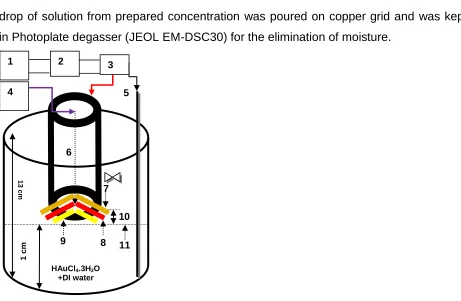
under the optimized conditions as shown in Figure 1. Copper tube internal diameter 3
mm along with flowing argon gas was utilized as a source of forced energy electron
streams and forcing energies (travelling photons) where 100 sccm flow rate of argon
gas was maintained through digital mass flow controller. Graphite rod (width: 1 cm) was
immersed in the solution which is also known as anode. The bottom of the copper
capillary was adjusted just above the surface of solution where distance (gap) between
the bottom of copper capillary and solution surface was maintained ~ 0.4 mm. The
length (distance) between the copper capillary and graphite rod was kept 4 cm.
Symmetric-bipolar modes of pulses were employed which were generated by the pulse
DC power controller (SPIK2000A-20, MELEC GmbH Germany). Temperature of the
solution was recorded from the distance of one meter by LASER-guided meter
(CENTER, 350 Series); 21°C at the start and 47°C at the end of 20 minutes with ±1°C
accuracy. An optimized precursor concentration for developing geometric anisotropic
particles in high number was chosen 0.3 mM (after the conduction of many experiments
results of which are presented in different studies [38-42]). Total quantity of solution
prepared was 100 ml. The processing time of the solution was set 20 minutes. In each
experiment, the average input DC power was measured to be 36 (watts) where running
voltage was ~30 (volts) and current was ~1.2 (amp) and light glow sustained after few
seconds under the slight variation of input power; power fluctuation was more at the
start of the process (initial few seconds), which has almost stabilized in the duration of
the afterward process. Step-up transformer increased voltage 40 times. Bipolar pulse
ON/OFF time was set 10 µsec.
Thickness of the copper capillary wall was 1.5 mm, whereas, the diameter of inner
hollow space through which argon gas flows was 3 mm (in Figure S1). Zones related to
the placing packets of nano shape energy under controlled tuned pulse protocol,
impinging electron streams and traveling photons of different wavelengths at the surface
of monolayer gold atoms are pointed out by (7), (8) and (9), respectively in Figure 1.
Further details of these are given in Figure S2. To characterize features of various
particles both bright field and high-resolution microscope images of particles were
Last and final version
drop of solution from prepared concentration was poured on copper grid and was kept
in Photoplate degasser (JEOL EM-DSC30) for the elimination of moisture.
Figure 1: Layout of pulse-based electronphoton-solution interface process; (1) power supply, (2) pulse
power controller, (3) step-up transformer, (4) argon gas, (5) graphite rod, (6) inner (hollow) region of
copper capillary, (7) placing of nano shape energy in a double-packet (outer region of light glow), (8)
electron-solution interface (middle region of light glow), (9) photon-solution interface (inner region of light
glow), (10) distance between copper capillary and solution surface ~0.4 mm and (11) air-solution interface
3. Results and discussion
Surplus photonic current under set power propagates through the graphite rod, which is
working for the positive terminal as known conventionally in the flow of current through
wire while it is known as anode in the case of electrochemistry. Mainly, the photonic
current propagates through the wire known in negative terminal which is connected to
copper capillary handling flow of argon gas also. The flowing argon gas splitted into the
electron streams at the bottom of copper capillary. Because of no availability of unfilled
states in the argon gas atoms and due to excess given field of propagating photons
characteristic current through their inter-state electron gap resulting into split them
where light glow is observed [44], which is known in plasma and that glow is just ignited
at the bottom of the copper capillary, which is known in cathode. Gold atoms
dissociated from the precursor by dissipated heat energy where the source of that heat
4
1 2 3
6
5
1
3
c
m
8 7
9
HAuCl4.3H2O +DI water
1
cm
10
Last and final version
energy was the dismantling of entered photons to the solution. Those photons
propagated in the graphite rod, which worked as positive terminal, in the form of
photons characteristic current. That heat energy is resulted from the interacted photons
characteristic current to solution as they propagated through inter-state electron gaps of
graphitic state atoms of the immersed graphite rod. A separate study discussed
conversion of photon energy to heat energy while interacting to certain medium [46].
The uplifting of metallic atoms to solution surface while dealing the transition is under
the reaction of entering forced energy of electrons and high energy photons (in high
density). The high energy photons entering to solution are resulted because of the splitting of flowing argon atoms where they didn’t work for splitted electrons. The splitted
electrons carry their own photons (force-energy) to pursue inside the solution.
It is discussed elsewhere [38] that both electron streams and photons result on
splitting of flowing inert gas atoms. Photons of high energy travelling more in the normal
manner to their points of generation entered to solution instead of traveling along the
air-matter interface because they carried their direction of travelling given at the point of
their generation [41]. Argon gas was used to activate the process of generating electron
streams and high energy photons, hence, developing gold particles in different sizes
and shapes. Splitting of inert gas atoms not only delivered electrons to impinge
underlying gold atoms but also enabled the propagation of photons characteristic
current to inter-state electron gaps, prior to split, resulting into allow them to travel in
their increasing wavelength under the ease of open medium. Therefore, a certain
amount of flowing inert gas atoms split just over the solution surface where photons
increasing in their wavelengths work at a place utilizing forcing energy to align
underlying electronic structure of elongated triangular-shaped tiny particle in the case of
perturbed electron states of atoms, thus, modify further the structure of elongated atoms
of tiny-shaped particle into structure of flatten smooth elements [43]. The inert gas
atoms split under the application of excess propagation of photons characteristic current
through their inter-state electron gaps for which further detail is given elsewhere [44].
Auto-controlled current for set pulse duration propagating through copper tube gave
packets of nano shape energy under the application of step-up transformer where tuned
Last and final version
capillary where monolayer assembly of gold atoms is developed, packets of nano shape
energy are placed horizontally over them resulting into bind atoms of monolayer
assembly into tiny particles of own shape nearly all around the region of light glow at
solution surface. The round surface width i.e. 1.5 mm, which is approximately equal to
the thickness of wall of copper capillary, is shown in Figure S1. Therefore, packets of
nano energy shape-like connected triangles developed tiny sized particles of monolayer
in their own shape. The gold atoms when bound into monolayer tiny-sized particle at
solution surface under the energy of triangular-shaped packet, they were under the
re-crystallization state [43]. A double-packet of nano shape energy placed over the
compact monolayer assembly results into bind gold atoms (of transition state) into the
formed shape where the orientation of electrons was more along the adjacent as
exerting naturally available opposite pole forces of surface format. Placing of nano
shape energy in a double-packet is resulted under the bipolar pulse ON/OFF time (10
µsec). Placing of nano shape energy in a single packet is resulted under the unipolar
pulse ON/OFF time (10 µsec) as for the case in reference 41 (in Figure 1). As graphite
rod is immersed into the solution from bottom level to top level of solution, surplus
propagation of photons related to current (wavelength lower than hard X-rays and in the
gap of inter-state electron gaps) occurs into it, on leaving the propagation of inter-state
electron gaps, it enters in the solution while converting into heat energy under the
interaction of medium to dissociate the gold atoms from the precursor. On the other
hand, entering forcing energy of photons along with splitted electron streams uplifting
those dissociated gold atoms under their force of reaction results into develop the
monolayer assembly of atoms. Due to the feature of bipolar pulse having unity ratio of
pulse OFF to ON time, each tiny-sized particle is first developed in shape of two joint
triangles. The detail of their separation into two equal equilateral triangular-shaped tiny
particles is given elsewhere [41-43].
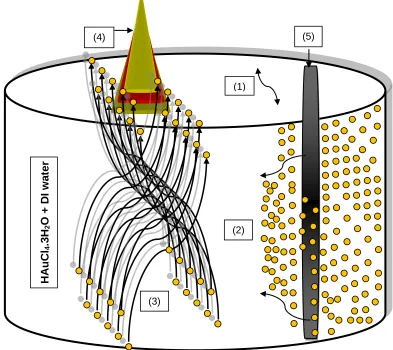
Figure 2 shows dissociation of gold atoms under the supply of heat energy via
immersed graphite rod and their uplifting to solution surface under the entering forced
energy streams of splitted electrons and photons of high energy (in high density). These
both constitute the light glow (plasma), thus, hereafter, where a light glow is referred it is
Last and final version
Figure 2: Gold atoms dissociating from the gold precursor for uplifting to solution surface under their
certain transition state; (1) solution surface, (2) dissociating gold atoms from the precursor on dissipating
the heat energy resulted on dismantling of photons (propagated in characteristic current through
inter-state electron gaps of atoms of graphite rod) under the interaction inside the solution, (3) uplifting of gold
atoms under the reaction of entering force-energy of splitted electrons and standalone photons of high
density, (4) light glow known as plasma generating at bottom points of copper capillary known as cathode
and (5) graphite rod handling excess propagation of photons (characteristic current) known as anode
Signatures of nano shape energy, electron streams and high energy photons (in
high density) covering 3D space while interacting circular plane surface of solution are
shown in Figure S2; accelerated electron streams under gained instantaneous velocities
by means of pursuing photons and high energy photons (in high density) form the light
glow, which is known in their plasma. Therefore, interactions of nano shape energy
(outer circular cone-shape), electron streams (middle circular cone-shape) and high
energy photons (inner circular cone-shape) to compact monolayer assembly of
transition state gold atoms at solution surface are labelled respectively in Figure S2; the
H
A
uC
l4
.3H
2
O
+
D
I
w
a
ter
(3)
(1)
(4) (5)
Last and final version
points of generating packets of nano shape energy, electron streams and high energy
photons (in high density) at the bottom of copper capillary are also shown in (6).
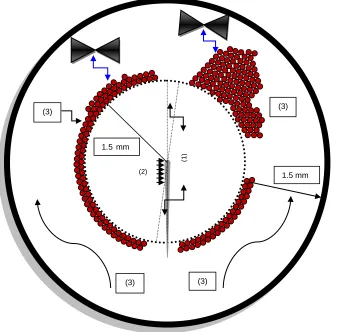
At solution surface, gold atoms under transition state construct monolayer assembly
nearly in the circular shape but by exempting the regions of zero-force axes as shown in
Figure 3. Placed packets of nano shape energy bound transition state atoms of
monolayer assembly into tiny-sized particle of own (formed) shape where having the
monolayer three-dimensional structure in surface format, which is known in hcp
structure or two-dimensional structure. However, our recently published work further
elaborates the origin of developing three-dimensional structure of gold atoms where
atoms of one-dimensional arrays remained non-elongated [40]. But, the evolution of
structure in gold atoms and in atoms of other closely-related family of elements, they do
not evolve three-dimensional structure under the natural span of their electron-dynamics
as only maximum three sorts of forces can exert for dedicated state electron in those
atoms because they deal the grounded format [45]. During processing AgNO3 solution,
there was no developing of triangular-shaped tiny particles although nearly the same
process conditions were employed indicating that silver atoms deal transition state
(re-crystallization state) to elongate at different level of ground surface as compared to the
case of gold atoms [40]. In the case of gold solution, it was not like silver and entire
solution in the beaker changed in a certain color under steady-state behavior; color of
the solution changed at fast rate in the initial few seconds utilizing atoms for developing
tiny-sized particles, nanoparticles and particles since start of process.
In view of above-said, our setup to process gold solution under optimized
concentration of gold precursors along with pulse time, duration of processing solution
along with positions of the copper capillary and graphite rod in glass beaker remained
vital to process the solution for developing various shapes of anisotropic particles. But,
the setup was not remained successful when the solutions of silver precursor and binary
composition were processed. Placed double-packets of nano shape energy bind atoms
of monolayer assembly into joint triangular-shaped tiny particles, in each case, where
binding transition state gold atoms of monolayer assembly in their own (formed) shape
as shown in Figure 3. At centre of light glow, a developing mono-layer of certain shape
Last and final version
the arrow signs where it sinks one step down under dealing the localized gravity.
Binding of such mono-layers in developing particle of certain shape is through the
lateral-orientation of electrons of elongated atoms of structures of smooth elements [43].
Tiny-shaped particles worked and directed as a one-unit from the regions of their
developing to pack at already allocated unfilled regions to develop a certain shape
particle under the immersing force exerting at the tips of their structures of smooth
elements. Structures of smooth elements of triangular-shaped tiny particles while
passing the regions of impinging electron streams may further elongate and prior to
pack at centre of light glow for developing a certain shape particle. An electron imagines
to underlying matter under the carrying force-energy of a photon is discussed elsewhere
[46]. On assembling for certain particle, structures of smooth elements acquire further
smoothness by travelling photons of interface.
Figure 3: Gold atoms at solution surface in suitable circular zone width i.e. 1.5 mm where
double-packets of nano shape energy placed over the compact monolayer assembly to bind transition state
atoms in formed (own) shape and size where amalgamations of the atoms along the zero-force axis
(rear-(3)
1.5 mm
(2)
(1)
(3) (3)
(3)
Last and final version
sides of the north and south poles) do not occur; (1) zero-force axes, (2) developing mono-layer and
developed mono-layers of a certain shape developing particle, (3) monolayer assembly of transition state
gold atoms around the favorable regions of the light glow dealing packets of nano shape energy
The predictor packing of triangular-shaped tiny particles is from the same region
where they were developed. At tuned bipolar pulse mode (pulse ON/OFF time: 10 µsec)
along with other set parameters described in the experimental details, the each
developed tiny particle contained the two connecting triangular-shaped tiny particles.
Joint triangular-shaped tiny particle separated into two equal triangular-shaped tiny
particles under the difference of force exerted along their slightly perturbed opposite
poles (at point of connection of their single atoms). It can be observed in the illustration
given in Figure 3 where tiny particles of joint triangular-shape are developing on placing
double-packets nano shape energy over the compact monolayer assembly of gold
atoms.
The disconnected tiny-shaped particle is in queue to go for packing while following
the packing of the earlier one in each case of separating a tiny particle of joint triangular
shape into two equilateral triangular-shaped tiny particles. One triangular-shaped tiny
particle directed tips of structures of smooth elements toward the regions of packing
under exerting force of surface format in immersing manner till their reaching to those
regions. In the similar manner, the other triangular-shaped tiny particles are arriving with
their structures of smooth elements to pack at pre-allocated regions as a one-unit in
each case to develop each mono-layer of developing certain shape particle. The
termination of their packing at any point results into sinking of particle where each
mono-layer binds under the mechanism of lateral-orientation of electrons [43]. In the
case of rod- and bar-shaped particles, tiny-shaped particles were developed at
oppositely-sided regions available at the sides of rear north-south poles on the solution
surface as illustrated in Figure S3. Such shaped particles are said to be particles of
one-dimensional shape but the packing of tiny-shaped particles in developing them
remained from the two sides (opposite to each other from the centre point). In the case
of plate-like particles in multi-dimensions, packed tiny-shaped particles also developed
in triangular-shaped tiny particles but in the regions of east-west poles and near regions
of east-west poles. To develop an ideal triangular-shaped particle, at one time, the
Last and final version
particle, it is at 120° angle. To develop hexagonal-shaped particle, at one time, the
momentum of packing remains the same from all six sides where packing of each
tiny-shaped particle remains at orientation of 60° angle and from the six different zones of
solution surface.
Figure 4 shows developing of connected triangular-shaped tiny particles where the
size is decreasing with prolonging the process duration. As discussed above, such tiny
particles separated into equal triangular-shaped tiny particles under exerting force along
their slightly perturbed axis. Decreasing the size of triangular-shaped tiny particles
resulted into decrease the aspect ratio of their particles also because they are being
developed by the packing of decreasing-sized tiny-shaped tiny particles as per reducing
time of processing the solution. At start of the process, large-sized tiny-shaped particles
are developed and their packings into certain shape particle also give the high aspect
ratio of that particle. As the size of the tiny-shaped particle decreases on reducing the
number of atoms per unit area at solution surface, particles of decreasing aspect ratio
develop with time despite of the fact that they maintain the same shape of their
tiny-sized particles (triangular-shaped tiny particles). Under the fixed concentration of
precursor, the number of amalgamating atoms into monolayer assembly reduced
significantly resulting into lower the aspect ratio of particles developed with the passage
of prolonging the process time. It is estimated that in the beginning of the process, the
size of developing tiny particle was varied depending on the ratio of pulse OFF to ON
time also.
Figure 4: Size of connected triangular-shaped tiny particles (through point of connection of their single
atoms) decreases with respect to process time under fixed precursor concentration of gold precursor
Each developing layer of the geometric anisotropic particle self-deal the packing as
left vacant places provide the force of exertion to structures of smooth elements for
each packing triangular-shaped tiny particle from the relevant zone. Therefore, the
predictor packing is related to self-filling of unpacked regions of a developing particle in
Last and final version
certain shape. May be, a complete mono-layer of developing geometric anisotropic
particle developed for each step of pulse ON time (10 µsec). That developed
mono-layer went down to solution surface while dealing the localized gravity and followed by
developing a new mono-layer starting exactly at the centre of the one previously
developed, in the same size and shape, as the developing of triangular-shaped tiny
particles along with predictor packing remained the same for that period, the shape of
developing particle is being maintained under the synchronization of the process. While
developing upper layer, downward layer descends level upto ~0.3 nm (an approx.
diameter of gold atom; lateral width), however, under the break of developing layers for
next set period of pulse ON time (10 µsec), the particle sinked by leaving the solution
surface completely resulting into leave the centre of light glow, thus, allowing to develop
a new particle. Once, the process of developing a new mono-layer to develop certain
shape particle is timed out; the particle is no more under growth. This leads into start
the developing process of the new particle. On utilizing the developed tiny-shaped
particles around centre, the newly developed tiny-shaped particles started utilizing
themselves under their predictor packings, thus, developing new particles of geometric
anisotropic shapes. Lower the number of binding mono-layers, then, higher is the
aspect ratio of resulted particle. The particle’s shape varies depending on the region of
initially packed triangular-shaped tiny particles, at one time, along with their quantity;
when three equal sized tiny-shaped particles packed simultaneously at 120° angle
placed side by side, it will result into develop a particle of triangular-shape and when six
equal sized tiny-shaped particles simultaneously packed at 60° angle placed side by
side, it will result into develop a particle of hexagonal-shape.
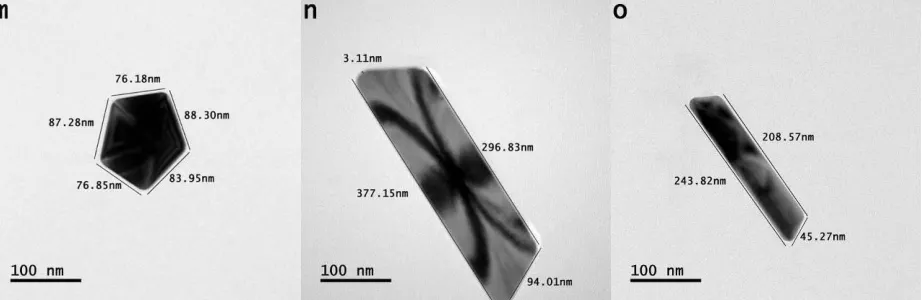
Figure 5 shows particles of various anisotropic shapes which were developed under
predictor packing of triangular-shaped tiny particles arriving from the relevant regions of
solution surface. The different shapes of particles in Figure 5 clearly figure out the
degree of orientation at which predictor packing is taken place and in each plane of the
particle by taking the centre of particle as a reference point. Therefore, photons working
at the place help in constructing perfect smooth elements having approx. equal
inter-spacing distance of each developed mono-layer of developing multi-dimensional
Last and final version
Figure 5: (a-o) bright field transmission microscope images of standalone triangle-, hexagon-, isosceles
trapezoid-, rhombus-, rod-, pentagon-, tape- and skating-like particles
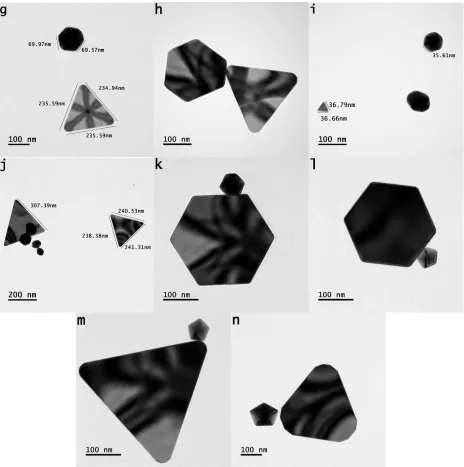
In addition to several shown geometric anisotropic particles in Figure 5, such
particles adhere to each other or approach to each other and to distorted (amorphous
structure) particles as well under prevailing forces as per their shape and their overall
situation in the solution as shown in Figure 6 where they possess different size and
shape. In those particles, some of them possess very small size while others possess
Last and final version
Figure 6: (a-n) bright field transmission microscope images of various geometric anisotropic particles;
in some cases, they are coupling to each other, in some cases, they keep the distance, and, in some
cases, they adhere to the distorted (amorphous structure) particles
In this work, an optimized pulse sequence (pulse ON/OFF time: 10 µsec) along with
optimized parameters of developing geometric anisotropic particles (precursor
concentration: 0.30 mM, distance between copper capillary and solution surface: 0.4
mm, input power, quantity of solution and shape of beaker, etc.) were employed.
Unoptimized pulse sequence was studied as well [41] where developing particles start
Last and final version
solution and under the certain scheme of monolayer assembly, tiny-sized particles of
shape other than equilateral triangle developed where their packing under
mixed-dimension of exerting forces resulted into develop amorphous structure particle. They
do not possess a specific shape, hence, possess anisotropy. Such particles are neither
in their one-dimensional shape nor in their multi-dimensional shapes. They are related
to distorted shapes. Particles of amorphous structure developed under the packing of
those tiny-sized particles (or tiny-shaped particles) where they assemble structures of
smooth elements under non-uniform (in mixed-dimension) exertion of forces. Further
details of developing amorphous structure (distorted) particles is given elsewhere [39,
41].
Atoms of monolayer assembly at solution surface remained in their compact
scheme. Gold atoms when at solution surface, they are in their certain transition state
as they are not at their original level. But, a grounded level is below to the ground level
surface. So, at solution surface, they deal the exerting forces of surface format at
electron levels. But, prior to uplifting of gold atoms, they were in their different state.
Therefore, just at the surface of solution, their atoms of one-dimensional arrays of
triangular-shaped tiny particles elongate under the exertion of those forces. Elongated
atoms of each one-dimensional array developed a structure of smooth element [43].
Therefore, while packing a triangular-shaped tiny particle for developing a certain shape
particle, all structures of smooth elements belonging to it work as a one-unit prior to
their assembling but, on reaching in the required regions of assembling, they adjust
them as per the previously assembled ones where controlled force handling their
inter-spacing distance, was available. On terminating the packing of developing large-sized
particles, they sink under free fall. The developing of various geometric anisotropic
particles and their sinking enables the arriving of new stock of gold atoms at air-solution
interface, thus, developing a new monolayer assembly at air-solution interface. The
binding of mono-layer developed in certain shape of developing particle bind to another
mono-layer placing over it under the lateral-orientation of electrons of elongated atoms
where expansion and contraction of energy knots contribute. Expansion and contraction
of clamped energy knots to electrons for different nature atoms under varying
Last and final version
states discussed [50]. A separate study discussed the precise structures of particles of
one-dimensional shapes and multi-dimensional shapes developed under the
assembling of structures of smooth elements, which resulted from the packing of
tiny-shaped particles arriving from different zones of the solution surface [51].
Photons propagated through graphite rod, they provided energy to dissociate gold
atoms from the precursor at solution surface, thus, developing monolayer assembly
around the pulse-based electronphoton-solution interface is under the reaction of forced
energy provided by the electron streams along with high energy photons (in high
density) entering to solution. Therefore, entering photons of different wavelengths along
with the electrons (under the carrying force-energy of photons) to solution from the
region of light glow don’t appear to dissociate metallic atoms from precursor in such a
large number. As the energy is associated with them as well but they can’t dissociate
the gold atoms in such a large quantity. Therefore, dissociation of the gold atoms from
the precursor is mainly through the immersed graphite rod. However, the systematic
placement of gold atoms at solution surface while uplifting in each cycle of bipolar pulse
ON time is under the reaction of entering electrons carrying force-energy of photons and
high energy photons (in high density). Therefore, uplifting of atoms to solution surface is
because of the light glow while their dissociation from the precursor is under the
immersed graphite rod. Thus, developing monolayer assembly at solution surface under
the uplifting of metallic atoms to solution surface is not only because of the one
component but involving both light glow and propagating photons through graphite rod
also.
Here, the word ‘monolayer’ refers to compact assembly of gold atoms in a single layer at solution surface but the word ‘mono-layer’ refers when tiny-shaped particles are
packed to develop a single layer of the certain shape developing particle under the
assembling of structures of smooth elements.
4. Conclusions
Under the optimized process parameters, different geometric anisotropic shapes of gold
particles developed in pulse-based electronphoton-solution interface process. For the
Last and final version
immersed graphite rod which transformed into heat energy on entering to solution
resulting into dissociate gold atoms from their precursor. Under tuned pulse protocol,
flowing argon atoms splitted into electrons where their carrying force-energy (photons),
pursuing to them, enter them to solution, as a reaction, dissociated gold atoms are
uplifted. Forced energy streams of electrons impinge to underneath passing tiny-sized
particles arriving to pack. When impinging electron streams transporting the forced
energies do not block by the passing tiny particles, they enter to the solution. In addition
to entering electrons carrying force-energy (photons), high energy photons (in high
density) also enter to solution. They both enable the uplifting of gold atoms to develop
monolayer assembly at solution surface while their entrance. They both are generated
at the bottom of copper capillary constituting the argon plasma.
Monolayer assembly developed around the light glow, on utilizing, renovated
because of uplifting the gold atoms. The placing packets of nano shape energy resulted
under the tuned bipolar pulse protocol enable the developing of joint triangular-shaped
tiny particles where gold atoms (of transition state) are isolated from monolayer
assembly. A tiny particle of joint triangular-shape separated into two equilateral
triangular-shape tiny particles on exerting the force along a bit perturbed axis at point of
their connection. Atoms of such tiny-shaped particle elongate under the existed exerting
force at electron levels where converting each of their one-dimensional array into
structure of smooth element. But, such tiny-shaped particles work as a one-unit to pack
at centre of light glow where their structures of smooth elements deal immersing force at uniform rate. A tiny-shaped particle doesn’t go for pre-allocated region of packing to
develop particle unless it has geometry of equilateral triangular-shape.
Triangular-shaped tiny particles undertake packing at pre-allocated regions first at the centre of
light glow following by unfilled regions of developing mono-layers of a certain shape
developing particle. The developed feature of tiny particles self-ensured regions of their
packings. Their packings develop particles of unprecedented features not possible
through other means.
On separation into two equal triangular-shaped tiny particles, a tiny-shaped particle
directed towards already reserved region of developing particle and same is the case
Last and final version
prior to assemble as a one-unit, a tiny-shaped particle has been developed into the
structure of smooth elements. The numbers of initially packed tiny-shaped particles, at
one time, from different zones of solution surface nucleate a particle where initial
number of simultaneously packing tiny-shaped particles flowing by continuity in the
packing for each developing mono-layer determine the shape and aspect ratio of that
particle. The synchronization of the setup resulted into develop several unprecedented
featured particles having their different sizes and shapes. Our investigations lead into
present new trends of researching means not only in the field of materials science and
physics but in the field of nanoscience and nanotechnology also.
Acknowledgements
Mubarak Ali thanks National Science Council, now, Ministry of Science and Technology
(MOST) Taiwan (R.O.C.) for awarding postdoctorship: NSC-102-2811-M-032-008
(August 2013-July 2014). Although, Dr. Yeh is co-author of this paper yet first author
appreciates giving his time and arriving from Hsinchu to conduct TEM operation under
the given directions.
References
[1] P. Kim, C. M. Lieber, Nanotube Nanotweezers, Science 286, (1999) 2148-2150. [2] Z. Tang, N. A. Kotov, M. Giersig, Spontaneous Organization of Single CdTe
Nanoparticles into Luminescent Nanowires, Science 297, (2002) 237-240.
[3] Z. Tang, Z. Zhang, Y. Wang, S. C. Glotzer, N. A. Kotov, Self-Assembly of CdTe
Nanocrystals into Free-Floating Sheets, Science 314, (2006) 274-278.
[4] Y. Liu, X. Zhang, Metamaterials: a new frontier of science and technology, Chem. Soc. Rev. 40, (2011) 2494-2507.
[5] A. Kuzyk, et al. DNA-based self-assembly of chiral plasmonic nanostructures with tailored optical response, Nature 483, (2012) 311-314.
[6] J. Kim, Y. Lee, S. Sun, Structurally ordered FePt nanoparticles and their
Last and final version
[7] K. Kusada, et al. Discovery of face-centered-cubic ruthenium nanoparticles: facile size-controlled synthesis using the chemical reduction method, J. Am. Chem. Soc. 135, (2013) 5493-5496.
[8] M. Brust, M. Walker, D. Bethell, D. J. Schiffrin, R. Whyman, Synthesis of
Thiol-derivatised Gold Nanoparticles in a Two-phase Liquid-Liquid System, J. Chem. Soc., Chem. Commun. (1994) 801-802.
[9] R. L. Whetten, et al. Nanocrystal Gold Molecules, Adv. Mater. 8, (1996) 428-433. [10] L. O. Brown, J. E. Hutchison, Formation and Electron Diffraction Studies of
Ordered 2-D and 3-D Superlattices of Amine-Stabilized Gold Nanocrystals, J. Phys. Chem. B 105, (2001) 8911-8916.
[11] M. Brust, C. J. Kiely, Some recent advances in nanostructure preparation from
gold and silver particles: a short topical review, Colloids and Surfaces A: Physicochem. Eng. Aspects 202, (2002) 175-186.
[12] G. M. Whitesides, M. Boncheva, Beyond molecules: Self-assembly of
mesoscopic and macroscopic components, Proc. Natl. Acad. Sci. USA 99, (2002) 4769-4774.
[13] J. Huang, F. Kim, A. R. Tao, S. Connor, P. Yang, Spontaneous formation of
nanoparticle stripe patterns through dewetting, Nature Mater. 4, (2005) 896-900. [14] S. C. Glotzer, et al. Self-assembly of anisotropic tethered nanoparticle shape
amphiphiles, Curr. Opin. Colloid Interface Sci. 10, (2005) 287-295.
[15] S. C. Glotzer, M. J. Solomon, Anisotropy of building blocks and their assembly
into complex structures, Nature Mater. 6, (2007) 557-562.
[16] S. Link, M. A. El-Sayed, Shape and size dependence of radiative, nonradiative
and photothermal properties of gold nanocrystals, Int. Rev. Phys. Chem. 19, (2000) 409- 453.
[17] D. Vanmaekelbergh, Self-assembly of colloidal nanocrystals as route to novel
classes of nanostructured materials,Nano Today 6, (2011) 419-437.
[18] C. P. Shaw, D. G. Fernig, R. Lévy, Gold nanoparticles as advanced building
Last and final version
[19] Y. Negishi, et al. A Critical Size for Emergence of Nonbulk Electronic and Geometric Structures in Dodecanethiolate-Protected Au Clusters, J. Am. Chem. Soc. 137, (2015) 1206-1212.
[20] N. Liu, M. L. Tang, M. Hentschel, H. Giessen, A. P. Alivisatos,
Nanoantenna-enhanced gas sensing in a single tailored nanofocus, Nat. Mater. 10, (2011) 631-637.
[21] N. Li, P. Zhao, D. Astruc, Anisotropic Gold Nanoparticles: Synthesis, Properties,
Applications, and Toxicity, Angew. Chem. Int. Ed. 53, (2014) 1756-1789.
[22] M. L. Brongersma, N. J. Halas, P. Nordlander, Plasmon-induced hot carrier science
and technology, Nature Nanotechnol. 10, (2015) 25-34.
[23] G. van Anders, D. Klotsa, N. K. Ahmed, M. Engel, S. C. Glotzer, Understanding
shape entropy through local dense packing, Proc. Natl. Acad. Sci. U.S.A. 111, (2014) E4812–E4821.
[24] V. N. Manoharan, Colloidal matter: Packing, geometry, and entropy, Science
349, (2015).
[25] S. Atkinson, F. H. Stillinger, S. Torquato, Existence of isostatic, maximally
random jammed monodisperse hard-disk packings, Proc. Natl. Acad. Sci. U.S.A.
111, (2015) 18436-18441.
[26] W. -H. Chiang, C. Richmonds, R. M. Sankaran, Continuous-flow,
atmospheric-pressure microplasmas: a versatile source for metal nanoparticle synthesis in the
gas or liquid phase, Plasma Sources Sci. Technol. 19, (2010) 034011-18.
[27] D. Mariotti, J. Patel, V. Švrček, P. Maguire, Plasma –Liquid Interactions at
Atmospheric Pressure for Nanomaterials Synthesis and Surface Engineering,
Plasma Process. Polym. 9, (2012) 1074-1085.
[28] J. Patel, L. Něemcová, P. Maguire, W. G. Graham, D. Mariotti, Synthesis of surfactant-free electrostatically stabilized gold nanoparticles by plasma –induced
liquid Chemistry, Nanotechnology 24, (2013) 245604-14.
[29] X. Huang, Y. Li, X. Zhong, Effect of experimental conditions on size control of Au
nanoparticles synthesized by atmospheric microplasma electrochemistry,
Last and final version
[30] N. Shirai, S. Uchida, F. Tochikubo, Synthesis of metal nanoparticles by dual
plasma electrolysis using atmospheric dc glow discharge in contact with liquid,
Jpn. J. Appl. Phys. 53, (2014) 046202-046207.
[31] C. Richmonds, et al. Electron-transfer reactions at the plasma-liquid interface, J. Am. Chem. Soc. 133, (2011) 17582-17585.
[32] M. Witzke, P. Rumbach, D. B. Go, R. M. Sankaran, Evidence for the electrolysis
of water by atmospheric-pressure plasmas formed at the surface of aqueous
solutions, J. Phys. D: Appl. Phys. 45, (2012) 442001-05.
[33] J. Hieda, N. Saito, O. Takai, Exotic shapes of gold nanoparticles synthesized
using plasma in aqueous solution, J. Vac. Sci. Technol. A 26, (2008) 854-856. [34] N, Saito, J. Hieda, O. Takai, Synthesis process of gold nanoparticles in solution
plasma. Thin Solid Films 518, (2009) 912-917.
[35] M. A. Bratescu, S. -P. Cho, O. Takai, N. Saito, Size-Controlled Gold
Nanoparticles Synthesized in Solution Plasma, J. Phys. Chem. C 115, (2011) 24569-24576.
[36] Y. K. Heo, M. A. Bratescu, D. Aburaya, N. A. Saito, phonon thermodynamics
approach of gold nanofluids synthesized in solution Plasma, Appl. Phys. Lett.
104, (2014) 111902-05.
[37] K, Furuya, Y. Hirowatari, T. Ishioka, A. Harata, Protective Agent-free Preparation of Gold Nanoplates and Nanorods in Aqueous HAuCl4 Solutions Using Gas–
Liquid Interface Discharge, Chem. Lett. 36, (2007) 1088-1089.
[38] M. Ali, I –N. Lin, The effect of the Electronic Structure, Phase Transition, and
Localized Dynamics of Atoms in the formation of Tiny Particles of Gold.
http://arxiv.org/abs/1604.07144 (last version)
[39] M. Ali, I –N. Lin, Development of gold particles at varying precursor
concentration. http://arXiv.org/abs/1604.07508 (last version)
[40] M. Ali, I –N. Lin, Tapping Opportunity of Tiny-Shaped Particles and Role of
Last and final version
[41] M. Ali, I –N. Lin, Controlling morphology-structure of particles at different pulse
rate, polarity and effect of photons on structure. http://arxiv.org/abs/1605.04408
(last version)
[42] M. Ali, I –N. Lin, Formation of tiny particles and their extended shapes -Origin of
physics and chemistry of materials. http://arxiv.org/abs/1605.09123 (last version) [43] M. Ali, The study of tiny-shaped particles developing mono-layer dealing
localized gravity at solution surface. http://arxiv.org/abs/1609.08047 (last version) [44] M. Ali, Atoms of electron transition deform or elongate but do not ionize while
inert gas atoms split. http://arxiv.org/abs/1611.05392 (last version)
[45] M. Ali, Structure evolution in atoms of solid state dealing electron transitions.
http://arxiv.org/abs/1611.01255 (last version)
[46] M. Ali, Revealing the Phenomena of Heat and Photon Energy on Dealing Matter
at Atomic level. https://www.preprints.org/manuscript/201701.0028/v10
[47] M. Ali, Nanoparticles-Photons: Effective or Defective Nanomedicine. J. Nanomed. Res. 5 (2017) 00139.
[48] M. Ali, M. Ürgen, Switching dynamics of morphology-structure in chemically deposited carbon films –A new insight, Carbon 122 (2017) 653-663.
[49] M. Ali, I –N. Lin, Phase transitions and critical phenomena of tiny grains carbon
films synthesized in microwave-based vapor deposition system.
http://arXiv.org/abs/1604.07152 (last version)
[50] M. Ali, Why Atoms of Some Elements are in Gas State and Some in Solid State,
but Carbon Works on Either Side (2018).
https://www.researchgate.net/profile/Mubarak_Ali5
(https://www.preprints.org/manuscript/201803.0092.v1)
[51] M. Ali, I –N. Lin, Precise Structural Identification of Different Shapes of High
Last and final version Authors’ biography:
Mubarak Ali graduated from University of the Punjab with B.Sc. (Phys& Maths) in 1996 and M.Sc. Materials Science with distinction at Bahauddin Zakariya University, Multan, Pakistan (1998); thesis work completed at Quaid-i-Azam University Islamabad. He gained Ph.D. in Mechanical Engineering from Universiti Teknologi Malaysia under the award of Malaysian Technical Cooperation Programme (MTCP;2004-07) and postdoc in advanced surface technologies at Istanbul Technical University under the foreign fellowship of The Scientific
and Technological Research Council of Turkey (TÜBİTAK; 2010). He completed another postdoc in the field of
nanotechnology at Tamkang University Taipei (2013-2014) sponsored by National Science Council now M/o Science and Technology, Taiwan (R.O.C.). Presently, he is working as Assistant Professor on tenure track at COMSATS University Islamabad (previously known as COMSATS Institute of Information Technology), Islamabad campus, Pakistan (since May 2008) and prior to that worked as assistant director/deputy director at M/o Science & Technology (Pakistan Council of Renewable Energy Technologies, Islamabad; 2000-2008). He was invited by Institute for Materials Research, Tohoku University, Japan to deliver scientific talk on growth of synthetic diamond without seeding treatment and synthesis of tantalum carbide. He gave several scientific talks in various countries. His core area of research includes materials science, physics & nanotechnology. He was also offered the merit scholarship (for PhD study) by the Government of Pakistan
but he couldn’t avail. He is author of several articles published in various periodicals available at
https://scholar.google.com.pk/citations?hl=en&user=UYjvhDwAAAAJ,https://www.researchgate.net/profile/Mubarak_Ali5