and Faster Binary-Field MACs
Daniel J. Bernstein1,2 and Tung Chou2
1 Department of Computer Science
University of Illinois at Chicago, Chicago, IL 60607–7053, USA [email protected]
2 Department of Mathematics and Computer Science
Technische Universiteit Eindhoven, P.O. Box 513, 5600 MB Eindhoven, the Netherlands
Abstract. This paper shows how to securely authenticate messages us-ing just 29 bit operations per authenticated bit, plus a constant overhead per message. The authenticator is a standard type of “universal” hash function providing information-theoretic security; what is new is com-puting this type of hash function at very high speed.
At a lower level, this paper shows how to multiply two elements of a field of size 2128 using just 9062 ≈ 71·128 bit operations, and how to multiply two elements of a field of size 2256 using just 22164≈87·256 bit operations. This performance relies on a new representation of field elements and new FFT-based multiplication techniques.
This paper’s constant-time software uses just 1.89 Core 2 cycles per byte to authenticate very long messages. On a Sandy Bridge it takes 1.43 cycles per byte, without using Intel’s PCLMULQDQ polynomial-multiplication hardware. This is much faster than the speed records for constant-time implementations of GHASH without PCLMULQDQ (over 10 cycles/byte), even faster than Intel’s best Sandy Bridge implementa-tion of GHASH with PCLMULQDQ (1.79 cycles/byte), and almost as fast as state-of-the-art 128-bit prime-field MACs using Intel’s integer-multiplication hardware (around 1 cycle/byte).
Key words:Performance·FFTs·Polynomial multiplication·Universal hashing ·Message authentication
1
Introduction
polynomial at a secret element ofF2128 =F2[x]/(x128+x7+x2+x+1), using one multiplication in F2128 for each 128-bit input block. The cost of GHASH is an important part of the cost of GCM, and it becomes almost the entire cost when large amounts of non-confidential data are being authenticated without being encrypted, or when a denial-of-service attack is sending a flood of forgeries to consume all available processing time.
Most AES-GCM software implementations rely heavily on table lookups and presumably leak their keys to cache-timing attacks. K¨asper and Schwabe [35] (CHES 2009) addressed this problem by introducing a constant-time tation of AES-GCM using 128-bit vector instructions. Their GHASH implemen-tation takes 14.4 cycles/byte on one core of an Intel Core 2 processor. On a newer Intel Sandy Bridge processor the same software takes 13.1 cycles/byte. For comparison, HMAC-SHA1, which is widely used in Internet applications, takes 6.74 Core 2 cycles/byte and 5.18 Sandy Bridge cycles/byte.
1.1 Integer-Multiplication Hardware. Much better speeds than GHASH were already provided by constant-time MACs that used integer multiplication rather than multiplication of polynomials mod 2. Examples include UMAC [15], Poly1305 [5], and VMAC [36]. Current Poly1305 software from [22] runs at 1.89 Core 2 cycles/byte and 1.22 Sandy Bridge cycles/byte. VMAC, which uses “pseudo dot products” (see Section 4), is even faster than Poly1305.
CPUs include large integer-multiplication units to support many different ap-plications, so it is not a surprise that these MACs are much faster in software than GHASH (including non-constant-time GHASH software; see [35]). How-ever, integer multiplication uses many more bit operations than multiplication of polynomials mod 2, so for hardware designers these MACs are much less at-tractive. MAC choice is a continuing source of tension between software designers and hardware designers.
1.2 New Speeds for Binary-Field MACs. This paper introduces Auth256, an F2256-based MAC at a 2255 security level; and a constant-time software im-plementation of Auth256 running at just 1.89 cycles/byte on a Core 2. We also tried our software on a Sandy Bridge; it runs at just 1.43 cycles/byte. We also have a preliminary Cortex-A8 implementation below 14 cycles/byte.
This new binary-field MAC is not quite as fast as integer-multiplication MACs. However, the gap is quite small, while the hardware advantages of binary fields are quite important. We plan to put our software into the public domain.
1.3 New Bit-Operation Records for Binary-Field Multiplication.The software speed advantage of Auth256 over GHASH, despite the much higher se-curity level of Auth256, is easily explained by the following comparison. School-book multiplication would take 1282 ANDs and approximately 1282 XORs for each 128 bits of GHASH input, i.e., approximately 256 bit operations per au-thenticated bit. Computing a 256-bit authenticator in the same way would use approximately 512 bit operations per authenticated bit. Auth256 uses just 29 bit operations per authenticated bit.
Of course, Karatsuba’s method saves many bit operations at this size. See, e.g., [4], [42], [18], [48], [45], [41], [8], [9], and [21]. Bernstein’s Karatsuba/Toom combination in [9] multiplies 256-bit polynomials using only about 133 ·256 bit operations. Multiplying 256-bit field elements has only a small overhead. However, 133 bit operations is still much larger than 29 bit operations.
Our improved number of bit operations is a combination of four factors. The first factor is faster multiplication: we reduce the cost of multiplication in F2256 from 133·256 bit operations to just 22292 ≈87·256 bit operations. The second factor, which we do not take credit for, is the use of pseudo dot products to reduce the number of multiplications by a factor of 2, reducing 87 below 44. The third factor, which reduces 44 to 32, is an extra speedup from an interaction between the structure of pseudo dot products and the structure of the multiplication algorithms that we use. The fourth factor, which reduces 32 to just 29, is to use a different field representation for the input to favor the fast multiplication algorithm we use.
Specifically, we use a fast Fourier transform (FFT) to multiply polynomials in F28[x]. The FFT is advertised in algorithm courses as using an essentially linear number of field additions and multiplications but is generally believed to be much slower than other multiplication methods for cryptographic sizes. Bernstein, Chou, and Schwabe showed at CHES 2013 [11] that a new “additive FFT” saves time for decryption in McEliece’s code-based public-key cryptosys-tem, but the smallest FFT sizes in [11] were above 10000 bits (evaluation at every element inF2m, where m≥11). We introduce an improved additive FFT that uses fewer bit operations than any previously known multiplier for fields as small as F264, provided that the fields containF28. Our additive FFT, like many AES hardware implementations, relies heavily on a tower-field representation of
F28, but benefits from this representation in different ways from AES. The extra speedup inside pseudo dot products comes from merging inverse FFTs, which requires breaking the standard encapsulation of polynomial multiplication; see Section 4.
The fact that we are optimizing bit operations is also the reason that we expect our techniques to produce low area for high-throughput hardware. Opti-mizing the area of a fully unrolled hardware multiplier is highly correlated with optimizing the number of bit operations. We do not claim relevance to very small serial multipliers.
soft-ware, Intel added “AES New Instructions” to some of its CPUs. These instruc-tions include PCLMULQDQ, which computes a 64-bit polynomial multiplication in F2[x].
Krovetz and Rogaway reported in [37] that GHASH takes 2 Westmere cy-cles/byte using PCLMULQDQ. Intel’s Shay Gueron reported in [26] that heav-ily optimized GHASH implementations using PCLMULQDQ take 1.79 Sandy Bridge cycles/byte. Our results are faster at a higher security level, although they do require switching to a different authenticator.
Of course, putting sufficient resources into a hardware implementation will beat any software implementation. To quantify this, consider what is required for GHASH to run faster than 1.43 cycles/byte using PCLMULQDQ. GHASH performs one multiplication for every 16 bytes of input, so it cannot afford more than 22.88 cycles for each multiplication. If PCLMULQDQ takestcycles andtis not very small then presumably Karatsuba is the best approach to multiplication inF2128, taking 3tcycles plus some cycles for latency, additions, and reductions. The latest version of Fog’s well-known performance survey [23] indicates that
t = 7 for AMD Bulldozer, Piledriver, and Steamroller and that t = 8 for Intel Sandy Bridge and Ivy Bridge; on the other hand, t = 2 for Intel Haswell and
t= 1 for AMD Jaguar. Gueron, in line with this analysis, reported 0.40 Haswell cycles/byte for GHASH.
It is quite unclear what to expect from future CPUs. Intel did not put PCLMULQDQ hardware into its low-cost “Core i3” lines of Sandy Bridge, Ivy Bridge, and Haswell CPUs; and obviously Intel is under pressure from other manufacturers of small, low-cost CPUs. To emphasize the applicability of our techniques to a broad range of CPUs, we have avoided PCLMULQDQ in our software.
2
Field Arithmetic in
F
28This section reports optimized circuits for field arithmetic in F28. We write “circuit” here to mean a fully unrolled combinatorial circuit consisting of AND gates and XOR gates. Our main cost metric is the total number of bit operations, i.e., the total number of AND gates and XOR gates, although as a secondary metric we try to reduce the number of registers required in our software.
Subsequent sections use these circuits as building blocks. The techniques also apply to largerF2s, butF28 is large enough to support the FFTs that we use in this paper.
2.1 Review of Tower Fields. We first construct F22 in the usual way as
F2[x2]/(x22+x2+ 1). We writeα2 for the image of x2 inF22, so α22+α2+ 1 = 0. We represent elements of F22 as linear combinations of 1 and α2, where the coefficients are in F2. Additions in F22 use 2 bit operations, namely 2 XORs.
We construct F24 as F22[x4]/(x24+x4+α2), rather than using a polynomial basis for F24 over F2. We write α4 for the image of x4 in F24. We represent elements ofF24 as linear combinations of 1 and α4, where the coefficients are in
Finally, we constructF28 as F24[x8]/(x28+x8+α2α4); write α8 for the image of x8 in F28; and represent elements of F28 as F24-linear combinations of 1 and
α8. Additions in F28 use 8 bit operations.
2.2 Variable Multiplications. A variable multiplication is the computation of ab given a, b ∈ F2s as input. We say “variable multiplication” to distinguish this operation from multiplication by a constant; we will optimize constant mul-tiplication later.
For variable multiplication inF22, we perform a multiplication ofa0+a1x, b0+
b1x∈F2[x] and reduction modulox2+x+ 1. Here is a straightforward sequence of 7 operations using schoolbook polynomial multiplication: c0 ←a0 ⊗b0;c1 ←
a0⊗b1;c2 ←a1⊗b0;c3 ←a1⊗b1;c4 ←c1⊕c2;c5 ←c0⊕c3;c6 ←c4⊕c3. The result is c5, c6.
For F24 and F28 we use 2-way Karatsuba. Note that since the irreducible polynomials are of the formx2+x+α the reductions involve a different type of multiplication described below: multiplication of a field element with a constant. We end up with just 110 bit operations for variable multiplication inF28. For comparison, Bernstein [9] reported 100 bit operations to multiply 8-bit polyno-mials in F2[x], but reducing modulo an irreducible polynomial costs many extra operations. A team led by NIST [19], improving upon various previous results such as [31], reported 117 bit operations to multiply in F2[x] modulo the AES polynomial x8+x4+x3+x+ 1.
2.3 Constant Multiplications.A constant multiplication in F2s is the com-putation of αb given b∈F2s as input for some constant α ∈F2s. This is trivial for α ∈ F2 so we focus on α ∈ F2s\F2. One can substitute a specific α into our 110-gate circuit for variable multiplication to obtain a circuit for constant multiplication, and then shorten the circuit by eliminating multiplications by 0, multiplications by 1, additions of 0, etc.; but for small fields it is much better to use generic techniques to optimize the cost of multiplying by a constant matrix. Our linear-map circuit generator combines various features of Paar’s greedy additive common-subexpression elimination algorithm [40] and Bernstein’s two-operand “xor-largest” algorithm [10]. Forα ∈F28\F2our constant-multiplication circuits use 14.83 gates on average. Compared to Paar’s results, this is slightly more gates but is much better in register use; compared to Bernstein’s results, it is considerably fewer gates.
The real importance of the tower-field construction for us is that constant multiplications become much faster when the constants are in subfields. Mul-tiplying an element of F28 by a constant α ∈ F24\F2 takes only 7.43 gates on average, and multiplying an element ofF28 by a constant α∈F22\F2 takes only 4 gates on average. The constant multiplications in our FFT-based multiplica-tion algorithms forF2256 (see Section 3) are often in subfields of F28, and end up using only 9.02 gates on average.
subcom-putations. For example, when anF28 element in this representation is multiplied by a constant inF22, the computation decomposes naturally into 4 independent subcomputations, each of which takes 2 input bits to 2 output bits.
Decomposability is a nice feature for software designers; it guarantees a smaller working set, which in general implies easier optimization, fewer memory opera-tions and cache misses, etc. The ideal case is when the working set can fit into registers; in this case the computation can be done using the minimum number of memory accesses. Section 5 gives an example of how decomposability can be exploited to help optimization of a software implementation.
The decomposition of multiplication by a constant in a subfield has the extra feature that the subcomputations are identical. This allows extra possibilities for efficient vectorization in software, and can also be useful in hardware implemen-tations that reuse the same circuit several times. Even when subcompuimplemen-tations are not identical, decomposability increases flexibility of design and is desirable in general.
3
Faster Additive FFTs
Given a 2m−1-coefficient polynomial f with coefficients in F28, a size-2m addi-tive FFT computes f(0), f(βm), f(βm−1), f(βm +βm−1), f(βm−2), etc., where
βm, . . . , β2, β1 are F2-linearly independent elements of F28 specified by the algo-rithm. We always choose a “Cantor basis”, i.e., elementsβm, . . . , β2, β1satisfying
βi2+1+βi+1 =βi andβ1 = 1; specifically, we take β1 = 1, β2 =α2, β3 =α4+ 1,
β4 = α2α4, β5 = α8, and β6 = α2α8 +α2α4+α2 + 1. We do not need larger FFT sizes in this paper.
Our additive FFT is an improvement of the Bernstein–Chou–Schwabe [11] additive FFT, which in turn is an improvement of the Gao–Mateer [24] additive FFT. This section presents details of our size-4, size-8, and size-16 additive FFTs overF28. All of our improvements are already visible for size 16. At the end of the section gate counts for all sizes are collected and compared with state-of-the-art Karatsuba/Toom-based methods.
3.1 Size-4 FFTs: the Lowest Level of Recursion. Given a polynomial
f =a+bx∈F28[x], the size-4 FFT computes f(0) =a, f(β2) =a+β2b, f(1) =
a+b, f(β2+ 1) =a+ (β2+ 1)b. Recall thatβ2 =α2 soβ22+β2+ 1 = 0. The size-4 FFT is of interest because it serves as the lowest level of recursion for larger-size FFTs.
As mentioned in Section 2, sinceβ2 ∈F22, the size-4 FFT can be viewed as a collection of 4 independent pieces, each dealing with only 2 out of the 8 bits.
Leta0, a1be the first 2 bits ofa; similarly forb. Thena0, a1andb0, b1represent
a0+a1β2, b0+b1β2 ∈F22. Sinceβ2(a0+a1β2) =a1+ (a0+a1)β2, a 6-gate circuit that carries out the size-4 FFTs operations on the first 2 bits isc00 ←a0;c01 ←
a1;c20 ←a0⊕b0;c21 ←a1⊕b1;c10 ←a0⊕b1;c31 ←a1⊕b0;c11 ←c31⊕b1;c30 ←
The whole computation costs the same as merely 3 additions in F28. This is the result of having evaluation points to be in the smallest possible subfield, namely F22, and the use of tower field construction for F28.
3.2 The Size-8 FFTs: the First Recursive Case.Given a polynomial f =
f0+f1x+f2x2+f3x3 ∈F28[x], the size-8 FFT computesf(0), f(β3), f(β2), f(β2+
β3), f(1), f(β3 + 1), f(β2+ 1), f(β2 +β3 + 1). Recall that β3 = α4+ 1 so β32+
β3 +β2 = 0. The size-8 FFT is of interest because it is the smallest FFT that involves recursion.
In general, a recursive size-2m FFT starts with a radix conversion that com-putes f(0) and f(1) such that f = f(0)(x2 +x) +xf(1)(x2 +x). When f is a 2m−1-coefficient polynomial we call this a size-2m−1 radix conversion. Since the size-4 radix conversion can be viewed as a change of basis inF42, each coefficient inf(0) andf(1) is a subset sum off0, f1, f2, andf3. In fact,f(0) =f0+(f2+f3)x and f(1) = (f1+f2+f3) +f3x can be computed using exactly 2 additions.
After the radix conversion, 2 size-4 FFTs are invoked to evaluatef(0),f(1) at 02+ 0 = 0,β32+β3 =β2, β22+β2 = 1, and (β2+β3)2+ (β2+β3) =β2+ 1. Each of these size-4 FFTs takes 24 bit operations.
Note that we have
f(α) =f(0)(α2 +α) +αf(1)(α2+α), f(α+ 1) =f(0)(α2+α) + (α+ 1)f(1)(α2+α).
Starting fromf(0)(α2+α) andf(1)(α2+α), Gao and Mateer multiplyf(1)(α2+α) byα and add f(0)(α2+α) to obtainf(α), and then add f(1)(α2+α) with f(α) to obtain f(α+ 1). We call this amuladdadd operation.
The additive FFT thus computes all the pairs f(α), f(α+ 1) at once: given
f(0)(0) andf(1)(0) apply muladdadd to obtainf(0) andf(1), givenf(0)(β2) and
f(1)(β
2) apply muladdadd operation to obtain f(β3) and f(β3+ 1), and so on. The way that the output elements form pairs is a result of having 1 as the last basis element. In general the Gao–Mateer FFT is able to handle the case where 1 is not in the basis with some added cost, but here we avoid the cost by making 1 the last basis element.
Generalizing this to the case of size-2m FFTs implies that the i-th output element of f(0) and f(1) work together to form the ith and (i+ 2m−1)th output element for f. We call the collection of muladdadds that are used to combine 2 size-2m−1 FFT outputs to form a size-2m FFT output a size-2m combine routine.
3.3 The Size-16 FFTs: Saving Additions for Radix Conversions. The size-16 FFT is the smallest FFT in which non-trivial radix conversions happen in recursive calls. Gao and Mateer presented an algorithm performing a size-2n radix conversion using (n−1)2n−1 additions. We do better by combining additions across levels of recursion.
The size-8 radix conversion finds f(0), f(1) such that f = f(0)(x2 + x) +
xf(1)(x2 +x). The two size-4 radix conversion in size-8 FFT subroutines find
f(i0),f(i1)such thatf(i)=f(i0)(x2+x)+xf(i1)(x2+x) fori∈ {0,1}. Combining all these leads to f =f(00)(x4+x) + (x2+x)f(01)(x4+x) +xf(10)(x4 +x) +
x(x2+x)f(11)(x4+x).
In the end the size-8 and the two size-4 radix conversions together compute from f the following: f(00) = f0 + (f4 + f7)x, f(01) = (f2 +f3 +f5 +f6) + (f6 +f7)x, f(10) = (f1 +f2 +f3 +f4 +f5 +f6 +f7) + (f5 +f6 +f7)x, and
f(11) = (f3 +f6) +f7x. The Gao–Mateer algorithm takes 12 additions for this computation, but one sees by hand that 8 additions suffice. One can also obtain this result by applying the circuit generator introduced in Section 2. Here is an 8-addition sequence generated by the circuit generator: f0(00) ← f0;f1(11) ←
f7;f (00)
1 ← f4 +f7;f (01)
0 ← f2 +f5;f (11)
0 ← f3 +f6;f (01)
1 ← f6 +f7;f (10)
0 ←
f1+f (00) 1 ;f
(10)
1 ←f5+f (01) 1 ;f
(01)
0 ←f
(01) 0 +f
(11) 0 ;f
(10)
0 ←f
(10) 0 +f
(01) 0 .
We applied the circuit generator for larger FFTs and found larger gains. A size-32 FFT, in which the input is a size-16 polynomial, requires 31 rather than 48 additions for radix conversions. A size-64 FFT, in which the input is a size-32 polynomial, requires 82 rather than 160 additions for radix conversions.
We also applied our circuit generator to the muladdadds, obtaining a 170-gate circuit for the size-16 combined routine and thus a size-16 FFT circuit using 8·8 + 4·24 + 2·76 + 170 = 482 gates.
3.4 Size-16 FFTs Continued: Decomposition at Field-Element Level. The size-16 FFT also illustrates the decomposability of the combine routines of a FFT. Consider the size-16 and size-8 combine routines; the computation takes as input the FFT outputs for the f(ij)’s to compute the FFT output for f.
Let the output forf bea0, a1, . . . , a15, the output forf(i)be a (i) 0 , a
(i) 1 , . . . , a
(i) 7 , and similarly for f(ij). For k ∈ {0,1,2,3}, a
k, ak+8 are functions of a (0) k and
a(1)k , which in turn are functions ofa(00)k , a(01)k , ak(10), and a(11)k ;ak+4, ak+12 are functions ofa(0)k+4 and a(1)k+4, which in turn are functions of the same 4 elements. We conclude that ak, ak+4, ak+8, ak+12 depend only on a
(00) k , a
(01) k , a
(10) k , and
a(11)k . In this way, the computation is decomposed into 4 independent parts; each takes as input 4 field elements and outputs 4 field elements. Note that here the decomposition is at the field-element level, while Section 2 considered decomposability at the bit level.
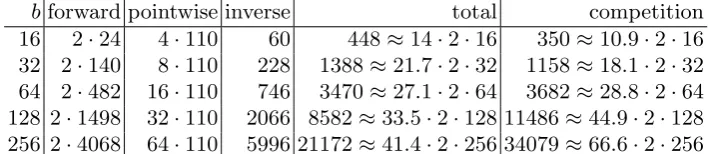
b forward pointwise inverse total competition 16 2·24 4·110 60 448≈14·2·16 350≈10.9·2·16 32 2·140 8·110 228 1388≈21.7·2·32 1158≈18.1·2·32 64 2·482 16·110 746 3470≈27.1·2·64 3682≈28.8·2·64 128 2·1498 32·110 2066 8582≈33.5·2·128 11486≈44.9·2·128 256 2·4068 64·110 5996 21172≈41.4·2·256 34079≈66.6·2·256
Table 1. Cost of multiplying b/8-coefficient polynomials over F28. “Forward” is the cost of two size-b/4 FFTs with size-b/8 inputs. “Pointwise” is the cost of pointwise multiplication. “Inverse” is the cost of an inverse size-b/4 FFT. “Total” is the sum of forward, pointwise, and inverse. “Competition” is the cost from [9] of an optimized Karatsuba/Toom multiplication of b-coefficient polynomials over F2; note that slight
improvements appear in [21].
3.5 Improvements: a Summary. We have two main improvements to the additive FFT: reducing the cost of multiplications and reducing the number of additions in radix conversion. We also use these ideas to accelerate size-32 and size-64 FFTs, and obviously they would also save time for larger FFTs.
The reduction in the cost of multiplications is a result of (1) choosing a “good” basis for which constant multiplications use constants in the smallest possible subfield; (2) using a tower-field representation to accelerate those constant mul-tiplications; and (3) searching for short sequences of additions. The reduction of additions for radix conversion is a result of (1) merging radix conversion at different levels of recursion and again (2) searching for short sequences of addi-tions.
3.6 Polynomial Multiplications: a Comparison with Karatsuba and Toom. Just like other FFT algorithms, any additive FFT can be used to mul-tiply polynomials. Given two 2m−1-coefficient polynomials in F2s, we apply a size-2m additive FFT to each polynomial, a pointwise multiplication consisting of 2m variable multiplications in F2s, and a size-2m inverse additive FFT, i.e., the inverse of an FFT with both input and output size 2m. An FFT (or inverse FFT) with input and output size 2m is slightly more expensive than an FFT with input size 2m−1 and output size 2m: input size 2m−1 is essentially input size 2m with various 0 computations suppressed.
Table 1 summarizes the number of bit operations required for multiplying
b-bit (i.e., b/8-coefficient) polynomials in F28[x]. Field multiplication is slightly more expensive than polynomial multiplication. ForF2256 we use the polynomial
4
The Auth256 Message-Authentication Code: Major
Features
Auth256, like GCM’s GHASH, follows the well-known Wegman–Carter [47] recipe for building an MAC with (provably) information-theoretic security. The recipe is to apply a (provably) “δ-xor-universal hash” to the message and en-crypt the result with a one-time pad. Every forgery attempt then (provably) has success probability at mostδ, no matter how much computer power the attacker used.
Of course, real attackers do not have unlimited computer power, so GCM actually replaces the one-time pad with counter-mode AES output to reduce key size. This is safe against any attacker who cannot distinguish AES output from uniform random; see, e.g., [33, comments after Corollary 3]. Similarly, it is safe to replace the one-time pad in Auth256 with cipher output.
This section presents two important design decisions for Hash256, the hash function inside Auth256. Section 4.1 describes the advantages of the Hash256 output size. Section 4.2 describes the choice of pseudo dot products inside Hash256, and the important interaction between FFTs and pseudo dot prod-ucts. Section 4.3 describes the use of a special field representation for inputs to reduce the cost of FFTs.
Section 6 presents, for completeness, various details of Hash256 and Auth256 that are not relevant to this paper’s performance evaluation.
4.1 Output size: Bigger-Birthday-Bound Security. Hash256 produces 256-bit outputs, as its name suggests, and Auth256 produces 256-bit authenti-cators. Our multiplication techniques are only slightly slower per bit for F2256 than for F2128, so Auth256 is only slightly slower than an analogous Auth128 would be. An important advantage of an increased output size is that one can safely eliminate nonces.
Encrypting a hash with a one-time pad, or with a stream cipher such as AES in counter mode, requires a nonce, and becomes insecure if the user accidentally repeats a nonce; see, e.g., [30]. Directly applying a PRF (as in HMAC) or PRP (as in WMAC) to the hash, without using a nonce, is much more resilient against misuse but becomes insecure if hashes collide, sob-bit hashes are expected to be broken within 2b/2 messages (even with an optimalδ = 2−b) and already provide a noticeable attack probability within somewhat fewer messages.
This problem has motivated some research into “beyond-birthday-bound” mechanisms for authentication and encryption that can safely be used for more than 2b/2 messages. See, e.g., [38]. Hash256 takes a different approach, which we call “bigger-birthday-bound” security: simply increasing b to 256 (and cor-respondingly reducing δ) eliminates all risk of collisions. For the same reason, Hash256 provides extra strength inside other universal-hash applications, such as wide-block disk encryption; see, e.g., [28].
4.2 Pseudo Dot Products and FFT Addition.Hash256 uses the same basic construction as NMH [29, Section 5], UMAC [15], Badger [16], and VMAC [36]: the hash of a message with blocks m1, m2, m3, m4, . . . is (m1 +r1)(m2+r2) + (m3+r3)(m4+r4) +· · ·. Halevi and Krawczyk [29] credit this hash to Carter and Wegman; Bernstein [6] credits it to Winograd and calls it the “pseudo dot product”. The pseudo-dot-product construction of Hash256 gives δ <2−255; see Appendix A for the proof.
A simple dot productm1r1+m2r2+m3r3+m4r4+· · · uses one multiplication per block. The same is true for GHASH and many other polynomial-evaluation hashes. The basic advantage of (m1+r1)(m2+r2) + (m3+r3)(m4+r4) +· · · is that there are only 0.5 multiplications per block.
For Auth256 each block contains 256 bits, viewed as an element of the finite field F2256. Our cost of Auth256 per 512 authenticated bits is 29·512 = 58·256 bit operations, while the our cost for a multiplication in F2256 is 87· 256 bit operations. We now explain one of the two sources of this gap.
FFT-based multiplication of two polynomialsf1f2 has several steps: apply an FFT to evaluatef1 at many points; apply an FFT to evaluatef2at many points; compute the corresponding values of the product f1f2 by pointwise multiplica-tion; and apply an inverse FFT to reconstruct the coefficients off1f2. FFT-based multiplication of field elements has the same steps plus a final reduction step.
These steps for F2256, with our optimizations from Section 3, cost 4068 bit operations for each forward FFT, 64·110 bit operations for pointwise multipli-cation, 5996 bit operations for the inverse FFT (the forward FFT is less expensive since more polynomial coefficients are known to be 0), and 992 bit operations for the final reduction. Applying these steps to each 512 bits of input would cost approximately 15.89 bit operations per bit for the two forward FFTs, 13.75 bit operations per bit for pointwise multiplication, 11.71 bit operations per bit for the inverse FFT, and 1.94 bit operations per bit for the final reduction, plus 1.5 bit operations per bit for the three additions in the pseudo dot product.
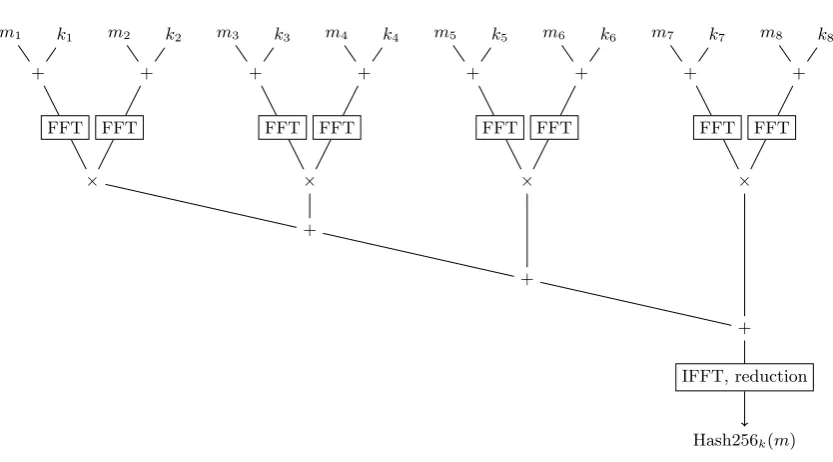
We do better by exploiting the structure of the pseudo dot product as a sum of the formf1f2+f3f4+f5f6+· · ·. Optimizing this computation is not the same problem as optimizing the computation of f1f2. Specifically, we apply an FFT to eachfi and compute the corresponding values off1f2, f3f4, etc., but we then add these valuesbefore applying an inverse FFT. See Figure 1. There is now only one inverse FFT (and one final reduction) per message, rather than one inverse FFT for every two blocks. Our costs are now 15.89 bit operations per bit for the two forward FFTs, 13.75 bit operations per bit for pointwise multiplication, 1 bit operation per bit for the input additions in the pseudo dot product, and 1 bit operation per bit for the pointwise additions, for a total of 31.64 bit operations per bit, plus a constant (not very large) overhead per message.
m1 k1 m2 k2
+ +
FFT FFT
×
m3 k3 m4 k4
+ +
FFT FFT
×
+
m5 k5 m6 k6
+ +
FFT FFT
×
+
m7 k7 m8 k8
+ +
FFT FFT
×
+
IFFT, reduction
Hash256k(m)
Fig. 1. Hash256 flowchart
UMAC and VMAC actually limit the lengths of their pseudo dot products, to limit key size. This means that longer messages produce two or more hashes; these hashes are then further hashed in a different way (which takes more time per byte but is applied to far fewer bytes). For simplicity we instead use a key as long as the maximum message length. We have also considered the small-key hashes from [6] but those hashes obtain less benefit from merging inverse FFTs. 4.3 Embedding Invertible Linear Operations into FFT Inputs. Sec-tion 4.2 shows how to achieve 31.64 bit operations per message bit by skipping the inverse FFTs for almost all multiplications in the pseudo dot product. Now we show how Auth256 achieves 29 bit operations per message bit by skipping operations in the forward FFTs.
Section 3.3 shows that the radix conversions can be merged into one invertible
F28-linear (actuallyF2-linear) map, which takes place before all other operations in the FFT. The input is a F2256 element which is represented as coefficients in
F28 with respect to a polynomial basis. Applying an invertible linear map on the coefficients implies a change of basis. In other words, the radix conversions convert the input into another 256-bit representation. If we define the input to be elements in this new representation, all the radix conversions can simply be skipped. Note that the authenticator still uses the original representation. See Section 6.2 for a definition of the new representation.
This technique saves a significant fraction of the operations in the forward FFT. As shown in Section 3, one forward FFT takes 4068 bit operations, where 82·8 = 656 of them are spent on radix conversions. Eliminating all radix con-versions then gives the 29 bit operations per message bit.
It is easy to generalize this to a “2k-way split” in which f(x) is written as P2k−1
i=0 x
if(i)(ψk(x)), whereψ(x) =x2+x. In particular, Gao and Mateer showed how to perform 22k−1-way-split FFTs for polynomials in
F22k[x]. The technique of changing input representation works for any 2k-way split. In fact we found that with 8-way-split FFTs, the number of bit operations per message bit can be slightly better than 29. However, for simplicity, Auth256 is defined in a way that favors 2-way-split FFTs.
5
Software Implementation
Our software implementation uses bitslicing. This means that we convert each bit in previous sections intowbits, wherewis the register width on the machine; we convert each AND into a bitwisew-bit AND instruction; and we convert each XOR into a bitwise w-bit XOR instruction.
Bitslicing is efficient only if there is adequate parallelism in the algorithm. Fortunately, the pseudo-dot-product computation is naturally parallelizable: we let thejth bit position compute the sum of all products (m2i+1+r2i+1)(m2i+2+
r2i+2) where i≡j (mod w). After all the products are processed, the results in all bit positions are summed up to get the final value.
The detailed definition of Auth256 (see Section 6) has a parameter b. Our software takesb=w, allowing it to simply pick up message blocks as vectors. Ifb
is instead chosen as 1 then converting to bitsliced form requires a transposition of message blocks; in our software this transposition costs an extra 0.81 cycles/byte. 5.1 Minimizing Memory Operations in Radix Conversions. We exploit the decomposability of additions to minimize memory operations for a radix con-version. When dealing with size-2k radix conversions with k ≤4, we decompose at bit level the computation into 2k parts, each of which deals with 16/2k bit positions. This minimizes the number of loads and stores. The same technique applies for a radix conversion combined with smaller-size radix conversions in the FFT subroutines.
Here is one strategy to maintain both the number of bit operations and the lower bound on number of loads and stores. First load the 8 bits of b into 8 registers t0, t1, . . . , t7. Use the sequence of XORs generated by the code gener-ator, starting from the ti’s, to compute the 8 bits of αb, placing them in the other 8 registers s0, s1, . . . , s7. Then perform si ← si ⊕ a[i], where a[i] is the corresponding bit of a in memory, to obtain a+αb. After that overwrite a with thesi’s. Finally, performti ←ti⊕si to obtaina+ (α+ 1)b, and overwritebwith the ti’s.
In our software muladdadd operations are handled one by one in size-64 and size-32 combine routines. See below for details about how muladdadds in smaller size combine routines are handled.
5.3 Implementing the Size-16 Additive FFT. In our size-16 FFT imple-mentation the size-8 radix conversion is combined with the two size-4 ones in the FFT subroutines using the decomposition method described earlier in this section. Since the size-4 FFTs deal with constants in F22, we further combine the radix conversions with size-4 FFTs.
At the beginning of one of the 4 rounds of the whole computation, the 2·8 = 16 bits of the input for size-8 radix conversion are loaded. Then the logic operations are carried out in registers, and eventually the result is stored in 2·16 = 32 bits of the output elements. The same routine is repeated 4 times to cover all the bit positions.
The size-16 and size-32 combine routines are also merged as shown in Section 3. The field-level decomposition is used together with a bit-level decompostion: in size-16 FFT all the constants are in F24, so it is possible to decompose any computation that works on field elements into a 2-round procedure and handle 4 bit positions in each round. In conclusion, the field-level decomposition turns the computation into 4 pieces, and the bit-level decompostion further decomposes each of these into 2 smaller pieces. In the end, we have an 8-round procedure.
At the beginning of one of the 8 rounds of the whole computation, the 4·4 = 16 bits of the outputs of the size-4 FFTs are loaded. Then the logic operations are carried out in registers, and eventually the result is stored in 4·4 = 16 bits of the output elements. The same routine is repeated 8 times to cover all the bit positions.
6
Auth256: Minor Details
To close we fill in, for completeness, the remaining details of Hash256 and Auth256.
6.1 Review of Wegman–Carter MACs. Wegman–Carter MACs work as follows. The authenticator of thenth messagemisH(r, m)⊕sn. The key consists of independent uniform random r, s1, s2, s3, . . .; the pad is s1, s2, s3, . . ..
m0 6=m, and every difference∆, a uniform randomrhasH(r, m)⊕H(r, m0) =∆
with probability at most δ.
6.2 Field Representation. We represent an element of F2s as a sequence of s bits. If we construct F2s as F2t[x]/φ then we recursively represent the ele-ment c0+c1x+· · ·+ct/s−1xt/s−1 as the concatenation of the representations of
c0, c1, . . . , ct/s−1. At the bottom of the recursion, we represent an element ofF2 as 1 bit in the usual way. See Sections 2 and 3.6 for the definition of φ for F22,
F24, F28, and F2256.
As mentioned in Section 4.3, we do not use the polynomial basis 1, x, . . . , x31
forF2256 inputs. Here we define the representation for them. Lety(b
k−1bk−2···b0)2 =
Qk−1 i=0(ψ
i(x))bi, where ψ(x) follows the definition in Section 4.3. Then each
F2256 input c0y0+c1y1+· · ·+c31y31 is defined as the concatenation of the represen-tations of c0, c1, . . . , c31. One can verify that y0, y1, . . . , y31 is the desired basis by writing down the equation between f(x) and f(00000)(x), f(00001)(x), . . . ,
f(111111)(x) as in Section 3.3.
Ifs ≥8 then we also represent an element ofF2s as a sequence ofs/8 bytes, i.e.,
s/8 elements of {0,1, . . . ,255}. The 8-bit sequence b0, b1, . . . , b7 is represented as the byte b=P
i2 ib
i.
6.3 Hash256 Padding and Conversion.Hash256 views messages as elements of K0∪K2∪K4∪ · · ·, i.e., even-length strings of elements ofK, where K is the finite field F2256. It is safe to use a single key with messages of different lengths. In real applications, messages are strings of bytes, so strings of bytes need to be encoded invertibly as strings of elements of K. The simplest encoding is standard “10∗” padding, where a message is padded with a 1 byte and then as many 0 bytes as necessary to obtain a multiple of 64 bytes. Each 32-byte block is then viewed as an element of K.
We define a more general encoding parametrized by a positive integerb; the en-coding of the previous paragraph hasb= 1. The message is padded with a 1 byte and then as many 0 bytes as necessary to obtain a multiple of 64bbytes, say 64bN
bytes. These bytes are split into 2N segmentsM0, M00, M1, M10, . . . , MN−1, MN0 −1, where each segment contains 32bconsecutive bytes. Each segment is then trans-posed into belements of K: segmentMi is viewed as a column-major bit matrix with b rows and 256 columns, and row j of this matrix is labeled cbi+j, while
c0bi+j is defined similarly using Mi0. This produces 2bN elements of K, namely
m0, m00, m1, m01, m2, m02, . . . , mbN−1, m0bN−1.
The point of this encoding is to allow a simple bitsliced vectorized imple-mentation; see Section 5. Our 1.59 cycle/byte implementation uses b= 256. We have also implemented b = 1, which costs 0.81 cycles/byte extra for transpo-sition and is compatible with efficient handling of much shorter messages. An interesting intermediate possibility is to take, e.g., b = 8, eliminating the most expensive (non-bytewise) transposition steps while still remaining suitable for authentication of typical network packets.
message, representing elementsr0, r00, r1, r10, . . .ofK. If the key is actually defined as, e.g., counter-mode AES output then the maximum length does not need to be specified in advance: extra key elements can be computed on demand and cached for subsequent use.
The Hash256 output is (m0+r0)(m00+r00) + (m1+r1)(m01+r01) +· · ·. This is an element of K.
The Auth256 key is a Hash256 key together with independent uniform random elements s1, s2, . . . of K. The Auth256 authenticator of the nth message mn is Auth256(r, mn)⊕sn.
References
[1] — (no editor), Information theory workshop, 2006. ITW ’06 Chengdu, IEEE, 2006. See [45].
[2] — (no editor), Design, automation & test in Europe conference & exhibition, 2007. DATE ’07, IEEE, 2007. See [41].
[3] — (no editor), Proceedings of the 6th WSEAS world congress: applied computing conference (ACC 2013), WSEAS, 2013. See [21].
[4] Daniel J. Bernstein, Fast multiplication (2000). URL: http://cr.yp.to/talks. html#2000.08.14. Citations in this document: §1.3.
[5] Daniel J. Bernstein,The Poly1305-AES message-authentication code, in FSE 2005 [25] (2005), 32–49. URL:http://cr.yp.to/papers.html#poly1305. Citations in this document: §1.1.
[6] Daniel J. Bernstein, Polynomial evaluation and message authentication (2007). URL: http://cr.yp.to/papers.html#pema. Citations in this document: §4.2,
§4.2.
[7] Daniel J. Bernstein, Fast multiplication and its applications, in [17] (2008), 325–384. URL: http://cr.yp.to/papers.html#multapps. Citations in this doc-ument: §4.2.
[8] Daniel J. Bernstein,Batch binary Edwards, in Crypto 2009 [27] (2009), 317–336. URL:http://cr.yp.to/papers.html#bbe. Citations in this document: §1.3. [9] Daniel J. Bernstein,Minimum number of bit operations for multiplication(2009).
URL: http://binary.cr.yp.to/m.html. Citations in this document: §1.3, §1.3,
§2.2,§1,§1.
[10] Daniel J. Bernstein, Optimizing linear maps modulo 2, in Workshop Record of SPEED-CC: Software Performance Enhancement for Encryption and Decryp-tion and Cryptographic Compilers (2009), 3–18. URL:http://cr.yp.to/papers. html#linearmod2. Citations in this document: §2.3.
[11] Daniel J. Bernstein, Tung Chou, Peter Schwabe,McBits: fast constant-time code-based cryptography, in CHES 2013 [12] (2013), 250–272. Citations in this docu-ment: §1.3, §1.3,§3.
[12] Guido Bertoni, Jean-S´ebastien Coron (editors), Cryptographic hardware and em-bedded systems—CHES 2013—15th international workshop, Santa Barbara, CA, USA, August 20–23, 2013, proceedings, Lecture Notes in Computer Science, 8086, Springer, 2013. ISBN 978-3-642-40348-4. See [11].
[14] Eli Biham, Amr M. Youssef (editors),Selected areas in cryptography, 13th inter-national workshop, SAC 2006, Montreal, Canada, August 17–18, 2006, revised selected papers, Lecture Notes in Computer Science, 4356, Springer, 2007. ISBN 978–3–540–74461–0. See [36].
[15] John Black, Shai Halevi, Hugo Krawczyk, Ted Krovetz, Phillip Rogaway,UMAC: fast and secure message authentication, in Crypto 1999 [49] (1999), 216–233. URL: http://www.cs.ucdavis.edu/~rogaway/umac/. Citations in this docu-ment: §1.1, §4.2.
[16] Martin Boesgaard, Ove Scavenius, Thomas Pedersen, Thomas Christensen, Erik Zenner, Badger—a fast and provably secure MAC, in [32] (2005), 176–191. Cita-tions in this document: §4.2.
[17] Joe P. Buhler, Peter Stevenhagen (editors),Surveys in algorithmic number theory, Mathematical Sciences Research Institute Publications, 44, Cambridge University Press, New York, 2008. See [7].
[18] Nam Su Chang, Chang Han Kim, Young-Ho Park, Jongin Lim,A non-redundant and efficient architecture for Karatsuba-Ofman algorithm, in [50] (2005), 288–299. Citations in this document: §1.3.
[19] Circuit Minimization Team, Multiplication circuit for GF(256) with irreducible polynomial X8+X4+X3+X+ 1 (2010). URL: http://cs-www.cs.yale.edu/ homes/peralta/CircuitStuff/slp_84310.txt. Citations in this document:§2.2. [20] Christophe Clavier, Kris Gaj (editors), Cryptographic hardware and embed-ded systems—CHES 2009, 11th international workshop, Lausanne, Switzerland, September 6–9, 2009, proceedings, Lecture Notes in Computer Science, 5747, Springer, 2009. ISBN 978-3-642-04137-2. See [35].
[21] Davide D’Angella, Chiara Valentina Schiavo, Andrea Visconti, Tight upper bounds for polynomial multiplication, in [3] (2013). URL:http://www.wseas.us/ e-library/conferences/2013/Nanjing/ACCIS/ACCIS-03.pdf. Citations in this document:§1.3,§1,§1.
[22] Andrew M. “Floodyberry”, Optimized implementations of Poly1305, a fast message-authentication-code (2014). URL: https://github.com/floodyberry/ poly1305-opt. Citations in this document: §1.1.
[23] Agner Fog, Instruction tables (2014). URL: http://www.agner.org/optimize/ instruction_tables.pdf. Citations in this document: §1.4.
[24] Shuhong Gao, Todd Mateer, Additive fast Fourier transforms over finite fields, IEEE Transactions on Information Theory 56 (2010), 6265–6272. URL:http:// www.math.clemson.edu/~sgao/pub.html. Citations in this document: §3.
[25] Henri Gilbert, Helena Handschuh (editors), Fast software encryption: 12th in-ternational workshop, FSE 2005, Paris, France, February 21–23, 2005, revised selected papers, Lecture Notes in Computer Science, 3557, Springer, 2005. ISBN 3-540-26541-4. See [5].
[26] Shay Gueron, AES-GCM software performance on the current high end CPUs as a performance baseline for CAESAR(2013). URL:http://2013.diac.cr.yp. to/slides/gueron.pdf. Citations in this document: §1.4.
[27] Shai Halevi (editor),Advances in cryptology—CRYPTO 2009, 29th annual inter-national cryptology conference, Santa Barbara, CA, USA, August 16–20, 2009, proceedings, Lecture Notes in Computer Science, 5677, Springer, 2009. See [8]. [28] Shai Halevi,Invertible universal hashing and the TET encryption mode, in Crypto
[29] Shai Halevi, Hugo Krawczyk, MMH: software message authentication in the Gbit/second rates, in FSE 1997 [13] (1997), 172–189. URL: http://www. research.ibm.com/people/s/shaih/pubs/mmh.html. Citations in this docu-ment: §4.2, §4.2.
[30] Helena Handschuh, Bart Preneel,Key-recovery attacks on universal hash function based MAC algorithms, in [46] (2008), 144–161. Citations in this document:§4.1. [31] Jos´e Luis Ima˜na, Rom´an Hermida, Francisco Tirado, Low-complexity bit-parallel multipliers based on a class of irreducible pentanomials, IEEE Transactions on Very Large Scale Integration (VLSI) Systems 14(2006), 1388–1393. Citations in this document: §2.2.
[32] John Ioannidis, Angelos D. Keromytis, Moti Yung,Applied cryptography and net-work security, third international conference, ACNS 2005, New York, NY, USA, June 7-10, 2005, proceedings, Lecture Notes in Computer Science, 3531, 2005. ISBN 3-540-26223-7. See [16].
[33] Tetsu Iwata, Keisuke Ohashi, Kazuhiko Minematsu,Breaking and repairing GCM security proofs, in Crypto 2012 [44] (2012), 31–49. URL: http://eprint.iacr. org/2012/438. Citations in this document: §4.
[34] Antoine Joux (editor), Fast software encryption—18th international workshop, FSE 2011, Lyngby, Denmark, February 13–16, 2011, revised selected papers, Lec-ture Notes in Computer Science, 6733, Springer, 2011. ISBN 978-3-642-21701-2. See [37].
[35] Emilia K¨asper, Peter Schwabe,Faster and timing-attack resistant AES-GCM, in CHES 2009 [20] (2009), 1–17. URL: http://eprint.iacr.org/2009/129. Cita-tions in this document: §1, §1.1,§1.4.
[36] Ted Krovetz, Message authentication on 64-bit architectures, in SAC 2006 [14] (2007), 327–341. Citations in this document:§1.1,§4.2.
[37] Ted Krovetz, Philip Rogaway, The software performance of authenticated-encryption modes, in FSE 2011 [34] (2011), 306–327. URL: http://www.cs. ucdavis.edu/~rogaway/papers/ae.pdf. Citations in this document: §1.4. [38] Will Landecker, Thomas Shrimpton, R. Seth Terashima,Tweakable blockciphers
with beyond birthday-bound security, in Crypto 2012 [44] (2012), 14–30. Citations in this document: §4.1.
[39] Alfred Menezes (editor),Advances in cryptology—CRYPTO 2007, 27th annual in-ternational cryptology conference, Santa Barbara, CA, USA, August 19–23, 2007, proceedings, Lecture Notes in Computer Science, 4622, Springer, 2007. ISBN 978-3-540-74142-8. See [28].
[40] Christof Paar, Optimized arithmetic for Reed–Solomon encoders (1997). URL:
http://www.emsec.rub.de/media/crypto/veroeffentlichungen/2011/01/19/ cnst.ps. Citations in this document:§2.3.
[41] Steffen Peter, Peter Langend¨orfer, An efficient polynomial multiplier in GF(2m) and its application to ECC designs, in DATE 2007 [2] (2007). URL: http:// ieeexplore.ieee.org/xpl/freeabs_all.jsp?isnumber=4211749&arnumber= 4211979&count=305&index=229. Citations in this document: §1.3.
[42] Francisco Rodr´ıguez-Henr´ıquez, C¸ etin Kaya Ko¸c,On fully parallel Karatsuba mul-tipliers for GF(2m), in [43] (2003), 405–410. Citations in this document:§1.3. [43] S. Sahni (editor),Proceedings of the international conference on computer science
and technology, Acta Press, 2003. See [42].
[45] Joachim von zur Gathen, Jamshid Shokrollahi, Fast arithmetic for polynomials overF2in hardware, in ITW 2006 [1] (2006), 107–111. Citations in this document:
§1.3.
[46] David Wagner (editor),Advances in cryptology—CRYPTO 2008, 28th annual in-ternational cryptology conference, Santa Barbara, CA, USA, August 17–21, 2008, proceedings, Lecture Notes in Computer Science, 5157, Springer, 2008. ISBN 978-3-540-85173-8. See [30].
[47] Mark N. Wegman, J. Lawrence Carter, New hash functions and their use in authentication and set equality, Journal of Computer and System Sciences 22 (1981), 265–279. ISSN 0022-0000. MR 82i:68017. Citations in this document: §4. [48] Andr´e Weimerskirch, Christof Paar, Generalizations of the Karatsuba algorithm for efficient implementations(2006). URL: http://eprint.iacr.org/2006/224. Citations in this document: §1.3.
[49] Michael Wiener (editor),Advances in cryptology—CRYPTO ’99, Lecture Notes in Computer Science, 1666, Springer, 1999. ISBN 3-5540-66347-9. MR 2000h:94003. See [15].
[50] Jianying Zhou, Javier Lopez, Robert H. Deng, Feng Bao (editors), Information security, 8th international conference, ISC 2005, Singapore, September 20–23, 2005, proceedings, Lecture Notes in Computer Science, 3650, Springer, 2005. ISBN 3-540-29001-X. See [18].
A
Security Proof
This appendix proves that Hash256 has differential probability smaller than 2−255. This is not exactly the same as the proofs for the pseudo-dot-product portions of UMAC and VMAC: UMAC and VMAC specify fixed lengths for their pseudo dot products, whereas we allow variable lengths.
Theorem 1. LetK be a finite field. Let`, `0, kbe nonnegative integers with` ≤k
and`0 ≤k. Letm1, m2, . . . , m2`−1, m2`be elements ofK. Letm01, m02, . . . , m02`0−1, m02`0 be elements ofK. Assume that(m1, m2, . . . , m2`)6= (m01, m02, . . . , m02`0). Let ∆ be an element of K. Let r1, r2, . . . , r2k be independent uniform random ele-ments of k. Let p be the probability that h=h0+∆, where
h= (m1+r1)(m2+r2) + (m3+r3)(m4+r4) +· · · + (m2`−1+r2`−1)(m2`+r2`),
h0 = (m01+r1)(m02+r2) + (m03+r3)(m04+r4) +· · · + (m02`0−1+r2`0−1)(m02`0 +r2`0).
Then p < 2/#K. If ` = `0 then p ≤ 1/#K, and if ` 6= `0 then p < 1/#K + 1/#K|`−`0|.
Proof. Case 1: `=`0. Then h=h0+∆ if and only if
r1(m2−m02) +r2(m1−m01) +r3(m4−m04) +r4(m3−m03) +· · · =∆+m01m02−m1m2+m03m
0
This is a linear equation in r1, r2, . . . , r2k. This linear equation is nontrivial: by hypothesis (m1, m2, . . . , m2`)6= (m01, m02, . . . , m02`0), so there must be some i
for which mi−m0i 6= 0. Consequently there are most #K
2k−1 solutions to the equation out of the #K2k possibilities for r; i.e., p≤1/#K as claimed.
Case 2:` < `0 and (m1, . . . , m`)6= (m01, . . . , m0`). Define
f = (m02`+1 +r2`+1)(m2`+2+r2`+2) +· · ·+ (m02`0−1+r2`0−1)(m02`0+r2`0).
Then h=h0+∆ if and only if
r1(m2−m02) +r2(m1−m01) +r3(m4−m04) +r4(m3−m03) +· · · +r2`−1(m2`−m02`) +r2`(m2`−1−m02`−1)
=f +∆+m01m02−m1m2+m03m04−m3m4+· · ·+m02`−1m02`−m2`−1m2`. This is a linear equation in r1, . . . , r2`, since f is independent of r1, . . . , r2`. For each choice of (r2`+1, r2`+2, . . . , r2k), there are at most #K2`−1 choices of (r1, . . . , r2`) satisfying this linear equation. Consequently p≤1/#K as above.
Case 3: ` < `0 and (m1, . . . , m`) = (m10, . . . , m0`). Then h = h0 + ∆ if and only if 0 = f +∆, where f is defined as above. This is a linear equation in
r2`+2, r2`+4, . . . , r2`0 for each choice of r2`+1, r2`+3, . . . , r2`0−1. The linear
equa-tion is nontrivial except when r2`+1 = −m02`+1, r2`+3 = −m02`+3, and so on through r2`0−1 =−m0
2`0−1. The linear equation thus has at most #K` 0
−`−1 so-lutions (r2`+2, r2`+4, . . . , r2`0) for #K`
0
−`−1 choices of (r
2`+1, r2`+3, . . . , r2`0−1),
plus at most #K`0−` solutions (r2`+2, r2`+4, . . . , r2`0) for 1 exceptional choice
of (r2`+1, r2`+3, . . . , r2`0−1), for a total of #K2` 0
−2`−1−#K`0−`−1+ #K`0−` < #K2`0−2`(1/#K + 1/#K`0−`) solutions. Consequently p < 1/#K + 1/#K`0−`
as claimed.