AN ADOPTION MODEL FOR CLOUD-BASED COLLABORATIVE LEARNING APPLICATIONS FROM TOP MALAYSIAN UNIVERSITIES’ EXPERIENCE
ELAHEH YADEGARIDEHKORDI
A thesis submitted in fulfilment of the requirements for the award of the degree of Doctor of Philosophy (Information Systems)
Faculty of Computing Universiti Teknologi Malaysia
iii
Specially Dedicated to…
My Parents
My Lovely Brother and Sister
My love to you will always remain and thank you for your
ACKNOWLEDGEMENT
First of all, I would like to thank Allah for granting me this opportunity and providing me with the strength to complete this thesis successfully.
I also wish to express my sincere appreciation to my supervisor, Dr. Noorminshah A. Iahad, for her kind advice and guidance. Her belief that it was, indeed, possible to finish kept me going. Without her valuable guidance this study could never have reached its completion.
v
ABSTRACT
ABSTRAK
vii
TABLE OF CONTENTS
CHAPTER TITLE PAGE
DECLARATION ii
DEDICATION iii
ACKNOWLEDGEMENTS iv
ABSTRACT v
ABSTRAK vi
TABLE OF CONTENTS vii
LIST OF TABLES xii
LIST OF FIGURES xiv
LIST OF APPENDICES xvi
1 INTRODUCTION 1
1.1 Introduction 1
1.2 Background of the Problem 3
1.3 Problem Statement and Research Questions 7
1.4 Research Objectives 10
1.5 Research Scope 11
1.6 Research Significance 11
1.7 Organization of the Thesis 13
1.8 Chapter Summary 14
2 LITERATURE REVIEW 15
2.1 Introduction 15
2.2 Literature Map 16
2.3 Cloud Computing 16
2.3.3 Benefits and Characteristics of Cloud
Computing 21
2.4 New Generation of Learners 23
2.4.1 Collaborative Learning 25
2.4.1.1 Collaborative Learning
Technologies 26
2.4.1.2 Common Collaborative Learning
Tools 27
2.4.1.3 Constraints of Wikis and Web
Conferencing 29
2.4.1.4 Cloud-based Collaborative
Learning Applications 32
2.4.1.5 Cloud-based Collaborative
Learning Applications Case Studies 34
2.5 Malaysian Higher Education 40
2.5.1 Collaborative Learning in Malaysian
Universities 43
2.5.1 Top Malaysian Universities 44
2.6 Importance of Developing Cloud-based
Collaborative Learning Applications Adoption
Model 46
2.7 Chapter Summary 49
3 RESEARCH MODEL DEVELOPMENT 50
3.1 Introduction 50
3.2 Adoption Theories 50
3.2.1 Theory of Planned Behavior (TPB) 51
3.2.2 Diffusion of Innovations Theory (DOI) 52
3.2.3 Unified Theory of Acceptance and Use of
Technology (UTAUT) 54
3.2.4 Task Technology Fit (TTF) 56
ix
3.4 Research Model Development 58
3.4.1 Clarification of Task and Technology
Characteristics 64
3.4.1.1 Technology Characteristics for
Cloud-based Collaborative
Learning Applications 65
3.4.1.2 Task Characteristics for Cloud-based Collaborative
Learning Applications 69
3.4.2 Considering Collaboration-related
Constructs 72
3.5 Chapter Summary 78
4 RESEARCH METHODOLOGY 80
4.1 Introduction 80
4.2 Research Paradigm 80
4.2.1 Discussion on Chosen Paradigm 82
4.3 Research Approach 83
4.4 Positivism and the Quantitative Methodological
Approach 83
4.5 Sampling Technique 85
4.6 Structural Equation Modelling (SEM) 87
4.6.1 Measurement Model 89
4.6.2 Structural Model 90
4.7 Research Operational Framework 91
4.7.1 Phase 1: Literature Review and Research
Model Development 93
4.7.2 Phase 2: Pilot Study 94
4.7.2.1 Conducting Interviews 95
4.7.2.2 Instrument Development 96
4.7.2.3 Content Validity 100
4.7.2.4 Instrument Validation 101
4.7.3.1 Main Study 104
4.7.3.2 Data Analysis and Results 105
4.7.4 Phase 4: Conclusion and Implications 107
4.8 Chapter Summary 108
5 PILOT STUDY 109
5.1 Introduction 109
5.2 Conducting Interviews 109
5.2.1 Interviews in University C 110
5.2.1.1 Center for Teaching and Learning
(CTL) 110
5.2.1.2 Center for Information
Communication and Technology
(CICT) 112
5.2.2 Interviews with Directors of IT Center and
Administrators of Students Email 114
5.2.3 Discussion on Interviews 116
5.3 Survey Instrument 119
5.4 Results of Pilot Study 120
5.4.1 Measurement Model Assessment 121
5.4.1.1 Indicator Reliability 122
5.4.1.2 Construct Reliability 123
5.4.1.3 Convergent Validity 124
5.4.1.4 Discriminant Validity 125
5.5 Chapter Summary 128
6 DATA ANALYSIS AND DISCUSSIONS 129
6.1 Introduction 129
6.2 Demographic Information 129
6.3 Measurement Model Assessment 132
6.3.1 Indicator Reliability 132
xi
6.3.3 Convergent Validity 133
6.3.4 Discriminant Validity 134
6.4 Structural Model Assessment 137
6.4.1 Explained Variance (R2) 137
6.4.2 Path Coefficient (β) 138
6.4.3 Effect Size (f2) 144
6.5 Moderating Effects 145
6.5.1 Results of PLS-MGA for Gender
Moderation 147
6.5.2 Results of PLS-MGA for Age Moderation 148
6.6 Discussion on Hypothesis Testing 151
6.6.1 Hypothesis Testing for TTF 151
6.6.2 Hypothesis Testing for UTAUT 157
6.6.3 Hypothesis Testing for Collaboration-
related Constructs 162
6.7 Discussion on Moderating Effect Results 164
6.8 Chapter Summary 166
7 CONCLUSION AND IMPLICATIONS 168
7.1 Introduction 168
7.2 Research Achievements 169
7.2.1 First Research Objective 169
7.2.2 Second Research Objective 170
7.2.3 Third Research Objective 170
7.3 Research Contributions and Implications 171
7.3.1 Theoretical Contribution 172
7.3.2 Practical Contribution 173
7.4 Limitations of Research 177
7.5 Suggestions for Future Research 178
REFERENCES 179
LIST OF TABLES
TABLE NO. TITLE PAGE
2.1 Characteristics of cloud computing 22
2.2 Millennial students’ characteristics (Monaco and Martin,
2007) 24
2.3 Prior research on collaborative learning 28
2.4 Prior research on collaborative learning using cloud-based
applications 47
3.1 Task and technology characteristics in the prior research
on TTF 66
3.2 Prior research on collaboration technology adoption 74
4.1 General characteristics of quantitative approach (Johnson
and Christensen, 2008; Lichtman, 2006) 84
4.2 Operational framework for phase 1 93
4.3 Operational framework for phase 2 94
4.4 Constructs and their measuring items 97
4.5 Kappa interpretation 100
4.6 Criterion for assessing measurement model 103
4.7 Operational framework for phase 3 104
4.8 Details of lecturers’ classes 105
4.9 Criterion of assessment of structural model and moderating
effects 107
4.10 Operational framework for phase 4 108
5.1 Interview results 114
5.2 Comparison of interview results in selected universities 116
5.3 Respondents demographic information 121
xiii
5.5 Reliability and convergent validity 125
5.6 Correlations between constructs 126
5.7 Factor loading with cross-loadings 126
6.1 Respondents demographic information based on university 130
6.2 Respondents demographic information based on gender 130
6.3 Respondents demographic information based on age 130
6.4 Respondents demographic information based level of
study 131
6.5 Number of group assignments per semester 131
6.6 Frequency of collaboration using internet 131
6.7 Reliability and convergent validity 133
6.8 Correlations between constructs 135
6.9 Factor loading with cross-loadings 136
6.10 R-square of dependent variables 138
6.11 Path coefficients (β), t-statistics and its significance level 140
6.12 Summary of hypothesis testing 142
6.13 f2 effect size of independent constructs 145
6.14 PLS-MGA for moderator gender 147
6.15 PLS-MGA for moderator age 149
6.16 Prediction power (R2) of proposed model in prior research
LIST OF FIGURES
FIGURE NO. TITLE PAGE
1.1 Organization of the Chapter1 2
1.2 Organization of the thesis 13
2.1 Organization of Chapter 2 16
2.2 Evolution of cloud computing 17
2.3 Use of and plans for using SaaS cloud (Lowendahl, 2012) 33
2.4 Student aspirations (Source: Malaysia Education
Blueprint 2015-2025 (Higher Education)) 41
2.5 The 10 shifts (Source: Malaysia Education Blueprint
2015-2025 (Higher Education)) 42
2.6 Top Malaysian universities (Source: Malaysia Education
Blueprint 2015-2025 (Higher Education)) 45
3.1 Theory of Planned Behavior (Ajzen, 1991) 51
3.2 Diffusion of innovation model (Rogers, 1995) 54
3.3 UTAUT model (Venkatesh et al., 2003) 55
3.4 TTF model (Goodhue and Thompson, 1995) 56
3.5 Linkage of TTF and technology adoption 59
3.6 Research model (1) 64
3.7 Research model (2) 72
3.8 Proposed cloud-based collaborative learning applications
xv
4.1 Measurement model and structural model 89
4.2 Research operational framework 92
5.1 Unstructured Vs integrated collaboration 119
6.1 Results of PLS algorithm analysis 139
6.2 Structural model assessment 143
6.3 Moderated relationship 146
6.4 Cloud-based Collaborative Learning Applications
LIST OF APPENDICES
APPENDIX TITLE PAGE
A Interview Questions for CTL and CICT 200
B Interview Questions for Directors of IT Centers and
Administrators of Students Email 201
C Survey Questionnaire 202
CHAPTER 1
INTRODUCTION
1.1 Introduction
Innovations in technology continue to change the business and education
environments. Cloud computing is a new computing paradigm that has quickly
attracted a number of customers by providing pay per use computing infrastructure
and different storage capabilities. The efficiency and effectiveness of cloud
computing are very important in higher education. The capabilities of this technology
can be used to support group collaborative learning in educational environments. It
allows group members to complete collaborative tasks in less time and with
increased satisfaction (White et al., 2009). Therefore, this research aims to develop
an adoption model for cloud-based collaborative learning applications in university
settings. In addition, identifying the factors that influence this adoption is another
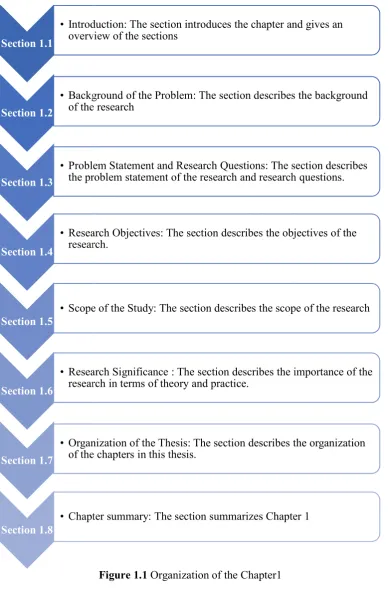
significant contribution of the present research. Figure 1.1 illustrates the organization
Section 1.1
• Introduction: The section introduces the chapter and gives an overview of the sections
Section 1.2
• Background of the Problem: The section describes the background of the research
Section 1.3
• Problem Statement and Research Questions: The section describes the problem statement of the research and research questions.
Section 1.4
• Research Objectives: The section describes the objectives of the research.
Section 1.5
• Scope of the Study: The section describes the scope of the research
Section 1.6
• Research Significance : The section describes the importance of the research in terms of theory and practice.
Section 1.7
• Organization of the Thesis: The section describes the organization of the chapters in this thesis.
Section 1.8
• Chapter summary: The section summarizes Chapter 1
Figure 1.1 Organization of the Chapter1
Introduction: The section introduces the chapter and gives an overview of the sections
Background of the Problem: The section describes the background of the research
Problem Statement and Research Questions: The section describes the problem statement of the research and research questions.
Research Objectives: The section describes the objectives of the research.
Scope of the Study: The section describes the scope of the research
Research Significance : The section describes the importance of the research in terms of theory and practice.
Organization of the Thesis: The section describes the organization of the chapters in this thesis.
Chapter summary: The section summarizes Chapter 1
Introduction: The section introduces the chapter and gives an
Background of the Problem: The section describes the background
Problem Statement and Research Questions: The section describes the problem statement of the research and research questions.
Research Objectives: The section describes the objectives of the
Scope of the Study: The section describes the scope of the research
Research Significance : The section describes the importance of the
Organization of the Thesis: The section describes the organization
3
1.2 Background of the Problem
Flux and evolution are constantly influencing the higher education landscape
around the world (Pardeshi, 2014). It is increasingly highlighted that incorporating
technology effectively in higher education is important to support high quality
education and to prepare students for the 21st century (Thomas, 2011). Currently, educational institutions have become increasingly reliant on information technology
to provide new skills to the students (Miseviciene et al., 2011). Furthermore, students
need to develop quite different kinds of skills and knowledge in comparison with the
past in order to be better prepared for their future life. The traditional
teaching-learning methods are not sufficient to support the expectations of academics and
students in universities (Thomas, 2011; Razak, 2009). Therefore, universities require
a basic change in knowledge and communication-based society in order to achieve
higher order learning experience and outcomes (Thomas, 2011). There are various
new teaching-learning methods using Information and Communication Technologies
(ICT) that can be appropriate to enable students to develop the needed intellectual
and practical skills and positive perceptions (Razak, 2009).
Cloud computing is one of the new trends in technology which has
significant impact on teaching and learning environments (Ercana, 2010). According
to Jain and Pandey (2013), although cloud computing has some constraints and
challenges, its potential benefits outweigh the risks. The push with IT industry and
significant advantages of cloud computing leads Cisco to the expectation that cloud
computing will be widely used in higher education. They believed that cloud
computing and its abilities should be considered as an enabler for academic
organizations in response to calls for transformation with efficiency and confidence.
(Cisco, 2014). Cloud computing is a good response to the growing trend towards
distance learning among students (Jain and Pandey, 2013). Furthermore, it offers
significant opportunities to educators and enhances engagement among them to
understand and improve practices, and therefore, increase productivity (Thomas,
2011). Since cloud computing aims to provide low cost or free applications, this
technology is a critical solution for educational institutions faced with budget
by students is not only useful for their education and in helping them to obtain new
skills, it is also economical for academic institutions and can save resources as well
(Bansal et al., 2012). Therefore, the preference in higher education sector is the move
towards adoption of cloud computing (Pardeshi, 2014).
Presently, a new generation of learners, also known as Millennial or
Generation Y who depend on technology and their support system, has immersed
themselves in the college classrooms. The learning needs of this genre are quite
different from their predecessors (Thomas, 2011). They want to spend less time on
tasks and be successful with little effort (Monaco and Martin, 2007). They prefer to
receive information really fast and are interested in parallel processes, multi-tasking,
random access, and games. They function best when networked (Prensky, 2001).
This generation is the generation of “Web 2.0”: interactivity, community,
communication, collaboration (Cornu, 2011). Furthermore, team orientation and less
interest in working independently have been highlighted by previous related research
(Cornu, 2011; Monaco and Martin, 2007; Oblinger, 2003; Howe and Strauss, 1993)
as significant characteristics of this generation of students. Therefore, it is clear that
the method of teaching and learning ten years ago is not a good method to achieve
learning with this generation (Monaco and Martin, 2007). Understanding
expectations of learners is an important factor to facilitate learning and to make
colleges competitive (Oblinger, 2003). Thus, universities and colleges are trying to
find new ways to meet students’ expectations for services, immediacy, interactivity,
and group activities (Oblinger, 2003). Pedagogy has to be rethought taking into
account the constructivist approach, collaborative learning, and networking for
learning (Cornu, 2011). Creative content delivery must be integrated and group
dynamic learning should be designed to keep the students engaged and to develop
their independent and critical thinking.
To succeed in today’s competitive world, institutions of higher education play
a significant role in preparing students for living in international and multicultural
society. Similar to other universities, universities in Malaysia face challenges
5
them a sense of professionalism (Razak, 2009). Graduates lack critical thinking and
communication skills, the links between academia and industry is insufficient, and
systemic issues hamper the efficiency and financial sustainability of the system
(Malaysia Education Blueprint 2015-2025 (Higher Education)). Malaysian
universities require the application of different teaching, learning and assessment
methods in order to help students learn a range of competencies (Razak, 2009).
Furthermore, the focus in higher education is to develop learned, value-driven talent
professionals, researchers, educators, entrepreneurs, and innovators who have an
international outlook and can propel Malaysia’s development forward.
To that end, the Ministry has developed the Malaysia Education Blueprint
2015-2025 (Higher Education), here known as MEB (HE), to chart the next horizon
of growth for the Malaysian education system. The objectives of the development of
the MEB (HE) are; assess current performance and challenges in order to improve
access to education, raise standards (quality), close achievement gaps (equity),
promote unity amongst students, and maximize student efficiency. Leadership skills
and thinking skills are two important student aspirations in MEB (HE). To achieve
these objectives and aspirations, MEB (HE) is committed to produce holistic,
entrepreneurial and balanced graduates in the first shift. In accordance with this shift,
higher education institutions aim to train graduates with practical skills, critical and
creative thinking skills, communication skills, social skills, teamwork and
responsibility, problem solving skills to deal with present and future demands.
Moreover, they focus on making students lifelong learners who are motivated to
continuously develop their knowledge and skills, to think critically, and be open to
change, new ideas and new ways of doing things.
Interestingly, previous research has recognized the highly significant
importance of collaboration learning in training creative and innovative learners
(Nayan et al., 2010; Chu et al., 2009; Maesin et al., 2009), improving team work
skills (Nayan et al., 2010; Maesin et al., 2009; Monaco and Martin, 2007), training
critical thinker (Suwantarathip and Wichadee, 2014; Nayan et al., 2010; Maesin et
al., 2009). Further, results of studies (Nayan et al., 2010; Maesin et al., 2009; Jedin
collaborative learning as an essential part of learning process in these universities.
Collaborative learning (CL) is an educational method to teaching and learning that
involves group of learners working together to solve a problem, complete a task, or
create a product (Laal and Laal, 2012). Therefore, in order to follow MEB (HE) as
well as fulfill the preference of students towards collaborative learning, Malaysian
educational institutions need to adopt technologies that will enable students to
collaborate in an effective manner.
Rapid spread of web-based collaboration tools leads educational intuitions
across the disciplines to incorporate learning activities that integrate their use.
Common Web 2.0 collaborative tools such as Blogs, wikis, and podcasts were the
first tools that have found their way into college classrooms (Davi et al., 2007).
Reviewing the previous studies (Wang, 2014; Caple and Bogle, 2013; Li and Zhu,
2013; Avci and Askar1, 2012; Hadjerrouit, 2012; Bruen et al., 2011; Hughes, 2011;
Mavridis et al., 2011; Giesbers et al., 2009; Leung and Chu, 2009; Chou and Chen,
2008; Ioannou and Artino, 2008; Loch and Reushle, 2008; Wheeler et al., 2008;
Minocha and Thomas, 2007) shows that wikis and web conferencing are two main
common collaborative learning tools examined and discussed by previous
researchers for the purposes of collaborative writing, creating knowledge, and
improving communication. However, constraints associated with these tools such as
lack of accuracy and veracity, limited capacity, weakness of discussion pages
ownership and intellectual property problems, limitation in number of participants,
rely on specific equipment are also worth consideration.
Consequently, cloud computing can be considered an appropriate solution in
this situation. Cloud computing provides communication and collaboration
applications in an effective way on the internet. Individual users can arrange their
meetings and share messages or email by using cloud-based applications anytime and
anywhere (Brohi and Bamiah, 2011). Cloud computing improves individual
collaboration on documents across the internet (Siegle, 2010). It creates innovative
environments for education by offering ubiquity, advanced online tools and
7
individuals to work on a project simultaneously – regardless of their location. In this
case the creator of a document can share a document with others and invite them to
view or edit it. Each version of the document is saved and a list of previous versions
of the document can be retrieved by users (Siegle, 2010).
Cloud-based collaborative learning applications are relatively new
paradigms. Although a broad definition may consider anything from e-mail on one
extreme to very complex systems on the other, this research considers those
cloud-based applications that have achieved widespread popularity in educational settings.
The mechanism for specifying this group is to view the domain to be considered in
terms of services. Cloud-based collaborative learning applications are considered as
those providing the seamless platform for collaboration, file management and
sharing, instant messaging, video conferencing, project management, task
management and reporting, etc. The applications to be considered are those that
cloud-based and facilitate these attributes in one centralized location.
Google and Microsoft are two main providers of cloud-based collaborative
learning applications. They provide communication and collaboration opportunities
for educational institutions like mail, messaging and collaboration tools (e-mail,
contact management, and calendars), office applications (document storage, creation
and sharing documents) and platform applications (the ability to create websites or
learning management systems) (Miseviciene et al., 2011).
1.3 Problem Statement and Research Questions
As Web 2.0 technologies are providing more group collaborative experience
and benefits for students, educators are also trying to adopt group collaborative
learning as an approach to achieve their educational objectives (Zurita and
Nussbaum, 2004). Therefore, understanding the adoption behaviors of collaborative
technologies is essential because acceptance is a prerequisite for participation (White
et al., 2009). However, White et al. (2009) argued that despite the growing
technologies.
Further, cloud computing is still relatively young in terms of maturity and
adoption (Park and Ryoo, 2013; Gital and Zambuk, 2011). Kim et al. (2009) believed
that an inevitable adoption of cloud computing is predicted for the future, and its
adoption will change the world of software and hardware. As reported by Bittman
(2009) cloud computing is being used in the areas of finance and business while it is
comparatively rarely used at educational institutions. However, Katz et al. (2009)
believed that cloud computing will achieve mainstream adoption in a two- to
five-year time frame and higher education is early in the “early adopters” stage of
diffusion. In a recent attempt, González-Martínez et al. (2015) reviewed literature
related to the cloud computing in education domain from 2007 to 2012. They
concluded that the main advantages of cloud computing in education are strongly
supported, however, the research in this topic may still be immature and many of the
contributions are introductory.
Looking at the research literature considering cloud-based collaborative
learning applications in educational environments by (Cheung and Vogel, 2014;
Orehovački and Babić, 2014; Suwantarathip and Wichadee, 2014; Cheung and
Vogel, 2013; Dominguez et al., 2012; Brodahl et al., 2011; Calvo et al., 2011;
Edwards, 2011; Miseviciene et al., 2011; Taylor and Hunsinger, 2011; Edwards and
Baker, 2010; Blau and Caspi, 2009; Chu et al., 2009; Rienzo and Han, 2009; White
et al., 2009), it can be concluded that most of the previous researches on
collaborative learning using cloud-based applications (mainly Google Apps and
Microsoft Office) have focused on collaborative writing. It appears that published
materials are categorized into: positive elements of use, advantages of using
cloud-based applications in collaborative learning, technical issue of cloud computing,
comparing students’ perceptions using Google Docs with those working in groups in
a face-to-face classroom, comparing outcomes of collaboration using cloud-based
applications with traditional collaboration systems, and critical role of teacher in
using these applications. Moreover, although learning theories have been used in a
9
adoption theories remains largely unexplored in the literature. This is in accordance
with the claim of Taylor and Hunsinger (2011) that even though the previous
research have considered the overall notion of cloud computing, there is a lack of
studies regarding students’ usage and acceptance of this technology in university
settings. Therefore, understanding the individual behaviour related to cloud
computing is worth consideration.
Meanwhile, the movement to cloud computing is a technology and cultural
shift which takes time and involves more than just the technology; it involves people,
process, and organization. As such, they should be well-considered before jumping
in too quickly (Cooke and Kirby, 2008). Yang et al. (2015) believed that in order to
examine the adoption of cloud computing (Software as a Service), the behavioural
perceptions of users in acquiring and using them should be carefully taken into
account. Successful implementation of cloud computing in educational settings
requires careful attention to a number of factors from both the student and school’s
perspective (Behrend et al., 2011). However, Park and Ryoo (2013) stated that there
are few studies which have examined adopting/switching behavior from previous IS
services to cloud computing from the perspective of users. Cloud computing allows
team members to work collaboratively. However, successful completion of the
collaborative tasks depends on whether the individual team members accept the new
methods and use them. Team members who use the new technology are more
important than the technology itself. Individual perceptions, attitudes, and reactions
regarding new technology provide an important area of interest. The successful
acceptance of the new collaboration tools may result in higher level of satisfaction
among team members and outcome will be more valuable (White et al., 2009).
Therefore, the decision of students to adopt cloud-based applications and use them
for collaborative learning is a very long-term and complicated process and there are
many factors that influence this adoption. In order to have successful adoption,
determining these factors, eliminating problems, and highlighting the profits of these
applications for users is very essential.
As stated previously, Malaysian educational institutions need to adopt
applications in educational settings. Integration of cloud-based applications into
educational processes requires specific consideration of students’ behavioural
intention to adopt. Few studies (Orehovački and Babić, 2014; Cheung and Vogel,
2013; Taylor and Hunsinger, 2011) have examined the factors influencing user
adoption of these kind of applications. Specifically, there have been few theoretical
models developed to understand adoption of cloud-based collaborative learning
applications by students in educational settings. Therefore, the main purpose of this
research is to develop and test an adoption model for cloud-based collaborative
learning applications in Malaysian universities. In order to address key issues as
mentioned before, the main research question for this research is:
” How can cloud-based collaborative learning applications be adopted by students in
Malaysian Universities?” Three sub questions have been formulated:
1. What is the current adoption status of cloud-based collaborative learning
applications in selected top Malaysian universities?
2. What are the factors that influence the adoption of cloud-based collaborative
learning applications by students?
3. What is the adoption model for cloud-based collaborative learning
applications?
1.4 Research Objectives
Objectives of this research are:
1. To understand the current adoption status of cloud-based collaborative
learning applications in selected top Malaysian universities
2. To identify the factors that influence the adoption of cloud-based
collaborative learning applications by students.
3. To develop and test an adoption model for cloud-based collaborative learning
11
1.5 Research Scope
The focus of this research is mainly on the individual adoption of cloud-based
applications to support collaborative learning. Therefore, the unit of analysis is the
individuals as user of cloud applications. This research targeted undergraduate and
postgraduate students from different educational backgrounds in Malaysian
universities, specifically on those universities that have already adopted cloud-based
collaborative learning applications. The process of data collection is done within the
selected top Malaysian universities. An investigation on the current adoption status
of cloud-based collaborative learning applications was done in selected universities
through interviews. This is followed by a survey method using online and paper
based questionnaire. The collected data was tested by Structural Equation Modelling
(SEM) using the Partial Least Squares (PLS) approach. The SmartPLS 2.0 software
was utilized as data analysis tool.
1.6 Research Significance
Currently, in the age of technology and innovation the preference of new
generation of students in collaborative learning is increasing with high speed and
they need new services in less time. On the other hand, universities confront some
limitations such as budget constraints and limited number of technical staff. Cloud
computing is increasingly becoming widespread as a way to offer low-cost
collaborative learning solutions. Therefore, the benefits of integrating cloud-based
applications into collaborative learning activities of students are worth consideration.
This research contributes to a more comprehensive understanding of
cloud-based collaborative learning applications adoption in university settings by: 1)
describing the benefits of cloud computing for educational institutions and
highlighting the importance of collaborative learning for students; 2) extending the
current understanding of cloud computing adoption to support collaborative learning
in university contexts; 3) synthesizing and integrating two theoretical lenses (TTF
collaboration-of cloud-based collaborative learning applications and developing an instrument and
theoretical model for this adoption; and 5) becoming a starting point for future
studies associated with adoption of cloud-based collaborative learning applications.
This research has a contribution to the growing body of literature on
collaborative learning and technology acceptance and usage. Developing and testing
an adoption model which integrates two adoption theories (UTAUT and TTF) and
even incorporates collaboration-related constructs will advance the body of
knowledge on the antecedents of technology adoption in university settings.
The findings of this research will contribute to the body of ideas and
knowledge about better strategic ways of adopting cloud-based collaborative learning
applications in universities. Since students are the largest group of cloud-based
collaborative learning applications’ users, this work has crucial implications for
cloud service providers, Ministry of Education, and university administrators because
it can help them to better understand students’ behavior and identify the factors that
facilitate their adoption. Understanding the key factors that influence the adoption of
cloud computing for collaborative learning helps Ministry of Education and
university administrators to plan their strategies for supporting and encouraging
students to integrate these technologies to their collaborative learning and achieve
high quality of educational outcomes. Furthermore, it helps cloud service providers
to keep close contact with universities and to establish standard cloud-based
applications based on user preferences.
This research provides a mechanism to better understand the moderating
effects of age and gender on the adoption of cloud-based collaborative learning
applications. The moderating relationships are conceptualized based on UTAUT.
This research is the first to demonstrate these moderating effects for cloud-based
collaborative learning applications and helps university administrative and cloud
service providers to know whether or not they need to develop different policies and
13
1.7 Organization of the Thesis
As visualized in Figure 1.2, this thesis is divided into six chapters which are
organized into three main sections:
Introduction
Chapter1 (Introduction): this chapter introduces the subject and the context of the research, together with the research problem, objectives of the research, significance, scope, and structure of the thesis
Chapter 2 (Literature Review): this chapter reviews the previous literature related to cloud computing, new generation of learners and collaborative learning. It highlights the importance of developing cloud-based collaborative learning applications adoption model.
Body
Chapter 3 (Research Model Development): this chapter reviews theories on user adoption of IS. Factors affecting individual adoption of cloud-based collaborative learning applications are identified and research model is developed
Chapter 4 (Research Methodology): this chapter presents the research design and methodology as well as the justification of choices and uses. The operational research framework that details the steps and activities involved throughout the research is also developed.
Chapter 5 (Pilot Study): this chapter reports the results of preliminary investigation and the pilot survey. Results of conducted interviews are presented. A pilot survey is conducted to develop appropriate instrument to test the research model.
Chapter 6 (Data Analysis and Discussions): this chapter describes the results of main survey and finalizes an adoption model for cloud-based collaborative learning applications.
Conclusion
Chapter 7 (Conclusion and Implications): this chapter describes research achievements that have emerged from this research and concludes with a discussion of the contributions and implications of the research outcomes, the limitations of the research, and the suggestions for future research.
This chapter provides an overview of the thesis. It begins by introducing the
background and research problems. This is followed by research statement,
development of research questions, and research objectives. The scope and
significance of the research are subsequently discussed. Finally, the organization of
the thesis is described in three main sections, namely, introduction, body, and
179
REFERENCES
Abas, Z. W. and Kaur, A. (2004). Preparing tutors for online collaborative learning at
the Open University Malaysia. International Conference on Computers in
Education Melbourne, Australia.
Abrahim, N. Z. (2009). Multiple Perspectives of Open Source Software
Appropriation in Malaysian Public Sector. PHD. Universiti Teknologi Malaysia
Aggelidis, V. P. and Chatzoglou, P. D. (2009). Using a modified technology
acceptance model in hospitals. International Journal of Medical Informatics.
78 (2): 115–126.
Ajzen, I. (1991). The Theory of Planned Behavior. Organizational Behavior and
Human Decision Processes. 50: 179-211.
Al-Gahtani, S. S., Hubona, G. S. and Wang, J. (2007). Information technology (IT)
in Saudi Arabia: Culture and the acceptance and use of IT. Information & Management. 44 (8): 681-691.
Alawadhi, S. and Morris, A. (2008). The Use of the UTAUT Model in the Adoption
of E-government Services in Kuwait. Hawaii International Conference on
System Sciences, Proceedings of the 41st Annual, IEEE.
Ambra, J. and Rice, R. (2001). Emerging factors in user evaluation of the World
Wide Web. Information & Management. 38 (6): 373-384.
Appelt, W., Hinrichs, E. and Woetzel, G. (1998). Effectiveness and efficiency: The
need for tailorable user interfaces on the web. Computer Networks and ISDN
Systems. 30 (1-7): 499-508.
avaya (2012) "Maximizing collaborative learning in higher education."
AVAYA.com.
Avci, U. and Askar1, P. (2012). The Comparison of the Opinions of the University
Students on the Usage of Blog and Wiki for Their Courses. Educational
Satisfaction And Productivity). MSc Business Administration. Erasmus University Rotterdam- Netherlands
Babin, B., Hair, J. F., Hair, J., Anderson, R. and Black, W. C. (2010). Multivariate
Data Analysis: A Global Perspective. New Jersey: Prentice Hall PTR.
Bandura, A. (1997). Self-Efficacy: The Exercise of Control. Worth Publishers.
Bansal, S., Singh, S. and Kumar, A. (2012). Use of Cloud Computing in Academic
Institutions. International Journal of Computer Science and Technology
(IJCST). 3 (1).
Baron, S. and Harris, A. P. K. (2006). Beyond technology acceptance: understanding
consumer practice. International Journal of Service Industry Management. 17
(2): 111-135.
Barriball, K. L. and While, A. (1994). Collecting data using a semi-structured
interview: a discussion paper. Journal of Advanced Nursing. 19 (2): 328–335.
Behrend, T. S., Wiebe, E. N., London, J. E. and Johnson, E. C. (2011). Cloud
computing adoption and usage in community colleges. Behaviour &
Information Technology. 30 (2): 231-240.
Benbasat, I. and Barki, H. (2007). Quo vadis, TAM? Journal of the Association for
Information Systems. 8 (4): 211-218.
Bertram, D. (2004). Likert Scales, University of Windsor.
Biljon, J. v. and Kotzé, P. (2008). Cultural Factors in a Mobile Phone Adoption and
Usage Model. Journal of Universal Computer Science. 14 (16): 2650-2679.
Biljon, J. v. and Renaud, K. (2008). A Qualitative Study of the Applicability of
Technology Acceptance Models to Senior Mobile Phone Users. ER 2008
Workshops (CMLSA, ECDM, FP-UML, M2AS, RIGiM, SeCoGIS, WISM) on Advances in Conceptual Modeling: Challenges and Opportunities Berlin: Springer-Verlag Berlin.
Bittman, T. (2009). Cloud Computing Inquiries at Gartner, Gartner.
Blau, I. and Caspi, A. (2009). Sharing and Collaborating with Google Docs: The
influence of Psychological Ownership, Responsibility, and Student's
Attitudes on Outcome Quality. Proceedings of World Conference on
E-Learning in Corporate, Government, Healthcare, and Higher Education 2009
181
Blom, J. (2000). Personalization: a taxonomy. CHI'00 extended abstracts on Human
factors in computing systems, ACM.
Blom, J. (2002). A theory of personalized recommendations. Human factors in
computing systems. New York, NY, USA: 540-541.
Bram, T. (2010). "Why Integrated Collaboration Tools Make Sense." Retrieved 3th
Dec, 2013, from
http://gigaom.com/2010/08/10/why-integrated-collaboration-tools-make-sense/.
Brodahl, C., Hadjerrouit, S. and Hansen, N. K. (2011). Collaborative Writing with
Web 2.0 Technologies: Education Students’ Perceptions. Journal of
Information Technology Education: Innovations in Practice. 10.
Brohi, S. N. and Bamiah, M. A. (2011). Challenges and Benefits for Adopting the
Paradigm of Cloud Computing. (IJAEST) International Journal of Advanced
Engineering Sciences and Technologies. 8 (2): 286 - 290.
Brown, S. A., Dennis, A. R. and Venkatesh, V. (2010). Predicting collaboration
technology use: Integrating technology adoption and collaboration research.
Journal of Management Information Systems. 27 (2): 9-54.
Bruen, C., Fitzpatrick, N., Gormley, P., Harvey, J. and MacAvinney, C. (2011).The
Management and Creation of Knowledge: Do Wikis Help? Critical Design
and Effective Tools for E-Learning in Higher Education: Theory into Practice, IGI GLOBAL.
Bullinger, A. C., Renken, U. and Möslein, K. (2011). Understanding online
collaboration technology adoption by researchers-a model and empirical
study. Thirty Second International Conference on Information Systems ICIS
Shanghai.
Buyya, R., Yeo, C. S. and Venugopal, S. (2008). Market-oriented cloud computing:
Vision, hype, and reality for delivering it services as computing utilities. High
Performance Computing and Communications, 2008. HPCC'08. 10th IEEE International Conference on. Dalian, IEEE: 5-13.
Callum, K. M. (2009). Student Characteristics and Variables That Determine Mobile
Learning Adoption: An Initial Study. E Universal College of Learning:
Teaching and Learning Conference, Palmerston North, NZ.
Calvo, R. A., O'Rourke, S. T., Jones, J., Yacef, K. and Reimann, P. (2011).
Collaborative writing support tools on the cloud. Learning Technologies,
and effectiveness: Implications for designing effective work groups.
Personnel Psychology. 46: 823-850.
Caple, H. and Bogle, M. (2013). Making group assessment transparent: what wikis
can contribute to collaborative projects. Assessment & Evaluation in Higher
Education. 38 (2): 198-210.
Carroll, J. and Swatman, P. (2000). Structured-case: a methodological framework for
building theory in information systems research. European Journal of
Information System. 9: 235–242.
Chadwick, D. W. and Fatema, K. (2012). A privacy preserving authorisation system
for the cloud. Journal of Computer and System Sciences. 78 (5): 1359-1373.
Chen, C.-M., Lee, H.-M. and Chen, Y.-H. (2005). Personalized e-learning system
using Item Response Theory. Computers & Education. 44: 237–255.
Chen, W. and Hirschheim, R. (2004). A paradigmatic and methodological
examination of information systems research from 1991 to 2001. Information
Systems Journal. 14 (3): 197-235.
Cheung, R. and Vogel, D. (2013). Predicting user acceptance of collaborative
technologies: An extension of the technology acceptance model for
e-learning. Computers & Education. 63: 160-175.
Cheung, R. and Vogel, D. (2014). Activity theory as a design framework for
collaborative learning using Google Applications technology.New Horizons
in Web Based Learning 140-149, Springer.
Chih-Wei, Shiue, C.-C. and Shih, P.-Y. (2011). Why firms do not adopt SaaS.
African Journal of Business Management. 5 (15): 6443-6449.
Chin, W. (2010).How to Write Up and Report PLS Analyses. V. Esposito Vinzi, W.
W. Chin, J. Henseler and H. Wang.Handbook of Partial Least Squares
655-690, Springer Berlin Heidelberg.
Chin, W. W. (1998). The partial least squares approach to structural equation
modeling.Modern methods for business research 295-336. Mahwah, New
Jersey, Lawrence Erlbaum Associates. 2.
Chin, W. W. (2000). Partial Least Squares For Researchers: An overview and
presentation of recent advances using the PLS approach. International
183
Chou, P.-N. and Chen, H.-H. (2008). Engagement in Online Collaborative Learning:
A Case Study Using a Web 2.0 Tool. MERLOT Journal of Online Learning
and Teaching. 4 (4): 574-582.
Chu, S. K.-W., Kennedy, D. and Mak, M. Y. K. (2009). Mediawiki and Google Docs
as Online Collaboration Tools for Group Project Co-Construction. The 6th
International Conference on Knowledge Management (ICKM 2009). Hong
Kong: 1-14.
Cisco (2014). Cloud Computing in Higher Education: A Guide to Evaluation and
Adoption, Cisco. 2014.
Cohen, J. (1988). Statistical Power Analysis for the Behavioral Sciences. lawrence
Erlbaum.
Compeau, D. R. and Higgins, C. A. (1995). Application of social cognitive theory to
training for computer skills. Information systems research. 6 (2): 118-143.
Converse, J. M. and Presser, S. (1986). Survey Questions: Handcrafting the
Standardized Questionnaire. SAGE Publications, Inc.
Cooke, J. and Kirby, S. (2008). Casting a Ray of Sunshine on Cloud Computing,
Cisco Internet Business Solutions Group. 2013.
Cornu, B. (2011). Digital Natives: How Do They Learn? How To Teach Them?
Moscow, UNESCO Institute.
Coursaris, C. and Hassanein, K. (2002). Understanding m-commerce: a
consumer-centric model. Quarterly journal of electronic commerce. 3: 247-272.
Craig, R., Frazier, J., Jacknis, N., Murphy, S., Purcell, C., Spencer, P. and Stanley, J.
(2009). Cloud Computing in the Public Sector: Public Manager’s Guide to
Evaluating and Adopting Cloud Computing, Cisco Internet Business
Solutions Group.
Creswell, J. W. (2003). Research Design: Qualitative, Quantitative, and Mixed
Methods Approaches. Thousand Oaks ,California: Sage Publication.
Creswell, J. W. (2007). Qualitative Inquiry and Research Design: Choosing Among
Five Approaches. California: Sage Publications, Inc; Second Edition
Cronbach, L. (1971). Test validation. Educational measurement, issues and practice.
2: 443-507.
Daniel, J. (2012). Sampling Essentials: Practical Guidelines for Making Sampling
Integrating Technology to Enhance Liberal Learning Journal of Online learning and Teaching(JOLT). 3 (3).
Dennis, A. R. and Garfield, M. J. (2003). The Adoption and Use of GSS in Project
Teams: Toward More Participative Processes and Outcomes. MIS Quarterly.
27 (2): 289-323.
Dennis, A. R., George, J. F., Jessup, L. M., Nunamaker, J. F. and Vogel, D. (1988).
Information Technology to Support Electronic Meetings. MIS Quarterly. 12
(4): 591-624.
Dennis, A. R., Kinney, S. T. and Hung, Y.-T. C. (1999). Gender Differences in the
Effects of Media Richness. small group research. 40 (3): 405-437.
Dennis, A. R., Venkatesh, V. and Ramesh, V. (2003a). Adoption of Collaboration
Technologies: Integrating Technology Acceptance and Collaboration
Technology Research. Sprouts: Working Papers on Information Systems. 3
(8).
Dennis, A. R., Venkatesh, V. and Ramesh, V. (2003b). Adoption of Collaboration
Technologies: Integrating Technology Acceptance and Collaboration
Technology Research. Indiana University, USA . Sprouts: Working Papers on
Information Systems. 3 (8).
Dennis, A. R., Wixom, B. H. and Vandenberg, R. J. (2001). Understanding Fit and
Appropriation Effects in Group Support Systems via Meta-Analysis. MIS
Quarterly 25 (2): 167-197.
Depken, C. A. and Mazonaite, E. (2009). The World University Rankings: Do
Country Characteristics Matter? . Department of Economics, The Belk
College of Business UNC, Charlotte, NC USA
Diaz, V., Brown, M. and Salmons, J. (2010). Unit 4: Assessment of Collaborative
Learning Project Outcomes. EDUCAUSE Learning Initiative, This work is
licensed under a Creative Commons Attribution-NonCommercial-Share
Alike 3.0 License.
DiCicco-Bloom, B. and Crabtree, B. (2006). The qualitative research interview.
Medical Education. 40 (4): 314–321.
Dishawa, M. T. and Strong, D. M. (1999). Extending the technology acceptance
model with task-technology fit constructs. Information & Management. 36:
185
Dominguez, C., Cruz, G., Maia, A., Pedrosa, D. and Grams, G. (2012). Online peer
assessment: An exploratory case study in a higher education civil engineering
course. Interactive Collaborative Learning (ICL), 2012 15th International
Conference on, IEEE.
Dongre, A. R., Deshmukh, P. R., Kalaiselvan, G. and Upadhyaya, S. (2009).
Application of Qualitative Methods in Health Research: An Overview.
Online Journal of Health and Allied Sciences. 8 (4).
Dwivedi, Y., Rana, N., Chen, H. and Williams, M. (2011). A Meta-analysis of the
Unified Theory of Acceptance and Use of Technology (UTAUT). M.
Nüttgens, A. Gadatsch, K. Kautz, I. Schirmer and N. Blinn.Governance and
Sustainability in Information Systems. Managing the Transfer and Diffusion of IT 155-170, Springer Berlin Heidelberg. 366.
Eckhardt, A., Laumer, S. and Weitzel, T. (2009). Who influences whom? Analyzing
workplace referents’ social influence on IT adoption and non-adoption.
Journal of Information Technology. 24 (1): 11-24.
Edwards, J. T. (2011) "A Case Study: Using Google Documents as a Collaborative
Writing Tool in Undergraduate Courses." Texas Speech Communication
Journal (TSCJ) Texas Speech Communication Association.
Edwards, J. T. and Baker, C. (2010). A Case Study: Google Collaboration
Applications as Online Course Teaching Tools. MERLOT Journal of Online
Learning and Teaching. 6 (4).
Ercana, T. (2010). Effective use of cloud computing in educational institutions.
Procedia Social and Behavioral Sciences. 2: 938–942.
Field, A. (2003).Designing Questionnaire.Questionnaire Design.
Fishbein, M. and Ajzen, I. (1975). Belief, attitude, intention, and behavior: an
introduction to theory and research. MA: Addison-Wesley.
Fjermestad, J. and Hiltz, S. R. (2000). A Description Evaluation of Evaluation of
Case and Field Studies. Journal of Management Information Systems. 17 (3):
115-159.
Fleiss, J. L. (1971). Measuring nominal scale agreement among many raters.
Psychological bulletin. 76 (5): 378.
Fontana, A. and Frey, J. (2005). The interview: From neutral stance to political
involvment. N. k.Denzin and Y. S.Lincoln.the Sage handbook of Qualitative
unobservable variables and measurement error. Journal of Marketing Research (JMR). 34 (2): 161-188.
Frand, J. (2000). The Information-Age Mindset: Changes in Students and
implications for higher education. EDUCAUSE review online, EDUCAUSE
review onlin: 14-24.
Gefen, D., Straub, D. W. and Boudreau, M. C. (2000). Structural equation modeling
and regression: Guidelines for research practice. Communications of the
Association for Information Systems. 4 (7): 1-70.
Gens, F. (2008). Defining “Cloud Services” and “Cloud Computing”, IDC exchange.
Ghani, N. F. A. and Abdullah, M. S. (2008). Groupware Technology Acceptance as a
Knowledge Sharing Tool: A Case Study in UUM. Knowledge Management
International Conference KMICs Langkawi Malaysia.
Giesbers, B., Rienties, B., Gijselaers, W. H., Segers, M. and Tempelaar, D. T.
(2009). Social presence, Web videoconferencing and learning in virtual
teams. INDUSTRY & HIGHER EDUCATION. 23 (4): 301–309.
Gital, A. Y. u. and Zambuk, F. U. (2011). Cloud computing: Solution to ICT in
higher education in Nigeria. Advances in Applied Science Research. 2 (6):
364-369.
González-Martínez, J. A., Bote-Lorenzo, M. L., Gómez-Sánchez, E. and Cano-Parra,
R. (2015). Cloud computing and education: A state-of-the-art survey.
Computers & Education. 80: 132-151.
Goodhue, D. (1995). Understanding user evaluations of information systems.
Management Science. 41 (12): 1827–1844.
Goodhue, D. L. and Thompson, R. L. (1995). Task-technology fit and individual
performance. MIS Quarterly. 19: 213-236.
Grapragasem, S., Krishnan, A. and Mansor, A. N. (2014). Current Trends in
Malaysian Higher Education and the Effect on Education Policy and Practice:
An Overview. International Journal of Higher Education. 3 (1).
Guba, E. G. (1990). The Paradigm Dialog. Newbery Park: CA: Sage.
Guo, H., Chen, J., Wu, W. and Wang, W. (2009). Personalization as a service: the
architecture and a case study. Proceedings of the first international workshop
187
Hadjerrouit, S. (2012). Pedagogical Criteria for Successful Use of Wikis as
Collaborative Writing Tools in Teacher Education. 3rd International
Conference on e-Education, e-Business, e-Management and e-Learning. Singapore, IACSIT Press. 27.
Hair, J., Black, B., Babin, B., Anderson, R. and Tatham, R. (2006). Multivariate
Data Analysis. Prentice Hall;6 edition.
Hair, J., Hult, G. T., Ringle, C. and Sarstedt, M. (2013). A Primer on Partial Least
Squares Structural Equation Modeling (PLS-SEM). London: SAGE Publication.
Hair, J. F., Ringle, C. M. and Sarstedt, M. (2011). PLS-SEM: Indeed a silver bullet.
The Journal of Marketing Theory and Practice. 19 (2): 139-152.
Hair, J. F., Sarstedt, M., Ringle, C. M. and Mena, J. A. (2012). An assessment of the
use of partial least squares structural equation modeling in marketing
research. Journal of the Academy of Marketing Science. 40 (3): 414-433.
Harpaz, I. (2002). Advantages and disadvantages of telecommuting for the
individual, organization and society. Work Study. 51 (2): 74-80.
He, D. H., LU, Y. B. and Alfred, U. (2007). An integrated framework for mobile
business acceptance. Alfred: Alfred Univ.
Henriksen, I. and Hviid, M. (2005). Diffusion of new technology and complementary
best practice: A case study. European Review of Economic History. 9: 365–
397.
Henseler, J. and Fassott, G. (2010). Testing moderating effects in PLS path models:
An illustration of available procedures.Handbook of partial least squares
713-735, Springer.
Henseler, J., Ringle, C. M. and Sinkovics, R. R. (2009). The use of partial least
squares path modeling in international marketing. Advances in international
marketing. 20 (1): 277-319.
Howe, N. and Strauss, W. (1993). Millennials Rising: The Next Great Generation.
New York: Vintage Books.
Hoyle, R. H. (1999).Structural equation modeling analysis with small samples using
partial least squares. Statistical Strategies for Small Sample Research 307– 341. London, Sage Publications.
Hsin Chang, H. (2010). Task-technology fit and user acceptance of online auction.
The Antecedents of Behavioral Intentions for Using Cloud Computing
Services: A Case of Software As A Service. International Conference on
Business and Information. Renaissance Sapporo Hotel, Japan: 87-105.
Huang, J.-H., Lin, Y.-R. and Chuang, S.-T. (2007). Elucidating user behavior of
mobile learning A perspective of the extended technology acceptance model.
The Electronic Library. 25 (5): 585-598.
Hughes, K. (2011). The Wiki Way: Supporting Collaborative Learning. Irish
Academy of Management Conference Dublin.
Hulland, J. (1999). Use of partial least squares (PLS) in strategic management
research: a review of four recent studies. Strategic management journal. 20 (2): 195-204.
Hume, D. (1993). An Enquiry Concerning Human Understanding. Indianapolis:
Hackett Publishing Company.
Ikäläinen, S. (2013). Collaboration Software Adoption: Factors Affecting Adoption
of Collaboration Software in Organizations. Master. Aalto University.
Ioannou, A. and Artino, A. (2008). Incorporating wikis in an educational technology
course: Ideas,reflections and lessons learned. Society for Information
Technology & Teacher Education International Conference (SITE) 2008 Las Vegas, Nevada, USA.
Jain, A. and Pandey, U. S. (2013). Role of Cloud Computing in Higher Education.
International Journal of Advanced Research in Computer Science and
Software Engineering. 3 (7): 966-972.
Jarvenpaa, S. L. and Staples, D. S. (2000). The use of collaborative electronic media
for information sharing: an exploratory study of determinants. The Journal of
Strategic Information Systems. 9 (2–3): 129-154.
Jedin, M. and Saad, N. (2006). A preliminary study on gender and learning style in
Malaysian higher learning institutions: Evidence from a cultural perspective.
Critical Visions, Proceedings of the 29th HERDSA Annual Conference,
Western Australia.
Jeong, H. and Hwa-Hong, B. (2012). Service based Personalized Learning System in
Cloud Computing Environment. International Conference on Advanced
Computer Science Applications and Technologies. Kuala Lumpur, Malaysia.
189
Johnson, D. W. and Johnson, R. T. (1989). Cooperation and competition: Theory
and research. Edina, MN, US: Interaction.
Johnson, R. B. and Christensen, L. B. (2008). Educational research: Quantitative,
qualitative, and mixed approaches. Thousand Okas, California: Sage Publication.
Junglasa, I., Abrahamb, C. and Watsonc, R. T. (2008). Task-technology fit for
mobile locatable information systems. Decision Support Systems. 45 (4):
1046–1057.
Karimi, J., Somers, T. M. and Gupta, Y. P. (2004). Impact of environmental
uncertainty and task characteristics on user satisfaction with data. Information
Systems Research. 15 (2): 175-193.
Katz, R., Goldstein, P. and Yanosky, R. (2009). Cloud Computing in Higher
Education, EDUCAUSE.
Keil, M., Tan, B. C., Wei, K.-K., Saarinen, T., Tuunainen, V. and Wassenaar, A.
(2000). A cross-cultural study on escalation of commitment behavior in
software projects. Mis Quarterly: 299-325.
Kim, M.-K. and Jee, K.-y. (2006). Characteristics of individuals influencing adoption
intentions for portable Internet service. ETRI journal. 28 (1): 67-76.
Kim, W., Kim, S. D., Lee, E. and Lee, S. (2009). Adoption Issues for Cloud
Computing. iiWAS 2009 Kuala Lumpur (Malaysia).
Klopping, I. M. and McKinney, E. (2004). extending the technology acceptance
model and task technology fit model to cunsumer E-commerce. Information
Technology, Learning, and Performance Journal. 22 (1): 35-48.
Komiak, S. Y. and Benbasat, I. (2006). The effects of personalization and familiarity
on trust and adoption of recommendation agents. Mis Quarterly: 941-960.
Kumar, R. (2005). Research methodology: a step-by-step guide for beginners. Sage
Publications Limited.
Laal, M. and Laal, M. (2012). Collaborative learning : what is it? social and
behavioral sciences. 31: 491-495.
Lakhal, S., Khechine, H. and Pascot, D. (2013). Student behavioural intentions to use
desktop video conferencing in a distance course: integration of autonomy to
the UTAUT model. Journal of Computing in Higher Education. 25 (2):
research in education as a wild profusion. International Journal of Qualitative Studies in Education. 19 (1): 35–57.
Lee, C.-C., Su, K.-W., Lu, C.-T. and Yu, X.-X. (2007). Task-Technology Fit and
Adoption Behaviors of Mobile Business Systems. International DSI / Asia
and Pacific DSI 2007.
Leung, K. and Chu, S. K. W. (2009). Using Wikis for Collaborative Learning: a Case
Study of an Undergraduate Students’ Group Project in Hong Kong. The 6th
International Conference on Knowledge Management (ICKM 2009) Hong Kong, ICKM.
Levitt, M. and Mahowald, R. P. (2003). There Should be More to Collaboration than
Email, An IDC White Paper Sponsored by Groove Networks.
Li, M. and Zhu, W. (2013). Patterns of computer-mediated interaction in small
writing groups using wikis. Computer Assisted Language Learning. 26 (1):
61-82.
Lichtman, M. (2006). Qualitative research in education: A user’s guide. Thousand
Oaks,CA: Sage Publication.
Liden, R. C., Wayne, S. J. and Bradway, L. K. (1997). Task interdependence as a
moderator of the relation between group control and performance. Human
Relations. 50 (2): 169-181.
Lin, T.-C. and Huang, C.-C. (2008). Understanding knowledge management system
usage antecedents: An integration of social cognitive theory and task
technology fit. Information & Management. 45: 410–417.
Lincoln, Y. S. and Guba, E. G. (2005). Paradigmatic controversies, contradictions,
and emerging confluences. N. K. Denzin and Y. S. Lincoln.Handbook of
qualitative research, Thousand Oaks: CA: Sage.
Loch, B. and Reushle, S. (2008). The practice of web conferencing: Where are we
now? ASCILITE 2008: 25th Annual Conference of the Australasian Society
for Computers in Learning in Tertiary Education: Hello! Where Are You in
the Landscape of Educational Technology?, In Hello! Where are you in the
landscape of educational technology?: 562-571.
Lowendahl, J.-M. (2012). A Quick Look at Cloud Computing in Higher Education,