Short Duration Grazing in
Rhodesia1
SID GOODLOEZ
Former Range Management Advisor, Near East Foundation.
Highlight
Remarkable results from a grazing management system were seen in three visits to Rhodesia between 1964 and 1969. The system, Short Duration Grazing, depends on intensive use for two weeks or less with varying rest periods. There are significant indications that the short duration- high intensity grazing period is just as important to range improvement as the rest period. Production records are essential to the success of the system.
In a recent JOURNAL
OF RANGE
MANAGE-
MENT
I noticed a plea for a greater exchange of
ideas.
This article
briefly
tells the history and
principles of a fresh approach to grassland use being
tried in Rhodesia.
I hope it will stimulate
in re-
search scientist
and rancher
alike, a renewal
of
interest in seeking a real breakthrough
in range
management.
A success story is always a pleasure to
tell, and I consider it a privilege to be able to record
the work done by a group of clear thinking
and
dedicated range men.
It was my good fortune to see a good portion of
Rhodesian rangeland in 1964 and I was aware that
something
was wrong somewhere.
Much of the
rangeland in Rhodesia had begun a headlong dive
toward irreparable
deterioration.
Palatable species
such as
Paniwmspp.,
Eurochelea
spp., and
Brachi-
aria
spp. were being replaced by
Heteropogon
spp.
and
Hyparrhenia
spp. resulting
in a drastic drop
in usable forage production.
Like everyone else I
assumed that many of the areas were overstocked
and that destocking
and brush control should be
the first moves toward range restoration.
I returned in 1967, a drought year, to discover a
few ranches showing a marked improvement
in
range cover and condition.
It was then that I
learned of the aggressive step taken toward range
reclamation
called “Short Duration Grazing.”
lManuscript received April 24, 1969; accepted for publica- tion May 29, 1969. The author gratefully acknowledges and expresses appreciation for the courtesy and help given by Mr. Allan Savory, Parliament, Salisbury; Mr. A. R. Mountain, Mayorca Ranch, Que Que; Mr. Robert Vaughn- Evans, Conservation and Extension Service, Que Que; Mr. D. Parkin, Rancher, Bulawayo; Mr. Pop Massen, Glendye Ranch, Que Que; and Mr. B. Rinsford, Rancher, Selukwe, Rhodesia.
2Present address is Mountain Top Angus Ranch, Capitan, New Mexico.
The basic facts for the development
of Short
Duration Grazing (SDG) had been there all along
-in researchpublications
and journals-but
it took
men that think originally
and independently
to
marry them to a system that would work on the
ground.
Expanding
on work done by Andri Voisin of
France, Mr. John Acocks and Mr. and Mrs. L. N.
Howell
of Hillside
Farm, Springfontein,
South
Africa, put into practice what was then called “Non
Selective Grazing.”
Although
the system did not
eliminate selective grazing, the term was applicable
because it reduced selective grazing and thus in-
creased the efficiency of utilization
of the pastures.
The semiarid grazing land on Hillside
Farm re-
sponded in a way few stockmen thought possible.
Not only was pasture reclamation
achieved, but an
increase in carrying capacity was obvious from the
beginning.
To a young Rhodesian
ecologist,
Mr. Allan
Savory of Bulawayo, the basic principles of the new
Acocks-Howell
grazing system were ecologically
sound. He went to see for himself and returned to
Rhodesia
convinced
that finally a breakthrough
had been made. He began immediately with bound-
less enthusiasm and determination
to fit this system,
renamed “Short Duration Grazing,” to the require-
ments of his own country.
The skeptics thought it was too expensive, and
since it contrasted with the officially recommended
slow rotation
systems, cold water was poured on
the idea. In spite of this significant opposition, Mr.
Savory persisted and began to share his ideas with
ranchers at local field days.
These ideas made sense to many who heard him,
and soon the system was being tried in most parts of
the country.
I found those pioneers who tried it
first, to be extremely open-minded
people desper-
ately searching for a solution to the problem of
continued pasture deterioration.
Only this type of
rancher could accept such a radical change.
I made another visit to Rhodesia in early 1969.
Progress made by these practical ranchers revealed
the importance
of economics
as a prerequisite
to
the acceptance of any grazing management
system.
I saw ranches
where existing
fences had been
stripped of one or two wires and those wires strung
from tree to tree to divide pastures until the in-
creased carrying capacity brought in enough money
to build permanent fences.
Mr. D. Parkin, a rancher from Bulawayo, stated
that he had more than doubled the carrying capac-
ity of his ranch since starting the system in Septem-
ber of 1966. During this period annual rainfall
was average or below.
SHORT
DURATION
GRAZING
371
FIG. 2. Records of pasture use and production are kept up to date on a blackboard on Mr. B. Rinsford’s ranch near Selukwe, Rhodesia.
The
judgment
and managerial
ability
of the
grassland is accurate records of actual use. It was
rancher are of utmost importance
in deciding on very clear to me that ranchers who were not in-
the movement of animals, the grazing intensity and
the need for changes in the general pattern of rota-
terested in keeping accurate records weren’t ready
for SDG. Both animal units of use and a simple
tion (Fig. 2). Strict adherence to the fundamentals
grading of grass use are recorded
in a “Range
is necessary.
Register”
(Fig. 3).
When starting the system with a given number of
pastures and herds, the length of the rest period
may be determined
in this manner:
RANGE REGISTERPADDOCK (Name or Number).
8
ACREAGE, 100 ,,Number of pastures - number of herds x
period of stay = rest period
SOIL TYPE/Si.e. 12 - 2 x14 = 140 days rest
When
starting
the system using a given rest
period, the number
of pastures needed may be
detemined by using this formula:
Rest
period
Period
+ number of herds = number of pastures
of stay
i.e.
90
10
+ 2 = 11 Pastures
An important
requirement
of the move toward
372
GOODLOE
GRAZING
CONTROL
CHART -
PADDOCKS
YEAR_j?a?.
GLENDYE RANCH-1491 ACRESYEAR
..19pe. TOTALU~DA,SAREANO JULY AUGUST SEPT OCT NOV DEC JAN FEB MARCH APRIL MAY JUNE
505 78.4 I _ 11.62. 1 : I : 7.5//l 3l.y/3 j
30.7 118 2 : i 4.
57.5 II3 3 4&d ‘If3 63/2 1 I+
:
47.3 113 4 --24. : * 4Jh 19.9/b
47.3 136 5 lb& i j 88/2 _- 41 2 ,Iz6j2: 1,
:
28.8 120 6 i :_ :: _,’
FIG. 4. The Grazing Control Chart as used by Glendye Ranch, Que Que, Rhodesia. Planning for future use of pastures is done in pencil, then production (in UDA’s) is recorded in ink after stock is moved.
Animal units
xdays in
pasture
(4 -
Acres in
= Animal unit days per acre
pasture
i.e.
300 AU
x14 days
200
=
21 UDA’s
(B) Grass Use Record
A grade is given to the pasture at the end of the
grazing period to indicate
the amount
of grass
remaining.
1. Abundant grass left (over %)
2.
Some grass left (about %)
3. No grass left (less than %)
When written in the Range Register
it might
read “Pasture No. 9, 2 1 UDA’s/3, Dec. 15 to 3 1.”
This would indicate that no further use could be
made of pasture No. 9 until the growing season
had begun and ample time was given to the grasses
to produce forage and resupply the root system.
Consideration
should be also given to the possi-
bility of reducing the number of stock for the next
time the pasture is used.
Should the Range Register read 2 1 UDA’s/ 1 for
pasture No. 9, the manager would be able to (1)
graze additional
UDA’s after sufficient
rest even
though no more growth had occurred, or (2) in-
crease the number of animal units for the next
grazing period after completion of the growth cycle.
Above all, the grazing period should not be longer
than two weeks. A yearly record of UDA’s is kept
for each pasture and when plotted on a graph indi-
cates the rise or fall in its forage yield.
The “Grazing Control Chart” (Fig. 4) is used to
record the following:
1. Pasture use planning
2. Animal use and grass use
3. Rainfall
4.
Herd deployment
5. Supplemental
feeding periods
6. Livestock
performance
records
Summary
FALL AND WINTER
BURNING
373
scale field trials are indicators of a worthwhile
de-
land the world over, is the beginning
of pasture
velopment in the field of range management.
production record keeping on a large scale. Work-
The SDG system demands that the rancher stay
ing hand in hand with livestock
performance
on top of everything
that happens on his place-
records, this finally gives the stockman a way to
from reading grass species transects to projecting
accurately measure his total off take.
the grazing control chart. This in itself is a signifi-
I, for one, will be watching the Charter Field
cant contribution
to more efficient management.
Trials
with interest, and wondering
where parts
Another significant
outcome of the SDG system
of the SDG system might fit our approach to range
that will prove invaluable
to custodians of range
management
in North America.
8
9
*
Fall and Winter Burning of
South Texas Brush Ranges1
THADIS W. BOX AND RICHARD S. WHITE2 Professor of Range Management
and Research Assistant, Texas Tech University,
Lubbock, Texas
Highlight
Plots with no pretreatment and pretreated by shredding, chopping, scalping, root plowing, and root plowing and raking were subjected to a fall fire, a winter fire, and a fall fire with a winter reburn the following year. All burning treatments reduced brush cover when compared to the unburned control. Burns on pretreated areas were more effective in reducing brush than were fires in vegeta- tion with no pretreatment. Two burns were more effective in reducing brush than was a single fire. Standing crops of herbage on all burned plots were greater than on the control. Fall burned plots had the largest amounts of grass; winter burned areas contained the most forbs.
Control
of woody plants is a major problem
associated with the management
of Texas range-
lands. In spite of active brush control practices
throughout
the state, the extent and density of
woody weeds has increased to over 88 million acres
(Smith
and Rechenthin,
1964).
In the South
Texas area alone, over 9,600,OOO acres were treated
to reduce brush density in the decade prior to 1958
(Carter,
1968).
Most of these same ranges were
treated again in the last 10 years, or need some
control of brush at the present time.
Regardless
of the method used to control the
brush, new woody plants become established
soon
after the original
ones have been destroyed.
In
most cases, the botanical composition
of the brush
complex may be altered, but regrowth is so rapid
lThis paper is contribution number 125 Welder Wildlife Foundation and contribution number 60 International Center for Arid and Semi-Arid Land Studies. Received December 23, 1968; accepted for publication March 22,
1969.
2Present address is Department of Range Science, Utah State University, Logan, Utah.
that most ranges need retreatment
in 5 to 15 years
after the original
control
program.
Control
of
brush
reinvasion
following
original
treatment
should be considered
a maintenance
item in the
budget of most Texas ranchers.
An effective and inexpensive
method of brush
control is needed.
Periodic mowing and fertiliza-
tion of ranges may retard brush encroachment
(Powell and Box, 1967), but may be expensive or
impractical in some areas.
The cessation of grass fires has been suggested as
a major cause of brush increase in South Texas
(Allred and Mitchell,
1955; Lehmann,
1965). Con-
clusions reached by these authors were based pri-
marily on historical reports. All the early writings
suggest a positive relationship
between the decrease
of fires and the increase of brush.
Results from a planned burn by Box, Powell and
Drawe (1967)
s ow that fire will decrease brush
h
density and cover without seriously harming grass
production.
This paper examines the effectiveness
of single fires in fall and winter and two fires in
consecutive
years as tools for maintaining
brush
free ranges following mechanical
control.
The study was conducted on the Rob and Bessie
Welder
Wildlife
Refuge,
San Patricia
County,
Texas.
The refuge is located near the southern
end of the Texas Gulf Prairies and Marshes de-
scribed by Thomas
(1962) and represents a transi-
tional area between the Gulf Prairies and the South
Texas Plains.
The soil type on the study area is
Victoria clay, and vegetation is a typical chaparral-
bristlegrass community
(Box and Chamrad, 1966).
The study area normally receives about 30 inches
of precipitation
annually.
Temperatures
are rela-
tively warm throughout
the year, and plant pro-
duction generally
follows rainfall
curves.
RIethods
and MaterialsFALL AND WINTER
BURNING
373
scale field trials are indicators of a worthwhile
de-
land the world over, is the beginning
of pasture
velopment in the field of range management.
production record keeping on a large scale. Work-
The SDG system demands that the rancher stay
ing hand in hand with livestock
performance
on top of everything
that happens on his place-
records, this finally gives the stockman a way to
from reading grass species transects to projecting
accurately measure his total off take.
the grazing control chart. This in itself is a signifi-
I, for one, will be watching the Charter Field
cant contribution
to more efficient management.
Trials
with interest, and wondering
where parts
Another significant
outcome of the SDG system
of the SDG system might fit our approach to range
that will prove invaluable
to custodians of range
management
in North America.
8
9
*
Fall and Winter Burning of
South Texas Brush Ranges1
THADIS W. BOX AND RICHARD S. WHITE2 Professor of Range Management
and Research Assistant, Texas Tech University,
Lubbock, Texas
Highlight
Plots with no pretreatment and pretreated by shredding, chopping, scalping, root plowing, and root plowing and raking were subjected to a fall fire, a winter fire, and a fall fire with a winter reburn the following year. All burning treatments reduced brush cover when compared to the unburned control. Burns on pretreated areas were more effective in reducing brush than were fires in vegeta- tion with no pretreatment. Two burns were more effective in reducing brush than was a single fire. Standing crops of herbage on all burned plots were greater than on the control. Fall burned plots had the largest amounts of grass; winter burned areas contained the most forbs.
Control
of woody plants is a major problem
associated with the management
of Texas range-
lands. In spite of active brush control practices
throughout
the state, the extent and density of
woody weeds has increased to over 88 million acres
(Smith
and Rechenthin,
1964).
In the South
Texas area alone, over 9,600,OOO acres were treated
to reduce brush density in the decade prior to 1958
(Carter,
1968).
Most of these same ranges were
treated again in the last 10 years, or need some
control of brush at the present time.
Regardless
of the method used to control the
brush, new woody plants become established
soon
after the original
ones have been destroyed.
In
most cases, the botanical composition
of the brush
complex may be altered, but regrowth is so rapid
lThis paper is contribution number 125 Welder Wildlife Foundation and contribution number 60 International Center for Arid and Semi-Arid Land Studies. Received December 23, 1968; accepted for publication March 22,
1969.
2Present address is Department of Range Science, Utah State University, Logan, Utah.
that most ranges need retreatment
in 5 to 15 years
after the original
control
program.
Control
of
brush
reinvasion
following
original
treatment
should be considered
a maintenance
item in the
budget of most Texas ranchers.
An effective and inexpensive
method of brush
control is needed.
Periodic mowing and fertiliza-
tion of ranges may retard brush encroachment
(Powell and Box, 1967), but may be expensive or
impractical in some areas.
The cessation of grass fires has been suggested as
a major cause of brush increase in South Texas
(Allred and Mitchell,
1955; Lehmann,
1965). Con-
clusions reached by these authors were based pri-
marily on historical reports. All the early writings
suggest a positive relationship
between the decrease
of fires and the increase of brush.
Results from a planned burn by Box, Powell and
Drawe (1967)
s ow that fire will decrease brush
h
density and cover without seriously harming grass
production.
This paper examines the effectiveness
of single fires in fall and winter and two fires in
consecutive
years as tools for maintaining
brush
free ranges following mechanical
control.
The study was conducted on the Rob and Bessie
Welder
Wildlife
Refuge,
San Patricia
County,
Texas.
The refuge is located near the southern
end of the Texas Gulf Prairies and Marshes de-
scribed by Thomas
(1962) and represents a transi-
tional area between the Gulf Prairies and the South
Texas Plains.
The soil type on the study area is
Victoria clay, and vegetation is a typical chaparral-
bristlegrass community
(Box and Chamrad, 1966).
The study area normally receives about 30 inches
of precipitation
annually.
Temperatures
are rela-
tively warm throughout
the year, and plant pro-
duction generally
follows rainfall
curves.
RIethods
and Materials374
BOX AND WHITE
In September, 1965 strips 150 x 220 yds were burned on each 20 acre plot. In December, 1966 additional 75 x 220
yd strips were burned on each plot and half the strip burned in 1965 was reburned. The result was three 75 x 150 yd strips on each plot, one fall burned, one winter burned, and one burned two years in succession.
Vegetation was sampled on each strip the summer before the winter burn, August 1966, and again in August 1967. Data were analyzed as a splitplot, randomized block design. Canopy cover of brush species on each strip was sampled using 15 line intercepts, each 100 ft long. Weight of herbage was estimated on 40 plots, each 2.4 ft2, on each strip.
Results
All plots pretreated in 1963 by mechanical
brush
control
practices
burned
uniformly.
Although
there was considerable
regrowth of brush species
present, grass and other herbaceous
material grew
in sufficient
densities
under the brush plants to
allow the fire to carry through the brush mottes
and under the individual
brush plants.
Canopy
cover was reduced sufficiently
to make almost all
forage available
to livestock.
Areas that had not
been
pretreated
by mechanical
brush
control
burned unevenly and resulted in a patchy appear-
ance. Grassy areas between brush clumps burned
clean, but insufficient
fuel was present within the
large brush mottes to allow the fire to burn through
them.
Reduction in Brush Canopy
Brush canopy in the summer of 1967 was signifi-
cantly lower on all burned areas compared to the
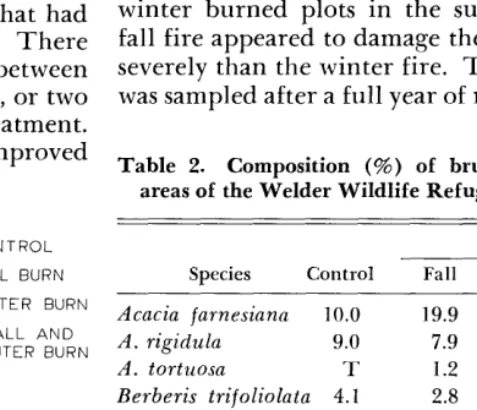
unburned control (Fig. 1). Burning reduced brush
canopy cover an average of 24% on areas that had
not been pretreated by mechanical
control.
There
was no statistical difference at the .05 level between
the percent reduction following fall, winter, or two
successive fires in the area without pretreatment.
The uneven pattern of burning was not improved
C F WFW
c
FWFWCONTROL SHRED
c_ Fw Fw
SCALP
B;;r
C_ F WFW
ROOT PLOW
C-CONTROL
F - FALL BURN
W-WINTER BURN
F-W- FALL AND
WINTER BURN
ROLLER CHOP
d cu In in rlrl &Q
C_ F WFW
ROOT PLOW AVERAGE
AND RAKE
FIG. 1. Canopy cover (%) on pretreated areas of the Welder Wildlife Refuge following prescribed burning treatments. Treatments connected by a solid line are not significantly different from each other at the 0.05 level.
Table 1. Reduction (%) in canopy cover of all brush plants on burned areas of the Welder Wildlife Refuge
(measured August 1967).
Percent reduction
Pretreatment Fall Winter Fall-Winter
Control (no burn) 33 43 35
Shredded 59 61 75
Chopped 62 62 73
Scalped 36 41 66
Root plowed 70 64 85
Root plowed and raked 44 71 87
by successive burns.
The large mottes probably
could withstand repeated fires due to the lack of
fuel to carry a fire through them.
Reduction
in brush canopy was significantly
greater on all pretreated
plots than on the un-
treated control plots. The fall burn reduced brush
canopy an average of 55% on all pretreated plots;
the winter burn resulted in a 57% reduction;
and
burning in two successive years gave 7 1 y0 less brush
canopy.
With the exception
of the root plowed
and raked plot, where insufficient
fuel resulted in
a poor fall burn, there was no difference
between
the percent reduction
following
fall and winter
burning.
Two
successive
burns
resulted
in a
further
significant
loss of brush canopy in all
instances.
Although
there was no statistical
difference
in
the amount of brush canopy cover on fall and
winter burned plots in the summer of 1967, the
fall fire appeared to damage the brush plants more
severely than the winter fire. The fall burned plot
was sampled after a full year of regrowth.
Box et al.
Table 2. Composition (%) of brush species on burned areas of the Welder Wildlife Refuge.
Time of burn
Species Control
Acacia farnesiana 10.0 A. rigidula 9.0 A. tortuosa T
Berberis trifoliolata 4.1 Cettis spinosa 5.0 Condalia obovata 2.0 C. obtusifolia 2.5
Diospyros texana 1 .O
Lycium berlandieri 1 .O Oprlntia leptocaulis 4.7 0. lindheimeri 8.4 Prosopis glandulosa 43.2 P. reptans
var. cinerascens 4.6 Zan thoxylum fagara 3.8
Fall Winter Fall & Winter
19.9 16.5 21.3
7.9 13.3 12.6
1.2 0.8 7.8
2.8 1.6 2.2
8.1 4.3 5.4
3.1 1.3 1.8
2.9 6.7 3.0 2.3 T 0.9
T T T
4.8 1.3 0.9 5.9 5.1 6.5 31.9 33.9 28.5
1.3 7.0 3.7
FALL AND WINTER
BURNING
375
C- CONTROL
F- FALL
BURN
q
FORBS
W- WINTER
BURN
•] GRASS
FW-FALL
AND WINTER
BURN
r
1
-
0g
F
r
-
w
1
-
FW
FIG. 2. Standing crop of herbage (lb) on untreated areas of the
Welder Wildlife Refuge.
(1967) reported
average canopy reduction
of 56
to 78yo on the fall burned plots the first growing
season following
the fire.
The least amount of canopy reduction occurred
in areas that had been scalped as a pretreatment
brush control
measure
where the brush plants
were large. The greatest reduction
was in areas
that had been root plowed or root plowed and
raked.
Here brush plants grew singly and were
completely
surrounded
by fuel.
The percent composition
of brush canopy cover
was altered by the burning treatments
(Table 2).
Huisache
(Acacia
furnesianu
(L) Wind.),
black-
brush acacia (A.
rigidulu
Benth.),
twisted acacia
(Acuciu totuosu (L) Wind.),
and lote bush (Con-
dalia obtusifoliu
Hook.) all increased
in relative
abundance.
Agarito (Berberis
trifoZioZutu Moric.),
(Opuntiu
Zeptocuulis
DC.), mesquite
(Prosopis
glundulosu
Torr.),
and creeping
mesquite
(P.
reptans
Benth. var cinerascens
(Gray) Burkart) all
declined in relative abundance.
Percent kill was
not determined
for each species. Box et al. (1967)
and White
(1969) reported varying mortality
of
brush depending
upon conditions
at the time of
the fire and stage of growth of the plants.
Response of Herbaceous Vegetation
More total herbage was produced on all burned
areas than on the unburned control
(Fig. 2). The
fall burned area produced significantly
(.05 level)
more grass than any other treatment.
The winter
burned
area had significantly
(.05 level) more
forbs than any other treatment.
The
fall and
winter burned areas produced more total herbage,
and more in both the grass and forb categories,
than the control.
They produced about the same
amount of total herbage as those burned in fall or
winter only, but they had less grass and more forbs
than plots burned fall only and less forbs and more
grass than plots burned winter only. Yield of in-
dividual species on the treated areas is included in
Table
3. These findings are similar to those of
Grelan and Epps (1967) who reported
increased
production
in Louisiana
following fire.
In general, plants that increased following burn-
ing were those normally considered
“disturbance”
species. For instance, filly panic (Panicurn
filipes
Scribn.) and plains bristlegrass
(Setaria Zeucopilu
(Scribn. and Merr.) K. Schum.), produced more on
all burned plots than on the control.
Several other
grasses were more abundant
on fall burned areas
than on the control plots or strips that had been
burned in the winter. However, statistically signifi-
cant differences
could not be shown between
individual
species response to the burning
treat-
ment.
Conclusions and Recommendations
Both fall and winter burning
will effectively
reduce brush canopy and frequency in South Texas
chaparral communities.
Fall burning appears to be
slightly more effective in reducing brush cover than
winter fires.
Fall burning
tends to reduce forb production
the following year and increase the amount of grass
produced (Box et al., 1967). Winter burning has
an opposite effect-forbs
are increased and grasses
remain unchanged in production.
Burning for two
successive years, once in the fall and once in the
winter, gives a balance between grass and forbs
simrlar to the unburned control, but total produc-
tion is higher.
376
BOX AND WHITE
Table 3. Herbage production (lb/acre) by species, on burned plots on the Welder Wildlife Refuge.
Time of burn
Species Control Fall Winter Winter Fall &
Grasses
Andropogon saccharoides 126 119
Aristida roemeriana 48 79
Buchloe dactyloides 355 330
Chloris verticillata 20 8
Hilaria belangeri T 24
Panicum filipes 43 90
P. obtusum 20 51
Paspalum pubiflorum 57 12
Schedonnardus paniculatus 4 11
Se taria gen icula ta 13 42 S. leucopila 12 110
Spore bolus asper 36 87
S. pyramidatus 6 5
Stipa leucotricha 77 28
Tridens albescens 31 47
T. congestus 22 5 Others (4 of less than
1 lb/acre each) 3 2
Total grasses 873 1050
Forbs
Ambrosia psilostachya 72 94
Cienfuegosia sulphurea 4 1
Commelina erecta 24 13
Croton monanthogynus 40 28
Desman thus virgatus 30 20
Lythrum californicum 2 1
Malvastrum aurantiacum 3 10
Phyla incisa 8 26
Portulaca pilosa 8 3
Ratibida columnaris 2 3
Ruellia sp. 110 95
Solanum eleagnifolium 23 26
Verbesina microptera 30 41
Xanthocephalum texanurn 219 185 Others (11 of less than
1 lb/acre each) 7 2
- -
Total forbs 583 548
~ ___
Total herbage 1456 1598
39 29 315 20 7 60 49 28 2 12 85 33 11 56 39 2 44 48 401 8 17 85 57 33 T 3 82 42 T 24 18 9
2 3
789 874
117 70
7 3
15 14
42 44
20 31
3 6
3 2
10 27
12 9
8 3
86 116
40 59
66 64
322 203
8 7
759 658
1548 1532
pretreatment,
the result is an uneven and patchy
burn with the large mottes left intact.
Repeated
burnings could conceivably
reduce the size of the
mottes by gradually
eroding
them around
the
edges, but it is not likely that chaparral areas would
burn that often.
Therefore
some sort of pretreatment
is desirable.
It appears that any type of mechanical control that
will crush or knock down the larger brush and
dense mottes will enhance the effects of fire. Best
results can probably be obtained by waiting suffic-
iently long following pretreatment
for the crushed
woody fuel to dry and a crop of herbaceous material
to mature among the debris.
No detrimental
effects on herbaceous vegetation
have been observed following a fire. In fact, grass
production may be increased (White, 1969). There-
fore, we recommend careful use of fire as a manage-
ment tool in South Texas chaparral.
LITERATURE
CITED
ALLRED, B. W., AND H. C. MITCHELL. 1955. Major plant types of Arkansas, Louisiana, Oklahoma, and Texas and their relationship to climate and soils. Texas J. Sci. 7: 7-19.
Box, T. W., AND A. D. CHAMRAD. 1966. Plant com- munities of the Welder Wildlife Refuge. Contr. 5, Ser. B, Welder Wildlife Refuge, Sinton, Texas. 28 p.
Box, T. W., J. POWELL, AND D. L. DRAWE. 1967. Influence of fire on South Texas Chaparral communities. Ecolocgy 48:955-961.
CARYER, M. G. 1958. Reclaiming Texas brushland range. J. Range Manage. 11: l-5.
GRELAN, H. E., AND E. A. EPPS. 1967. Season of burning affects herbage quality and yield on pine-bluestem ranges. J. Range Manage. 20:31-33.
LEHMANN, V. W. 1965. Fire in the range of Attwater’s prairie chicken. Proc. Tall Timbers Fire Ecol. Conf. 4:
127-142.
POWELL, J., AND T. W. Box. 1967. Mechanical control and fertilization as brush management practices affect forage production in South Texas. J. Range Manage. 20: 227-236.
SMITH, H. N., AND C. A. RECHENTHIN. 1964. Grassland restoration: the Texas brush problem. Unnumbered bull. U. S. Dep. Agr., Soil Conserv. Service, Temple, Texas.
THOMAS, G. W. 1962. Texas plants: an ecological sum- mary In Texas Plants, a checklist and ecological summary. Texas Agr. Exp. Sta. Misc. Pub. 585. p. 5-14.
WHITE, R. S. 1969. Fire temperatures and the effect of burning on South Texas brush communities. Unpub- lished M.S. Thesis. Texas Technological College, Lub- bock, Texas.
Specialists
in
Quality
N
AT
1 V E
G
R
A S S
E S
Wheatgrasses l Bluestems l Gramas l Switchgrasses l Lovegrasses l Buffalo l and Many Others
We grow, harvest, process these seeds Native Grasses Harvested in ten States Your Inquiries
Appreciated
SHARP
BROS. SEED CO.
Responses of Mountain
Vegetation to Gopher
Reduced Grazing,
Herbicide1
Grassland
Control,
and
GEORGE T. TURNER
Plant Ecologist, Rocky Mountain Forest and Range Experiment Sta tion,a
Fort Collins, Colorado.
Highlight
Deteriorated mountain grassland range on Grand Mesa in western Colorado improved slowly during 19 years of nonuse. It improved almost as much under light grazing. In contrast, grass production increased markedly within a short time after competition from forbs and shrubs had been reduced by herbicide. Pocket gopher control for 9 years increased production of certain plant species and decreased production of others.
Efficient
management
of mountain
grasslands
for grazing, recreation,
or watershed purposes calls
for increased knowledge of responses of the vegeta-
tion to different management
practices. This paper
reports responses of grassland vegetation on Grand
Mesa to: (1) exclusion of livestock;
(2) reduction
in livestock grazing;
(3) control of pocket gophers;
and (4) herbicide.
The study was conducted
by
the Rocky Mountain Forest and Range Experiment
Station between 1941 and 1960 in cooperation with
the Bureau of Sport Fisheries and Wildlife,
U. S.
Department
of the Interior,
and the Grand Mesa-
Uncompahgre
National
Forest, Forest Service, U.
S. Department
of Agriculture.
Study Area and Methods
Grand Mesa is located near Grand Junction, Colorado, between the bordering valleys of the Gunnison and Colorado Rivers. Capped with basalt, it slopes gently upward from an elevation of 9,800 ft at its western edge to over 10,500 ft at its eastern extremity. The terrain is generally flat to rolling. Though rich in organic matter and fertile, soils are generally rocky and shallow. Average annual precipitation is estimated to be about. 30 inches. From November through May the ground usually is snow covered; the snowpack commonly attains a depth of 4 to 6 ft.
Near the western edge of the Mesa the aspect of silver sagebrush (Artemisia cana) is broken here and there by groves of Engelmann spruce (Picea engelmannz) and sub- alpine fir (Abies Zasiocarpa). At higher elevations timber
l Received Sep tember 20, 1968; accepted for publication June 6, 1969.
2 Forest Service, U. S. Department of Agriculture, with headquarters at Fort Collins, Colorado, in cooperation with Colorado State University. The author is grateful to David F. Costello, Clyde W. Doran, Maynard W. Cummings, and others who helped plan and conduct the study.
stands are more extensive, and grassland “parks,” here- after referred to as the grass-forb type, are occupied mainly by herbaceous plants.
Since about 1880 Grand Mesa has been grazed by cattle. Soon after the turn of the century the range was heavily stocked, and dense stands of Thurber fescue (Festuca thurberi), photographed by George B. Sudworth in 1889, were replaced or obscured by sagebrush.
When this study was started in 1941, orange sneezeweed (HeCenium hoopesii) was conspicuous in the grass-forb type. Grass cover was sparse and the range was heavily populated with northern pocket gophers (Thomomys talpoides). After snowmelt the ground was cluttered with cores of soil de- posited in snow tunnels, and later with mounds of earth excavated by gophers (Fig. 1). By summer’s end, cattle had closely grazed most forage plants.
To determine and compare responses of vegetation to different combinations of gopher and grazing control, eight pairs of l-acre areas on Grand Mesa were located in 1941 for detailed study. The most, distant, 7 miles apart, dif- fered in elevation by 600 ft. The two’ lowest and western- most pairs supported mainly silver sagebrush; the others supported a mixture of forbs and grasses. One member of each pair was fenced in 1941 to exclude livestock, and the other*continued to be grazed. Grazing was much lighter, however, after the number of cattle aid length of grazing season were reduced about one-half during the period 1946 to 1950. The lighter grazing continued through 1960.
From 1941 to 1949, pocket gophers were trapped con- tinuously during the snow-free period from every other pair of study areas. On the average, 18 gophers an acre per year were trapped from control areas (Cummings, 1949). Yearly averages ranged from 9 to 35 and those for individual study areas from 14 to 23 an acre. Equal numbers were trapped from grazed and nongrazed range. Although the number of gophers on gopher-present areas was not determined, soil disturbance indicated populations were generally high.
Between 1955 and 1958, the four pairs of study areas on the western part of the Mesa were sprayed with herbicide. An ester of 2,4-D mixed with diesel fuel was applied by airplane at a rate of 3 lb/acre acid-equivalent. Except during the year of treatment, the open range continued to be grazed after it had been sprayed.
Vegetation records were collected from 1941 to 1960. For sampling purposes, each acre was subdivided into nine units of equal size, and two 12.5 ft2 plots were located at random in each unit each time records were taken.
Herbage production was measured in 1941 by harvesting and weighing vegetation from each plot; thereafter, it was determined by double sampling in which herbage weight was estimated and the estimates adjusted as indicated by records from clipped plots (Pechanec and Pickford, 1937). Weights were converted to an air-dry basis. Production by individual species was estimated in 1942 and 1960; in other years it was determined only for herbage classes, except for sneezeweed, which was measured separately. Sneeze- weed was of particular interest because it was very abundant, is nonpalatable to cattle, and poisonous to sheep.
Plant cover was estimated by the square-foot-density method (Stewart and Hutchings, 1936). An index of plant vigor was obtained by measuring maximum heighis of flower stalks of 30 no&razed plants per acre for each of seven species. Measurements w&e made in July or August when most plants were fully developed. -
.
-
MOUNTAIN
GRASSLAND
RESPONSES
379
Table 2. Composition (96) of plant cover as influenced by pocket gopher control.
Species
Gophers controlled 1941 1951
Gophers uncontrolled 1941 1951
Grass and Sedges percentage of grass-sedge cover
Slender wheatgrass 7 9 4 14
Sedges 22 32 21 11
Forbs percentage of forb cover
Orange sneezeweed 13 3 7 4
Lupines 8 22 11 12
Penstemons 10 9 8 17
Common dandelion 21 27 14 12
less prominent
(Table
2). Branson
and Payne
(1958) reported similar responses of dandelion and
slender wheatgrass to gopher control in Montana.
On the Wasatch
Mountains
in Utah,
Richens
(1965)
found that bulbed
plants became more
abundant, and annual plants less abundant, follow-
ing gopher control.
The increases in lupine and dandelion on Grand
Mesa are in accordance
with earlier findings that
those plants
commonly
are eaten
by gophers
(Keith,
Ward, and Hansen,
1959; Ward,
1960;
Ward and Keith, 1962). Lupine increased on all
areas on which gopher control was attempted, and
dandelion
increased
on seven of the eight areas.
Neither changed appreciably
where gophers were
not controlled.
After gopher control was discon-
tinued, lupine again became relatively
inconspic-
uous.
Gopher-Grazing
Relationships.
Vegetation
responses to gopher control varied
considerably with range use by cattle. For example,
forbs other than sneezeweed increased most (373
lb/acre) between
1941 and 195 1 on grazed range
on which gophers were controlled.
The increase
was smallest
(41 lb/acre) on nongrazed range on
which gophers were not controlled.
Orange sneeze-
weed, on the other hand, decreased
as much as
106 lb where both cattle and gophers were ex-
cluded, and as little as 14 lb where neither was
excluded.
The largest increase
( 18 1 lb/acre) in grass and
sedges resulted
from exclusion
of cattle
only.
Slender wheatgrass provided most of the additional
forage. Grass increased least (96 lb/acre) on grazed
range on which gophers were controlled.
Browse
responses were relatively
small and inconsistent.
Changes in sneezeweed cover were similar to its
changes in production.
Common dandelion
and
sedge cover increased
most on grazed range on
which gophers were controlled,
and decreased on
nongrazed range on which gophers were present.
Table 3. Average production of herbage (lb/acre, air-dry) on four grazed and four nongrazed areas in a grass-forb type not sprayed with herbicide.
Class of herbage
Grass and sedges Forbs
Shrubs All herbage
Grazed Nongrazed
1941 1960 1941 1960
124 300 130 353
562 433 600 440
20 30 10 8
706 763 740 801
Under
the latter
treatment,
slender
wheatgrass
attained its greatest prominence.
Responses of lu-
pine and penstemon
to gopher control were not
influenced appreciably by grazing.
Comparative changes in vegetation between 1941
and 195 1 for the four gopher-grazing
treatments are
summarized below. Under all treatments,
produc-
tion of grass and forbs other than sneezeweed was
higher, and that of sneezeweed and browse lower,
in 1951 than in 1941.
Gophers present on grazed range.
1. Average increase in grass production.
2. Below average increase in forbs other than
sneezeweed.
3. Least reduction in sneezeweed.
Gophers present on nongrazed range.
1. Largest
increase
in grass
(mainly
slender
wheatgrass).
2. Least increase in forbs other than sneezeweed.
3. Small reduction
in sneezeweed; moderate re-
duction in dandelion.
Gophers controlled on grazed range.
1. Least increase in grass (no change in wheat-
grass).
2. Largest increases in lupine, dandelion, sedges,
and forbs (as a group) other than sneezeweed.
3. Average reduction in sneezeweed.
Gophers controlled on nongrazed range.
1. Average increase in grass production.
2. Above average increase in forbs other than
sneezeweed.
3. Largest reduction in sneezeweed.
Responses
to Reduced
Grazing.
382
TURNER
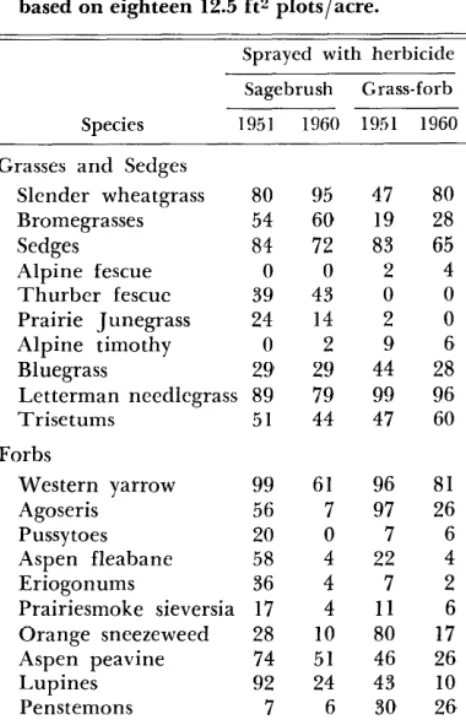
Table 5. Frequency (%I) of common plants on sagebrush and grass-forb types treated with herbicide, and on un- treated grass-forb type, in 1951 and 1960. Each entry is based on eighteen 12.5 ft2 plots/acre.
Sprayed with herbicide Not sprayed Sagebrush Grass-forb Grass-forb Species 1951 1960 1951 1960 1951 1960
Grasses and Sedges
Slender wheatgrass 80 95 47 80 40 60
Bromegrasses 54 60 19 28 8 26
Sedges 84 72 83 65 96 77
Alpine fescue 0 0 2 4 74 62
Thurber fescue 39 43 0 0 0 0
Prairie Junegrass 24 14 2 0 0 0 Alpine timothy 0 2 9 6 32 24
Bluegrass 29 29 44 28 68 64
Letterman needlegrass 89 79 99 96 98 88
Trisetums 51 44 47 60 58 66
Forbs
Western yarrow 99 61 96 81 96 93
Agoseris 56 7 97 26 90 57
Pussytoes 20 0 7 6 21 8
Aspen fleabane 58 4 22 4 2 1
Eriogonums 36 4 7 2 2 1
Prairiesmoke sieversia 17 4 11 6 43 40 Orange sneezeweed 28 10 80 17 86 70 Aspen peavine 74 51 46 26 25 25
Lupines 92 24 43 10 87 46
Penstemons 7 6 30 26 78 73
Douglas knotweed 76 85 72 88 22 41 Cinquefoils 93 71 100 74 22 21 Pseudocymopterus 6 4 8 0 72 46 Common dandelion 86 26 100 71 95 91
American vetch 74 4 47 2 22 20
Shrubs
Silver sagebrush 92 15 10 3 0 0
(Erigeron
macranthus),
eriogonum
(Eriogonum
su balpinum
and
E. negkectum),
orange sneezeweed,
lupine,
and American
vetch
(Yicia americana).
Reductions
were smaller or less consistent in west-
ern yarrow, pussytoes
(Antennaria
spp.), prairie-
smoke sieversia
(Geum ciliaturn),
aspen peavine
(Lathyrus Zeucanthus),
common dandelion,
Ryd-
berg penstemon,
and cinquefoils
(Po ten tilla an-
serina
and
P. pulcherrima).
In 1960 these two species
of cinquefoil
comprised 30 to 40% of the forb herb-
age on sprayed areas, much more than any other
species.
Changes in frequency of individual grass species
were relatively
small and generally
similar
on
sprayed and nonsprayed range. This would indi-
cate that causes other than herbicide
were mainly
responsible,
and that increased production of grass
on sprayed range resulted not from establishment
of new plants but from improved vigor of plants
present when the range was sprayed.
Responses to herbicide
were influenced
by site
characteristics
and nature of the vegetation
prior
to spraying.
In 195 1 frequencies
of several plant
species within
the sagebrush
type differed
con-
siderably from those for the grass-forb type. Thur-
ber fescue and prairie Junegrass
(Koeleria cristata),
for example, were nearly restricted to the sagebrush
type before and after treatment
(Table 5). Within
the grass-forb type, alpine fescue
(Festuca ovina
brachyphylla),
alpine timothy
(Phleum alpinum)
and bluegrasses were much more common in 195 1
on areas not to be sprayed than on those subse-
quently sprayed. By 1960, 2 to 5 years after herbi-
cide was applied,
the relative
abundance
and
distribution
of these plants had changed very little.
Summary and Conclusions
Vegetation
responses to pocket gopher control,
exclusion of livestock, reduced grazing, and herbi-
cide were observed on 16 l-acre study areas on
Grand Mesa in western Colorado
from 1941 to
1960. The sites were paired, one fenced to exclude
livestock and the other left open to grazing by
cattle. From 1941 to 1949 pocket gophers were con-
trolled during summer months on every other pair
of study areas. Livestock were excluded from eight
sites from 1942 to 1960, and stocking of the open
range was sharply reduced during the period 1946
to 1950. Thereafter,
grazed sites received light to
moderate use. The western part of the Mesa on
which half the study areas were located was sprayed
with herbicide during the period 1955 to 1958.
Because control of pocket gophers by poisoning
and trapping was feasible only during snow-free
periods, some gophers reinvaded
gopher-control
areas during winter.
Consequently,
the responses
reported are from intensive, but incomplete,
con-
trol of gophers.
Principal conclusions are:
1. Gopher
control
resulted
primarily
in in-
creased production of perennial forbs, particularly
lupine and dandelion
which commonly are eaten
by gophers. Forbs other than sneezeweed increased
by 258 lb/acre between 1941 and 195 1, the increase
on grazed range being considerably
larger than on
non<grazed range. Orange sneezeweed became less
productive as the result of gopher control.
Grasses
and shrubs were little
affected.
Responses
to
gopher control, however, varied considerably
with
grazing use by cattle.
MOUNTAIN
GRASSLAND
RESPONSES
383
bromegrasses,
and trisetum
became more promi-
nent, while Letterman
needlegrass, blueg-rasses, and
sedges became less prominent.
Composition of forb
herbage was generally
stable, the largest change
being a 12% reduction in western yarrow. Compe-
tition from forbs apparently was mainly responsible
for the slow and relatively
small increase in grass
production.
3. Vegetation
changes on range grazed lightly
to moderately
for 10 years after stocking rate and
length of grazing season had been reduced were
generally similar to those on rangeland not grazed
for 19 years. Principal exceptions were that Letter-
man needlegrass
and bluegrasses
retained
their
former prominence,
and dandelion
became more
prominent, under continued grazing. The findings
indicate that deteriorated
mountain grassland range
may improve almost as rapidly under light grazing
as under nonuse.
4. Grass production increased considerably
more
on range sprayed with herbicide than on range not
sprayed.
Much of the increase evidently resulted
from more vigorous growth of grasses present when
the range was sprayed.
Kind and frequency
of
grasses on individual sites 2 to 5 years after the range
was sprayed were not much different
from those
prior to spraying. Although many forbs were killed
by herbicide,
some were almost as abundant a few
years after the range was sprayed as before.
Ap-
parently the latter were resistant to herbicide
or
quickly became reestablished.
Although
plant cover responded differently
to
each treatment, the vegetation on each site tended
to retain its individuality
throughout
the study.
The nature of existing plant cover and other site
characteristics
should
be considered,
therefore,
when predicting
responses of mountain
grassland
to specific management
practices.
LITERATURE
CITED
BRANSON, F. A., AND G. F. PAYNE. 1958. Effects of sheep and gophers on meadows of the Bridger Mountains of Montana. J. Range Manage. 11: 165-169.
CUMMINGS, M. W. 1949. Grand Mesa pocket gopher study, progress reports for 1942-48. Unpubl. mss. Denver Wildlife Res. Lab., Fish and Wildlife Serv., U.S. Dep. Int. HANSEN, R. M., AND A. L. WARD. 1966. Some relations
of pocket gophers to rangelands on Grand Mesa, Colo- rado. Colo. Agr. Exp. Sta. Tech. Bull. 88. 22 p. KEITH, JAMES O., A. LORIN WARD, AND RICHARD M. HANSEN.
1959. Effect of 2,4-D on abundance and foods of pocket gophers. J. Wildlife Manage. 23: 137-145.
PECHANEC, JOSEPH F., AND G. D. PICKFORD. 1937. A weight estimate method for the determination of range or pasture production. Amer. Sot. Agron. J. 29:894-904.
RICHENS, V. B. 1965. An evaluation of control on the Wasatch pocket gopher. J. Wildlife Manage. 29:413425. STEWART, GEORGE, AND S. S. HUTCHINGS. 1936. The point-
observation-plot (square-foot density) method of vegeta- tion survey. Amer. Sot. Agron. J. 28:714-722.
WARD, A. LORIN. 1960. Mountain pocket gopher food habits in Colorado. J. Wildlife Manage. 24:89-92. WARD, A. LORIN, AND JAMES 0. KEITH. 1962. Feeding
habits of pocket gophers in mountain grasslands, Black Mesa, Colorado. Ecology 43:744-749.
Statement of Ownership, Management and Circulation
1. Date of Filing: September 29, 19692. TitZe of Publication: Journal of Range Management 3. Frequency of Issue: Bimonthly
4. Location of Known Office of Publication:
2120 South Birch Street Denver, Colo. 80222
5. Location of General Business Offices: 2120 South Birch Street
Denver, Colo. 80222 6. Names and Addresses of-
Publisher:
Editor:
Managing
American Society of Range Management 2120 South Birch Street,
Denver, Colo. 80222 Elbert H. Reid
624 South Shields Street, Fort Collins, Colo. 80521
Editor: Francis T. Colbert 2120 South Birch Street, Denver, Colo. 80222
7.
Owner: American Society of Range Management 2120 South Birch Street, Denver, Colo. 80222 (A nonprofit corporation; no capital stock authorized or issued.)8. Known Bondholders, Mortgagees, etc: None
9. The purpose, function, and nonprofit status of this organization and the exempt status for Federal income tax purposes have not changed during preceding 12 months.
10. Extent and Nature of Circulation:
Average each Actual for issue for issue preceding nearest 12 months filing date Total copies printed 4,94 1 4,800 Paid dealer, counter sales -O- -o- Paid mail subscriptions 4,694 4,694 Total paid circulation 4,694 4,694
Free distribution 12 6
Total distribution 4,702 4,558
Office-use, left over, unaccounted 235 242
Total 4,941 4,800
I certify that the statements made by me above are correct and complete.