IJEDR1603136
International Journal of Engineering Development and Research (www.ijedr.org)839
Performance Analysis of Energy Efficient Routing
Protocols For Mobile Ad-hoc Networks
Nisha Kumari1, Er. Vivek Sharma2 1 PG Student,2Assistnat Professor
Department of Electronics and Communication Bahra University Shimla Hills
________________________________________________________________________________________________________
Abstract - Mobile Ad-hoc network is a continuously self-configuring, infrastructure less wireless network consisting of mobile device. An energy efficient protocol is important in design of Ad-hoc network because the nodes in Ad-hoc networks operate in limited battery energy and it is not possible to recharge or replace the battery. A shortest path is always selected in Ad-hoc networks by conventional routing protocols. Today most mobile Ad-hoc networks operate on batteries. Power consumption is an important issue. When single path used then the nodes will exhaust very soon and the lifetime of the network is very less. In this paper the discussion of AODV, MEP-AODV and the SELECTIVE AODV is done. The MEP-AODV is the multipath energy efficient probability routing protocol. Minimum battery energy consumption and multipath selection is considered in MEP-AODV. Multipath will selected with sufficient battery energy by destination. Source node can send data via the selected multipath. The proposed model is simulated in MATLAB to evaluate the performance.
Keywords - AODV, Energy, life time, Mobile Ad-hoc network, MEP-AODV, Multipath, MATLAB, Routing protocols ________________________________________________________________________________________________________
I. INTRODUCTION
A mobile Ad-hoc network (MANET) is a continuously self- configuring infrastructure less wireless network consisting of mobile devices. Each device in MANET is free to move independently in any direction and changes its links to other devices frequently. Each device must forward traffic unrelated to its own use [1]. Due to possible intermediate haste which has to be crossed in reaching its destination routing becomes a difficult process for large and complex networks [2].
Figure1 Mobile Ad hoc network[3]
Energy efficient routing protocol can be classified in 3 categories: ideal energy save protocols, transmission power control protocol and energy aware routing protocols.
Advantages of MANETS
• They provide access to information and services regardless of geographic position.
• Independence from central network administration. Self-configuring network, nodes are also act as routers. Less expensive as compared to wired network.
• Scalable accommodates the addition of more nodes. • Improved Flexibility.
• Robust due to decentralize administration.
• The network can be set up at any place and time[3].
II. MAJOR CHALLENGES IN MANETs
Regardless of the attractive applications, the features of MANET introduce several challenges that must be studied carefully before a wide commercial deployment can be expected. These include:-
a) Dynamic topologies:- Nodes are free to move arbitrarily; thus, the network topology which is typically multi hop, may change randomly and rapidly at unpredictable times, and may consist of both bidirectional and unidirectional links.
IJEDR1603136
International Journal of Engineering Development and Research (www.ijedr.org)840
c) Bandwidth constrained variable capacity links:- Wireless links will capacity than their hardwired counterparts. Continue to have significantly lower.d) Power-constrained and operation:- Some or all of the nodes in a MANET may rely on batteries or other exhaustible means for their energy. For these nodes, the most important system design criteria for optimization may be energy conservation. For most of the light-weight mobile terminals, the communication-related functions should be optimized for lean power consumption. Conservation of power and power-aware routing must be taken into consideration[5].
III. PROTOCOLS IN MANETS
In Ad-hoc network, three protocols are proactive, reactive and hybrid.
Figure.2 Classification of MANETS routing protocols[6]
Proactive protocol is about give up the data information of all nodes. In routing protocol the information store by every node in the form of tables and if there is any change in information then the tables are need to update.
The reactive protocol is used to send data from source to destination. In this protocol there is no need of distribution of information. It consumes bandwidth when transfer data source to destination. Hybrid protocols have an advantage of both reactive and proactive protocols [6].
a) AODV: - AODV stands for Ad-hoc on demand distance vector. AODV is a reactive routing protocol when the routes are needed then only AODV maintain routes. Unicast broadcast and multicast is done in AODV. It uses traditional routing tables, as one enter destination.
AODV is the combination of both DSR and DSDV. For route discovery RREQ and RREP messages are responsible. AODV avoids the counting to infinity problem. AODV leads to heavy control overhead [7].
At the cost of increased latency in finding new routes tends to reduce the control overhead.
Figure 3 A possible path for a route reply if A wishes to find a route to J[8]
When a node wishes to transmit traffic to a host to which it has no route, it will generate a route request (RREQ) message that will be flooded in a limited way to other nodes. A route is considered found when the RREQ message reaches either the destination itself or an intermediate node with a valid route entry for the destination. A route reply (RREP) massage is uni-casted back to the originator of a RREQ if the receiver is either the node using the requested address. If route is available in an intermediate node the node immediately send back RREP instead of the destination terminal. When active route is lost then route error message (RRER) is send back to all the source nodes using the route. Hello message is about activation link.[9]
Advantages of AODV
1) To handle the routing process it does not require any inner organizational method because it is basically flat routing protocol. 2) Routes established on demand and that destination sequence numbers are applied for find the latest route to the destination. 3) The AODV protocols are a loop free and avoid the counting to infinity problem.
4) At most one route per destination maintain at each node.
Disadvantages
1) Heavy control overhead.
IJEDR1603136
International Journal of Engineering Development and Research (www.ijedr.org)841
b) MEP-AODV:- It is the multicast extension of AODV. Both AODV and MEP-AODV are routing protocols for Ad-hoc networks. AODV for unicast traffic and MEP-AODV for multicast traffic. MEP-AODV allows every node in the network to send multicast packet of data[10].MEP-AODV Probability Function:- The probability function of MEP-AODV is 𝑏𝑖 =𝑐𝑖
𝑒𝑖 (1.1)
𝑝𝑖 = {
1 𝑏𝑖 ≥ 𝑟1
1 −𝑟1−𝑏𝑖
𝑟1−𝑟2 𝑟2 ≤ 𝑏𝑖 < 𝑟1 0 𝑏𝑖 < 𝑟2
} (1.2)
ci is the current remaining battery energy of node i. ei is the full battery energy of node i.
𝑏𝑖 > 𝑟1 relay the RREQ.
1 −𝑟1−𝑏𝑖
𝑟1−𝑟2 𝑟2 ≤ 𝑏𝑖 < 𝑟1 the probability relaying the RREQ. 0 𝑏𝑖 < 𝑟2 drop the RREQ.
r1 and r2 are predefined threshold and the values are 1>r1>r2>0. bi it’s the remaining energy ration.
pi represents the probability of RREQ rebroadcasting[11].
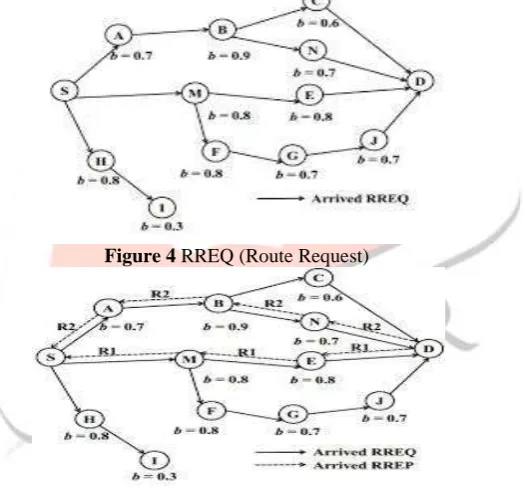
Route Discovery of MEP-AODV:-bl minimum node remaining battery energy of route l.
Source node:- Source node checks its route table if there is no available route to the destination. Route discovery process is initiated and RREQ is flooded to neighbouring nodes.
Intermediate node:- When an intermediate node receives an RREQ. Whether the RREQ was preceded before or not.bi is compared with bl if bi < bl, bl would be replace by bi. Then the RREQ is rebroadcast towards the destination node.
Figure 4 RREQ (Route Request)
Figure 5 RREP (Route Reply) using multiple reverse path
Destination node:- It does not generate a RREP and send it back to the source node immediately. The received RREQs would be buffered for a certain period until delay timer expires in order to collect as many RREQ possible. In the procedure the destination node select k paths. After the route selection, the destination node initiates the corresponding RREPs and unicasts then through the reverse path.
Route maintenance process in MEP-AODV:- Remaining battery energy is checked by intermediate node.
Figure 6 Route maintenance from source to destination
IJEDR1603136
International Journal of Engineering Development and Research (www.ijedr.org)842
IV SIMULATION RESULTS AND DISCUSSIONFollowing are the results carried out for the proposed model 1) AODV:-
Figure 7 RREQ of AODV
In figure7, 200 nodes are plotted. Here one node is source and the other is sink. In AODV source node is send the route request (RREQ) to the destination node. If the destination node send any route reply to the source node then the source node will send the data from that path. If no route reply obtained from that path then no data send from that path. In this graph two nodes are communicate with each other and send the data from source to destination.
MEP-AODV:-
Figure 8 Route from source to destination from multipath in MEP-AODV.
In figure 8, MEP- AODV is a multipath energy efficient probability routing protocol in Ad-hoc network. Here 200 nodes are plotted and the one node is source and the other node is sink. But in this it uses the multipath. Because of the multipath the lifetime of the system is increased. If the energy of the system is more then the packet delivery is more in the system.
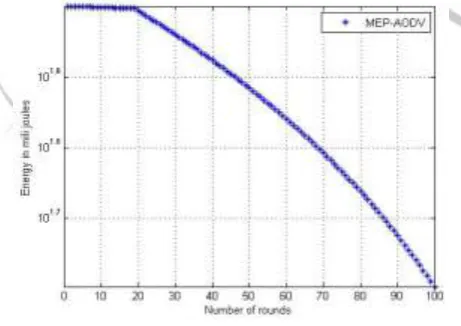
Figure 9 Energy consumption In figure 9, the graph is between number of rounds and energy in mili joules. Formula to calculate energy :-
𝑎𝑐𝑒𝑝(𝑘: 100) = 𝑎𝑒𝑐𝑝(𝑘: 100) − 𝑑𝑚𝑖𝑛∗ 𝑑𝑒𝑐𝑓𝑝 (1.3)
IJEDR1603136
International Journal of Engineering Development and Research (www.ijedr.org)843
Figure 10 Throughput in mili secondsIn figure 10, this graph is in between number of rounds and throughput. Throughput of the system is more in case of MEP-AODV. When the life time of the system is increase then the throughput is also increase. The throughput of the system is increase by increasing the number of rounds.
2) SELECTIVE MEP-AODV:-
Figure 11 Route from source to destination from multipath in selective MEP-AODV.
In figure 11, MEP- AODV is a multipath energy efficient probability routing protocol in Ad-hoc network. Here 200 nodes are plotted and the one node is source and the other node is sink. But in this it uses the multipath. Because of the multipath the lifetime of the system is increased. If the energy of the system is more then the packet delivery is more in the system.
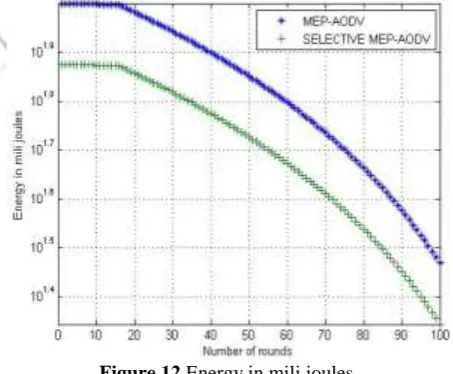
Figure 12 Energy in mili joules.
In figure 12, this graph is between energy in mili joules and the number of rounds. Here the comparison of MEP-AODV and selective MEP-AODV is done.
Selective MEP-AODV gives better performance then MEP-AODV.
IJEDR1603136
International Journal of Engineering Development and Research (www.ijedr.org)844
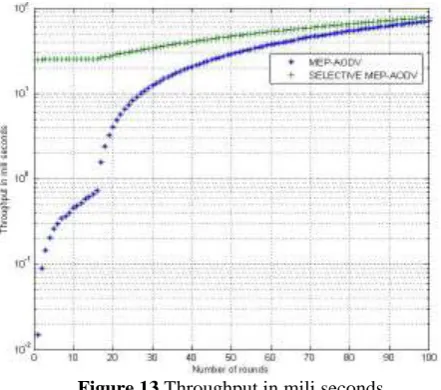
Figure 13 Throughput in mili secondsIn figure 13, the graph is in between throughput and number of rounds. Selective MEP-AODV gives better performance then MEP-AODV. Throughput of selective MEP-AODV is better than MEP-AODV. If energy consumption is less then throughput of the system is more and it also increases the life time of the system and will give good results. Due to less decreasing factor it will give better throughput of the system.
V. CONCLUSION
It has been concluded that in this the performance of proposed protocol i.e. Selective MEP-AODV is enhanced. It gives a better performance in terms of extending the life time of Ad hoc networks. It selects multiple routes with significant battery and energy and avoids selecting low battery energy routes. Due to this method the battery energy of each node is used more in a balanced manner. This paper demonstrates simulated results i.e. the Selective MEPAODV against the MEPAODV and AODV in MATLAB. The parameters used are network lifetime, Throughput, End to End delay and Energy consumption comparison. In all four aspects of comparisons the Selective MEPAODV outperforms the existing algorithms.
VI. REFERENCES
[1] Macro Conti and Silvia Giordano. “Mobile Ad hoc Networking: Milestones, Challenges, and New Research Directions” Communication Magazine, IEEE (Volume:52, issue:1) January 2014.
[2]S.Basangi et al., Eds., “Mobile Ad-hoc Networking-Cutting Edge Direction”, IEEE press and Wiley 2012.
[3] Harjeet Kaur, Varsha Sahni and Dr. Manju Bala. “A Survey of Reactive, Proactive and Hybrid Routing Protocol in MANET: A Review” International Journal of Computer and Information Technologies, Vol 4(3),2013.
[4] S.Giordano and W.W.Lu, “Challenges in Mobile Ad Hoc Networking,” IEEE commun.Mag., vol. 39. no. 6 2001. [5] S.Giordano. “Mobile Ad Hoc Networks,” Handbook of Wireless Networks and mobile computing, Wiley 325-346
[6] Kapang Lego, Pranav Kumar Singh and Dipankar Sutradhar. “Comparative Study of Ad hoc Routing Protocol AODV, DSR and DSDV in mobile Ad hoc Network” Indian Journal of Computer Science and Engineering Vol.1 no.4.
[7] C.E. Perkins, S.R. Das, Elizabeth M. Royer and Mahesh K. Marina. “ Performance Comparison of Two On-Demand Routing Protocols for Ad hoc Networks” Nineteenth Annual Joint Conference of the IEEE Computer and Communication Societies. Proceedings IEEE (Volume:1) INFOCOM 2000.
[8] C. E. Perkins and E. M. Royer “ Ad-hoc on-demand distance vector routing”, Mobile Computing Systems and Applications, 1999, Proceedings. WMCSA '99. Second IEEE Workshop, on 25-26 Feb 1999.
[9] Rajendiran.M, Srivasta.S.K. ”On- Demand Multicasting In Ad-hoc Networks: Performance Evaluation of AODV, ODMRP, and FSR”. International Journal of Computer Science Issues, Vol. 8, Issue 3, No. 1, May 2011.
[10] Qutaiba A. Razouqi Ali H. Afsari “MEP-AODV: AODV based Maximum Energy Path Routing in Ad hoc Networks”, Proceeding of Isccsp, _,Morocco,,2006.
[11] S. Singh, M. Woo, and C.S. Raghavendra, “Power-aware routing in mobile ad hoc networks,” in Proc. 4th Annual ACM/IEEE Int. Conf. Mobile Comput. Netw., pp. 181-190, Oct. 1998.
[12] Zhimu Huang, Ryo Yamamoto and Yoshiaki Tanaka. “A Multipath Energy-Efficient Probability Routing Protocol in Ad hoc Networks” Advanced Communication Technology (ICACT), 2014 16th International Conference IEEE on 16-19 Feb. 2014.
![Figure.2 Classification of MANETS routing protocols[6] Proactive protocol is about give up the data information of all nodes](https://thumb-us.123doks.com/thumbv2/123dok_us/8269169.1375953/2.595.193.411.164.304/figure-classification-manets-routing-protocols-proactive-protocol-information.webp)