Article
1
Influence of the Rift Molango on the mineralization of
2
platinum group elements and light rare earths into a
3
sedimentary exhalative ore deposit
4
Edgar A. Cárdenas-Reyes1, Eleazar Salinas-Rodríguez1*, Juan Hernández-Ávila1, Ventura
5
Rodríguez-Lugo1, Ma. Pilar Gutierrez-Amador2, Edmundo Roldan-Contreras1 and Eduardo
6
Cerecedo-Sáenz1,*
7
1 Academic Area of Earth Sciences and Materials, Institute of Basic Sciences and Engineering, Autonomous
8
University of Hidalgo State, Carretera Pachuca-Tulancingo Km. 4.5, C.P. 42184, Hidalgo, México;
9
[email protected]; [email protected]; [email protected]; [email protected]
10
2 Escuela Superior de APAN, UAEH, Carretera APAN-Calpulalpan Km 8, APAN, Hidalgo, C.P. 43920;
11
12
Corresponding authors: [email protected] & [email protected]
13
Received: date; Accepted: date; Published: date
14
15
Abstract:
This paper describes the influence of the ancient Rift Molango, Mexico, during the origin16
of the sedimentary exhalative ore deposits, according to the tectonic, chemical, climate and
17
biological evolution of the place where these deposits were formed through time. The mineralization
18
found in these deposits contains elements of the platinum group and some light rare earths, showing
19
two types of mineralizations; philonian and sedimentary, both of lower Jurassic age (Plienbanchian).
20
The sedimentary ore deposits, show a philonian lithology that has traces of hydrothermal
21
remobilization of chalcopyrite, quartz, biotite and muscovite, containing sperrilite, calaverite, native
22
platinum, gold and silver; as well as some light rare earths. Meanwhile, in the sedimentary outcrop
23
there are values of platinoids (8 ppm of Pt, 10 ppm of Pd, and 5 ppm of Au), and light rare earths
24
into the monazite minerals (Ce, La, Nd, Th, (PO4) and bastnaesite minerals.By means of XRD it was
25
possible to identify medium temperature minerals such as pyrite, albite, quartz, and also carbon;
26
high temperature mineral, such as monazite and low temperature minerals, such as jarosite,
27
chalcopyrite and bornite. In conclusion, the behavior of both mineralizations has a very close
28
relationship with a transgressive event during the lower Jurassic; the high contents of siliciclasts, the
29
presence of exhalative roots, the deficiency of sulfur and a mega structure Rift type, allow to classify
30
them according to their genesis as exhalative sedimentary type (SEDEX).
31
Keywords: platinum; light rare earths elements; sedimentary ores; SEDEX
32
33
1. Introduction
34
The occurrence of mineral deposits of the platinum group has been described in the Yukon in
35
Canada [1], where the exploration of platinoids in blackboards is carried out, and there are included
36
deposits of different origins. The association of V-Cr-PGE is known in exhalative deposits [2], and
37
also the chromifera spinels associated with Pd minerals have been described in Nairme, Australia
38
[3]. Pasava [4] suggests that the PGE anomalies have their origin in exhalative deposits related to
39
volcanism in rift zones in the presence of organic matter. Consequently, the main characteristics of
40
the massive vulcanogenic sulfide (VMS) deposits [5] and SEDEX, are scarcely known in Mexico [6]
41
as well as those of other deposits sedimentary that have been studied recently, being these objects of
42
artisanal production; such as those described in the mid-2000s in eastern Mexico that are of the RED
43
BED and KUPFERSHIEFER type. However, its main economic attractiveness is based on the
44
potential contents of Cu and Ag.
45
The largest occurrence of rare earth elements (REE) is in Asia, where about 95% of total
46
production is in the People's Republic of China. Particularly the Bayan Obo deposits, of high grade,
47
igneous type of carbonatite with about 80% of LREEs [7], but the typical in these deposits is a low
48
content of HREEs.
49
The first attempts in exploration to find strategic minerals and in particular rare earths in
50
Mexico, occurred in the middle of the eighties for the prospection of phosphorites located in western
51
Mexico, particularly in Baja California, using the traditional method of exploration. In addition, the
52
first reports on its occurrence date from the first half of 1990, in the El Picacho Complex [8], in
53
Tamaulipas in eastern Mexico; there, the presence of an intrusive tertiary age complex of
54
nepheline-foidolites and rare earth mineralization has been reported.
55
Likewise, at the beginning of the 2000s, geochemical studies were performed on Precambrian
56
rocks in eastern Mexico, in the Grenvillian basement of Gneiss Huiznopala [9], where anomalies
57
were obtained positive Eu and low concentrations of Y, Zr, Nb, Th and U. Similarly, anomalies were
58
found in the Complejo Oaxaqueño [10], from the southeast of Mexico. It should be mentioned that
59
there are still no reports of deposits in production of rare earths in Mexico, and similarly there is no
60
report of the occurrence of platinoids (PGE).
61
On the other hand, exhalative deposits are known in Mexico in Rift zones and an example of this
62
is the one located in eastern Mexico, where there is a giant syngenetic reservoir of marine affinity
63
manganese [11], of the SEDEX type (in Molango, Hidalgo) and is by far the largest known deposit by
64
researchers from the United States [12], with 3 MT of measured reserves, proven reserves of 200 MT
65
and estimated at 1500 MT, of a degree of 10%, which is a sample of the potential mineral contents of
66
these SEDEX-type deposits.
67
Traditionally, platinum deposits are related to V, Cr and Ni (as trace elements) and because in
68
Mexico there is not much evidence of these tracers, but the analysis have always been done on
69
ultramafic rocks. It is for this reason, that there has been no exploration in any type of deposit to look
70
for elements of the platinum group, leaving only the sedimentary deposits as the last option to be
71
able to determine its occurrence.
72
In the manganese district of Molango, the zone containing stratigraphic and structural remains
73
is located, which allows us to infer the presence of an old Rift that shows a heterochronic stage of
74
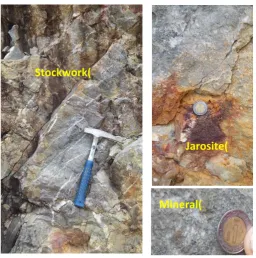
proto and neo-jurassic transgression, according to Cantú-Chapa [13], which is related to the SEDEX
75
mineralization. On the other hand, it is worth mentioning that the SEDEX deposits in Cuba [14]
76
occur in stratigraphic lithological sequences and tectonic characteristics very similar to those of these
77
deposits, located in the Rift Molango. Thus, the following deposits, their respective content and
78
tonnage, are examples of this type of deposits that lie in the San Cayetano Formation, a stratigraphic
79
equivalent to the Huayacocotla Formation [15].
80
Similarity, there is structural evidence of a Triassic Rift -Jurassic in this area [17,18,19,20] and
81
whose basement is of Grenville age, which contains evidence of different tectonic stages as is
reported in the North Qaidam orogen, Western China [21]. Moreover, it is inferred that the origin of
83
the mineralization of PGE´s, base metals and rare earths may be related to fluvial sediments
84
associated with a hydrothermal activity linked to the Rift that could give rise to the Gulf of Mexico, a
85
region of study that has been defined as an old Jurassic Triassic Rift [6]. The foregoing is important,
86
because it is widely accepted that exhalative sedimentary deposits (SEDEX) and other stratiform
87
sedimentary deposits, occur in such environments.
88
Similarly, the fact that Mexico has traditionally been a producer of gold and silver, led to the
89
search only for deposits rich in these metals and for its ease of exploitation and superficial
90
occurrence; deposits that were mainly of epithermal and mesothermal igneous type during the
91
tertiary. Thus, low-content marine and continental sedimentary deposits have received little
92
attention, but this type of deposits has base and precious metals such as Cu, Pb, Zn, Au and Ag in
93
small quantities [20], and elements from the group of Platinum and other strategic elements.
94
However, advances in the study of new metal extraction processes have achieved efficient results in
95
the extraction of Au, Ag and Cu, from deposits with low values of these metals [22] and considering
96
the large volumes of sedimentary deposits, its exploitation has now become profitable.
97
In terms of extractive metallurgy and exploitation, the times are changing because REE ores
98
have a different arrangement of fine-grained refractory minerals that hinder the benefit for their
99
physical concentration by over-grinding. For the mining and extractive metallurgy processes, they
100
are comparatively low cost processes [23]. Another alternative for obtaining REE and minimal
101
amounts of PGE is offered by underwater nodules [24].
102
The nature of the emergent continental zones and the marine transgressions, provided an
103
adequate environment to give origin to exhalative sedimentary deposits in marine rocks, as well as
104
sedimentary deposits in continental rocks, since the type of deposit generates different lithologies
105
and deposit environments; both, oxidants (continental) and reducers (marine). It was with this
106
methodology that indirect exploration was proposed and based on the results of previous works [5],
107
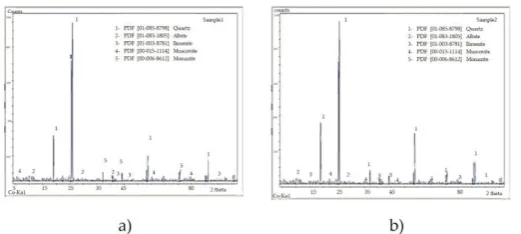
with which was considered the existence of land anomalies of LREs and PGE minerals in eastern
108
Mexico and the results presented here, show that the potential resources of PGE are similar to other
109
deposits in the world [14].
110
111
2. Materials and Methods
112
The location of the SEDEX deposit described here was carried out using the method described by E
113
Cerecedo et al [5], where indirect exploration method has been described. Then, samples were taken
114
from ore deposit using a channel sampling method avoiding contamination of samples.
115
Samples so obtained, were homogenized and quartered to get a homogeneous sample to be
116
characterized. The characterization carried out in this work was executed in order to obtain accurate
117
data of the mineralogical phases present, for which an analysis of general phases was proposed by
118
means of X-ray diffraction (XRD).
119
Likewise, the characterization studies were complemented by Scanning Electron Microscopy (SEM)
120
to identify texture, granulometry and morphology of the detected phases; in the same way, the
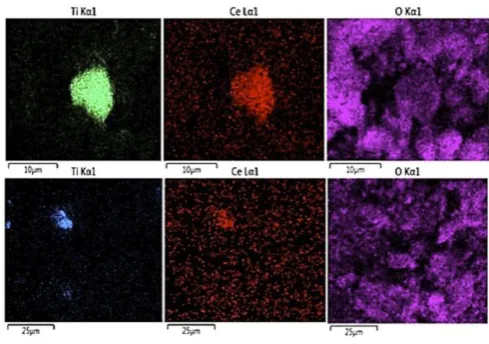
121
analysis by mapping and EDS helps us to determine the semi-quantitative composition of some of
the previously identified phases. Finally, an Inductively Couple Plasma Spectrometry (ICP) analysis
123
was done to find the average total rock composition of the mineralized phase, where the positive
124
anomalies of the light rare earth and mineral contents of the platinum group (PGE) were found.
125
126
3. Results
127
In the study area, the mineralization is located in the lower Jurassic (Huayacocotla Formation of
128
Pleinsbachian age); Figure 1 shows the two lithologies of the production unit, philonian and
129
sedimentary, and this formation is divided into three members:
130
The intermediate member is constituted by conglomerates, sandstone and slate and is characterized
131
by the presence of ammonites.
132
133
134
135
Figure 1.Lithology of the production unit
136
137
Furthermore, the upper member consists of sandstone, siltstone, slate, some conglomerates and
138
fossil plants. In this last horizon near the top of the Huayacocotla Formation, the producer mining
139
horizon was found, and in the initial portion of the transgressive cycle some exhalative roots could
140
be located and are shown in the Figure 1, where the contact between the two lithological,
141
sedimentary lithology is observed in contact whit philonian lithology.
142
143
In the study area, there was only one producer mining horizon located in the middle part, and close
144
to the top of the Huayacocotla Formation of Pleinsbachian age of the lower Jurassic. However, in the
145
initial portion of the transgressive cycle some exhalative roots could be located. and Figure 2 (a)
146
shows the exhalation roots mineralization of stockwork type, jarosite 2(B), and disseminated pyrite
147
(C).
148
Normal'Fault'
Stockwork'
149
150
Figure 2. Mineralization zone
151
152
In the Huayacocotla formation of Pleinsbachian age, there is an outcrop of two members where
153
can be observed the three lithologies of the mentioned formation, that consist of the intermediate
154
member constituted by conglomerates, sandstone and slate, and is characterized by the presence of
155
ammonites. It is worth mentioning that in this area, the existence of an inverse fault is considered,
156
Figure 3 (A), in contact whit the mineralization figure 3 (B), because the intermediate member that
157
has ammonites rides the upper member inorganic carbon Figure 3 (C), area that is made up of
158
sandstone, siltstone, slate, some conglomerates and fossil plants. In this last horizon near the top of
159
the Huayacocotla Formation the producer mining horizon was found.
160
161
162
Figure 3. Huayacocotla Formation
163
164
The SEDEX base metal deposits are located only in the intermediate unit of transgressive
165
lithology of shale, and sandstone in rhythmic intervals, which overlie the shale unit with plants of
166
Stockwork(
Jarosite(
the Huayacocotla Formation. While in the unit with shale with high carbon content, is where the
167
greatest presence of monazite is observed, possibly at the base of the intermediate unit, and the
168
exhalative roots appear.
169
Possibly, at the base of this outcrop there is a small interval of the oldest limestone unit that in
170
its complete sequence includes conglomerate, sandstone, siltstone, and shale with gap intervals,
171
with reworked fossils, sandstone exoclastics, rock fragments volcanic and in a smaller proportion of
172
limestone rocks, the size of the measured clast was from 5 to 100 cm in a sandy matrix, the size of the
173
clasts of the conglomerate and the clasts suggest a continental affinity.
174
The intermediate unit represents a marine transgression because in the fieldwork it was
175
observed that it consists of sandstone and shale in rhythmic sequence, in the conglomerates the size
176
is not larger than 10 cm, and the main characteristic of this unit is the presence of marine ammonites
177
at the base of this unit, mainly in the shale. In this unit near the top, the exhalative roots of the
178
outcrop were observed.
179
In the study area, thicknesses of 350 meters were measured at 900 meters from the
180
Huayacocotla Formation and the thickness of the producing horizon surfaced 100 meters, the upper
181
shale unit with plants outcrops 250 meters of sedimentary rocks and increases in some areas with
182
rock outcrops volcanic at 350 meters, the intermediate portion is greater than 250 meters thick, and
183
the basal portion has been observed at about 450 meters.
184
In the production unit, sandstone lenses were observed, and meanwhile, in the unit that
185
overlies it, sandstone lenses were observed, and some rich in organic matter that mark a continental
186
deposit environment.
187
The mining geological behavior is different in the Huayacocotla Formation, since the SEDEX
188
mineralization is only attributed here to the lithology of the intermediate portion, and that infrayace
189
to the shale unit with plants. In Figure 4, the hydrothermal system that host epithermal veins are
190
characterized by length scales on the order of 15 km and heat and mass flux of fluid that is steady
191
relative to the timescale of vein formation, the inset is illustrative of the localization of veins by faults
192
in the system. The hydrothermal system for vein zones in the processes of heat extraction applied to
193
a wide range of deposits of styles of surface bark deposits associated with fragile deformation. The
194
range of epithermal veins, deposits of massive sea floor sulphides, mesothermal veins in cortical
195
zones, high temperature veins and hypothermic stockork.
196
197
Figure 4. The hydrothermal system and veins
199
200
201
2.3. CHARACTERIZACION OF SEDEX ORE BODY
202
203
The preliminary characterization of the SEDEX type found was based on the mineralogical
204
description by XRD, as well as the morphological identification and some semi-quantitative point
205
analyzes with the use of SEM - EDS, as well as mapping to be able to identify the distribution of
206
contents at a depth in the samples of holes made from 0 - 9 meters. Finally, a total rock analysis was
207
carried out by fire test, IPC - masses.
208
209
X – Ray Difraction
210
The results of X-ray diffraction are shown mainly in figure 5 (a, b), showing the presence of high
211
and medium temperature minerals, such as monazite, mogonite-type quartz, muscovite and albite.
212
Highlights the presence of ilmenite that could be associated with rare earths.
213
Figure 5a shows chalcopyrite minerals that are evidence of hydrothermal remobilization,
214
confirming that the type of deposit found is SEDEX.
215
216
217
218
Figure 5. XRD spectra of; a). Medium temperature minerals; and b). High temperature minerals
219
220
Finally, Figure 5b shows the distribution and identification of the minerals using XRD, which
221
are found in the extracted drill core. It can be noted that there are minerals of high, medium and low
222
temperature distributed through the lithological column (Figure 6), confirming the existence of
223
thermal pulses.
226
Figure 6. Lithological column obtained by XRD data
227
The quartz is distributed through the column from 1 to 4.75 m, and from 6 to 9 m with an
228
absence of 4.75 m to 6 m, having a density of 3.83 g/cm3, which indicates that we have an alpha
229
quartz with a temperature of 597 ° K, that is also found in the form of mogonite at 1 m, 4 m and
230
5 m depth, with a density of 2.55 g/cm3 and a high temperature of 1354 ° K. The albite is found
231
from 1 m to 1.75 m and 4 m 6.75 m, with absence at 2 m, 3 m, 7 m, 8 m and 9 m, is distributed
232
more to the center of the column, with a density of 2.6 g/cm3.
233
234
Scanning Electron Microscopy (EDS & Mapping)
235
The characterization carried out by scanning electron microscopy, and mappings analysis, allowed
236
us to corroborate the presence of REE of the samples analyzed as can be seen in the Figure 7, shows
237
an image of which corroborates the presence of the cerium element (Ce), which is a rare earth, is also
238
observed.
239
240
Figure 7. Mapping of SEDEX ore body
241
242
In Figure 7, can be observed contains of elements such as oxygen (O), thallium (Tl). On the other
243
hand, Figure 8; shows contains of elements such as titanium (Nd), and cerium (Ce).
246
Figure 8. Mapping of mineral SEDEX.
247
248
Likewise, Figures 9 and 10 show some micrographs of the original mineral, showing the points
249
where its semi-quantitative composition was obtained, which was done with the scanning electron
250
microscopy technique (MEB) in conjunction with EDS.
251
252
253
254
Figure 9. SEM images and EDS microanalysis got from SEDEX mineral (SEM-SE & SEM-EDS)
255
256
In Figure 9, can be observed a sinuous surface constituted by particles of the order of 6.6 μm to
257
21 μm showing euhedral structures, the images show almost similar microstructures, with a
258
variation in the types of shapes, where can be identified euhedral, anhedral and subhedral forms,
259
with smooth surface microstructures, fibrous and sinuous and a wide distribution of sizes no
260
greater than millimeters. Images at x5000 are shown in figure 9 (A),(B).
261
On the other hand, in the detailed image of Figure 9 (C) and (D), it was possible to identify the
262
presence of elements such as C, Si and Al.
263
The analyzes carried out by EDS, show an association between silicon (Si) and oxygen (O) with
264
a wide distribution, marking the most oxidizing zones, while potassium (K) and aluminum (Al) are
265
relationed to 1m, 4m, 6m and 8 m deep.
266
Alternatively, there is also a relationship between iron (Fe) and titanium (Ti), at 1 m, 4 m and 6
267
m depth, inside the column. But also iron (Fe) has a relationship with magnesium (Mg).
Finally, the relationship that exists between silicon (Si) and aluminum (Al) at 1 m, 4 m, and at 6
269
m depth, that are areas of neutral pH.
270
According the above, with the results of ICP (total rock), allows confirming the presence of
271
these strategic elements in the SEDEX type deposit, described here. Which constitutes the potential
272
basis to consider this deposit economically attractive.
273
Table 1 shows the average chemical composition of the sample, where the contents are shown in
274
majority, minority and trace elements, and can be appreciated the presence of the elements of rare
275
earths.
276
277
Table 1 Average chemical composition by ICP
278
Element Units Concentration
Ce, Nd, La, Eu, Gd, Sm, Y ppm 0.4 - 20.5
Au, Pd, Pt ppm 0.05 - 10
Ti, Si, Mg, Fe, Al, K % 0.08 - 40.8
279
The Figure 10 shows a XRD spectra and an image of al Au-Ag-Pt alloy, obtained by cupellation
280
to determinate the contents of platinum and gold (using Ag as catalyst). The obtained results by this
281
essay show that mineral contents are 5 g/t of Pt and 10 g/t of Au.
282
283
284
Figure 10. Cupellation results to determine Pt and Ag contents in mineral
285
3. Discussion
286
There are two controversial aspects in this work; the classification of the deposit and the
287
mineral association. In the first case, it is considered to be SEDEX-type mineralization because two
288
types of mineralization are recognized: philonian and stratiform, in the philonian exhalation roots
289
are observed the stockwork towards the base, which of course, do not cut the top of the sedimentary
290
sequence, so here it is inferred that they can correspond to the emission channels.
291
Meanwhile, the stratiform mineralization is concordant with lutitic, slate sediments of
292
submarine origin, that is the same that in some zones showing great schistosity, reason why it could
293
be inferred that the age of this mineralization is previous to the development of the mountains and
294
hills in this area, with which it is found associated the schistosity and pyrite. Additionally, it is
295
inferred here that perhaps due to reductive conditions, the precipitation of the sulfides observed in
the hand specimen was favored, such as the finely disseminated pyrite, which in some cases shows
297
framboidal crystallization and botroidal growths, showing that its formation corresponds to a
298
chemical nature, formed in a submarine media. So all this approaches to a SEDEX mineralization of
299
the Selwyn type, because the nature of the Huayacocotla Formation of lower Jurassic age is of the
300
siliciclastic type of a reducing environment. Finally, the low amount of nickel and other metallic
301
contents such as chromium, as well as other elements of ultrabasic affinity are present in this
302
mineralization, and the additional results found allow this site to be classified as SEDEX. However,
303
considering these results and the improtant contents of platinum in metallic form; this deposit can be
304
subclassified as a more regional sub type.
305
4. Conclusions
306
The mineralogy of the outcrop, presents a clear and continuous mineralogical zoning that is
307
reflected by the contents of Au, Pt, V, Cr, Cu, Ag, Zn, Pb and Ba. Meanwhile, in the stratiform body
308
vertical zonation with pyrite and chalcopyrite at the base and wurzite towards the top and sperrilite
309
are recognized, while, in the fillonian deposit based on the concentration profiles obtained by XRD,
310
it shows the existence of two pulses, which can be inferred by the presence of high temperature
311
minerals obtained according to the results of XRD. The high temperature exhalative minerals are
312
ilmenite, monazite, and mogonite, which contrasts with medium temperature minerals that mark
313
the end of the pulse, such as those of the albite type (AlSi308), that were detected and chalcopyrite as
314
the typical mineral of re mobilization hydrothermal solutions.
315
The characterization through SEM-EDS and Mapping, allowed establishing the presence of REE and
316
PGE, the latter not previously known in Mexico. On the other hand, the analysis by ICP is
317
concordant with the aforementioned analyzes confirming the presence of PGE and REE. Likewise,
318
the SEDEX deposit has felsic affinity as presented by the low contents of transition trace elements
319
such as V, Cr, Co, Cu, Ni.
320
It was also observed anomalies of V, and Cr that can be associated with metal contents of the
321
platinum group.
322
323
Author Contributions: conceptualization, E. C-S, E. C-R., and E. S-R; methodology, E.C-S., E. S-R; validation,
324
V.R-L., J.H-A., E. C-R., and E. R-C.; formal analysis, E.S-R.; investigation, E.C-S.; data curation, E.C-S.;
325
writing—original draft preparation, E.S-R.; writing—review and editing, E.S-R.; supervision, M.P.G-A.
326
327
Funding: This research received no external funding
328
Acknowledgments: Authors want to thank to the Autonomous University of the State of Hidalgo for its
329
support during the execution of the work. Thanks also to SEP – PRODEP for its support in the payment of the
330
publication. Finally, the support provided by the CONACyT – Mexico, through the PhD scholarship granted to
331
Edgar A. Cardenas Reyes (number 604680).
332
333
Conflicts of Interest: The authors declare no conflict of interest.
334
335
References
337
1. Hulbert, L; Carne, R.; Gregory, C.; Pakfunc, D. Sedimentary nickel, zinc, and platinum group element
338
mineralization in Devonian Black Shales and the nickel property Yucon Canada a new deposit type.
339
Expl. Min.Geol. 1992,volume 1, pp. 1-30.
340
2. Jorge S.; Melgarejo, J.C. Pura, A. Asociaciones minerals en sedimentos exhalativos y sus derivados
341
metamorficos, in Atlas de Asociaciones Minerales en Lamina Delgada. First edition. Eds. University of
342
Barcelona (in Spanish), Spain. 1997; volume 1, pp. 287-308.
343
3. PaŠava, J. Anoxic sediments-an important environment for PGE; An overview. Ore Geol. Rev. 1993,
344
volume 8 (5), pp. 425-445.
345
4. Mortensen, J.K.; Hall, B.V. Bissing, T.; Friedman, R.M. Danielson, T.; OliverJ.; Rhys, D.A.; Ross, K.V.;
346
Gabites J.E. Age and Paleotectonic setting of volcanogenic massive sulfide deposits in the Guerrero
347
Terrene of central Mexico: constrain from U-Pb age and Pb isotope studies. 2008, Econ. Geol. volume 103,
348
pp. 117-140.
349
5. Salinas, E.; Cerecedo, S. E.; Rodriguez, L. V.; Hernández, A. J.; Ma., I R.V. Mineralization of Rare
350
Earths, Platinum and gold in sedimentary Deposit, found Using an Indirect Method of Exploration,
351
2018. Aspects Min. Miner. Sci. volume 1(2), pp. 1-9.
352
6. Verplank P.L.; Van Gosen B.S.; McCafferty A.E. A deposit model for carbonatite and peralkaline
353
intrusion–related rare earth elements deposit, USA. Geol. Surv. Sci. Inv. Rep. 2014, pp. 58-68
354
7. Herrera E.M.; Rubinovich K.R.; Lozano S.R; Sanchez Z.J.L. Nepheline rich foidodolites and rare earths
355
mineralization in the Picacho tertiary intrusive complex, sierra de Tamaulipas, north-eastern Mexico,
356
1991. Can. Min. Volume 29 (2), pp. 319-336.
357
8. Lawlor, P.J; Ortega, G; Cameron, K.L.; Ochoa, C.; Lopez, R. U-Pb geochoronology geochemistry and
358
provenance on the Grenvilian Huiznopala Gneiss of eastern Mexico. 1999. Precam. Res. Volume 94
359
(1-2), pp. 73-99.
360
9. Keppie, J.D.; Dostal J.; Cameron K.L.; Solari L. Ortega G. Geochronology and geochemistry of
361
grenvillian igneous suites in the Northern Oaxaca Complex, southern Mexico. 2003. Precam. Res.
362
Volume 120 (3-4), pp. 365-389.
363
10. Maynard B.J.; Klein G.D. Tectonic Subsidece analysis in the characterization of sedimentary Ore
364
Deposits: Examples from the Witwatersrand (Au), White Pine (Cu), and Molango (Mn). Econ. Geol.
365
1995. Volume 90 (1), pp. 37-50.
366
11. Okita, P.M. Manganese Carbonate Mineralization in the Molango District, México. Econ.Geol. 1992.
367
Volume 87(5), pp. 1345-1366.
368
12. Cantú, C. A. Las Transgresiones Jurásicas en México. Rev. Mex. Cienc. Geol. 1998. Volume 15 (1), pp.
369
25-37.
370
13. Perez V.R.; Melgarejo J.C.El Yacimiento Matahambre (Pinar del Rio Cuba): Estructura y mineralogia.
371
Act. Geol. Hispana. 1998. Volume 33 (1-4), pp. 133-152.
372
14. Erben, H.K. The Middle Jurassic and Callovian of Mexico: Mexico D.F. Cong. Geol. Inter. (in Spanish).
373
1956, pp. 393.
374
15. Cerecedo, S. E. La mineralización de Cu-Ag del rift Triásico-Jurásico del oriente de México. Instituto
375
Politecnico Nacional. Escuela Superior de Ingenieria y Arquitectura. Master Thesis. 2003, pp. 284.
376
16. Jowet E.C. Effects of continental rifting on the location and genesis of stratiform copper-silver deposits.
377
Geol. Assn. Can.1986. Volume 36, pp. 53-66.
378
17. Sillitoe, R.H. Rifting, bimodal volcanism, and bonanza gold veins. Soc. of Econ. Geol. News. 2002.
379
Volume 48, pp. 24-27.
380
18. Cong, Z.; Zhang L.; Bader T.; Song S.; Lou Y. Geochemistry and trace elements behaviors of eclogite
381
during its exhumation in the Xitieshan terrane, North Qaidam UHP belt, NW China, jour. of Asi. Ea. Sci.
382
2013.Volume 63. pp. 81-97.
383
19. Kato, Y; Fugjinaga K.; Nakamura, K.; Takaya, Y.; Kitamura K. Deep –sea mud in the Pacific Ocean as a
384
potential resourse for rare earth elements. Nature. Geos. 2011. Volume 4, pp. 535-539.
385
20. Kynicky, J.; Smith, M.P.; Xu, C. Diversity of rare earth deposits: the key Example of China. Elements.
386
2012. Volume, 8(5), pp. 361-367.
387
21. Cerecedo, S. E.; Salinas R. E. Guía rápida de exploración geológica minera. Editorial Academica
388
Española (in Spanish) Saarbruken Alemania. 2013. pp. 73.
22. Cerecedo, S. E.; Rodriguez, L.V.; Andrade, T.; Salinas R.E.; Hernández A.J. Chemistry and
390
characterization of a mineral deposit mineralogical economic interest. Mater. Res. Soc. Symp. Proc. 2015,
391
Volume 1, pp. 1776.
392
23. Salinas, R. E.; Hernandez, A. J.; Rivera L.I.; Cerecedo S. E.; Reyes V.M. et.al. Leaching of silver
393
contained in mining tailing, using sodium thiosulfate: A kinetic Study. Hydrometallurgy. 2016. Volume
394
160, pp. 6-11.