ISSN 2348 – 7968
A NOVEL SPARSE ADAPTIVE FILTER FOR ECHO
CANCELLATION
Krishna Samalla1, Ch.Satyanarayana2
1
Department of Computer Science and Engineering
Jawaharlal Nehru Technological University Kakinada, Andhra Pradesh, India 2
Department of Computer Science and Engineering
Jawaharlal Nehru Technological University Kakinada, Andhra Pradesh, India
Abstract
In mobile environment, Acoustic Echo Cancellation (AEC) greatly changes due to the sparseness level of acoustic impulse response. To overcome this problem, we propose a Modified Sparseness Controlled Improved μ - Law Proportionate Normalised Least-mean-square (MSC-MPNLMS) algorithm that can not only work well in both spars and dispersive circumstances but also adapt dynamically to the level of sparseness. Simulation results with input as White Gaussian Noise (WGN) show the improved performance over existing methods.
Keywords: Acoustic Echo Cancellation (AEC), Modified
Sparseness Controlled Improved Proportionate Normalized Least Mean Square (MSC-MPNLMS), White Gaussian Noise (WGN)
.
1. Introduction
Echo phenomenon is always present in telecommunications networks. It can be mainly observed in on long international telephone calls. Echo cancellation in telecommunication network requires Identification of unknown echo path impulse response. The length of network echo path is typically in the range between 32 and, 128milliseconds, which is characterized by bulk delay depending on network loading, encoding chg and jitter delay [1]. Because of this, “active” region of echo path is in the range between 8 and 12milliseconds, so it contains mainly “inactive” components where the coefficient magnitudes are close to zero, making the impulse response more sparse. In general, adaptive filters have been used to estimate the unknown echo path by using algorithm such as NLMS. But, as the length of echo paths are more, NLMS requires more number of taps (up to 1024 taps) which will make the convergence of NLMS becomes poor.
Several approaches have been proposed over recent years to get better performance than NLMS for Network echo cancellation (NEC). These include Variable step size (VSS) algorithms, partial update adaptive filtering techniques and sub-band adaptive filtering (SAF)
techniques. There approaches aim to address the issues in echo cancellation. Including the performance with colored input signals and time varying echo paths and a computational complexity to name but a few. In contrast to these algorithms, sparse adaptive algorithms have been developed to address the performance of adaptive filters sparse system identification.
ISSN 2348 – 7968 sparseness measure via a modified coefficient update
function.
This paper is organized as follows, in section 2.Review of section A,B,&C algorithms for Echo cancellation is presented. In section 3 explains the characterization of framework for robust convergence. In Section 4 proposed MSC-MPNLMS algorithm and Section 5 computational complexity is presented. In section 6&7 results and conclusions are presented.
Fig.1. Adaptive system for acoustic echo cancellation in a Loudspeaker- Room- Microphone system (LRMS)
Figure 1 shows a Loudspeaker-Room-Microphone
system (LRMS) and an adaptive filter
^ ^ ^ ^
0 1 1
( ) [ ( ) ( )...
L( )]
Th n
=
h n h n
h
−n
deployed to cancel acoustic echo, where L is the length of the adaptive filter assumed to be equal to the unknown room impulse response and [·]T is the transposition operator. Defining the input signal x(n)=[x(n) x(n − 1) ... x(n − L + 1)]Tand h(n)=[h0(n) h1(n) ... hL−1(n)]T as the unknown impulse response, the output
of the LRMS is given by y(n)= hT (n)x(n)+ w(n), (1)
where w(n) is additive noise and the error signal is given by
e(n)= y(n) − hT(n − 1)x(n). (2) Several adaptive algorithms such as those described below have been developed for either AEC or NEC.
Many adaptive algorithms can be described by (2) and the following set of equations:
^ ^
(
1) ( ) ( )
( )
(
1)
( ) (
1) ( )
T
Q n
x n e n
h n
h n
x n Q n
x n
µ
δ
−
=
−
−
+
(3)Q(n − 1) = diag{ q0(n − 1) ... qL−1(n − 1)}, (4)
where μ is a step-size and δ is the regularization parameter. The diagonal step-size control matrix Q(n) is introduced here to determine the step-size of each filter coefficient and is dependent on the specific algorithm.
A. The NLMS, PNLMS and MPNLMS
algorithms
The NLMS algorithm is one of the most popular for AEC due to its straightforward implementation and low complexity compared to, for example, the recursive least squares algorithm. For NLMS, since the step-size is the same for all filter coefficients, Q(n)= IL×L with IL×L being an L×L identity matrix.
One of the main drawbacks of the NLMS algorithm is that its convergence rate reduces significantly when the impulse response is sparse, such as often occurs in NEC. The poor performance has been addressed by several sparse adaptive algorithms such as those described below that have been developed specifically to identify sparse impulse responses in NEC applications.
The PNLMS and MPNLMS algorithms have been proposed for sparse system identification. Diagonal elements ql of the step-size control matrix Q(n) for the PNLMS [2] and MPNLMS [18] algorithms can be expressed as
where ^
1
(
( ) )
F h n
is specific to the algorithm. Theparameter γ =0.01 in above equation prevents the filter
coefficients ^
1
( )
h n
from stalling when^
(0)
h
= 0L×1 at initialization and ρ, with a typical value of 0.01, prevents the coefficients from stalling when they are much smaller than the largest coefficient.The PNLMS algorithm achieves a high rate of convergence by employing step-sizes that are proportional to the magnitude of the estimated impulse response
coefficients where elements
F h n
(
^1( ) )
are given by
^ ^
1 1
(
( ) )
( )
F h n
=
h n
(5)Hence, PNLMS employs larger step-sizes for ‘active’ coefficients than for ‘inactive’ coefficients and consequently achieves faster convergence than NLMS for sparse impulse responses. However, it is found that PNLMS achieves fast initial convergence followed by a slower second phase convergence [18].
ISSN 2348 – 7968
computing the optimal proportionate step- size during the adaptation process. The MPNLMS algorithm was derived such that all coefficients attain a convergedvalue to within a vicinity of their optimal value in the same number of
iterations [18]. As a consequence, ^
1
(
( ) )
F h n
forMPNLMS is specified by
^ ^
1 1
(
( ) )
ln(1
( ) )
F h n
=
+
β
h n
(6)with β =1/
∈
and∈
is a very small positive number chosen as a function of the noise level [18]. It has been shown that∈
=0.001 is a good choice for typical echo cancellation. The positive bias of 1 in (8) is introduced to avoid numerical instability during theinitialization stage when ^
1
(0)
h
=0, ∀ l. It is important tonote that both PNLMS and MPNLMS suffer from slow convergence when the unknown system h(n) is dispersive [14], [13]. This is because when h(n) is dispersive, κl(n) in the above equation becomes significantly large for most 0 ≤ l ≤ L − 1. As a consequence, the denominator of ql(n) in above equation is large, giving rise to a small step-size for each large coefficient. This causes significantly degradation in convergence performance for PNLMS and MPNLMS when the impulse response is dispersive such as can occur in AIRs.
B. The IPNLMS algorithm
The IPNLMS [15] algorithm was originally developed for NEC and was further developed for the identification of acoustic room impulse responses [20]. It employs a combination of proportionate (PNLMS) and non-proportionate (NLMS) adaptation, with the relative significance of each controlled by a factor αIP such that the diagonal elements of Q(n) are given as
( )
(
)
^ 1 IP IP l ^ 1 11
( )
1
q n
, 0
1
2L
2
( )
ph n
l
L
h n
α
α
δ
+
−
=
+
≤ ≤ −
+
, where 1.
is defined as the l1-norm and the first and second terms are the NLMS and the proportionate terms respectively. It can be seen that IPNLMS is the same as NLMS when αIP = −1 and PNLMS when αIP =1. Use of a higher weighting for NLMS adaptation, such as αIP =0, −0.5 or −0.75, is a favorable choice for most AEC/NEC applications [15]. It has been shown that, although the IPNLMS algorithm has faster convergence than NLMSand PNLMS regardless of the impulse response nature [15], we note from our simulations that it does not outperform MPNLMS for highly sparse impulse responses with the above choices of αIP.
C. PNLMS, MPNLMS and
SC-IPNLMS algorithms
In order to address the problem of slow convergence in PNLMS and MPNLMS for dispersive AIR, they used step size control elements. the proposed sparseness-controlled algorithms are robust to variations in the level of sparseness in AIR with only a modest increase in computational complexity. Moreover, they have shown that these proposed algorithms have same or faster convergence in NEC.
2.SPARSENESS MEASURE
Degree of sparseness can be qualitatively referred as a range of strongly dispersive to strongly sparse. Quantitatively, the sparseness of an impulse response can be measured by the following sparseness measure.
ξ(h) =
Where =
=
L is the length of filter h. The measure takes values between 0 and 1 where the lower bound can be obtained by using the uniform filter [1 1...1]T and the upper limit can be achieved by using the Dirac filter [[1 0 ...0]T.
3.SPARSE IMPULSE RESPONSE
GENERATOR
Sparseness of impulse responses for Network and acoustic echo cancellation can be studied by generating synthetic impulses using random sequences. This can be achieved by first defining an L×1 vector.
(4)
Where the leading zeros with length Lp models the length of the bulk delay and Lu = L − Lp is the length of the decaying window which can be controlled by ψ. Smaller the ψ value yields more sparse system.
Defining a Lu × 1 vector b as a zero mean white Gaussian noise (WGN) sequence with variance σb2, the L × 1 synthetic impulse response can then be expressed as
ISSN 2348 – 7968
h
=
u +p (5)
Where the L × 1 vector p ensures elements in the ‘inactive’ region are small but non-zero and is an independent zero mean WGN sequence with variance σp2.
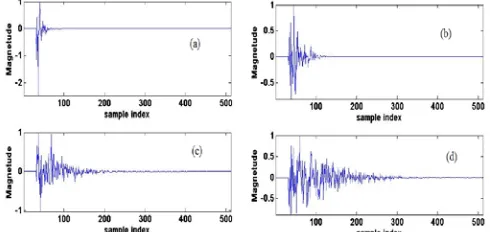
The two impulse responses that can be attained using the approach, by setting the impulse length L =512, the bulk delay length Lp =32 and ψ to 8(more sparse), 20, 50 and 100(more sparse).
Fig. 2.Impulse responses controlled using (a) ψ = 8, (b) ψ = 20, (c) ψ =50 and (d) ψ =80 giving sparseness measure (a) ξ = 0.905, (b) ξ = 0.809, (c) ξ = 0.667 and (d) ξ = 0.5448.
4.Proportionate-Normalized Least Mean
Square (PNLMS):
One of the first sparse adaptive filtering algorithms considered as a milestone for NEC is PNLMS, in which each filter coefficient is updated with an independent step-size that is linearly proportional to the magnitude of that estimated filter coefficient. It is well known that PNLMS has very fast initial convergence for sparse impulse responses after which its convergence rate reduces significantly, sometimes resulting in a slower overall convergence than NLMS.
In order to track sparse impulse response faster Proportionate NLMS (PNLMS) was introduced from the NLMS equation. The coefficient update equation of the PNLMS is slightly differ from NLMS with the extra step size update matrix Q as shown below and the rest of the terms are carried over from NLMS.
Where
Q(n) = diag
(6)
controls the step size. These control matrix elements can be expressed as
(n) = , l=0,1….L-1
(7)
Parameters ρ and γ have typical values of 5 / L and 0.01 [8],
The constant 1 inside the logarithm is to avoid obtaining
negative infinity at the initial stage when .
The denominator normalizes to
be in the range [0, 1]. The vicinity ε is a very small positive number, and its value should be chosen based on the noise level. ε = 0.001 is a good choice for echo cancellation, as the echo below -60 dB is negligible.
Improved Proportionate NLMS (IPNLMS) Algorithm Initialization:
Parameters:
Error:
Update:
ISSN 2348 – 7968
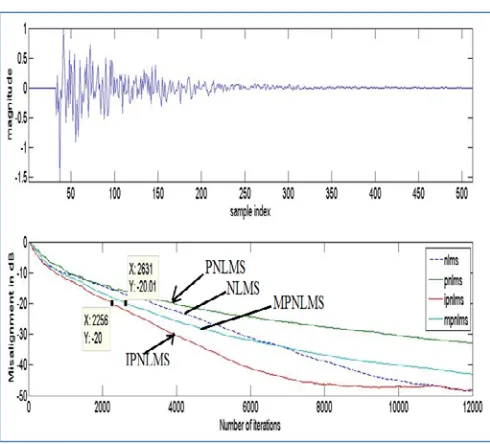
Fig.3: Relative convergence of NLMS, PNLMS,IPNLMS and MPNLMS using WGN input for (a) ψ=8 and (b) ψ=80 Initial step size µ=0.3 for NLMS, PNLMS,IPNLMS and MPNLMS and α=-0.75.
5.
SPARSENESS CONTROLLED
ADAPTIVE FILTER ALGORITHMS
Sparseness Measure:
Degree of sparseness can be qualitatively referred as a range of strongly dispersive to strongly sparse. Quantitatively, the sparseness of an impulse response can be measured by the following sparseness measure
ξ(h) =
Where =
=
L is the length of filter h. The measure takes values between 0 and 1 where the lower bound can be obtained by using the uniform filter [1 1...1]T and the upper limit can be achieved by using the Dirac filter [[1 0 ...0]T.
Sparseness-controlled MPNLMS
(SC-MPNLMS) algorithm:
In order to address the problem of slow convergence in PNLMS and MPNLMS for dispersive AIR, we require the to be robust to the sparseness of the impulse response. Several choices can be employed to obtain the desired effect of achieving a high convergence when
is small when estimating dispersive AIRs. We consider an example function
The variation of in MPNLMS for the exponential
function is as shown in figure below for the cases is 4, 6 and 8.
Fig 4: Variation of ρ against sparseness measure of impulse response for different values of λ
It can be noted that a linear function
also achieves our desired function. We have tested this case and found it to perform worse than more general form of 3 so we will not consider it further.
The choice of λ is important. As can be seen from above figure that, larger value of λ will cause the proposed SC-MPNLMS to inherit more of the SC-MPNLMS properties compared to NLMS giving good convergence performance when Impulse response (IR) is sparse. On the other hand, when IR is dispersive, λ must be small for good convergence performance. Hence, as shown in above figure, that a good compromise is given by λ=6.
In addition, we note that when n=0, and
hence, to prevent division by zero or small number,
can be computed for . When , we set
Sparseness controlled µ-Law Proportionate
NLMS (SC-MPNLMS) Algorithm
.
Initialization:
Parameters:
ISSN 2348 – 7968
Error:
Update:
MODIFIED SPARSENESS CONTROLLED
MPNLMS (MSC-MPNLMS):
It can be seen that low values of are allotted for large range of sparse impulse responses such as when
. As a result of small values in , the proposed SC-MPNLMS inherits more of MPNLMS properties when estimated impulse response is sparse and distributes uniform.step size across , as in NLMS, when estimated Impulse response is dispersive.
The choice of λ is important. As can be seen from above figure that, larger value of λ will cause the proposed SC-MPNLMS to inherit more of the SC-MPNLMS properties compared to NLMS giving good convergence performance when Impulse response(IR) is sparse. On the other hand, when IR is dispersive, λ must be small for good convergence performance.
In addition, we note that when n=0, and
hence, to prevent division by zero or small number,
can be computed for
. When
, we set
ρ(n)=2.5⁄L.
In the earlier algorithm SC-MPNLMS, the sparseness measure used to measure the time varying sparseness of the impulse response.[20] But this sparseness measure is the good representation of sparse impulse response only. So, we can improve the performance of SC-MPNLMS by incorporating another sparseness measure which is average of the existing sparseness measure.
Convergence Performance of
MSC-MPNLMS for AEC:
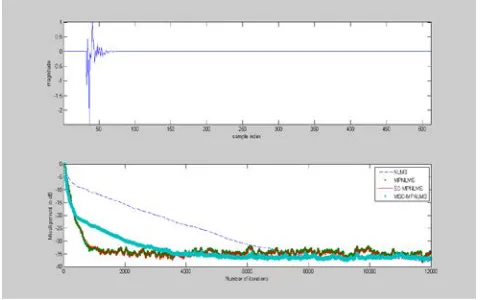
Figure 5 and 6 illustrates the performance of NLMS, MPNLMS, SC-MPNLMS and MSC-MPNLMS using WGN as the input signal. Step sizes are adjusted to achieve the same steady state misalignment for all algorithms. This corresponds to NLMS=0.4 , MPNLMS =0.3, SC-MPNLMS =0.7, MSC-SC-MPNLMS =0.9.
So by including ζ12∞ in the above SC-MPNLMS algorithm in the place of ζ^, this new MSC-MPNLMS algorithm showing the improvement of 2 dB over SC-MPNLMS when impulse response is more sparse and it is showing the improvement of 4 dB when impulse response is less sparse or dense
ISSN 2348 – 7968
Fig 6: Relative Convergence of NLMS, MPNLMS, SC-MPNLMS and MSC-MPNLMS when impulse response is Sparse
Sparseness-Controlled IPNLMS
(SC-IPNLMS) algorithm.
A different approach, compared to SC-MPNLMS, is chosen to incorporate sparseness-control into the IPNLMS algorithm (SC-IPNLMS) because, two terms are employed in IPNLMS for control of the mixture between proportionate and NLMS updates. The proposed SC-IPNLMS improves the performance of the SC-IPNLMS by
expressing ql(n) for n ≥ L as
As can be seen, for large ξ^(n) when the impulse response is sparse, the algorithm allocates more weight to the proportionate term of IPNLMS. For comparatively less sparse impulse responses, the algorithm aims to achieve the convergence of NLMS by applying a higher weighting to the NLMS term. An empirically chosen weighting of 0.5 in the above equation is included to balance the performance between sparse and dispersive cases, which could be further optimized for a specific application. In addition, normalization by L is introduced to reduce significant coefficient noise when the effective step-size is large for sparse AIRs with high ξ^(n).
Fig 7: Magnitude of ql(n) for 0 ≤ l ≤ L-1 against the magnitude of coefficients in SC-IPNLMS and different sparseness measures of 8 systems.
Figure 7. illustrates the step-size control elements ql(n) for SC-IPNLMS in estimating different unknown AIRs. As can be seen, for dispersive AIRs, SC-IPNLMS allocates a uniform step-size across while, for sparse AIRs, the algorithm distributes ql(n) proportionally to the magnitude of the coefficients. As a result of this distribution, the SC- IPNLMS algorithm varies the degree of NLMS and proportionate adaptations according to the nature of the AIRs
Sparseness controlled Improved
Proportionate NLMS (SC-IPNLMS)
Algorithm
:
Initialization:
Parameters:
Error:
Update:
ISSN 2348 – 7968
6. EXPERIMENTALS RESULTS
Experimental Setup:
Throughout the simulations, algorithms were tested using a zero mean WGN and a male speech signal as inputs while another WGN sequence w(n) was added to give an SNR of 20 dB. The length of the adaptive filter L = 1024 was assumed to be equivalent to that of the unknown system. The sparseness measure of these AIRs are computed by giving ξ(n) = 0.83 and ξ(n) = 0.59 respectively.
Convergence Performance of SC-MPNLMS
for AEC:
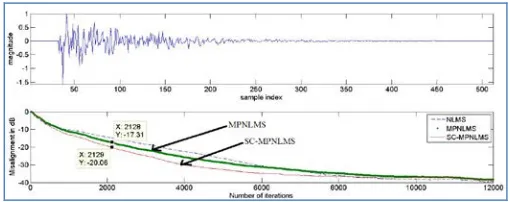
Figure 8 and 9 illustrates the performance of NLMS, MPNLMS and SC-MPNLMS using WGN as the input signal. Step sizes are adjusted to achieve the same steady state misalignment for all algorithms. This corresponds to µNLMS=0.3, µMPNLMS=0.25, µSC-MPNLMS=0.35. The value of λ=6 was used for SC-MPNLMS. As can be seen from the result, the SC-MPNLMS algorithm attains
approximately 9 dB improvement in normalized
misalignment during initial convergence compared to NLMS and same initial performance followed by approximately 2.5 dB improvement over MPNLMS for the sparse AIR and SC-MPNLMS achieves approximately 2.7 dB improvement compared to MPNLMS and about 5 dB better performance than NLMS for dispersive AIR.
During Sparse Impulse response:
Fig 8: Relative Convergence of NLMS, MPNLMS and SC-MPNLMS when impulse response is Sparse
During Dispersive Impulse response:
Fig 9: Relative Convergence of NLMS, MPNLMS and SC-MPNLMS when impulse response is Dispersive
The sparseness-controlled algorithms (PNLMS, SC-MPNLMS and SCIPNLMS) give the overall best performance compare to their conventional methods across the range of sparseness measure. This is because the proposed algorithms take into account the sparseness measure of the estimated impulse response at each iteration.
7. MODIFIED SPARSENESS
CONTROLLED IPNLMS (MSC-IPNLMS):
In the earlier algorithms like IPNLMS and SC-MPNLMS, the sparseness measure used to measure the time varying sparseness of the impulse response to be identified is based on the l1 and l2 norms. But this sparseness measure is the good representation of sparse impulse response only. So, we can
improve the performance of SC-IPNLMS by incorporating another sparseness measure which is good representation of both sparse and dense impulse response. The new sparseness measure is the average of ζ12 ( i.e. sparseness measure based on l1 and l2 norms) and ζ2∞ ( i.e. sparseness measure based on l2 and l∞ norms). ζ12 is a good representation of sparse impulse response where as ζ2∞ is a good representation of dense impulse response. Hence ζ12∞ is good representation of both sparse impulse response and dense impulse response.
Convergence Performance of MSC-IPNLMS
for AEC:
ISSN 2348 – 7968 So by including ζ12∞ in the above SC-IPNLMS algorithm
in the place of ζ^, this new MSC-IPNLMS algorithm showing the improvement of 4 dB over SC-IPNLMS when impulse response is more sparse and it is showing the improvement of 8 dB when impulse response is less sparse or dense.
Fig10: Relative Convergence of IPNLMS, SC-IPNLMS and MSC-IPNLMS when impulse response is Sparse
Fig11: Relative Convergence of IPNLMS, SC-IPNLMS and MSC-IPNLMS when impulse response is Dispersive
Conclusions:
This paper has addressed the significant problem caused by undesirable echoes that result from coupling between the loud speakers and microphones in the near end room. The research for this work focuses on the development of the adaptive filtering algorithms for sparse and non-sparse systems, emphasizing on the achievement of fast convergence rate with relatively low computational cost.
The trade-off between convergence speed and the steady state misalignment is an important issue in this context, and can be balanced by choosing a sensible step size for the adaptive processes.
A series of experiments carried out both within and across NLMS, as well as a few other proportionate techniques, namely PNLMS, IPNLMS and MPNLMS, help to investigate their strengths and weaknesses. NLMS gives better performance in non-sparse system, whereas MPNLMS performs well in sparse impulse response. The combination of non-sparse and sparse technique, IPNLMS, exhibits an overall of better performance in all sparse levels. This identified an important factor, the sparseness measure (ξ), which affects their convergence speed. By introducing ξ in both MPNLMS and IPNLMS, adaptive algorithms for acoustic echo cancellation can achieve fast convergence and robustness to sparse impulse response. The algorithms, known as MPNLMS and SC-IPNLMS, take into account this factor differently via the coefficient update function. Simulation results show that
the SC-IPNLMS exhibits more robustness to sparse
systems than the other techniques. And the sparseness
measure ζ12 used by the SC-IPNLMS and SC-MPNLMS
is a goodrepresentation of sparse impulse response, so we have replaced this with ζ12∞ which is a good representation of both sparse and dense impulse response. And the algorithm with this sparseness measure showing better performance over SC-IPNLMS in the both sparse and dense impulse response, though its computational complexity is slightly higher than the existing main stochastic algorithms, this modified algorithms perform better in all ξ levels.
REFERENCES:
[1] M. M. Sondhi, “An adaptive echo canceller,” Bell
Syst.Tech. J., vol. XLVI-3, pp. 497–510, Mar. 1967
[2] J. Benesty, T. Gänsler, D. R. Morgan, M. M. Sondhi, and S. L. Gay, Advances in Network and Acoustic Echo Cancellation. Berlin, Germany: Springer-Verlag, 2001.
[3] S. Haykin, Adaptive Filter Theory. Fourth Edition, Upper Saddle River, NJ: Prentice-Hall,2002
[4] K.Ozeki and T. Umeda, “An adaptive filtering algorithm using an orthogonal projection to an affine subspace and its properties,” Electron. Commun. Jpn., vol. 67-A, pp. 19–27, May 1984.
[5] S. L. Gay and S.Tavathia, “The fast affine projection
ISSN 2348 – 7968
[6] M. Tanaka, Y. Kaneda, S. Makino, and J. Kojima, “A fast projection algorithm for adaptive filtering,” IEICE Trans. Fundamentals, vol. E78-A, pp. 1355–1361, Oct. 1995.
[7] J. Homer, I. Mareels, R. R. Bitmead, B. Wahlberg, and A. Gustafsson, “LMS estimation via structural detection,” IEEE Trans. Signal Processing, vol. 46, pp. 2651–2663, Oct. 1998.
[8] S. Makino, Y. Kaneda, and N. Koizumi,
“Exponentially weighted step-size NLMS adaptive filter based on the statistics of a room impulse response,” IEEE Trans. Speech, Audio Processing, vol. 1, pp. 101–108, Jan. 1993.
[9] A.Sugiyama, H. Sato,A. Hirano, and S. Ikeda, “A fast
convergence algorithm for adaptive FIR filters under computational constraint for adaptive tap-position control,” IEEE Trans. Circuits Syst. II, vol. 43, pp. 629–636, Sept. 1996
[10]D.L.Duttweiler, “Proportionate normalized
least-mean-squares adaptation in echo cancelers,”
IEEETrans. Speech,Audio Processing, vol. 8, pp. 508–518, Sept. 2000
[11] Patrick A Naylor, Jingjing Cui, Mike Brookes,
Adaptive algorithms for sparse echo cancellation, Signal Processing, Elsevier.
[12]P O Hoyer, “Non-negative matrix factorization with sparseness constraints”, Journal of Machine learning research, vol. 5, Nov. 2004.
[13]J Benesty, Y A Huang, J Chen and P A Naylor,
“Adaptive algorithms for the identification of sparse impulse sresponses”, in selected methods for acoustic echo and noise control, 2006, ch.5.
[14]Donald L. Duttweiler, Fellow, IEEE, “Proportionate Normalized least mean squares adaptation in echo cancellers”, Transactions on speech and audio processing IEEE, 2000.
[15]Hongyang Deng, Doroslovacki M., “Improving convergence of the PNLMS algorithm for sparse impulse response identification”, Signal Processing Letters, IEEE, March 2005.
[16]Jacob Benesty and Steven L Gay, “An Improved PNLMS algorithm”, IEEE, 2002.
[17]S. Haykin, Adaptive Filter Theory, 4th edition, Information and System Sciences series. Prentice Hall, 2002. Constantin
Paleologu, Jacob Benesty,” Sparse adaptive filters for echo cancellation”, Morgan and Claypool publishers.
[18]Echo basics tutorial:www.iec.org
[19]Krishna Samalla,Dr.Ch Satyanarayana “Survey of Sparse Adaptive Filters for Acoustic Echo Cancellation”‖ I.J. Image, Graphics and Signal Processing, 2013, 1, 16-24 Published Online January 2013 in MECS
(http://www.mecs-press.org/) DOI: 10.5815/ijigsp.2013.1.03
[20]Krishna Samalla,Dr.Ch Satyanarayana “Modified Sparseness Controlled IPNLMS Algorithm Based on l1, l2 and l∞ Norms”‖ I.J. Image, Graphics and Signal Processing, ISSN Print: 2074-9074, ISSN Online: 2074-9082, Volume 5, Number 4, April 2013.
Mr. Krishna Samalla is a Research Scholar of Department of Computer Science and Engineering Jawaharlal Nehru Technological University, Kakinada. He completed his Masters Degree in Systems and Signal Processing from Osmania University. He has 10 years of teaching experiences for Graduate and Post Graduate engineering courses. He has published his research work many International Journals and conferences .His current research interests are Signal Processing, Image and Speech Processing.