Intelligent PID Controller Tuning Using PSO for Linear
System
Mrs. A. Asuntha, M.E 1, Dr Andy Srinivasan 2
1
Assistant Professor, Department of Electronics and Instrumentation Engineering, SRM University,
Tamil Nadu, India
2
Professor & Head , Department of Electronics and Instrumentation Engineering, Valliammai
Engineering College, Tamil Nadu, India
Abstract
In chemical industries in mid 90’s, process engineers were using the classical controller
tuning methods to find the controller parameter values like Kp, Ki ,and Kd. The classical
controller tuning methods may require complex computations to identify the controller
parameters. With the evolution of soft computing methods these classical control methods
were eliminated. This paper focus on design method for determining the optimal
proportional-integral-derivative (PID) controller parameters of linear system using the
particle swarm optimization (PSO) algorithm. The proposed approach had superior features,
including easy implementation, stable convergence characteristic, and good computational
efficiency. At first genetic algorithm (GA) of automatic voltage regulator(AVR) setting is
designed and compared with PSO based PID controller settings. The proposed method has
more robust stability and efficiency, and can solve the searching and tuning problems of PID
controller parameters more easily and quickly than the GA method.
Keywords: GA, PSO, PID controller, AVR, MATLAB.
1.Introduction:
During the past decades, the process control techniques in the industry have made
great advances. Numerous control methods such as adaptive control, neural control, and
fuzzy control have been studied. Among them, the best known is the
proportional-integral-derivative (PID) controller, which has been widely used in the industry because of its simple
structure and robust performance in a wide range of operating conditions. Unfortunately, it
has been quite difficult to tune properly the gains of PID controllers because many industrial
plants are often burdened with problems such as high order, time delays, and non- linearity’s.
Over the years, several heuristic methods have been proposed for the tuning of PID
controllers. The first method used the classical tuning rules proposed by Ziegler and Nichols,
Ziegler-Nichols formula in many industrial plants.For these reasons, it is highly desirable to
Increase the capabilities of PID controllers by adding new features. Many Artificial
Intelligence (AI) techniques have been employed to improve the controller performances for
a wide range of plants while retaining their basic characteristics. AI techniques such as
Neural Network, Fuzzy System, and Neural-Fuzzy Logic have been widely applied to proper
tuning of PID controller parameters.
The computation efficiency is the advantage of particle swarm optimization algorithms over
other tuning techniques. The advantage of optimization algorithms over other controllers is
that they can be integrated in PID tuning with ease and simplicity. Optimality is just with
respect to the criterion at hand and the real performance depends on the suitability of the
chosen criterion (T.Bartz–Beielstein K.E. Parsopoulos and M.N. Vrahatis (2004)).
The most familiar representatives of swarm intelligence in optimization problems are:,
particle swarm optimization (S. M. GirirajKumar, R. Sivasankar, T.K. Radhakrishnan, V.
Dharmalingam and N. Anantharaman (2008)), artificial immune system (Castro LN, Timmis
JI (2002)), food-searching activities of ants and bacterial foraging (Muller SD, Marchetto J,
Airaghi S, Koumoutsakos P (2002)). A special approach of swarm intelligence based on
simplified simulations of animals’ social behaviours, such as fish schooling and bird flocking,
is the particle swarm optimization (PSO) algorithm (Kennedy JF, Eberhart RC.( 1995)). PSO
is a self-adaptive search optimization, first introduced by Kennedy and Eberhart (Kennedy
JF, Eberhart RC.( 1995)).
In this paper, a simple performance criterion in time domain is proposed for
evaluating the performance of a PSO-PID controller that was applied to the complex control
system. The generator excitation system maintains generator voltage and controls the reactive
power flow using an automatic voltage regulator (AVR). The role of an AVR is to hold the
terminal voltage magnitude of a synchronous generator at a specified level. Hence, the
stability of the AVR system would seriously affect the security of the power system. In this
paper, a practical high-order AVR system with a PID controller is adopted to test the
performance of the proposed PSO-PID controller. In this paper, besides demonstrating how to
employ the PSO method to obtain the optimal PID controller parameters of an AVR system,
many performance estimation schemes are performed to examine whether the proposed
method has better performance than the real-value GA method in solving the optimal.
Main aim of AVR system is to control and maintain the voltage between
limits by adjusting the excitation of the machines. The entire excitation system maintains
voltage and controls the reactive power flow using an automatic voltage regulator (AVR).
The role of an AVR is to hold the terminal voltage magnitude of a generator at a specified
level. Hence, the stability of the AVR system would seriously affect the security of the power
system. A practical high-order AVR system with a PID controller is been used to measure the
performance.
3. Block Diagram of an AVR System
:
Since the components of a power system are non linear, a linearized model
around an operating point is used in the design process of AVR controllers. However,
controllers based on linearized models are not capable of supporting parameter variations for
stability. When the process becomes too complex to be described by analytical models, it is
unlikely to be efficiently controlled by conventional fixed gain controllers. Conventional
proportional–integral–derivative (PID) controllers have been well developed and are
extensively used for industrial automation and process control. The role of an AVR is to hold
the terminal voltage magnitude of a generator at a specified level. A simple AVR system
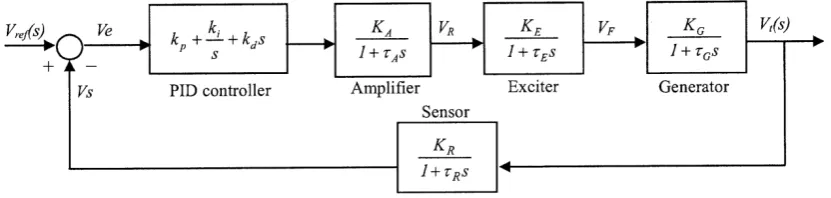
comprises four main components, namely amplifier, exciter, generator, and sensor.
For mathematical modeling and transfer function of the four components, these
components must be linearized, which takes into account the major time constant and ignores
the saturation or other nonlinearities. The reasonable transfer function of these components
may be shown in Fig.5.1.
Fig 3.1. Block diagram of an AVR system
3.1.
Controller settings:The PID controller is simple and easy to implement. It is used to improve the dynamic
response as well as to reduce or eliminate the steady-state error. The derivative controller
adds a finite zero to the open-loop plant transfer function and improves the transient
and reducing the steady-state error due to a step function to zero. The PID controller transfer
function is
Where,
- Is the control (controller output) and tracking error signals in
S-domain, respectively
- Proportional gain,
- Integration gain,
- Derivative gain,
3.2. Amplifier model:
The amplifier model is represented by a gain KA and a time constant ƮA; the transfer
function is
Typical values of gain are in the range of 10 to 400. The amplifier time constant is very small
ranging from 0.02 to 0.1 s.
3.3. Exciter model:
The transfer function of a modern exciter may be rep- resented by a gain KE and a
single time constant, ƮE;
Typical values of gain are in the range of 10 to 400. The time constant is in the range of 0.5
to 1.0 s.
3.4. Generator model:
In the literalized model, the transfer function relating the generator terminal voltage
to its field voltage can be represented by a gain KG and a time constant ƮG ,
These constants are load dependent, gain may vary between 0.7 to 1.0, and time
constant between 1.0 and 2.0 s from full load to no load.
Where, time constant ƮR, is very small, ranging from of 0.001 to 0.06 s.
4. Key Features of AVR System include:
• Voltage Boost & Buck
• Common Mode noise filtering: <0.5 Volts
• Normal Mode noise filtering: <10 Volts
• Over Voltage Protection
5. PARTICLE SWARM ALGORITHM
Particle Swarm Optimization (PSO) algorithm is a population based evolutionary
computation technique developed by the inspiration of the social behavior in bird flocking or
fish schooling. It attempts to mimic the natural process of group communication of individual
knowledge, to achieve some optimum property. In this method, a population of swarm is
initialized with random positions Si and velocities Vi. At the beginning, each particle of the
population is scattered randomly throughout the entire search space and with the guidance of
the performance criterion, the flying particles dynamically adjust their velocities according to
their own flying experience and their companions flying experience. Each particle remembers
its best position obtained so far, which is denoted pbest ( ). It also receives the globally
best position achieved by any particle in the population, which is denoted as gbest ( ). The
updated velocity of each particle can be calculated using the present velocity and the
distances from pbest and gbest. The updated velocity and the position are given in Eqn.1 and
2 respectively.
(1)
(2)
(3)
Where, C1, C2 are positive constants. C1 is the cognitive learning rate and C2 is the
global learning rate. R1, R2 are random numbers in the range 0-1. The parameter W is
inertia weight that increases the overall performance of PSO. The larger value of W
(Wmax) can favor the global wide-range search and lower value of W (Wmin)implies a
higher ability for local nearby search.
t i P t i G ) S .(G .R C ) S .(P .R C .V W
Vit+1 = t it + 1 1 it − it + 2 2 it − ti
1 t i t i 1 t
i S V
S+ = + +
6. PSO based PID Controller:
Fig. 6.1
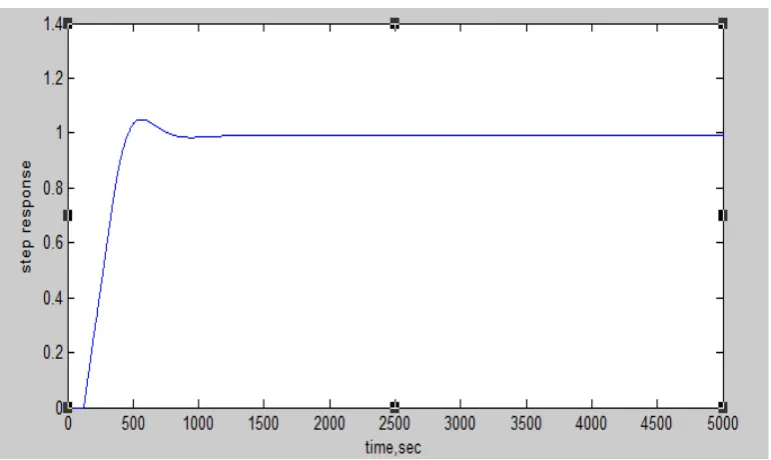
PSO based PID controllerFig. 6.3. Step Response of AVR system using PSO based PID controller
Conclusion:
In this work a novel design method for determining the PID controller parameters
using the PSO method. Proposed method integrates the PSO algorithm with time-domain
performance criterion into a PSO-PID controller. Through the simulation of a practical AVR
system, the show that the proposed controller can perform an search for the optimal PID
controller parameters. In addition, in order to verify it being superior to method, many
performance estimation schemes are performed, such as
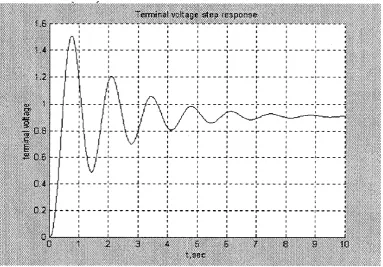
• Multiple simulation examples for their terminal voltage step responses;
• Convergence characteristic of the best evaluation value;
• Dynamic convergence behaviour of all individuals in population during the
evolutionary processing;
• Computation efficiency.
Most of the industrial it is clear from the results that the proposed PSO method can void
the shortcoming of premature convergence of GA method and can obtain higher quality
solution with better computation efficiency. Therefore, the proposed method has more robust
stability and efficiency, and can solve the searching and tuning problems of PID controller
Different PSO optimization parameters are required for solving different problems in
practical application, such as the number of agents (individuals), weight factors and,
acceleration factors and, and the limit of change in velocity. Hence, how to select suit
parameters for the target problem, such as the sensitivity analysis of optimization parameters
for finding the best parameters, is one of our future process loops use conventional or
modified structure PID controllers. Tuning the controller parameter is a challenging work if
the system model is other than a first order plus dead time. In this work, design of
optimization based model independent controller tuning for an AVR model have been
attempted.
References
[1] A. Visioli, “Tuning of PID controllers with fuzzy logic,” Proc. Inst.Elect. Eng. Contr.
Theory Applicat., vol. 148, no. 1, pp. 1–8, Jan. 2001.
[2] T. L. Seng, M. B. Khalid, and R. Yusof, “Tuning of a neuro-fuzzy controller by genetic
algorithm,” IEEE Trans. Syst., Man, Cybern. B, vol. 29, pp. 226–236, Apr. 1999.
[3] R. A. Krohling and J. P. Rey, “Design of optimal disturbance rejection PID controllers
using genetic algorithm,” IEEE Trans. Evol. Comput., vol. 5, pp. 78–82, Feb. 2001.
[4] Y. Mitsukura, T. Yamamoto, and M. Kaneda, “A design of self-tuning PID controllers
using a genetic algorithm,” in Proc. Amer. Contr. Conf., San Diego, CA, June 1999, pp.
1361–1365.
[5] T. Kawabe and T. Tagami, “A real coded genetic algorithm for matrix inequality design
approach of robust PID controller with two degrees of freedom,” in Proc. 12th IEEE Int.
Symp. Intell. Contr., Istanbul, Turkey, July 1997, pp. 119–124.
[6] R. A. Krohling, H. Jaschek, and J. P. Rey, “Designing PI/PID controller for a motion
control system based on genetic algorithm,” in Proc. 12th IEEE Int. Symp. Intell. Contr.,
Istanbul, Turkey, July 1997, pp. 125–130.
[7] D. P. Kwok and F. Sheng, “Genetic algorithm and simulated annealing for optimal robot
arm PID control,” in Proc IEEE Conf. Evol. Comput., Orlando, FL, 1994, pp. 707–713.
[8] T. Ota and S. Omatu, “Tuning of the PID control gains by GA,” in Proc. IEEE Conf.
Emerging Technol. Factory Automation, Kauai, HI, Nov. 1996, pp. 272–274.
[9] A. H. Jones and P. B. D. Oliveira, “Genetic auto-tuning of PID controllers,” in Proc. Inst.
Elect. Eng. Conf. Genetic Algorithm Eng. Syst.: Innovations Applicat., Sept. 1995, pp. 141–
[10] D. B. Fogel, Evolutionary Computation: Toward a New Philosophy of Machine
Intelligence, 2 ed. New York: IEEE Press, 2000.
[11] J. Kennedy and R. Eberhart, “Particle swarm optimization,” in Proc. IEEE Int. Conf.
Neural Networks, vol. IV, Perth, Australia, 1995, pp. 1942–1948.
[12] Y. Shi and R. Eberhart, “A modified particle swarm optimizer,” in Proc. IEEE Int. Conf.
Evol. Comput., Anchorage, AK, May 1998, pp. 69–73.
[13] Y. Shi and R. C. Eberhart, “Empirical study of particle swarm optimization,” in Proc.
IEEE Int. Conf. Evol. Comput., Washington, DC, July 1999, pp. 1945–1950.
[14] R. C. Eberhart and Y. Shi, “Comparison between genetic algorithms and particle swarm
optimization,” in Proc. IEEE Int. Conf. Evol. Comput., Anchorage, AK, May 1998, pp. 611–
616.
[15] P. J. Angeline, “Using selection to improve particle swarm optimization,” in Proc. IEEE