Tuba G. Edgnülü
1, A, C–E, Aynur Özge
2, A, B, Nurten
Erdal
3, A, E,
Oktay Kuru
1, D, E, Mehmet E. Erdal
4, A, D, EAssociation Analysis of the Functional
MAOA
Gene Promoter and
MAOB
Gene Intron 13
Polymorphisms in Tension Type Headache Patients
1 Muğla School of Health Sciences, Muğla Sıtkı Koçman University, Muğla, Turkey2 Department of Neurology, Faculty of Medicine, Mersin University, Mersin, Turkey 3 Department of Biophysics, Faculty of Medicine, Mersin University, Mersin, Turkey
4 Department of Medical Biology and Genetics, Faculty of Medicine, Mersin University, Mersin, Turkey
A – research concept and design; B – collection and/or assembly of data; C – data analysis and interpretation;
D – writing the article; E – critical revision of the article; F – final approval of article; G – other
Abstract
Background. Monoamine oxidase (MAO) enzymes play an important role in the etiology of many neurologi-cal diseases. Tension type headache (TTH) treatments contain inhibitors for selective re-uptake of serotonin and monoamine oxidase inhibitors. MAO (EC 1.4.3.4) has two isoenzymes known as MAOA and MAOB. A promoter polymorphism of a variable number of tandem repeats (VNTR) in the MAOA gene seems to affect MAOA tran-scriptional activity in vitro. Also, G/A polymorphism in intron 13 (rs1799836) of the MAOB gene have been previ-ously found to be associated with the variability of MAOB enzyme activity.
Objectives. The aim of our study was to investigate a possible association of monoamine oxidase (MAOA and
MAOB) gene polymorphisms in tension type headache.
Material and Methods. MAO gene polymorphisms were examined in a group of 120 TTH patients and in another 168 unrelated healthy volunteers (control group). MAOA promoter and MAOB intron 13 polymorphisms were genotyped using PCR-based methods.
Results. An overall comparison between the genotype of MAOA and MAOB genes and allele frequencies of the patients and the control group did not reveal any statistically significant difference between the patients and the control group (p = 0.162).
Conclusions. Factors like estrogen dosage, the limited number of male patients and other genes’ neurotransmitters involved in the etiology of TTH could be responsible for our non-significant results (Adv Clin Exp Med 2014, 23, 6, 901–906).
Key words:MAOA, MAOB, TTH, PCR-RFLP.
Adv Clin Exp Med 2014, 23, 6, 901–906 ISSN 1899–5276
ORIGINAL PAPERS
© Copyright by Wroclaw Medical University
The International Headache Society (IHS) in-troduced the classification “tension type headache” (TTH) in 1988 and a revised version in 2004. The IHS sub-classifies the diagnosis of TTH into an ep-isodic and chronic form. TTH occurring at least 10 times within a 15 day period is classified as ep-isodic (ETTH). The chronic TTH (CTTH) form must cover additional diagnostic criteria and oth-er defining charactoth-eristics according to the IHS classification. These characteristics involve muscle tenderness, physical activity nausea, pain,
photo-phobia and a history of physical and neurological examinations [1–2].
(70%), but their functions are different. MAOA and MAOB genes contain 60 kb and 15 exons [3–4].
Two monoamine oxidase (EC 1.4.3.4) isoen-zymes MAOA and MAOB are expressed in the outer mitochondrial membrane. Serotonin, dopa-mine and norepinephrine are substrates preferred by MAOA while phenylethylamine is processed by MAOB. Decreased levels in MAOA activity and MAOA gene mutations have been mentioned in connection with criminal, violent or impulsive be-havior. [5–7]. MAO enzymes play an important role in the etiology of several neurological diseas-es. For this reason, the functional polymorphisms of MAO genes are important as it may guide us to the diagnosis and treatment of illnesses which are related to neurotransmitters [8–11].
Furthermore, MAOA catalyzes the oxida-tive deamination of several biogenic amines, in-cluding key neurotransmitters such as serotonin, norepinephrine and dopamine. MAOA is also strongly implicated in the regulation of neuro-transmission by cathecolamine and indolamine. Dopamine is metabolized through oxidative de-amination by MAOA to form 3,4-dihydroxyphe-nyl-acetaldehyde (DOPAL) [12]. The activity lev-els of the MAOA enzyme expose a high range of difference (over 50-fold) in a population [13]. Sev-eral lines of evidence indicate that monoamine ox-idase, and in particular MAOA, plays an impor-tant role in human behavior and physiology [3]. The MAOA gene promoter region contains a 30 bp Variable Number of Tandem Repeat (VNTR) polymorphism. The location of this polymorphism is defined 1.2 kb upstream in the coding sequenc-es of MAOA [11]. Allelsequenc-es with 3 or 5 copisequenc-es of the repeat sequence have lesser transcription while a more efficient transcription (2–10 times) is ported for other alleles with 3.5 or 4 copies of re-peat [3]. This polymorphism is a strong candidate for association studies of psychiatric disorders and related vulnerability traits [14].
MAOB is an enzyme involved in the metabo-lism of dopamine, benzylamine, phentylamine, ty-ramine and tryptamine. The MAOB gene has a sin-gle nucleotide polymorphism (SNP) in intron 13, which is based on GA transition (rs1799836) [8]. The G/A polymorphism in intron 13 of the MAOB gene have been previously reported to be related to the variability of MAOB enzyme activity. Al-tered levels of MAOB have previously been asso-ciated with a number of psychiatric and neuro-logical conditions [15–16]. The other studies have suggested that MAOB is potentially relevant to Parkinson’s disease because of its role in catabo-lizing dopamine, with the resultant production of reactive oxidative free radicals [10]. The aim of this study is to examine the relationship between
the G/A polymorphism in intron 13 and TTH pa-tients. In this context, we aimed to assess a possi-ble significance of MAOA and MAOB genes poly-morphism in tension type headache. This study will also be addressingthe polymorphic patterns of MAOA and MAOB, both in TTH patients and the healthy population in our country.
Material and Methods
168 healthy volunteers formed our control group and 120 individuals with a TTH diagno-sis represent the patients group. The TTH group was subdivided to 2 other groups as episodic TTH (n = 66) and chronic TTH (n = 54) based on clini-cal diagnostic criteria (IHS-ICHD 2 edition).
There were 106 (86.8%) females and 14 (13.2%) males in the TTH group with mean ag-es of 37.6 ± 10.6 years, and 100 (59.6%) femalag-es and 68 (40.4%) males in the healthy control group with mean ages of 32.9 ± 18.9 years. The TTH pa-tients and healthy controls were unrelated. TTH patients and healthy controls were nearly age and sex matched. Patients with migraine having any le-sion in their brain computed tomography and pa-tients with clear psychiatric disturbance were ex-cluded from the study. Additionally, patients with a history of cervical and cranial trauma were also excluded. Venous blood withdrawal was complet-ed with sampling in ethylene diamine tetra ace-tic acid (EDTA) containing tubes. The salting out procedure was used for DNA extraction [17].
MAOA gene (Gene ID: 4128) alleles were deter-mined using a Polymerase Chain Reaction (PCR) method [3]. MAOB gene (Gen ID: 4129) rs1799836 polymorphism was determined by using the PCR and Restriction Fragment Length Polymorphism (RFLP) methods [10]. The genotypes of MAOA and MAOB genes were determined by 3% agarose gel electrophoresis containing 0.5 μg/mL ethidium bromide.
A 100 bp DNA Ladder (Fermentas, Vilnius, Lithuania) was used as a size standard for each gel lane. The gel was visualized under UV light us-ing a gel electrophoresis visualizus-ing system (Vil-ber Lourmat, Marne La Vallée, France). The sum-marized PCR-RFLP conditions and band sizes are shown in Table 1. The genotype determinations were duplicated in independent experiments and all inconclusive samples were re-analyzed.
Statistical Analysis
repeat units) as described previously [18]. MAOB alleles were also divided into 2 groups: allele G and allele A, as described previously [8]. The data is presented as mean ± standard error for continu-ous data or frequencies and percentages for cate-gorical data. Chi-square or Fisher exact tests were used to compare proportions of patients for cate-gorical data among groups. Analysis of variance or t-tests were used to compare the continuous vari-ables among groups. We used odds ratio (OR) as a measure of the association of the genetic poly-morphisms in MAOA and MAOB with TTH. OR
values were calculated from genotype frequen-cy data. The SPSS 11.5 for Windows program was used for statistical analysis. A p value < 0.05 was considered to be statistically significant.
Results
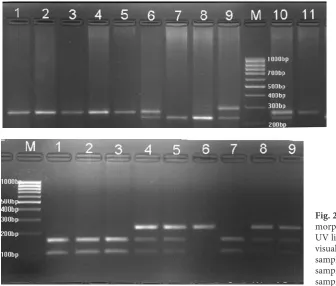
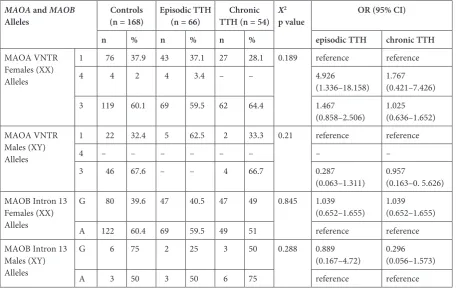
The visualized samples of polymorphism anal-yses for MAOA and MAOB genes are presented in Fig.1 and 2, respectively. The participants in both groups were similar in mean age (p = 0.162).
Table 1. Primers and Restriction Enzymes (RE) used for MAOA and MAOB genes polymorphisms
Gene Poly-
morphism RE Primers Sequence Ann. temp (oC)
Fragment size (bp)
MAOA VNTR – F 5’-CAGCGCCCAGGCTGCTCCAGAAAC- 3’ 65 Allele 1; 221 bp (3 repeats) Allele 2; 233 bp (3 and a half repeats) R 5’- GGT TCGGGACCTGGGCAGTTGTGC- 3’ Allele 3; 251 bp
(4 repeats) Allele 4; 281 bp (5 repeats)
MAOB rs1799836 NmuCI F 5’- GGAACCTCTTATACCACAGG -3’ 54 GG :232 bp GA: 232,146,86 bp R- 5’ GACTGCCAGATT TCATCCTC 3’ AA:146/86 bp
Fig. 1.MAOA gene VNTR polymorphism was visualised under UV light using a gel electrophoresis visualising system,
samples 1–5 and 11 – 3-3 genotype; samples 6 and 10 – 3-1 genotype; samples 7 and 8 – 1-1 genotype, sample 9 – 1-4 genotype
Fig. 2. MAOB gene intron 13 poly-morphism was visualised under UV light using a gel electrophoresis visualizing system,
MAOA and MAOB genes are located on the X chromosome and analyses were performed sep-arately for male and female subjects.
Results for MAOA gene promoter 30 bp VNTR polymorphism revealed that the geno-types were similar in TTH patients and the control group for female (p > 0.05) as well as male subjects (p > 0.05). There was no relationship between ep-isodic TTH, chronic TTH and the control group between females (p > 0.05) and males (p > 0.05). Table 2 represents all of the MAOA genotype re-sults for VNTR polymorphism in our group. Allele
frequencies for MAOA gene VNTR polymor-phisms are shown in Table 3.
The results of MAOB gene intron 13 polymor-phism genotypes were similar in TTH patients and the control group in females and males (p > 0.05). There was also no difference between episodic TTH, chronic TTH patients and the control group between females and males (p > 0.05). The geno-types of MAOB gene intron 13 polymorphisms are shown in Table 2. Table 3 demonstrates the fre-quencies of G and A alleles of MAOB gene intron 13 polymorphisms in TTH patients and controls.
Table 2. Genotypes of MAOA and MAOB genes in female patients and control groups
Females (XX) Genotypes Controls (n = 100) Episodic TTH
(n = 58) Chronic TTH (n = 48) TTH (n = 106)
X2p value
n % n % n %
MAOA VNTR 1-1 19 19 11 19 5 10.4 0.657
1-3 37 37 21 36.2 14 29.2
3-3 40 40 22 37.9 23 47.9
3-4 2 2 4 6.9 2 4.2
1-4 1 1 – – 3 6.3
4-4 1 1 – – 1 2
MAOB Intron 13 GG 11 10.9 8 13.8 11 22.9 0.363
GA 58 57.4 31 53.4 25 52.1
AA 31 31.7 19 32.8 12 25
Table 3. Alleles of MAOA and MAOB genes polymorphisms in patients and control groups
MAOA and MAOB
Alleles (n = 168)Controls Episodic TTH (n = 66) TTH (n = 54)Chronic X
2
p value OR (95% CI) n % n % n % episodic TTH chronic TTH
MAOA VNTR Females (XX) Alleles
1 76 37.9 43 37.1 27 28.1 0.189 reference reference 4 4 2 4 3.4 – – 4.926
(1.336–18.158) 1.767 (0.421–7.426) 3 119 60.1 69 59.5 62 64.4 1.467
(0.858–2.506) 1.025 (0.636–1.652) MAOA VNTR
Males (XY) Alleles
1 22 32.4 5 62.5 2 33.3 0.21 reference reference
4 – – – – – – – –
3 46 67.6 – – 4 66.7 0.287
(0.063–1.311) 0.957 (0.163–0. 5.626) MAOB Intron 13
Females (XX) Alleles
G 80 39.6 47 40.5 47 49 0.845 1.039
(0.652–1.655) 1.039 (0.652–1.655) A 122 60.4 69 59.5 49 51 reference reference MAOB Intron 13
Males (XY) Alleles
G 6 75 2 25 3 50 0.288 0.889
Discussion
The recent definition of MAOA and MAOB gene polymorphisms lead the studies to be focused on the involvement of these polymorphisms in differ-ent neurological and psychiatric disorders [19–20]. Related studies have shown that MAOA gene mu-tations could be associated with borderline men-tal retardation and abnormal behavior, including increased impulsive behavior [21]. The association between MAOA promoter region polymorphism and migraine was also investigated, but no rela-tion was found [22]. Kelada et al. suggested that the G allele of MAOB had approximately two times the increased risk for PD [23]. Lung F. et al. spec-ulated that MAOA activity might increase in ho-mozygous/hemizygous subjects for the MAOA 4R allele which might lead to abnormal serotonin me-tabolism in the central nervous system. Their study provided data for an enhanced vulnerability to sui-cide in depressed males with major depressive dis-order, associated with the MAOA 4R allele [24]. In a study by Filic V et al., no association was de-tected in migraine patients with and without au-ra [22]. Another study revealed that plasma 5-HT levels in migraine patients without aura are lower
when compared to controls, based on the high-er G allele and G/G genotype of T941G polymor-phisms of MAOA in migraine patients [25]. Our results failed to show a relationship between MAO enzymes gene polymorphisms and TTH. A simi-lar genetic association was also investigated in pa-tients with chronic daily headache and migraine. Beside other genes studied in that study, MAOA gene polymorphism was also found to be unrelat-ed to headache in the subgroups analyzunrelat-ed [26]. Sci-entific data provides a strong association between MAO gene polymorphisms and several neurolog-ical/psychiatric disorders. Although there is a lack of evidence for a relationship between VNTR poly-morphism of the MAOA gene and intron 13 G/A polymorphism of the MAOB gene and TTH, cat-echolamine metabolism related pathways remain worthy to be investigated in the future to clarify a possible connection.
In conclusion, the authors have not found any association between tension type headache patients and MAO (MAOA, MAOB) genes poly-morphism. Further investigations are warranted in larger populations with other susceptible neu-rotransmitter genes that might be associated with tension type headache.
References
[1] Headache Classification Committee of the International Headache Society. The international classification of headache disorders: 2nd ed. Cephalalgia 2004, 24, Suppl 1, 1–160.
[2] Stovner LJ, Hagen K, Jensen R, Katsarava Z, Lipton RB, Scher AI, Steiner TJ, Zwart JA: The global burden of headache: a documentation of headache prevalence and disability worldwide. Cephalalgia 2007, 27, 193–210.
[3] Sabol SZ, Hu S, Hamer D: A functional polymorphism in the monoamine oxidase A gene promoter. Hum Genet 1998, 103, 273–279.
[4] Shih JC, Thompson RF: Monoamine oxidase in neuropsychiatry and behaviour. Am J Hum Genet 1999, 65, 593–595.
[5] Chen K, Holschneider D P, Wu W, Rebrin I, Shih JC: A spontaneous point mutation produces monoamine oxidase A/B knock-out mice with greatly elevated monoamines and anxiety-like behavior. J Biol Chem 2004, 279, 39645–39652.
[6] Balciuniene J, Emilsson L, Oreland L, Pettersson U, Jazin E:Investigation of the functional effect of monoamine oxidase polymorphisms in human brain. Hum Genet 2002, 110, 1–7.
[7] Orru S, Mascia V, Casula M, Giuressi E, Loizedda A, Carcassi C, Giagheddu M, Contu L: Association of mono-amine oxidase B alleles with age at onset in amyotrophic lateral sclerosis. Neuromuscul Disord 1999, 9, 593–597.
[8] Checkoway H, Franklin GM, Costa-Mallen P, Smith-Weller T, Dilley J, Swanson PD, Costa L: A genetic poly-morphism of MAOB modifies the association of cigarette smoking and Parkinson’s disease. Neurology 1998,50, 1458–1461.
[9] Costa P, Checkoway H, Levy D, Smith-Weller T, Franklin GM, Swanson PD, Costa LG:Association of a poly-morphism in intron 13 of the monoamine oxidase B gene with Parkinson disease. Am J Med Genet 1997, 74, 154–158.
[10] Wu RM, Cheng CV, Chen KH, Lu SL, Shan DE, Ho YF, Chern H:The COMT L allele modifies the association between MAOB polymorphism and PD in Taiwanese. Neurology 2001, 56, 375–382.
[11] Yirmiya N, Pilowsky T, Tidhar S, Nemanov L, Altmark L, Ebstein RP: Family-based and population study of a functional promoter-region monoamine oxidase A polymorphism in autism: possible association with IQ. Am J Med Genet 2002, 114, 284–287.
[12] Wang TJ, Huang SY, Lin WW, Lo HY, Wu PL, Wang YS, Wu YS, Ko HC, Shih JC, Lu RB: Possible interaction between MAOA and DRD2 genes associated with antisocial alcoholism among Han Chinese men in Taiwan. Prog Neuropsychopharmacol Biol Psychiatry 2006, 26, 1–7.
[14] Jorm AF, Henderson AS, Jacomb PA, Christensen H, Korten AE, Rodgers B, Tan X, Easteal S: Association of a functional polymorphism of the monoamine oxidase A gene promoter with personality and psychiatric symp-toms. Psychiatr Genet 2000, 2, 87–90.
[15] Garpenstrand H, Ekblom J, Forslund K, Rylander G, Oreland L: Platelet monoamine oxidase activity is related to MAOB intron 13 genotype. J Neural Transm 2000, 107, 523–530.
[16] Sery O, Hrazdilova O, Didden W, Klenerová V, Staif R, Znojil V, Sevcík P:The association of monoamine oxi-dase B functional polymorphism with postoperative pain intensity. Neuro Endocrinol Lett 2006, 3, 29–27.
[17] Miller SA, Dykes, DD, Polesky HF: A simple salting out procedure for extracting DNA from human nucleated cells. Nucleic Acids Res 1988, 16, 1215.
[18] Schulze T, Muller DJ, Krauss H, Scherk H, Ohlraun S, Syagailo YV, Windemuth C, Neidt H, Grässle M, Papassotiropoulos A, Heun R, Nöthen MM, Maier W, Lesch KP, Rietschel M: Association between a functional polymorphism in the monoamine oxidase A gene promoter and major depressive disorder. Am J Med Genet 2000, 96, 801–803.
[19] Takehashi M, Tanaka S, Masliah E, Ueda K: Association of Monoamine oxidase A gene polymorphism with Alzheimer’s disease and Lewy body variant. Neurosci Lett 2002, 327, 79–82.
[20] Sjöberg RL, Nilsson KW, Wargelius HL, Leppert J, Lindström L, Oreland L: Adolescent girls and criminal activity: role of MAOA-LPR genotype and psychosocial factors. Am J Med Genet B Neuropsychiatr Genet 2007, 5, 159–164.
[21] Gilad Y, Rosenberg S, Przeworski M, Lancet D, Skorecki K: Evidence for positive selection and population struc-ture at the human MAOA gene. Proc Natl Acad Sci USA 2002, 99, 862–867.
[22] Filic V, Vladic A, Stefulj J, Cicin-Sain L, Balija M, Sucic Z, Jernej B: Monoamine oxidases A and B gene poly-morphisms in migraine patients. J Neurol Sci 2005, 228, 149–153.
[23] Kelada SN, Costa–Mallen P, Costa LG Smith-Weller T, Franklin GM, Swanson PD, Longstreth WT Jr, Checkoway H: Gender difference in the interaction of smoking genotype in Parkinsons’ disease. Neurotoxicology 2002, 23, 515–519.
[24] Lung FW, Tzeng DS, Huang MF, Lee MB: Association of the MAOA promoter uVNTR polymorphism with suicide attempts in patients with major depressive disorder. BMC Med Genet 2011, 12, 74.
[25] Ishii M, Shimizu S, Sakairi Y, Nagamine A, Naito Y, Hosaka Y, Naito Y, Kurihara T, Onaya T, Oyamada H, Imagawa A, Shida K, Takahashi J, Oguchi K, Masuda Y, Hara H,Usami S, Kiuchi Y: MAOA, MTHFR, and TNF-β genes polymorphisms and personality traits in the pathogenesis of migraine. Mol Cell Biochem 2012, 363, 357–366.
[26] Cevoli S, Mochi M, Scapoli C, Marzocchi N, Pierangeli G, Pini LA, Cortelli P, Montagna P: A Genetic associa-tion study of dopamine metabolism-related genes and chronic headache with drug abuse. Eur J Neurol 2006, 3, 1009–1013.
Address for correspondence:
Tuba G. Edgünlü
Mugla Sitki Kocman University School of Health Sciences Mugla city, 48000 Turkey
Tel: +00 90 252 211 32 03 E-mail: [email protected] Conflict of interest: None declared Received: 27.06.2013