Deep Reinforcement Learning for Soft Robotic
Applications: Brief Overview with Impending
Challenges
Sarthak Bhagat1,2,†,Hritwick Banerjee1,3† ID, Zion Tsz Ho Tse4and Hongliang Ren1,3,5,*ID
1 Department of Biomedical Engineering, Faculty of Engineering, 4 Engineering Drive 3, National University of Singapore, Singapore 117583, Singapore; [email protected] (H.B.)
2 Department of Electronics and Communications Engineering, Indraprastha Institute of Information Technology, Delhi, New Delhi, Delhi 110020, India; [email protected] (S.B.)
3 Singapore Institute for Neurotechnology (SINAPSE), Centre for Life Sciences, National University of Singapore, Singapore 117456.
4 School of Electrical & Computer Engineering, College of Engineering, The University of Georgia, Athens 30602, USA; [email protected] (Z.T.H.T)
5 NUS (Suzhou) Research Institute (NUSRI), Wuzhong Dist., Suzhou City, Jiangsu Province, China. † These authors equally contributed towards this manuscript.
* Correspondence: [email protected] (H.R.); Tel.: +65-6601-2802
Abstract:The increasing trend of studying the innate softness of robotic structures and amalgamating it with the benefits of the extensive developments in the field of embodied intelligence has led to sprouting of a relatively new yet extremely rewarding sphere of technology. The fusion of current deep reinforcement algorithms with physical advantages of a soft bio-inspired structure certainly directs us to a fruitful prospect of designing completely self-sufficient agents that are capable of learning from observations collected from their environment to achieve a task they have been assigned. For soft robotics structure possessing countless degrees of freedom, it is often not easy (something not even possible) to formulate mathematical constraints necessary for training a deep reinforcement learning (DRL) agent for the task in hand, hence, we resolve to imitation learning techniques due to ease of manually performing such tasks like manipulation that could be comfortably mimicked by our agent. Deploying current imitation learning algorithms on soft robotic systems have been observed to provide satisfactory results but there are still challenges in doing so. This review article thus posits an overview of various such algorithms along with instances of them being applied to real world scenarios and yielding state-of-the-art results followed by brief descriptions on various pristine branches of DRL research that may be centers of future research in this field of interest.
Keywords:deep reinforcement learning; imitation learning; soft robotics
1. Introduction
1.1. Soft robotics: a new surge in robotics
The past decade has seen engineering and biology coming together [1–5] leading to cropping up of a relatively newer field of research- Soft Robotics (SoRo). SoRo has come to our aid by enhancing physical potentialities of robotic structures amplifying the flexibility, rigidity and the strength and hence, accelerating their performance. Biological organisms use to good advantage their soft structure to maneuver in complex environments, giving motivation to exploit such physical attributes that could be incorporated in our models to perform tasks that demand robust interactions with uncertain environments. SoRo is capable of creating three dimensional bio-inspired structures[6] that are capable of self-regulated homeostasis, resulting in robotics actuators that have the potential to mimic biomimetic motions with simple, inexpensive actuation [7,8] and able to achieve bending, twisting,
extension, flexion with non-rigid materials [5,9]. These developments in creating such robotic hardware presents before us an opportunity to couple them with imitation learning techniques by exploiting the special properties of these materials to clich much higher levels of precision and accuracy. Various underlying physical properties including body shape, elasticity, viscosity, softness, density and many more has certainly prompted us to employ such unconventional structures and morphologies in our robotic systems bringing about a revolution in research domain of embodied intelligence. Developing such technique would definitely lead to fabrication of robots that could invulnerably communicate with the environment. SoRo also presents before us strong prospects of being melded withTissue Engineeringgiving rise to composite systems that could find vast applications in medical domain. [10]
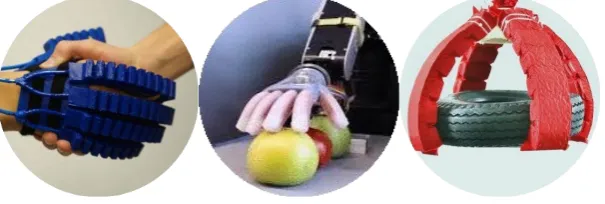
Figure 1.The figure shows various application of SoRo in today’s world.
1.2. Deep learning: an overviewDeep Learning for Controls in Robotics
There has been a certain incline towards utilization of deep learning techniques for creating autonomous systems that are capable to replace humans in varied domains. Deep learning [11] approaches have shown tremendous amount of success when combined with reinforcement learning (RL) tasks in the past decade and are known to produce state-of-art results in various diverse fields [12]. There have been several pioneer algorithms in this domain that have shown ground-breaking results in tasks difficult to handle with former methods. The need for creating completely autonomous intelligent robotic systems has led to the heavy dependence on the use of Deep RL to solve a set of complex real world problems without any prior information about the environment. These continuously evolving systems aid the agent to learn through a sequence of multiple time steps, gradually moving towards an optimal solution. Robotics: perception & control
Essentially, all robotics tasks can be broken down into 2 different fragments, namely perception [13,14] and control. The task of perception can be viewed as a relatively simpler problem wherein agents are provided with necessary information about the environmentviasensory inputs, from which they may extract desired target quantities or properties. But in the case of learning a control policy, the agent actively interacts with environment trying to achieve an optimal behaviour based on the rewards received.
The problem of control goes one step further than the former due to the following factors:
• Data distribution : In case of Deep RL for perception, the observations are independent and identically distributed while in case of controls, they are accumulated in an online manner due to their continuous nature where each one is correlated to the previous ones[15].
• Supervision Signal : Complete supervision is often provided in case of perception in form of ground truth labels while in controls there are only sparse rewards available.
1.3. Deep learning in SoRo
The implementation of Deep Learning Techniques for solving compound problems in the task of controls[16–18] in soft robotics has been one of the hottest topics of research. Hence, there has been development of various algorithms that have certainly surpassed the accuracy and precision of earlier approaches. There are innumerable control problems that exist but by far the most popular and in-demands control task involves manipulation. The last decade has seen a huge dependence on soft robotics (and/or bio-robotics) for solving the control related tasks, and applying such DRL techniques on these soft robotics systems has become a focus point of heavy ongoing research. Hence, the amalgamation of these budding fields of interests presents before us a challenge as well as potential of building much smarter control systems[10] that can handle objects of varying shapes [19], adapt to continuously diverging environments and perform substantial tasks of manipulation combining the hardware capabilities of a soft robotic system alongside the learning procedures of a deep learning agent. Hence, in this paper we focus applying DRL and imitation learning techniques to soft robots to perform the task of control of robotic systems.
1.4. Forthcoming challenges
The next big step towards learning policy controls for robotic applications is imitation learning. In such approaches, the agents learns to perform a task by mimicking the actions of an expert, gradually improving its performance with time just as a Deep Reinforcement Learning agent. Even though, it is really hard to design the reward/loss function in these cases due to the huge dimension of the action space pertaining to the wide variety of motions possible in soft robots, these approaches are extremely useful for humanoid robots or manipulators with high degrees of freedom where it is easy to demonstrate desired behaviours as a result of the magnified flexibility and tensile strength. Manipulation tasks especially the ones that involve the use of soft robotics are effectively integrated with such imitation learning algorithms giving rise to agents that are able to imitate expert’s actions much more accurately than normal robotic agent that do not make use of bio-inspired structures[3,20,
21]. Various factors including the extremely large dimension of the action space, varying composition and structure of the soft robot and the alterations in the environment due to constant interactions with our agent presents before us a variety of challenges that require intense surveillance and deep research. Attempts have also been made to reduce the variations required to be made into our model when transferring from one trained on a simulation to the one that functions effectively in real world. These challenges not only appear as hindrances to achieve complete self-sufficiency but also act as strong candidates for future of AI and Robotics research. In the paper, we list various DRL and Imitation Learning algorithms that have been successfully applied to solve real world problems, besides mentioning various such challenges that prevail and could act as centers of upcoming research.
1.5. Overview of the present study
This review article comprises of various sections broadly divided into two sub-categories - deep reinforcement learning4and imitation based learning10. The former gives a basic overview about the algorithms in RL3and Deep RL4followed by descriptive explanation about the application of Deep RL in Navigation6and Manipulation7mainly on SoRo environments. The succeeding section10
2. Brief Overview of Reinforcement Learning
Soft robots that intend to solve non-trivial tasks are generally required to have several adaptive and evolving capabilities that make them proficient in interacting with their constantly varying environments. Hence, for designing such intelligent embodied agents, we require the aid of Reinforcement Learning. It is a branch of Artificial Intelligence that involves making machines that are able to continually enhance their performance with respect to a certain context of a task they aim to execute, identifying optimal behaviour in terms of a certain reward (or loss) function. Thus, in short Reinforcement Learning can be expressed in simple terms as a procedure in which at each state s the agent performs an action a, receiving a response in form of a reward from the environment on the basis of which it decides the goodness of the previous state-action pairs and this process continues until the agent has learned a policy good enough for our set standards. This is a process that involves both exploration that refers to exploring different ways to achieve a particular task at a given state as well as exploitation is the method of simply utilizing the current information gained and trying to receive the largest reward possible at that given state.
Each robotics task that we wish to perform can be seen as a Markov Decision Process (MDP), consisting of a 5-tuple such as :(i) S : set of all states; (ii) A : set of all actions; (iii) P : transition dynamics; (iv) R : set of all rewards; andγ: discount factor. In most situations, we consider Episodic MDPs, where there exists a terminal state which once obtained ends the learning procedure. Episodic MDPs with time horizonT, ends afterTtime steps regardless of the fact that it has reached its goal or not. In the problem of controls for robots, the information about the environment is gathered through the sensors which might not be enough to collect all information that it requires to make a decision about the action it must perform in the future time steps, such MDPs are called Partially Observable MDPs. These are countered by either stacking all observations upto that time step before processing them or by using a recurrent neural network. In any RL task, we intend to maximize the expected discount return that is the weighted sum of rewards received by the agent [22]. For this purpose, we have two type of policies namely stochastic (π(a|s)) where actions are drawn from a probability distribution and deterministic (µ(s)) where they are selected specifically for every state. Then, we have Value functions (Vπ(s)) that depict the expected outcome starting from state s and following policyπ.
3. Reinforcement Learning Algorithms
This section provides an overview of major RL algorithms that have been extended by using deep learning frameworks.
• Value-based Methods: These methods estimates the probability of being in a given state, using which the control policy is determined. The sequential state estimation is done by making use of Bellman’s Equations (Bellman’s Expectation Equation and Bellman’s Optimality Equation). Most popular Value-based RL algorithms include State-Action-Reward-State-Action (SARSA) and Q-Learning, which differ in their td-targets that is the target value to which Q-values are recursively updated by a step size at each time step. SARSA is an on-policy method where the value estimations are updated towards a policy while Q-Learning being an off-policy method updates the value estimations towards a target optimal policy.This algorithm is a complex algorithm that is used to expound various multiplex-looking problems but computational constraints act as stepping stones to utilizing it, hence, not popularly exploited with soft robots.Detailed explanation can be found in recent works like Dayan[23], Kulkarniet al.[24], Barretoet al.[25], and Zhanget al.[26].
focus on gradient-based methods where gradient descent seems to be the popular choice of optimization algorithm. Here, we try to optimize the objective function as:
J(πθ) =Eπθ[fπθ(.)] (1)
and the score function[29], given by fπθ(.). In the previous equation, decides on how good
the current policy performs on the task in hand. A popular RL algorithm is the REINFORCE algorithm[30], that simply plugs in the sample return equal to the score function given by:
fπθ(.) =Gt. (2)
A baseline term b(s) is often subtracted from the sample return to reduce the variance of estimation which updated the equation in the following manner:
fπθ(.) =Gt−bt(st). (3)
While using Q-value function as our score function we can make use of either stochastic policy gradient4or deterministic policy gradient5[31] given by:
∇θ(πθ) =Es,a[∇θlogπθ(a|s).Qπ(s,a)] (4) and
∇θ(µθ) =Es[∇θµθ(s).Qµ(s,µθ(s))]. (5) It is observed that this method certainly overpowers the former in terms of computational time and space limitations, and hence it more popularly employed to formulate control tasks, but still it cannot be extended to tasks involving interaction with continuous evolving environments that require the agent to be highly adaptive.
At times, it has been noted that it may not practically suitable to follow the policy gradient on account of safety issues and hardware restrictions. Therefore, we often optimise using the policy gradient on stochastic policies wherein integration is done over only state space due to the extraordinarily large dimension of the action space in case of soft robots that can sustain movements in almost all directions and angles possible.
• Actor Critic Method: These are algorithms that keep a clear representation of the policy and state estimations. The score function for this is obtained by replacing the return Gtfrom equation3of
policy based methods with Qπθ(st,at) and baseline b(s) with Vπθ(st) that results in the following
equation:
fπθ(.) =Qπθ(st,at)−Vπθ(st). (6)
The advantage function A(s,a) is given by:
A(s,a) =Q(s,a)−V(s). (7)
It is not wrong to say that actor critic methods could be described as an intersection of policy based and value based methods, wherein it combines iterative learning methods of both the methods.
leads to exceptionally expensive interaction with environment and hence, compromising on the training data available.
Table 1.Key differences between Value Based and Policy Based (along with Actor Critic Methods) on various different factors of variation.
Algorithm Value Based Methods Policy Based Methods(and Actor Critic Methods)
Examples Q-Learning, SARSA, Value Iteration REINFORCE, Advantage Actor Critic, Cross Entropy Method
Steps Involved Finding optimal value function and find the
policy based on that (policy extraction) Policy evaluation and policy improvement
Iteration The two processes (listed in above cell) are not repeated after once completed
The above two processes (listed in above cell) are iteratively done to achieve convergence
Convergence Relatively Slower Relatively Faster
Type of Problem
Solved Relatively Harder control problems Relatively Simpler control problems Method of Learning Explicit Exploration Innate Exploration and Stochasticity
Advantages Simpler to train off-policy Blends well with supervised way of learning
Process Basis Based on Optimality Bellman Operator- is
non-linear operator Based on Bellman Operator
4. Deep Reinforcement Learning Algorithms coupled with SoRo
The heavy benefits gained by roboticists in terms of physical and mechanical properties as well as the added precision and accuracy due to increased degrees of freedom allowing a wide range of actions while dealing with soft robots has lead to their involvements in almost all domains possible. There are a good deal of sectors wherein soft robotics have found extensive applications:
Bio-medical: Soft Robots has found enormous applications in the domain of bio-medicine. They have found wide range of applications that include development of soft robotic tools for surgery, diagnosis, drug delivery, wearable medical devices, prostheses, artificial organs, active simulators that copy the working of human tissues for training and bio-mechanical research. The fact that they are highly durable and flexible makes them apt for applications involving maneuvering in close and delicate areas where a possible human error could cause heavy damage. Certain special properties of them being completely water-soluble or ingestible makes them a good candidate for future medication delivery agent for human bodies.
Manipulation: Another domain wherein soft robots are considered to be extremely useful is for autonomous picking, sorting, distributing, classifying and grasping capabilities in various workplaces including warehouses, factories, and industries.
Mobile Robotics: Various types of diverse domain-specific robots that posses the ability to move have been employed for countless purposes. Robots that could walk, climb, crawl or jump having structures inspired from other animals that portray special movement capabilities may find applications in inspection, monitoring, maintenance and cleaning tasks. The recent works in the field of swarm technology has greatly enhanced the performance of robots that are mobile and posses such flexible and adaptive structures.
Super-Strong Mechanics: Origami - a really atavistic concept that has been in use for hundreds of years, has been imployed to enhance the physical strength of soft robotic systems. These robots that have structures inspired from such a concept are capable of having varied sizes, shape and appearances and are proficient in lifting weight upto 1000 times it’s own weight. These robots can find intensive applications in various diverse industries that require lifting of heavy material.
Even apart from these there are innumerable fields whereing soft robots have found applications in including motor control in machines, assistive robots, military reconnaissance, natural disaster relief, pipe inspection and so much more.
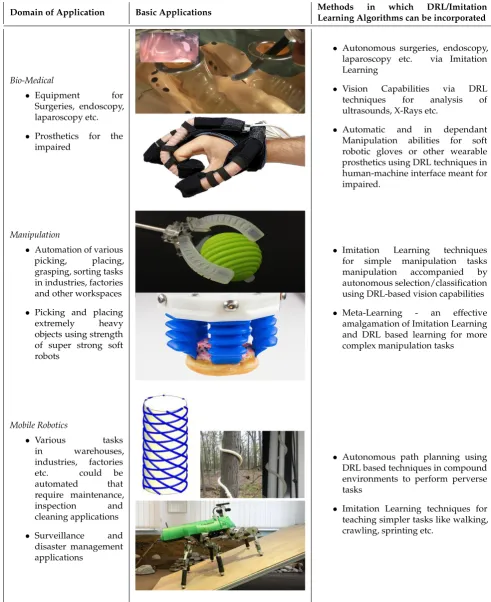
The vast domain applications of soft robotics has made its study alongside DRL-based methods even more necessary due to the fact that now not only do we have to make systems that can perform compound tasks as a consequence of their special mechanical capabilities but also incorporate self-adaptive and evolving models that learn from interactions from the environment. The following table shows various domains wherein soft robots are considerably utilized but also some areas that are capable of engulfing within them some DRL techniques those will be discussed in detail in the sections to follow.
Neural networks have been real asset in approximating various optimal value functions in Reinforcement Learning Algorithms and hence, have been extensively applied to predict the most favourable control policy in robotics. Systems involving soft robots generally have more challenges in policy optimisation due to large action and state spaces, and hence, in most scenarios we have to incorporate neural networks in our models alongside adaptive reinforcement learning techniques. The last decade has seen a sharp rise in the usage of DRL methods for performing a variety of tasks to make use of the bio-inspired structures of soft robots. The following are the common DRL algorithms that have been put in practise and have shown fine potential in solving such control problems:
• Deep Q-Network (DQN) [35]: In this approach the optimal value of Q-function is obtained using a deep neural network (generally a CNN), just like we do in all other value-based algorithms. We denote the weights of this Q-network by Q*(s,a) and the td-error and td-target are given by equations:
δtDQN=ytDQN−Q(st,at;θtQ) (8)
and
ytDQN =Rt+1+γ. (9)
The weights are recursively updated by the equation:
θt+1←θt−α(∂(δtDQN(θtQ))2/∂θtQ). (10)
moving in the direction of decreasing gradient with a rate equal to the learning rate. These are capable of solving problems involving high dimensional state spaces but restricted to discrete low dimension when it comes to action space. These methods have been extremely useful when applied to various problems of manipulation using soft robotics that have structure inspired from biological creatures, combining which gives systems are able to interact with the environment alongside additional flexibility and adaptation to changing situations.
Two main methods employed in DQN for learning are:
– Target Network: Target network Q- has same architecture as the Q-network but while learning the weights of only the Q-network are updated, while repeatedly being copied to weights ofθ-network. In this procedure, td-target is computed from the output ofθ -function[17].
Table 2.SoRo applied state-of-the-art results and sub-domains where utilization of DRL and imitation learning techniques could be useful.
Domain of Application Basic Applications Methods in which DRL/Imitation Learning Algorithms can be incorporated
Bio-Medical
• Equipment for Surgeries, endoscopy, laparoscopy etc.
• Prosthetics for the impaired
• Autonomous surgeries, endoscopy, laparoscopy etc. via Imitation Learning
• Vision Capabilities via DRL techniques for analysis of ultrasounds, X-Rays etc.
• Automatic and in dependant Manipulation abilities for soft robotic gloves or other wearable prosthetics using DRL techniques in human-machine interface meant for impaired.
Manipulation
• Automation of various picking, placing, grasping, sorting tasks in industries, factories and other workspaces
• Picking and placing extremely heavy objects using strength of super strong soft robots
• Imitation Learning techniques for simple manipulation tasks manipulation accompanied by autonomous selection/classification using DRL-based vision capabilities
• Meta-Learning - an effective amalgamation of Imitation Learning and DRL based learning for more complex manipulation tasks
Mobile Robotics
• Various tasks in warehouses, industries, factories
etc. could be
automated that require maintenance, inspection and cleaning applications
• Surveillance and disaster management applications
• Autonomous path planning using DRL based techniques in compound environments to perform perverse tasks
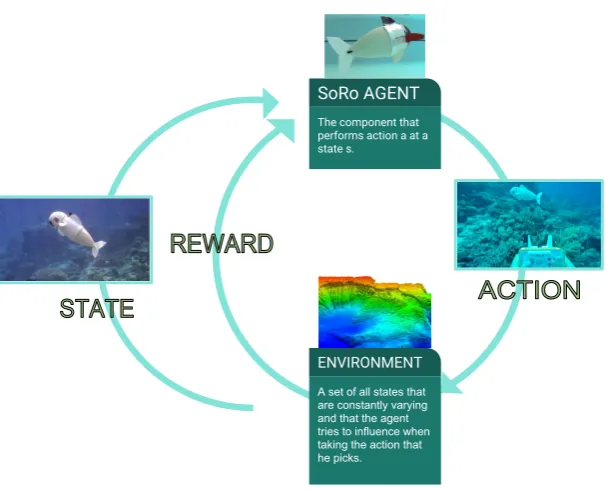
The component that performs action a at a state s.
SoRo AGENT
A set of all states that are constantly varying and that the agent tries to influence when taking the action that he picks. ENVIRONMENT
Figure 2.The figure depicts the training architecture of a DQN agent.
learning task follows the usual steps of using gradient descent to reduce loss between learned Q-network and target Q-network.
These two methods are used to stabilize the learning in DQN by reducing the correlation between estimated and target Q-values, and between consecutive observations respectively. Advanced techniques for stabilizing and creating more efficient models include Double DQN[36] and Dueling DQN[37].
• Deep Deterministic Policy Gradients (DDPG) [17]: This is a modification of the DQN combining techniques from actor-critic methods allowing us to model problems with continuous high dimensional action spaces. The training procedure of a DDPG agent is depicted in figure3. The equations for stochastic11and deterministic12policies are given by equations:
Qπ(s
t,at) =ERt+1,st+1∼E[Rt+1+γEat+1∼π[Qπ(st+1,at+1)]] (11)
and
Qµ(s
t,at) =ERt+1,st+1∼E[Rt+1+γQ
µ(s
t+1,µ(st+1))]. (12)
The difference between this and DQN lies in the dependence of Q-value on action where it is represented by giving one value from each action in DQN and by taking action as input to theta Q in case of DDPG. This method remains to be one of the premiere algorithms in the field of DRL that have been successfully applied to systems have soft robotic structure.
The SoRo agent that performs action a at a state s.
Actor
This is what describes the current situation of the agent, acting as the input.
State s
A set of all states that are constantly varying and that the agent tries to influence when taking the action that he picks.
Environment
Q-Value
Critic
ACTOR LOSS CRITICAL LOSS
ensure there is least correlation in observations collected over time. The advantage term in NAF is given by:
A(s,a;θµ,θL) =−(1/2)(a−µ(s,θµ))TP(s;θL)(a−µ(s;θµ)) (13) wherein,
P(s;θL) =L(s;θL)L(s;θL)T. (14) This is a much simpler form of solving problems that can’t be solved using common DQN techniques. Asynchronous NAF approach has also been introduced in the work by Guet al.[39].
• Asynchronous Advantage Actor Critic (A3C) [40]: In several asynchronous DRL approaches, various actors-learners are utilized to collect as many observations as possible, each storing gradient for their respective observations that used to update the weights of the network. A3C is the most commonly used algorithm of this type. This method always maintains a policy representationπ(a|s;θπ) and a value estimation V(s;θV) making use of score function in form of an advantage function that is obtained by observations that are provided by all the action-learners. Each actor-learner collects roll-outs of observations of its local environment upto T steps, accumulating gradients from samples in the roll-outs. The approximation of advantage function used in this approach is given by equation:
A(st,at;θπ,θV) = [
T−1
∑
k=t[γk−t] +γT−tV(sT;θV)−V(st;θV);θπ]. (15)
The network parametersθVandθπare updated repeatedly according to the equations given by:
dθπ←dθπ+∇
θπlogπ(at|st;θπ)A(st,at;θπ,θV) (16)
and
dθtV←dθV+∂A(st,at;θπ,θV)2/∂θV. (17) This approach doesn’t require learning stabilization techniques like memory replay as the parameters are updated simultaneously rather than sequentially hence, eliminating the correlation factor between them. Also, there are several action-learners involved in this method that tend to explore a much wider view of the environment and helping learning a more optimal policy. A3C has proven out to be the stepping stone for DRL research and a popular algorithm that has been extremely efficient in providing state-of-art results alongside greatly reduced time and space complexity and its range of problem solving capabilities.
• Advantage Actor Critic (A2C) [41,42]: In some scenarios, it is not necessary that asynchronous methods lead to better performance. It has been shown in some papers, that synchronous version of the previous algorithm also provides fine results wherein each actor-learner finishes collecting observation after which they are averaged and an update is made.
• Guided Policy Search (GPS) [43]: This approach involves collecting samples making use of current policy, generating a training trajectory at each iteration that are utilized to update the current policy according to supervised learning. The change is bounded by adding it like a regularization term in the cost function, to prevent sudden changes in policies leading to instabilities.
• Trust Region Policy Optimization (TRPO) [44]: In Schulmanet al.[44], an algorithm was proposed for optimization of large nonlinear policies which gave some improvement in the accuracy. Discount cost function for an infinite horizon MDP is given by replacing reward function with cost function giving the equation:
η(π) =Eπ[ ∞
∑
t=0Similarly, the same replacement made to state-value functions give us the following two equations: (38) and (39) Hence, resulting in advantage function given by:
Aπ=Qpi(s,a)−Vπ(s). (19) Optimizing equation19would result in giving us an updation rule for the policy as follows:
η(π) =η(πold) +E[ ∞
∑
t=0γtAπold(st,at)|s0∼ρ0]. (20)
This has been mathematically proved via advanced literatures by Kakade and Langford [45] that this method greatly improves the performance by quite a bit, and hence its popularity. This algorithm requires advanced optimization problem solving techniques using conjugate gradient and then using line search[44].
STEP 4:
Update the policy depending on the value of KL
STEP 3:
Perform Stochastic Gradient Descent/ Conjugate Gradient or some other optimization method for n epochs
STEP 2:
Estimate advantage function at each time step
STEP 1:
Run policy for T time steps
TRPO Algorithm
STEP 1
Reset model to global network STEP 5 Use the gradients to update global network STEP 2
Allow agent to interacts with environment STEP 4 Calculate gradients using the losses computed STEP 3 Calculate vaue and policy loss
A3C Algorithm
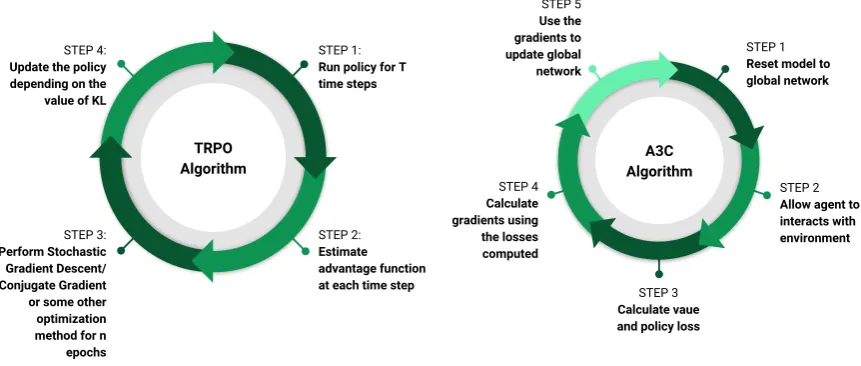
Figure 4.The figure depicts the training architectures of A3C and TRPO agents.
• Proximal Policy Optimization (PPO) [46]: This methods tries to solve soft constraint optimization problem making use of standard Stochastic Gradient Descent problem, in which C is tuned according the KL-divergence term. This is one of the most popular DRL algorithms due to its simplicity and effectiveness in solving control problems. It has been widely applied to various fields of policy estimation and is also the default algorithm in OpenAI.
• Actor Critic Kronecker-Factored Trust Region (ACKTR) [42]: This uses a form of trust region gradient descent algorithm for a actor-critic with curvature estimated using Kronecker-Factored approximation. It is effectively one of the most efficient DRL algorithms being computationally better than TRPO. It makes use of natural gradient descent being much more sample efficient than other methods using gradient descent.
These methods have shown great prospect when combined with the innumerable physical capabilities of the soft structure of bio-inspired robots[3,20], and are topic of great interest. Various works showcase that such neural network oriented approaches have been hugely successful when dealing with controls tasks especially manipulation with soft robots.
5. Deep Reinforcement Learning Mechanisms
solving DRL problems to obtain nearly optimal action with respect to each state for soft robotics has achieved great success as well as attention of robotics researcher around the world, hence, increasing the demand to not only formulate computationally less expensive DRL algorithms but also introduce mechanisms that enhance the productivity and efficiency if these algorithms. Some of them that have been common applied to diverse set of control tasks include :
• Auxiliary Tasks[47–51]: Usage of several other supervised and unsupervised machine learning methods like regressing depth images from colour images, detecting loop closures etc. besides the main algorithm to receive some information from sparse supervision signals in the environment.
• Prioritized Action Replay[52]: Prioritizing memory replay according to td-error
• Hindsight Action Replay[12]: Relabeling the rewards for the collected observations by more effective use of failure trajectories along with using binary/sparse labels that speed the off-policy methods.
• Curriculum Learning[53–55]: Exposing the agent to more sophisticated setting of the environment helping it to learn to solve complex tasks.
• Curiosity-Driven Exploration[56]: Incorporating internal rewards besides external ones collected from observations.
• Asymmetric Action Replay for Exploration[57]: The interplay between two forms of the same learner generates a curricula, hence, driving exploration
• Noise in Parameter Space for Exploration[58,59]: Inserts additional noise so as to aid exploration more in the learning procedure.
The persistently rising demands for creating not only structure that overpower humans in the physical capabilities and potentialities in terms of flexibility, strength, rigidness etc. but also systems that are completely autonomous and constantly evolving, has lead to heavy growth in the developments in DRL that could be applied to soft robots. This has lead to employment of such robots in almost all domains possible leading to a rise in the demand to create systems that are not only capable of performing a task but executing it within hardware constraints, ensuring safety, reducing environmental damage and using of minimum computational time and storage resources. This brings about a need for incorporating such mechanisms (as mentioned in this section) in our models that enhance and strengthen the impact of our DRL algorithms that are coupled with soft structure of our robots.
6. Deep Reinforcement Learning for Soft Robotics Navigation
Autonomous driving tasks with completely automated navigation in which the goal of the agent is to reach a given goal point avoiding static or moving obstacles in the path while following a trajectory that is planned minimizing the cost/effort exerted remains to be one of the pioneer tasks in robotic controls even with soft robotic systems.Deep RL approaches have turned out be an aid for suchnavigation tasks helping to generate such trajectories by learning from observations taken from the environment in form of state-action pairs. Similar to all other types of robots, Soft Robots also require autonomous navigation capabilities that can be coupled with their essential mechanical properties allowing them to execute onerous looking tasks with ease. Various soft robots that may be meant for investigation, maintenance or monitoring purposes at various workplaces have walking, climbing or crawling capabilities that require self-sufficient path planning potentialities for better use. Completely reliable and independent movement is necessary for creating better systems that perform tasks requiring continuous interaction with environment in order to find the path for desired movements.
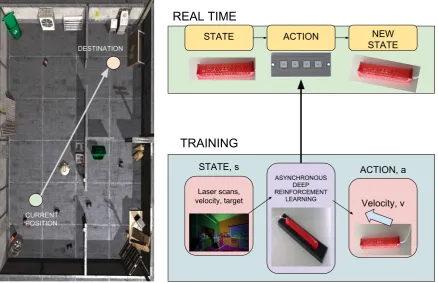
CURRENT POSITION VELOCITY
REAL TIME
TRAINING
STATE NEW
STATE ACTION
ASYNCHRONOUS DEEP REINFORCEMENT
LEARNING
Laser scans, velocity, target
STATE, s
Velocity, v ACTION, a
CURRENT POSITION
DESTINATION
Figure 5.The figure depicts the application of DRL techniques in the task of navigation.
Several experiments have been carried out in this growing field of research and some of them are stated below:
• Zhuet al.[60] gave the A3C system the first-person view alongside the target image to conceive the goal of reaching the destination point, by the aid of universal function approximators. The network used for learning is a ResNet[61] that is trained using a simulator[62] that creates a realistic environment consisting of various rooms each as a different scene for scene-specific layers. The model gave 70% accuracy for predicting the policy for targets away by one step from the trained targets and 42% for the ones two steps away. After being provided with images of a real scene of an office the robot could navigate effectively and in a collision-free manner. An A3C agent was trained on 100 million frames with an optimal solution of 17.6 steps over an average trajectory length of 210.7[60].
• Zhanget al.[26] implemented a deep successor representation formulation for predicting Q-value functions that learn representations interchangeable between navigation tasks that may be related in some way. Successor feature representation[24,25] breaks down the learning into two fragments - learning task-specific reward functions and task specific features alongside their evolution for getting the task in hand done. This method takes motivation from other DRL algorithms that make use of optimal function approximators to relate and utilize the information gained from previous tasks for solving the tasks we currently intend to perform[26]. This method has not only been observed to work effectively in transferring current policies to different goal positions in the same environment and varied/scaled reward functions but also to newer complex situations like new unseen environments. The models (pre-trained or transferred) attained high accuracy (nearly best possible) in solving control problem given a 3D maze with given start and goal point and RGB images for observation.
al.[63] proposes an approach in which it tries to create a trajectory for the mobile robot with the help of relative position of the robot with respect to the ultimate destination position that could be obtained with the help of Wi-fi or visible light localization. Such models are trained via asynchronous DDPG for varied set of real and simulations of real environments.
• Mirowskiet al.[47] made use of a popular DRL mechanism of using a additional supervision signals available (especially loop closures and depth prediction losses) in the environment allowing the robot to freely move between varying start and end point with increased accuracy and efficiency.
• Chen et al.[64] proposed a solution for highly compound problems involving dynamic environment (essentially obstacles) like navigating on a path with pedestrians as probable obstacles. It utilizes a simple set of hardware to demonstrate the proposed algorithm in which LIDAR sensor readings are used to predict the different properties associated with pedestrians (like speed, position, radius) that contribute to forming the reward/loss function. Longet al.[65] also makes use of PPO to conduct multi-agent obstacle avoidance task.
• Simultaneous Localisation and Mapping (SLAM)[66] have been at the heart of recent robotic advancements with a loads of papers been written regularly annually in this field in the last decade. SLAM may make use of DRL methodologies partially or completely and have shown to produce one of the best results in such tasks of localisation and navigation.
• A popular imitation learning problem that will be dealt with later in more detail trains a Cognitive Mapping and Planning (CMP)[67] model with DAGGer that inputs 3-channeled images and with the aid of Value Iteration Networks (VIN) creates a map of the environment. The work of Guptaet al.[68] has also introduced a new form of amalgamation of spatial reasoning and path planning.
• Zhanget al.[54] also introduced a new form of SLAM called Neural SLAM that took inspiration from works of Parisotto and Salakhutdinov[69] that allowed our agent to interact with Neural Turing Machine(NTM). Graph-based SLAM[66][70] led way for Neural Graph Optimiser by Parisottoet al.[71] which inserted this global pose optimiser in the network.
Further advanced readings on Navigation using DRL techniques include Zhuet al.[60], Schaulet al.[72], Heet al.[61], Kolveet al.[62], Zhuet al.[73], Longet al.[65], Guptaet al.[67], Khanet al.[74], Bruce et al.[75], Chaplotet al.[76] and Savinovet al.[77].
7. Deep Reinforcement Learning for Soft Robotics Manipulation
The extensive use of soft robots in industrial applications, replacing human labour and accelerating accuracy and efficiency has lead to sprouting of this new field of interest for roboticists. The application of DRL techniques for Manipulation tasks like picking, dropping, reaching etc.[17,40,44,78]. The enhanced rigidity, flexibility, strength and adaptation capability of soft robots over hard robots[79,80] has lead to its extensive applications in the manipulation field and combining it with DRL has been observed to give highly precise and satisfactory results. The coming of the soft robotics technologies and its extremely effective blend with such deep learning technologies has often contributed to robots becoming a crucial part of almost all manipulation tasks.
After great developments in the domain of soft robotics, we require much better learning algorithms that can solve much complex manipulation tasks alongside taking care that we follow all constraints that are enforced as a result of the physical structure of such bio-inspired robots[3,20]. Coming of DRL technologies have hugely influenced and more importantly enhanced the performance of such agents.
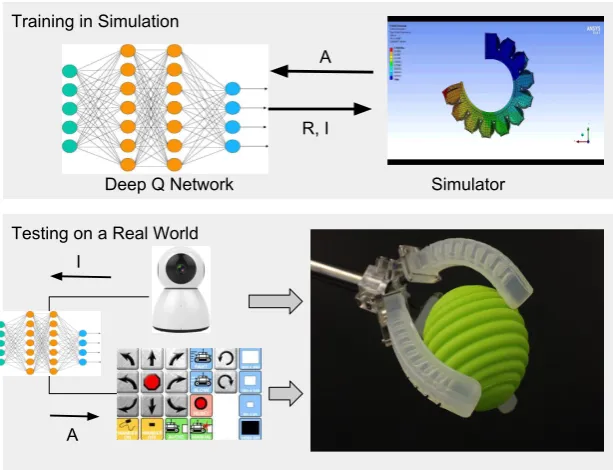
Training in Simulation
Testing on a Real World
Deep Q Network Simulator
A
R, I
I
A
Figure 6. The figure depicts the application of DRL techniques (DQN Method) in the task of manipulation.
• Guet al.[39]: Gave a modified form of NAF that works in a asynchronous fashion in the task of door opening taking state inputs like joint angles, end effector position, and position of target. It gave a whopping 100% accuracy in this task and learning it in mere 2.5 hours of time.
• Levineet al.[50]: Proposed a visuomotor policy based model that is an extended deep version of GPS algorithm studied earlier. The architecture of the network consists of convolutional layers along with softmax activation function taking in as input images of the environment and concatenating the necessary information gained along with the robot’s state information. The required torques are predicted by passing this concatenated input to linear layers at the end of the network. These experiments were carried out with a PR2 robot for various tasks like screwing a bottle, inserting block into a shape sorting cube etc. Despite its highly desirable results, it is not widely used in real world applications are it requires complete observability in state space that is sometime difficult to obtain in real life.
• Finnet al.[81] and Tzenget al.[82]: Made use of DRL techniques for predicting optimal control policies by studying state representations.
• Fu et al.[83]: Introduced the use of a dynamic network for creating a one-shot model for manipulation problems. There have been advancements in the area of manipulation using multi-fingered bio-inspired hands that may be model-based[84,85] or model-free[86].
• Riedmilleret al.[48]: Gave a new algorithm that enhanced the learning procedure from the time complexity as well as accuracy point of view. It said that sparse rewards for the model help in attaining more optimal policy faster than providing binary rewards that may lead to policy that not the desirable trajectories for the end effector. For this, another policy (referred to as intentions) was learned for auxiliary tasks whose inputs are easily attainable via basic sensors [87]. Alongside this, a scheduling policy is also learned for scheduling the intention policies. Such a system have much better results than a normal DRL algorithm for the task of lifting that took about 10 hours to learn from scratch.
Refer to figure??for images of some these ground-breaking works in field of DRL utilized for robotic manipulation tasks.
superiority over other alternative methods. The accuracy, precise and efficiency displayed by these autonomous bio-inspired industrial systems are huge in comparison to the human or hard robotic counterparts[88]. Involving more of such soft robots in place of humans has also lead to a drastic dip in chances of industrial disasters due to human error (as a result of their environment adaptation property) and they have proven to be extremely useful for working environments that are unsuitable for our bodies.
8. Difference between Simulation and Real World
Collecting training samples is not an easy task while solving the problem of controls in soft robotics as it is in perception for similar systems. Collection of real world dataset (state-action pair) is a costly operation due to the high dimensionality of the control spaces and the lack of availability of a central source of control data for every environment. This causes what we call asreality gapwhich refers to the difference in various factors in simulations and real world. This inflicts upon us various challenges while bringing models that have been trained in simulation to real world scenarios. Even though, we have various simulation software for soft robotics especially designed for manipulation tasks like picking, dropping, placing etc. as well as navigation tasks like walking, jumping, crawling etc., there are still challenges that act as hindrances in this problem of solving control tasks making use of these flexible robots.
Soft robots that have bio-inspired designs and materials making use of DRL techniques like the ones listed in the previous sections are known to yield satisfactory results, but still they face various obstacles that hinder their performance when tested on real world problem after being trained on simulation settings. Such a gap is most prevalently viewed in disparities in visual data[26] or laser readings[63] and some papers have aimed at reducing the discrepancies by proposing certain approaches. Following section provides an overview of some of them:
• Domain Adaptation: This basically just translates images from source domain to the destination domain. Domain confusion loss that was first proposed in the paper Tzenget al.[89] learns a representation that is undeviated and steady towards changes in domain. But the limitation to this approach lies in the fact that it requires the source and destination domain information before the training step, which is not possible for most models. Visual data coming from multiple sources is represented by X (simulator) and Y (on-board sensors). The problem arises when we train the model on X and test it on Y, wherein we observe a considerable amount of performance difference between the two. This problem ofreality gapis a genuine problem faced while dealing with systems involving soft robots due to the constant variations in the position of end-effector in numerous degrees of freedom, hence, there is need of a system that is invariant to changes in perspective (transform) with which the agent observes various key points in the environment. Domain adaptation is a simple yet effective approach that is widely utilized to solve simpler problems of low accuracy due to variations between simulation and real world accuracies.
• This problem can be solve if we have some kind of a mapping function that can map data from one domain to the other one. This can be done by employing a deep generative model called Generative Adversarial Network or commonly known as GANs[90–92]. GANs are deep models that have two basic components - a discriminator and a generator. The job of the generator or popular known as the decoder is produce images samples from the source domain to the destination domain, while that of the discriminator is to differentiate between true and false (generated) samples.
the mapping is reversible. It is a combination of two normal GANs and hence, two separate encoders, decoders and discriminators are trained according to equations:
LGANY(GY,DY;X,Y) =Ey[logDY(y)] +Ex[log(1−DY(DY(x)))] (21)
and
LGANX(GX,DX;Y,X) =Ex[logDX(x)] +Ey[log(1−DX(DX(y)))]. (22)
The loss term for the complete weight updation (after incorporating the cycle consistent loss terms for each GAN) step now turns out to be:
L(GY,GX,DY,DX;X,Y) =LGANY(GY,DY;X,Y) +LGANX(GX,DX;Y,X)
+λcycLcycY(GX,GY;Y) +λcycLcycX(GY,GX;X).
(23)
Hence, the final optimization problem turns out to be equation24.
GY∗,G∗X =arg min GY,GX
max
DY,DX
L(GY,GX,DY,DX) (24)
This is known to produce desirable results for scenes where it is relatively simpler to draw comparisons/relations between both domains but sometimes fails on complex domains environments.
– CyCADA[93]: The problems that CycleGAN, that was first introduced in Hoffmannet al.[93], faced were resolved by making use of the semantic consistency loss that could be used to map complex environments. It trains a model to move from the source domain containing semantic labels, helping us to map the domain images from X to that in Y. The equations that is used for mapping using the decoder are given by:
LsemY(GY;X,fX) =CE(fX(X),fX(GY(X))) (25)
and
LsemX(GY;Y,fX) =CE(fX(Y),fX(GX(Y))). (26)
Here, CE(SX,fX(X)) represents the cross-entropy loss between data-points predicted by
pre-trained model and the true labels SX.
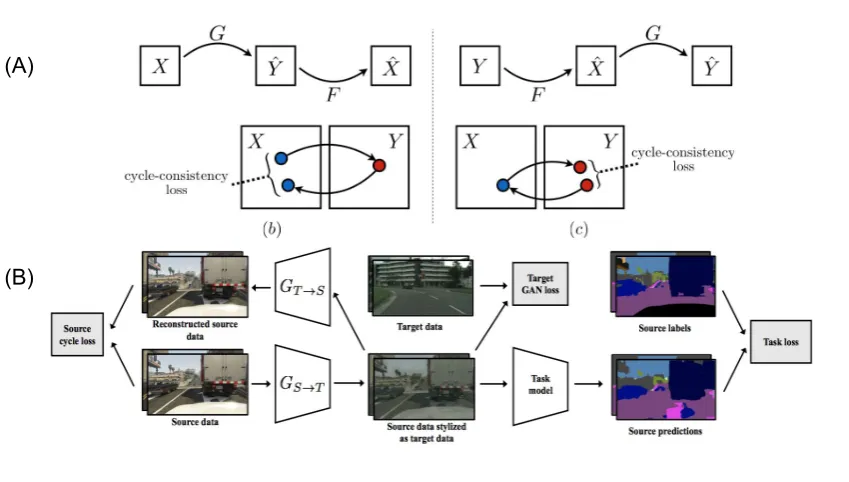
The training architecture of a CycleGAN and a CyCADA is described in figure7.
Not just these two applications (Domain Adaptation and GANs) but there are many more algorithms/techniques in which the usage of modern day deep learning frameworks like GANs[90–92], VAEs[94], disentangled representations[95,96] and many that have greatly aided the process of controls of soft robots. These developing frameworks have certainly widened the perspective of DRL for robotic controls during the current era of technological advancements, have proven that there is a huge scope for research in these fields and that they have ever growing applications in robotics. The combination of two such extremely tender fields of technology - soft robotics and modern deep learning frameworks (especially generative models) may be something that might act as stepping stones to major technological advancement in the next decade, and an essential part of all domains making use of robotics for controls (more generally manipulation).
• Domain Adaptation for Visual DRL Policies: In such adaptation techniques, we try to transform the policy from source domain to destination domain.
(A)
(B)
Figure 7.(A) Training Architecture of CycleGAN. (B) Training Architecture of a CyCADA.
9. Simulation Platforms
There are several platforms that are available for simulation purposes of DRL agents before testing them on real world applications. Some of them are given below in table??.
Table 3. The following tables lists down various simulation softwares available for simulating real-looking environments for training of DRL agents alongside the modularities available with them and their special domain of use.
Simulator Modalities Special Purpose of Use
Gazebo (Koeniget al.[103]) Sensor Plugins General Purpose Vrep (Rohmeret al.[114]) Sensor Plugins General Purpose
Airsim (Shahet al.[115]) Depth/Color/Semantics Autonomous Driving Carla (Dosovitskiyet al.[105]) Depth/Color/Semantics Autonomous Driving Torcs (Panet al.[116]) Color/Semantics Autonomous Drivings AI-2 (Kolveet al.[62]) Color Indoor Navigation Minos (Savvaet al.[117]) Depth/Color/Semantics Indoor Navigation House3D (Wuet al.[118]) Depth/Color/Semantics Indoor Navigation
The readily available softwares have lead to ease in robotics software development, and hence contributing heavily to the upcoming research in the field of controls. The fact that soft robotics hardware is relatively expensive and not easy to use and that a normal DRL agent requires lots of training even before testing it in the real environments, makes the presence of special purpose simulation tools more and more important. Hence, these upcoming simulation softwares have come to the aid of robotics researchers who wish to contribute in this field of robotic research.
Another problem that arises when we utilize soft robots for solving control tasks in place of the hard ones is that are there are much fewer simulation softwares available for soft robotics applications[10] as compared to the hard ones. The fact that soft robotics is a relatively new field results is the reason that there are scarcely any simulation softwares for manipulation tasks using a soft robot. The number of such softwares are expected to rise at a much brisk rate due to the heavy demand of soft robotics and the fact that DRL techniques are extremely expensive to train in real world environments. One of the most famous soft robotics simulator is SOFA that allows the user to model, simulate and control a soft robot. Soft-robotics toolkit[119] is a plugin that aids us to simulate soft robots using SOFA framework[120]. Others that are also capable of modeling and simulating soft robotics agents are V-REP simulator[121], Action simulation by Energid, and MATLAB (Simscape modeling)[122]. Some of these simulation softwares are shown in figure8.
10. Imitation Learning for Soft Robotic Actuators
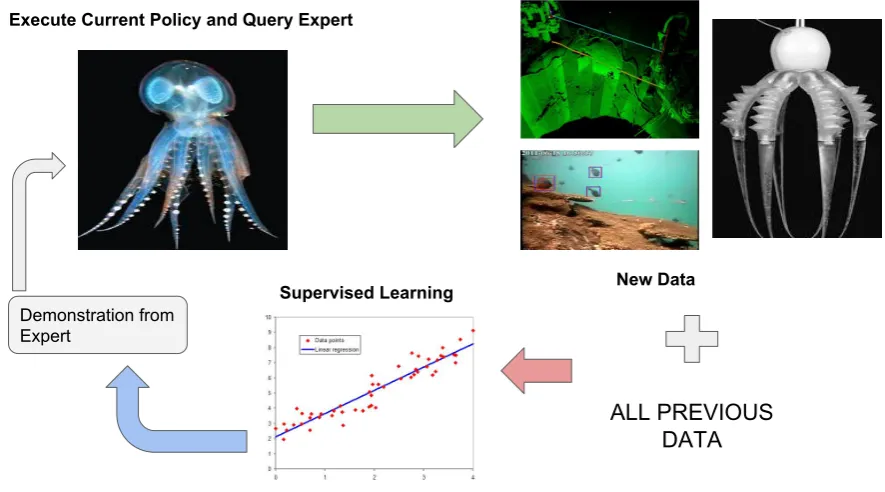
There are several drawbacks of training a DRL agent to perform control tasks especially for soft robots: relatively high training time and data that requires robot to interact with the real world which is computationally expensive, a well formulated reward function which might not be practical to obtain in some scenarios. Imitation Learning is a unique approach to perform a control task especially the ones involving use of bio-inspired robots without the requirement of a reward function due to the fact that it is inconvenient to formulate one in such cases where the problem is ill-posed, but requires an expert whose actions are mimicked by the agent[15]. In situations where we have such an expert present with high degrees of movement/action space leading to enormous computation time and necessity of a huge training set and it is difficult to give a reward function to describe the problem, Imitation Learning is extremely useful. An overview of the training procedure for an imitation learning agent is shown in figure9.
Execute Current Policy and Query Expert
Demonstration from Expert
New Data
ALL PREVIOUS
DATA
Supervised LearningFigure 9.The figure depicts the training procedure of an Imitation Learning Agent
The use of imitation learning for solving problems of manipulation like picking, dropping, etc.[123,124] where we can exploit several benefits of soft robotics over hard ones have become extremely essential. Controls tasks in such situations generally have tough to compute cost functions due to high dimension of action space caused by the flexibility introduced in the motion of the actuator/end-effector because of the soft structure of the robot leading to increased difficulty of applying DRL techniques. Under such situations the study of imitation learning becomes a topic of utmost significance due to the fact that it doesn’t require a cost function, all that it requires is an expert agent which in most cases of manipulation using soft robotics is a person who performs the same tasks that robot is required to copy. Therefore, manipulation with soft robotics and imitation learning algorithms for performing the control task in hand really go hand in hand and compliment each other, and hence, combining these two and finding new and better ways to do so may be a topic that gathers much attention in the coming years.
in common supervised learning problems and control problems. Following section provides overview of some of the variations:
• Errors - Independent or Compound: The basic assumption of common supervised learning task that assumes that the actions of the soft robotics agent do not affect the environment in any way is violated in the case of imitation learning control tasks. The presupposition that all data samples (observations) collected are independent and identically distributed is not valid for imitation learning tasks, hence, causing error pr opagation making the system highly unstable due to minor errors too.
• Time-step Decisions - Single or Multiple: Supervised learning models generally ignore the dependence between consecutive decisions which might be different from what primitive robotic approaches. The goal of imitation learning might be sometimes different from simply mimicking the expert’s actions. At times, there is a hidden objective that is often missed by the agent while simply copying the actions of the expert. These hidden objectives are somethings like avoiding to collide with obstacles, increasing the chances to complete a specific task, or minimizing the effort by the mobile robot.
In the next section, we describe three of the main imitation learning algorithms that have been successfully applied to real life scenarios effectively.
• Behaviour Cloning: This is one of most basic imitation learning approaches in which we train a supervised learning agent based on actions of the expert agent from input states to output states via performed actions. Despite it also facing problems mentioned in the last section, it gives reliable results provided we have good amount of training data available. DAGGer(Data AGGregation)[125] is one of the algorithms described earlier that solves the problem of propagation of errors in a sequential system. This simple yet useful algorithm is quite similar to common supervised learning problems in which at each iteration the updated (current) policy is applied and observations hence recorded are labeled by expert policy. The data collected is concatenated to the data already available and the training procedure is applied to it. This technique has been readily utilized in diverse domain applications due it simplicity and effectiveness. Even though this algorithm has now been observed to give satisfactory results in various fields of controls but this is still not believed to be effective with soft robots, and so in those case we generally avoid using this due to lack of labelled data. Bojarskiet al.[126] trained a navigation control model that collected data from 72 hours of actual driving by the expert agent and tried to mimic the state (images pixels) to actions (steering commands) with the help of a mapping function. Similarly, Taiet al.[127] and Giustiet al.[128] also came up with imitation learning applications for real life robotic control. Advanced readings also include Codevillaet al.[129] and Dosovitskiyet al.[105].
Imitation learning is also effective in problems involving manipulation. Some of them are listed below:
– Duanet al.[130] improved the one-shot imitation learning to formulate the low-dimensional state to action mapping, using behavioural cloning that tries to reduce the differences in agent’s and the expert actions. He used this method in order to make a robotic arm stack various blocks in the way the expert does it, observing the relative position of the block at each time step. The performance level achieved after incorporating various other additional features like temporal dropouts and convolutions was similar to that of a DAGGer. – Finnet al.[131] and Yuet al.[49] modified the already existing Model Agnostic Meta-Learning
(MAML)[132], which is a highly diverse algorithm that train a model on several varied tasks and making it capable to solve a new unseen task when given it. The updation of weights is quite similar to the common gradient algorithm and given by equation:
The learning is done to achieve the objective function given by:
∑
Ti∼p(T)LTi(fθ0) =
∑
Ti∼p(T)
LTi(fθ−α∇θLTi(fθ)) (28)
which leads us to the gradient descent step given by:
θ←θ−β∇θ
∑
Ti∼p(T)
LTi(fθ0i) (29)
whereinβrepresents the meta step size.
– While Duanet al.[130] and Finnet al.[131] proposes a way to train a model that works on newer set of samples as well the earlier described Yuet al.[49] is an effective algorithm in case of domain shift problems. Eitelet al.[133] came up with a new approach wherein he gave a new model that takes in over segmented RGB-D images as inputs and gives actions as outputs for segregation of objects in an environment.
• Inverse Reinforcement Learning: This method aims to formulate the utility function that makes the desired behaviour nearly optimal. Once, we have the utility function, our tasks is simplified as we only have to apply reinforcement learning algorithms on it to find the correct policy. A popular IRL algorithm called as Maximum Entropy IRL[134] uses an objective function as given by equation:
argmax
c∈C(minπ∈∏−H(π) +Eπ[c(s,a)])−EπE[c(s,a)]. (30) It is a highly appropriate algorithm for robotic applications where the robot is supposed to follow a set a constraints[135–137] (like for a soft robot trying to pick and drop certain coloured boxes the constraints could be to assemble them according to their colour) as in such situations it is not viable to formulate an accurate reward function but these actions are easy to demonstrate. Soft robotic systems generally have constraint issues due to the composition and configuration of different materials of the actuators resulting in elimination of a certain part of the action space (or sometimes state space also) hence, forcing us to involve IRL techniques under such situations. This is an extremely fruitful algorithm for soft robotic systems unlike the one mentioned before this, due to the ease of performing the task that we want to solve by the human expert due to the flexibility and adaptability of the soft robot. Maximum Entropy IRL[138] has been successfully used alongside deep convolutional networks to learn the multiplex representations in problems involving a soft robot to copy the actions of a human expert for simple control tasks.
• Generative Adversarial Imitation Learning: Even though, IRL algorithms are highly effective but they require large sets of data and huge training time. Hence, a more efficient alternative was proposed by Ho and Ermon[139] who gave Generative Adversarial Imitation Learning (GAIL) that comprises of an Generative Adversarial Network (GAN)[90]. Such generative models are extremely essential when working with soft robotic systems as they require huge sets of training data because of the wide variety of actions-state pairs possible in such cases and the fact that GANs are much complex deep networks that are able to learn complex representations in the latent space.
Like all other GANs, GAIL also consists of two separately and independently trained fragments -generator (or the decoder) that tries to generate state-action pairs close to that of the expert and the discriminator that learns to distinguish between samples created by the generator and real samples. The objective function of such a model is given by equation:
Some extensions of GAIL have been proposed in recent works including Baramet al.[140] and Wanget al.[141]. GAIL has been extremely successful in solving imitation learning problems in navigation (Liet al.[142] applied GAIL to autonomous navigation problems and Taiet al.[143] applied it for the purpose of finding socially complaint policies) as well as manipulation (Stadie et al.[144] used GAIL for mimicking an expert’s actions through domain agnostic representation). This presents before us an opportunity to be applied to systems involving soft actuators for its composite structure and unique learning technique.
Imitation learning for soft robotics being a relatively newer field of research, hasn’t yet been explored to its fullest and has extreme potential for future research lying ahead of it. It is highly effective in the domains of industrial applications, capable of replacing its human counterpart due to its precision, accuracy, reliability, and efficiency. It is the future of robotic developments in all areas where we have an expert agent (in most situations a person) whose actions can be mimicked to perfection by an autonomous soft robotics agent. These are the go-to algorithms in fields that involve tough and sometimes almost impossible formulation of an appropriate cost function due to high action space dimensionality of soft robots. These techniques present before us a huge scope of combining with common DRL approaches and could form a really effective amalgam that could copy the expert as well as learn on it own via exploration depending on the situation in hand, and hence, must be a center for future deep learning developments in soft robots.
11. Future Scope
Even though, deep learning has been successfully applied to innumerable real life problems and has proven out to be the best alternative to solve control problems like manipulation in soft robots, there are still various challenges that need to be conquered and hence, open new avenues for further growth and research in this field. Further, we list some of the steps stones in the path of using deep reinforcement approaches to solve such tasks that will certainly be hot topics of research in the near future:
• Sample Efficiency: It takes great amount of effort and resources in collecting observations for training by making our agent interact with the environments especially for soft robotic systems due to the huge number of actions possible at each state pertaining to the biomimetic motions possible [9,155] because of the flexible bio-inspired actuators, hence, making way for further research in creating efficient systems who can collect experiences without much expense.
• Strong Real-time Requirements: Training huge networks with millions of neurons and tons of tuneable parameters that requires special hardware and loads of time. The current policies need to made compact in its representation to prevent wastage of time and hardware resources in training. The dimensionality of the actions as well as the state space for soft robotic actuated systems is much sizeable as compared to its hard counterpart leading to a rise in the number of neurons in the deep network.
• Safety Concerns: The control policies need designed need to extremely precise in its decision making process as robots like factories producing food items using soft robots are required to operate in environments where even a small error could cause loss of life and property.
• Stability, Robustness and Interpretability[156]: Slight changes in configurations of parameters or robotic hardware or chances in concentration or composition of material of soft robot over time might affect the performance of the agent in a great way, hence making it unstable. Especially in soft robotic systems a constant or static configuration of the agent is extremely hard to maintain and the fact that our model is unable to operate for such changes after completion of training is a challenges when involving these technologies on such systems. Some kind of a learned representation that can detect adversarial scenarios could be of great use and a topic of interest for researchers aiming to improve performance of DRL agents on soft robotic systems.
Table 4.The following tables lists and describes few instances of bio-inspired soft robotics applications that make (or may in the future) use DRL or Imitation Learning technologies.
Type of Soft Bio-Inspired Robot Features of Soft Physical Structure
Applications of DRL/Imitation Learning Algorithms
MIT’s Soft Robotic Fish (SoFi)[145–149]
• 3D Movements • Soft Fluidic Elastomer
Actuators
• Rapid Planar
Movements
• Continuum Body Motion
• Multiple Degrees of Freedom
• Quick Escape
Capabilities • Completely Autonomous Maneuvering using DRL navigation techniques (described in section6)
• DRL techniques
imployed for
underwater vision capabilites
Harvard’s Soft Octopus (Octobot)[150,151]
• Microfluidic logic • Immense Strength
and Dexterity with no internal skeleton • Innumerable Degrees
of Freedom
• Ease in protyping due 3D printable structure • Rapid Maneuvering through tight spaces
• DRL and Imitation Learning algorithms extensively employed for manipulation capabilities like grasping and picking
• Completely Autonomous
navigation potential via use of Deep Learning techniques
CMU’s Inflatable Soft Robotic Arm[152,153] • Quick Planar
Movement via Soft Artificial Muscle Actuators, Soft and Stretchable Elastic Films and Flexible Electronics
• Touch Sensors and Pressure-Sensitive Skins to predict the shape of objects
• Highly precise grasping, holding and picking capabilities via DRL techniques
• DRL and Deep Learning Vision abilities
Soft Caterpillar Micro-Robot[154]
• Light-sensitve rubby material that harvest energy from light • Ease in protyping due
3D printable structure • Horizontal/Vertical
Movement possible in tough environment, angles and conditions • Strength to push items
10 times its mass
• Completely Autonomous Movement