Mixed Design Procedure for Self Compacting Concrete
Malle. Mallikarjuna Rao & Ch.Prahasith1pg Scholar,Department Of Civil Engineering,Ellenki College Of Engineering And Technology Near
Bhel, Paltelguda, Patancheru, Medak. Mailid:[email protected]
2assistant Professor,Department Of Civil Engineering,Ellenki College Of Engineering And Technology
Near Bhel, Paltelguda, Patancheru, Medak. Mailid:[email protected] ABSTRACT:
Self-compacting concrete(SCC) possesses enhanced qualities and improves productivity and working conditions due to elimination of compaction. SCC is suitable for placing in structures with congested reinforcement without vibration and it helps in achieving higher quality of surface finishes. However utilization of high reactive Metakaolin and Flyash as an admixtures as an effective pozzolan which causes great improvement in the pore structure, also compactibility is affected by the characteristics of materials and the mix proportions, it becomes necessary to evolve a procedure for mix design of SCC .In this paper presents an experimental procedure for the design of self-compacting concrete mixes. The relative proportions of key components are considered by volume rather than by mass. A simple tool has been designed for self compacting concrete (SCC) mix design with 29% of coarse aggregate, replacement of cement with Metakaolin and class F flyash, combinations of both and controlled SCC mix with 0.36 water/cementitious ratio(by weight)
and 388 litre/m3 of cement paste volume. Crushed granite stones of size 16mm and 12.5mm are used with a blending 60:40 by percentage weight of total coarse aggregate. Detailed steps are discussed in this study for the SCC and its mortar.
Keywords–– Self compacting concrete, Metakaolin, Flyash, mixdesign, simple tool
for transportation networks in Sweden in the mid1990’s. The EC funded a multi-national, industry lead project “SCC” 1997-2000 and since then SCC has found increasing use in all European countries. Self-compacting concrete offers a rapid rate of concrete placement, with faster construction times and ease of flow around congested reinforcement. The fluidity and segregation resistance of SCC ensures a high level of homogeneity, minimal concrete voids and uniform concrete strength, providing the potential for a superior level of finish and durability to the structure. SCC is often produced with low water-cement ratio providing the potential for high early strength, earlier demoulding and faster use of elements and structures. The elimination of vibrating equipment improves the environment on and near construction and precast sites where concrete is being placed, reducing the exposure of workers to noise and vibration. The improved construction practice and performance, combined with the health and safety benefits make .SCC a very attractive solution for both precast concrete and civil engineering construction. In 2002 EFNARC published their “Specification & Guidelines for Self-Compacting concrete” which, at that time, provided state of the art information for producers and users. Since then, much additional technical
information on SCC has been published but European design, product and construction standards do not yet specifically refer to SCC and for site applications this has limited its wider acceptance, especially by specifiers and purchasers. In 1994 five European organisations BIBM, CEMBUREAU, ERMCO, EFCA and EFNARC, all dedicated to the promotion of advanced materials and systems for the supply and use of concrete, created a “European Project Group” to review current best practice and produce a new document covering all aspects of SCC.
1.1 CONCRETE MIXTURE
1.2 SELECTION OF MIX PROPORTIONS In designing the SCC mix, it is most useful to consider the relative proportions of the key components by volume rather than by mass [9]. The following key proportions for the mixes listed below [15], [9], [13] and [7]: 1. Air content (by volume) 2. Coarse aggregate content (by volume) 3. Paste content (by volume) 4. Binder (cementitious) content (by weight) 5. Replacement of mineral admixture by percentage binder weight 6. Water/ binder ratio (by weight) 7. Volume of fine aggregate/ volume of mortar 8. SP dosage by percentage cementitious (binder) weight 9. VMA dosage by percentage cementitious (binder) weight
1.3. RESEARCH SIGNIFICANCE A simple and user friendly tool has been developed for SCC mix design on the basis of key proportions of the constituents of SCC with or without blended cement and with or without coarse aggregate blending.
1.4. OUTLINE OF THIS PAPER This paper includes the selection of mix proportions for SCC from the relevant literature, the experimental program, material properties, design of SCC mix design tool, calculation of key proportions for a given SCC scenario, evaluation of SCC mix design and conclusions.
II. EXPERIMENTAL STUDY
2.1. EXPERIMENTAL PROGRAM According to SCC mix design with the available materials. In this study, this tool has been used to design a SCC mix having 29% of coarse aggregate content and 388 litre/m 3 of paste volume, 5%, 10%, 15% & 20% replacement of cement with Metakaolin and 10%,20%&30% replacement with class F fly ash and 0.36 water/cement ratio (by weight). Crushed granite stones of size 16mm and 12.5mm are used with the blending 60:40 by percentage weight of total coarse aggregate.
2.2. MATERIAL PROPERTIES This section will present the chemical and physical properties of the ingredients. Bureau of Indian Standards (IS) and American Society for Testing and Materials (ASTM) procedures were followed for determining the properties of the ingredients in this investigation.
2.2.1. CEMENT Ordinary Portland Cement 43 grade was used corresponding to IS-8112(1989).The specific gravity of cement is 3.15.
2.2.3. ADDITIVE OR MINERAL ADMIXTURE Metakaolin manufactured from pure raw material to strict quality standards. Metakaolin is a high quality pozzolanic material, which blended with Portland cement in order to improve the strength and durability of concrete and mortars. Metakaolin removes chemically reactive calcium hydroxide from the hardened cement paste. It reduces the porosity of hardened concrete. Metakaolin densified and reduces the thickness of the interfacial zone, this improving the adhesion between the hardened cement paste and particulars of sand or aggregate. Metakaolin procured from 20 Microns company Vadodara, Gujarat, India and Class F fly ash from Rayalaseema ThermalPower Plant (RTPP), Muddanur, A.P,India is used as additives according to ASTM C 618 [5]. As per IS- 456(2000) [6], cement is replaced by weight of material. The specific gravity of Metakaolin is 2.5 and fly ash is 2.12.
2.2.4. COARSE AGGREGATE Crushed granite stones of size 16mm and 12.5mm are used as coarse aggregate. As per IS: 2386 (Part III)-1963 [6], the bulk specific gravity in oven dry condition and water absorption of the coarse aggregate are 2.66 and 0.3% respectively. The dry-rodded unit weight (DRUW) of the coarse aggregate with the coarse aggregate blending
60:40 (16mm and 12.5mm) as per IS: 2386 (Part III)1963 [4] is1608 kg/m 3 .
2.2.5. FINE AGGREGATE Natural river sand is used as fine aggregate. As per IS: 2386 (Part III)-1963 [6], the bulk specific gravity in oven dry condition and water absorption of the sand are 2.6 and 1% respectively.
2.2.6. WATER Ordinary tap water is used
3.LITERATURE REVIEW
Hajime Okamura et al. (2003)
In early 1980s, the problem of the durability of concrete structures was a major topic of interest in Japan.
The creation of durable concrete structures requires adequate compaction by skilled workers.
Lack of uniform and complete compaction as the primary factor responsible for poor performance of concrete structures. Okamura solved the issue of degrading quality of concrete construction due to lack of compaction by the employment of SCC which is independent of the quality of construction work. Introduced SCC in the late 1980s.
Early 1990s limited public knowledge about SCC, mainly in the Japanese language. The prototype of SCC was completed in 1988 with available materials in the market and is shown below.
Okamura and Ozawa proposed simple mix design method.
The coarse aggregate content in concrete is fixed at 50% of solid volume.
The fine aggregate content is fixed at 40% of mortar volume.
The water-powder ratio in volume is assumed as 0.9 to 1.0, depending on the properties of the powder.
The SP dosage and the final w/b ratio are determined so as to ensure self compactability.
Nan Su et al. (2001)
Proposed new Mix design method based on experimental investigation carried out in Taiwan. Packing Factor is used to determine the aggregate contents.The volume of fine aggregate is more than coarse aggregate.
Simpler, easier for implementation and less-time consuming, requires smaller amount of binders and saves cost as compared to the method developed by JRMCA (Japanese Ready-Mixed Concrete Association).
Soo-Duck Hwang et al. (2006)
Studied the suitability of various test methods for workability assessment and proposed performance specifications.70 SCC mixes with w/c ranges of 0.35 and 0.42.
For structural applications slump flow ranges of 620 to 720mm, L-box ratio (h2/h1)≥0.7, J-Ring flow of 600 to 700mm, V-Funnel Flow time ≤8 sec.
Paratibha Aggarwal et al. (2008) [
Presented the experimental procedure to obtain the SCC mixes based on Japanese Method of mix design.Initially trial mixes, CA – 50% by volume of concrete, FA - 40% by volume of mortar with a w/c ratio of 0.90.
the required results in all the tests i.e., slump flow, V-funnel and L-Box.
Dr. Hemant Sood et al. (2009) [2]
Presented the experimental investigation of SCC using Flyash and Rice husk ash as mineral admixtures and testing rheological properties as per European Standards.
S. Venkateswara Rao et al. (2010) Aims at developing standard and high strength SCC with different sizes of aggregate based on Nan-su’s mix design procedure.The variables involved in the study are size of aggregate, dosage of fly ash and grade of concrete.SCC can be developed with all sizes of graded aggregate satisfying the SCC characteristics.
Noticed that the fresh properties improved with increase in fly ash percentages. This study illustrated that the optimum dosages of fly ash were 52% addition in case of standard grade SCC and it is 31% addition in case of high strength Self Compacting Concrete. N R Gaywala et al. (2011)
Studied the strength properties of SCC when cement is replaced by different proportions of fly ash ranging from 15% to 55% and are compared with M25 concrete. The experimental result shows that the 15% fly ash mix gives the better strength characteristics as compared to the other fly ash mixes.
Prof. Shriram H. Mahure et al. (2013)
Aimed to develop Self Compacting Concrete using two industry wastes: cement kiln dust (CKD) and fly ash (FA). CKD was used to replace the cement content b0y three various percentages (5, 10 and 15%) and fly ash was kept as constant (20%).
. Nan Su et al
proposes a simple design mix method for Self-compacting concrete in 2001. Primarily, required quantities of aggregates are evaluated and binder paste is then poured in to space of aggregates to make sure that concrete attained flowability, its own compactability and other properties of SCC. To observe the behavior of SCC compressive test were carried out. Obtained result indicates this method could produce successfully high quality of self-compacting concrete. As compare to the Japanese Ready-Mixed Concrete Association this method is easier, simple for execution, time consumption is less and cost effective. Hajime Okamura et al[4] presented an “Experimental studies on self-compacting concrete” in 2003. For creating SCC as a standard concrete so many experiments, testing methods and some investigation for prop
3.
EXPERIMENTAL
INVESTIGATIONS
An experimental study is conducted to find out the 7 and 28 days Compression strengthon self-compacting concrete. In concrete micro silica and GGBS are added. The effect of addition of micro silica and GGBS on strength and workability of concrete over the conventional concrete are investigated.
3.2MATERIALS
3.2.1Cement
Bond is a fine, dim powder. It is blended with water and materials, for example, sand, rock, and squashed stone to make concrete. The bond and water frame glue that ties alternate materials together as the cement solidifies. The standard concrete contains two fundamental fixings in particular argillaceous and calcareous. In argillaceous materials mud prevails and in calcareous materials calcium carbonate prevails. Fundamental piece of bond is demonstrated in Table
INGREDIENT % CONTENT
CaO (Lime) 60-67
SiO2 (Silica) 17-25
Al2O3 (Alumina) 3-8
Fe2 O3 (Iron Oxide) 0.5-6
MgO (Magnesia) 0.1-4
Alkalies 0.4-1.3
Sulphur 1-3
Table 1.1 Composition limits of Portland cement
Grade 43 Ultra Tech bond was utilized for throwing shapes and chambers for every solid
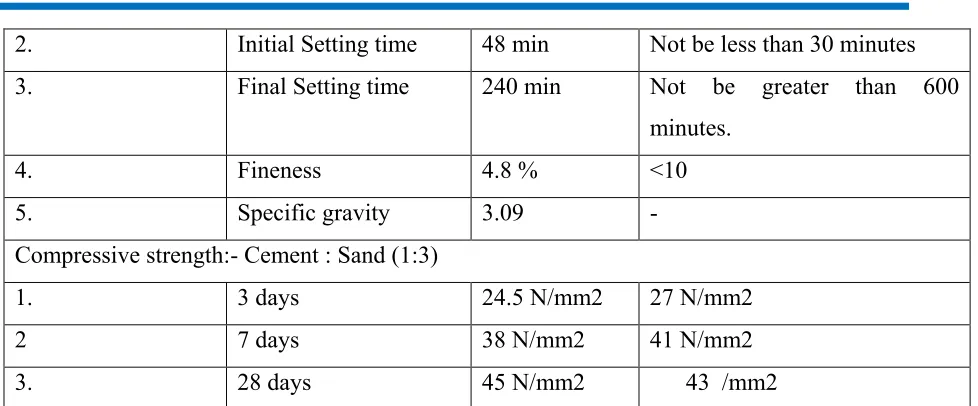
blend. The concrete was of uniform shading i.e. dark with a light greenish shade and was free from any hard bumps. Synopsis of the different tests led on bond is as under given underneath in Table.
S.No. Characteristics Values Obtained
Standard values
2. Initial Setting time 48 min Not be less than 30 minutes
3. Final Setting time 240 min Not be greater than 600
minutes.
4. Fineness 4.8 % <10
5. Specific gravity 3.09 -
Compressive strength:- Cement : Sand (1:3)
1. 3 days 24.5 N/mm2 27 N/mm2
2 7 days 38 N/mm2 41 N/mm2
3. 28 days 45 N/mm2 43 /mm2
Table 1.2: Physical Properties of Cement
3.2.2.Fine Aggregates
The sand used for the experimental programme was locally procured and conformed to Indian Standard Specifications IS: 383-1970. The sand was first sieved through 4.75 mm sieve to remove any particles greater than 4.75 mm and
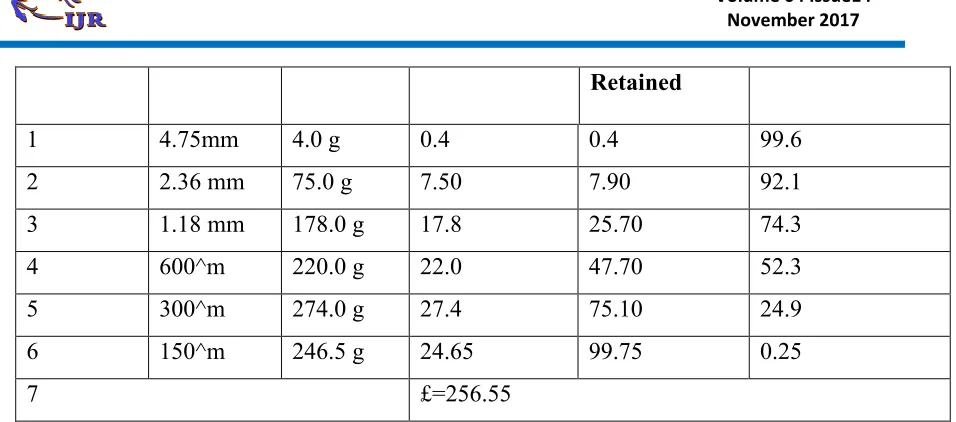
then was washed to remove the dust. Properties of the fine aggregate used in the experimental work are tabulated in Table. The aggregates were sieved through a set of sieves to obtain sieve analysis and the same is presented in Table. The fine aggregates belonged to grading zone III.
Sr. No. Characteristics Value
1. Specific gravity 2.46
2. Bulk density 1.4 kg/m3
3. Fineness modulus 2.56 m2/g
4. Water absorption 0.85 %
5. Grading Zone (Based on
percentage passing 0.60 mm)
Zone III
Table 1.3:Physical Properties of fine aggregates
Sr. No. Sieve Size Mass retained
Percentage Retained
Cumulative Percentage
Retained
1 4.75mm 4.0 g 0.4 0.4 99.6
2 2.36 mm 75.0 g 7.50 7.90 92.1
3 1.18 mm 178.0 g 17.8 25.70 74.3
4 600^m 220.0 g 22.0 47.70 52.3
5 300^m 274.0 g 27.4 75.10 24.9
6 150^m 246.5 g 24.65 99.75 0.25
7 £=256.55
Table 1.4: Sieve analysis of fine aggregates
Total weight taken = 1000gm Fineness Modulus of sand = 2.56
3.2.3.Coarse aggregate
The material which is retained on IS sieve no. 4.75 is termed as a coarse aggregate. The crushed stone is generally used as a coarse aggregate. The nature of work decides the maximum size of the coarse aggregate. Locally available coarse aggregate having the maximum
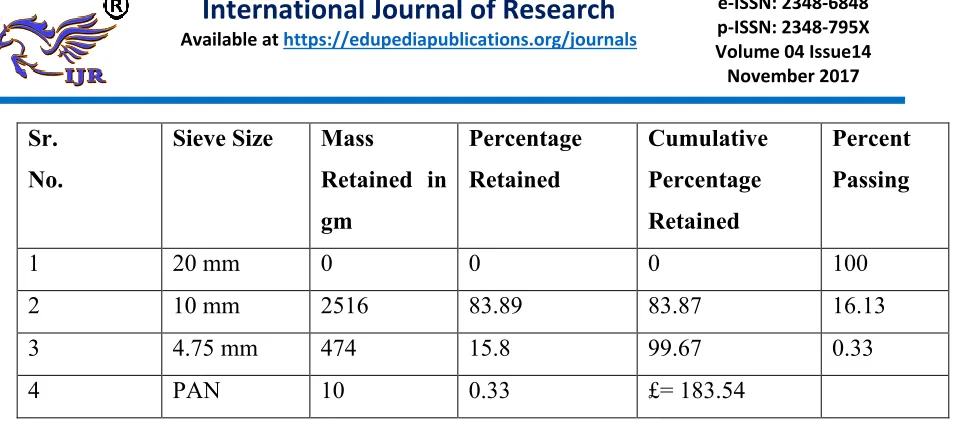
size of 10 mm was used in our work. The aggregates were washed to remove dust and dirt and were dried to surface dry condition. The aggregates were tested as per IS: 3831970. The results of various tests conducted on coarse aggregate are given in Table 3.5 and Table 3.6 shows the sieve analysis results.
Sr. No Characteristics Value
1 Type Crushed
2 Specific Gravity 2.66
3 Total Water Absorption 0.56
4 Fineness Modulus 6.83
Sr. No.
Sieve Size Mass
Retained in gm
Percentage Retained
Cumulative Percentage Retained
Percent Passing
1 20 mm 0 0 0 100
2 10 mm 2516 83.89 83.87 16.13
3 4.75 mm 474 15.8 99.67 0.33
4 PAN 10 0.33 £= 183.54
Table 1.6: Sieve Analysis of C.A Total weight taken = 3Kg
FM of Coarse aggregate = [183.54+500] / 100 = 6.83.
3.2.4.GGBS
Ground granulated blast-furnace slag is a non-metallic product consisting essentially of silicates and aluminates of calcium and other bases. The molten slag is rapidly chilled by quenching in water to form glassy sand like material. The granulated material when further
ground to less than 45 micron will have specific surface about 400 to 600m2/kg. The chemical composition of blast furnace slag is similar to that of cement clinker. In this investigation, GGBS is brought from steel work at Bellary. Specific gravity of GGBS is 2.62 and its chemical composition is shown in table.
Sl No Parameter Quantity (% wt)
1 Insoluble residue 0.83
2 Manganese Oxide 0.25
3 Magnesium oxide 10.13
4 Sulphide sulphur 0.75
5 CaO+MgO+1/3Al2O3
SiO2+2/3Al2O3
1.10
6 CaO+MgO+ Al2O3 SiO2 1.84
CONCLUSIONS
At the water/powder ratio of 1.05, slump flow test, V-funnel test and L-box test results were found to be satisfactory, i.e. passing ability, filling ability and segregation resistance are well within the limits.
By using Ordinary Portland cement, normal strength of 50.60 MPa is obtained at 28 days, keeping the cement content 390 kg/m3. As SCC technology is now being adopted in many countries throughout the world, in absence of suitable standardized test methods it is necessary to examine the existing test methods and identify or, when necessary to develop test methods suitable for acceptance as International Standards. Such test methods have to be capable of a rapid and reliable assessment of key properties of fresh SCC on a construction site. At the same time, testing equipment should be reliable, easily portable and inexpensive. A single operator should carry out the test procedure and the test results have to be interpreted with a minimum of training. In addition, the results have to be defined and specify different SCC mixes. One primary application of these test methods would be in verification of compliance on sites and in concrete
production plants, if self-compacting
concrete is to be manufactured in large quantities.
REFERENCES
Japan Society of Civil Engineers,
‘Recommendations for Design and Construction of AntiwashoutUnderwater Concrete’, Concrete library of JSCE, 19 (1992) 89.
Peterson, Ö., Billberg, P., Van, B.K., ‘A
model for self-compacting Concrete’,
Proceedings ofInternational RILEM Conference on ‘Production Methods and Workability of Concrete’, edited byP.J.M. Bartos, et al. (Chapman & Hall/E & FN Spon) (Paisley, 1996) 483-490.
Bartos, P.J.M., ‘An appraisal of the
Orimet Test as a Method for On-site
Assessment of Fresh SCCConcrete’,
Proceedings of International Workshop on Self-Compacting Concrete, (Japan, August1998) 121-135.
Haykawa, M., ‘Development and
Application of Super Workable Concrete’, Proceedings ofInternational RILEM Workshop on ‘Special Concretes - Workability and Mixing’, edited by Prof.P.J.M. Bartos, (Paisley, 1993) 183-190.
Ozawa, K., Sakata, N., Okamura, H.,
Concrete UsingThe Funnel Test’, Concrete Library of JSCE, (25) (June 1995) 59-75.
Rooney, M., Bartos, P.M.J.,
‘Development of the settlement column
segregation test for fresh
self-compactingconcrete (SCC)’, to appear in the second international symposium on SCC, Tokyo, Japan (2001).
Brite-EuRam programme:
BE96-3801/BRPR-CT96-0366, ‘Rational production and improvedWorking environment through using self-compacting concrete’.
Henderson N A, Baldwin N J R,
McKibbins L D, Winsor D S, & Shanghavi H B,
'Concretetechnology for foundation
applications', CIRIA Report C569: 2002.
M. S. SHETTY Concrete Technology, by
S. CHAND Publisher.
EFNARC (www.efnarc.org)
SUBRAMNIAN. S.
CHATTOPADHYAY. D. "Experiments for
mix- proportioning of self-compacting
concrete", The Indian Concrete Journal, Jan 2002.
Indian Standard Codes for Concrete & Guidelines.
CHAMPION, J. M. and JOST, P.,
'Self-compacting concrete: Expanding the possibility of Concrete Design and Placement', Concrete
International, Vol.22, No.4, pp. 159-178, June 1998.
HEINE, HANS J. "Saving Dollars
through Sand Reclamation - Part 1,” Foundry Management and Technology. (May, 1983), pp.
KAMESWARA RAO, C.V.S (1983)
"Analysis of Some Common Workability Tests". Indian Concrete Journal.
KATHY STANFIELD, "Self-compacting
concrete a Growth area", The Str.Engg., Vol. 76, No’s 23 and 24
NAGATAKI, S. and FUJIWARA, H.
"Self-compacting property of Highly-Flowable Concrete" ICI Journal July-September 2002.
KLAUS HOLSCHEMACHER,
"Structural Aspects of Self- compacting concrete", NBM & CW, July 2002
MAHINDRAKAR A.B. Research work
Study on Red Mud by, KLESCET, Belgaum, 1999.
MEHTA, P.K., 'Concrete structure:
Properties and materials', Prentice Hall, 1986. ICI Journal July-Sep 2002.
MICHEAL J. CAMPION and
PHILLIPPE JOST, "Self-compacting concrete", Concrete Int. 2000.
OKAMURA (1997), "Self-Compacting
High Performance concrete", Concrete