Original Research Article
An evaluation of health-related quality of life and its determinants
among people living with HIV/AIDS attending tertiary care hospital of
Kurnool, India
S. Cynthia Subhaprada, Shasank R. V. S. S., T. Sivakala*, S. Madhusai
INTRODUCTION
Acquired immune deficiency syndrome (AIDS) is a syndrome caused by human immunodeficiency virus (HIV). HIV or AIDS is one of the serious public health problems with severe impact on various facets of life. Globally, 36.9 million people were living with HIV at the end of 2017. An estimated 0.8% of adults aged 15-49 years worldwide are living with HIV.1 Around 59% of people living with HIV were receiving antiretroviral
treatment by the end of 2017.In India, an estimated 21.40 lakhs people living with HIV (2017) with the prevalence of 0.22% of adult population. Andhra Pradesh state stands among top five highest prevalent states with a prevalence of 0.63%.2 According to recent National AIDS Control Organization data, India is estimated to have around 87.58 (36.45-172.90) thousand new HIV infections in 2017, showing new HIV infection decline by 85% since the peak of 1995 and by 27% between 2010 to 2017. As per UNAIDS report in 2017 there were a
ABSTRACT
Background: HIV/AIDS is known to affect an individual not only physically but also mentally, socially, and financially. It is a syndrome that builds a vacuum in a person affecting his/her life as a whole. Combined with ART, Quality of life (QoL) is an important component in the evaluation of the wellbeing of people living with HIV/AIDS (PLHIV). The objective of this study is to assess health related quality of life of HIV/AIDS patients attending ART clinic Tertiary care hospital, GGH, Kurnool and to determine the association of socio-demographic and disease related variables with health related quality of life.
Methods: A cross-sectional study was conducted from April 2019 to June 2019 involving 400 purposively selected HIV-positive patients of age >18 years, who were taking highly active anti-retroviral therapy for the past 6months from the ART center, GGH, Kurnool. After obtaining IEC clearance and informed consent, WHOQOL-BREF instrument was used for data collection. Data analysis was performed using IBM SPSS version 26.0.
Results: Out of the 400 participants, 60% were males. The mean age of the participants was 38.5±10.54 years. Overall quality of life had a mean score of 69.71. Physical (82.57) and level of independence (78.78) domains showed higher mean score when compared to psychological (63.82), environmental (61.49) and Social (60.26) domains.
Conclusions: Among study subjects 15.5% had excellent QoL (≥80), nearly 69.75% had good QoL (60-79) and 14.75% had poor QoL (<60). Low QoL scores were seen in the social domain, suggesting that more social interventions are required in this population.
Keywords: Health related quality of life, Patients living with HIV/AIDS, WHOQOL-BREF Department of Community Medicine, Kurnool Medical College, Kurnool, Andhra Pradesh, India
Received: 02 August 2019
Revised: 12 September 2019
Accepted: 13 September 2019
*Correspondence:
Dr. T. Sivakala,
E-mail: [email protected]
Copyright: © the author(s), publisher and licensee Medip Academy. This is an open-access article distributed under the terms of the Creative Commons Attribution Non-Commercial License, which permits unrestricted non-commercial use, distribution, and reproduction in any medium, provided the original work is properly cited.
total 69000 number of HIV/AIDS related deaths in India. Since the peak, the number of annual AIDS-related deaths has declined by almost 71%.2
Antiretroviral drugs have revolutionized the treatment for HIV by increasing the average life span of HIV positive individuals. India has launched national ART (antiretroviral therapy) program in 2004 with the aim to provide free ART drugs to the patients suffering from HIV or AIDS. At present there are 448 ART centers providing access to patients to get free ART drugs. With the introduction of antiretroviral treatment the course of disease has drastically changed from a fatal to a chronic and potentially manageable disease. However people with HIV or AIDS continue to have substantially lower quality of life than general population, even where the majority of those living with HIV have virological control and immunologically stable. Combined with ART, improving quality of life is central to the care and support of people living with HIV (PLHIV).3 Improved access to ART and other biomedical interventions must be adequately matched with the requisite psychosocial treatment to help improve the effectiveness of such interventions and for overall better outcome of the disease.4
Optimizing care for PLHIV requires an understanding of the factors that contribute to physical health, psychological wellbeing, social relationships, and quality of life. In view of achievable longer life span among people using ART, quality of life (QOL) has emerged as a significant medical outcome measure and its enhancement has an important goal. The World Health Organization (WHO) defined QOL as individuals perception of their position in life in the context of the culture and value systems in which they live and relation to their goals, standards, expectations and concerns.5 It is a broad ranging concept affected in a complex way by the person's physical health, psychological state, personal beliefs, social relationships and their relationship to salient features of their environment.5The second objective of the National AIDS control program phase IV of India aims to provide comprehensive care to people living with HIV or AIDS (PLHIV).6 Improving QOL is in line with comprehensive care. Studies in context of assessing QOL among PLHIV are few in India and very few in Andhra Pradesh state which stand among one of the highest prevalence states in the country. Hence this study was aimed to assess health related quality of life of HIV or AIDS patients attending ART clinic, Tertiary care hospital, GGH, Kurnool and to determine the association of socio-demographic and disease related variables with health related quality of life.
METHODS
A cross-sectional study was conducted among people living with HIV positive/AIDS aged above 18 yrs and on ART drugs for more than 6months duration attending to
ART centre of tertiary care hospital, Kurnool from April 1st to June 30th 2019.
Ethical issues
Ethical clearance was obtained from the Ethical Committee of Kurnool Medical College before starting the study proper. The purpose of the study was clearly explained to all study subjects in their local language and interviewed after taking informed consent.
Sample size
Sample sizewas calculated by using, a z value of 1.96 as the degree of accuracy at 95% confidence interval, proportion of PLWHA with QOL level of better than average was assumed to be 50% and 10% allowable error. Based on this the sample size was calculated to be 392.7 in the present study, 400 study subjects were enrolled.
Inclusion criteria
People living with HIV or AIDS (PLHIV) older than 18 years and on ART drugs for more than 6 months duration attending to ART centre, GGH, Kurnool.
Exclusion criteria
People living with HIV/AIDS (PLHIV) less than 18 years, patients on ART drugs less than 6 months duration, those not registered at the center and patients who were severely ill were excluded from the study.
Study tool
Statistical analysis
Analysis was performed using Statistical Package for Social Sciences (SPSS) version 26.0. Data were represented using frequency, percentages and mean scores with standard deviation. Tests of significance were performed at each level and a p value less than 0.05 is considered statistically significant; homogeneity of variance was tested and considered appropriately. Percentage scores were calculated as the sum of individual scores in a domain divided by total attainable score in that domain multiplied by 100.Thus the percentage scores ranges from minimum of 25 to a maximum of 100.9,10 Internal consistency reliability scale was examined using Cronbach’s α. Cronbach’s α of 0.6 or above was considered acceptable.
RESULTS
Out of the 400 participants, 240 (60) were males and 160 (40) were females. Age ranged from 18 to 70 years. The mean age of the participants was 38.5±10.54 years. Most of them were in age group 31-45 years (48.7) (Figure1). The majority of the patients were Hindus 345 (86); 360
(90) were married, 229 (57.2) were illiterates. Unemployed and unskilled workers together account for 207 (52). Most of them 161 (40.2) belonged to lower-middle socio-economic class and nearly 287 (72) were in Stage 1 (Table 1).
Internal consistency reliability scale was examined using Cronbach’s α. Cronbach’s α of 0.6 or above was considered acceptable. The internal consistency of all the domains of the instrument (WHOQOL-HIV bref) was found to be good. Average of internal consistency of all domains of the instrument was found to be between 0.65 and 0.83. The mean±SD of overall quality of life was 69.71±10.15. Physical (82.57) and level of independence (78.78) domains showed higher mean score when compared to psychological (63.82), environmental (61.49) and social (60.26) domains which had lowest mean scores (Table 2).
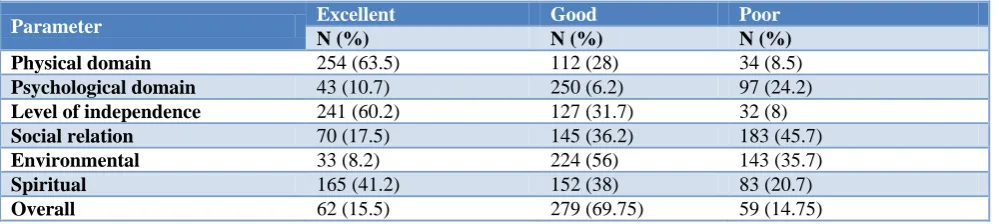
Among the study population, 62 (15.5) were graded as presenting with an excellent (≥80) overall QoL, 279 (69.75) presented with good overall QoL (60-79), and 59 (14.75) had poor QoL (<60 ) (Table 3).
Table 1: Socio-demographic and disease related characteristics of the study subjects.
Characteristics Male Female Total
N (%) N (%) N (%)
Age group (years)
15-30 47 (11.7) 63 (16.7) 110 (27.5)
31-45 121 (30.2) 74 (18.5) 195 (48.7)
46-60 65 (16.2) 21 (5.2) 86 (21.4)
>60 7 (1.7) 2 (0.5) 9 (2.2)
Marital status
Un-married 18 (4.5) 6 (1.5) 24 (6)
Married 219 (54.7) 141 (35.2) 360 (90)
Divorce 1 (0.25) 2 (0.5) 3 (0.75)
Widowed 2 (0.25) 11 (2.7) 13 (3.2)
Religion
Hindu 208 (52) 137 (34) 345 (86)
Muslim 17 (4.2) 11 (2.7) 28 (7)
Christian 15 (3.7) 12 (3) 27 (6.7)
Education status
Illiterate 118 (29.5) 111 (27.7) 229 (57.2)
Primary 13 (3.2) 5 (1.2) 18 (4.5)
middle 20 (5) 10 (2.5) 30 (7.5)
High school 65 (16.2) 26 (6.5) 91 (22.7)
Intermediate 16 (4) 5 (1.2) 21 (5.2)
Graduate and above 8 (2) 3 (0.7) 11 (2.7)
Employment status
Professional 0 0
Semi professional 20 (5) 3 (0.7) 23 (5.7)
Skilled worker 64 (16) 11 (2.7) 75 (18)
Semi-skilled worker 69 (17.2) 26 (6.5) 95(23.7)
Un skilled worker 77 (19.2) 63 (15.7) 140 (35)
Characteristics Male Female Total SES
Upper 7 (1.7) 1 (0.25) 8 (2)
Upper-middle 80 (20) 42 (10.5) 122 (30.5)
Lower-middle 93 (23.2) 68 (17) 161 (40.2)
Upper-lower 27 (6.7) 20 (5) 47 (11.7)
Lower 33 (8.2) 29 (7.2) 62 (15.5)
Stage of HIV
Stage 1 159 (39.7) 128 (32) 287 (71.7)
Stage 2 57 (14.2) 25 (6.2) 82 (20.5)
Stage 3 23 (5.7) 7 (1.7) 30 (7.5)
Stage 4 1 (0.25) 0 1 (0.25)
Table 2: Mean (SD) of domains of the quality of life with scales description.
QoL-domain Mean (SD) Cronbach’s α Correlation with total score
Physical domain 82.57±15.61 0.683 0.679
Psychological domain 63.82±12.47 0.676 0.774
Level of independence 78.78±13.81 0.689 0.665
Social relation 60.26±15.32 0.829 0.287
Environmental domain 61.49 ±13.07 0.717 0.558
Spiritual domain 72.47±17.48 0.695 0.679
Overall HQOL 82.57±15.61 0.653 1.000
Table 3: Components of the quality of life of people living with HIV or AIDS in study subjects.
Parameter Excellent Good Poor
N (%) N (%) N (%)
Physical domain 254 (63.5) 112 (28) 34 (8.5)
Psychological domain 43 (10.7) 250 (6.2) 97 (24.2)
Level of independence 241 (60.2) 127 (31.7) 32 (8)
Social relation 70 (17.5) 145 (36.2) 183 (45.7)
Environmental 33 (8.2) 224 (56) 143 (35.7)
Spiritual 165 (41.2) 152 (38) 83 (20.7)
Overall 62 (15.5) 279 (69.75) 59 (14.75)
Table 4: Comparison of the mean±SD of different domains based on demographic variables, disease related characteristics.
Variable Physical domain
Psychological domain
Level of independenc e
Social relation
Environ-mental Spiritual Overall score
Gender
Male
(n=240) 82.88±15.94 63.83±14.04 78.12±15.08 62.47±15.69 61.23±13.65 73.77±17.97 70.13±11.20 Female
(n=160) 82.09±15.13 63.80±9.70 79.69±11.62 56.96±14.16 61.89±12.20 70.52±16.58 69.08±8.29
P value 0.62 0.98 0.24 0.000* 0.62 0.068 0.28
Age (years)
≤30 84.6±15.9 65.06±13.1 80.85±12.6 61.45±14.6 63.14±14.2 68.47±18.5 70.35±9.9 >30 81.7±15.4 63.34±12.2 77.9±14.1 59.81±15.5 60.87±12.5 73.99±16.8 69.47±10.2
P value 0.10 0.21 0.06 0.34 0.12 0.005* 0.43
Marital status
Married 82.20±15.61 64.01±12.18 78.67±13.75 60.81±15.09 61.84±13.06 72.72±16.95 69.84±9.90 Un-married 89.78±14.57 67.22±13.38 83.26±10.40 61.13±17.26 61.89±11.99 76.52±20.91 73.26±11.04 Divorce 78.33±25.68 46.67±23.09 66.67±32.14 33.33±11.54 53.00±18.24 50.00±8.66 54.66±19.73 Widowed 80.77±13.51 56.54±12.01 75.77±14.41 49.77±9.61 53.15±12.41 63.62±21.92 63.23±8.19 P value 0.138 0.007** 0.147 0.001** 0.077 0.022** 0.002**
Variable Physical domain
Psychological domain
Level of independenc e
Social relation
Environ-mental Spiritual Overall score
Education status
Illiterate 81.80±15.58 63.06±11.20 77.85±13.19 58.85±14.93 60.09±12.78 71.35±17.20 68.82±9.76 Primary 79.72±14.60 61.67±15.03 76.50±14.93 58.00±15.48 54.47±10.70 72.50±16.56 66.94±11.70 Middle 84.67±14.67 61.47±15.26 79.20±15.20 58.43±16.40 61.76±10.88 70.50±20.98 68.70±10.98 High school 84.39±15.41 67.02±13.12 80.61±14.21 64.23±15.19 64.56±13.54 74.13±16.75 72.00±10.02 Intermediate
or diploma 80.24±19.00 60.19±12.55 77.86±17.36 59.90±17.53 63.73±14.00 74.81±19.97 69.14±10.89 Graduate and
above 86.91±15.49 70.27±15.07 86.36±6.74 66.64±12.01 72.18±12.89 83.18±13.46 77.90±7.58 P value 0.518 0.021** 0.257 0.056 0.001** 0.248 0.009**
Socioeconomic status
Upper 86.88±16.02 61.50±12.81 83.75±10.93 62.75±16.43 65.25±19.31 75.00±17.11 73.12±10.03 Upper-middle 82.69±14.52 65.48±11.85 79.56±13.34 60.13±14.31 65.33±10.49 74.16±14.11 70.89±8.84 Lower-middle 83.29±16.10 63.99±12.89 77.98±14.88 59.96±16.03 61.37±13.24 72.37±18.11 69.44±10.74 Upper-lower 80.96±14.50 63.98±12.24 78.72±12.66 58.00±13.11 59.31±13.01 69.79±19.99 68.53±9.59 Lower 81.53±17.09 60.37±12.44 78.52±13.25 62.69±16.90 55.28±13.94 70.85±19.78 68.55±11.38 P value 0.786 0.126 0.740 0.583 0.000** 0.583 0.396
Stage of disease
Stage 1
(n=287) 85.07 ±14.88 65.71±11.02 81.18±12.08 60.97±15.39 63.14±12.37 74.55±16.50 71.50±9.20 Stage 2
(n=82) 78.18 ±15.18 61.07±14.32 74.61±15.16 58.54±14.75 58.53±13.59 67.79±18.41 66.14±10.44 Stage 3
(n=30) 71.67 ±15.72 54.27±13.55 67.40±16.99 57.37±15.51 53.45±14.27 66.43±19.86 62.80±12.48 Stage 4
(n=1) - - - -
P value <0.001** <0.001** <0.001** 0.149 <0.001** <0.001** <0.001**
Duration of ART (years)
0.5-4 82.58±15.41 63.16±13.28 79.01±13.15 60.23±15.75 61.16±13.13 71.26±17.61 69.11±10.13 4.1-8 84.24±14.56 64.95±11.16 80.06±12.80 59.04±14.23 61.37±12.30 73.67±17.14 70.68±9.50 8.1-12 80.63±16.67 64.03±12.48 76.54±16.90 61.69±15.93 62.57±14.32 73.22±17.11 69.51±11.19 >12 78.95±19.40 62.11±12.67 76.11±13.20 63.05±15.78 61.52
±13.35
73.68
±20.26 70.16±10.62
P value 0.316 0.593 0.296 0.565 0.893 0.638 0.609
CD4 count
<350/µl 79.97±17.07 61.32±12.94 74.90±16.73 58.67±14.38 58.18±13.15 71.91±17.64 66.93±10.35 >350/µl 83.61±14.88 64.82±12.16 80.30±12.13 60.91±15.65 62.83±12.83 72.69±17.44 70.83±9.86 P value 0.046* 0.011* 0.002* 0.187 0.001* 0.686 0.000*
* P value (Student’s t-test), **P value (ANOVA).
Physical domain which measured pain, discomfort, energy and sleep was affected by CD4 count (p value 0.046, Table 4) and stage of the disease (p<0.001) with the advancement of stage of disease mean score value is decreased significantly. Psychological domain which measured ability to concentrate, self-satisfaction, enjoyment and negative feelings was significantly affected by educational status, marital status (divorced individuals had lowest mean score 46.67 followed by widowed who had mean score of 56.54), stage of the disease and CD4 count (Table 4). In the Level of independence domain which measured dependence on medications, mobility, ability to perform daily activities and capacity to work, significantly lower mean scores
were observed with advancement of stage of disease and lower CD4 count (p<0.001).
living place, money for daily needs was significantly affected by educational status (p <0.001), socioeconomic status (p<0.001), stage of the disease (p<0.001) and CD4 count (p<0.001). Spiritual domain which measured blame, fear about future and death was affected by age (individuals aged <30 years had a mean of68.47 and individuals aged >30 years had a mean of 73.99, p<0.001), marital status and stage of the disease. Overall quality of life showed significant variation with marital status, educational status, stage of the disease and CD4 count. The mean score of all the domains significantly
decreased with advancement of stage of the disease. (Table 4).
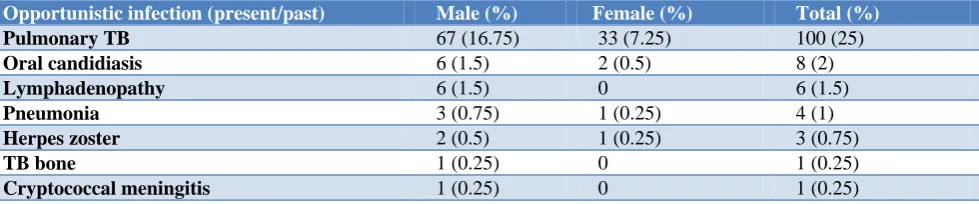
Most commonly associated opportunistic infection was pulmonary TB (1 in 4 individuals had pulmonary TB) followed by oral Candidiasis (2) (Table 5).
CD4 count varied between 12-1290 cells/ mm3. Mean CD 4 counts in all study subjects was 492.66±220.51 cells/ mm3. Overall quality of life significantly improved with increased CD4 counts in PLHA (p value 0.019) (Table 6).
Table 5: Comparison of groups with different CD4 counts with overall quality of life score by one-way ANOVA.
CD4 cell count No. of patients (%) Overall HQOl
Mean±SD P value
<50 3 (0.75) 59.33±3.511
0.019**
51-100 7 (1.75) 63.14±9.13
101-200 19 (4.75) 67.89±10.56
201-300 48 (12) 68.85±8.30
301-400 69 (17.25) 67.43±11.73
401-500 66 (16.5) 71.91±10.72
Above 500 188 (47) 70.59±9.52
Table 6: Opportunistic infections (present and past) among patients.
Opportunistic infection (present/past) Male (%) Female (%) Total (%)
Pulmonary TB 67 (16.75) 33 (7.25) 100 (25)
Oral candidiasis 6 (1.5) 2 (0.5) 8 (2)
Lymphadenopathy 6 (1.5) 0 6 (1.5)
Pneumonia 3 (0.75) 1 (0.25) 4 (1)
Herpes zoster 2 (0.5) 1 (0.25) 3 (0.75)
TB bone 1 (0.25) 0 1 (0.25)
Cryptococcal meningitis 1 (0.25) 0 1 (0.25)
DISCUSSION
In our study, the most affected domain was social relationship domain followed by environmental and psychological domains. Various other studies also showed low social and psychological domain scores.12-15 This can be explained by societal discrimination, stigmatization, isolation, dissatisfaction with sex life and negative feelings. Poor environmental domain score in our study is in contradiction with other studies11,15 as majority of people are from rural area because of which they have poor access to health care, poor environmental conditions and poor transport facilities.
In the present study, the average of internal consistency of all domains of the instrument was found to be between 0.65 and 0.83.The study done by Nojomi et al among people living with HIV/AIDS, Iran showed that the average of internal consistency of the four domains of the instrument was found between 0.64 and 0.83, which is similar to the present study.16
Age and gender
The results of the present study showed that the majority of the patients were young men who were affected with disease during their active life. This result is agreed with other studies.16,13 Age had a significant association with spiritual domain only. There is no significant variation in any domain of QoL by gender except in social relationships domain, this may be due to lack of social and family support, cultural beliefs in addition to stigma of the disease.
Marital status
stigma and lack of physical and emotional support from their spouses as it was before.
Educational status
Overall quality of life significantly improved with higher educational status. This is because patients with higher education can have better understanding about their disease state, coping strategies and adherence to treatment. Primary education has no effect on quality of life as patients with only primary school education scored less than patients with no education. Higher education level had significant association with psychological and environmental domains. Study done by Liping et al showed that Those with higher education level had better scores in physical and environmental domains (p<0.05)
Socioeconomic status
Present study shows that overall quality of life does not have significant association with socio economic status of HIV/AIDS Patients. Socio economic status had a significant association with Environmental domain. This makes economically backward patients more prone to poor QOL in environmental domain. Similar findings observed in study done by Dasgupta et al.15
Stage of the disease and CD4 count
Both stage of the disease and CD4 count are indirectly related to each other. Significantly better scores were observed with higher CD4 count and with asymptomatic stage of disease except for the social domain. The significant impact of stage of illness reflects grievous and disabling nature of the disease on various aspects of quality of life.14 Stage of the illness does not appear to have a significant effect on personal relationships and sex life.
CONCLUSION
The present study shows the physical domain, level of independence and spirituality of the patients were relatively higher than psychological, environmental and social relationship domains. Age, sex, socioeconomic status was significantly associated with at least one domain of HQoL. Educational status was strongly associated with psychological, environmental domain. Marital status was strongly associated with psychological, social and Spiritual domain. Moreover, WHO clinical stage was strongly associated with all HQoL domains except social domain.CD4 count was strongly associated with all HQoL domains except Spiritual and social domain. We observed that overall poor quality of life is related to educational status, marital status, CD4 cell count and stage of illness.
Recommendations
The present findings highlight the need for enhanced socio psychological support and better environmental
health. Strengthening social relations seems relatively more demanding than other domains. Awareness programs to address the issue of stigma
and discrimination at level of family and community to reduce stigma to the barest minimum, which may help to create a sense of safe living conditions or help PLHIV to receive a necessary support from their family and community should be organized.
Mental health care should be provided for all the PLHIV and suitable employment opportunities considering their functional capacities should be done thus focusing aspects of HIV beyond clinical care. Employment and financial security would lead to improve social health.
Regular sensitization is needed for all health professionals and staff in ART centers about the condition of PLHA, so that at any time of the treatment they should maintain the focus, affection and empathy towards these patients.
Clinical assessment of adverse reactions during the course of ART treatment and careful monitoring of patient after any ART switch could contribute to a better QOL, improve the patient– doctor relationship, and potentially maintain adherence with fewer undesired side effects.
Sometime hospital-based care is not feasible or the patient is unable to come due to his personal reasons, home or community-based care is one appropriate option for better care and compliance.
Policies should be made and rules should be enforced to protect the rights of PLHA in the work place as well as prevent any form of discrimination against them in the society.
Therefore, the focus should be on various multidisciplinary care models (including primary medical care, social support, education and employment opportunities) with help of Government schemes and involving NGOs and care at home to promote HR-QOL in these patients.
ACKNOWLEDGEMENTS
The authors acknowledge the patients for their cooperation, Interns for data collection and cooperation from ART center healthcare staff in conducting this study.
Funding: No funding sources Conflict of interest: None declared
Ethical approval: The study was approved by the Institutional Ethics Committee
REFERENCES
1. World Health Organization HIV/AIDS. Available at: https://www.who.int/hiv/data/en/. Accessed on 1st June 2019.
3. Osei-Yeboah J, Owiredu WKBA, Norgbe GK, Lokpo SY, Christian Obirikorang,2 et al. Quality of Life of People Living with HIV/AIDS in the Ho Municipality, Ghana: a cross sectional study. AIDS Research and Treatment. 2017;2017:6806951. 4. Abrefa-Gyan T, Cornelius LJ, Okundaye J.
Socio-demographic factors, social support, quality of life, and HIV or AIDS in Ghana. J Evid Inf Soc Work. 2016;13(2):206-16.
5. Health statistics and information systems. Available at https://www.who.int/healthinfo/survey/whoqol-qualityoflife/en/. Accessed on 10 September 2019. 6. National AIDS Control Programme Phase-IV.
2012-2017 NACP Phase IV-Cover ctc for Printing ctc - NACO naco.gov.in › sites › default › files. Available at: http://naco.gov.in/sites/default/files/strategy_ document_NACP phase IV.pdf. Accessed on 10 September 2019.
7. Surur AS, Teni FS, Wale W, Ayalew Y, Tesfaye B. Health related quality of life of HIV or AIDS patients on highly active anti-retroviral therapy at a university referral hospital in Ethiopia. BMC Health Services Res. 2017;17:737.
8. World Health Organization. (2002). WHOQOL-HIV bref, 2012 revision. World Health Organization. Available at: http://www.who.int/iris/ handle/10665 /77775. Accessed on 1 June 2019. 9. Pedroso B, Gutierrez GL, Duarte E, Pilatti LA,
Picinin CT. Quality of Life Assessment in People Living with HIV/AIDS: Clarifying the WHOQOL-HIV and WHOQOL-WHOQOL-HIV-Bref Instruments, Global View of HIV Infection, www.IntechOpen. Available at: https://www.intechopen.com/books/global-view-of-hiv-infection/quality-of-life-assessment-in-people living-with-hiv-aids-clarifying-the-whoqol-hiv-and-whoqol-hiv-bref. Accessed on 1 June 2019.
10. Osei-Yeboah J, Owiredu WKBA, Norgbe GK, LokpoSY, Obirikorang C, Allotey CA, et al., Quality of Life of People Living with HIV/AIDS in
the Ho Municipality, Ghana: A Cross-Sectional Study, AIDS Research and Treatment. 2017;6806951.
11. Bello SI, Bello IK. Quality of life of HIV/AIDS patients in a secondary health care facility, Ilorin, Nigeria. Proc (Bayl Univ Med Cent). 2013;26(2):116–9.
12. Fatiregun AA, Mofolorunsho KC, Osagbemi KG. Quality of life of people living with HIV/AIDS in Kogi State, Nigeria. Benin J Postgrad Med. 2009;11(1):21–7.
13. Marashi T, Garg S, Gupta VK, Singh MM, Sinha P, Dewan R, et al. Assessment of quality of life among HIV positive people attending tertiary hospital of Delhi, India. J commun Dis 2009 Jun ;41(2):101-8. 14. Imam MH, Karim MR, Ferdous C, Akhter S.
Health-related quality of life among the people living with HIV. Bangladesh Med Res Counc Bull 2011;37:1-6.
15. Dasgupta P, Mukhopadhyay S, Saha D. Assessment of quality of life among human immunodeficiency virus/acquired immuno deficiency syndrome patients: A study at antiretroviral therapy center at Malda, West Bengal, India. Arch Med Health Sci. 2018;6:208-13.
16. Nojomi M, Anbary K, Mitra Ranjbar MD MPH**. Health-Related Quality of Life in Patients with HIV/AIDS: Arch Iranian Med. 2008;11(6):608–12. 17. Liping M, Peng X, Haijiang L, Lahong J, Fan L.
Quality of life of people living with HIV/AIDS: A Cross-sectional study in Zhejiang Province, China. PLoS One. 2015;10(8):e0135705.