ISSN 2286-4822 www.euacademic.org
Impact Factor: 3.1 (UIF) DRJI Value: 5.9 (B+)
Effect of Supplementation of Ginger Root Powder
in Ration on Performance of Broilers
AHMED YASIR REBH M.Sc. Student Ministry of Higher Education and Scientific Research The Foundation of Technical Education The Technical Institute Shatrah
Iraq DR. P. KUMAR Supervisor, Associate Professor
Poultry Production S.S.A.H.
Dairying Sundaresan School of Animal Husbandry and Dairying India Prof. Dr. NEERAJ Co-Advisor, Professor Animal Nutrition Dean, S.S.A.H. Dairying Sundaresan school of Animal Husbandry and Dairying
Abstract:
ad lib. Birds were managed under similar managemental conditions. Data on weekly body weight, gain in weight, and feed efficiency of broilers up to five weeks of age, the data were collected and analyzed statistically to determine influence of treatments on performance of broiler. It was revealed that diets supplemented with ginger root powder had significant (P<0.05) effect on the body weights, gain in weight of broilers. There were non-significant differences (P>0.05) in feed conversion ratio among all dietary treatments for birds .Result showed that non-significant decreased (P>0.05) were observed in feed intake .Best body weight ,gain in weight of broilers was observed in diet supplemented with 0.75 g, followed by 1.75 g, 1.25 g ginger powder and diet as per NRC standard (control).treatments 0.75, 1.75 were economically better than control. Supplementation 0.75 g in ration was most economical followed by inclusion of 1.75 g ginger powder in ration. Compared to with control and other treatments proved better.
Key words: Ginger root powder, Broiler, growth performance
Introduction
Materials and Methods
The ginger root used in this experiment was obtained from the local market of the city of Allahabad, India. The ginger freshly dried in hot air oven ,and grinded in grinder to make powder .The experiment commenced on 8 March 2014 and continued till 11 April 2014 for period of five weeks .The birds were divided into 5 treatments (15 birds/treatment) with 3 replicates using completely randomized design (CRD) Broiler chicks of T0
were fed ration as per NRC standard CP (22) and ME (2900) but broiler of T1, T2, T3 and T4 were fed standard ration with
ginger root powder @ 0.75 ,1.25 ,1.75 , 2.25 per kg of feed, respectively. The birds were raised open sided field. Water and feed were provided A bulb of 100 watts was fitted in each chamber. And Broilers were given floor space 1 sq, fit to birds each. The chicks bred breeding ground on a litter of sawdust thickness (5.3 cm). Taking into account that no any sort of treatments has been used while conducting the experiment, and the percentage of mortality is null. Equipment's were properly cleaned disinfected and sterilized before use. Weekly feed intake and body weight was recorded. Throughout the period of the study as it occurred. Feed conversion ratio (FCR) was calculated. Initial weight of each chick was recorded on arrival and then weekly to obtain the growth rate. The feed consumption was also recorded weekly to determine the feed conversion ratio.
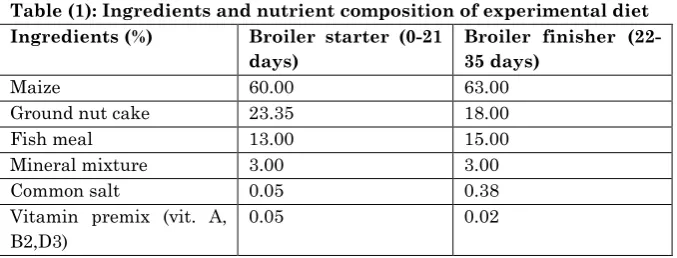
Table (1): Ingredients and nutrient composition of experimental diet
Ingredients (%) Broiler starter (0-21
days)
Broiler finisher (22-35 days)
Maize 60.00 63.00
Ground nut cake 23.35 18.00
Fish meal 13.00 15.00
Mineral mixture 3.00 3.00
Common salt 0.05 0.38
Vitamin premix (vit. A, B2,D3)
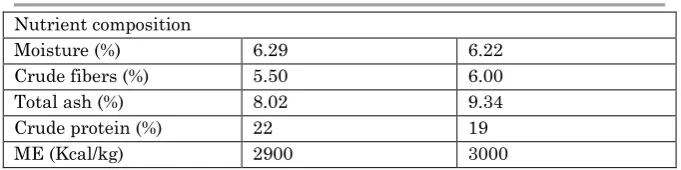
Nutrient composition
Moisture (%) 6.29 6.22
Crude fibers (%) 5.50 6.00
Total ash (%) 8.02 9.34
Crude protein (%) 22 19
ME (Kcal/kg) 2900 3000
Analysis of Experiment data:
The data on various parameters were recorded tabulated and statistically analyzed using analysis of variance (ANOVA) technique as per Snedecar & Cocharan (1994) in RBD consisting of four treatments, one control and three replications.
Results
The overall growth performance of broilers chicks fed the various levels of ginger root powder is shown in table (2). Feed intake were decreased non significantly (P<0.05) in treatment T1 ,T3 Respectively compare to other treatments, body weight ,
weight gain also were significantly (P<0.05) high in the treatment T1 ,T3 compared to other treatments. There were no
significant differences in feed conversion efficiency among the treatments (P>0.05).
Table (2) Effect of dietary ginger root powder on growth performance of the broilers
Parameter Levels of ginger root powder (g)
0 0.75 1.25 1.75 2.25 Sig
Live Body
weight
1192.66
b 1385.8 a 1170.4 b
1264.2 ab
1176.86 b
S
gain in Weight 228.65
bc 253.90 a 223.88 c
242.81
ab 224.93 bc
S
Feed
Consumption
806.68 782.46 882 768.26 766.93 NS
Feed Conversion
Ratio
a,b: mean with different superscripts along rows are significantly different (P<0.5). NS=Non-significantly difference (P>0.05 )
Discussion and Conclusion
The overall growth performance of broilers chicks fed the various levels of ginger root powder is shown in table (2).Highest mean weekly body weight of broilers was recorded in T1 (673.42), followed-by T3 (620.59),-T0 (601.13), T2 (578.93),
and T4 (578.47), however the differences in these values of
weekly body weights were found significant indicating thereby a significant effect of treatments on weekly body weight of broilers. The broilers body weight were significantly, higher in T1, T3, compared to control (T0) except (T2) and (T4) which was
at less with control. As expected the body weight of broilers increased significantly weekly up to five weeks of experimental period. These results are similar or close to those reported by Herawati and Marjuki (2011). Feed intake were decreased non significantly (P<0.05) in treatment 0.75 g ,1.75 g compare to other treatments,This result could be compared with the work of Ademola et al. (2009) who reported higher feed intake of broilers on diet supplemented with ginger. The results were however in agreement with the report of Herawati, (2010) who stated that broilers fed 2% dried supplementary red ginger meal had significantly lower feed intake than those on the control diet. T0, this result was contrary to that reported by
supplementation to the diets can increase body weight when supplemented up to 2% level. This result didn't agreed those of Ghazaiah et al. (2007) and Tollba (2003). .There were non significant differences in feed conversion efficiency among the treatments (P>0.05), Feed conversion ratio were not significantly differ among all groups, this results disagreed with the work of Moorthy et al. (2009) and Onimisi et al. (2005) who reported significantly better feed conversion ratio in ginger fed groups of broilers compared to control. Note that Red ginger has potential as phytobiotic or stimulant which improve the efficiency of feed utilization by chickens. reported that red ginger contains active compounds such as atsiri oil (a-pinen, 3-felandren, borneol, kamfen, limonen, linalool, sitral, nonilaldehida, desilaldchida, metilhepte-non, sineol, hisaholen, 1-a kurkuinin, farnesen, humulen, zingiberen, zingiberol) and oleoresin (consist of the substance with hot taste, like: gingerol, zingeron, shogaol, tanin, gingerdiol, resin). All the compounds adding phytobiotic of red ginger causing an improvement in feed digestion. The adding of phytobiotic of red ginger in the poultry also assumed also causing the digestion process for the poultry can be stimulated, hence the poultry conversion become meat can optimal. Red ginger has characteristic as stimulant for feed digestion and conversion which increase body weight gain (Conley, 1997).
Conclusion
Based on results it was concluded that diets supplemented with ginger root powder had significant effect on the body weights, feed intake, gain in weight and feed efficiency of broilers. Based on feed efficiency best performance of broilers was observed in diet supplemented with 0.75 g for 1 kg ginger root powder, followed by 1.75 g for 1 kg, and diet as per NRC standard (control). Treatments' were T1 0.75, T3 1.75 economically
in ration was most economical followed by inclusion of 1.75 in ration. Compared with other treatments.
REFERENCES
Adel, Al-Hamadani et al. 2010. The effect of diet supplementation with antibiotic and Ginger on Broiler
performance.
Ademola, S.G., G. Farinu and G.M. Babatunde. 2009. “Serum lipid, growth and haematological parameters of broilers fed garlic, ginger and their mixtures.” World J. Agric. Sci. 5: 99-104.
Awang, D. V. C. 1992. “Ginger.” Can. Pharm. J. 125:309–311. Bhandari, U., J. N. Sharma, and R. Zafar. 1998. “The protective action of ethanolic ginger (Zingiber officinale) extract in cholesterol fed rabbits.” J
Ethnopharmacol. 61:167– 171.
Banerjee, G. C. 1998. A text book of animal husbandry. 2nd Edition. Delhi, India: India Publication.
Biovet, S. and Laboratories, A. 2005. “The Intensive Production and the Spreading of High Productivity Genetic stocks have conditioned the common use of chemical substances known as "Growth Promoters.” wwwThepigsite.com/articles
Brugalli, I. 2003. “Alimentacao alternativa: a utilizacao de fitoterapicos ounutraceuticos como moduladores da imunidade e desempenho animal.” Anais Do Simposio
Sobre Manejo E Nutricao De Aves E Sunos. Sao Paulo:
Campinas. 167-182.
Christakia, E., P. Florou-Paneria, I. Giannenasa, M. Papazahariadoub, N.A. Botsogloua, and A.B. Spaisa. 2004. “Effects of a mixture of herbal extracts on broiler chickens infected with eimeria tenella.” Animal
Chrubasik, S., M. H. Pittler, and B. D. Roufogalis. 2005. “Zingiberis rhizoma: A comprehensive review on the ginger effect and efficacy profiles.” Phytomedicine 12:684–701.
Cole, H. and Garrett, W. N. 1980. Animal Agriculture. 2nd Edition. W.H Freeman and Company Publishers, U.S.A. Conley, M., 1997. “Ginger” -Part II. Retrieved from
http://www.Accessnewage.com/articles/Health/ginger2.ht m, October 11, 2009.
Doley, S., J.J. Gupta and P.B. Reddy. 2009. “Effect of supplementation of ginger, garlic and turmeric in broiler chicken.” Vet. J. 86: 644-645.
El-Deek, A.A., Y.A. Attea, M. Maysa, and M. Hannfy. 2002. “Effect of anise (Pimpinella anisumii), ginger (Zingiber officinale Roscoe) and fennel (Foeniculum vulgare) and their mixture on performance of broilers.” Arch.
Geflugelkd, 67: 92-96.
Ernst, E., M.H. Pitler, M.H., and C. Stevenson. 2002. “Complementary Alternative Medicine in Dermatology.”
Am J. Clinical Dermatol. 3: 341-342.
Ghazaiah, A.A., A.S. El-Hakim, and A.M. Refaie. 2007. “Response of broiler chicks to some dietary growth promoters throughout different growth periods.” Egypt.
Poult. Sci. J. 27: 53-57.
Herawati. 2006. “Effect of red ginger (Zingiber officinale Rosc) phytobiotic addition to the broiler performance and blood profile.” Pengaruh Penambahan Fitobiotik Jahe Merah. 14: 173-142.
Herawati 2010. “The effect of feeding red ginger as phytobiotic on body weight gain, feed conversion and internal organs condition of broiler.” Int. J. Poult. Sci. 9: 963-967.
(zingiber officinale) additive in diets.” Animal Research
International 8 (2): 1398 – 1404.
Keith, R. 2001. “Could environment play a role in Alzheimer’s diseases?” Newsline. Alabama Cooperative Extension
System Nutritionist. 334-844-3273.
Larsen, K., H. Ibrahim, S. H. Khaw, and L. G. Saw. 1999.
Gingers of Peninsular Malaysia and Singapore. Natural
History Publications (Borneo), Kota Kinabalu, Malaysia.
Longhout, P. 2000. “New additives for broiler chickens.” World
Poultry- Elsevier: 16 (3): 22-27.
Malekizadeh, M., M. M. Moeini, and Sh. Ghazi. 2012. “The Effects of Different Levels of Ginger (Zingiber officinale Rosc) and Turmeric (Curcuma longa Linn) Rhizomes Powder on Some Blood Metabolites and Production Performance Characteristics of Laying Hens.” J. Agr.
Sci. Tech. 14:127-134.
Mohammed A. and M. Yusuf. 2011. “Evaluation of ginger (Zingiber officinale) as a feed additive in broiler dietism.” Department of Animal Science Usmanu Danfodiyo University, Sokoto, Nigeria. Livestock
Research for Rural Development 23 (9).
Onimisi, P.A., I.I. Dafwang, and J.J. Omaga. 2005. “Growth performance and water consumption pattern of broiler chicks fed graded levels of ginger waste meal.” J. Agric.
For. Soc. Sci. 3: 113-119.