ISSN 2286-4822 www.euacademic.org
Vol. II, Issue 10/ January 2015
Impact Factor: 3.1 (UIF)
DRJI Value: 5.9 (B+)
The Deteriorate Function of Somatic Anxiety on Rowing Athletes
VINCENT PARNABAS Sport Science and Recreation Faculty University of MARA Technology (UiTM)
Shah Alam, Malaysia JULINAMARY PARNABAS Institut Pendidikan Guru, Kampus Darulaman
Jitra, Kedah, Malaysia ANTOINETTE MARY PARNABAS Medical Unit, Hospital Taiping Taiping, Perak, Malaysia
Abstract
The main purpose of this study was to identify the levels of somatic anxiety and sport performances among Rowing athletes of different skill. In other words, this research aims to correlates the relationship between the level of somatic anxiety and sport performance. The instrument used for the study comprised of a 27-item Competitive State Anxiety Inventory–2 and The Psychological Performance Inventory which had been distributed during sport between universities competition. The sample consisted of 77 Rowing players, including the national athletes (N=27), state athletes (N=17), district athletes (N=18) and university athletes (N= 15).The results showed that elite or national Rowing athletes exhibited lower levels of somatic anxiety, F (3, 77) = 14.180, p < .01. The result also showed that the exits of negative correlation between somatic anxiety and sport performance among Rowing players, (r = -0.66; p<0.05). Sport psychologists, sport counselors and coaches should use the present findings to recommend coping strategies to university and district level athletes that are appropriate for dealing with their athletes’ somatic anxiety.
Keyword: Somatic, Sport Performance, Skill of players.
1. Introduction
EUROPEAN ACADEMIC RESEARCH- Vol. II, Issue 11/ February 2015
muscular tension, rapid heart rate, sweaty palms and butterflies in your stomach (Jarvis, 2002; Jones, 2000; Martens, Vealey & Burton, 1990).
Researchers have reported that over 50 of consultations among athletes at an Olympic festival were related to stress or anxiety problems (Murphy, 1988). According to Hann (2000) high levels of anxiety during competition are harmful, worsening performance and even leading to dropout. Therefore, it’s very important to know the level of anxiety especially the somatic anxiety in order to take all necessary preparation to reduce it.
Recent investigation found that male and female athletes suffering stresses resulted pressure to win, excessive anxiety, frustration conflict, irritation and fear, which significantly affected their mental or emotional health (Humphrey, Yow & Bow 2000). Heavy playing schedules, competition for team places, the media and fans as well as the pressure to win trophies all play a part in players developing high stress and anxiety levels (Heather, 2010), especially the level of somatic anxiety. However, since lack of research on somatic anxiety and its effect on performances, sport psychologists still failed to determine the relationship among those variables. Moreover, most of the previous research, focused on elite athletes, while ignoring less successful athletes. This was confirmed by Krane (1995) that research on competitive anxiety mainly focused on elite athletes. The extant literature also shows that there is a limited research comparing on somatic anxiety among Rowing athletes of state, district and university level.
The main purpose of this study was to examine the levels of somatic anxiety among football players of different skill. The present study aim to determine the level of somatic anxiety and its effect on performances between Rowing players of national, state, district and university level. In other words, this research sought to correlate the relationship between somatic anxiety and performance.
2. Methods
The participants of this study were recruited from sport between universities. The instrument used for the study comprised of a 27-item Competitive State Anxiety Inventory–2 (CSAI-2) and 42-item The Psychological Performance Inventory, which had been distributed during sport between universities. The Psychological Performance Inventory asses seven factor of performance: Self Confident, Negative Energy, Attention Control, Visualization and Imagery, Motivation, Positive Energy Control and Attitude Control.
The sample consisted of 77 Rowing athletes, including the national athletes (N=27), state athletes (N=17), district athletes (N=18) and university athletes (N= 15).
3. Result
3.1. Respondents’ Profile
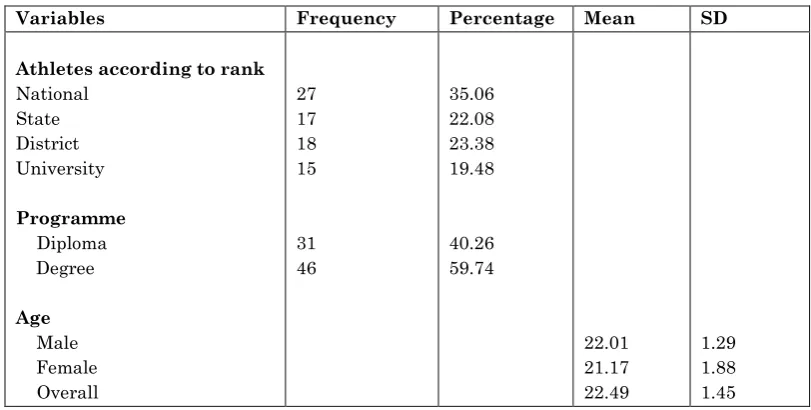
The variable “rank which is gathered through this study is categorized into four levels namely, national, state, district and university. The result showed that 27 respondents had participated at national, whilst 17 respondents participate at state, 18 had participated at district and 15 respondents participated at the university level. Majority of the respondents, were undergraduates for Degree (n=46) and Diploma (n=31) programmes.
Table 1: Respondents’ Profile (n=77)
3.2. Cronbach Reliability Coefficients
In this study, Cronbach alpha coefficients were found relatively high, ranging from .81 to .84 (Table 2).
Table 2: Cronbach Reliability Coefficients
Questionnaire Cronbach’s Alpha (n=77)
Somatic Anxiety Sports Performance
.8401 .8139
3.3. Level of Somatic Anxiety
Table 3 shows the mean scores for the somatic anxiety among Rowing athletes of different skills, F (3, 77) = 14.180, p < .01. Apparently, significant differences emerged for the athletes having different skills at competition. Overall, the mean score obtained for the national athletes was lower than those in other categories.
Table 3: Level of Somatic Anxiety among Rowing Players
Skills of Athletes Mean F-Value P-Value
National 11.3477
14.180** 0.000
State 13.7120
District 17.8342
University 20.4481
** p=.01
Post-Hoc Tukey Test (Table 4) showed that the level of somatic anxiety of university were
Variables Frequency Percentage Mean SD
EUROPEAN ACADEMIC RESEARCH- Vol. II, Issue 11/ February 2015
level of somatic anxiety of district were higher than state (p=.05) and national (p=.05), but lower than university level athletes (p=.05). In addition, the level of somatic anxiety of state were higher than national (p=0.05), but lower than district (p=.05) and university (p=.05) level athletes. Lastly, the level of somatic anxiety of national were lower than state (p=.05), district (p=.05) and university level athletes (p=.05).
Table 4: Post Hoc Tukey Test: Level of Somatic Anxiety among Rowing Players
Skill of Athletes National State Distict University N
National * (1.1452) * (1.4750) * (2.3412) 27
State 17
Distict 18
University 15
*p=.05
3.4. Level of Sport Performance
Table 5 shows the mean scores for the sport performance among the Rowing athletes of different skills, F (3, 77) = 20.457, p < .01. Apparently, significant differences emerged for the athletes having different skills at competition. Overall, the mean score obtained for the national athletes was higher than those in other categories.
Table 5: Level of Sport Performance among Rowing Players
Skills of Athletes Mean F-Value P-Value
National 24.3120
20.457** 0.000
State 21.4487
District 19.8143
University 15.0023
** p=.01
Post-Hoc Tukey Test (Table 6) showed that the level of sport performance of national were higher than district (p=.05), state (p=.05) and university (p=.05) level athletes. Furthermore, the level of sport performance state Rowing players were higher than district (p=.05) and university (p=.05), but lower than national level athletes (p=.05). In addition, the level of sport performance of district were higher than university (p=0.05), but lower than national (p=.05) and state (p=.05) level athletes. Lastly, the level of sport performance of university were lower than state (p=.05), district (p=.05) and national level athletes (p=.05).
Table 6: Post Hoc Tukey Test: Level of Sport Performance among Rowing Players
Skill of Athletes National State Distict University N
National * (1.2311) * (1.7641) * (2.1127) 27
State 17
Distict 18
University 15
*p=.05
3.5. Correlation of Somatic Anxiety and Sport Performance
(Table 7). Negative correlation indicates that either variables increase or decrease contradictory.
Table 7: The Relationship between the Level of Somatic Anxiety and Sport Performance
Subject Sport Performance
The Level of Somatic Anxiety
-0.66** (0.000)
* * p=.05
4. Discussion
4.1. Level of Somatic Anxiety
The result showed that football players of university level exhibited higher somatic anxiety level than those in state and district categories, whereas national athletes showed the lowest level of somatic anxiety. In Malaysia, no research involving the four categories of skills has been conducted so far, therefore this research has failed to compare these with the findings of previous research. However, according to Drive theory, the present of audience for low skilled athletes, during the sport competition not only increase their cognitive anxiety but also the somatic anxiety. Somatic anxiety refers to athletes’ changes in their physiology, such as increased perspiration, difficulty in breathing, increased heart beat, changes in the brain wave, elevated blood pressure, increased urination, butterflies in the stomach, less saliva in the mouth and muscle tension. The sympathetic nervous system is stimulated by fear perception in the cerebral cortex, prompting an immediate stress response. Elite athletes like national and state level, who have learned anxiety management skills, often respond to a greater degree to somatic anxiety but return to their resting rate sooner than those athletes, who are not trained in anxiety management like district and university level. At the interview session with the Rowing athletes it was found that most of the national athletes using coping strategies like positive self talk, relaxation techniques and imagery to reduce their somatic anxiety level. In the other hand, most of the low skill athletes like district and university level unaware and not practicing of these techniques. Therefore, the level of somatic anxiety of district and university level athletes was very high.
4.2. Level of Sport Performance
The result showed that national Rowing athletes obtain the highest sport performance compared state, district and university skill athletes. The main reason national athletes perform better than other skill athletes because most of them use coping strategies to reduce their somatic anxiety. High level of somatic anxiety is the barrier for high performances in sport. The result showed that district and university Rowing skill athletes experienced highest level of somatic anxiety, therefore their sport performances has been drop. Many research proved that high level of somatic anxiety has been the barrier to deteriorate performance in sport.
4.3. Level of Somatic Anxiety and Sport Performance
EUROPEAN ACADEMIC RESEARCH- Vol. II, Issue 11/ February 2015
anxiety effect performance. The relationship between somatic anxiety, where an athlete experiences physiological changes, such as, increases in the levels of muscle tension, nervousness, sweating and heartbeat, it will affect the performance (Ampofo-Boateng, 2009).
5. Conclusion
The findings of the research determined that there are differences in the level of somatic anxiety, showed by different categories of Rowing athletes. These differences were related to their level of skill. The results showed that elite or national Rowing athletes exhibited lower levels of somatic anxiety than non-elite athletes. Low somatic anxiety levels are very important in high sport performance. This study also showed that exist of negative correlation between somatic anxiety and performance. Sport psychologists, sport counselors and coaches should use the present findings to recommend coping strategies to university and district level athletes that are appropriate for dealing with their athletes’ somatic anxiety.
Future research should identify the most prevalent sources of somatic anxiety among different skill of Rowing athletes. Initial evidence suggest among the sources of anxiety are fear of injury, presence of audience, past unpleasant experiences, fear of lose, negative evaluation, knowledge of the opposition team, uncertainty, playing at the opposition’s place, high hope, and perceived sport events as very important. Seeking sources of somatic anxiety should be a great value to reduce the level of anxiety. Furthermore, types of coping strategies can be used to reduce the level of somatic anxiety among athletes much depend on the sources of anxiety.
REFERENCES
Ampofo-Boateng, K. 2009. Understanding Sport Psychology. Selangor, Malaysia: UPENA. Heather B. 2010. Psychology: motivation, anxiety, confidence and goal
setting.(http://www.soccernh.org/LinkClick.aspx?fileticket=z-jKZpam25k%3D&tabid=4766).
Humara, M. 2001. The relationship between anxiety and performance: A Cognitive-behavioral perspective. Athletic Insight 1(2): The Online Journal of Sport
Psychology
Humphrey, J. H., Yow, D. A. & Bowden, W. W. (2000). Stress in college athletics: Causes, consequences, coping. Binghamton. NY: The Haworth Half-Court Press.
Jarvis, M. 2002. Sport Psychology. New York: Routledge.
Jones, G. 2000. Stress and anxiety. In S.J. Bull, Sport Psychology: A self-help Guide (p. 31-51). Ramsbury, Marlborough: Crowood.
Krane, V. 1995. Anxiety and stress: reflection of the past and visions of the future. Paper presented as the Dorothy Harris Young Scholar – Practitioner lecturer at the meeting of the Association for the Advancement of Applied Sport Psychology. New Orleans, LA. Martens, R., Vealey, R.S., & Burton, D. 1990. Competitive Anxiety in Sport. Champaign,
Illinois: Human Kinetics.
Raglin, J.S. & Hanin, Y.L. 2000. Competitive anxiety. In Yuri, L.H., Emotions in Sport (p. 93-111). Champaign, IL: Human Kinetics.