International Journal in Management and Social Science
http://www.ijmr.net
ASSESSING THE COMPETENCIES AND DEVELOPING A
COMPETENCY MAPPING SYSTEM FOR
MANAGING TALENT
*Vijaya Mani
ABSTRACT
Competencies refer to those unique set of skills and abilities (technical as well as behavioural) which are required for achieving the desired level of performance. These competencies provide a framework for distinguishing between poor performances and exceptional performance. Despite the growing level of awareness, competency-based Human Resource still remains an unexplored process in many organizations. The process of competency mapping is much more complex than it seems to be, and most HR departments have been struggling to formulate the right framework for their organizations. The research was undertaken with the primary objective of creating an effective system for assessing the competencies of the employees. This system has also been used in the research to assess the competency levels of the executives in one of the renowned Auto Component manufacturing Organization in Tamil Nadu India. For this purpose, a list of competencies was prepared for each department, consisting of Technical and Behavioral competencies along with their desired levels titled as the Competency Dictionary. Based on this, Assessment Sheets were prepared to assess the actual levels of competencies as against the desired standards based on Self Assessment and functional head’s Assessment. With the desired and actual levels, a Gap Analysis was done to identify the gaps in competencies and training programs were suggested to bridge the gaps.
Key Words: Competency, Skill Sets, Gap Analysis, Content Analysis, Assessment.
International Journal in Management and Social Science
http://www.ijmr.net
INTRODUCTION AND BACKGROUND
In today’s competitive scenario, the concept of Competency Mapping has gained significant
importance. Competency management focuses on identifying the knowledge that employees
need to have to achieve their respective goals. It is strongly related to organisational efforts
towards workforce empowerment to achieve competitive advantage. As workplaces lay more
and more emphasis on skills and behavioural attitudes, organisations have begun to improve
their talent pipelines by focusing on their core competencies and skills. People are no longer
considered as parts of a larger organisation performing the same tasks repeatedly. They are
treated as key competitive assets within an organisation whereby each individual adds value
by aligning him/herself with the mission, vision and values of the organisation, through the
expected Competency model.
A Competency is a measurable pattern of knowledge, skills, abilities, behaviors, and other characteristics that an individual needs, to perform work roles or occupational functions successfully. Competencies specify the "how" of performing job tasks, or what the person needs to do the job successfully. In other words a Competency may be defined as an underlying characteristic required for performing a given task, activity, or role successfully.
Competency Mapping refers to the process of identifying the key competencies for the effective performance of a particular job. This would be the desired/ expected level of competency for the job. Further the individual’s level of competency is measured against performance standards established by the organization which would be his actual level of competency. The desired and the actual levels of competencies are compared and analyzed to arrive at the gaps. Employee competency mapping is to make a connection between what the company needs and what the employee can perform and eventually detect a gap.
International Journal in Management and Social Science
http://www.ijmr.net
An organization might possess extremely capable human resources, but they might not work on the job that suits them. This is where competency mapping and the appraisal tools come to help the HR experts choose who should work on what job profile. A human mind is a tool that innovates. Therefore for an innovative business practice to flourish effectively an appropriate competency mapping of the workforce is required. Large organizations, invest much effort on “human capital” and its development. They know that internal competences are able to impress a distinctive feature on the company, and that the knowledge of their human resources represents the primary wealth of the organization. They, therefore, develop and implement tools and methods to manage, transfer and capitalize competence, and to define standards for their evaluation and validation. Superior organizational performance is unlikely, in the absence of a competent, coordinated, and motivated workforce; and competency management can be an effective methodology for developing such a workforce. It can be convincingly argued that competency management should be the central focus of every business system; yet, it is conspicuously absent in many Indian organizations. Renowned HR Guru and philosopher Ulrich has thus gone to some length to show how to link individual and organizational competence. Capabilities according to Ulrich represent the skills, abilities, and expertise within an organization. They describe what an organization is able to do and how it is able to do that. Capabilities are thus associated with groups of individual competencies that collectively turn into organizational competence. Traditionally, a firm’s competitive advantage is developed through perceived uniqueness and derived from financial or economic capability, strategic or marketing capability, and technological capability. Now organizational capability is a critical fourth source of competitive advantage. A first step, then, is to generate employee competencies that provide the organization with the right mix of talent to meet existing and future needs. An alternative to traditional job based organizational systems is to use information on organizational competencies, of which employees are the focus to develop organizational capabilities that provide competitive advantage. Therefore, it appears necessary to investigate if a difference exists in job competency expectations held by the organization for their employees between the required
competency levels to the existing level of working.. Research indicates that the closer the
employer’s job competency expectations i.e, the required competency level to the actual job
competency level of the employees brings the better chance for productivity improvement,
waste elimination, multi skill development and the higher employees will rate overall job
International Journal in Management and Social Science
http://www.ijmr.net
required competency to work in an organization the professionals, supervisors and functional
heads were asked to rate the importance of the specific job competencies for the workforce.
Klemp defined competence as “an underlying characteristic of a person which results in effective and/or superior performance on the job.” While a more detailed definition is “a cluster or related knowledge, skills, and attitudes that reflects a major portion of one's job (a role or responsibility), that correlates with performance on the job, that can be measured with well-accepted standards, and that can be improved with training and development. Competencies tend to be either Behavioral or Technical. Behavioral competencies reflect the cognitive and social capabilities (e.g., problem solving, interpersonal skills) required for job performance in a variety of occupations. On the other hand, technical competencies are more specific as they are tailored to the particular knowledge and skill requirements necessary for a specific job. In 1973, David McClelland, Professor of Psychology at Harvard University wrote a seminar paper that created a stir in the field of psychology (McClelland, 1973). According to his research, traditional academic aptitude and knowledge content tests seldom predict on-job performance. He went on to argue that the real predictors of job performance are a set of underlying personal characteristics or ‘competencies’. Hence, the history of competency can be traced to the early 1970s when industrial psychologists and human resource managers were seeking ways to predict job performance. There was significant evidence to show that personality testing was very poor at predicting job performance (about 10 percent success rate was achievable). At the same time, a number of studies showed that traditional academic aptitude, knowledge tests, school grades and credentials did not predict job performance. Evarts (1988) defined competency as an underlying characteristic of a manager which causally relates to his/her superior performance in the job. According to Jacobs (1989), it is an observable skill or ability to complete a managerial task successfully.
International Journal in Management and Social Science
http://www.ijmr.net
October 1995. A competency is “A cluster of related knowledge, skills and attitudes that affect a major part of one’s job (a role or responsibility), that correlates with performance in the job, that can be measured against well-accepted standards, and that can be improved with training and development”.(HRD specialists South Africa, October 1995).Katz and Kahn (1966) grouped competency under three areas, which were later expanded to the following four:
1. Technical or functional: Associated with the technical or functional expertise required to perform the specific role.
2. Managerial: Knowledge, attitude and skills required to plan, organize and mobilize various resources.
3. Human: Knowledge, attitude and skills required to motivate, utilize and develop human resources.
4. Conceptual: The ability to visualize the invisible and think at abstract levels.
International Journal in Management and Social Science
http://www.ijmr.net
succession planning (McLagan, 1989). Different companies use different kinds of model, e.g., a small, yet fast growing and upcoming product development company, with astaff strength of 650, introduced a role and value-based universal competency model for different hierarchical levels in the organization ranging from engineer to vice president. They identified a set of eight competencies—product knowledge, technical skills, planning, communication, initiative, self-development, team work and management—that are applicable to every level. On being asked the idea behind such a design, the response was, “Competencies remain the same for different levels but the way it is demonstrated becomes different for different roles”, e.g., technical skills for a development manager will be to evaluate different technologies, develop product map, cost benefit analysis, etc. For a vice president it would mean developing product vision, that is, envisioning the competition the product would likely face and the like.
International Journal in Management and Social Science
http://www.ijmr.net
International Journal in Management and Social Science
http://www.ijmr.net
McLagan’s early work focused on competency models as an integrated approach to conducting a manpower review.
This paper reports empirical findings from a recently conducted study in one of the leading a Auto Manufacturing Organization in Tamil Nadu, India. The research was undertaken to develop an effective competency mapping system, in order to identify the gaps between the
desired and actual level of competencies and thereby find out the areas of improvement, so
that training programs may be suggested to bridge the gaps.
RESEARCH METHODOLOGY
A Research Design is the arrangement of conditions for collections and analysis of data in a manner that aims to combine relevance to the research purpose with economy in procedure. The research is a descriptive research, as it includes data collection and fact-finding. The research was not done before for the organization. It is supposed to explore details for further studies.
Competency analysis begins with identification of the workforce competencies required to perform the organizational business activities. Once the competencies are identified, a mapping between the targeted vs. actual value of competencies is required to measure, analyze and predict the future capability of competencies and take necessary corrective/preventive action to either enhance or maintain the current capability. Identifying the tasks, skills, knowledge and attitude required to perform various organizational roles can be used in formulating job description, assessing employees’ current level of competency, and activities like planning career development and coordinating competency development. The competency mapping impact in the selected organization is analyzed; interpreted and appropriate interpretations are drawn. To gain in-depth knowledge, the researcher interacted with HR Practitioners who are involved in employee competency mapping at various levels. The researcher before identifying the present research problem, thoroughly reviewed literature of the topic and noticed the research gap.
International Journal in Management and Social Science
http://www.ijmr.net
used to choose the elements of the population.Primary data were collected using assessment sheets. A list of competencies was prepared for each department, consisting of Technical and
Behavioral competencies along with their desired levels. This is called the Competency Dictionary. Based on this, Assessment Sheets were prepared to assess the actual levels of competencies as against the desired standards based on Self Assessment and functional head’s Assessment. With the desired and actual levels, a Gap Analysis was done to identify the gaps in competencies Assessment sheets were designed to suit the needs of each department. Each assessment sheet would have a column for the list of technical and
behavioural competencies, a column for the Self Assessment, a Column for the functional
head’s Assessment, a column for actual scores, a column for desired levels and finally a
column to identify the gaps. Subsequently, data have been mustered; analyzed, interpreted and appropriate logical conclusions are arrayed. The study had the following Objectives:
• To develop an effective Competency Mapping System for the Executive /managerial staff of the sampled organization
• To identify the roles and responsibilities of the managerial staff
• To prepare a list of competencies for each role identified in different managerial
levels
• To prepare a Competence Dictionary
• To prepare assessment sheets to assess the actual level of competencies of the
managerial staff
• To identify the gaps and give suggestions for training needs, in order to bridge the gap
ANALYSIS AND FINDINGS
This study compared the workforce job competency expectations for experienced trained employees in possession of more than 2 years experience from the date of joining.
The data collection instrument (Assessment Sheets) was developed from a literature review of job competencies and was refined to three content areas namely knowledge, ability and attitude. Interviews and brain storming sessions were conducted with the functional heads for designing the assessment sheets.
International Journal in Management and Social Science
http://www.ijmr.net
the linkage outcomes in terms of individual employee performance and organization performance
The comparisons were made between the existing competencies arrived from the assessment sheets to the required competencies for an employee to perform a particular job. The gaps between these two are the need identified for the competency training.
Consistently, the employees were rated by their immediate line supervisor about their performance. Gap analysis was used to identify the gaps.
.
Department wise findings:
PRODUCTION PLANNING & CONTROL (PPC) – Department 1:
Figure 1 – Competencies that employees in the PPC dept. lacks
Where
A – Knowledge of Process
B – Knowledge of Plant Deliverable Capacity Total No. of Employees in PPC – 3
Employee wise findings:
a) Manager 1:
Gaps are found in the following competencies
• Knowledge of Process
• Knowledge of Plant Deliverable Capacity b) Dy. Executive 1: No gaps are found
International Journal in Management and Social Science
http://www.ijmr.net
Department wise findings:
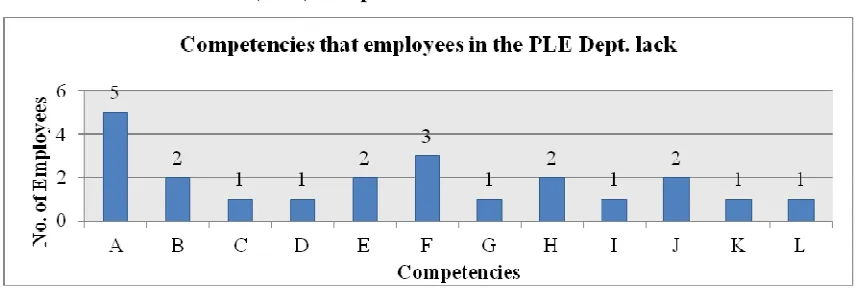
PLANT ENGINEERING (PLE) – Department 2
Figure 2 - Competencies that employees in the PLE Dept. lack
Where
A- Knowledge of Plant Maintenance Module in SAP B- Knowledge of various maintenance practices C- Knowledge on Equipments
D- Knowledge of PLC
E- Knowledge of statutory and Regulatory Practices F- Knowledge on Spares Management
G- Knowledge of utility maintenance
H- Knowledge of Breakdown preventive and time based maintenance I- Knowledge on improvement activities
J- Analytical ability K- Planning
L- Project Management
Total no. of employees in PLE = 6
Employee wise findings:
Gaps are found in the following competencies for each individual employee: a) Manager 1: Knowledge of Plant Maintenance Module in SAP b) Executive 1 : Knowledge of various maintenance practices Knowledge of Plant Maintenance Module in SAP
International Journal in Management and Social Science
http://www.ijmr.net
Knowledge of PLC
c) Dy. Executive 1: Knowledge of various maintenance practices Knowledge of Plant Maintenance Module in SAP Knowledge on Spares management
Knowledge on breakdown, preventive and time based maintenance Analytical ability
Planning
Project Management
d) Dy. Executive 2 : Knowledge of Statutory and regulatory requirements Knowledge of Plant Maintenance Module in SAP Knowledge on Spares management
Knowledge of utility maintenance
Knowledge on breakdown, preventive and time based maintenance
Knowledge on improvement activities Analytical ability
e) Dy. Executive 3 : Knowledge of Statutory and regulatory requirements Knowledge of Plant Maintenance Module in SAP f) Diploma Engineering Trainee (DET) No gaps were found
Department wise findings:
PRODUCTION – Department 3
International Journal in Management and Social Science
http://www.ijmr.net
Where
A- Knowledge of Statutory and Regulatory Requirements B- Knowledge of Scrap Ratio
C- Knowledge of Process D- Knowledge of Products
E- Knowledge of Functional Application Software F- Analytical Ability
G- Cost Control H- Results Orientation I- Decision Making
Total no. of employees in the Production Department – 12
Employee wise findingss:
Gaps are found in the following competencies for each individual employee: a) Manager :
• Knowledge of statutory and regulatory requirements • Knowledge of Process
b) Assistant Manager 1:
• Knowledge of statutory and regulatory requirements • Knowledge of scrap ratio
• Knowledge of Process • Knowledge of Products
• Knowledge of functional application software • Cost control
• Results orientation c) Asst. Manager 2:
• Knowledge of Process • Knowledge of Products
• Knowledge of functional application software • Analytical ability
International Journal in Management and Social Science
http://www.ijmr.net
• Decision making d) Dy. Executive 1:
• Knowledge of functional application software e) Dy. Executive 2 :
• Knowledge of functional application software f) Dy. Executive 3:
• Knowledge of functional application software
• Analytical ability g) Dy. Executive 4:
• Knowledge of functional application software h) Executive 1 :
• Knowledge of functional application software • Cost control
i) Dy. Executive 5:
• Knowledge of functional application software j) Dy. Executive 6:
• Knowledge of functional application software k) Dy. Executive 7:
• Knowledge of functional application software l)Executive 2:
• No gaps were found Department wise findings:
International Journal in Management and Social Science
http://www.ijmr.net
Figure 4 - Competencies that employees in MED lack
Where
A- Knowledge on latest manufacturing concepts B- Knowledge of Quality systems and standards C- Knowledge of Products
D- Knowledge of Process
E- Knowledge on various types of Equipments F- Knowledge on Capacity Planning
G- Analytical Ability H- Cost Control
I- Conflict Management J- Project Management K- Innovation
Total no. of employees in MED – 11
Employee wise findings:
Gaps are found in the following competencies for each individual employee: a) Manager:
• Knowledge on latest manufacturing concepts • Knowledge of Quality systems and standards
• Knowledge of Products • Knowledge of Process
• Knowledge on various types of Equipments • Knowledge on Capacity Planning
• Analytical Ability • Cost Control
• Conflict Management
• Project Management • Innovation
b) Dy. Executive 1:
• Knowledge of Quality systems and standards • Knowledge of Products
International Journal in Management and Social Science
http://www.ijmr.net
• Knowledge of Quality systems and standards
• Knowledge of Products • Knowledge of Process
• Knowledge on various types of Equipments d) Graduate Engineering Trainee (GET):
• Knowledge of process
• Cost Control
• Conflict Management
• Project Management • Innovation
e) Asst. Manager:
• Knowledge on latest manufacturing concepts • Knowledge of Quality systems and standards • Knowledge of Products
• Knowledge of Process • Analytical ability
• Cost control f) Executive:
• Knowledge on latest manufacturing concepts
• Knowledge of Quality systems and standards • Knowledge of Products
• Knowledge of Process
• Knowledge on various types of Equipments
• Knowledge on Capacity Planning • Analytical Ability
• Cost Control
• Conflict Management • Project Management
• Innovation g) Senior Executive 1:
• Knowledge on latest manufacturing concepts
International Journal in Management and Social Science
http://www.ijmr.net
• Knowledge of Products
• Knowledge of various types of equipments h) Dy. Executive 3:
• Knowledge on latest manufacturing concepts
• Knowledge of Quality systems and standards • Knowledge of Products
• Knowledge of various types of equipments • Innovation
i) Dy. Executive 4:
• Knowledge on latest manufacturing concepts • Knowledge of Quality systems and standards
• Knowledge of Products
• Knowledge of various types of equipments • Cost Control
j) DET:
• No gaps were found k) Senior Executive 2:
• Knowledge on latest manufacturing concepts • Knowledge of Quality systems and standards
• Knowledge of Products
• Knowledge on various types of equipments
• Knowledge on capacity planning Department wise findings:
International Journal in Management and Social Science
http://www.ijmr.net
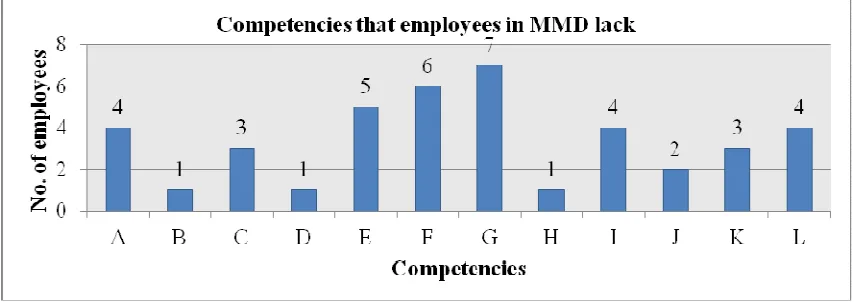
Figure 5 - Competencies that employees in MED lack
Where
A- Knowledge of Product and manufacturing process B- Purchasing function
C- Supply Chain Management D- Value Analyzing
E- Inventory Management F- Knowledge of Commodities G- Business focus
H- Knowledge of costing work and commercials I- Interpersonal skills
J- Relationship building
K- Internal Customer Service Orientation L- Communication
Total no. of employees in Materials – 13 Employee Wise Findings
Gaps are found in the following competencies for each individual employee: a) Manager:
• Knowledge of Product and manufacturing process
• Purchasing function • Supply Chain Management
International Journal in Management and Social Science
http://www.ijmr.net
• Knowledge of Commodities
• Business focus • Communication b) Dy. Executive 1:
• Knowledge of product and manufacturing process • Inventory management
• Knowledge of commodities • Business focus
• Interpersonal skills
• Internal customer service orientation • Communication
c) Dy. Executive 2:
• Supply Chain Management d) Dy. Executive 3:
• Knowledge of product and manufacturing process • Business focus
• Interpersonal skills
• Communication e) Senior Executive 1:
• Inventory Management f) Senior Executive 2 :
• Knowledge of commodities
• Business focus • Interpersonal skills
• Interpersonal skills • Communication g) Dy. Executive 4:
• Internal customer service orientation h) DET:
• No gaps were found i) Dy. Executive 5:
International Journal in Management and Social Science
http://www.ijmr.net
• Business focus
• Knowledge of costing work and commercials j) Dy. Executive 6:
• Inventory Management
• Knowledge of commodities • Business focus
• Interpersonal skills • Relationship building k) Executive:
• No gaps were found l) Dy. Manager:
• Knowledge of product and manufacturing process
• Purchasing function m) Dy. Executive 7:
• Supply Chain Management
• Inventory management • Knowledge of commodities
• Business focus • Relationship building Suggestions
Based on the Gap Analysis that has been done, a number of gaps have been found to exist between the desired levels and actual levels of competencies. Hence this situation calls for improving the competency levels of the employees, to enable effective performance on the job. The gaps that have been identified may be bridged through relevant training programs. The organization has its own Training and Development centre. It offers a number of training programs that suit the specific needs of the organization. Following suggestions on training programs for each department have been forwarded to the organization.
TRAINING PROGRAMS FOR PPC:
Based on the list of competencies that PPC lacks, the following training programs are suggested:
International Journal in Management and Social Science
http://www.ijmr.net
• SAP – Production Planning
• Statistical Process Control (SPC) TRAINING PROGRAMS FOR PLE:
Employees of PLE require training in the following areas to bridge the gaps in competencies:
• Preventive & Predictive Maintenance
• Pneumatic System design and Maintenance (PNE) • Lean Production System (LPS)
• SAP – Plant Maintenance • Plant Maintenance Process
• Project Management using Network Analysis
• Statutory Compliance/ Statues governing Factory Management
• Planning, Organizing & Analytical Problem Solving (POAP) TRAINING PROGRAMS FOR PRODUCTION:
The following training programs are suggested for the Production department:
• Statutory Compliance
• Statues governing Factory Management
• Planning, Organizing and Analytical Problem Solving TRAINING PROGRAMS FOR MED:
MED requires training in the following programs:
• Planning, organizing & analytical problem solving (POAP)
• Project Management using Network Analysis • Interpersonal skills & Conflict resolution • TQM awareness
• FANUC & Siemens (F&S)
• Geometric Dimensioning & Tolerance GD&T)
• Measurement System Analysis (MSA) • CNC Programming
• Minitab Application
• Pneumatic System Design & Maintenance • Programmable Logic Controller (PLC)
International Journal in Management and Social Science
http://www.ijmr.net
MMD require training in the following programs:
• Supply Chain Management • Inventory Management • Interpersonal Skills
• Value Engineering
• SAP – Materials Management
CONCLUSION
The research was undertaken with the primary objective of creating an effective system for assessing the competencies of the employees.. A list of competencies was prepared for each department, consisting of Technical and Behavioural competencies along with their desired levels. This is called the Competency Dictionary. Based on this, Assessment Sheets were prepared to assess the actual levels of competencies as against the desired standards based on Self Assessment and functional head’s Assessment. With the desired and actual levels, a Gap Analysis was done to identify the gaps in competencies and training programs were suggested to bridge the gaps. This system has also been used to assess the competency levels of the managerial staff
REFERENCES
1. Armity Gaur (2005), “Competency Mapping”, The Hindu Opportunities, November 30,
2. Ashworth P D and Saxton J (1990), “On ‘Competence’”, Journal of Further and Higher Education, Vol. 14 No. 2, pp. 8-25.
3. Balasubramanian Rajesh ‘Competency Mapping — An Approach’, Training & Management, Vol. 3, Issue 5, Sept 2007
4. Beverly Kaye and Sharon Jordan Evans (2000), Retention: Tag, You are it! Training and Development, April.Competency Mapping and Managing Talent 93
5. Bhosale H (2003), “Galvanizing People”, Smart Manager, Vol. 2, No. 4, p. 75.
6. Boam R and Sparrow P (Eds.) (1992), Designing and Achieving Competency, McGraw-Hill, Reading.
International Journal in Management and Social Science
http://www.ijmr.net
8. Burgoyne J (1989), “Creating the Management Portfolio: Building on Competency Approaches to Management Development”, Management education & development, Vol. 20, No. 1, pp. 56-61.
9. Douglas A Ready and Jay A Conger (2007), “Make Your Company a Talent Factory”, Harvard Business Review, June.
10.Evarts H F (1988), “The Competency Programme of the American Management Association”, Journal of Management Development, Vol. 7, pp. 48-56.
11.Farah Naqvi, “Competency Mapping and Talent Management”, The Icfaian Journal of management Research (Vol. VIII, No. 1, 2009)
12.Harvard Management Update (1999), “Managing the Labor Shortage, Part 2: Finding and Keeping—Good Young Employees”, Vol. 4, October.
13.Hoffman T (1999), “The Meaning of Competency”, Journal of European Industrial Training, Vol. 23, No. 6, pp. 25-286.
14.Hornby D and Thomas R (1989), “Toward a Better Standard of Management”, Personnel Management, Vol. 21, No. 1, pp. 52-55
15.Jacobs R (1989), “Getting the Measure of Management Competence”,Personnel Management, Vol. 21, No. 6, pp. 32-37.
16.Katz Daniel and Kahn Robert L (1966), The Social Psychology of Organizations, John Wiley & Sons, New York.
17.Kirsten B Donahue (2001), “Time to Get Serious About Talent Management”, Harvard Management Update, August.
18.Margaret Olesen (1999), What Makes Employees Stay, Training and Development, October.
19.McClelland D C (1971), Assessing Human Motivation, General Learning Press, New York.
20.McClelland D C (1973), “Testing for Competence Rather Than for Intelligence’ American Psychologist, Vol. 28, No. 1, pp. 1-14.
21.McClelland D C (1975), A Competency Model for HR Management Specialists to be Used in the Delivery of the Human Resource Management Cycle, McBer, Boston. 22.The Icfaian Journal of Management Research, Vol. VIII, No. 1, 2009
International Journal in Management and Social Science
http://www.ijmr.net
24.Radhika Gopal Krishnan and Neisha Loba (2007), “Hewitt Associates Best Employers 2007”, Economc Times Special, April, pp. 1-3.
25.Rao T V and Chawla Nandini (2005), 360-Degree Feedback, Assessment, and Development, Excel Books, New Delhi.
26.Sankar R (2003), “Competency Mapping”, Smart Manager, Vol. 2, No. 4,p. 58. 27.Seema Sanghi (2004), The Handbook of Competency Mapping, Response Books,
New Delhi.
28.28. Silver M (1991), Competent to Manage: Approaches to Management Training and Development, Routledge and Kegan Paul, London.
29.Spencer L and Spencer S (1993), Competence At Work: Model for Superior Performance, John Wiley & Sons, New York.
30.Steve Garrett, “Competency Mapping: What is it and How it Can be Done by Individuals”, Career Planning and Adult Development Network.
31.Strebler M, Robinson D and Heron P (1997), “Getting the Best Out of Competencies”, Institute of Employment Studies Report 334, Brighton.
32.Tate W (1995), Developing Managerial Competence: A Critical Guide to Methods and Materials, Gower, UK.
33.Vaishali Kumar M P (2004), “Competency Mapping Based Training Need Assessment: An Empirical Investigation”, Vision, Vol. 8, No. 1, p. 69.