1
Re-inventing community development: Utilizing relational networking and
cultural assets for infrastructure provision
Charles Che Fonchingong
Canterbury Christ Church University
School of Nursing, Midwifery and Social Work
E-Mail:[email protected]
Abstract: Utilizing relational networking and cultural assets provide an arena for village development associations (VDAs) to fill the gaps in infrastructure in resource limited communities of Cameroon’s north-western region. Through case study, this study interrogates the foundational thesis of relational networking and cultural assets deployed to deal with social development challenges. Semi-structured interviews were undertaken with community participants. Purposive sampling was used, and data were analysed and critically synthesized with comparable literature. Communities increasingly shoulder their own development through a multiplicity of agency with internal and external stakeholders. The analysis captures a typology of incremental cultural assets, galvanised and re-engineered, promoting a rejuvenated community. A multi-layered approach centred on intersecting elements with unvarying input from community members are perceptible. Though the translational benefits are not clear-cut, relational networking and incremental cultural assets hold out the prospect for community transformation in infrastructure provision - supply of fresh water, equipping schools, community halls, building roads, bridges and community halls. In the process, social inequality and other barriers of disadvantage are narrowed.
Keywords: Cameroon, agency; community; cultural assets; empowerment; relational networking; infrastructure; traditional authority
1. Introduction
Powering community development (CD) requires an amplified level of community participation and empowerment [1, 2, 3, 4]. Such an approach relies on asset-based community development (ABCD) strategy which has gained traction in most of Africa as an emerging development approach against the backdrop of system’s perspective underpinned by assets and capabilities. The asset-based community development praxis is premised upon building up community assets and resources that already exist in the community through mobilization of individuals, associations and other allied institutions [5, 2, 4]. Whilst several studies have highlighted the role of assets in CD [6, 4, 44], very few studies have emphasized the
2
intersection of cultural assets and relational networking in CD within resource depleted communities.
Essentially, this paper unpicks the re-invention of CD with focus on the development trajectory of the Ndong Awing Cultural and Development Association (NACDA) in Cameroon’s north west region. I engage with the intersecting elements of CD underpinned by cultural assets, matched with the propelling influence of relational networking. For CD to flourish, community capability, collective advocacy; social mobilisation and revitalizing social networks across socio-economic differences are crucial [7, 3]. It is contended that a key to overcoming mass poverty centres on empowerment of disadvantaged groups, taking into consideration local situations and realities [8]. Up-scaling cultural assets through community layers of power and building capability for access, working with partners, enlisting the voice and participation of the community for greater control are vital [9]; these strategies offers communities greater leverage, fostered through conscientised empowerment [3].
Building on my previous research [3], this paper interrogates whether utilizing cultural assets and relational networking incrementally, provides an arena for VDAs to fill gaps in infrastructure provision. Drawing from case study and analysis of the NACDA, the process of galvanising community members is scrutinized. The intertwined elements of cultural assets and relational networking marshalled to promote community development are laid out (Figure 1). Such an approach ties up with rethinking CD from the bottom-up. It is anchored on defining the role of proactive, active citizens, how they can work together with the main purpose of improving the well-being of their communities [10]. This strategy reinforces the conceptual grounding of community development - a mutual process from every day existence, understanding histories, cultures and values; listening to the hopes and concerns of the community aimed at ushering a process of empowerment and change [11, 3]. A major upshot of Cameroon’s struggling economy has been the shattering impact on vast segments of its rural population. This has subjected many, particularly in rural areas to unprecedented levels of economic and social dislocation, exacerbated by inadequate infrastructure, institutional failings and government dithering [12]. Yet, there is little questioning of the deployment of relational networking to fill the gaps in infrastructure provision, through needs identification and local solution focused strategies.
3
Cameroon’s economic situation is exacerbated by the growing inability of the state to respond adequately to the growing development concerns and essential needs of rural communities. Community participation has been advanced, and in fact tried, as a strategy that can be potentially viable in complementing government efforts to meet community needs [13]. The NACDA has a track record of operationalised wards and development assemblies, amplified through strategic leadership and capacity building, a prevalent approach to grassroots development in Cameroon’s north west region [14, 3]. The foundational elements of community development are perceived through the prism of relational networking and utilization of cultural assets by VDAs, creating a people-oriented and outward-facing community. Case study evidence in tune with recent research on the subject area underpin the elements of relational networking and cultural assets, calibrated for meaningful CD (figure 1). Whilst these elements are crucially important in CD initiatives, implementation lags, hampered by intersecting factors must be proportionately balanced to fulfil the potential of community driven development (CDD). For the NACDA to take charge of its development, priorities are set and agreed, and local solutions devised. Visionary leadership and a sense of community engagement championed by traditional authority and the leadership of VDAs are crucial. This strategy is anchored on mobilising available assets through streamlined networking and partnerships (Figure 1).
2. Conceptualising relational networking and cultural assets
Community development occupies a contested space between top down and bottom up, which attracts many competing agendas [11]; plural objectives and contested practices [15, 16], people experiencing the ordinary [17]. Given the complexities inherent in engineering development in resource poor settings, the theoretical literature situating agency, community empowerment and capability (strength-based approach) are critical in understanding the contextual realities. A strengths-based approach (SBA) is an emerging approach in development practice to operationalise participatory development principles [18, 8]. Other proponents of the approach emphasize a focus on both assets and strengths [5, 19, 20, 21, 22, 4].
4
to produce a desired effect [25]. Whilst social capital enables this potential, a keen sense of agency crystalizes this approach [26].
In alignment with this notion of agency, it is argued that people demonstrate agency not necessarily for their own self-interest but acting for a collective interest. It is thinking beyond the self in more narrow terms, showing consideration for the wider community [27, 28]. The potential for agency serves as latent energy, unlocking the dormant potential in the human condition. Such potential becomes manifest when social conditions develop in a manner that call for change and alternative perspectives. Although agency may be visible at multiple levels – individual, group or through democratic participation [29], the focus here is on community agency, members degree of interaction with others, enhancing community capability and sustainability.
From field data, it is evident that collective agency is vital for community development. The Awing maxim enshrined in the constitution flags up this commitment: ‘holding on to each other towards modernizing Awing’ [3]. The community must be taken on board through a development-oriented mindset, conceptually framed as conscientised empowerment. We have argued elsewhere, that self-reliant development has proved its usefulness as an easy, all-onboard and results-oriented approach to contemporary modes of translating boardroom ideas into meaningful development [30]. Relational networking can readily maintain both self and social empowerment, when it is deeply rooted in the praxis of change. The use of cultural assets engineered by different actors (figure 1) is usefully deployed to galvanise community members. This is achieved through a carefully tailored narrative of development through reliance on inner capabilities and assets. This message is embedded in speech by AEEF president during the launch of one of NACDA’s flagship initiatives: ‘let’s build our community and not wait on others to do it for us’ [3]. The relational networking perspective espoused are informed by the community conscientization at the consequences of inaction. This strategy seeks to engage the community to consciously reflect and find local solutions to local problems of development illuminated in figure 1. This is in tandem with active citizenship, seen as individualized self-help or ‘do-it-yourself’ [7].
5
and capabilities enables a proactive role for the citizen, replacing the passive, dependent role of the client in welfare service delivery model of community development practice [2,8]. As embedded in figure 1, relational networking is underpinned by the community taking the lead, through active involvement in programmed social and cultural events, geared at solving identified problems, ushering in meaningful change within the community. Development outcomes are determined by the environment and gamut of natural resources or assets including individuals, associations and institutions [2, 5, 31]. It is argued that focusing on strengths is motivating [22], nurturing existing capacity and strengths will expand and contribute to a positive change process [32]. Further, people take responsibility, initiative and leadership, remain owners and directors of the change process. Mathie and Cunningham [2] aver that communities can self-evaluate and drive the development process themselves. It hypothesized when this happens, then outcomes will be sustained, and people will become more self-reliant [30, 3].
3. Methodology and Context
Contextual research, including observation, interviews, and case study research were employed to obtain local people’s perspectives [33], informed by the perspective that community development should not be externally driven by the researcher’s objectives. In this light, a qualitative grounded theory method was deemed appropriate here as it enables the researcher to construct theories to better understand phenomena [34]. To capture the bigger picture, the case study approach examines the gate-keeping role, played out through cultural asset building and relational networking. Based on documented web evidence, elicited from the NACDA, connections are made between the agency, displayed by NACDA and internal stakeholders, particularly community members (CM). The alternative perspective is drawn from a random sample that takes cognizance of key actors, context of community, strategic leadership and participation of CM. The features, dynamics and elements of agency displayed are unpicked with the theoretical literature.
Community members (CM) purposively sampled, numbering 67, were varied in age, gender, educational and social backgrounds. The age ranged from 25 to 70 years of age, and educational background also varied. The leadership of the NACDA and other members constituted of youths and women were randomly selected. CM who participated span diverse sectors and based in the village, other regions nationally and in the diaspora.
6
with key questions and archival material obtained from NACDA officials. Other information gleaned from interviewees were triangulated through follow-up interviews. Alongside the interviewing, a contextual coverage of NACDA 50th anniversary celebrations were validated with group discussions, which allowed community members to be directly involved in the research process. This helped to facilitate an understanding of the elements of cultural assets and relational networking. Also, three government officials with expertise in CD were interviewed to get a snapshot of state relations.
Thomas' [35] knowledge-development research typology aligns with my chosen research methodology. This flags up the process approach, entailing describing and contextually analysing the people's development experience, rather than examining participation through a snapshot approach as in a quantitative study. Involving the participants closer into the research process is an attempt to understand their existence and actions within their world. This enables reflection, evaluation of change, and alternative perspectives within the mechanics of qualitative inquiry and research design [36]. The participatory approach and group discussions in community development requires: ‘... an understanding that research problems are defined through a dialectic; this means a more ambiguous and shifting relationship between the research questions and the communities in which they are studied’ [37].
Open-ended, semi-structured interviews were conducted, with a pre-determined number of questions, and the interviewees were freely allowed to elucidate on key questions as they envisaged. The average duration of each interview were 45 minutes to an hour. Some interviewees opted to speak in pidgin English which is a popular medium of expression in both rural and urban Cameroon. The transcripts were read over and codes applied, modified and revised in line with dominant and emergent themes [38]. The stages of the methodology involved: (i) semi structured interviews involving VDA officials and community members, (ii) follow-up interviews with participants (iii) triangulated interviews with state officials and selected participants, (iv) data pieced together from VDA website and what resonated/differed from interviews, (v) themes identified were refined and synthesized in tune with comparable literature.
4. Emergent themes and discussion
7
organisation celebrated its 50th anniversary from November to December 2012. NACDA’s mission statement embedded in the constitution is unambiguous: ‘uniting around self-reliant development of the Awing Fondom, creating an atmosphere of peace, promoting its diverse cultural and social acumen, and projecting a good image of the Fondom’.
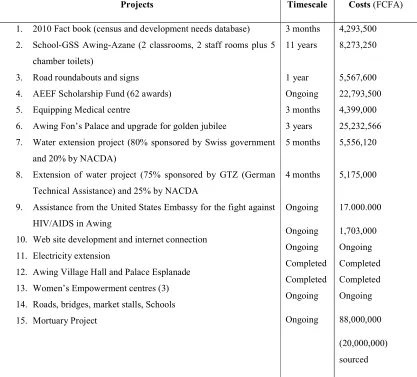
Of vital importance in projects completed by the NACDA are addressing essential services such as water and electricity supply, health needs and educational requirements, thereby, increasing school attainment and enrolment rates, are key social development concerns pursued. The provision of basic infrastructure is undertaken in partnership with traditional authorities, overseeing decisions within traditional councils, thereby enhancing traditional governance, fostered through ward and chapter designated representatives.
Table 1: Balance sheet of NACDA projects, timescale and projected costs
Projects Timescale Costs (FCFA)
1. 2010 Fact book (census and development needs database) 2. School-GSS Awing-Azane (2 classrooms, 2 staff rooms plus 5
chamber toilets)
3. Road roundabouts and signs 4. AEEF Scholarship Fund (62 awards) 5. Equipping Medical centre
6. Awing Fon’s Palace and upgrade for golden jubilee
7. Water extension project (80% sponsored by Swiss government and 20% by NACDA)
8. Extension of water project (75% sponsored by GTZ (German Technical Assistance) and 25% by NACDA
9. Assistance from the United States Embassy for the fight against HIV/AIDS in Awing
10. Web site development and internet connection 11. Electricity extension
12. Awing Village Hall and Palace Esplanade 13. Women’s Empowerment centres (3) 14. Roads, bridges, market stalls, Schools 15. Mortuary Project
3 months 11 years 1 year Ongoing 3 months 3 years 5 months 4 months Ongoing Ongoing Ongoing Completed Completed Ongoing Ongoing 4,293,500 8,273,250 5,567,600 22,793,500 4,399,000 25,232,566 5,556,120 5,175,000 17.000.000 1,703,000 Ongoing Completed Completed Ongoing 88,000,000 (20,000,000) sourced
8
As detailed in table 1, projects implemented included roads rehabilitation, equipping health clinics, providing essential textbooks for pupils, schools, funding payment of teachers hired through Parent Teacher Association, building bridges and culverts, creating a fact book (database of Awing citizens), developing a cultural and web manifesto on development projects earmarked and a track of ongoing projects. These projects are implemented through a community schedule, overseen by officials of VDA in collaboration with traditional authority.
Figure 1: Intersection framework and elements of relational networking and cultural Assets
9
In fostering relational networking, the creation of mutual based schemes to improve educational attainment, health care requires the dynamic participation of women and youth groups. The foundational speech by the chairperson of the Awing Education Enhancement Fund (AEEF) tunes in with a development narrative meant to enthuse; building on community sense of fervent relations, mutuality and sustainability. Such an approach fosters dynamic participation - a key marker of relational networking. Asnarulkhadi and Aref [39] in their Malaysian case study, make the case that the mutual-help spirit that underlies the Asian traditional community spirit of working hastens the achievement of shared interests through group-based activities. The spirit of collective action in which members participate enables an understanding of group dynamics and processes within which participation takes place. Participation counters the reductionist perspective of community development. Basically, the application of values and principles of community development involves upholding or practising human rights, and encouraging people to be self-reliant, to think, to make decisions, own them and to participate in the entire process [30, 3, 40]. As captured by AEEF chairperson,
•
• Community
• Village
Development
Association
• Cultural Assets
• RelationalNetworking
Quarter development unions Social bonding groups
Contingency support Empowerment and credit
rotation schemes Social protection Ward assemblies Diaspora Associations
Men, Women's and Youth groups Social and cultural
capital
Traditional authority Council of elders
Sense of identity Assemblage of cultural
events Communal values and
precepts Ecology and indigenous
resources Website development and
cultural arena
Stakeholders
Social Development space Locus of projects Village, nationwide and diaspora communities Context of people driven development
Fon's Palace as
community habitat Operational leadership,
vision and direction Harnessing social and
human capital Prevalent vehicle for community mobilisation
Sourcing for funds Links with traditional authority and diaspora
communities Links with the State and
10
development begins with ‘sowing the right seed and spirit’ [3]. This community spirited discourse needs to be harnessed, for it to blossom, and must be carefully managed to ensure sustainability.
Despite the workings of community engineered by traditional authority and VDAs, the prevalent thinking engenders a spirit of community ownership, sense of community pride to see its ‘mustard seed’ harnessed for common good of the community, resonates with the empowerment drive. Relational networking in the context of Cameroon, where the politics of identity and ethnicity creates a hegemonic state [41], are maintained by both the state, political elite and citizens, networking through tribal affiliation. However, these forms of tribalism reinforce the sense of group identity and constitutes attempts at grassroots level to embed a development philosophy, built on trumpeting vibes that connect members. This energy and vibrancy is captured in remarks by the AEEF Chairperson: “donor fatigue is what we want to avoid” [3]. Such an inward-looking strategy is anchored on building social capital through community agency, an a priori condition that manifests itself at both the individual and the collective level through social mobilization and network formation [27, 28, 42], with focus on inclusive CD and a heightened sense of social justice.
5. Re-calibrating relational networks and cultural assets
11
empowerment, there is a NACDA women’s wing - a good arena for women’s issues to be factored into debates at general assemblies.
Rooted in the community mind-set is the need to keep members active through upscaling social interactions. Interviewees noted that through the women’s empowerment centres nationwide, NACDA female members are pulled into cooperatives to market their goods; they are drilled on micro-enterprise development, skills development in cooking, sewing, business know-how. The centres also generate capital for small business ventures and pooled savings from women’s business activities. The viability of such small business and returns from empowerment centres permit members to make yearly contributions and donations to project committees for earmarked projects. The women’s wing also gives women greater leverage to undertake projects that address women’s specific needs [3]. Approximately one third of the NACDA development dues are ploughed back into women’s wing; for instance, if a female member contributes 3,000 frs CFA, one third (1,000frs) is passed over to women’s wing (NACDA executive 2013). Both agency and empowerment are intrinsically valuable, and instrumentally effective in reducing poverty and promoting human development [29].
A member of the women’s wing intimated: ‘We’re trying our possible best to see that Awing village makes progress, by always paying our development levy as allocated’. Further, the president of the women’s wing said: ‘when I became chairperson in 2010, my main goal was to foster greater unity amongst women in Awing to work under one umbrella, to intensify their support for projects. The number of women attending meetings and taking an active part in NACDA activities has increased.
She went further: ‘Apart from infrastructure development, also, we continue to sensitise mothers and our daughters on hygiene issues and diseases like malaria, cholera and HIV/AIDs. We use gatherings to emphasize cultural norms and encourage women to take up leadership positions in NACDA’.
12
it and contributed to its growth. We have succeeded in repairing the roof of the women centre in the village which was not in a good state’.
Such assertions above tie up with the enabling aspect of empowerment according to Labonte and Laverack [9], implies that people cannot ‘be empowered’ by others; they can only empower themselves by acquiring more of power’s different forms. Craig [43] defines empowerment in the community development context as: ‘the creation of sustainable structures, processes, and mechanism, over which local communities have an increased degree of control, and from which they have a measurable impact on public and social policies affecting these communities’. Whilst cultural assets are influential, issues around power, leadership roles and male dominant traditions must be addressed as it this can impact on community relations and levels of participation.
5.1 External partners and agencies
NACDA thrives on a philosophy that development is first and foremost locally driven before knocking on the doors of external assistance and development partners. The engagement of external development partners such as the British High Commission, SWISS, German embassies, and other Diplomatic missions in Cameroon are attributed to relational networking steered by NACDA visionary leadership. At NACDA’s 50th anniversary, erstwhile British High Commissioner to Cameroon - Bharat Joshi, in attendance, re-iterated the relevance of inward looking development: ‘only you can make your country an emerging economy by 2035. We can only help but we can’t tell you how to do it’.
13
water project. Such relational strategies, as stated by Ledwith [11] are attuned to collective action for change, which follows through from local to structural levels with sustainable outcomes.
From the explanations of participants, the reliance on strategic leadership is crucial in building community spirit of mobilisation. However, lengthy discussions and coordination between the different antennas of the VDA creates managerial challenges. An interviewee opined: ‘communication can be very slow between branch presidents; they are not reachable by email frequently to move urgent matters on’. Another interview was concerned with time span for implementing projects from conception: ‘it is hard to know when projects would be completed as valuable time is spent in the follow of funds and pledges’. Added to this is the often-lethargic response of state officials, particularly with roads projects that require upfront authorisation. Irrespective of these challenges, the community draws on available cultural resources and networks to provide the much-needed infrastructure. A diverse human capital and social capital building are obligatory for the implementation of sustainable community development [25, 27].
6. Policy implications and conclusion
Community agency, displayed through the utilization of relational networking and cultural assets incrementally, as argued in this paper have gained traction in indigenous polities, striving to fill gaps in infrastructure provision. Community engagement and participation of local people in CD initiatives to provide basic services which affect their daily lives, represents the core principle of bottom-up, endogenous development that this paper has advocated. It is contended that an autonomous model of empowering community members from mere spectators to active citizens can build community resilience and capability for sustainable CD endeavours, which responds appropriately to livelihood concerns and community needs. The intersection of cultural assets and relational networks adds to the understanding of grassroots modelled development, grounded in a holistic perspective of CDD which and social policy and CD practice could benefit from.
14
crucial. For example, at NACDA’s 50th anniversary, the government official, speaking on behalf of the Ministry of Culture acclaimed NACDA’s grassroots development drive, offering a financial package (2 million frs CFA) noted: ‘I want to express my congratulations to the job done by NACDA so far. You have contributed a lot to change the image and the lives of the people of Awing. We are behind you’ [3].
A co-production of policies for CD and the deployment of key personnel and practitioners (social workers, health workers, welfare officials and other development agencies) in collaboration with VDA can enhance relational networking and better strategizing of cultural assets. Engaging with key stakeholders can expand spaces for participation, thereby optimising cultural assets for social development [45], although the ambivalent relationship between community work and state interventions can limit the potential of community development [11]. Evidently, social workers and social welfare practitioners are of prime importance in enabling all stakeholders leverage available resources, tapping into existing strengths, capabilities and assets [3,4]. However, the challenge of remaking community development requires a multi-directional approach; communities need resources beyond their reach; development organizations, in turn, need the embedded knowledge and networks that communities can mobilize [46].
Relational networking and cultural assets reinforce the sense of mutuality, community cohesion, and sense of ownership in community development ventures. The community vision is kept alive through bench marking progress, ensuring the development vision is sustainable, based on careful calibration of multifaceted and multi-layered relations with internal and external stakeholders. A heightened sense of community networking enables members to give back to the community, thereby enhancing social and community development in resource poor and disadvantaged communities. Leveraging the duality of cultural assets and relational networking is premised on a community sense of recognising its own strengths and pulling together for infrastructure provision. Community members are mobilized to re-invent and focus on their assets and resources, rather than concentrate on deficits and barriers.
Acknowledgements
The author is grateful to NACDA officials and community participants for taking part in interviews and providing very useful information on NACDA activities.
Conflict of Interest
15
References
1. Fonchingong, C.; Ngwa, C. “Grassroots participation for infrastructural provisioning in north-west Cameroon: are village development associations the panacea”. Canadian Journal of Development Studies, September 2005, 26 (3): 443-460
2. Mathie, A., and Peters, B; ‘Joint (ad) ventures and (in) credible journeys evaluating innovation: asset-based community development in Ethiopia.’ Development in Practice 2014, 24(3):405-419. doi: 10.1080/09614524.2014.899560
3. Fonchingong, C. Shoring up local development initiatives: elderly elite and conscientised empowerment in Cameroon, International Development planning Review, 2017, 39 (2): 123-142
4. Nel, H. A comparison between the asset-oriented and needs-based community development approaches in terms of system changes, Practice, 2018, 30:1, 33-52. 5. Mathie, A.; Cunningham, G. Mobilising Assets for Community-Driven Development
– Participant Manual. Nova Scotia: Coady International Institute, St. Francis Xavier University, 2008.
6. Russell, C., and Smeaton, T. From Needs to Assets: Charting a Sustainable Path towards Development in sub-Saharan African Countries. Chicago, IL: Asset Based Community Development Institute, North-western University, 2010.
7. Cornwall, A. 'Unpacking participation': models, meanings and practices', Community Development Journal, 2008, 43 (3) pp. 269-283.
8. Chambers, R. “Participation for development: A good time to be alive.” Development Bulletin, (75), challenges for participatory development in contemporary development practice, 2013.
9. Labonte, R.; and Laverack, G. Health Promotion in Action: From Local to Global Empowerment. Palgrave Macmillan, London, 2008.
10.Kenny, S Towards unsettling community development, Community Development Journal, 2011, 46 (1): i7–i19
11.Ledwith, M. (2nd edition) Community Development: A Critical Approach, Bristol, UK: The Policy Press, 2011: 141-143
16
13.Njoh, A. Barriers to community participation in development planning: Lessons from the Mutengene (Cameroon) self-help water project, Community Development Journal, 2002, 37 (3): 233-248
14.Fonchingong, C. Citizen strategizing amid a solidarity economy in Cameroon: are village development associations (VDAs) resilient? Draft Paper prepared for UNRISD conference on Potentials and Limits of Social and Solidarity Economy, Geneva, May 2013, available at: www.unrisd.org
15.Craig, G., Mayo, M.; Taylor, M; Globalisation from below: Implications for the community development journal, Community Development Journal, 2000, 35 (4), 323– 335.
16.Shaw, M. Community development and the politics of community, Community Development Journal, 2007, 43 (1): 24–36.
17.Shor, I. Empowering Education: Critical Teaching for Social Change, London and Chicago, IL: University of Chicago Press, 1992.
18.Chambers, R. Rural development: Putting the last first, Longman, London, 1983. 19.Ford Foundation ‘Building assets to reduce poverty and injustice’,
http://www.fordfoundation.org/pdfs/library/building_assets.pdf. 2002, accessed May 15, 2018.
20.Burkett, I. Appreciating assets: a new report from the international association for community development (IACD). Community Development Journal, 2011, 46 (4): 573–578.
21.O’Leary, T., Burkett, I. and Braithwaite. K. Appreciating Assets. International Association for Community Development (IACD) and Carnegie UK Trust, 2011. 22.Willetts, J., Carrard, N.; Crawford, J.; Rowland, C.; Halcrow G.; Working from
Strengths to Assess Changes in Gender Equality.” Journal of Development in Practice 2013, 23 (8): 991–1006.
23.Bandura, A. Exercise of human agency through collective efficacy, Current Directions in Psychological Science, 2009, 9 (3): 75–78.
24.Harvey, D. (2002) Agency and community: a critical realist paradigm, Journal for the Theory of Social Behavior, 2002, 32 (2): 163–194.
25.Onyx, J. and Bullen, P. (2000) Measuring social capital in five communities, The Journal of Applied Behavioral Science, 36 (1), 23–42.
17
27.Dale, A.; Newman, L. Social capital: a necessary and sufficient condition for sustainable community development? Community Development Journal, 2010, 45 (1), 5–21.
28.Dale A. Agency: individual ‘fit’ and sustainable community development, Community Development Journal, 2013, 49 (3): 426–440
29.Alkire, S. Concepts and measures of agency. In K. Basu, S. M. R. Kanbur; Sen, A.; (Eds.), arguments for a better world. essays in honour of Amartya Sen. Ethics, Welfare and Measurement, Oxford: Oxford University Press, 2009, Vol. 1, pp. 455–474. 30.Fonchingong, C.; Fonjong, L. The concept of self–reliance in community development
initiatives in the Cameroon grassfields, GeoJournal, 2002, 57 (issues 1-2): 83-94 31.Saleebey, D. 5th ed. “Introduction: Power in the People.” In the Strengths Perspective
in Social Work Practice, Edited by D. Saleebey, Boston: Pearson Education, 2009, pp.7-9
32.Winterford, K. ‘A Strengths Perspective on Social Accountability: Informing Citizen and State Action for Improved Services and Development’, PhD Dissertation, University of Technology Sydney, Sydney, 2013.
33.Yin, R. Case Study Research: Design and Methods. London: Sage Publications, 2003. 34.Corbin, J.; Strauss, A. Grounded theory research: Procedures, canons, and evaluative
criteria. Qualitative sociology. 1990, 13, 3-21.
35.Thomas, D.N. Research and community work, Community Development Journal, 1980, 15 (1): 30-40
36.Creswell, J.W. Qualitative Inquiry and Research Design. London: Sage 2014
37.Graham, H. and Jones, J. Community development and research, Community Development Journal, 1992,24 (3): 235-241
38.Miles, M.B. and Huberman, A.M. Qualitative Data Analysis: An Expanded Sourcebook, Sage Publications, London, 1994
39.Asnarulkhadi, A. S; Aref, F. People’s participation in community development: a case study in a planned village settlement in Malaysia, World Rural Observations 2009; 1(2): 45-54
40.Pawar, M. Social and Community Development Practice, London: Sage Publications, 2014, pp. 94-95
18
42.Ling, C. and Dale, A. Agency and social capital: characteristics and dynamics, Community Development Journal, 2014, 49: 4–20.
43.Craig, G. Towards the measurement of empowerment: the evaluation of community development, Journal of the Community Development Society, 2002, 33 (1), 124–146. 44.Mathie, A., and Cunningham, G. From clients to citizens: asset-based community development as a strategy for community-driven development.” Development in Practice, 2003, 13 (5): 474–486.
45.Fonchingong, C. Optimising community driven development through sage tradition in Cameroon, Global Social Welfare, 2016, https://doi.org/10.1007/s40609-016-0052-6
46.Eversole, R. Remaking participation: challenges for community development practice, Community Development Journal, 2012 (47)1: 29–41